2 Kings 4:34
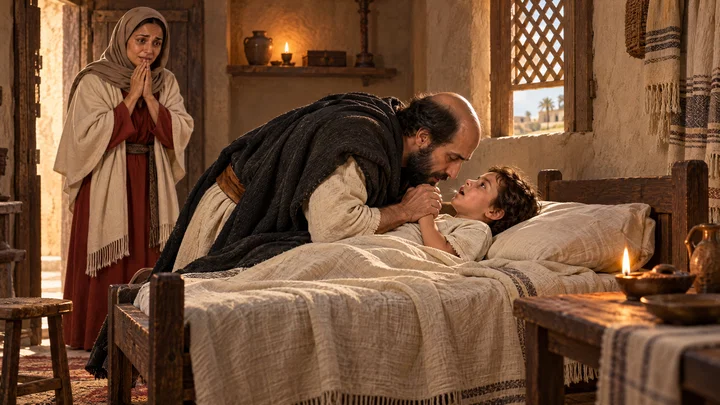
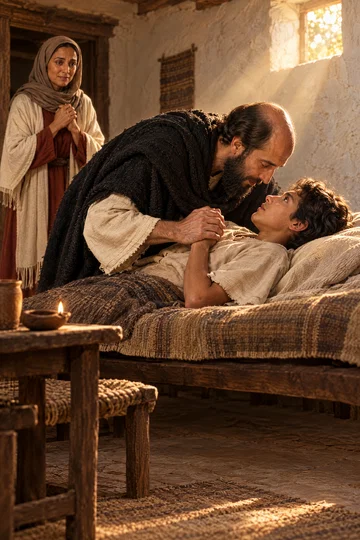
And he went up, and lay upon the child, and put his mouth upon his mouth, and his eyes upon his eyes, and his hands upon his hands: and he stretched himself upon the child; and the flesh of the child waxed warm.
Translations
And he went up, and lay on the child, and put his mouth on his mouth, and his eyes on his eyes, and his hands on his hands: and stretched himself on the child; and the flesh of the child waxed warm.
King James Version, KJV Cambridge Paragraph Bible
And he went up, and lay upon the child, and put his mouth upon his mouth, and his eyes upon his eyes, and his hands upon his hands: and he stretched himself upon the child; and the flesh of the child waxed warm.
And he went up, and lay upon the child, and put his mouth upon his mouth, and his eyes upon his eyes, and his hands upon his hands: and he stretched himself upon the child; and the flesh of the child became warm.
Revised Version, American Standard Version
And he went up, and lay upon the child, and put his mouth upon his mouth, and his eyes upon his eyes, and his hands upon his hands: and he stretched himself upon him; and the flesh of the child waxed warm.
And he goeth up, and lieth down on the lad, and putteth his mouth on his mouth, and his eyes on his eyes, and his hands on his hands, and stretcheth himself upon him, and the flesh of the lad becometh warm;
And he went up, and lay upon the child, and put his mouth upon his mouth, and his eyes upon his eyes, and his hands upon his hands, and bent over him; and the flesh of the child grew warm.
Then gat he up, and lay upon the child, and put his own mouth upon his mouth, and his own eyes upon his eyes, and his own hands upon his hands, and bowed himself upon him,—and the flesh of the child, waxed warm.
Berean Standard Bible, Majority Standard Bible
Then Elisha got on the bed and lay on the boy, mouth to mouth, eye to eye, and hand to hand. As he stretched himself out over him, the boy’s body became warm.
He went up and lay on the child, and put his mouth on his mouth, and his eyes on his eyes, and his hands on his hands. He stretched himself on him; and the child’s flesh grew warm.
Then he got up on the bed, stretching himself out on the child, and put his mouth on the child's mouth, his eyes on his eyes and his hands on his hands; and the child's body became warm.
After he went vp, and lay vpon the child, and put his mouth on his mouth, and his eyes vpon his eies, and his hands vpon his handes, and stretched himselfe vpon him, and the flesh of the child waxed warme.
Douay-Rheims (Challoner revision)
And he went up, and lay upon the child: and he put his mouth upon his mouth, and his eyes upon his eyes, and his hands upon his hands: and he bowed himself upon him, and the child’s flesh grew warm.
Pictures
Cross-references
- 1 Kings 17:21-22
And he stretched himself upon the child three times, and cried unto the LORD, and said, O LORD my God, I pray thee, let this child’s soul come into him again.
Elijah prays, and God restores the dead child to life.
- John 11:43-44
And when he thus had spoken, he cried with a loud voice, Lazarus, come forth.
Jesus calls Lazarus out of the tomb and restores him to life.
- Luke 7:11-17
And it came to pass the day after, that he went into a city called Nain; and many of his disciples went with him, and much people.
Jesus raised the widow of Nain’s son.
- Luke 8:54-55
And he put them all out, and took her by the hand, and called, saying, Maid, arise.
Jesus restored Jairus’s daughter to life.
- Mark 5:41-42
And he took the damsel by the hand, and said unto her, Talitha cumi; which is, being interpreted, Damsel, I say unto thee, arise.
Jesus raises Jairus’s daughter from the dead.
- 2 Kings 13:21
And it came to pass, as they were burying a man, that, behold, they spied a band of men; and they cast the man into the sepulchre of Elisha: and when the man was let down, and touched the bones of Elisha, he revived, and stood up on his feet.
A dead child and a dead man are both restored to life through Elisha.
- 2 Kings 8:1-6
Then spake Elisha unto the woman, whose son he had restored to life, saying, Arise, and go thou and thine household, and sojourn wheresoever thou canst sojourn: for the LORD hath called for a famine; and it shall also come upon the land seven years.
Her son’s restoration is recalled as she receives protection and restoration during the famine.
- Acts 9:40
But Peter put them all forth, and kneeled down, and prayed; and turning him to the body said, Tabitha, arise. And she opened her eyes: and when she saw Peter, she sat up.
Peter prays alone before Dorcas is restored to life.
- John 11:25
Jesus said unto her, I am the resurrection, and the life: he that believeth in me, though he were dead, yet shall he live:
Jesus identifies himself as the resurrection and life, the source of resurrection power.
- Acts 20:10
And Paul went down, and fell on him, and embracing him said, Trouble not yourselves; for his life is in him.
Paul falls on the dead child, and the child lives.
- Hebrews 11:35
Women received their dead raised to life again: and others were tortured, not accepting deliverance; that they might obtain a better resurrection:
Speaks of women receiving their dead raised to life.
- John 5:28-29
Marvel not at this: for the hour is coming, in the which all that are in the graves shall hear his voice,
Christ says the dead will hear his voice and come forth.
- 1 Corinthians 15:20-23
But now is Christ risen from the dead, and become the firstfruits of them that slept.
Christ’s title as first-fruits raises the question of earlier resurrections.
Commentary
Each commentary is drawn from primary sources: the writings of Ellen G. White and Adventist pioneers and periodicals. Each commentary is separate. Its own words are not a quotation; follow the references to read the source passages.
Ellen G. White
2 sources
Elisha went up and laid himself upon the dead Shunammite child, putting his mouth upon his mouth and his eyes upon his eyes and his hands upon his hands, stretching himself over him.PK 237.3–239.2PK 239.3–240.1 He did this while praying for God to bring the child back to life.PK 237.3–239.2 The first effect was that the flesh of the child grew warm.PK 237.3–239.2PK 239.3–240.1
Elisha then repeated the stretching action over the child.PK 237.3–239.2 The child revived and opened his eyes, with the signs that followed confirming that life was fully restored.PK 237.3–239.2PK 239.3–240.1 That restoration rewarded the faith of his mother.PK 239.3–240.1 It points to Christ as the Life-giver, who at His coming will raise the dead and restore children to their parents.PK 239.3–240.1
Sources
Pioneers and periodicals
38 sources
Elisha shut himself in alone with the dead child and prayed to the Lord, then laid his own body upon the boy with mouth upon mouth and eyes upon eyes and hands upon hands and stretched himself upon him, after which the child's flesh grew warm.ST Oct 5, 1904ST Jul 28, 1898ST Jul 28, 1898ST Nov 24, 1887ST Apr 24, 1893 That growing warm was only the first sign of returning life, and he kept laboring over the child until he fully lived again.RH Apr 22, 1915 The return to life shows the power of prayer reaching even to death, yet the life-restoring power belongs to God working through His Spirit and not to the prophet's actions alone, so the staff in Gehazi's hand had no virtue without the Spirit in Elisha himself.RH Jul 25, 1907RH Mar 8, 1864RH Aug 31, 1869ST Sep 5, 1900 It was a genuine resurrection from the dead, but not to immortality, only a return to mortal life distinct from the general resurrection, and it does not contradict calling Jesus the firstfruits and firstborn from the dead, since those terms mean His preeminent rank in redemption and not first in time.RH Aug 6, 1872ST Aug 12, 1889RH May 28, 1861ST Apr 30, 1896ST Dec 30, 1903 By coming into such close personal contact with the dead, Elisha illustrates personal work for those dead in sin, which requires more than instruction and is sought through earnest prayer and close, persevering effort until life is restored.RH Apr 22, 1915
What Elisha Did
He shut himself in alone with the dead child and prayed to the Lord, then went up and lay upon the child, laying his own body upon the child's body with his mouth upon his mouth and his eyes upon his eyes and his hands upon his hands and stretching himself upon him.ST Oct 5, 1904ST Jul 28, 1898ST Jul 28, 1898ST Oct 5, 1904RH Feb 5, 1867 The effect upon the child was that his flesh grew warm.ST Oct 5, 1904ST Jul 28, 1898ST Jul 28, 1898ST Oct 5, 1904RH Feb 5, 1867 This joining of direct personal effort to prayer was part of the means through which God restored the child to life.ST Oct 5, 1904ST Jul 28, 1898RH Feb 5, 1867
The growing warm of the flesh was only the first sign of returning and restored life before full recovery came, not the restoration of life itself.RH Apr 22, 1915ST Jul 28, 1898ST Oct 5, 1904 Elisha continued laboring over the child in faith until the child fully lived.RH Apr 22, 1915ST Jul 28, 1898ST Oct 5, 1904
He was alone with the child as he pleaded with God in prayer for his raising from the dead.ST Nov 24, 1887ST Apr 24, 1893ST Apr 2, 1902 The mother was not present with them.ST Apr 24, 1893 This pleading alone with God was like Peter's prayer before Dorcas was restored.ST Nov 24, 1887ST Apr 24, 1893ST Apr 2, 1902
Setting and Background
The raising was God's greatly desired blessing rewarding the Shunammite home for perceiving Elisha as a holy man of God and thoughtfully building and furnishing a little chamber on the wall with a bed and table and stool and candlestick for him when he passed by.CO 73.5 That hospitality was genuine, thought out and planned and carried out to make him comfortable specially because he was a man of God, and the Lord in loving-kindness remembers and blesses such acts of kindness shown to His servant, with mercy and goodness blessing also thought and care for the work and worship and service of God. After first being blessed with embracing a son, the highest aspiration of every wife among the children of Israel in hope of the coming Messiah, she had that son restored to her even from the dead as a second rich reward. The same hospitality God later remembered by saving them from a great famine.CO 73.5 Kind care in housing and feeding the Lord's servant never brings regret, but brings great things in return to the home that gives it, and the same sweet cooperation between ministers and families opens the way for the mighty power of God to be manifested.RH Jul 25, 1907
It took place in that bedchamber on the wall that the Shunammite family had built and furnished for Elisha, where he enjoyed blessed seasons of secret prayer alone with the Lord and prepared for public service.RH Jul 25, 1907 When her son died the Shunammite woman laid him to rest on that same bed while she went to call the man of God to pray that the boy might be raised from the dead.RH Jul 25, 1907 The son had been struck down by sunstroke out on the plains, the same kind of sunstroke still common upon those plains.RH Aug 29, 1871 His affliction is one of the diseases of the Holy Land that remain of the same types as in scriptural days, bearing witness that the statements of Scripture about that land are true.RH Aug 29, 1871
Shunem lay on the opposite side of the hill from Nain, where Jesus raised a widow's son, with the plain of Jezreel beneath.ST Jun 2, 1881 The verse belongs to the account of Elisha raising to life the only son of the lady at Shunem who had hospitably entertained him.ST Jun 2, 1881 The associations of Elijah and Elisha were rife in that very scene of their lives, remembered as the proudest sign of greatness as prophets and a triumph over the grave, so that at the raising of the widow's son at Nain the memory of Elijah and Elisha was on every lip and the people's words about a great prophet may have recalled them.ST Jun 2, 1881
The restoration brought the woman and her husband the joy of having their own son returned to life and health.ST Jun 16, 1914RH Jul 25, 1907 The account belongs to the experiences of Elisha as Elijah's devout pupil.ST Jun 7, 1899 It is presented as an example of the development produced by the prophets' system of education.ST Jun 7, 1899
Prayer and Divine Power
The return of the child to life shows the power of prayer, which reaches even to death and to the heart of the Infinite.RH Aug 31, 1869ST Sep 5, 1900RH Aug 7, 1855RH Aug 1, 1871 Elisha prayed over the dead child, and as he stretched himself upon him the child's body grew warm as part of the restoration of life.ST Sep 5, 1900STRH Aug 7, 1855 He called upon the Lord to restore life, stretching himself upon the child and continuing his supplications until God heard his prayers and the child's flesh waxed warm and he lived again.RH Jul 25, 1907RH Aug 31, 1869RH Aug 1, 1871 This took place in the bedchamber on the wall that the Shunammite family had built and furnished for Elisha, where he had enjoyed blessed seasons of secret prayer alone with the Lord in preparation for public service, and where the mother had laid her dead son to rest on that same bed while she went to call the man of God to pray that the boy might be raised.RH Jul 25, 1907 The same sweet cooperation between ministers and families that provides kind care in housing and feeding the Lord's servant brings great things in return to the home that gives it, and opens the way for the mighty power of God to be manifested.RH Jul 25, 1907
The life-restoring power belongs to God working through His Spirit, not merely to the prophet's actions.RH Mar 8, 1864 God gave Elisha power to raise the dead, and the warming of the child's body as Elisha stretched himself upon him stands as an example of resurrection by that gift.RH Mar 8, 1864 The child was raised not by Elisha's staff in Gehazi's hand but by Elisha himself because the Spirit of God was in him.ST Jul 28, 1898 The staff had no virtue in itself, and Gehazi's hasty, ostentatious ministration was not honored of God, because an instrument has spiritual power only when connected with the Spirit of God and with one in whom that Spirit is manifested.ST Jul 28, 1898
The Shunammite woman knew this, so she had no confidence in the staff or the servant and refused to go home without the prophet.ST Jul 28, 1898 She clung to him in a struggle of faith like Jacob wrestling with the angel until she prevailed and Elisha accompanied her home.ST Jul 28, 1898 Her faith was shown by an urgent journey of some sixteen miles and by importunate pleadings that constrained the man of God to yield and minister personally, and she received Heaven's response to the prayer of faith according to the promise that we receive according to our faith.ST Jul 28, 1898 The boy's return to life and health is a resurrection accomplished through earnest prayer to God, and the account gives no indication that he was conscious or had experiences while dead.STST
Resurrection and Firstfruits Doctrine
The Shunammite woman's son was really raised to life, a genuine resurrection from the dead and a true example and victory over death that took place before the resurrection of Christ.RH Aug 6, 1872ST Aug 12, 1889ST Mar 30, 1876RH Mar 8, 1864ST Jan 11, 1905 As Elisha stretched himself upon the child the boy's body grew warm, showing that God had given Elisha power to raise the dead.ST Aug 12, 1889RH May 28, 1861RH Mar 8, 1864 His return to life broke the power of death.ST Aug 12, 1889
That raising was not to immortality but a return to mortal life.RH Aug 6, 1872ST Aug 12, 1889 It is not a different kind of event simply because the child was not raised to immortality, for all who are raised, including the wicked, are spoken of as resurrected.RH Aug 6, 1872ST Apr 30, 1896 It was one exceptional raising from the dead, distinct from the general resurrection in which the dead who belong to Christ will live again.RH May 28, 1861ST Jan 28, 1889
The fact that this true resurrection happened before Jesus rose does not contradict calling Jesus the firstfruits and the firstborn and firstbegotten from the dead.ST Mar 30, 1876ST Apr 30, 1896ST Dec 30, 1903 Those titles mean His preeminent rank and station in redemption, not that He was first in time, and can express pre-eminence rather than priority in time.ST Apr 30, 1896ST Dec 30, 1903 All resurrections, whether before or after His own, center in Jesus as the resurrection and the life and stand foremost in Him as the chief one, because the raising of all the others depended on His power.ST Apr 30, 1896
The bringing back to life of a dead young child gives comfort when an infant or little child dies, by holding out the resurrection and the glad reunion to come.RH Jan 4, 1906RH Jun 24, 1902
Christ and Other Scriptures
The raising of the Shunammite woman's son was made possible by the sacrifice of the Son of God, established in God's purpose even before that sacrifice took place.ST Oct 12, 1876 Christ is the Life-giver who raises the dead, and this restoration to life came through His power.ST Oct 12, 1876
That others also raised the dead shows that such a miracle was not by itself proof that Jesus was the Messiah.ST Jan 30, 1912 Elisha restored the Shunammite woman's son to life, and others likewise performed such miracles.ST Jan 30, 1912 Jesus' Messiahship was proved by His death, burial, and resurrection in fulfillment of prophecy.ST Jan 30, 1912
The account of Elisha raising the dead is a true biblical assertion, to be accepted on the authority of a divinely inspired book.RH Aug 29, 1912 It is not to be judged by how scientifically reasonable it seems when taken in isolation.RH Aug 29, 1912 The son had been struck down by sunstroke out on the plains, the same kind of sunstroke still common upon those plains.RH Aug 29, 1871 His affliction is one of the diseases of the Holy Land that remain of the same types as in scriptural days, and with its setting the account bears witness that the statements of Scripture about that land are true.RH Aug 29, 1871
Seeking the Spiritually Dead
Elisha laid himself upon the lifeless child with mouth upon mouth and eyes upon eyes and hands upon hands, stretching his own body over the small body in close identification.RH Apr 22, 1915RH Jul 20, 1916 That bodily closeness illustrates personal work for souls, in which divine power operates through close and sympathetic contact to awaken the dead to life.RH Apr 22, 1915RH Jul 20, 1916
A work laid upon a person is to be done personally and not passed off to another, as Elisha himself went to the dead child and stretched himself upon him until warmth came and life returned.RH Jan 23, 1913
Those dead in trespasses and sins, and youth who are spiritually dead, cannot be helped by instruction alone or by outward moral improvement, for they need life from heaven.RH Apr 22, 1915 That life is sought by earnest prayer and supplication for God to restore, with faith and entire surrender and deep consecration, joined to close personal and persevering effort.RH Apr 22, 1915 The growing warm of the child's flesh was only the first sign of returning life and not the restoration itself, so the labor is to continue over the lifeless one until life is fully restored.RH Apr 22, 1915
Seeking another's salvation calls for that personal closeness and sympathetic contact, and no one should be hastily judged to have rejected truth or to deserve condemnation until everything possible has personally been done to reach him.
Sources