2 Kings 4:35
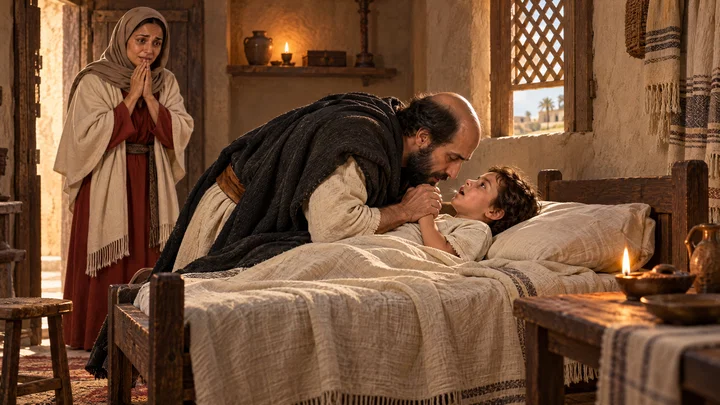
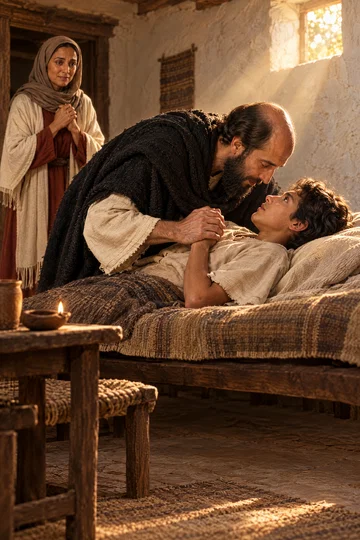
Then he returned, and walked in the house to and fro; and went up, and stretched himself upon him: and the child sneezed seven times, and the child opened his eyes.
Translations
Then he returned, and walked in the house to and fro; and went up, and stretched himself on him: and the child sneezed seven times, and the child opened his eyes.
King James Version, Webster Bible
Then he returned, and walked in the house to and fro; and went up, and stretched himself upon him: and the child sneezed seven times, and the child opened his eyes.
Then he returned, and walked in the house to and fro; and went up, and stretched himself upon him: and the child neesed seven times, and the child opened his eyes.
Revised Version, American Standard Version
Then he returned, and walked in the house once to and fro; and went up, and stretched himself upon him: and the child sneezed seven times, and the child opened his eyes.
and he turneth back and walketh in the house, once hither and once thither, and goeth up and stretcheth himself upon him, and the youth sneezeth till seven times, and the youth openeth his eyes.
And he returned, and walked in the house to and fro; and went up, and bent over him. And the lad sneezed seven times, and the lad opened his eyes.
Then retraced he, and walked in the house—once to and fro, and then went up and bowed himself upon him,—and the boy sneezed as many as seven times, and the boy opened his eyes.
Berean Standard Bible, Majority Standard Bible
Elisha turned away and paced back and forth across the room. Then he got on the bed and stretched himself out over the boy again, and the boy sneezed seven times and opened his eyes.
Then he returned, and walked in the house once back and forth, then went up and stretched himself out on him. Then the child sneezed seven times, and the child opened his eyes.
Then he came back, and after walking once through the house and back, he went up, stretching himself out on the child seven times; and the child's eyes became open.
And hee went from him, and walked vp and downe in the house, and went vp and spred himselfe vpon him: then the childe neesed seuen times, and opened his eyes.
Douay-Rheims (Challoner revision)
Then he returned and walked in the house, once to and fro: and he went up, and lay upon him: and the child gaped seven times, and opened his eyes.
Pictures
Cross-references
- 1 Kings 17:21-22
And he stretched himself upon the child three times, and cried unto the LORD, and said, O LORD my God, I pray thee, let this child’s soul come into him again.
Elijah prays, and the dead child returns to life.
- Luke 7:14-15
And he came and touched the bier: and they that bare him stood still. And he said, Young man, I say unto thee, Arise.
Jesus raises the widow’s son and restores him to his mother.
- John 11:43-44
And when he thus had spoken, he cried with a loud voice, Lazarus, come forth.
Jesus raises Lazarus from the dead before his own resurrection.
- Luke 8:54-55
And he put them all out, and took her by the hand, and called, saying, Maid, arise.
Jesus raises Jairus’s daughter from the dead.
- 2 Kings 13:21
And it came to pass, as they were burying a man, that, behold, they spied a band of men; and they cast the man into the sepulchre of Elisha: and when the man was let down, and touched the bones of Elisha, he revived, and stood up on his feet.
A dead man revives after contact with Elisha’s bones.
- 2 Kings 8:1-6
Then spake Elisha unto the woman, whose son he had restored to life, saying, Arise, and go thou and thine household, and sojourn wheresoever thou canst sojourn: for the LORD hath called for a famine; and it shall also come upon the land seven years.
The woman whose son Elisha restored to life later receives her home and land back.
- Mark 5:41-42
And he took the damsel by the hand, and said unto her, Talitha cumi; which is, being interpreted, Damsel, I say unto thee, arise.
Jesus raises Jairus’s daughter from death.
- Acts 20:9-12
And there sat in a window a certain young man named Eutychus, being fallen into a deep sleep: and as Paul was long preaching, he sunk down with sleep, and fell down from the third loft, and was taken up dead.
Paul restores Eutychus to life.
- John 11:25
Jesus said unto her, I am the resurrection, and the life: he that believeth in me, though he were dead, yet shall he live:
Jesus identifies himself as the resurrection and life, whose power raises the dead.
- Acts 9:36-42
Now there was at Joppa a certain disciple named Tabitha, which by interpretation is called Dorcas: this woman was full of good works and almsdeeds which she did.
Peter raises Tabitha from the dead.
- Hebrews 11:35
Women received their dead raised to life again: and others were tortured, not accepting deliverance; that they might obtain a better resurrection:
Women received their dead restored to life through faith.
- Revelation 1:18
I am he that liveth, and was dead; and, behold, I am alive for evermore, Amen; and have the keys of hell and of death.
Christ lives and holds the keys of death and the grave.
Commentary
Each commentary is drawn from primary sources: the writings of Ellen G. White and Adventist pioneers and periodicals. Each commentary is separate. Its own words are not a quotation; follow the references to read the source passages.
Ellen G. White
3 sources
Elisha labored prayerfully and persistently for the dead son of the Shunammite woman, walking to and fro in the house and then stretching himself upon the child again.PK 237.3–239.2 God restored the son to life through that effort, after Elisha stretched himself upon the child again.PK 237.3–239.2
After Elisha stretched himself upon him, the child sneezed seven times and opened his eyes, showing that he had revived and was restored to life.PK 235.1PK 237.3–239.2PK 239.3–240.1 That healing was Elisha's personal ministry bringing healing and rejoicing.PK 235.1 The child's restoration points to Christ's power to restore life and to the hope that at Christ's coming the faithful will be reunited with children who have died.PK 239.3–240.1
Sources
Pioneers and periodicals
41 sources
Elisha had already stretched himself once upon the dead boy until his flesh grew warm, then he walked back and forth in the house and went up to stretch himself upon him a second time, after which the child sneezed seven times and opened his eyes in restored life.ST Oct 5, 1904ST Jul 28, 1898ST Jul 28, 1898 This was a literal, real resurrection from the dead, not to immortality but to mortal life again.RH Nov 20, 1860ST Aug 12, 1889RH Aug 6, 1872RH May 28, 1861ST Mar 30, 1876 The restoration came through earnest, persevering secret prayer alone with God, by the operation of the Spirit through Elisha, while Gehazi's use of the staff alone had no virtue to give life.RH Jan 23, 1913ST Nov 24, 1887ST Jul 28, 1898RH Aug 31, 1869 It was accomplished by virtue of the Son of God's sacrifice and resurrection already settled in God's purpose, with Christ standing foremost as the resurrection and the life and first in rank though not first in time.ST Oct 12, 1876ST Apr 30, 1896STST Jan 11, 1905ST Dec 30, 1903 Elisha's continued effort until life returned shows that awakening the spiritually dead calls for earnest prayer, close personal contact, and persevering labor until life from heaven enters the soul.RH Jul 20, 1916
Setting and Course of Miracle
This raising belongs to the blessing God sent to the Shunammite home as reward for entertaining Elisha after perceiving he was a holy man of God.CO 73.5 With her husband she had made a little chamber on the wall with a bed and a table and a stool and a candlestick for him when he passed by.CO 73.5 There Elisha had enjoyed blessed seasons of secret prayer.RH Jul 25, 1907 The woman laid her dead son to rest on that bed while she went to call the man of God to pray that the boy might be raised from the dead.RH Jul 25, 1907
The son was the only son of the woman who had hospitably entertained Elisha at Shunem.ST Jun 2, 1881 He had fallen under the influence of sunstroke on the plains.RH Aug 29, 1871 Shunem was a village on the opposite side of the very hill on which Nain stood, with the plain of Jezreel stretching beneath.ST Jun 2, 1881 Sunstrokes are still common on the plains, and the diseases of the Holy Land being of the same types as in scriptural days bears witness to scriptural truth.RH Aug 29, 1871
After private prayer and first stretching himself upon the dead child, the child's flesh had grown warm.ST Oct 5, 1904ST Oct 5, 1904 Elisha then continued his effort and made a further, continued effort for the child.ST Jul 28, 1898ST Jul 28, 1898 He walked in the house to and fro, once back and forth, walking back and forth in the house.ST Jul 28, 1898ST Jul 28, 1898ST Oct 5, 1904 Then he went up again and stretched himself upon him a second time.ST Oct 5, 1904ST Jul 28, 1898ST Jul 28, 1898ST Oct 5, 1904
Restored life was then manifested when the child sneezed seven times and opened his eyes.ST Jul 28, 1898ST Jul 28, 1898ST Oct 5, 1904RH Feb 5, 1867 Elisha had prayed and ministered over the dead child at the Shunammite's house, and the child was restored to life.ST Dec 7, 1904RH Feb 5, 1867 This sneezing and opening of the eyes showed he had been revived and restored to life.ST Oct 5, 1904ST Jul 28, 1898ST Jul 28, 1898ST Dec 7, 1904ST Oct 5, 1904
Prayer and Agency in Restoration
Elisha was shut in alone with the dead child and alone with God as he pleaded for his restoration, and the child sneezed seven times and opened his eyes and returned to life.ST Nov 24, 1887RH Aug 31, 1869RH Feb 5, 1867ST Apr 24, 1893ST Apr 2, 1902 The raising was the blessing received through earnest personal and secret prayer, showing the power of prayer by which Elisha prayed and the dead child was restored to life.ST Nov 24, 1887RH Aug 31, 1869RH Aug 1, 1871 It was accomplished in God's presence and by the operation of the Spirit, through which Elisha's prayer brought the child back to life.
Elisha called upon the Lord in the walled bedchamber to restore life to the child and continued his supplications until God heard and raised the boy to life again.RH Jul 25, 1907 Prayer reaches even to the restoration of life, for the child Elisha prayed over and stretched himself upon sneezed seven times and opened his eyes and returned to life.ST Sep 5, 1900ST That return to life after Elisha's prayer and actions stands as a supernatural act of divine favor accomplished through faith, and as a wondrous answer proving that prayer reaches God.RH Aug 31, 1869RH Jan 29, 1861ST
Gehazi's attempt with Elisha's staff failed, so Elisha himself had to come and go personally to the child and stretch himself upon him before life returned.RH Jan 23, 1913 The staff carried by Gehazi had no virtue in itself to give life, because an instrument has spiritual power only when connected with the Spirit of God in one in whom that Spirit is present, and Gehazi's ministration was not honored of God.ST Jul 28, 1898 The woman knew the Spirit of God was in the prophet and had no confidence in the staff or the servant, but clung to Elisha and would not go home without him.ST Jul 28, 1898 She prevailed by a struggle of faith after a journey of some sixteen miles and by importunate pleading that constrained the man of God to yield and go with her, to which Heaven responded when Elisha himself came and raised the child to life.ST Jul 28, 1898
A Real Resurrection
The child's return to life is a literal, real resurrection from the dead and a true restoration of a deceased person to life.RH Nov 20, 1860RH Aug 6, 1872ST Mar 30, 1876RH Mar 8, 1864 It stands as evidence that the resurrection of the dead is a reality.RH Mar 8, 1864 As a true assertion in a divinely inspired book, it is not to be rejected as unreasonable when considered in isolation.RH Aug 29, 1912 It is cited as an example of a prophet raising a dead child, alongside the people's recognition of Jesus' mighty work in raising the widow's son at Nain.
It is one of six cases of resurrection before Christ's resurrection, three in each dispensation.RH Nov 20, 1860RH Aug 6, 1872ST Mar 30, 1876 It stands among the exceptions to the general rule of resurrection from the dead occurring before the first advent of Christ, along with the widow's son raised by Elijah, the raising of Moses, the man raised by the bones of Elisha, and others raised since the first advent, while all others live only by a resurrection through the power of Christ.ST Jan 28, 1889
The boy broke the power of death but was not raised to immortality or to immortal life.ST Aug 12, 1889RH May 28, 1861 His raising was nevertheless a real resurrection from the dead, for the Bible makes no distinction between resurrections on the basis of the condition to which the person is raised.RH May 28, 1861ST Apr 30, 1896 It was not merely a return to mortality distinct from resurrection, since even the wicked who are raised to mortality are spoken of as resurrected.ST Apr 30, 1896 The boy's return to life gives no account of thoughts or experiences during death, supporting that the dead are unconscious.ST It is an example of resurrection through God's power over death, comparable to the raising of Lazarus, Jairus's daughter, and the widow of Nain's son.ST Dec 30, 1903
Christ the Giver of Life
The raising was accomplished by virtue of the Son of God’s sacrifice and death and resurrection, already established in God’s purpose though not yet accomplished, and settled in His character and purpose from the foundation of the world.ST Oct 12, 1876STST Jan 11, 1905 Like other lives restored before Christ was raised, the Shunammite woman’s son returned to life before Christ’s resurrection by depending on the virtue of Christ’s sacrifice.STST Jan 11, 1905 It was a real resurrection from the dead before Jesus died and rose.ST Jan 11, 1905
Christ as the first-fruits of those that slept is first in rank and station and pre-eminence, not first in order of time.ST Apr 30, 1896ST Jan 11, 1905 As Ephraim and Jacob were called firstborn though Manasseh and Esau were older, so Jesus is still called the firstfruits of those who sleep not as first in time but as first in pre-eminence.ST Jan 11, 1905 Every such raising centers in Christ, who is the resurrection and the life, depended on His power, and leaves Christ standing foremost and preeminent in it.ST Apr 30, 1896 The Shunammite’s son stands with Moses, Enoch, Lazarus, and others as victors over the power of death through Christ.ST Jan 11, 1905 Christ is the one through whom the dead are raised, and he called Moses back to life.ST Dec 30, 1903 This raising is an example of resurrection through God’s power over death, comparable to the raising of Lazarus, Jairus’s daughter, and the widow of Nain’s son.ST Dec 30, 1903
Elisha acted as an instrument in raising the Shunammite woman’s child from the dead, so that Jesus’ own acts of raising the dead, by themselves, did not prove that He was the Messiah.ST Jan 30, 1912 Shunem was on the opposite side of the hill from Nain where Jesus raised a widow’s son, a village on the other side of the very hill on which Nain stood, with the plain of Jezreel stretching beneath.ST Jun 2, 1881 It lay in the region where both Elijah and Elisha had lived.ST Jun 2, 1881 Their triumphs over the grave lingered in the mind of the nation and were especially alive there as the proudest sign of their greatness as prophets.ST Jun 2, 1881 That memory may have helped prompt the people to recognize Jesus’ mighty work in raising the widow’s son at Nain and to confess that a great prophet had risen and God had visited His people.ST Jun 2, 1881
Lessons for Spiritual Work
Elisha persevered in his effort until the dead child's life was restored, returning and stretching himself upon the child again, after which the child sneezed seven times and opened his eyes. This persevering work illustrates the earnest, persevering labor needed to bring spiritual life to those dead in sin, for spiritually dead people need life from heaven. Bringing them to life calls for earnest prayer, unconditional surrender, deep consecration, close personal contact, and persevering labor. The restoration through such close personal contact illustrates how God's power, working through people, can awaken others from death to life.RH Jul 20, 1916
Spiritual work among young people must bring life from heaven into their souls, for instruction and moral teaching alone are not enough.RH Apr 22, 1915 Elisha continued his effort with the dead child until life was restored, stretching himself upon the child again until the child sneezed seven times and opened his eyes.RH Apr 22, 1915 His experiences as Elijah's devout pupil present the spiritual development produced by the education of the prophets' school as valuable for young people.ST Jun 7, 1899
After Gehazi's attempt with Elisha's staff failed, Elisha went personally to the child and stretched himself upon him, and the child then sneezed seven times and opened his eyes, showing that life had returned.RH Jan 23, 1913 This teaches that people must personally carry out the missionary work God assigns them rather than delegate it to someone else.RH Jan 23, 1913 The account shows God's power to bring a dead child back to life.RH Jan 4, 1906 It gives sorrowing parents comfort in looking forward to the glad reunion of the resurrection, including comfort to parents mourning the death of an infant child.RH Jan 4, 1906RH Jun 24, 1902
The child's return from death is a sign of the Lord's mercy and of the reward given to the home for housing and feeding the Lord's servant.RH Jul 25, 1907 It repaid the couple for their hospitality and loving service.ST Jun 16, 1914 The raising took place in the bedchamber on the wall that the Shunem family had built and furnished for Elisha, where he had enjoyed blessed seasons of secret prayer, and where the woman had laid her dead son to rest on that bed while she went to call the man of God to pray that the boy might be raised from the dead.RH Jul 25, 1907 There Elisha called upon the Lord to restore life to the child and continued his supplications until God heard his prayers and raised the boy to life again, showing the mighty power of God manifested through sweet cooperation between God's ministers and the people who care for their needs.RH Jul 25, 1907
Sources