Psalms 51:1
Have mercy upon me, O God, according to thy lovingkindness: according unto the multitude of thy tender mercies blot out my transgressions.
Translations
Have mercy on me, O God, according to your loving kindness: according to the multitude of your tender mercies blot out my transgressions.
Have mercy upon me, O God, according to thy lovingkindness: according unto the multitude of thy tender mercies blot out my transgressions.
Have mercy upon me, O God, according to thy lovingkindness:
According unto the multitude of thy tender mercies blot out my transgressions.To the chief Musician, A Psalm of David, when Nathan the prophet came to him, after he had gone in to Bath-sheba. Have mercy upon me, O God, according to thy loving-kindness: according to the multitude of thy tender mercies, blot out my transgressions.
Have mercy upon me, O God, according to thy lovingkindness; according to the multitude of thy tender mercies blot out my transgressions.
Have mercy upon me, O God, according to thy lovingkindness:
According to the multitude of thy tender mercies blot out my transgressions.To the Overseer. — A Psalm of David, in the coming in unto him of Nathan the prophet, when he hath gone in unto Bath-Sheba. Favour me, O God, according to Thy kindness, According to the abundance of Thy mercies, Blot out my transgressions.
Be gracious unto me, O God, according to thy loving-kindness; according to the abundance of thy tender mercies, blot out my transgressions.
Be favorable unto me, O God, according to thy lovingkindness, And, in the multitude of thy compassions, blot out my transgressions;
Have mercy on me, O God,
according to Your loving devotion;
according to Your great compassion,
blot out my transgressions.For the choirmaster. A Psalm of David. When Nathan the prophet came to him after his adultery with Bathsheba. Have mercy on me, O God, according to Your loving devotion; according to Your great compassion, blot out my transgressions.
Have mercy on me, God, according to your loving kindness.
According to the multitude of your tender mercies, blot out my transgressions.Have pity on me, O God, in your mercy; out of a full heart, take away my sin.
To him that excelleth. A Psalme of David, when the Prophet Nathan came unto him, after he had gone in to Bath-sheba. Have mercie vpon me, O God, according to thy louing kindnes: according to the multitude of thy compassions put away mine iniquities.
Douay-Rheims (Challoner revision)
Unto the end, a psalm of David,
When Nathan the prophet came to him after he had sinned with Bethsabee.
Have mercy on me, O God, according to thy great mercy. And according to the multitude of thy tender mercies blot out my iniquity.
Pictures

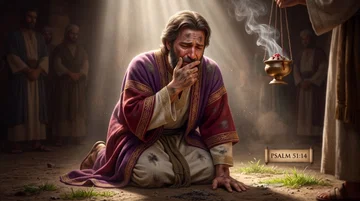


Cross-references 20 of 69
- 2 Samuel 12:1-13
And the LORD sent Nathan unto David. And he came unto him, and said unto him, There were two men in one city; the one rich, and the other poor.
Nathan rebukes David, who acknowledges his sin.
- Psalms 51:10
Create in me a clean heart, O God; and renew a right spirit within me.
The plea for mercy is joined to David’s prayer for a clean heart.
- Psalms 32:5
I acknowledged my sin unto thee, and mine iniquity have I not hid. I said, I will confess my transgressions unto the LORD; and thou forgavest the iniquity of my sin. Selah.
Acknowledging and confessing transgressions is followed by God’s forgiveness.
- 2 Samuel 11
And it came to pass, after the year was expired, at the time when kings go forth to battle, that David sent Joab, and his servants with him, and all Israel; and they destroyed the children of Ammon, and besieged Rabbah. But David tarried still at Jerusalem.
David’s sin provides the setting for his plea for mercy and repentance.
- Luke 18:13
And the publican, standing afar off, would not lift up so much as his eyes unto heaven, but smote upon his breast, saying, God be merciful to me a sinner.
The penitent sinner asks God for mercy and is justified.
- Psalms 103:13
Like as a father pitieth his children, so the LORD pitieth them that fear him.
The Lord’s pity for those who fear him is compared to a father’s compassion for his children.
- Psalms 51:14
Deliver me from bloodguiltiness, O God, thou God of my salvation: and my tongue shall sing aloud of thy righteousness.
The forgiven penitent asks deliverance from bloodguiltiness and sings of God’s righteousness.
- 2 Samuel 12:14
Howbeit, because by this deed thou hast given great occasion to the enemies of the LORD to blaspheme, the child also that is born unto thee shall surely die.
David’s reproof and penalty provide the setting for his penitence.
- Hebrews 9:14
How much more shall the blood of Christ, who through the eternal Spirit offered himself without spot to God, purge your conscience from dead works to serve the living God?
Christ’s blood purges the conscience, providing the cleansing sought.
- 1 John 1:9
If we confess our sins, he is faithful and just to forgive us our sins, and to cleanse us from all unrighteousness.
Both connect confession of sin with God’s forgiveness.
- Psalms 51:9
Hide thy face from my sins, and blot out all mine iniquities.
David asks God to blot out his iniquities.
- Psalms 51:7
Purge me with hyssop, and I shall be clean: wash me, and I shall be whiter than snow.
The psalm develops the request to be cleansed from sin.
- Psalms 51:17
The sacrifices of God are a broken spirit: a broken and a contrite heart, O God, thou wilt not despise.
God does not despise a broken and contrite heart.
- Isaiah 43:25
I, even I, am he that blotteth out thy transgressions for mine own sake, and will not remember thy sins.
God blots out transgressions and remembers sins no more.
- Exodus 34:6-7
And the LORD passed by before him, and proclaimed, The LORD, The LORD God, merciful and gracious, longsuffering, and abundant in goodness and truth,
God’s merciful character is abundant in lovingkindness and forgiveness of sin.
- Psalms 32:1-2
Blessed is he whose transgression is forgiven, whose sin is covered.
David’s plea for mercy connects with the blessing of forgiven sin and uncounted iniquity.
- Micah 7:18
Who is a God like unto thee, that pardoneth iniquity, and passeth by the transgression of the remnant of his heritage? he retaineth not his anger for ever, because he delighteth in mercy.
God pardons transgression because he delights in mercy.
- 2 Samuel 12:7
And Nathan said to David, Thou art the man. Thus saith the LORD God of Israel, I anointed thee king over Israel, and I delivered thee out of the hand of Saul;
Nathan’s reproof led David to confess and repent.
- Nehemiah 4:5
And cover not their iniquity, and let not their sin be blotted out from before thee: for they have provoked thee to anger before the builders.
One prayer asks for sins to be blotted out; the other asks that sins not be blotted out.
- 2 Samuel 12:10
Now therefore the sword shall never depart from thine house; because thou hast despised me, and hast taken the wife of Uriah the Hittite to be thy wife.
David is told the sword will remain in his house as punishment for his sin.
Commentary
Each commentary is drawn from primary sources: the writings of Ellen G. White and Adventist pioneers and periodicals. Each commentary is separate. Its own words are not a quotation; follow the references to read the source passages.
Ellen G. White
24 sources
It is the plea of a guilty king after grievous wrongdoing to be pardoned out of God's unfailing love and abundant compassion, with every offense wiped away.SC 24.3–25.2ED 165.2Ms 147, 1903, par. 10–13PP 724.35T 639.2 True repentance makes no excuse and seeks no escape, but owns the sin, humbles the heart, and declares God right in judging and merciful in forgiving.SC 24.3–25.2Ms 147, 1903, par. 10–13SG4 88.2–89.1EDFCP 16.1ST Jan 28, 1886 The cry asks for more than release from guilt, longing for a cleansed soul-temple, a pure heart, and restored fellowship with God.SC 24.3–25.2ED 165.215MR 101.2–102.1ST Aug 12, 187521MR 379.5–6 When the sinner humbly confesses and turns, God forgives, erases the record of sin, and restores the wanderer to covenant favor through the blood of Christ and the cleansing of the Holy Spirit.ST Jan 28, 18865T 343.1SPBC 154.2–3Ms 20, 1892, par. 16–17Lt 57, 1895, par. 54–57 It therefore stands as an urgent call to come to God at once without delay or self-saving, trusting His power alone to wash, sanctify, and keep, with assurance that every fallen one who returns and yields may take courage and begin again.15MR 101.2–102.1Ms 73, 1893, par. 14–16Lt 356, 1906, par. 8–10ST Jan 28, 1886PP 726.2
Words and Historical Setting
The prayer asks God to show mercy in line with His lovingkindness and to blot out transgressions in line with the multitude of His tender mercies.SC 24.3–25.2ED 165.2Ms 147, 1903, par. 10–13PP 724.31SP 380.2–381.2 It is the prayer of David, the exalted and honored king of Israel, after departing from righteousness and transgressing God's law in great sin.ED 165.2Ms 147, 1903, par. 10–13PP 724.3ST Aug 12, 187521MR 379.5–6 That sin included his wrong against Uriah and his wife, and the prayer came when the Lord's message of reproof reached him through His prophet Nathan.Ms 147, 1903, par. 10–13PP 724.35T 639.2SG4 88.2–89.121MR 379.5–6
After his sin he turned directly to God as his best friend and Creator rather than to a priest, pleading with trust and hope for pardon.ED 165.21SP 380.2–381.25T 639.2SG4 88.2–89.1 Pardon is sought from the Creator because wrongs done to other people also reach back to God.5T 639.2 His plea also asked God to cleanse him from sin, seeking more than pardon alone.SC 24.3–25.2ED 165.2
His confession was unconcealed and public, a penitential sacred song recounting his sin and repentance and his hope of pardon through God's mercy.1SP 380.2–381.2SG4 88.2–89.1PP 725.1 It was sung by all Israel in public assemblies before the court, with priests and elders and judges and princes and men of war and lords present.SG4 88.2–89.1PP 725.1 He did not conceal his guilt even though he knew it would bring his guilt to the notice of other generations, but desired that others might be instructed by the sad history of his fall and that knowledge of his fall be preserved to the latest generation.1SP 380.2–381.2SG4 88.2–89.1PP 725.1
True Repentance Explained
The verse teaches true repentance for sin and lays out the course to take when departed from the Lord.Ms 147, 1903, par. 10–13 It confronts people with how far they fall short of the purity and Christlikeness God requires, and its lessons must be taken to heart.Lt 79, 1901, par. 13 A merely nominal profession does not refine and sanctify the life, but leaves influence worthless like salt without savor.Lt 79, 1901, par. 13 Sincere repentance makes no attempt to excuse guilt or escape judgment, but rests its hope on God's mercy.SC 24.3–25.2EDFCP 16.1 It confesses sin, humbles the heart, declares God to be just in all His dealings, and accepts God's decision as just and merciful.Ms 147, 1903, par. 10–13EDFCP 16.1
David's response was in dust and ashes, with deep humility and sincere repentance.SG4 88.2–89.1EDFCP 16.1 He poured out the soul in penitence and humiliation, with fear and trembling at the word of the Lord under rebuke.SG4 88.2–89.1ST Jan 28, 1886 He did not turn against the prophet who reproved him.EDFCP 16.1 This stood in contrast to the rulers of the surrounding nations, who would have taken the life of the faithful reprover.SG4 88.2–89.1 He trusted God rather than people who excused unrepented sin, feeling he could endure the loss of his crown but could not be deprived of God's favor, so that his need for God's favor mattered more than keeping his crown.EDFCP 16.1ST Jan 28, 1886ST Jan 28, 1913
True repentance requires realizing the enormity of sin.ST Aug 12, 1875 It keeps the transgression ever before the mind and does not repeat the offense.21MR 379.5–6 The changed life it produces is not merely a passing response to emotional excitement.ST Aug 12, 1875 The mercy and compassion asked from God are given on that condition, and to repeat the same sin after reproof would forfeit compassion.21MR 379.5–6 The sinner recognizes that sin has polluted the soul and the soul-temple, and that only God can cleanse it and save it from ruin.15MR 101.2–102.1Ms 73, 1893, par. 14–16
The plea therefore seeks more than pardon, longing also for cleansing, a clean heart, purity, and restored communion with God.SC 24.3–25.2ED 165.2 The verse expresses genuine repentance toward God and faith in Jesus Christ in the midst of human struggle and temptation.PP 726.2 It shows one burdened with guilt pleading for mercy through Christ instead of giving up to despair.ST Aug 12, 1875PP 726.2 Sincere repentance and confession are accepted by God even though the transgressor still suffers for the transgression.PP 726.2
Forgiveness and Present Call
God's mercy and forgiveness can blot out transgression, erasing sins from His remembrance and from His book of remembrance.5T 343.1SPBC 154.2–3Lt 57, 1895, par. 54–5714MR 133.2–135.1 After confessing wrongs and making restitution as far as possible, people may ask God to do what they cannot do for themselves, to forgive and erase sin.5T 343.1 That asking rests on the assurance that there is forgiveness with God, by which the sinner is justified by the blood of Christ and sanctified by the cleansing power of the Holy Spirit.14MR 133.2–135.1
When the sinner becomes penitent and humble after rebuke and punishment, the Lord forgives and restores to covenant relation with Himself.Ms 20, 1892, par. 16–17Ms 34, 1892, par. 39–40 David felt he could endure the loss of his crown but could not be deprived of God's favor.ST Jan 28, 1886ST Jan 28, 1913 His need for God's favor mattered more than keeping his crown.ST Jan 28, 1913
The verse directs the sinner to seek God humbly without delay, speculation, or hesitation for mercy, pardon, and conversion so that sins may be blotted out.15MR 101.2–102.1Lt 356, 1906, par. 8–10ST Jan 28, 1886 It means coming after opening the heart to Satan, defiling the soul-temple with buyers and sellers and idols, trying to save self and finding self held by an unbreakable power and unable to cleanse one stain of guilt.15MR 101.2–102.1 It means bringing the sinful polluted soul to God, laying it at His feet and trusting it to no power but His, recognizing that sin has polluted the soul-temple and that only God can cleanse it and save it from ruin.15MR 101.2–102.1Ms 73, 1893, par. 14–16 It means asking to be washed in the blood of the Lamb, clothed with garments of purity and righteousness, sanctified through truth, given the Spirit and love in the heart, inclined to keep the commandments, united in will to God, and cleansed and kept as His temple.15MR 101.2–102.1 It is especially the prayer for those who have long resisted light and opposed righteousness, acknowledging many sins and iniquities that have separated them from God, to humble the heart, cease stubborn resistance, and confess.14MR 133.2–135.1
The verse stands through all ages as encouragement for fallen children of God to take courage, repent, and try again to walk in the way of God's commandments, showing one burdened with guilt pleading for mercy instead of giving up to despair.PP 726.2 The Lord knows how strong the inclinations of the natural heart are and will hear and help in every time of temptation, and that same mercy is still extended to the sinner who returns and heeds the pleading voice of the Spirit.ST Jan 28, 1886 Those who humble themselves and turn from resistance to light can be forgiven, converted, and transformed.SPBC 154.2–314MR 133.2–135.1
Sources
Pioneers and periodicals
83 sources
David pleaded for mercy after his double sin of adultery with Bathsheba and arranging Uriah's death to hide it.ST Jul 17, 1884RH Mar 19, 1861ST Apr 29, 1908 He asked God to erase and remove his transgressions from the record on the ground of divine lovingkindness and the multitude of tender mercies, not on any righteousness or worthiness of his own.ST Aug 19, 1886ST Jul 15, 1908RH Apr 16, 1901ST Jul 29, 1889ST Feb 2, 1915 His plea is a most humble confession of grievous guilt that frankly admits its enormity without excuse, concealment, or blame of others, in broken contrition and revolt against wrong because it is wrong.RH Jul 27, 1869ST Apr 15, 1897ST Jun 10, 1889ST Feb 18, 1886 Pardon and cleansing come through Christ alone, whose mercy is inexhaustible toward the repentant, restoring joy and making even one guilty of shocking crimes whole.ST Aug 12, 1875ST Feb 2, 1915ST Jul 1, 1903RH Aug 26, 1862RH Oct 28, 1915 It is a Spirit-inspired prayer of repentance that every sinner in every age can sincerely make his own, joining plea for forgiveness to the need for a clean heart and renewed spirit.ST Aug 19, 1886RH Apr 16, 1901ST Jun 14, 1910ST May 14, 1902ST Jun 4, 1912
David's Sin and Conviction
This cry is David's penitence after his adultery and murder in the affair of Uriah and Bathsheba, his double sin of adultery and of arranging Uriah's death to take his wife and hide his sin.ST Jul 17, 1884RH Mar 19, 1861RH Mar 12, 1861RH Jan 7, 1904 It is his confession and prayer after conviction of those crimes connected with Uriah's murder, expressing penitence and faith in God while condemning himself without palliation or excuse in abject humility, deep penitence, heart-rending agony, self-loathing and self-abhorrence.ST Jul 17, 1884RH Mar 19, 1861 It shows him acknowledging the righteousness of God's judgment against him and pleading as a guilty sinner to be blotted out only according to lovingkindness and tender mercies, displaying the nature of genuine repentance and the consolation religion gives to a penitent soul burdened with consciousness of guilt even while enduring the awful lifelong consequences of sin.RH Mar 19, 1861 It is his sorrow and humility after the prophet reproved him for his sin against God in the matter of Uriah, and his seeking God's mercy after that sin involving Uriah.ST Apr 29, 1908ST Apr 10, 1893
The psalm expresses genuine repentance prompted by Nathan's wise reproof after David's terrible sin and transgression of God's law, turning him from ruin and from the stubbornness and destructive sorrow of an unrepentant heart.ST Aug 12, 1875ST Aug 26, 1875 That reproof was wisely directed not merely to rebuke him but to save him from utter ruin on the brink of which he stood, and it is repentance that does not need to be repented of, the opposite of the stubborn hardness of the natural heart and the sorrow of the world that works death.RH Dec 22, 1868 The quality of that repentance after grievous sin and God's reproof is commendable, and those reproved by the testimonies of the Spirit of God should read the psalm again and again and drink deep into its spirit.RH Dec 22, 1868ST Feb 20, 1879
The plea followed a year of idleness and luxury that led to temptation, the consummation of the sin in adultery and the plot to kill Uriah the Hittite to hide the sin, reproof by Nathan, humble repentance, and the Lord's forgiveness. Its words of penitence are profitable to read in light of his sinful conduct and the severe penalty he faced, and profitable for every sinner to study, because all have sinned.ST Jul 27, 1904
David had often gone up with the multitude that kept the yearly Day of Atonement, and remembrance of those days and those symbols of pardoning mercy saved him from sinking into hopeless despair under his sense of awful guilt when Nathan brought his great sin in the matter of Bathsheba and Uriah to his mind.RH Jan 15, 1861 The hope inspired by those symbols drew him near to God to plead for mercy according to lovingkindness and according to the multitude of tender mercies to blot out his transgressions.RH Jan 15, 1861 This teaches the blessed truth taught even under that dispensation that God can forgive, that sin may be forgiven and also taken away so as to be remembered against the sinner no more forever.RH Jan 15, 1861
David, chosen to be king over Israel because he was a man after God's own heart, fell by temptation into grievous sins, acknowledged them before God, and pleaded for mercy and pardon.RH Dec 22, 1868 That confession and cry for mercy rather than a profession of perfection proves that holy men of old did not hold themselves up as perfect, sinless patterns.RH Dec 22, 1868 His repentance after his adultery when he was reproved does not justify his wrong but condemns it, showing that living up to the light of that age would have kept him from it, yet it gives greater evidence of deep, heartfelt penitence than any other person in Scripture, joined with firm abiding faith in God.RH Aug 22, 1871 That repentance vindicates his character and makes him stand eminent among the saints of both Testaments in repentance and faith.RH Aug 22, 1871
The verse belongs to the group of seven psalms known as the Penitential Psalms.RH Apr 14, 1903 It opens the Miserere, the saddest of the psalms, a wailing prayer prayed kneeling to entreat the mercy of God, a cry raised aloud together by a multitude in calamity, as the people gathered on the hills overlooking ruined Lisbon sang it at nightfall after the earthquake.RH Jul 14, 1874 It is the psalm on which Savonarola based his prison meditation called the Miserere, expressing a sinner's distrust of his own strength and trust in God's mercy as a pure image of faith and hope in God, placing hope not in vows, religious office, ceremonies, or works, but in the gospel, faith, and righteousness.ST Nov 18, 1889
After his sin David repented in bitterness and anguish of soul, and God eventually forgave him.ST Mar 22, 1883 His is a humble confession of great transgression, a thorough heartfelt contrition showing that despite human weakness he had strength of principle to gain the victory in the end.RH Oct 12, 1869ST Nov 11, 1880 He humbled himself and sought God's mercy in words and acts corresponding to the wrong he did, belonging to a model of returning to God through humiliation and confession, with forgiveness and God's favor following a thorough facing and cleansing of the sin.ST Jul 10, 1893 He repeatedly mourned his sin in the matter of Uriah, his grief over sin returning as he saw its wrong more fully, connected with his failure to keep God's precepts and his earnest, bitter repentance.RH Oct 4, 1864RH Nov 7, 1912
Wording of Mercy Plea
The plea asks God to show mercy according to His lovingkindness and according to the multitude of His tender mercies, to erase and blot out transgressions, and forgiveness is grounded in that merciful character and compassion.ST Aug 19, 1886ST Jul 15, 1908ST Jul 29, 1889ST Jun 3, 1908RH Jan 25, 1912 It is the sinner's cry in bringing sin to God and the Saviour, turning to Him for mercy and forgiveness and for removal of guilt, with the following plea to wash away iniquity and cleanse from sin continuing the same request.ST Jul 15, 1908ST Jul 29, 1889ST Jun 3, 1908RH Nov 19, 1908 Together with the verses that follow, it presents conversion as repentance and cleansing joined to the creation of a clean heart, the renewal of the spirit, and the continued presence of the Holy Spirit, expressing the beginning of conversion after sin.ST Aug 19, 1886ST Jul 29, 1889 Hope for mercy rests on the abundance of that lovingkindness and tender mercy, not on anything in the sinner.RH Jan 25, 1912RH Nov 19, 1908
The ground of the appeal is God's loving-kindness, not any righteousness, worthiness, or works in the sinner, for human works are mixed with error.RH Apr 16, 1901ST Nov 8, 1899 The sinner is to appeal for mercy and confess transgression rather than claim to be righteous or wait to become worthy, and pardon and cleansing come through Christ rather than through effort to make oneself pure.ST Jul 1, 1903RH Aug 26, 1862 Those who lived before Christ did not know His name, yet by asking wholly for mercy they came through Christ, whose self-giving makes forgiveness possible, and a prayer so inspired by the Spirit will be heard by the Father.ST Feb 2, 1915ST Nov 8, 1899 The greatness of sin should not keep anyone from coming, because His mercy is inexhaustible and He delights to bestow it.ST Jul 1, 1903
Mercy with God is never singular but a multitude of tender mercies, meaning many mercies multiplied and constantly bestowed.RH Nov 24, 1874 They are too many to count, like the stars or the sand on the seashore, quietly falling upon pilgrims through the years of pilgrimage, and blotting out is sought according to that abundance, on the ground of the number and tenderness of His mercies.RH Nov 24, 1874 To blot out is to ask Him to remove recorded sin and guilt, for sins are marked and kept in God's record where they are examined in the judgment, and their removal is an act of divine mercy.RH Jan 1, 1875ST Jan 24, 1878RH Nov 16, 1869 God's hiding His face from sin means blotting it out and cleansing the sinner, not treating sin as a small matter.RH Jan 1, 1875
Having transgressions blotted out is expressed as taking away and washing away stains, pardoning guilt, destroying wrong, healing the wounds sin caused, and making the sinner whole.RH Nov 7, 1912 It means old sins pardoned, forgiven and forgotten by Him, taken away so as to be remembered against the sinner no more forever, buried in the depths of the sea, so that He regards the forgiven as though they had never sinned.RH Nov 7, 1912RH Jan 15, 1861ST Jan 28, 1913 It was left on record after grievous sin as encouragement that God freely forgives and welcomes back those who return to Him from the riches of His grace in Christ.ST Jan 28, 1913 True repentance voicing this plea is the revolt of conscience against wrongdoing because it is wrong, not regret for consequences nor reformation because a sinful life costs much, and it is evidenced by abandoning sin and acknowledging it without concealment, palliation, or defense, bearing its penalty unshrinkingly and doing all conscience and duty call for to repair the evil, which Christians must preach and practice toward repentant wrongdoers by remembering it no more against them; merely borrowing its words proves nothing, for words are cheap and only deeds demonstrate reality.ST Feb 18, 1886
The verse shows conscience at work under the old dispensation, as active then as under the new even though the word conscience never appears in the Old Testament.ST Feb 20, 1907 This proves God does His work in man by means for which man has no name or different names.ST Feb 20, 1907
True Repentance and Confession
This psalm is one of the most humble confessions of guilt ever penned, showing heartfelt earnest repentance after very grievous sin.RH Jul 27, 1869 It does not cover guilt, excuse crime, throw blame on others, or hide the record from future ages, but is ashamed of sin yet not ashamed to make penitence known.RH Jul 27, 1869 It frankly admits the enormity and blood-guiltiness of transgression with a realizing sense of deep depravity, without offering extenuating reasons or shifting blame, and pleads for pardon that is not deserved.ST Jun 10, 1889
True repentance is the revolt of conscience against wrongdoing because it is wrongdoing, not regret for sin because of its consequences and not reformation because a sinful life costs much and pays little.ST Feb 18, 1886 Merely borrowing its words proves nothing, for words are cheap and only deeds demonstrate reality.ST Feb 18, 1886 Repentance is evidenced by abandoning sin and acknowledging it without concealment, palliation, or defense, bearing its penalty unshrinkingly, and doing all that conscience and duty call for to repair the evil.ST Feb 18, 1886
The petition for forgiveness comes before the confession, but pardon requires a full confession that recognizes the wrong with intention to live better.ST Jul 17, 1884 Confession is specific and names particular sins, joined with sincere repentance and reformation.ST Sep 25, 1893 Sins are to be confessed to God, and wrongs against other people are also to be confessed to them, for unconfessed sins are not forgiven.ST Sep 25, 1893
True confession is joined with contrition and brokenness of heart and of spirit, pleading God's mercy alone without excusing self.ST Apr 15, 1897RH Aug 17, 1876ST Apr 15, 1897 Because sin permeates the man to every fiber and becomes part of his very being, interlacing and intertwining the whole man, repudiating and separating from it brings agony of soul and sorrow of heart.ST Apr 15, 1897 Enlightened by God's Word the sinner sees how sinful sin is and how fully he has been identified with it, keeps his own sin ever before him in all its deformity as it appears before God, does not see the enormity of others' sins or compare himself with them, and offers no excuse, justification, or extenuation.ST Apr 15, 1897 Such confession acknowledges God's right to render justice and justifies God in whatever sentence He gives, asking God to be glorified by exercising His goodness, and confession of sins against God is to be poured into God's ears alone, not man's.ST Apr 15, 1897 At that humbled time, when self-complacency and pride have been broken, favor can be successfully sought and petitions for blotting out can ascend to God, together with seeking a new heart.
David's humble and full confession after grievous sin was made freely and without compulsion, openly and frankly and publicly without concealment or self-justification.RH Apr 14, 1859RH Jun 20, 1871 Though doing wrong is sad and censurable, the most noble thing after sin is to frankly and fully confess it, and because he confessed in this way he was pardoned, giving courage to discouraged souls betrayed into wrong through strong temper and passion and repeatedly failed that they too can confess and be forgiven and helped.RH Jun 20, 1871 He speaks personally and openly about his experience without egotism because he gives all glory to God rather than praising himself.RH Jan 5, 1860
The psalm teaches how to regard sin and what kind of confession and prayer is acceptable to God, calling for an honest wholehearted appeal for mercy and forgiveness.RH May 10, 1870 Confession of particular sins and a plea for forgiveness belong in prayer, humbly seeking pardon so that sin no longer hinders communion with God.RH Jul 10, 1860 It is an example of the heart-searching that prayer can bring.ST Aug 18, 1887 His penitence for sin was part of the wisdom by which he pleased God, and it is the same kind required of believers in Christ.RH May 5, 1863RH May 2, 1865
God's Forgiving Mercy
Pardon and cleansing come through Christ, not through any effort to make oneself pure, and those who lived before He came did not know His name yet came through Him by asking wholly for mercy, whose self-giving makes forgiveness possible.ST Feb 2, 1915RH Aug 26, 1862 Forgiveness comes from the riches of grace in Christ, who freely forgives and welcomes back those who return to Him and regards the forgiven as though they had never sinned.ST Jan 28, 1913 David repented and found pardon through Christ, and his changed life proved it was not merely a passing response to emotional excitement but required realizing the enormity of sin.ST Aug 12, 1875 The greatness of sin should not keep anyone from coming to God, because His mercy is inexhaustible and He delights to bestow it.ST Jul 1, 1903 He grants mercy because He delights in showing it to the repentant who humbles himself over the depth of sin and confesses it while crying for mercy.RH Oct 28, 1915
The appeal accompanies confession of guilt and acknowledgment of unworthiness to be called His child, made by a grievously sinful backslider turning in bitter repentance on the basis of abundant tender mercies.RH Apr 16, 1867 God restores the joy of salvation, makes the broken bones and the brokenhearted rejoice, and gives the penitent praise of His righteousness.RH Apr 16, 1867ST Jun 28, 1877 Even a sinner guilty of shocking crimes can receive complete cleansing when repentance is humble and thorough, as David's grave sins show.ST Dec 2, 1913 The fallen are taught to acknowledge their sins to God and come in faith to the Crucified, where another pardon remains, and by divine strength they can resolve not to let sin rule them.ST Oct 2, 1893
Sin can be forgiven yet leaves bruises and scars in character that cause shame and suffering, as David's fall shows.ST Jul 24, 1879 Every deviation from right leaves its impress on character, and sin torments and constantly reproves while kept ever before the mind, bringing voluntary humiliation in brokenness of spirit and contrition of heart with prayer to be washed thoroughly from iniquity.RH Aug 17, 1876 Its penalty is as severe physically as morally, with the iniquities of the fathers visited through successive generations as inherited weakness and imbecility.RH Aug 17, 1876 The plea is answered at last with the assurance of a land where the inhabitants shall not say they are sick because their iniquities are forgiven, where he whose transgression is forgiven and whose sin is covered is blessed.RH Aug 17, 1876 With its petitions to hide the face from sin, blot out iniquity, restore joy and uphold by His Spirit, this is a prayer for those who are not God's children and for those adopted who have sinned and lost heirship, to seek mercy from God as Judge rather than address Him as Father.ST Feb 24, 1887
The convicted sinner should seek God without delay for mercy and pardon, pouring out the soul in penitence, humiliation and humility as David did after he was convicted of transgressing the law.ST Jan 28, 1886ST Feb 8, 1883 The Lord knows how strong the inclinations of the natural heart are and will hear and help in every time of temptation, and that same mercy is still extended to the sinner who returns and heeds the pleading voice of the Spirit.ST Jan 28, 1886 His favor matters more than keeping the crown or earthly honor, for David felt he could endure the loss of his crown but could not be deprived of the favor of God.ST Jan 28, 1886ST Feb 8, 1883ST Jan 28, 1913
Prayer for Every Sinner
This is a Spirit-inspired prayer of repentance after great sin that every truly penitent sinner in every age can sincerely make his own as a practical prayer for mercy in light of the cross, and such a prayer inspired by the Spirit will be heard by the Father.ST Jun 14, 1910ST May 14, 1902ST Jun 4, 1912ST Nov 8, 1899 It belongs to the psalmist's prayer for a clean heart, which presents the need for a cleansed heart as the beginning of genuine reform, since without cleansing of the heart reform cannot last.ST May 14, 1902
Together with the verses that follow it joins repentance and cleansing from sin and removal of transgressions and guilt within to the creation of a clean heart, the renewal of the spirit, the continued presence of the Holy Spirit, and God's beginning of His work in the heart.ST Aug 19, 1886RH Apr 16, 1901 The plea rests on God's loving-kindness and abundant compassion rather than on any righteousness in the sinner, asking Him to erase transgressions.ST Aug 19, 1886RH Apr 16, 1901
It is David's penitence, the song of his broken heart whose music is in its words, and its words carry spiritual power when sung with the spirit to sympathetic and appropriate music. Set to such music and sung in a revival meeting, its plea for mercy and blotting out of transgressions has appealing power beyond any humanly written hymn to pierce and break the hardest heart.
Genuine repentance keeps this need before the believer throughout the Christian life, for the psalm is the language of a heart deeply sorrowful for sin, humbled before God and seeking to be made clean.RH Dec 10, 1872 In a converted person sin or sinful thoughts cause pain expressed in this plea for mercy and for transgressions to be blotted out, and that painful sense of sin is an evidence of conversion profitable for every sinner to study because all have sinned.ST Jan 17, 1906
The prayer gives the language of a heart humbling itself fully to overcome the wicked one and gain victory over besetting sins, feeling after every fault and bringing it with broken heart and contrite spirit to Jesus to be washed away by His precious blood.RH Feb 12, 1861 Then wrong influences are thoroughly counteracted, the burden leaves the mind, the door of the heart is fully opened for Jesus to come in in His fullness, and the church rises from lukewarmness.RH Feb 12, 1861 It expresses sorrow and repentance of one who recognizes personal unfaithfulness and wrong, seeks forgiveness, longs for the light of God's presence and the communion of His Spirit, and describes the state of mind in confessing failures and beginning reform so that sin no longer hinders communion.RH Jul 31, 1866RH Jul 10, 1860 It is a psalm for sinners to learn through personal experience in humbling themselves before God, applied as prayer for mercy and forgiveness according to abundant compassion and not according to guilt, to remove every transgression so sinners may be fit to stand with the redeemed on Mount Zion.RH Feb 12, 1857
Its words can awaken a person to the burden and weight of sin and the need to repent, expressing trust that a sinner may seek pity and forgiveness from God on the basis of abundant mercy.RH Jun 13, 1865RH Jun 13, 1865 David repented with all his soul after sinning and found pardon and acceptance with the Lord, his experience linked with chastisement that brought him to a saving knowledge of Christ.RH Apr 23, 1901ST Jul 19, 1905 The Spirit follows the sinner with warnings, reproofs and invitations, and the sinner must turn to God rather than trust in corrupt human nature.ST Apr 22, 1903
Merely borrowing its words proves nothing, for words are cheap and only deeds can demonstrate the reality of repentance, and repeating Bible language does not make prayer sincere when the speaker does not truly feel or live the experience expressed.ST Feb 18, 1886ST Jun 21, 1883 True repentance voiced here is the revolt of conscience against wrongdoing because it is wrongdoing, not regret for consequences nor reformation because a sinful life costs much, and it is evidenced by abandoning sin and acknowledging it without concealment, palliation or defense, bearing its penalty unshrinkingly and doing all conscience and duty call for to repair the evil.ST Feb 18, 1886 David's greater prayer of confession takes about three minutes to pray aloud.RH Jul 14, 1868 It is also the prayer of one broken by woes and griefs who has accepted the rod and cup of sorrow without asking for suffering to be removed or God's will to be questioned, but asks tonight for mercy as release, for peace to drive care and suffering from the heart and make the burden light, for God Himself to come to remove afflicting burdens and sustain by His own strength and might, and for forgetfulness for one short hour when stumbling and almost falling so the cross can be borne tomorrow.RH Jul 20, 1911
Sources