2 Samuel 12:3
But the poor man had nothing, save one little ewe lamb, which he had bought and nourished up: and it grew up together with him, and with his children; it did eat of his own meat, and drank of his own cup, and lay in his bosom, and was unto him as a daughter.
Translations
But the poor man had nothing, save one little ewe lamb, which he had bought and nourished up: and it grew up together with him, and with his children; it did eat of his own meat, and drank of his own cup, and lay in his bosom, and was to him as a daughter.
But the poor man had nothing, save one little ewe lamb, which he had bought and nourished up: and it grew up together with him, and with his children; it did eat of his own meat, and drank of his own cup, and lay in his bosom, and was unto him as a daughter.
but the poor man had nothing, save one little ewe lamb, which he had bought and nourished up: and it grew up together with him, and with his children; it did eat of his own meat, and drank of his own cup, and lay in his bosom, and was unto him as a daughter.
But the poor man had nothing save one little ewe-lamb, which he had bought and nourished: and it grew up together with him, and with his children: it fed of his own meat, and drank of his own cup, and lay in his bosom, and was to him as a daughter.
Revised Version, American Standard Version
but the poor man had nothing, save one little ewe lamb, which he had bought and nourished up: and it grew up together with him, and with his children; it did eat of his own morsel, and drank of his own cup, and lay in his bosom, and was unto him as a daughter.
And the poor one hath nothing, Except one little ewe-lamb, Which he hath bought, and keepeth alive, And it groweth up with him, And with his sons together; Of his morsel it eateth, And from his cup it drinketh, And in his bosom it lieth, And it is to him as a daughter;
but the poor man had nothing at all, but one little ewe lamb which he had bought, and was nourishing; and it grew up with him, and together with his children: it ate of his morsel, and drank of his own cup, and slept in his bosom, and was to him as a daughter.
whereas the, poor, man had, nothing,—save one little lamb, which he had made his own, and sustained, and it had grown up with him and with his children, all together,—of his own morsel, used it to eat, and, out of his own cup, used it to drink, and, in his own bosom, used it to lie, and it was to him, as a daughter.
Berean Standard Bible, Majority Standard Bible
but the poor man had nothing except one small ewe lamb that he had bought. He raised it, and it grew up with him and his children. It shared his food and drank from his cup; it slept in his arms and was like a daughter to him.
but the poor man had nothing, except one little ewe lamb, which he had bought and raised. It grew up together with him and with his children. It ate of his own food, drank of his own cup, and lay in his bosom, and was like a daughter to him.
But the poor man had only one little she-lamb, which he had got and taken care of: from its birth it had been with him like one of his children; his meat was its food, and from his cup it took its drink, resting in his arms, and it was like a daughter to him.
But the poore had none at all, saue one litle sheepe which he had bought, and nourished vp: and it grew vp with him, and with his children also, and did eate of his owne morsels, and dranke of his owne cup, and slept in his bosome, and was vnto him as his daughter.
Douay-Rheims (Challoner revision)
But the poor man had nothing at all but one little ewe lamb, which he had bought and nourished up, and which had grown up in his house together with his children, eating of his bread, and drinking of his cup, and sleeping in his bosom: and it was unto him as a daughter.
Pictures
Cross-references
- 2 Samuel 12:7
And Nathan said to David, Thou art the man. Thus saith the LORD God of Israel, I anointed thee king over Israel, and I delivered thee out of the hand of Saul;
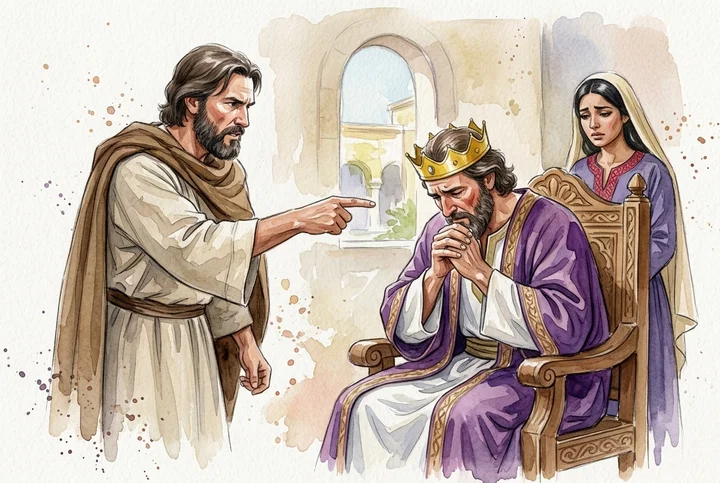
Nathan applies the parable to David: “Thou art the man.”
- 2 Samuel 11
And it came to pass, after the year was expired, at the time when kings go forth to battle, that David sent Joab, and his servants with him, and all Israel; and they destroyed the children of Ammon, and besieged Rabbah. But David tarried still at Jerusalem.
The lamb parable illustrates David’s taking of Bathsheba and arranging Uriah’s death.
- 2 Samuel 12:9-14
Wherefore hast thou despised the commandment of the LORD, to do evil in his sight? thou hast killed Uriah the Hittite with the sword, and hast taken his wife to be thy wife, and hast slain him with the sword of the children of Ammon.
Nathan exposes David’s sin, pronounces judgment, and declares its consequences.
- 2 Samuel 12:13
And David said unto Nathan, I have sinned against the LORD. And Nathan said unto David, The LORD also hath put away thy sin; thou shalt not die.
David confesses his sin, and God forgives him.
- 2 Samuel 11:14-17
And it came to pass in the morning, that David wrote a letter to Joab, and sent it by the hand of Uriah.
David’s order caused Uriah’s death, the event behind Nathan’s parable.
- 2 Samuel 12:14
Howbeit, because by this deed thou hast given great occasion to the enemies of the LORD to blaspheme, the child also that is born unto thee shall surely die.
The child’s death is punishment for giving the LORD’s enemies occasion to blaspheme.
- 2 Samuel 12:11
Thus saith the LORD, Behold, I will raise up evil against thee out of thine own house, and I will take thy wives before thine eyes, and give them unto thy neighbour, and he shall lie with thy wives in the sight of this sun.
David faces judgment from within his own household for his polygamy.
Commentary
Each commentary is drawn from primary sources: the writings of Ellen G. White and Adventist pioneers and periodicals. Each commentary is separate. Its own words are not a quotation; follow the references to read the source passages.
Ellen G. White
21 sources
The poor man owned only one little lamb that he had bought and raised as part of his family, feeding it from his own food, letting it drink from his own cup, holding it close, and loving it like a daughter.Lt 98, 1899, par. 8PP 720.5–721.2Lt 57, 1897, par. 13–16 It stood in stark contrast to the rich man with very many flocks and herds, so that taking that one cherished lamb was a shameful act of wrong and oppression.PP 720.5–721.2Lt 57, 1897, par. 13–16 The lamb pictured what David seized from another man, Uriah's wife, exposing his guilt in taking what was not his while he failed to see himself in the rich man.ST Aug 12, 1875SG4 86.2–87.11SP 380.2–381.2 God sent plain reproof through His messenger, laying the case before David in this figure so his sympathies were engaged and he condemned himself, and when it was applied to him he awoke, felt his sin, and confessed without excuse.Lt 19a, 1875, par. 18–241SP 378.1–379.1PP 720.5–721.2SG4 86.2–87.1SG4 88.2–89.1 Because he humbly repented God forgave his sin and spared his life through the blood of Christ, yet He still punished him because he had given God's enemies great occasion to blaspheme and showed that transgression is never excused.Lt 19a, 1875, par. 18–241SP 378.1–379.1ST Aug 12, 1875
Lamb and Its Setting
The poor man had nothing else except one small female lamb, which he had purchased and fed and tended until it matured alongside him and his children as part of the family.Lt 98, 1899, par. 8PP 720.5–721.2Lt 57, 1897, par. 13–161SP 380.2–381.2PK 75 It shared his own food and drank from his own cup and rested against his chest, and it was loved and treated as a daughter.PP 720.5–721.2Lt 57, 1897, par. 13–161SP 380.2–381.221MR 144.2PK 75 That one cherished creature stood in sharp contrast to a rich man who owned very many flocks and herds in abundance.PP 720.5–721.2 To seize the single lamb under those conditions was a grave injustice, a deed of wrong and oppression that cried out for redress.PP 720.5–721.2Lt 57, 1897, par. 13–16
In the parable the lamb stands for what David took from another man, namely Uriah's wife.ST Aug 12, 1875SG4 86.2–87.11SP 380.2–381.2 The figure set David's crime before him in vivid and shameful colors and laid bare his wrongdoing concerning Uriah.SG4 86.2–87.1Lt 57, 1897, par. 13–16SG4 88.2–89.1 Yet while hearing it David did not recognize himself in the rich man's actions.Lt 57, 1897, par. 13–16
The verse belongs to the account of David's sin in bringing about Uriah's death and in the case of Bathsheba.PP 719.2–31SP 378.1–379.1 David had received kingly power from God to be exercised only in harmony with God's law in judgment and justice to all, but in ordering Uriah to be placed where he would be killed he departed from God and for the time became an agent of wrongdoing while still holding his God-given position and authority.PP 719.2–31SP 378.1–379.1 That command was contrary to God's law, so that to obey it, as Joab did, was itself sin, because allegiance is owed to God above a king.PP 719.2–3 One wrong step in taking more than one wife and departing from God's arrangement had prepared the way for the next, and forsaking God's word sullied a previously fair reputation and led into sin and its consequences.1SP 378.1–379.121MR 169.1
Reproof, Repentance and Pardon
The little ewe lamb belongs to a reproof sent by a just and impartial God who did not sanction or excuse the offense but portrayed it plainly in living colors.1SP 378.1–379.1PP 720.5–721.2 He gave the message to Nathan as His messenger and watchman, though the words were contrary to Nathan's nature and terrible in severity, and Nathan delivered it unflinchingly with heaven-born wisdom.1SP 378.1–379.1PP 720.5–721.2Lt 48, 1887, par. 23–24 It was not given with sensational songs or humorous anecdotes, but by laying before David all the favors God had bestowed upon him and upbraiding him for abusing and misapplying mercy.Lt 19a, 1875, par. 18–24Lt 48, 1887, par. 23–24 The king's own case was placed before him in a figure of the rich man and the poor man, engaging his sympathies and arousing his conscience so that he was led to pass sentence upon himself before the word was applied directly to him as his own sin in "Thou art the man."Lt 19a, 1875, par. 18–24PP 720.5–721.2Lt 48, 1887, par. 23–244MR 185.1–186.2
David had blinded himself and excused his course until it seemed passable, with only flashes of guilt on his conscience and no compunction working heart repentance.1SP 378.1–379.1Lt 48, 1887, par. 23–24 When the story was applied to him he awakened as from a dream and felt his sin, having no heart or face to stand out against the message.1SP 378.1–379.1Lt 48, 1887, par. 23–24 He recognized and confessed his guilt with remorse and sincere grief, without excusing or palliating his course as Saul had done.1SP 378.1–379.1SG4 86.2–87.1 His willingness even to hear the vivid and shameful exposure of his wrong over Uriah showed that he still feared and respected God's word.SG4 86.2–87.1SG4 88.2–89.1
He learned from God's dealings, accepted the reproof humbly and meekly, and was helped to put his sins away.5T 683.14T 14.3–15.1 He bowed under chastisement and before the prophet without resisting or hating him, showing profound humility and sincere penitence.EDFCP 16.14T 14.3–15.1 Afterward he repented bitterly, with his transgression continually before him.EDFCP 16.121MR 379.5–6
Because of that repentance and humble confession God forgave his sin, averted part of the threatened calamity, and spared his life.Lt 19a, 1875, par. 18–241SP 378.1–379.1 Pardon came through reliance for the broken law upon the efficacy of the blood of Christ.Lt 19a, 1875, par. 18–24ST Aug 12, 18754MR 185.1–186.2 Yet He still punished David because he had given great occasion for the enemies of the Lord to blaspheme, an occasion improved from that day until the present by skeptics to assail Christianity and ridicule the Bible, and He permitted evils to rise up against him from his own house.1SP 378.1–379.1 This shows that God in no degree justifies transgression of His commandments but will surely punish the guilty, however righteous and favored they once were while following the Lord in purity of heart, for when the righteous turn from righteousness and do evil their past righteousness will not save them from the wrath of a just and holy God.1SP 378.1–379.1 David is described as a man after God's own heart only when pure and walking in God's counsel, not when he departed and stained his character, and God's displeasure at his plurality of wives was shown by visiting him with judgments.1SP 378.1–379.1
Faithful Reproof for Today
Nathan's telling of the poor man's cherished lamb concealed a rebuke so that David would pronounce judgment on himself before recognizing his own guilt, and Christ later used that same approach with Simon.DA 566.4–5 The rebuke was hidden in a parable about another case, leading the hearer to judge the case fairly and then to see himself in it.DA 566.4–5 In Simon's case as in David's, the personal reproof came through a story that drew out self-condemnation before direct application.DA 566.4–5
God's way of bringing a sinner to true repentance is shown in sending His prophet to reprove and convict David for transgressing His law.Lt 19a, 1875, par. 18–24 That work was not done with sensational songs or humorous anecdotes, but by placing David's own case before him in the figure of a rich man and a poor man, letting him pass sentence upon himself, and then declaring Thou art the man.Lt 19a, 1875, par. 18–24 Such heart work led David to repent before God whose law he had broken and to rely for pardon on the efficacy of the blood of Christ.Lt 19a, 1875, par. 18–24 David had stolen Uriah's wife from her husband to satisfy only his own pleasure, an inexcusable theft and adultery that was sin and only sin, with covetous thoughts as well as words and deeds registered in the books of heaven.Lt 74, 1886, par. 6 Nathan as God's servant laid the charge of sin heavily upon David without glossing over the matter at all, and the same sin must not be cloaked or passed in silence but must be openly reproved and acted upon, lest the offense rest upon the church, for remaining on Satan's ground gives him control and cause for exultation and brings deepest affliction and misery.Lt 74, 1886, par. 6
The poor man's one ewe lamb was deeply cherished, nourished and cared for as part of his household and treated like a daughter.Lt 98, 1899, par. 821MR 144.2 Taking that sole and precious lamb while having ample resources pictures the wrong of diverting funds raised for the Southern field.Lt 98, 1899, par. 821MR 144.2 It is the injustice of taking from a field that has little while keeping buildings, machinery, and workers for oneself.Lt 98, 1899, par. 8 It leaves its owner to bear the loss after what was dedicated to his need has been taken away.21MR 144.2
Sources
Pioneers and periodicals
40 sources
The poor man had nothing but one little lamb, which he had bought and nourished until it grew up with him and his children, sharing his food and drink, lying in his bosom, and becoming to him as a daughter.RH Sep 7, 1869ST Apr 29, 1913ST Mar 31, 1881 The cherished lamb pictures Uriah's one wife, taken by David the rich man who already had many, including what had come to him as successor to Saul's household.ST Aug 12, 1875ST Feb 27, 1893 The story was told indirectly so that David listened and judged the wrong without knowing it concerned himself, kindling his anger against the wrongdoer and drawing from his own mouth the sentence he deserved, until he was faced with Thou art the man.ST Mar 11, 1889ST Aug 19, 1880ST Aug 19, 1880RH Apr 3, 1879RH Jul 27, 1869 The closeness of the lamb to its owner and the injustice of taking it expose the gravity of David's sin against Uriah and his wife as flagrant wickedness contrary to God's command.ST Nov 11, 1880RH Mar 19, 1861ST May 6, 1897 The rebuke awakened heartfelt repentance, so that David humbled himself, renounced his sin, confessed it before God and the world, and found pardon and forgiveness through Christ.ST Aug 12, 1875RH Oct 12, 1869RH Jul 27, 1869RH Dec 22, 1868RH Jan 15, 1861
Lamb in Nathan's Story
The poor man had nothing except one little ewe lamb, his sole possession, which he had bought and nourished up until it grew up together with him and with his children.RH Sep 7, 1869ST Apr 29, 1913ST Mar 31, 1881 It ate of his own food, drank of his own cup, lay in his bosom, rested in his arms and shared his home life, and it was cherished and cared for like a daughter and beloved as a member of his household.ST Apr 29, 1913ST Mar 31, 1881RH Mar 19, 1861ST May 6, 1897RH Mar 13, 1879 Its closeness to its owner and its preciousness as his only lamb make the taking of it a picture of the gravity of the wrong done and of the grievousness of the sin.ST Mar 31, 1881RH Mar 19, 1861ST May 6, 1897 The parable is therefore a fitting rebuke to those who have many flocks and herds yet would take from someone who has little.RH Mar 13, 1879
The beloved lamb represents what David took from another man, for in Nathan's illustration of David's own course the poor man is Uriah, who had but one wife pictured as the one little ewe lamb.ST Aug 12, 1875ST Feb 27, 1893 David is the rich man in contrast, who already had many, including Saul's wives and concubines by the customary right of an oriental king succeeding to his predecessor's household.ST Feb 27, 1893 His possession of many should have kept him from taking Uriah's one wife.ST Feb 27, 1893 Nathan used the illustration to lead David to judge the wrong for himself, then exposed him with Thou art the man, by which David was convicted, repented, and found pardon through Christ.ST Aug 12, 1875ST Mar 11, 1889
The verse belongs to the account in 2 Samuel 11 and 12 of David's idleness and luxury, his adultery involving Bathsheba and his plot to kill Uriah, Nathan's warning and reproof, David's humble repentance, the Lord's forgiveness, and the death of Bathsheba's child.ST Sep 10, 1896 Psalm 32:1-11 has reference to that sin and forgiveness, in which David confessed his sin to God and published it to the world and then, notwithstanding his punishment, praised God for the forgiveness he received.ST Sep 10, 1896 When Nathan brought that sin to mind, David remembered the lessons of the yearly Day of Atonement, whose symbols gave him hope in God's pardoning mercy and kept him from despair.RH Jan 15, 1861 The verse is part of the parable the Lord commanded Nathan to speak to David, telling of a poor man's one cherished lamb and a man who terribly wronged his neighbor by taking it.ST Mar 11, 1889 That telling greatly kindled David's anger so that he declared the wrongdoer should surely die, thereby unwittingly pronouncing sentence against himself when Nathan answered Thou art the man.ST Mar 11, 1889 Nathan's plain rebuke proves him a true prophet and David's constant adviser.RH Sep 7, 1869ST Jul 3, 1884
How Nathan Rebuked David
Nathan approached David not with direct accusation but with a wise and indirect figurative story, clothing the rebuke in vivid details of a poor man's single cherished lamb raised as part of his household.ST Aug 19, 1880RH Apr 3, 1879RH Dec 22, 1868ST Aug 26, 1875 Because the appeal was indirect, David listened attentively and judged the rich man's act on its merits without realizing the story concerned himself.ST Aug 19, 1880ST Aug 19, 1880RH Dec 22, 1868 The illustration exposed the sin and drew the verdict out of David himself, so that the lesson was brought home only when the application was made.ST Aug 19, 1880ST Aug 19, 1880RH Apr 3, 1879
Hearing of the terrible wrong done to a neighbor by taking the one lamb, David's anger was greatly kindled against the wrongdoer.ST Mar 11, 1889RH Apr 1, 1873 He declared that such a man should surely die, thereby unwittingly pronouncing sentence against himself.ST Mar 11, 1889RH Jul 27, 1869RH Apr 1, 1873 In condemning the wrongdoer he drew from his own mouth the sentence he deserved and passed judgment upon his own conduct.RH Apr 3, 1879RH Jul 27, 1869RH Apr 1, 1873
Nathan led David first to condemn the wrong for himself and then exposed him with the declaration Thou art the man.ST Aug 12, 1875RH Sep 7, 1869ST Mar 11, 1889ST Aug 19, 1880 The cherished lamb cared for like a daughter made the illustration of David's own course unmistakable once the mask was removed.ST Aug 12, 1875RH Sep 7, 1869ST Mar 11, 1889 By that sudden personal application David was made to recognize his own guilt.ST Aug 12, 1875ST Aug 19, 1880
The account shows how a parable can deliver a pointed personal rebuke and bring wrongdoing forcefully to the conscience.ST Nov 5, 1885ST Jan 28, 1889ST Oct 10, 1911 It shows how a holy man could confront a king with unwelcome truth and still have his warning heard.ST Nov 5, 1885STST Oct 10, 1911 The lamb's tender place in the poor man's household made the rebuke of the taking especially effective.ST Jan 28, 1889ST
The reproof was meant not only to rebuke David but to save him from ruin.RH Dec 22, 1868ST Aug 26, 1875 Through the story of the single cherished lamb David was helped to recognize his sin and turn toward genuine repentance rather than being driven to ruin.RH Dec 22, 1868ST Aug 26, 1875 His acceptance of the reproof made him afterward a more spiritual channel for God's word.RH Sep 13, 1906
Sin Exposed and Judged
The cherished closeness of the little ewe lamb to its owner makes the taking of it a picture of the gravity of David's sin against Uriah and Uriah's wife.ST Nov 11, 1880RH Mar 19, 1861ST May 6, 1897 The lamb had been bought and nourished up until it grew up together with the poor man and his children, eating of his own food, drinking of his own cup, lying in his bosom and resting in his arms as dear to him as a daughter, so that seizing what was precious to a man who had nothing but this one sole possession exposes the injustice of the act.RH Mar 19, 1861ST May 6, 1897ST Aug 2, 1910 That conduct stands exposed as flagrant, open wickedness directly contrary to God's command, showing God's abhorrence of what David did.ST Nov 11, 1880ST Apr 17, 1907
David stands as a great sinner whose transgression is not covered up or excused but is openly placed on record and rebuked.RH Oct 12, 1869RH Jul 1, 1902 The account presents him as a sinful and selfish man rather than hiding his faults or praising him without qualification.ST Mar 11, 1913 His status as king does not exempt him from the same moral standard and judgment that apply to everyone, and for his great sin he deserved punishment.RH Jul 1, 1902ST Mar 11, 1913
His wicked conduct toward Uriah brought retribution through the rest of his life, especially within his family.RH Apr 26, 1870ST Mar 31, 1881 The judgments threatened in Nathan's terrible denunciation were completely accomplished in his subsequent history, for by his great wickedness in the case of Uriah he gave great occasion to the enemies of the Lord to blaspheme.RH Oct 12, 1869 Severe punishment followed his grave sin, including Nathan's warning and the death of Bathsheba's child, even while forgiveness was also given.ST Sep 10, 1896RH Feb 6, 1879
His repentance was bitter and lasting, and he did not afterward repeat this sin against the marriage law.RH Feb 6, 1879 The account thus joins together David's grievous sin, God's severe reproof, and David's commendable and humble repentance after the reproof, with the Lord's forgiveness.ST Feb 20, 1879 That full course runs from idleness and luxury through adultery and the plot to kill Uriah to reproof, humble repentance, and forgiveness.
Repentance and Forgiveness
Nathan's rebuke made David see his guilt and awakened heartfelt repentance rather than leaving him to ruin.RH Jul 27, 1869RH Dec 22, 1868ST Aug 26, 1875 When his guilt was brought to his attention he humbled himself before God, renounced his sin, and turned again to righteousness.RH Jul 27, 1869RH Dec 22, 1868ST Aug 26, 1875RH Mar 27, 1913 His transgression in the case of Uriah was not covered up or excused but was openly placed on record and rebuked in a terrible denunciation for his great wickedness, by which he gave great occasion to the enemies of the Lord to blaspheme.RH Oct 12, 1869 The judgments threatened in that denunciation were completely accomplished in his subsequent history, yet he himself left a most humble confession of his great transgression for all future time.RH Oct 12, 1869
The account belongs to the history in 2 Samuel 11 and 12 of David's great sin and his forgiveness, including Nathan's warning and the death of Bathsheba's child.ST Sep 10, 1896 David confessed his sin to God and published it to the world, and Psalm 32:1-11 has reference to that sin and forgiveness, in which he, notwithstanding his punishment, praised God for the forgiveness he received.ST Sep 10, 1896 By the illustration of the poor man's beloved lamb representing what David took from another man, Nathan led David to judge the wrong for himself and then exposed him with Thou art the man, and in this way David was convicted, repented, and found pardon and forgiveness through Christ.ST Aug 12, 1875 When Nathan brought that sin involving Bathsheba and Uriah to mind, David remembered the lessons of the yearly Day of Atonement, whose symbols gave him hope in God's pardoning mercy and kept him from despair.RH Jan 15, 1861 His sin against Uriah stands as an example of sorrow and disgrace over sin, and when a sinner hates and loathes the sin Christ sends the Comforter within.ST Apr 10, 1893
David's fall warns those who fear God not to forget their danger, while his repentance gives no ground for hope to anyone who deliberately transgresses God's law.RH Jul 27, 1869
Pattern for Teaching Others
The story supplies the pattern for driving a parable home to the hearer's conscience as Jesus did, standing as a parallel to His parable of the two sons that exposes the difference between professing obedience and actually doing the father's will.ST Oct 11, 1899 As Nathan used a story to confront David, so Jesus used a story to make Simon recognize his own failure.ST Jun 9, 1881 That confrontation is the pattern for courageous reproof, so that ministers who rebuke religious leaders for wrongdoing are reproving Nathans.RH Apr 23, 1872
The poor man's one ewe lamb was especially precious because he had bought and cared for it, and it shared his food and drink and home life with him and his children.RH Mar 13, 1879 Nathan's parable is therefore a fitting rebuke to those who have many flocks and herds yet would take from someone who has little.RH Mar 13, 1879 The depth of that cherishing, treating the lamb as part of the household until it was like a daughter to him, illustrates a woman's only child, the joy of her heart, whom she cared for devotedly.ST Sep 15, 1881
Sources