2 Samuel 12:4
And there came a traveller unto the rich man, and he spared to take of his own flock and of his own herd, to dress for the wayfaring man that was come unto him; but took the poor man’s lamb, and dressed it for the man that was come to him.
Translations
And there came a travelers to the rich man, and he spared to take of his own flock and of his own herd, to dress for the wayfaring man that was come to him; but took the poor man’s lamb, and dressed it for the man that was come to him.
King James Version, KJV Cambridge Paragraph Bible
And there came a traveller unto the rich man, and he spared to take of his own flock and of his own herd, to dress for the wayfaring man that was come unto him; but took the poor man’s lamb, and dressed it for the man that was come to him.
And there came a traveler to the rich man, and he spared to take of his own flock and of his own herd, to dress for the way-faring man that had come to him; but took the poor man's lamb, and dressed it for the man that had come to him.
Revised Version, American Standard Version
And there came a traveller unto the rich man, and he spared to take of his own flock and of his own herd, to dress for the wayfaring man that was come unto him, but took the poor man’s lamb, and dressed it for the man that was come to him.
And there cometh a traveller to the rich man, And he spareth to take Of his own flock, and of his own herd, To prepare for the traveller Who hath come to him, And he taketh the ewe-lamb of the poor man, And prepareth it for the man Who hath come unto him.'
And there came a traveller to the rich man, and he spared to take of his own flock and of his own herd, to dress for the wayfaring man that had come to him; and he took the poor man's lamb, and dressed it for the man that had come to him.
Now there came a traveller to the rich man, but he thought it a pity to take of his own flock, or his own herd, to make ready for the wayfarer who had come to him,—so he took the lamb of his poor neighbour, and made ready for the man who had come to him.
Berean Standard Bible, Majority Standard Bible
Now a traveler came to the rich man, who refrained from taking one of his own sheep or cattle to prepare for the traveler who had come to him. Instead, he took the poor man’s lamb and prepared it for his guest.”
A traveler came to the rich man, and he didn’t want to take of his own flock and of his own herd to prepare for the wayfaring man who had come to him, but took the poor man’s lamb and prepared it for the man who had come to him.”
Now a traveller came to the house of the man of wealth, but he would not take anything from his flock or his herd to make a meal for the traveller who had come to him, but he took the poor man's lamb and made it ready for the man who had come.
Now there came a stranger vnto the rich man, who refused to take of his owne sheepe, and of his owne oxen to dresse for the stranger that was come vnto him, but tooke the poore mans sheepe, and dressed it for the man that was come to him.
Douay-Rheims (Challoner revision)
And when a certain stranger was come to the rich man, he spared to take of his own sheep and oxen, to make a feast for that stranger, who was come to him, but took the poor man’s ewe, and dressed it for the man that was come to him.
Pictures
Cross-references
- 2 Samuel 11:2-17
And it came to pass in an eveningtide, that David arose from off his bed, and walked upon the roof of the king’s house: and from the roof he saw a woman washing herself; and the woman was very beautiful to look upon.
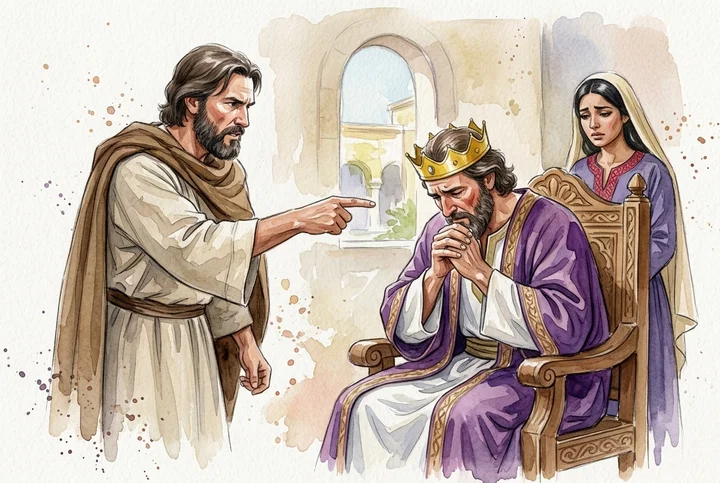
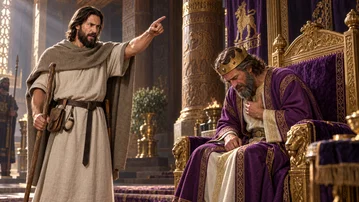
David’s taking of Bathsheba and arranging Uriah’s death form the crime behind Nathan’s parable.
- 2 Samuel 12:13
And David said unto Nathan, I have sinned against the LORD. And Nathan said unto David, The LORD also hath put away thy sin; thou shalt not die.
David confesses his sin, and the LORD forgives him and spares his life.
- 2 Samuel 12:11-12
Thus saith the LORD, Behold, I will raise up evil against thee out of thine own house, and I will take thy wives before thine eyes, and give them unto thy neighbour, and he shall lie with thy wives in the sight of this sun.
Absalom’s public outrage fulfills the judgment announced against David’s house.
- 2 Samuel 12:14
Howbeit, because by this deed thou hast given great occasion to the enemies of the LORD to blaspheme, the child also that is born unto thee shall surely die.
David’s deed gave the LORD’s enemies occasion to blaspheme, and he was still punished after forgiveness.
- Psalms 51:1-17
Have mercy upon me, O God, according to thy lovingkindness: according unto the multitude of thy tender mercies blot out my transgressions.
David confesses and repents of the sin exposed by Nathan’s parable.
- Matthew 21:28-31
But what think ye? A certain man had two sons; and he came to the first, and said, Son, go work to day in my vineyard.
Jesus’ parable is likened to Nathan’s story.
Commentary
Each commentary is drawn from primary sources: the writings of Ellen G. White and Adventist pioneers and periodicals. Each commentary is separate. Its own words are not a quotation; follow the references to read the source passages.
Ellen G. White
19 sources
The verse tells of a wealthy owner of many flocks and herds who refused to use his own animals to feed a visiting traveler, but seized a poor man's single cherished little lamb raised like a daughter in his house and slaughtered it for his guest.ST Aug 12, 18755T 683.1PP 720.5–721.2 It is Nathan's mirror held before David to expose his theft of Uriah's wife after he had stained his honorable standing and used God-given power against God's law.PP 719.2–31SP 378.1–379.1SG4 86.2–87.1Lt 74, 1886, par. 6 Concealing the charge in a story of wrong and oppression demanding redress, Nathan engaged the king's sympathy as guardian of his people's rights until David condemned himself from his own lips.Lt 19a, 1875, par. 18–24ST Aug 12, 1875PP 720.5–721.2 The taking of the lamb lays bare selfishness, injustice and oppression in living colors, showing a sinner blinded and excusing his course until God's rebuke awakened him as from a dream.1SP 378.1–379.15T 683.1PP 720.5–721.2SG4 86.2–87.1 Truthfully told without glossing over sin, the reproof brought David to humble, contrite acknowledgment and reliance on pardon through Christ, so God forgave and spared his life yet punished him to show that past righteousness will not save the guilty who turn to evil.Lt 19a, 1875, par. 18–241SP 378.1–379.15T 683.14T 14.3–15.1Lt 74, 1886, par. 6
Nathan's Parable to David
The verse tells of a rich man with exceeding many flocks and herds who spared taking from his own flock and his own herd to dress for a wayfaring traveler come to him as visitor and guest, but took the poor man's one little beloved ewe lamb and killed and prepared it for him.ST Aug 12, 18755T 683.1PP 720.5–721.2SG4 86.2–87.1Lt 57, 1897, par. 13–16 That lamb was cherished and nourished in the poor man's house as a daughter.PP 720.5–721.2Lt 57, 1897, par. 13–16 The taking instead of using an animal from his own flock portrays the wrong Nathan used to expose David's sin.5T 683.1SG4 86.2–87.1SG4 88.2–89.1
The verse belongs to the account of David's sin in the matter of Uriah and Bath-sheba.PP 719.2–31SP 378.1–379.1SG4 86.2–87.1SG4 88.2–89.1 After remaining steadfast David departed from God, stained his previously honorable reputation, and for the time became an agent of Satan.PP 719.2–31SP 378.1–379.121MR 169.1 He still held the position and authority God had given him, but used God-given power contrary to divine law.PP 719.2–3
It belongs to God's reckoning with David after David had Uriah killed.PP 719.4–720.1 Joab sent a carefully worded account of the battle that implicated neither Joab nor the king, and instructed the messenger to quiet the king's wrath by adding that Uriah the Hittite was dead also.PP 719.4–720.1 David received the news with indifference, telling Joab not to be displeased because the sword devours one as well as another and to make the battle stronger and overthrow the city.PP 719.4–720.1
The verse is part of a reproof sent by a just and impartial God who did not sanction or excuse David's heinous crime.1SP 378.1–379.1SG4 86.2–87.1 It was given to Nathan as God's messenger and servant and spoken with heaven-born wisdom and words given by God.PP 720.5–721.2Lt 48, 1887, par. 23–24 The message laid before David all the favors God had bestowed upon him and upbraided him for abusing and misapplying God's mercies.PP 720.5–721.2Lt 48, 1887, par. 23–24
Nathan set David's own case before him in this illustration as a mirror and concealed his charge under a parable.Lt 19a, 1875, par. 18–24Lt 57, 1897, par. 13–164MR 185.1–186.2 It set forth a wrong and oppression demanding redress, addressed to David as the divinely appointed guardian of his people's rights.PP 720.5–721.2 It was framed to engage the king's sympathies, arouse his conscience, and draw the sentence of death from his own lips, leading him to pass sentence on himself and condemn the wrongdoing before Nathan revealed that David himself was the man in the illustration.Lt 19a, 1875, par. 18–24ST Aug 12, 1875PP 720.5–721.2Lt 57, 1897, par. 13–164MR 185.1–186.2
Sin Exposed by Parable
The taking of the poor man's lamb portrays selfishness, injustice, wrong and oppression, exposing David's sinful course and grievous offense against Uriah and Bath-sheba.5T 683.1PP 720.5–721.2SG4 86.2–87.1SG4 88.2–89.11SP 380.2–381.2 The rich man with exceeding many flocks and herds spares his own animals and takes the poor man's one little beloved ewe lamb, cherished and nourished in his house as a daughter, and kills and prepares it to feed a traveler come to him as visitor and guest.PP 720.5–721.2SG4 86.2–87.1Lt 57, 1897, par. 13–16 Nathan set that picture before David in living and abominable colors as a mirror of hidden guilt, a case the king as guardian of his people's rights could judge clearly while failing at first to recognize his own sin.1SP 378.1–379.1PP 720.5–721.2Lt 57, 1897, par. 13–16SG4 88.2–89.11SP 380.2–381.2 The verse means David stole Uriah's wife from her husband to please himself.Lt 74, 1886, par. 6 Such taking of another's spouse and taking liberties with another's person is inexcusable sin and only sin, registering both parties in the books of heaven as adulterers.Lt 74, 1886, par. 6
The verse shows David had been blinded to his departure from God and had excused his sinful course until his ways seemed passable.1SP 378.1–379.1 One wrong step prepared the way for another, until Jehovah's rebuke awakened him as from a dream to feel his sin.1SP 378.1–379.1 The verse presents the same picture of taking what belongs to someone weaker while ignoring the harm caused, with the lamb representing the Southern field's funds diverted from the work for which they had been raised even though those who diverted them had ample resources of their own, an action driven by covetousness.21MR 144.2 Concealed adultery gives Satan ground to exult and point to filthy garments, and brings deepest affliction and misery.Lt 74, 1886, par. 6 It will be revealed from the books of heaven in covetous thoughts as well as words and deeds, and must not be kept cloaked lest the offense rest upon the church.Lt 74, 1886, par. 6
Repentance and Faithful Reproof
Nathan's truthful account did not gloss over sin at all but laid the charge heavily, and by faithfully portraying David's true state it made him aware of his sins, stirred flashes of guilt on his conscience, and helped him put them away.5T 683.14T 14.3–15.1Lt 74, 1886, par. 6Lt 48, 1887, par. 23–24 Yet the parable alone did not work heart repentance until God applied it directly with Thou art the man, and only then did David condemn the wrongdoing and pass sentence upon himself.Lt 19a, 1875, par. 18–244MR 185.1–186.2Lt 48, 1887, par. 23–24 The reproof was keenest, sharpest, and most resolute, spoken to David as ruling king with words given by God, laying before him all the favors bestowed upon him and upbraiding him for abusing and misapplying those mercies.Lt 48, 1887, par. 23–24
David bore that rebuke rather than resisting it or hating the prophet who delivered it, and with remorse and sincere grief, deep humility, and contrition he bowed before God's prophet, meekly accepted the counsel, humbled himself before God, and humbly acknowledged all with which he was charged and acknowledged his guilt.1SP 378.1–379.15T 683.1EDFCP 16.14T 14.3–15.11SP 380.2–381.2 He did not excuse or palliate his sin as Saul did.1SP 378.1–379.1 His bearing the picture of his crime in its truly abominable colors is evidence that he still feared and trembled at the word of the Lord and did not manifest the spirit of an unconverted man, for if he had possessed the spirit of the rulers of the nations around him he would have taken the life of the faithful reprover instead of bearing it.1SP 380.2–381.2
David repented before God whose law he had transgressed and relied for pardon on the efficacy of the blood of Christ.Lt 19a, 1875, par. 18–244MR 185.1–186.2 Because of his repentance and humble confession God forgave his sin, averted part of the threatened calamity, and spared his life, yet his sin remained before him after Nathan reproved him.1SP 378.1–379.121MR 379.5–6 God in no degree justified David in his sins or in having a plurality of wives, but punished him because he had given great occasion to the enemies of the Lord to blaspheme, an occasion used from David's day to the present by skeptics to assail Christianity and ridicule the Bible.1SP 378.1–379.1 He visited David with judgments and permitted evils to rise against him from his own house, which proves to after generations that God surely punishes the guilty in transgressing His commandments however righteous and favored they once were while following the Lord in purity of heart, that violating God's will brings retribution, and that when the righteous turn from righteousness to do evil their past righteousness will not save them from the wrath of a just and holy God.1SP 378.1–379.121MR 169.1
True conviction comes by clearly defining sin as transgression of the Father's law, without sensational songs or humorous anecdotes, so that the sinner repents understandingly with heart work and thorough conversion rather than mere excitement of feeling that vanishes like early dew.Lt 19a, 1875, par. 18–24 Faithful watchmen must therefore speak such plain, keen, sharp, and resolute reproof and not connive at sin, and true friends are those who tell faults.Lt 19a, 1875, par. 18–24Lt 48, 1887, par. 23–24 Those who sympathize with the sinner and encourage bold resistance to reproof do the devil's work.Lt 48, 1887, par. 23–24
Sources
Pioneers and periodicals
40 sources
The verse tells of a traveler coming to a rich man who spared his own flock and herd and instead took the poor man's only cherished lamb and dressed it for his guest.ST Nov 5, 1885RH Sep 7, 1869ST Nov 11, 1880 It is the Lord-commanded figurative address Nathan spoke to David to bring its lesson home to his conscience as a pointed personal rebuke.ST Mar 11, 1889ST Jan 28, 1889RH Apr 3, 1879 The rich man's taking portrays David's sin against Uriah in taking his wife Bathsheba and arranging his death to hide his sin, involving adultery and murder in flagrant deliberate wickedness contrary to God's command.ST Nov 11, 1880ST Apr 29, 1913ST Apr 14, 1909RH Jul 1, 1902RH Feb 6, 1879 The account kindled David's anger so that he condemned the wrongdoer and declared he should surely die, unwittingly pronouncing sentence against himself before Nathan identified him as the guilty man.ST Aug 12, 1875ST Mar 11, 1889RH Apr 3, 1879 David humbled himself with sorrow, confessed his sin and submitted to God, and through Nathan the Lord told him his sin was put away and he should not die, yet though forgiven he still remained under punishment with trouble and anguish for the rest of his life chiefly within his own family.ST Mar 11, 1889RH Sep 7, 1869ST Apr 29, 1913ST Mar 31, 1881RH Sep 14, 1869
Parable's Words and Setting
A traveler came to a rich man who had abundant flocks and herds of his own.ST Mar 11, 1889ST Nov 5, 1885RH Sep 7, 1869ST Jan 28, 1889RH Sep 14, 1869 Rather than take from his own flock and his own herd to dress food for the wayfaring guest who had come to him, he spared his own animals.ST Nov 5, 1885ST Nov 11, 1880ST Apr 29, 1913ST Jan 28, 1889RH Sep 14, 1869 He instead took the poor man's lamb, his only lamb, a cherished possession, and slaughtered and dressed it to prepare a meal for the traveler who had come as visitor and guest.RH Sep 7, 1869ST Nov 11, 1880ST Apr 29, 1913ST Jan 28, 1889RH Sep 14, 1869 The taking was the injustice at the heart of the story, the refusal to use one's own while taking what belongs to another who has little.ST Nov 11, 1880ST Jan 28, 1889RH Sep 14, 1869 The account belongs to Nathan's parable and rebuke of David, in which this wrong exposes David's wrongdoing.RH Sep 7, 1869ST Nov 11, 1880ST Apr 29, 1913RH Sep 14, 1869
The story is the figurative address the Lord commanded Nathan to speak to David.ST Mar 11, 1889RH Apr 3, 1879RH Dec 22, 1868ST Aug 26, 1875ST Jun 9, 1881 It was a wisely directed reproof, formed as a pointed personal rebuke to bring its lesson home to David's conscience and to bring the baseness of his deed home to him.ST Jan 28, 1889RH Apr 3, 1879RH Dec 22, 1868ST Aug 26, 1875ST Jun 9, 1881 By it Nathan exposed David's sin and guilt and drew from him the sentence he justly deserved.ST Mar 11, 1889RH Apr 3, 1879RH Dec 22, 1868ST Aug 26, 1875 Its aim was not only to rebuke but to save David from utter ruin and to lead him to genuine repentance.RH Dec 22, 1868ST Aug 26, 1875 Its storytelling method is parallel to Jesus' parable of the two sons, in that both expose wrongdoing through a story and bring the hearers to recognize the right judgment.ST Oct 11, 1899
Sin Against Uriah Exposed
The rich man's taking of the poor man's lamb portrays David's sin against Uriah, in taking Uriah's wife Bathsheba and arranging Uriah's death.ST Nov 11, 1880ST Apr 29, 1913ST Apr 14, 1909RH Mar 19, 1861RH Nov 15, 1870 The lamb's loss illustrates the enormity of taking the wife and then plotting the husband's killing in order to hide the first sin, an adultery followed by murder.ST Nov 11, 1880ST Apr 29, 1913RH Mar 19, 1861RH Nov 15, 1870 That awful sin drew Nathan's rebuke, David's humble repentance, and God's forgiveness, yet also God's condemnation and severe punishment without excuse.ST Apr 29, 1913RH Mar 19, 1861
David had been a great sinner who committed a great sin and deserved punishment.RH Jul 1, 1902 Unlike failures arising where duty was not clearly understood, this was flagrant, deliberate wickedness directly contrary to God's command.ST Apr 17, 1907 It was a grave violation of the marriage law, followed by bitter, lasting repentance and severe punishment.RH Feb 6, 1879
The refusal to take from his own abundant flock and herd in order to feed the traveler, and instead to take and dress the poor man's only cherished lamb, exposes the injustice, selfishness and baseness of taking what belongs to another while sparing one's own.ST Nov 11, 1880RH Sep 14, 1869ST Aug 19, 1880RH Sep 13, 1906 In that injustice is expressed God's abhorrence of David's conduct, with no approval of his deeds and no excuse for them.ST Nov 11, 1880RH Mar 19, 1861 The same taking portrays the wrong done against both Uriah and Bathsheba.RH Sep 13, 1906
The terrible denunciation for that great wickedness in the case of Uriah was openly placed on record without covering up or excusing the transgression.RH Oct 12, 1869 By it David gave great occasion to the enemies of the Lord to blaspheme, and the judgments denounced were completely accomplished upon him in his subsequent history.RH Oct 12, 1869 That open exposure shows Scripture faithfully records and rebukes the sins of even Israel's king rather than glossing them over, for though God's chosen instrument he was a sinful and selfish man to be judged as a man with no exemption because he was king.RH Oct 12, 1869ST Mar 11, 1913ST
David's Sentence on Himself
The account of the traveler coming to the rich man, who spared his own flock and herd and took the poor man's lamb to dress for the wayfaring guest, kindled David's anger against the wrongdoer and drew from him condemnation and the declaration that the man should surely die.ST Aug 12, 1875ST Mar 11, 1889ST Aug 19, 1880 In so speaking David unwittingly pronounced sentence against himself before Nathan identified him as the guilty man, the story illustrating his own sinful course and leading him to pass sentence on himself.ST Aug 12, 1875ST Mar 11, 1889RH Jul 27, 1869 Nathan had framed the figurative address to expose David's sin and draw from him the sentence he justly deserved, exposing the selfishness and injustice of taking what belonged to another while sparing one's own.RH Apr 3, 1879ST Aug 19, 1880 David therefore condemned the rich man before realizing that the judgment applied to himself.ST Aug 19, 1880RH Jul 27, 1869
As part of the ewe-lamb parable, the act made David's wrongdoing a pointed personal rebuke and brought its baseness home to his conscience.ST Jan 28, 1889ST Jun 9, 1881 Nathan used the story to expose David's guilt, to convict him of sin, and to bring its lesson home as the Lord's reproof and warning told in 2 Samuel 11 and 12.ST Jan 28, 1889ST Sep 10, 1896ST Jul 17, 1884ST Jun 9, 1881ST Oct 10, 1911 It forms part of Nathan's message and account of rebuke to King David.ST Jul 17, 1884ST Oct 10, 1911ST Aug 2, 1910 David's passing judgment in a way that exposed his own guilt warns that people may condemn in others the very wrong they themselves commit.RH Apr 1, 1873
Repentance Forgiveness and Discipline
David recognized the rebuke when it came to him, humbled himself with sorrow instead of turning against the prophet, confessed his sin, accepted the reproof, and submitted himself to God.RH Sep 7, 1869ST Apr 29, 1913ST Apr 29, 1908 His humility of heart under reproof belongs to the same history as his open publishing of his confession to the world.ST Apr 29, 1908ST Sep 10, 1896 The warning that exposed the great sin told in 2 Samuel 11 and 12, which led to the death of Bathsheba's child, stands behind that confession to God and that open publication to the world.ST Sep 10, 1896
The reproof was directed not only to rebuke him but to save him from utter ruin and to lead him to genuine repentance.RH Dec 22, 1868ST Aug 26, 1875 Believing the prophetic word brought confession, humble repentance, and a return to righteousness.RH Sep 14, 1869RH Mar 27, 1913 In that return he humbled himself, renounced his sin, and came back to righteousness.RH Mar 27, 1913
His later prayer shows that repentance involved seeking God's mercy, cleansing, a clean heart, and renewal by the Holy Spirit.ST Aug 19, 1886 Despite his guilt he could hope in God's mercy and seek pardon rather than sink into despair.RH Jan 15, 1861 Though bowed beneath sorrow and disgrace for his sin in Uriah's case after being baffled by the tempter's power in a weak unguarded hour, comfort mitigates that shame because God understands the feeble human frame, and as soon as sin is hated and loathed Christ sends the Comforter within.ST Apr 10, 1893
Through Nathan the Lord told him his sin was put away and he should not die, meaning only that his own sentence for that sin would not be carried out against him, with no promise of total exemption from the first death or the second death.ST Mar 11, 1889 Though forgiven he still remained under punishment, yet praised God for forgiveness received.ST Sep 10, 1896 Believing brought forgiveness and he afterward prospered, having renounced his sin and returned to righteousness.RH Sep 14, 1869RH Mar 27, 1913 His sin was grave because as king his influence reached far, yet God's reproof brought him to heartfelt repentance and God forgave him.ST May 6, 1897
Although not put to death at once, he faced trouble and anguish for the rest of his life, chiefly within his own family.ST Mar 31, 1881RH Apr 26, 1870 That retribution for his wicked conduct toward Uriah followed through the rest of his life and illustrates that wrongdoing brings consequences in kind and that sin does not pay.ST Mar 31, 1881RH Apr 26, 1870 The terrible denunciation for his great wickedness was openly placed on record without covering up or excusing the transgression, and it was completely accomplished in the judgments that came upon him throughout his subsequent history, including the death of Bathsheba's child, while he himself left a humble confession on record for all future time.RH Oct 12, 1869ST Sep 10, 1896RH Mar 19, 1861 He had been a great sinner who committed a great sin and deserved punishment, and the story presents the deed without excuse and leads to God's condemnation and severe punishment.RH Jul 1, 1902RH Mar 19, 1861
Warning Example and Application
David's guilt was great and his fall was grave because as king his influence reached far, and the account that includes the taking of the poor man's lamb exposes rather than conceals that sin.RH Jul 27, 1869ST Mar 11, 1913ST May 6, 1897 Although David was God's chosen instrument, he was a sinful and selfish man who must face God's judgment as a man, with no exemption because he was king.ST Mar 11, 1913ST May 6, 1897 Led by Nathan's parable to pronounce judgment on himself, he was not put to death at once but faced trouble and anguish for the rest of his life as judgment for his sin, while God's reproof brought him to heartfelt repentance and forgiveness.RH Jul 27, 1869ST May 6, 1897
David's experience warns those who fear God not to forget their danger, and his repentance gives no ground for hope to a deliberate transgressor.RH Jul 27, 1869 His sin involving Uriah was not a failure arising where duty was not clearly understood, but flagrant, deliberate wickedness directly contrary to God's command.RH Jul 27, 1869ST Apr 17, 1907 Willingness to accept Nathan's pointed reproof, to see his sin, and to submit to God is the test of loyalty.RH Jul 27, 1869ST Apr 17, 1907
The story of the rich man sparing his own flock and herd and taking the poor man's lamb to feed a visitor illustrates how a holy man could confront a king with rebuke and warning, and how the king might listen and heed it.ST Nov 5, 1885 It shows Nathan's figurative address bringing its lesson home so that the king heard and responded.ST Nov 5, 1885
The taking from the one with little while sparing abundant flocks and herds supplies a rebuke for people or groups with plentiful resources who take from those with little.RH Mar 13, 1879 It applies to stronger conferences drawing useful young workers away from a poor and feeble conference.RH Mar 13, 1879
Sources