2 Samuel 6:7
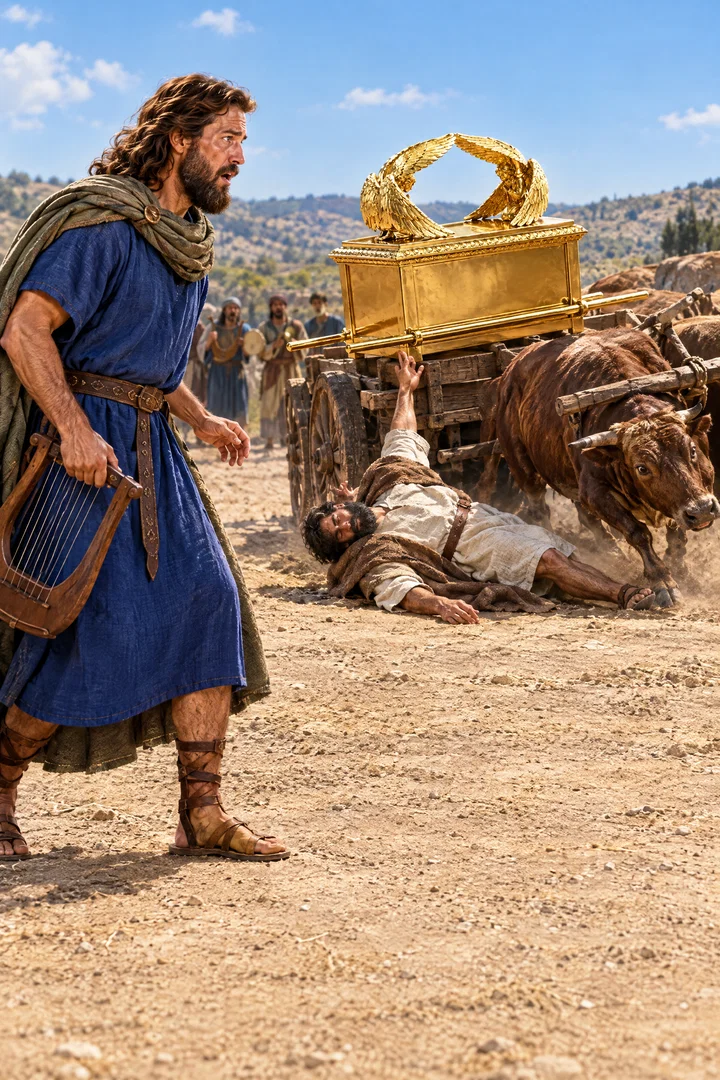
And the anger of the LORD was kindled against Uzzah; and God smote him there for his error; and there he died by the ark of God.
Translations
American King James Version, King James Version, Revised Version
And the anger of the LORD was kindled against Uzzah; and God smote him there for his error; and there he died by the ark of God.
And the anger of the Lord was kindled against Uzzah; and God smote him there for his error; and there he died by the ark of God.
And the anger of the LORD was kindled against Uzzah, and God smote him there for his error; and there he died by the ark of God.
American Standard Version, Darby Translation
And the anger of Jehovah was kindled against Uzzah; and God smote him there for his error; and there he died by the ark of God.
and the anger of Jehovah burneth against Uzzah, and God smiteth him there for the error, and he dieth there by the ark of God.
Then was kindled the anger of Yahweh, against Uzzah, and God smote him there, for the error,—so that he died there, by the ark of God.
Berean Standard Bible, Majority Standard Bible
And the anger of the LORD burned against Uzzah, and God struck him down on the spot for his irreverence, and he died there beside the ark of God.
The LORD’s anger burned against Uzzah, and God struck him there for his error; and he died there by God’s ark.
And the wrath of the Lord, burning against Uzzah, sent destruction on him because he had put his hand on the ark, and death came to him there by the ark of God.
And the Lord was verie wroth with Vzzah, and God smote him in the same place for his fault, and there he dyed by the Arke of God.
Douay-Rheims (Challoner revision)
And the indignation of the Lord was enkindled against Oza, and he struck him for his rashness: and he died there before the ark of God.
Pictures
Cross-references 20 of 34
- Numbers 4:15
And when Aaron and his sons have made an end of covering the sanctuary, and all the vessels of the sanctuary, as the camp is to set forward; after that, the sons of Kohath shall come to bear it: but they shall not touch any holy thing, lest they die. These things are the burden of the sons of Kohath in the tabernacle of the congregation.
The Kohathites were forbidden to touch the holy things, on pain of death.
- 1 Chronicles 13:9-10
And when they came unto the threshingfloor of Chidon, Uzza put forth his hand to hold the ark; for the oxen stumbled.
Parallel account of Uzzah being struck down while steadying the ark.
- Numbers 7:9
But unto the sons of Kohath he gave none: because the service of the sanctuary belonging unto them was that they should bear upon their shoulders.
The Kohathites carried the ark on their shoulders, not on a wagon.
- Leviticus 10:1-2
And Nadab and Abihu, the sons of Aaron, took either of them his censer, and put fire therein, and put incense thereon, and offered strange fire before the LORD, which he commanded them not.
Both accounts show swift judgment for disregarding God’s instructions.
- 1 Chronicles 15:13-15
For because ye did it not at the first, the LORD our God made a breach upon us, for that we sought him not after the due order.
David explains the breach as failure to follow God’s order, then has the Levites carry the ark as commanded.
- 1 Samuel 6:19
And he smote the men of Beth-shemesh, because they had looked into the ark of the LORD, even he smote of the people fifty thousand and threescore and ten men: and the people lamented, because the LORD had smitten many of the people with a great slaughter.
Both show God striking people dead for irreverent treatment of the ark.
- Exodus 25:14
And thou shalt put the staves into the rings by the sides of the ark, that the ark may be borne with them.
The ark was to be carried by its staves, not handled as Uzzah handled it.
- 1 Chronicles 15:2
Then David said, None ought to carry the ark of God but the Levites: for them hath the LORD chosen to carry the ark of God, and to minister unto him for ever.
David later appoints the Levites to carry the ark.
- 1 Chronicles 15:15
And the children of the Levites bare the ark of God upon their shoulders with the staves thereon, as Moses commanded according to the word of the LORD.
The Levites carry the ark on their shoulders as God commanded.
- Exodus 25:16
And thou shalt put into the ark the testimony which I shall give thee.
The testimony was placed inside the ark.
- Numbers 4:20
But they shall not go in to see when the holy things are covered, lest they die.
Warns that looking at the holy things brings death.
- 1 Chronicles 13:8
And David and all Israel played before God with all their might, and with singing, and with harps, and with psalteries, and with timbrels, and with cymbals, and with trumpets.
Describes the rejoicing as the ark was being brought up.
- 1 Chronicles 13:12
And David was afraid of God that day, saying, How shall I bring the ark of God home to me?
David fears God after Uzzah is struck dead.
- 1 Samuel 5:3-4
And when they of Ashdod arose early on the morrow, behold, Dagon was fallen upon his face to the earth before the ark of the LORD. And they took Dagon, and set him in his place again.
Dagon falls before the ark, showing that idols cannot stand before it.
- 1 Samuel 7:2
And it came to pass, while the ark abode in Kirjath-jearim, that the time was long; for it was twenty years: and all the house of Israel lamented after the LORD.
The ark abode at Kirjath-jearim for twenty years before its later journey.
- 1 Chronicles 15:25-28
So David, and the elders of Israel, and the captains over thousands, went to bring up the ark of the covenant of the LORD out of the house of Obed-edom with joy.
same bringing up from Kirjath-jearim
- 2 Samuel 6:1-2
Again, David gathered together all the chosen men of Israel, thirty thousand.
David gathers Israel to bring up ark
- Deuteronomy 10:8
At that time the LORD separated the tribe of Levi, to bear the ark of the covenant of the LORD, to stand before the LORD to minister unto him, and to bless in his name, unto this day.
The Levites were appointed to carry the ark, unlike Uzzah.
- Numbers 18:3
And they shall keep thy charge, and the charge of all the tabernacle: only they shall not come nigh the vessels of the sanctuary and the altar, that neither they, nor ye also, die.
The command restricted who could approach and handle the sanctuary objects.
- 1 Kings 8:9
There was nothing in the ark save the two tables of stone, which Moses put there at Horeb, when the LORD made a covenant with the children of Israel, when they came out of the land of Egypt.
The ark held the covenant tablets, making it holy.
Commentary
Each commentary is drawn from primary sources: the writings of Ellen G. White and Adventist pioneers and periodicals. Each commentary is separate. Its own words are not a quotation; follow the references to read the source passages.
Ellen G. White
43 sources
When the ark was being brought toward Jerusalem, the oxen stumbled at Nachon's threshingfloor and Uzzah put out his hand to steady it, and God smote him dead there by the ark for his error.1SP 410.1–2PP 704.5–705.1Ms 132, 1903, par. 33 His act was rash and presumptuous, laying an unhallowed hand on what God had commanded to be treated as sacred and touched only by consecrated appointment, as though God could not care for His own presence and symbols.1SP 410.1–2PP 704.5–705.1SG4 111.1–2ST Jul 24, 1884 The judgment guarded the ark because it was sacred as God's presence and as the container of His holy law, warning men not to meddle with holy things or treat what God calls holy as common.Ms 132, 1903, par. 33ST Jul 24, 18848T 283.3–4ST Feb 21, 1911Ms 81, 1900, par. 19 To steady the ark today is to take God's work into finite hands and control it by human judgment without seeking His counsel, and it is just as great a sin, dangerous to the doer and disastrous to the cause, for God lives and will manage, direct and protect His own work.STA 108.2ST2 2.1Ms 100, 1894, par. 4–5Lt 212, 1902, par. 9Ms 29a, 1890, par. 11–13 Therefore men must keep hands off, trust God and wait for His leading, and not assume jurisdiction He never gave to dictate to His workers, block the light and message He commands to be borne, or reshape His principles and instrumentalities for popularity and success.STMW9 3.3Ms 51, 1895, par. 2–3Lt 82, 1894, par. 17–18Lt 78, 1896, par. 42–4310MR 66.1–2
Circumstances of the Death
The death took place at Nachon's threshingfloor while the ark of God as the symbol of the divine presence was being brought from Kirjath-jearim toward Jerusalem with thirty thousand leading men of Israel amid exultant shouts and songs of rejoicing with musical instruments.PP 704.5–705.1 When the oxen stumbled and shook the ark, Uzzah impatiently put forth his hand to steady it, and God smote him dead there by the ark for his error and rash, presumptuous act, with angels attending the ark striking him down.1SP 410.1–2PP 704.5–705.1Ms 132, 1903, par. 33SG4 111.1–2 The sudden stroke turned that season of triumph and solemn gladness into grief and mourning and brought sudden terror upon the rejoicing throng.PP 704.5–705.1 David was left astonished and greatly alarmed, questioning the justice of God in sending fearful judgment while seeking to honor the ark, so that feeling it unsafe to have the ark near him he let it remain nearby at the house of Obed-edom the Gittite.PP 704.5–705.1
Reason for the Judgment
Uzzah's act was rash, presumptuous and impatient, a sudden reach to steady the ark when the oxen stumbled and shook it.1SP 410.1–2PP 704.5–705.1SG4 111.1–2 It showed distrust that God could care for the ark, even though God had brought it safely back from the Philistines, and angels attending the ark struck him down for presuming to touch it.1SP 410.1–2SG4 111.1–2 He acted as though God could not care for His own sacred symbols, reaching out in a spirit of presuming unauthorized control over what belongs to God.STMW9 3.3Ms 7, 1895, par. 2–3 That same spirit is at work when erring mortals take God's human agencies under their own dictation and control, telling them what they shall and shall not do, as if those workers were under their command.STMW9 3.3Ms 7, 1895, par. 2–3 God has not given men that power and authority over His human workers, far less should such power be exercised toward them, and He will judge those who assume it, for men must leave God to rule His own work.Ms 7, 1895, par. 2–3
He touched the ark with an unhallowed hand contrary to the Lord's plain command to treat it as sacred with fear and trembling.ST Jul 24, 1884 Only a consecrated priest could touch it, and special purification and preparation were required.ST Jul 24, 1884 What God had forbidden him to touch he was forbidden to meddle with, and for that meddling he was removed from God's work.Ms 81, 1900, par. 19 The ark was sacred because it represented God's presence among His people, so it was to be treated with reverence and according to God's directions.Ms 81, 1900, par. 19 Those serving God must obey His instructions rather than substitute their own plans, and disregarding them by following human plans shows unfitness for a position of trust in His sacred work.Ms 81, 1900, par. 19
Laying hands on the ark without appointment from God kindles the anger of the Lord and brings His smiting and condemnation.Lt 212, 1902, par. 9Ms 16, 1889, par. 3–6 His judgment in smiting Uzzah guarded the ark and impressed its sacred character on the people.ST Jul 24, 1884 Men, whether ministers, general canvassing agents, or conference presidents, must therefore keep to their own line of work until God gives the orders, being sure the orders come from God and not from human judgment.Lt 212, 1902, par. 9 God never gives to any mortal man the burden and work of setting human wisdom over sacred things by sitting in judgment on the living oracles to decide what is inspired and what is not, what degrees of inspiration attend some utterances and what is wanting in others, and by cutting and carving the Scriptures.Ms 16, 1889, par. 3–6 To do that work is to act in self-exaltation and to dare to touch what God has made holy.Ms 16, 1889, par. 3–6
Reverence for Sacred Things
The ark was sacred as the symbol of God's presence among His people, and it was to be treated with reverence strictly according to His directions and not steadied by a presumptuous touch.8T 283.3–4ST Feb 21, 1911Ms 81, 1900, par. 19MH 435.1–436.1 Uzzah was struck dead for presuming to touch it when he put forth his hand to steady it, showing that what God has declared sacred must not be handled irreverently.8T 283.3–4ST Feb 21, 1911MH 435.1–436.1 His meddling was touching what God had forbidden him to touch, and those who serve God must obey His instructions rather than substitute their own plans.Ms 81, 1900, par. 19
Treating what God has made holy with irreverence or as common is a serious offense that brings severe judgment, even death beside the ark for handling it improperly.ST Feb 21, 19115T 77.2Lt 33, 1899, par. 16–18 God struck Uzzah dead for his rash act against something holy, for the ark represented His presence and rash, irreverent touching incurred the penalty of death.ST Feb 21, 1911MH 435.1–436.1Lt 33, 1899, par. 16–18 God sees both actions and the motives behind them and records them, so sacred things treated as common stand as an offense against Him.Lt 33, 1899, par. 16–18
The death by the ark warns men to beware how they seek to look into and meddle with the mysteries and holy things of the Most High, as Uzzah did while the ark was being taken from Kirjath-jearim and the anger of the Lord was kindled against him.Ms 132, 1903, par. 33 God requires implicit obedience to His plain command to treat the ark as sacred with fear and trembling, and reverence for the methods He has appointed.Ms 81, 1900, par. 19 Substituting human plans and disregarding His instructions shows unfitness for a position of trust in His sacred work and leads to removal from it.Ms 81, 1900, par. 19 The warning about holy hands bearing the ark applies this lesson to a time when faithful bearers are no longer present, when woe will come upon the people.5T 77.2
Law, Message, and Scripture
The stroke that guarded the ark guarded what was inside it, for it contained the holy law, and by that judgment its sacred character was impressed upon the people.ST Jul 24, 1884 The law expresses perfect character and love, so that to despise the law is to despise its Author.ST Jul 24, 1884 Though ordained for life, the law brings death to the transgressor, and only because Jesus honored it and satisfied its claims by dying for sin can sinners through His imputed righteousness be reconciled to God and escape the punishment due to disobedience.ST Jul 24, 1884
The third angel's message to the world is the ark of God, sacred and not to be touched by human hands.Ms 6, 1889, par. 11–12 To cavil over what is plainly revealed and to force decisions on momentous subjects in open meeting by pen and vote, without prolonged earnest seeking of God with prayer and fasting and the descent of the Holy Spirit, is to lay presumptuous hands on the ark in blindness, and such meddling is the greatest folly and brings God's displeasure as did the error at the threshingfloor.Ms 6, 1889, par. 11–12 Mortal man is never given the burden and work of setting human wisdom over sacred things by sitting in judgment upon the living oracles to decide what is inspired and what is not, and to state what degrees of inspiration attend some utterances and what is wanting in others.Ms 16, 1889, par. 3–6 To cut and carve the sacred Scriptures in that way is to act in self-exaltation and to dare to touch what God has made holy, and the hand laid upon the ark in that spirit kindles the anger of the Lord and brings His smiting and condemnation.Ms 16, 1889, par. 3–6
Touching the ark warns against laying a sacrilegious hand upon the Bible by dissecting the Word, telling what is revelation and what is or is not inspiration, and saying this will be rejected and this will be received, or that is not inspired because someone else has said so.Ms 13, 1888, par. 43–45 The Bible as a whole and as it is must be held with implicit faith that inspires faith, with not a jot or tittle ever taken from it.Ms 13, 1888, par. 43–45 Hands off means not meddling with God's Word by man's ideas but letting God move with His own power and giving Him room to work to compass salvation instead of binding Him about, for those who meddle do not know what they are doing and are not able to comprehend the things of the mystery of God.Ms 13, 1888, par. 43–45
Steadying the Ark Today
The ark belongs to God and is under His special supervision, and God Himself manages His own work, for He lives and reigns and will care for His holy ark.Lt 212, 1902, par. 9Ms 29a, 1890, par. 11–1310MR 66.1–2Ms 21a, 1894, par. 20–22Lt 208, 1902, par. 33 Human hands must keep off the ark and give Him opportunity to direct it, to fashion and mold it according to His will, and to bring it to the place where it belongs.Ms 100, 1894, par. 4–5Lt 212, 1902, par. 9Ms 21a, 1894, par. 20–22Lt 208, 1902, par. 33 To undertake what God has not appointed is Uzzah's error, so ministers, general canvassing agents, and conference presidents must keep to their own line of work until orders come from God and not from human judgment.Ms 100, 1894, par. 4–5Lt 212, 1902, par. 9
Reaching out to steady the ark was a grave sin for which God struck Uzzah dead, and taking control of what belongs to God according to human judgment, contrary to His will and without seeking His counsel, is just as great a sin.STA 108.2ST2 2.1STBk 108.2LSEGW 320.2–321.1Ms 40a, 1890, par. 17–20 Laying a human hand upon God's great instrumentality to place a human superscription and a human mold upon it repeats that sin, and every such movement to take control is dangerous business to the one who does it and disastrous to the work of God, imperiling souls with terrible loss.STMW6 43.3–44.2Ms 40a, 1890, par. 17–20Ms 40, 1890, par. 2–6Ms 61, 1890, par. 7 God's sovereignty stands supreme above all human authority, however great, and presuming to interfere with or judge His work risks His wrath.STA 108.2STBk 108.2LSEGW 320.2–321.1STMW6 43.3–44.2Ms 40a, 1890, par. 17–20
Steadying the ark means human interference with what God has placed and ordered, taking into finite hands what God alone is competent to accomplish and limiting the power of the Holy One of Israel.Ms 100, 1894, par. 4–5Lt 82, 1894, par. 17–18 Even when moved by pity, love, or fear that jostling will hurt the ark and its bearers, such meddling intrudes upon work He Himself can protect and direct.Ms 100, 1894, par. 4–5Lt 25, 1888, par. 1–321MR 321.1–322.3 It steps in with human ideas and judgment between God and the channel He provides, cutting off and diverting the means He has appointed to meet necessity, as though He cannot manage His own work in His own time and in His own way.Lt 82, 1894, par. 17–18Lt 25, 1888, par. 1–3
The lesson is to trust God and not distrust Him, to believe the Lord can do all things, to pray for increased faith, and to wait for Him to act rather than run ahead in self-confidence.Lt 82, 1894, par. 17–1810MR 66.1–2 The work is God's and He will do it, so people must follow their Captain, feel their own weakness as a broken reed, depend on the Lord Jesus alone, and walk with trembling before God in the sacred work.Lt 82, 1894, par. 17–1810MR 66.1–2
This warning applies especially to the publishing work as God's great instrumentality, where undertaking what God has not appointed and entering into other men's labors with self-magnifying mismanagement repeats Uzzah's sin.Ms 40a, 1890, par. 17–20Lt 212, 1902, par. 9Ms 40, 1890, par. 2–6Ms 61, 1890, par. 7 Those who enter that labor are only to do their duty humbly, deal justly toward all employed, love mercy, labor conscientiously in the work entrusted to them, and walk humbly with God.Ms 40a, 1890, par. 17–20Ms 40, 1890, par. 2–6 Mismanagement by erring men must not shake confidence in the publishing work, for whatever a person's position or authority, even as much as Ahab's, God is above them and His sovereignty must and will be supreme.Ms 40a, 1890, par. 17–20Ms 40, 1890, par. 2–6Ms 61, 1890, par. 7
Changing the principles God has given and reshaping His cause for popularity, patronage, and larger success is doing a work which does not belong to men to do.Ms 29a, 1890, par. 11–13Ms 29, 1890, par. 11–1321MR 447.5–449.2 Proposals to drop the words Seventh-day Adventist and say nothing about the Sabbath in The American Sentinel to gain the patronage of great men, become popular, do a larger work, and affiliate with unbelievers and non-professors are steadying the ark.Ms 29a, 1890, par. 11–13Ms 29, 1890, par. 11–13 Such altering of truth for popular success tampers with the very sum and substance of Sabbath advocacy and is the first step in a succession of wrong steps.Ms 29a, 1890, par. 11–13Ms 29, 1890, par. 11–1321MR 447.5–449.2
When true religion is endangered by mingling with worldliness, and worldly policy takes the place of true piety and wisdom from above, God will remove His prospering hand and the ark of the covenant will be removed from His people.Ms 29, 1890, par. 7–10Ms 29a, 1890, par. 2–10 The ark means God's presence and rule in the sanctuary and cause, the true doctrines and principles given by God which made His people what they are, and God's instrumentalities such as the publishing house.Ms 29, 1890, par. 7–10Ms 29a, 1890, par. 2–10 Its removal means idols smuggled in, false principles and false precepts brought into the sanctuary, antichrist respected, true doctrines ignored, and a sacred instrumentality turned through blinded, unconsecrated men into a mere political, worldly institution.Ms 29, 1890, par. 7–10Ms 29a, 1890, par. 2–10
Putting the hand to the ark brings woe, for it means those who claim to know the truth laying every obstacle so that the light God commands His chosen messengers to bear does not come to the people.Lt 19d, 1892, par. 45–46Ms 9, 1890, par. 2216MR 113.3–114.1 To lay hands on the ark is to stand against God, to block His message in mighty power, and to hold others in that resistance, and those who do this will have an account to settle with God that they will not be pleased to meet.Lt 19d, 1892, par. 45–46Ms 9, 1890, par. 2216MR 113.3–114.1 Those commanded to bear a message must declare what He gives without reservation and move out even when obstacles of a forbidding character are in the way, while others must get out of the way, take the hand off, and stop all human interference and control so the Spirit of God can come in and work freely.Lt 19d, 1892, par. 45–46Ms 9, 1890, par. 2216MR 113.3–114.1
To touch the ark is for finite men in councils to assume a jurisdiction God never gave them by bringing the minds, talent, and liberty of God's human agents and workmen whom He is using and controlling under their own control.STMW9 3.3Ms 51, 1895, par. 2–3Lt 78, 1896, par. 42–43Ms 7, 1895, par. 2–318MR 223.2 It is telling them what they shall and shall not do, deciding what shall be brought before God's people and what shall be repressed, restricting their liberty, being conscience for them, and pronouncing judgment and condemnation upon the work of God and His workers because ideas do not coincide with their own supposed truth.Ms 51, 1895, par. 2–3Lt 78, 1896, par. 42–43Ms 7, 1895, par. 2–318MR 223.2 It is the same spirit as the Pharisees condemning Christ though He gave unmistakable evidence He was sent of God, even charging Him who made the Sabbath and is Lord of the Sabbath with being a Sabbath-breaker.Lt 78, 1896, par. 42–43
God has not chosen such men in positions of trust as He chose Moses as men through whom to communicate divine instruction, has not placed the lines of control in their hands, has not required this at their hand, and has never delegated to them Moses' responsibility of voicing God's words to the people.Ms 51, 1895, par. 2–3Lt 78, 1896, par. 42–43Ms 7, 1895, par. 2–318MR 223.2 Presidents of conferences and laborers in places of responsibility who make out with minute definiteness just what course workers in the harvest field must pursue repeat Uzzah's error and take on a false burden.Ms 100, 1894, par. 4–5Ms 51, 1895, par. 2–318MR 223.2 The counsel is to humble the heart before God, leave God to rule His own work, leave room for the Lord to take care of His sacred work and direct it where it belongs, and leave His arrangements alone.Ms 100, 1894, par. 4–5Lt 78, 1896, par. 42–43Ms 7, 1895, par. 2–3 Workers are not to be moved from where God put them by human judgment about health, climate, need, or danger, but God is to be trusted to protect, sustain, and bless those who have given themselves to do His will.Ms 100, 1894, par. 4–5Ms 7, 1895, par. 2–321MR 321.1–322.3
Sources
Pioneers and periodicals
55 sources
Uzzah was struck dead beside the ark for putting out his hand to steady it when the oxen stumbled at Nachon's threshing-floor, while David was bringing it from the house of Abinadab toward Jerusalem with music and rejoicing.RH Apr 21, 1851RH Sep 7, 1869RH Aug 28, 1856 He died because God had commanded that the ark be carried on the shoulders of appointed Levites and never touched, yet Israel laid it on a new cart like the Philistines and Uzzah laid his hand upon it in direct violation of that command.ST Oct 14, 1889ST Apr 18, 1911ST Sep 10, 1896ST Jul 2, 1896RH Sep 5, 1871 His act seemed natural and well-meant, but good motives and urgent need did not excuse it, for it was presumptuous irreverence that put no difference between the holy and the common.RH Sep 7, 1869ST Jun 26, 1884ST Dec 13, 1883ST Oct 17, 1895 The swift judgment was just punishment that also showed merciful warning, teaching David and all Israel to fear God, to treat his work and sacred things with reverence, and to obey exactly what he says.ST Jun 26, 1884ST Jun 26, 1884ST Jul 2, 1896ST Jul 2, 1896 The ark was holy as the sign of God's presence and the repository of his holy law, so the death warns against tampering with the commandments, especially the Sabbath within it, and against trying to steady or prop up God's work and government by human hands and civil power instead of trusting him.ST Jul 24, 1884ST Jul 2, 1896RH Apr 26, 1860RH Sep 7, 1869
Historical Setting and Wording
The verse belongs to the removal of the ark after it had remained a long time in the house of Abinadab at Kirjath-jearim in the keeping of Eleazar his sanctified son.RH Apr 21, 1851 David with thirty thousand chosen men of Israel placed it on a new cart driven by Uzzah and Ahio and followed with music on psalteries, timbrels, cornets and cymbals.RH Apr 21, 1851 When they came to Nachon's threshing-floor the oxen stumbled and Uzzah put forth his hand to steady it.RH Apr 21, 1851RH Aug 28, 1856 The gathering was to bring the ark from Kirjath-jearim to Jerusalem to the tent David had pitched for it.RH Aug 28, 1856
Uzzah died there by the ark, which abruptly ended the rejoicing of the great national celebration of bringing it toward David's city.RH Apr 21, 1851RH Sep 7, 1869 David was terrified and displeased, asked how the ark should come to him, feared God and reconsidered the directions for carrying it.RH Apr 21, 1851RH Sep 7, 1869RH Sep 7, 1869 He would not bring it to the city of David but carried it aside to the house of Obed-edom the Gittite where it remained three months and blessed Obed-edom and all his house.RH Apr 21, 1851RH Jan 6, 1853RH Aug 28, 1856 Afterward David brought it up with gladness, sacrificing oxen and fatlings when the bearers had gone six paces and dancing before the Lord with all his might.RH Apr 21, 1851 His death remains an awful lesson about God's holiness in that journey.ST Apr 19, 1910
The word translated error also means rashness, describing Uzzah's hasty, presumptuous touch when the ark was jolted.RH Sep 5, 1871
Disobedience That Caused Death
God had expressly forbidden any touching of the ark and had commanded that it be borne by its staves upon the shoulders of the appointed Kohathite Levites and priests, with special consecration, purification and preparation.ST Oct 14, 1889ST Sep 10, 1896ST Jul 2, 1896ST Nov 12, 1912ST Jun 22, 1882 Only those whom God designated were permitted to approach or carry it as commanded, and no profane or unappointed hands were allowed to lay hold of it.ST Sep 10, 1896ST Jul 2, 1896ST Nov 12, 1912RH Apr 7, 1868 Even members of God's holy nation and consecrated Levites could not handle it carelessly or presumptuously.ST Jul 2, 1896RH Apr 7, 1868 Presuming to steady or carry it outside that order was a serious offense punishable by death, and ignorance did not excuse transgression of that order.ST Jul 2, 1896STRH Apr 7, 1868
Israel had already departed from that order by setting the ark upon a new cart drawn by oxen instead of bearing it by hand upon the shoulders as commanded.ST Oct 14, 1889RH Sep 5, 1871ST Apr 8, 1889ST Oct 29, 1894ST Oct 17, 1895 That change substituted human invention, convenience, human wisdom and a supposedly better way for obedience to the prescribed order.ST Oct 14, 1889ST Apr 18, 1911ST Oct 29, 1894ST Oct 17, 1895 It copied the Philistines, who had used a new cart when returning the ark perhaps without knowing God's instructions, while Israel knew them, so their exceptional precedent gave no right to depart when the directions of the law could be followed.ST Apr 18, 1911ST Jun 22, 1882 Had the ark been carried as commanded it would not have been jolted, and this first disregard made further disobedience easier, for one neglect of God's requirements leads to another.ST Oct 14, 1889ST Jul 2, 1896RH Sep 5, 1871ST Apr 8, 1889
When the oxen stumbled and the ark shook at the threshing-floor, Uzzah reached out and laid his unholy hand upon it to steady it and keep it from falling.RH Sep 7, 1869ST Dec 13, 1883ST Oct 17, 1895ST Mar 3, 1881 From a human point of view the act seemed natural, harmless and protective, especially since he had been entrusted with its care.RH Sep 7, 1869ST Apr 22, 1903ST Mar 3, 1881 Yet it directly violated the command, for he was not commissioned to touch it, and God's word carried out the sentence upon that knowing violation.ST Sep 10, 1896ST Dec 13, 1883ST Apr 22, 1903 The irregular mode of transport did not make the act permissible.ST Jun 26, 1884
Good intentions, clean hands, good motives, pious reverence, concern for the ark and urgent circumstances did not make the disobedience acceptable.RH Sep 5, 1871ST Oct 17, 1895RH Nov 27, 1860ST Jun 22, 1882ST Mar 5, 1912 Uzzah chose his own way instead of God's way, guided by human reasoning and seeing no reason why he might not touch it, but careful intentions cannot replace obedience.ST Oct 17, 1895ST Jun 22, 1882ST Mar 5, 1912 Even David's displeasure did not change the consequence, for God knows the secrets of every heart and is just even when He does not explain His reasons.ST Dec 13, 1883RH Nov 27, 1860 To obey is better than sacrifice, and keeping the spirit without the letter is not enough.ST Mar 5, 1912
His irreverent, presumptuous handling was a grievous sin, not momentary thoughtlessness or a small mistake, revealing disregard for sacredness like the sin of Nadab and Abihu.ST Jun 26, 1884ST Jun 26, 1884 Although he may have touched the ark before without harm, familiarity had not made it ordinary or removed its holiness, and he put no difference between the holy and the profane.ST Apr 22, 1889ST Mar 5, 1912 The word rendered error also means rashness, describing his hasty touch.RH Sep 5, 1871 No sin is small before God and He does not compromise with sin, for even an apparently minor or rash violation of His law is sin.ST Oct 14, 1889RH Sep 4, 1860RH Apr 7, 1868 When a person remains identified with sin in God's presence, that presence brings sin's destructive consequence.ST Jun 26, 1884
Justice and Mercy in Judgment
The anger kindled against Uzzah was righteous judgment, and the stroke that killed him beside the ark was just and proportionate to a grievous offense, not a penalty for mere momentary thoughtlessness.ST Jun 26, 1884ST Jun 26, 1884RH Nov 27, 1860RH Sep 7, 1869 He died for knowing violation of an explicit command not to touch the holy things, and the divine word itself carried out the sentence upon disregard of the instructions for carrying the ark.ST Apr 22, 1903ST Mar 3, 1881RH Sep 7, 1869 That the ark was already being moved in an irregular way on a cart did not make his act permissible, for the earlier Philistine cart was an exceptional case that gave Israel's leaders no right to depart from the law's directions when they could be followed.ST Jun 26, 1884ST Jun 26, 1884RH Sep 7, 1869 His reaching out to keep the ark from falling seemed harmless and even well-intentioned from a human point of view, and David was displeased at the outcome, yet God who knows the secrets of every heart is just even when He does not explain His reasons.RH Nov 27, 1860ST Mar 3, 1881
That anger expressed righteous indignation and jealous care for the divine name and word, joined with loving concern and watchful love that the people remain obedient.ST Jul 2, 1896ST Jul 2, 1896 Even severe judgments of this kind are prompted and moved by infinite love.ST Jul 2, 1896ST Jul 2, 1896
The swiftness and public, representative character of the stroke made it a pointed warning to David, the priests, and all Israel to treat God's work, worship, and sacred things with reverence and fear.ST Jun 26, 1884ST Jun 26, 1884ST Jul 2, 1896 Familiarity from former contact had not made the ark ordinary nor removed its holiness as the sacred sign of the Lord's special presence, and the irreverent presumption revealed a disregard for its sacredness akin to that of Nadab and Abihu.ST Jul 24, 1884 By guarding the ark and upholding its due order, the judgment made clear that God means what He says, and it kept others from changing the prescribed order or degrading their regard for sacred things.ST Jun 26, 1884ST Jun 26, 1884ST Jul 2, 1896RH Sep 7, 1869 In this way the stroke was an act of mercy as well as a defense of God's honor and word.ST Jul 24, 1884ST Jun 26, 1884RH Sep 7, 1869
Holiness of Ark and Law
The ark was holy as the sacred sign and symbol of the Lord's special presence, not ordinary or common, and God treated it as holy so that a rash touch or even a curious glance brought death, demonstrating the awe and reverence due to it.ST Jun 3, 1886ST Feb 21, 1911ST Jul 2, 1896ST Apr 22, 1889 Familiarity had not made it ordinary or removed its holiness though it may have been touched before without harm, and laying an unholy hand upon it to steady it after it was carried by cart was irreverence and presumption revealing disregard for its sacredness, like the sin of Nadab and Abihu.ST Jun 3, 1886 The striking dead of Uzzah for his error violated God's express directions for handling it and illustrated the seriousness of disregarding His instructions about sacred things, teaching Israel that what God has made holy cannot be treated as common and that only those appointed by God could approach or carry it as commanded.ST Jul 2, 1896ST Apr 22, 1889 His public, representative act served as a pointed warning to David, the priests and all Israel that even a seemingly small neglect of God's requirements could lead to greater disobedience, while God's anger expressed righteous indignation and jealous care for His name and word as well as loving concern and watchful love that His people remain obedient, for even His severe judgments are prompted and moved by infinite love.ST Jul 2, 1896ST Jul 2, 1896
The ark was sacred as the repository containing the tables of God's holy law, and its holiness reflects the still greater holiness of the commandments within it, for it was the law that made the ark holy.ST Jul 24, 1884ST Mar 31, 1898ST Jun 20, 1906ST Jun 14, 1899RH Jun 17, 1873 Only a consecrated priest with special purification and preparation could touch it, and God had instructed that it be carried on the shoulders with poles and staves by the designated priests and Kohathite Levites, yet Israel chose its own method by placing it on a cart, so that Uzzah's reaching out when it shook violated plain instruction and showed God's exacting regard for obedience even when a violation may seem small or well-intended.ST Jul 24, 1884ST Mar 31, 1898ST Jul 2, 1896RH Jun 17, 1873 Its treatment taught that God is holy and not common, that the law is sacred, that treating its appointed place with disregard brings God's displeasure, and that still greater care is due to the Ten Commandments as the foundation of God's throne, and this warning has been preserved for later generations while God's judgment guarded the ark and impressed its sacred character upon the people.ST Jul 24, 1884ST Jun 20, 1906ST Jul 2, 1896 The event teaches that God's commandments are to be obeyed rather than replaced by human judgment.ST Mar 31, 1898
The law expresses God's perfect character and love and was ordained for life, but it brings death to the transgressor, and to despise the law is to despise its Author.ST Jul 24, 1884 Jesus honored the law and satisfied its claims by dying for sin, so that through His imputed righteousness people can be reconciled to God and escape the punishment for disobedience.ST Jul 24, 1884
Uzzah's death warns against tampering with God's commandments, altering the testimony kept within the ark, and teaching others to disregard them, especially removing or disregarding the fourth commandment.ST Jun 14, 1899ST Feb 4, 1886 The swift punishment made clear that God means what He says and could warn Israel against changing the order He had established, applied as a warning that people must not treat God's command to keep the seventh-day Sabbath as optional or substitute another day for convenience.RH Sep 7, 1869ST Jun 14, 1899 Just as only consecrated hands could touch the ark that contained Jehovah's Sabbath law, only authority equal to God's could justify changing it, and its sacredness does not depend on human laws for its preservation, while human efforts to protect a divine institution by their own authority are like trying to steady the ark and show that God's law needs no human support or protection.RH Oct 11, 1906RH Dec 13, 1906ST Feb 4, 1886
Warning Against Steadying Ark
To reach for the ark when it shakes is to take God's work into one's own hands when it looks endangered, tipping, or about to fail.RH Mar 23, 1869RH May 22, 1879RH Jul 25, 1865RH Jan 23, 1855RH Mar 2, 1911 The warning is to take heed and keep hands off, not to murmur, worry, interfere, control, correct, prop it up, or steady it by braking and holding back His opening providence as He leads out a people for the last great work.RH Apr 26, 1860RH Mar 23, 1869RH May 22, 1879RH Jul 25, 1865RH Mar 2, 1911 Such steadying comes from finite judgment and the assumption that the work will fail unless men intervene according to their own ideas.RH May 22, 1879RH Jan 23, 1855RH Mar 2, 1911 The ark was God's responsibility, and He will care for His truth and its upbuilders even when it shakes.RH Jul 25, 1865RH Jan 23, 1855RH Mar 2, 1911 The shaking is a trial meant to test trust in His providence and to show dependence on heaven rather than human strength, for God is caring for it, His plans and the progress of His work are right even when not understood, He does not need men to take charge of it, and the needed humble response is confidence that it will not fail.RH Apr 26, 1860RH Mar 23, 1869RH May 22, 1879RH Jul 25, 1865RH Mar 2, 1911
Within the church this forbids presuming to take over the burden entrusted to those God has chosen, taking up sacred responsibilities without understanding His work and one's own proper place and directions, or steadying the church through human organization and invention instead of His plan.RH Nov 19, 1861RH Sep 17, 1861RH Nov 1, 1853RH Jun 12, 1860 Those whom God has called to its care should steady it in His way, while others should not presume to take that responsibility upon themselves but humbly learn and faithfully do their own part.RH Nov 19, 1861RH Nov 1, 1853RH Jun 12, 1860 The tottering ark is the cause of God shaking through neglect, and the outstretched hand is ministers stepping in to hold it up themselves when the laity leave their duty undone, yet God deals hardly with such leaders and is wroth with them for the sake of the people whose dereliction put them in that place.RH Nov 19, 1861RH Mar 19, 1901RH Jun 12, 1860 God requires implicit obedience to His commands and reverence with fear and trembling for the methods He has appointed, and following human plans instead makes men unfit for positions of trust and puts them in Uzzah's position, removed from His work.RH Apr 26, 1860RH Nov 19, 1861RH Sep 17, 1861RH Nov 1, 1853 He reserves the right to correct His servants directly or through another prophet and does the sifting Himself rather than through zealous recruits, so zeal must not act without His guidance nor overlook weightier matters.RH Nov 19, 1861RH Nov 1, 1853RH Mar 19, 1901RH Jun 12, 1860
The same reaching forbids upholding God's law and government by profane civil power, political authority, oppressive human laws, or human reasoning.ST Mar 29, 1899RH Oct 11, 1906RH Dec 13, 1906ST Mar 30, 1904ST Feb 17, 1909 The ark, which held God's law and is the symbol of His government, is not weak and needs no human support, protection, or control.ST Mar 29, 1899RH Oct 11, 1906RH Dec 13, 1906ST Mar 30, 1904ST Aug 23, 1910 To use the ballot-box, Sunday legislation, state enforcement of Sabbath observance, temperance reform by force, or other civil power to steady or control God's work and matters of conscience is to assume authority to intervene in God's affairs as His representative without His sanction or blessing, denying His power, wisdom, and foresight.ST Mar 29, 1899RH Oct 11, 1906RH Dec 13, 1906ST Mar 30, 1904ST Feb 17, 1909 To treat a creed as a cart and attempt to steady the ark is to try to fix or limit His living truth in human forms.ST Mar 29, 1899ST Mar 30, 1904ST Aug 23, 1910 The ark contained Jehovah's Sabbath law, whose sacredness does not depend on human laws for its preservation, and using oppressive human laws to compel men toward God buries the love that could have won them to Him.ST Mar 29, 1899RH Oct 11, 1906RH Dec 13, 1906ST Mar 30, 1904ST Feb 17, 1909
Sources