Acts 12:4
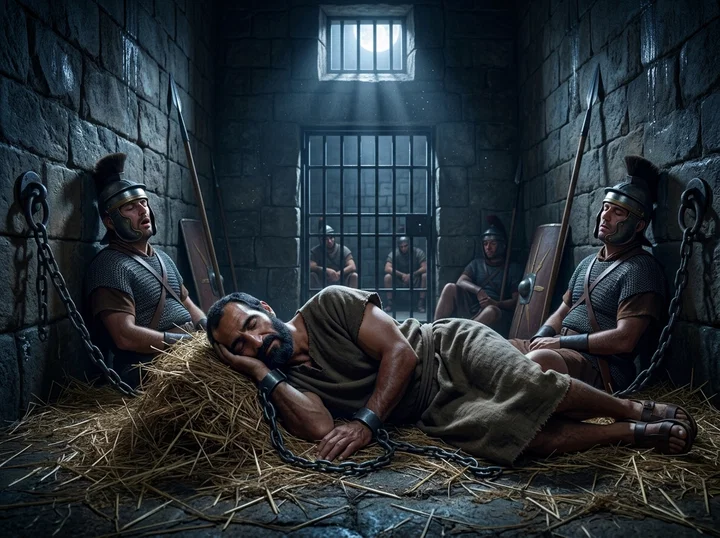
And when he had apprehended him, he put him in prison, and delivered him to four quaternions of soldiers to keep him; intending after Easter to bring him forth to the people.
Translations
And when he had apprehended him, he put him in prison, and delivered him to four squads of soldiers to keep him; intending after Easter to bring him forth to the people.
King James Version, KJV Cambridge Paragraph Bible
And when he had apprehended him, he put him in prison, and delivered him to four quaternions of soldiers to keep him; intending after Easter to bring him forth to the people.
And when he had apprehended him, he put him in prison, and delivered him to four quaternions of soldiers to keep him; intending after the passover to bring him forth to the people.
Revised Version, American Standard Version
And when he had taken him, he put him in prison, and delivered him to four quaternions of soldiers to guard him; intending after the Passover to bring him forth to the people.
whom also having seized, he did put in prison, having delivered [him] to four quaternions of soldiers to guard him, intending after the passover to bring him forth to the people.
whom having seized he put in prison, having delivered him to four quaternions of soldiers to keep, purposing after the passover to bring him out to the people.
Whom also having seized, he put into prison, delivering him up unto four quaternions of soldiers, to be guarding him,—intending, after the passover, to bring him up unto the people.
Berean Standard Bible, Majority Standard Bible
He arrested him and put him in prison, handing him over to be guarded by four squads of four soldiers each. Herod intended to bring him out to the people after the Passover.
When he had arrested him, he put him in prison and delivered him to four squads of four soldiers each to guard him, intending to bring him out to the people after the Passover.
And having taken him, he put him in prison, with four bands of armed men to keep watch over him; his purpose being to take him out to the people after the Passover.
And when he had caught him, he put him in prison, and deliuered him to foure quaternions of souldiers to be kept, intending after the Passeouer to bring him foorth to the people.
Douay-Rheims (Challoner revision)
And when he had apprehended him, he cast him into prison, delivering him to four files of soldiers to be kept, intending, after the pasch, to bring him forth to the people.
Pictures
Cross-references
- Acts 5:19-20
But the angel of the Lord by night opened the prison doors, and brought them forth, and said,
Peter remembers the apostles’ earlier miraculous escape from prison.
- John 21:18-19
Verily, verily, I say unto thee, When thou wast young, thou girdedst thyself, and walkedst whither thou wouldest: but when thou shalt be old, thou shalt stretch forth thy hands, and another shall gird thee, and carry thee whither thou wouldest not.
Jesus foretold Peter’s death, which Peter expected was near.
- Acts 12:21-23
And upon a set day Herod, arrayed in royal apparel, sat upon his throne, and made an oration unto them.
Herod is struck down after accepting acclaim as a god instead of giving God glory.
- Exodus 12:14
And this day shall be unto you for a memorial; and ye shall keep it a feast to the LORD throughout your generations; ye shall keep it a feast by an ordinance for ever.
Passover was the memorial feast during which Peter was imprisoned, with his execution delayed until afterward.
- Mark 6:27
And immediately the king sent an executioner, and commanded his head to be brought: and he went and beheaded him in the prison,
Herod orders John the Baptist beheaded in prison.
- John 19:14
And it was the preparation of the passover, and about the sixth hour: and he saith unto the Jews, Behold your King!
Jesus’ death was demanded on Passover day, contrary to Jewish tradition.
- Acts 12:12-19
And when he had considered the thing, he came to the house of Mary the mother of John, whose surname was Mark; where many were gathered together praying.
Recounts what happened after Peter escaped from prison.
Commentary
Each commentary is drawn from primary sources: the writings of Ellen G. White and Adventist pioneers and periodicals. Each commentary is separate. Its own words are not a quotation; follow the references to read the source passages.
Ellen G. White
34 sources
Herod Agrippa imprisoned Peter under sixteen soldiers in four watches to hold him for public execution after the Passover feast to win favor with the Jews.AA 143.1–2ST Jun 5, 1879ST May 22, 1879AA 144.3–4RH Apr 27, 1911 He had already beheaded James the brother of John because it pleased the Jews, and he seized Peter to please them further.AA 143.1–23SP 334.13MR 96.1 Peter was chained between two soldiers in a rock cell with barred doors and guards answerable for him, because Herod remembered his former escape and made human rescue or escape appear impossible.ST Jun 5, 1879AA 145.4–146.1AC1 71.1 That cutting off of all human help only made God's triumph more complete, for man's extremity is God's opportunity, and God sent His mighty angel to loose Peter's chains, open the prison doors, and deliver him because He had further work for him.Lt 191, 1905, par. 16–17ST Jun 5, 1879SG1 71.1AA 145.4–146.17RED 68.3–69.1 The delay until after the feast gave the church time to search their hearts and pray earnestly for Peter, whose life and work they believed were urgently needed.RH Apr 27, 19113SP 335.2–336.13SP 336.2
Herod's Prison and Guard
Herod Agrippa vexed the church as ruler of Judea under the Roman emperor Claudius and also tetrarch of Galilee.AA 143.1–2 He was a professed proselyte to the Jewish faith, apparently very zealous in carrying out the ceremonies of the Jewish law.AA 143.1–2 Desiring to secure his offices and honors by obtaining the favor of the Jews, he carried out their desires in persecuting the church of Christ, spoiling the houses and goods of believers and imprisoning leading members of the church.AA 143.1–2
He had cast James the brother of John into prison and sent an executioner to kill him with the sword, as another Herod had caused the prophet John to be beheaded.AA 143.1–2 Seeing that this pleased the Jews, he imprisoned Peter also to please them further and win their favor as part of his persecution of Christ's followers.AA 143.1–23SP 334.13MR 96.1AC1 67.27RED 67.2 Peter was thus cast into prison after James was beheaded, during the Passover season.3SP 334.13MR 96.1AC1 67.27RED 67.2Ms 44, 1886, par. 8–10
The Easter named in the verse is Passover, when Jews from many places were gathered in Jerusalem to worship.ST May 22, 1879 Herod kept Peter in custody through that feast with intent to bring him before the people afterward.ST May 22, 18797RED 74.2
Peter was put under sixteen soldiers in four quaternions, four groups of four, with four on duty at a time in rotating watches day and night to keep him until execution.ST Jun 5, 1879RH Apr 27, 1911AC1 71.13SP 338.1AC1 69.1 These rotating reliefs and the strong guard were meant to secure him for death after Passover, so that human rescue appeared impossible.ST Jun 5, 1879RH Apr 27, 1911AC1 71.13SP 338.17RED 71.1
Double precautions were taken because Herod remembered the former escape of Peter and John from prison after confinement for their faith.AA 145.4–146.1AC1 71.17RED 71.1 Peter was confined in a rock-hewn cell with strongly bolted and barred doors, placed between two soldiers and bound by two chains each fastened to the wrist of one of them, so that he could not move without their knowledge.AA 145.4–146.1 A strong guard was set before the doors and made answerable for his safekeeping, cutting off all chance of rescue or escape by human means.ST Jun 5, 1879AA 145.4–146.1RH Apr 27, 1911
The imprisonment fell during Passover, the sacred memorial of Israel's deliverance from Egypt.ST May 22, 1879AC1 68.2AA 144.1ST May 22, 18793SP 335.1 While celebrating that deliverance and professing zeal for God's law, the Jews persecuted and killed believers in Christ in violation of the law's principles.AC1 68.2AA 144.1ST May 22, 18793SP 335.1 Their religious gatherings at that season stirred them to united hatred against Christians.AC1 68.23SP 335.1
Plot for Public Execution
Herod held Peter in custody meaning to bring him out before the people for a public death as a spectacle after the Passover, when Jerusalem was filled with worshipers come from many places, in order to gratify the Jews further after James's death had pleased them.ST May 22, 1879AA 144.3–4AC1 68.37RED 68.3–69.1RH Apr 27, 1911 The word rendered Easter means Passover, and the execution was postponed until after the feast.ST May 22, 18793SP 335.2–336.1 The delay also gave the church time to search their hearts and pray earnestly for Peter.RH Apr 27, 19113SP 335.2–336.1 It was not safe to bring him forth during the feast, for the rulers feared the sight of Peter led out to die.AA 144.3–4AC1 68.37RED 68.3–69.1 They feared his venerable appearance would excite pity and respect in the multitude, and that he would make a powerful, persuasive appeal for Christ which the priests and elders could not answer, stirring the crowd to examine and study the life and character of Jesus, winning them to Christ and leading them to demand his release from the king.ST May 22, 1879AA 144.3–4AC1 68.37RED 68.3–69.1AC1 69.1
For the morning after the feast Herod planned to have Peter executed.7RED 74.2AC1 74.2 He meant to send officers to fetch him with an imposing, heavily armed guard.7RED 74.2AC1 74.2 This display was both to make escape impossible and to intimidate Peter's supporters and exhibit his own power.7RED 74.2AC1 74.2
Divine Deliverance and Response
Herod's securing of Peter with sixteen soldiers in four watches, with bolts and bars and chains binding him between two guards, cut off every human possibility of rescue or escape, and that very cutting off of all human help only made God's triumph more complete.ST Jun 5, 1879AA 145.4–146.1AC1 71.13SP 338.1 Man's extremity is God's opportunity, so the precautions meant to make the execution certain set the stage for God by the putting forth of His might to save the precious life the Jews were plotting to destroy.AA 145.4–146.17RED 68.3–69.1RH Apr 27, 1911 In holding Peter, Herod was lifting his hand against Omnipotence, and his attempt to take the life of God's servant was to end in utter defeat and humiliation.AA 145.4–146.1AC1 71.13SP 338.1 The human barriers that seemed to prevent any rescue instead made God's deliverance more decisive.AC1 71.13SP 338.1RH Apr 27, 1911
Peter's experience belongs to the truth that God employs angels as powerful helpers of His chosen messengers to communicate with human beings.Lt 191, 1905, par. 16–17SG1 71.1 When the enemy had determined to destroy him, God by His might sent His angel to take the prey from him and stop the shedding of his blood.7RED 68.3–69.1AC1 69.1Lt 27a, 1892, par. 5–6 God had further work for Peter to do, and He sent His messengers from heaven and opened the gates and set His servant free because He always has care for the true and faithful.SG1 71.13MR 96.1Ms 44, 1886, par. 8–10 No soldiers on guard could prevent God from intervening.7RED 68.3–69.1AC1 69.1
At the presence of the mighty angel the prison doors flew open and Peter's bands were loosed.3MR 96.1Ms 44, 1886, par. 8–10 Peter was awakened by the touch of the angel and was amazed because of the light, thinking he saw a vision.3MR 96.1Ms 44, 1886, par. 8–10 The angel told him to gird himself and put on his sandals, and Peter was so astonished that he thought not of his other garments.3MR 96.1Ms 44, 1886, par. 8–10
Postponing the execution until after Passover, under various pretexts, gave the church time to search their hearts and pray earnestly for Peter.RH Apr 27, 19113SP 335.2–336.17RED 69.2AC1 69.2AA 145.1 They prayed because they believed his life and work were urgently needed and essential to the Christian work.3SP 336.27RED 69.2AA 145.1 They feared the church could not endure and faced extinction without God's special help.7RED 69.2AC1 69.2 Peter believed he was about to die for Christ, and the believers praying for him likewise expected he would have to suffer death.RH Apr 27, 19113MR 96.1Ms 44, 1886, par. 8–10 So when they heard his voice at the gate after his deliverance they were astonished.3MR 96.1Ms 44, 1886, par. 8–10
Peter had been imprisoned because he obeyed God rather than men in proclaiming Jesus after the resurrection though civil law forbade it.Ms 6, 1884, par. 7–8 His case is an example of the reproach, persecution, and strait places that come to those who take their stand to stem prevailing iniquity and carry God's aggressive truth with a loud cry when laws and powers oppose God.Ms 6, 1884, par. 7–8 It teaches believers to keep bearing the message and letting their light shine wherever they are, even inside prison walls.Ms 6, 1884, par. 7–8 The account of the angel taking the prey from the enemy who had determined to destroy him is a lesson for children and youth that makes a deep impression on the young mind.Lt 27a, 1892, par. 5–6 When read slowly and solemnly it keeps the story vividly before the mind for a lifetime, showing the duty to educate and train youth to read and understand the Scriptures, registering them for instruction and leading their minds from truth to truth up higher and higher.Lt 27a, 1892, par. 5–6 In this, Scripture interprets Scripture, one passage being the key to other passages, so that Scripture itself becomes the educating power holding thoughts in captivity to Christ.Lt 27a, 1892, par. 5–6
Sources
Pioneers and periodicals
53 sources
Herod Agrippa I seized Peter during the days of unleavened bread and the Passover, after beheading James to please the Jews, and put him in prison under sixteen soldiers in four quaternions to keep him for public execution after the feast.ST Aug 13, 1874ST Nov 11, 1897ST Jan 8, 1885ST Apr 30, 1902ST Apr 30, 1902 The word rendered Easter is the Greek pascha, which means Passover, as it is rendered everywhere else.ST Sep 5, 1911ST Mar 16, 1915RH May 20, 1909 There was no Christian feast called Easter in Peter's day, but the Jewish Passover feast.ST Mar 16, 1915RH Apr 4, 1907ST Mar 3, 1909 While Peter was kept in prison the church prayed continually and earnestly for him, and in answer God sent an angel who shone light in the prison, freed him, and led him out.ST Aug 13, 1874ST Jul 26, 1883RH Nov 18, 1909RH Mar 30, 1916 The verse gives no scriptural warrant for observing Easter as a Christian festival in honor of the resurrection, which came into the church from paganism after apostolic days.ST Sep 5, 1911RH Apr 4, 1907ST Jul 22, 1908ST Jul 1, 1889ST Mar 16, 1915
Easter Means Passover
The word Easter in the King James Version translates the Greek pascha, which means Passover.ST Sep 5, 1911ST Mar 16, 1915RH May 20, 1909ST Jun 20, 1911ST Nov 11, 1897 Everywhere else the same word is rendered Passover, and here also it should have been rendered Passover.ST Sep 5, 1911ST Mar 16, 1915RH May 20, 1909ST Jun 20, 1911RH Apr 4, 1907 The Revised Version corrects the word to Passover, as do nearly all other versions.ST Sep 5, 1911ST Mar 16, 1915ST Jun 20, 1911RH Apr 4, 1907ST Nov 11, 1897
The mistaken Easter reflects later church custom that joined the early Pasch to the heathen festival of Ostara.RH May 20, 1909 There was no Christian feast called Easter in Peter's days, so the reference is to the Jewish Passover feast and not to a Christian resurrection day.ST Mar 16, 1915RH Apr 4, 1907ST Mar 3, 1909ST Mar 16, 1915 At that early date Easter Sunday was unknown, for the Easter of those times came on a certain day of the month on any day of the week from a different motive.ST Mar 3, 1909ST Mar 16, 1915 The disciples knew neither the word Easter nor the festival, except perhaps as the name of a heathen deity.ST Nov 11, 1897
Prison Setting And Motive
Herod put Peter in prison under the strictest human security, sixteen soldiers in four quaternions of four, with four on duty at a time.ST Aug 13, 1874ST Apr 12, 1899ST Nov 11, 1897ST Apr 30, 1902ST Nov 5, 1894 Peter was chained between two soldiers while two more kept the door, and the doors themselves were secured.ST Jun 5, 1879RH Apr 27, 1911ST Apr 12, 1899ST Jul 26, 1883 The imprisonment was inspired by Satan, and the guards, chains and prison represented the strongest security human power could provide.ST Jun 5, 1879ST Aug 13, 1874ST Apr 12, 1899 The arrest and imprisonment occurred during the days of unleavened bread and the Passover, when Jews from many places were gathered in Jerusalem.ST May 22, 1879ST Aug 13, 1874ST Nov 11, 1897ST Apr 30, 1902ST Nov 11, 1897 The persecution of Christ's followers thus took place as the Jews observed Passover and professed zeal for the law.ST May 22, 1879
Herod delayed bringing Peter before the people until after Passover and the days of unleavened bread.ST Nov 11, 1897ST Apr 30, 1902ST Mar 6, 1884ST Apr 30, 1902ST Apr 30, 1902 Putting him to death during that feast would have been contrary to Jewish religious traditions, so he was kept in prison during the feast to be brought forth for execution immediately after its expiration.ST Apr 8, 1897ST Mar 6, 1884ST Apr 30, 1902 The Jews ordinarily avoided trying and executing prisoners during that solemn season, though Jesus had been tried during the feast and executed the next day.ST Mar 6, 1884ST Apr 30, 1902 People observed restrictions against contact with the dead and other defilement during its ceremonies, and Herod waited until this period of religious restraint was over while regarding their tradition against executions in Passover week.ST Apr 8, 1897ST Apr 30, 1902ST Apr 30, 1902 Herod had already killed James the brother of John with the sword, putting him to death early and before the Passover.ST Jan 8, 1885ST May 13, 1903ST Apr 8, 1897ST Apr 30, 1902 He seized Peter to please the Jews and to gain the support of those who opposed him.ST May 22, 1879ST May 22, 1879ST Nov 5, 1894ST Apr 30, 1902ST Apr 8, 1897
His design was to hold Peter in prison through the Passover and then bring him forth to the people, meaning to hand him over to the hostile crowd for public execution after the feast.ST May 22, 1879ST Nov 11, 1897ST Apr 30, 1902ST Apr 30, 1902ST Jun 10, 1880 The execution day was set, and the next night was intended for it.RH Apr 27, 1911ST Apr 30, 1902 The delay was intended to please the Jews while avoiding the risk that Peter's venerable appearance or powerful appeals about Jesus would stir the crowd to pity him, to examine Jesus' life and character, or to demand his release.ST May 22, 1879 Peter was awaiting execution with no prospect of release before being brought out, and escape by human means seemed impossible.ST Jun 5, 1879RH Apr 27, 1911ST Aug 13, 1874ST Jul 26, 1883 The guards themselves faced death if he escaped, and Peter was bound between two soldiers with additional guards and secured doors making human rescue appear impossible.ST Jun 5, 1879RH Apr 27, 1911ST Jul 26, 1883
The Herod of the verse is Herod Agrippa I, who beheaded James and imprisoned Peter and then met a tragic end.ST Jan 8, 1885ST Jun 23, 1909ST May 13, 1903 He was the one who afterward sat on a royal throne at Caesarea dressed in a garment wholly of silver with the bright sun shining and reflected from it, delivered an oration to the people, accepted their cry that he was a god and not a man, and was immediately smitten by the angel of the Lord.ST Jan 8, 1885 He was the father of King Agrippa before whom Paul made his defense, and both that Agrippa and Bernice were Jews in religion and were familiar with the facts concerning the crucifixion and resurrection of Christ.ST May 13, 1903 Peter was seized during the Passover in disregard for the sacred day, showing the same unscrupulousness toward holy time that sent officers to arrest Jesus on the great day of the feast of Tabernacles and crucified Jesus on the first yearly sabbath.RH Jun 24, 1873 Those who hold the Roman tradition place his keeping in the ancient carcer in Rome, situated near the temple of Concord under the chapel of S. Pietro in carcere below the church of S. Giuseppe dei Falegnami, with a spring in its rock floor.ST Jun 14, 1899
The verse belongs to the graphically portrayed account of Peter's miraculous release standing together with the death of James the brother of John and the horrible death of Herod.ST Jun 23, 1909 Its chief characters are to be named and what happened to each told.ST Jun 2, 1898 It closes evening readings from Acts 8:26 onward read on the evening of July 3.ST Jun 23, 1909
Prayer And Angel Deliverance
While Peter was kept in prison, the church prayed continually and earnestly for him.ST Aug 13, 1874ST Jul 26, 1883RH Nov 18, 1909ST Jun 10, 1880ST May 1, 1901 Herod had seized him after beheading James, holding him under strict guard with four groups of soldiers assigned to keep him, chaining him to Roman soldiers with two in the cell and two at the door, planning to bring him before the people after the days of unleavened bread and Passover for public execution.ST Aug 13, 1874ST Jul 26, 1883ST Jun 10, 1880ST May 1, 1901 Escape seemed humanly impossible, Peter had no prospect of release, and the guards themselves faced death if he escaped.ST Aug 13, 1874ST Jul 26, 1883ST Oct 8, 1912 The delay until after the feast gave the church time to pray earnestly for Peter.RH Apr 27, 1911RH Apr 27, 1911ST Aug 13, 1874
In answer to that prayer God sent an angel into the prison, where a light shone, freed Peter, opened the prison doors, and led him out.ST Aug 13, 1874RH Nov 18, 1909RH Mar 30, 1916ST May 1, 1901 Peter's life was in danger while Christians prayed for his deliverance, and God delivered him beyond the limits of natural law.ST Aug 13, 1874ST Jun 10, 1880 This proves angels are real heavenly beings with power to act physically, not mere pure thoughts from God or mere influences or impulses.ST Dec 30, 1913RH Apr 10, 1913RH Feb 27, 1900 The account illustrates the work of angels ministering in behalf of God's people through deliverance in time of need.RH Apr 10, 1913RH Mar 30, 1916RH Feb 27, 1900
Peter believed he was about to die for Christ, with the execution day set and with himself bound between two soldiers behind additional guards and secured doors making escape by human means impossible.RH Apr 27, 1911RH Apr 27, 1911ST May 22, 1879 Those impossible precautions made God's deliverance more complete and Herod's defeat more evident, for human power could not prevail against God and divine power intervened to preserve him.RH Apr 27, 1911RH Apr 27, 1911ST May 22, 1879 Chained and guarded in a common prison and expecting his fate, Peter slept calmly, resting in faith and trust in God.RH Apr 27, 1911ST Mar 6, 1884
Peter was a veritable prisoner in Jerusalem held with intent that he should be put to death, not sitting in one place as a prisoner in royal luxury.ST May 1, 1901ST Nov 30, 1904 He was again set at liberty by an angel of God and then went away on another missionary tour, proving his work was that of a traveling pioneer missionary apostle who kept traveling and preaching rather than remaining settled.ST Nov 30, 1904 This imprisonment belongs to the contrast between his early and closing career.ST Nov 30, 1904 The deliverance shows the labors of the apostles and the triumph of the cross through them, after which God's word grew and multiplied.ST Jun 1, 1882RH Feb 1, 1912
Easter Observance Without Warrant
Herod's waiting until after the Passover to bring Peter out gives no establishment of an annual or weekly observance in honor of Christ's resurrection, and it provides no scriptural authority for keeping Easter as a Christian festival.ST Sep 5, 1911ST Jul 1, 1889 There is no warrant of Scripture whatsoever for Easter, and no sacredness attaches to the day.ST Jul 22, 1908 The wording gives no evidence that Christians observed Easter in apostolic times.RH Apr 4, 1907 It proves the Easter festival was not established by Christ or His apostles, but came into the church from paganism after the apostolic days.ST Mar 16, 1915
The chapter says nothing about the first day of the week being sanctified, and this silence shows that no such sanctification had taken place by the end of Acts 12.ST Jun 1, 1882 Peter's work recorded here, including his imprisonment by Herod and his being brought out by an angel, gives no example of keeping the first day of the week.ST Sep 15, 1887 Easter is wholly of pagan origin and in no sense Christian.ST Apr 3, 1893ST Apr 8, 1903 The English term comes from Eostre or Ostara, the Anglo-Saxon goddess of spring and fruitfulness, also called Eastre, goddess of love or Venus of the North, worshiped in spring with flowers, vernal plants, eggs, and dainties as symbols of fruitfulness.ST Jul 22, 1908ST Apr 3, 1893ST Mar 3, 1909ST Mar 16, 1915 Easter, Anglo-Saxon Eastre, German Ostern, like the names of the days of the week, is a survival from the old Teutonic mythology.ST Mar 16, 1915
This Eostre or Ostara is identical with Ishtar or Astarte of Babylon and Nineveh and Ashtaroth of the Phoenicians, the female of Bel in Babylon and Nineveh and of Baal in Phoenicia, representing the female element in sun worship.RH Apr 17, 1900 She is only another name for the goddess of sensual love worshiped as Isis by the Egyptians, Astarte by the Babylonians and Phoenicians, Aphrodite by the Greeks, Venus, Flora, and Ceres by the Romans, Diana by the Ephesians, and Ashtoreth by the Zidonians.RH Apr 17, 1900ST Apr 8, 1903 Her worship was almost invariably connected with lewdness and licentiousness, and the word, the custom, and the name is in no sense Christian.ST Apr 8, 1903 When the agents of Rome entered Britain the heathen were celebrating this festival of Eostre in early spring in the fourth month called Eostur-month answering to April, and Rome adopted that heathen name and festival as the so-called Christian Passover with new gladness.RH Apr 17, 1900
This gathering of a host to the man of sin by reason of transgression explains why Easter, though always on Sunday, is variable, always the first Sunday after the first full moon after March 20 or the spring equinox.RH Apr 17, 1900 Rome and from her all the west adopted Sunday as the day, requiring the celebration always on the Sunday nearest the fourteenth day of the Jewish year, or the next Sunday if the fourteenth were itself Sunday.RH Apr 17, 1900 At that early date Easter Sunday was unknown, for the Easter of those times came on a certain day of the month on any day of the week from a different motive.ST Mar 3, 1909 Israel kept the Passover by eating the paschal lamb with unleavened bread and bitter herbs, while the early Christians celebrated the Passover in remembrance of the death of Christ the true Passover on the fourteenth day of the first month.RH Apr 17, 1900ST Mar 3, 1909
The Passover has served its time and Easter is a heathen institution later brought into Christian use and fixed to Sunday in honor of the resurrection.ST Mar 3, 1909 Instead Christians should celebrate the ordinance of humility and the Lord's Supper, living in obedience to God and at peace with the brethren to do so acceptably.ST Mar 3, 1909 James had been put to death before the Passover and Peter was held through it in regard for Jewish tradition against executions in Passover week.ST Apr 30, 1902 This contrasts with the Jews demanding the death of Jesus on the very day of the Passover, violating not only the law but even their own traditions.ST Apr 30, 1902
Faith Under Hostile Power
Herod Agrippa I used his official position to imprison Peter under guard of four groups of soldiers and to plan bringing him before the people after Passover, an example of worldly rulers arrayed against God's people.ST Nov 5, 1894ST Jul 13, 1904 Having beheaded the apostle James, he held Peter with intent to execute him, exercising power over Peter's temporal fate.ST Jul 13, 1904 The angel of the Lord interfered to thwart his purpose and prevent the execution.ST Jul 13, 1904 Power to decide life and death does not always belong to the good or the great, and brief human authority does not make men wiser or better than their fellows.ST Jul 13, 1904
He kept Peter under guard while waiting for a favorable time to have him killed, delaying bringing him before the people until after the Passover and the days of unleavened bread.ST Apr 30, 1902 He observed the religious festival even though he intended to commit murder afterward, so religious observance coexisted with wickedness. The Passover was a major Jewish feast with restrictions against contact with the dead and other defilement during its ceremonies, and he waited until this period of religious restraint was over before carrying out his plan.ST Apr 30, 1902 Religious forms can thus persist after their spiritual life and power have been lost, and people may use religious observances alongside cruelty.ST Apr 30, 1902
The imprisonment occurred during the sacred Passover occasion while Herod was seeking the favor of the Jews, and the persecution of Christ's followers took place as the Jews observed Passover.ST May 22, 1879ST May 22, 1879 They were celebrating their deliverance from Egypt and observing its memorial while professing zeal for the law, yet persecuting and killing Christ's followers.ST May 22, 1879 Peter was kept in prison under the guard of sixteen soldiers, with his public execution postponed until after the Passover, threatening to give the Jews an opportunity to shed his blood.ST May 22, 1879 Human power could not prevail against God, for divine power intervened to preserve him.ST May 22, 1879
God watching over the imprisoned apostle proves that God has every believer on His great, almighty, loving heart and cares for them.ST Feb 18, 1886 Casting care on Christ therefore brings strength enough to carry every legitimate load in life.ST Feb 18, 1886
Sources