John 19:14
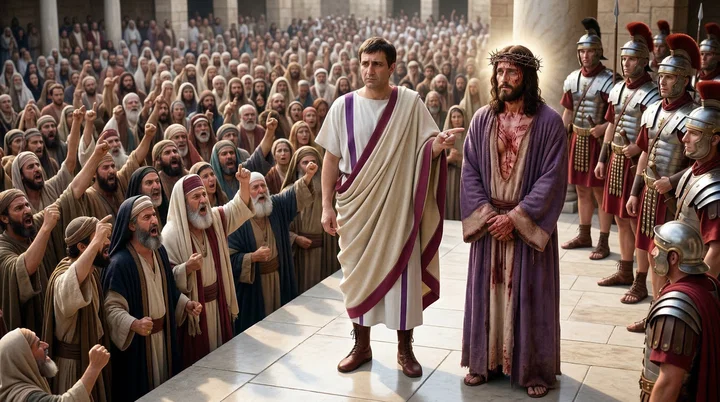
And it was the preparation of the passover, and about the sixth hour: and he saith unto the Jews, Behold your King!
Translations
And it was the preparation of the passover, and about the sixth hour: and he says to the Jews, Behold your King!
And it was the preparation of the passover, and about the sixth hour: and he saith unto the Jews, Behold your King!
And it was the preparation of the passover, and about the sixth hour: and he saith unto the Jews, Behold your King.
And it was the preparation of the passover, and about the sixth hour: and he saith to the Jews, Behold your King!
Revised Version, American Standard Version
Now it was the Preparation of the passover: it was about the sixth hour. And he saith unto the Jews, Behold, your King!
and it was the preparation of the passover, and as it were the sixth hour, and he saith to the Jews, 'Lo, your king!'
( now it was [ the] preparation of the passover; it was about the sixth hour;) and he says to the Jews, Behold your king!
Now it was the preparation of the passover,—it was about the sixth hour. And he saith unto the Jews—See! your King!
Berean Standard Bible, Majority Standard Bible
It was the day of Preparation for the Passover, about the sixth hour. And Pilate said to the Jews, “ Here is your King!”
Now it was the Preparation Day of the Passover, at about the sixth hour. He said to the Jews, “ Behold, your King!”
( It was the day when they made ready for the Passover; and it was about the sixth hour.) And he said to the Jews, There is your King!
And it was the Preparation of the Passeouer, and about the sixt houre: and hee sayde vnto the Iewes, Beholde your King.
Douay-Rheims (Challoner revision)
And it was the parasceve of the pasch, about the sixth hour, and he saith to the Jews: Behold your king.
Pictures
Cross-references 20 of 31
- John 18:28
Then led they Jesus from Caiaphas unto the hall of judgment: and it was early; and they themselves went not into the judgment hall, lest they should be defiled; but that they might eat the passover.
The leaders avoid defilement so they can eat the Passover, indicating the meal was still ahead.
- Matthew 27:24-25
When Pilate saw that he could prevail nothing, but that rather a tumult was made, he took water, and washed his hands before the multitude, saying, I am innocent of the blood of this just person: see ye to it.
Pilate washes his hands as the crowd accepts responsibility for Jesus’ sentence.
- 1 Corinthians 5:7
Purge out therefore the old leaven, that ye may be a new lump, as ye are unleavened. For even Christ our passover is sacrificed for us:
Christ is the Passover sacrifice, whose death occurs at the appointed time.
- Luke 23:20-24
Pilate therefore, willing to release Jesus, spake again to them.
Pilate declares Jesus innocent, yet yields to the crowd’s demand for His death.
- Luke 23:54
And that day was the preparation, and the sabbath drew on.
Identifies Jesus’ crucifixion day as preparation for the Sabbath.
- Exodus 12
And the LORD spake unto Moses and Aaron in the land of Egypt, saying,
The Passover lamb’s slaying prefigures Jesus’ death.
- Mark 15:12-14
And Pilate answered and said again unto them, What will ye then that I shall do unto him whom ye call the King of the Jews?
The crowd rejects Jesus as king and demands his crucifixion.
- John 19:31
The Jews therefore, because it was the preparation, that the bodies should not remain upon the cross on the sabbath day, ( for that sabbath day was an high day,) besought Pilate that their legs might be broken, and that they might be taken away.
The Sabbath following the crucifixion was a high day during Passover.
- Mark 15:25
And it was the third hour, and they crucified him.
Mark gives the third hour, while John gives the sixth hour before the crucifixion.
- John 18:38
Pilate saith unto him, What is truth? And when he had said this, he went out again unto the Jews, and saith unto them, I find in him no fault at all.
Pilate questions truth and declares Jesus without fault.
- Leviticus 23:5
In the fourteenth day of the first month at even is the LORD’s passover.
Sets the Passover date matched by Christ’s death.
- Matthew 27:2
And when they had bound him, they led him away, and delivered him to Pontius Pilate the governor.
Jesus is delivered to Pilate before his crucifixion.
- Mark 15:42
And now when the even was come, because it was the preparation, that is, the day before the sabbath,
Preparation was the day before the Sabbath.
- Matthew 27:22
Pilate saith unto them, What shall I do then with Jesus which is called Christ? They all say unto him, Let him be crucified.
The crowd demands Jesus’ crucifixion.
- Luke 23:14-16
Said unto them, Ye have brought this man unto me, as one that perverteth the people: and, behold, I, having examined him before you, have found no fault in this man touching those things whereof ye accuse him:
Pilate declares Jesus innocent, yet yields to the demand for His death.
- Acts 3:13-14
The God of Abraham, and of Isaac, and of Jacob, the God of our fathers, hath glorified his Son Jesus; whom ye delivered up, and denied him in the presence of Pilate, when he was determined to let him go.
The people rejected Jesus before Pilate and chose a murderer instead.
- Luke 23:4
Then said Pilate to the chief priests and to the people, I find no fault in this man.
Pilate declares Jesus innocent before his condemnation.
- Matthew 27:62
Now the next day, that followed the day of the preparation, the chief priests and Pharisees came together unto Pilate,
Both identify the day of Jesus’ crucifixion as the preparation day.
- Luke 22:7-9
Then came the day of unleavened bread, when the passover must be killed.
Compared with John 19:14 on when the Passover meal could be eaten.
- John 12:13
Took branches of palm trees, and went forth to meet him, and cried, Hosanna: Blessed is the King of Israel that cometh in the name of the Lord.
The crowd welcomes Jesus as king before rejecting him.
Commentary
Each commentary is drawn from primary sources: the writings of Ellen G. White and Adventist pioneers and periodicals. Each commentary is separate. Its own words are not a quotation; follow the references to read the source passages.
Ellen G. White
15 sources
At the Passover preparation about the sixth hour Pilate set Jesus before the Jews as their King during the trial that led from his hall to Calvary.Ms 51, 1897, par. 33–34DA 723.1–724.1DA 722.5 He did so in mockery, asking what should be done with him standing condemned before the crowd.Ms 51, 1897, par. 33–34Ms 78, 1893, par. 55–56Ms 39, 1898, par. 5–7 The crowd rejected him, called for his crucifixion and for Barabbas instead, while the chief priests declared they had no king but Caesar.Ms 51, 1897, par. 33–34Ms 78, 1893, par. 55–56Ms 39, 1898, par. 5–7Ms 95, 1897, par. 8–9Lt 12, 1911, par. 8–11 That cry denied God as ruler and withdrew the nation from His theocratic rule under leaders who led them to that choice.Ms 95, 1897, par. 8–9DA 737.2–738.5 Though Pilate knew Jesus was faultless, he sacrificed the innocent to save his own power and place, and that rejection bound the rejecters to judgment ending in Jerusalem's ruin while the crucified one stands acknowledged as King and Judge of all.Ms 39, 1898, par. 5–7Ms 95, 1897, par. 8–9EW 152.3SG1 56.1Ms 74, 1911, par. 17
Trial Setting and Presentation
The presentation belongs to the trial before Pilate at the preparation of the Passover, about the sixth hour.Ms 51, 1897, par. 33–34DA 723.1–724.1DA 722.5 It is the moment in that trial when Pilate brings Jesus forth and bids the Jews behold their King.Ms 51, 1897, par. 33–34DA 723.1–724.1 That trial is the one that leads from Pilate's hall to Calvary for crucifixion.DA 723.1–724.1DA 722.5
The Jewish officials would not enter the Roman judgment hall, fearing ceremonial defilement would keep them from the feast.DA 723.1–724.1 Yet murderous hatred had already defiled their hearts.DA 723.1–724.1 Christ was the real Passover lamb, and by rejecting Him they emptied the feast of its significance.DA 723.1–724.1
The trial and execution stood under the Roman charge of treason, as a supposed offender against Roman rule.5RED 92.2 Those condemned for this crime were normally taken down by Roman soldiers and buried in a burial ground reserved for criminals who had received the death penalty.5RED 92.2 In that setting Pilate presented Jesus standing condemned before the crowd as their King, calling on them to behold Him.Ms 51, 1897, par. 33–34Ms 39, 1898, par. 5–7Ms 95, 1897, par. 8–9DA 737.2–738.54RED 102.2–103.1 He asked what should be done with Him.Ms 78, 1893, par. 55–56Ms 39, 1898, par. 5–7 He did so in mockery.Ms 51, 1897, par. 33–34Ms 95, 1897, par. 8–9
The presentation came amid pressure from the Jewish leaders.ST May 22, 1884 That pressure included appeals to loyalty to Caesar.ST May 22, 1884 They used that claim to intimidate Pilate, as they later tried to intimidate Festus.ST May 22, 1884
Rejection of the King
When he was presented as King and the question was put what should be done with him, the crowd rejected him, demanded his crucifixion, and called for Barabbas to be released instead.Ms 78, 1893, par. 55–56Ms 39, 1898, par. 5–7Lt 12, 1911, par. 8–11 Barabbas was a robber, murderer, and thief chosen in his place.Ms 78, 1893, par. 55–56Ms 39, 1898, par. 5–7Lt 12, 1911, par. 8–11 The chief priests and rulers joined that demand for crucifixion and declared that they had no king but Caesar.Ms 51, 1897, par. 33–34Ms 39, 1898, par. 5–7Ms 95, 1897, par. 8–9DA 737.2–738.5
That declaration was a denial of God as ruler, a rejection of God as king, and a withdrawal from the theocracy.Ms 95, 1897, par. 8–9DA 737.2–738.5 The religious leaders bore responsibility for leading the nation into that choice and its consequences.DA 737.2–738.5 The same crowd that had earlier welcomed him as king now reviled him and cried for his crucifixion, showing how fickle popular favor is.4RED 102.2–103.1 His faithful disciples had been prepared for this rejection and did not base their faith on the crowd's changing opinions.4RED 102.2–103.1
Satan stood at the head of those who reviled and crucified him and led the cruel mob in abuse of the Saviour.Lt 12, 1911, par. 8–11 His aim was to provoke retaliation or to drive him to use a miracle to release himself and thus break up the plan of salvation.Lt 12, 1911, par. 8–11 Though by a command he could have brought the heavenly hosts to his aid, he submitted with perfect calmness to the coarsest insults and outrage.Lt 12, 1911, par. 8–11 One stain upon his human life and one failure to endure the terrible test would have made the Lamb of God an imperfect offering and the redemption of humanity a failure.Lt 12, 1911, par. 8–11
Guilt and Consequences
Pilate repeatedly declared that he found no fault in Jesus and knew Him to be innocent, even asserting his power to release or to condemn Him, yet he delivered Him to be scourged and then to be crucified.Ms 39, 1898, par. 5–7EW 152.3Ms 74, 1911, par. 173SP 147.1Lt 12, 1911, par. 8–11 He did so not from conviction of guilt but to protect his own position, yielding from fear of losing his power, authority, and life and from concern for worldly honor and power.EW 152.3SG1 56.1Ms 74, 1911, par. 173SP 147.1 His attempt to shift responsibility to the accusers did not make him blameless, and he remained responsible and guilty for condemning Christ.Ms 51, 1897, par. 33–34SG1 56.1 At the same time his authority over Jesus came from above, and the one who delivered Jesus to him bore the greater sin.Ms 51, 1897, par. 33–34
His choice shows that indecision and compromise with evil can lead to ruin, as self-interest overcomes conscience and duty.3SP 147.1 After Christ's resurrection Pilate was convinced that the One he had condemned was the Son of God, and his guilt left him in lasting despair.EW 152.3 By rejecting Christ and choosing a robber and murderer in His place the rejecters bound themselves to judgment.Ms 39, 1898, par. 5–7 That choice was followed by Jerusalem's destruction forty years later and rule by a foreign power, leaving the nation as a severed, fruitless branch without a Savior, while the rejected and crucified Christ is acknowledged by the heavenly universe as King and Judge of all living.Ms 39, 1898, par. 5–7Ms 95, 1897, par. 8–9
Sources
Pioneers and periodicals
42 sources
The verse places the close of the trial and the choice to crucify at about the sixth hour on the preparation day, which is Friday, the sixth day of the week, the day before the weekly Sabbath.ST Apr 21, 1914RH Mar 15, 1860RH Jan 2, 1908 The preparation of the passover is the preparation for the weekly Sabbath falling in Passover week, a high day because the yearly Passover Sabbath and the weekly Sabbath coincided, with the crucifixion on the fourteenth of Nisan before the Passover meal had been eaten.RH Jun 24, 1873RH Jun 24, 1873RH Mar 15, 1860RH Jun 24, 1873ST Mar 4, 1903 His death at that season is the fulfillment of the Passover type, with Christ as the Passover sacrifice and Lamb of God slain on the day and hour the typical lamb was slain.RH Oct 30, 1855RH Apr 15, 1873ST Aug 13, 1874 Although Pilate repeatedly declared Him innocent and found no evil in Him, self-interest and fear for his position led him to hand Him over to scourging and crucifixion, presenting the beaten and bleeding prisoner as king in hope of exciting pity and turning the leaders from demanding death.ST Mar 15, 1877ST Mar 28, 1911ST May 13, 1897ST Jul 11, 1878 When the people demanded crucifixion and the chief priests answered that they had no king but Caesar, they finally rejected their rightful King, renounced allegiance to Jehovah and the covenant with the house of David, and severed their last bond as a nation to God.ST Oct 10, 1895ST May 13, 1897ST Nov 9, 1882
Hour and Day Described
The close of the trial and the decision to crucify fell at about the sixth hour on the preparation day, which is Friday, the sixth day of the week, the day just before the weekly Sabbath.ST Apr 21, 1914RH Mar 15, 1860RH Jan 2, 1908ST Mar 4, 1903ST May 13, 1897 The preparation and observance of the Passover are described in Exodus 12:1-28.ST Mar 4, 1903 The Greek word for preparation became the regular name for Friday, as did its Aramaic equivalent.RH Jan 2, 1908 Pilate's presentation of Jesus as King with the words Behold your King took place on that preparation day of Passover at about the sixth hour, even as the Jews demanded His crucifixion.ST May 13, 1897
The apparent conflict with Mark placing the crucifixion after the third hour is resolved because the Jews divided the day into four periods ending at the third, sixth, ninth, and twelfth hours, so that an hour can mean the period ending at that point.ST Nov 15, 1910 Jesus was therefore crucified between the third and sixth hours, between about 9 a.m. and noon, without a precise time given.ST Nov 15, 1910 Another explanation proposes that a copyist mistook the Greek numeral for three for that for six, so that the verse should read about the third hour to agree with the other Gospels.ST May 13, 1897RH Jun 24, 1873 On that view the word about shows the time is not exact.RH Jun 24, 1873
On the contrary, the true reading must remain the sixth hour counted from midnight, about six o'clock in the morning.RH Jul 29, 1873RH Jun 24, 1873 John uses midnight reckoning unlike Mark's nine in the morning, with Mark reckoning the crucifixion at the third hour as about nine in the morning.RH Jul 29, 1873RH Jun 24, 1873 The word about is indefinite but does not allow sixth to be read as third, and sixth must not be changed to third.RH Jul 29, 1873 This use of midnight-to-midnight timekeeping is the prevailing Roman-era way of reckoning days among Christians.RH Jun 24, 1873 The verse provides no basis for a change in the reckoning of the day.RH Jul 29, 1873
The preparation of the passover means the preparation for the weekly Sabbath falling during Passover week, not preparation for the Passover feast itself.RH Jun 24, 1873RH Jan 9, 1872 The word preparation means the day before the Sabbath, and the phrase preparation of the passover means the Passover sabbath and the weekly Sabbath fell together on that occasion.RH Mar 15, 1860 The word passover also covers the holy days of Passover week, and does not mean the day before the 14th of Nisan.RH Jan 9, 1872 That Sabbath was a high day because the yearly Passover Sabbath and the weekly Sabbath coincided, since one of the great days of the Passover feast fell on it.RH Jun 24, 1873RH Mar 15, 1860ST Mar 4, 1903RH Jan 9, 1872
More precisely, the preparation was likely for eating the paschal lamb, placing the crucifixion before the Passover meal had been eaten and not on the fifteenth after it.RH Jun 24, 1873RH Jun 24, 1873 The Friday of the crucifixion was the day of preparation for Passover observance, the day preceding the fifteenth of Nisan, so Friday was the fourteenth of Nisan, not the fifteenth.RH Apr 15, 1873 The fifteenth, the first day of unleavened bread, coincided that year with the weekly Sabbath.RH Apr 15, 1873RH Jan 9, 1872 The first of those holy days fell always on the 15th of Nisan, which that year fell on the seventh-day weekly Sabbath.RH Jan 9, 1872
That coincidence made the Sabbath both a weekly Sabbath in commemoration of creation and a yearly Sabbath in remembrance of escape from Egypt.RH Jan 9, 1872 The crucifixion thus occurred on Friday while the Jews observed both Sabbaths together on the next day, with the first day of the week coming next.RH Mar 15, 1860RH Jan 9, 1872 Fifty days reckoned from the sixteenth placed Pentecost on the first day of the week.RH Apr 15, 1873 The coincidence served as the starting point for dating Pentecost.RH Jun 24, 1873
Compared with Luke 22:7-9, the Passover could be eaten either on its regular day or the following day.ST Apr 2, 1912 By Christ's time it had become a leisurely reclining supper with wine unlike the hurried meal eaten standing in Moses' day.ST Apr 2, 1912 The Jews may therefore have been less strict about its exact timing.ST Apr 2, 1912 Jesus was tried and condemned by the highest Jewish authority during the feast and executed the following day, an exception to the usual reluctance to try and execute prisoners during Passover.ST Mar 6, 1884 The Jews clamored for His condemnation on the Passover day in disregard of their own traditions and law in desperation to have Him put to death.ST Apr 30, 1902
Trial Before Pilate
Although He was repeatedly declared innocent and recognized as having no evil in Him, self-interest and fear for his position led Pilate to hand Him over to scourging, mockery, and crucifixion.ST Mar 28, 1911ST Jul 11, 1878RH Jun 15, 1911ST Mar 13, 1901 When he brought forth the beaten and bleeding Jesus before the crowd with the words Behold your King, he hoped to excite pity and turn them from demanding death.ST Mar 15, 1877ST May 13, 1897 That presenting of Jesus as King was not sincere, but a contemptuous taunt taking a poor satisfaction in ridiculing the Jewish leaders on their most tender point, their Messianic hopes.ST Mar 15, 1877ST Nov 9, 1882
The proceedings had shifted from a charge of blasphemy to accusing Jesus of treason against Caesar, and on that political accusation Pilate sentenced Him to death.ST Mar 15, 1877 The leaders pressed appeals to loyalty to Caesar to intimidate Pilate, as they later tried to intimidate Festus.ST May 22, 1884ST Mar 15, 1877 After washing his hands before all to clear himself of guilt for shedding innocent blood, Pilate still yielded to religious bigotry, threats, and pressure from the mob.ST Jul 11, 1878ST Nov 9, 1882ST Feb 12, 1894ST Mar 13, 1901 That yielding exposed weakness, cowardice, and inconsistency, a suppression of conscience in choosing earthly honor over faithfulness to God.ST Jul 11, 1878ST Mar 13, 1901
His inconsistency appeared in persistently appealing to the people for consent to do his plain duty, and in offering by way of compromise to cruelly scourge an innocent man to appease unreasoning wrath.ST Mar 13, 1901 The rulers showed their own inconsistency in crying for the release of Barabbas, who was convicted of practically the same crime they charged against Jesus, while Jesus Himself was declared innocent.RH Jun 15, 1911ST Mar 13, 1901 The same chapter that records this trial also records His crucifixion and His care for His mother and the courage of Nicodemus.
Rejection of the King
On the preparation day of the Passover, about the sixth hour, Pilate presented Jesus to the Jews as their King even as they demanded His crucifixion.ST Oct 10, 1895ST May 13, 1897 That demand was the final rejection of Israel's rightful King, displaying the result of the nation's departure from God and its rejection of the kingdom He had entrusted to it.ST Oct 10, 1895 When the chief priests declared allegiance to Caesar, they severed their last bond as a nation to God.ST Oct 10, 1895 That answer, that they had no king but Caesar, was an open renunciation of allegiance to Jehovah and of the covenant made with the house of David, marking the culminating point of national apostasy.ST Nov 9, 1882
That apostasy proceeded step by step in rejecting the Messiah, preferring a robber and murderer before Him, demanding His shameful death, and openly proclaiming the Roman emperor as king.ST Nov 9, 1882 The crowd's choice of Barabbas and rejection of Jesus showed their guilt in condemning Him to be led away to be crucified.ST Nov 9, 1882RH Jun 15, 1911
By turning from the Lord to Caesar in rejecting Jesus presented to them as King, the leaders brought desolation to their house and loss of the kingdom of God.ST Nov 7, 1895 At the same time they observed the Passover with punctilious form while participating in the crucifixion of Christ, the one in whose honor the Passover was observed, showing that observance of the religious form did not make their actions faithful to its meaning.ST Jul 1, 1897
Passover Type Fulfilled
The time given places the crucifixion in the Passover season, and the death of Jesus fulfills the Passover type, for Christ the Passover sacrifice and Lamb of God was killed on the fourteenth day of the first month when the Passover lamb was slain.RH Oct 30, 1855ST Aug 13, 1874RH Dec 15, 1868 The account in John 18-19 identifies the time of the crucifixion with that season and presents that killing on the fourteenth day as the fulfillment of the type's timing.RH Oct 30, 1855ST Aug 13, 1874RH Dec 15, 1868 Friday was the preparation for the Passover observance, meaning the day preceding the fifteenth of Nisan, so Friday was the fourteenth and not the fifteenth.RH Apr 15, 1873 That placed the fifteenth, the first day of unleavened bread, upon the weekly Sabbath, with fifty days reckoned from the sixteenth bringing Pentecost to the first day of the week.RH Apr 15, 1873
His death thus corresponded to the very day and hour of killing the typical Passover lamb, fulfilling the antitype of Christ as the Paschal Lamb.RH Apr 15, 1873 This fulfillment is evidence that the major events represented by the spring feasts occurred on the corresponding feast days.RH Oct 30, 1855 His death fell on the anniversary of the Passover feast which typified His death, as His resurrection answered to the first-fruits of those who sleep.RH Oct 30, 1855ST Jun 1, 1882 The verse belongs also to the New Testament fulfillment of the suffering and crucifixion of the Messiah foretold in Psalm 22:16-17.RH Jun 24, 1858
Prophecy and Roman Power
The crucifixion took place in the spring because it took place at the Passover. It was the cutting off of the Messiah in the middle of the seventieth week, in A.D. 31. Three and a half years before that point reaches back to the autumn for the beginning of Christ's anointed ministry at baptism, and three and a half years after that point reaches forward to the autumn for the end of the seventy weeks. That fixes the end of the seventy weeks to the autumn of A.D. 34 and the end of the remainder of the 2300 days to the autumn of 1844.
Jesus, the Prince of God's people, was crucified under the authority of pagan Rome.ST Feb 10, 1898 That power then held the authority to execute the death penalty.ST Feb 10, 1898
Church State Coercion Exposed
The religious leaders condemned Jesus because He rejected their traditions, because He claimed to be the Son of God, and because He did not keep the Sabbath according to their customs.ST May 19, 1914 After that religious condemnation they turned to the Roman governor with complaints and threats to compel him to condemn and execute Jesus, the Lord's Christ.ST May 19, 1914ST Dec 18, 1893ST Oct 16, 1893 In this He was made a victim of religious legislation.ST May 19, 1914
His death was thus made possible through religious bigotry and intolerance joined to civil power.ST Feb 12, 1894ST Oct 2, 1893 Religious bigotry with threats pressured Pilate to deliver Him to be crucified, as the leaders demanded His death and appealed to Roman civil authority to carry it out.ST Feb 12, 1894ST Oct 2, 1893 They used Roman authority to condemn Him to death because He rejected their traditions, which they had made part of civil law.
In taking to themselves the work of defining sin when they condemned the Lord's Christ, and then by threats compelling the Roman governor to execute Him, civil power entered the domain of conscience to define sin and punish sin.ST Oct 9, 1907 In doing so it usurped the place of God and became rebel to His authority.ST Oct 9, 1907 That course brings disaster to the government itself and persecution to its most conscientious and devoted citizens.ST Oct 9, 1907 Their union of church and state turned against God and treated the Son of God as a subject to be executed for refusing their religious ordinances.
Faith and Life Response
John 19 stands in the account written so that readers may believe that Jesus is the Christ and that by believing they may have life through His name, and its lessons bring life to every believer. In this cruel manner His life was sacrificed so that our lives might be saved, after unmerited torture and mockery and compromise scourging though He had been declared innocent.ST Mar 13, 1901 Reading Christ's sufferings in this chapter can subdue pride and cast out discontent and help a fretful, gloomy, or discontented Christian.ST Apr 17, 1879
Jesus is shown as a man of sorrows who suffered bitter depths of human woe here below, with days of toil and nights of prayer, coming in pitying love to share every human burden and care. He bore the heavy cross, wore the piercing crown of thorns, and endured the nails, the spear, and the gore. With such memories believers cannot murmur or complain in grief and pain, cannot ask for a life of ease or live one hour to please self, and find pain sweet because it brings them lower at His feet in closer sympathy with Him.
He is brought forth as the thorn-crowned, blood-stained, cross-laden King amid the rabble's cry to go forth and die, then pierced in hands and feet while three hours of fierce noontide heat beat upon Him.RH Apr 8, 1902 His going forth to die makes Him wholly ours and calls for being made wholly His by divine grace and strength to do His will in thought, word, and deed and to follow Him even though it costs bleeding.RH Apr 8, 1902 Pilate faced Jesus as incarnate Truth and had to decide whether to protect the innocent or yield to the mob by sentencing Him to be scourged and crucified, making his choice a test of conscience that presents each reader with a decision about whether to accept Jesus as leader.
Sources