Acts 14:18
And with these sayings scarce restrained they the people, that they had not done sacrifice unto them.
Translations
And with these sayings scarce restrained they the people, that they had not done sacrifice to them.
King James Version, KJV Cambridge Paragraph Bible
And with these sayings scarce restrained they the people, that they had not done sacrifice unto them.
And with these sayings they scarce restrained the people from doing sacrifice to them.
Revised Version, American Standard Version
And with these sayings scarce restrained they the multitudes from doing sacrifice unto them.
and these things saying, scarcely did they restrain the multitudes from sacrificing to them.
And saying these things, they with difficulty kept the crowds from sacrificing to them.
Even these things, saying, scarcely restrained they the multitudes from offering sacrifice unto them.
Berean Standard Bible, Majority Standard Bible
Even with these words, Paul and Barnabas could hardly stop the crowds from sacrificing to them.
Even saying these things, they hardly stopped the multitudes from making a sacrifice to them.
And even with these words, it was hard for them to keep the people from making an offering to them.
And speaking these things, scarce appeased they the multitude, that they had not sacrificed vnto them.
Douay-Rheims (Challoner revision)
And speaking these things, they scarce restrained the people from sacrificing to them.
Pictures
Cross-references
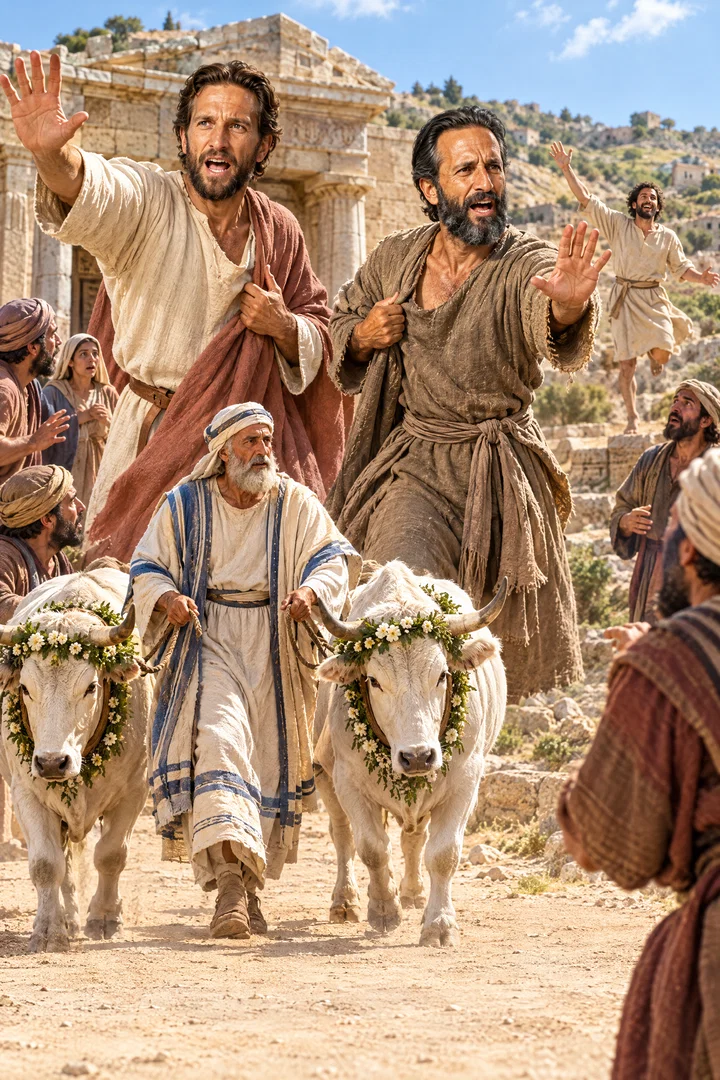
- Acts 14:11-13
And when the people saw what Paul had done, they lifted up their voices, saying in the speech of Lycaonia, The gods are come down to us in the likeness of men.
The crowd called the apostles gods and prepared to sacrifice to them.
- Acts 14:8-10
And there sat a certain man at Lystra, impotent in his feet, being a cripple from his mother’s womb, who never had walked:
The cripple’s miraculous healing prompted the crowd to honor the apostles as gods.
- Acts 14:13-14
Then the priest of Jupiter, which was before their city, brought oxen and garlands unto the gates, and would have done sacrifice with the people.
The priest brought oxen and garlands for sacrifice, and the apostles intervened.
- Acts 14:14
Which when the apostles, Barnabas and Paul, heard of, they rent their clothes, and ran in among the people, crying out,
apostles rent clothes to stop sacrifice
- Acts 14:12
And they called Barnabas, Jupiter; and Paul, Mercurius, because he was the chief speaker.
named Barnabas Jupiter and Paul Mercury
Commentary
Each commentary is drawn from primary sources: the writings of Ellen G. White and Adventist pioneers and periodicals. Each commentary is separate. Its own words are not a quotation; follow the references to read the source passages.
Ellen G. White
10 sources
At Lystra Paul healed a cripple who had never walked and who had faith to be healed, making him strong to leap and walk.Ms 117a, 1901, par. 30–32AA 181.2–182.3 When the people saw the miracle they shouted in the Lycaonian speech that the gods had come down in the likeness of men.Ms 117a, 1901, par. 30–32 They called Barnabas Jupiter and Paul Mercurius because he was the chief speaker, and the priest of Jupiter brought oxen and garlands to the gates to sacrifice with the people.Ms 117a, 1901, par. 30–32
When Paul and Barnabas heard it they tore their clothes and ran in among the people, positively denying that they were divine.Ms 117a, 1901, par. 30–32AA 181.2–182.3 They declared that they were men of like passions and representatives of the God of heaven and of His Son the great Healer.Ms 117a, 1901, par. 30–32AA 181.2–182.3 They urged the people to turn from these vanities to the living God who made heaven and earth and sea and all things therein, the only object worthy of adoration.Ms 117a, 1901, par. 30–32AA 181.2–182.3SG1 94.1 That living God in times past suffered all nations to walk in their own ways, yet did not leave Himself without witness in that He did good and gave rain from heaven and fruitful seasons and filled hearts with food and gladness.Ms 117a, 1901, par. 30–32
Even with those sayings they only barely and with great difficulty restrained the people from doing sacrifice to them.Ms 117a, 1901, par. 30–32AA 181.2–182.3SLP 72.2SG1 94.13SP 363.1–364.2 The heathen enthusiasm remained so great and the people were so firmly convinced from what they had seen with their own eyes that they were gods, and so loath to acknowledge their error, that only after much persuasion and careful explanation did they reluctantly give up their purpose.AA 181.2–182.33SP 363.1–364.2GW 107.3 Their readiness to abandon idol worship shows their worship of idols was giving way to a first understanding of the true God and the honor due to Him as Creator of heaven, earth, the sea, and all things in them.SG1 94.1
Very soon after refusing sacrifice, the reverence of people whose faith was not firmly rooted in the true God was turned into insult, abuse, and a determination to kill him.SLP 59.1–23SP 378.1SLP 72.2 False accusations and falsehood and misrepresentation by opposing Jews persuaded them against him, showing how quickly they could change from honoring the apostles to hostility and how vulnerable to deception they were.Lt 218, 1901, par. 13–15SLP 59.1–23SP 378.1 Paul refused to be worshiped as a god and, after being stoned and left for dead, rose up and went on preaching with Barnabas from city to city.Lt 218, 1901, par. 13–15 He faced this furious crowd while remaining committed to serving Christ, unturned by opposition and upheld by faith.GW 107.3
The response at Lystra parallels the islanders' response after Paul survived the viper bite, when they likewise regarded him as a god.SLP 270.2 That regard gave him influence that he used to lead them toward the gospel.SLP 270.2
Sources
Pioneers and periodicals
30 sources
At Lystra Paul healed a man crippled from birth who had never walked, and the astonished crowd concluded the gods had come down among them in human form and would have offered sacrifice to Paul and Barnabas, whom words could scarcely restrain.ST Jun 17, 1897RH Nov 16, 1916ST Nov 21, 1892ST May 21, 1902 The sayings that barely held them back declared the apostles were men of like passions and urged the crowd to turn from vain things to the living God.ST Dec 9, 1897ST Dec 9, 1897ST May 21, 1902 True messengers refuse such divine honors and will not accept idolatrous worship, but exalt Christ alone.ST Jul 4, 1905ST Apr 6, 1882ST Nov 13, 1893RH Mar 5, 1857 Their reaction rested on the miracle's appearance rather than on righteousness or principle, which warns that religion guided by feeling and outward displays of power turns quickly toward delusion and rejection of truth.ST Jul 4, 1905 The same fickle people who would worship Paul and Barnabas soon became as anxious to destroy them, stoning Paul and leaving him for dead, so ministers should distrust praise rather than measure their work by it.ST Aug 16, 1883RH Feb 15, 1870ST Aug 16, 1883RH Apr 10, 1913
Healing at Lystra
At Lystra Paul healed a man crippled from birth who had never walked, and the astonished crowd concluded the gods had come down among them in human form and would have offered sacrifice to Paul and Barnabas, whom words could scarcely restrain.ST Jun 17, 1897RH Nov 16, 1916ST Nov 21, 1892ST Nov 21, 1892ST Apr 29, 1897 The appeal of Paul and Barnabas only just stopped the people of Lystra from sacrificing to them, for the idolaters mistook them for gods after the miraculous healing, and the apostles refused those divine honors while using the occasion to teach about God.ST Jun 17, 1897RH Nov 16, 1916ST Nov 21, 1892ST Apr 29, 1897ST Apr 6, 1882 After fleeing a mob at Iconium that meant to stone them, the apostles came to Lystra where Paul looked steadily at the man with deformed feet from birth, saw he had faith to be healed, commanded him loudly to stand upright on his feet, and the man jumped up and walked.ST May 21, 1902 That healing drove the conviction that sacrifice was due, as the astonished crowd cried out that the gods had made themselves like men and come down to them, and that conviction made the sacrifice so hard to stop.ST May 21, 1902
Paul had addressed the Lycaonians in the common Greek speech, but as excitement grew the people returned to their native language, which the apostles did not understand, and the excitement was so great that Paul and Barnabas could scarcely stop them from sacrificing.RH May 20, 1915 The sayings that barely restrained them declared the apostles were men of like passions and urged the crowd to turn from vain things to the living God.ST Dec 9, 1897ST Dec 9, 1897ST May 21, 1902 Even after Paul and Barnabas explained that they were ordinary people and presented the living God, the people of Lystra were still intent on sacrificing to them and were only with difficulty restrained.ST Dec 9, 1897ST Dec 9, 1897ST May 21, 1902
The healing at Lystra connects miraculous healing with forgiveness of sins and divine power, and the people's response belongs to that account of healing.ST Aug 16, 1883 The verse belongs to the account of Paul's travels and labors in Acts 13-20, to the places of labor in Acts 14 where Paul healed a cripple and where he was stoned, counted among the miracles wrought through Paul, the persecutions he suffered, and the examples of his zeal and forgetfulness of self.ST Mar 10, 1898 It belongs to the Lystra account in Acts 14:8-22, which teaches enduring hardness as a good soldier of Jesus Christ.ST Jun 18, 1902
Lystra was an uncultivated, semibarbarous place in contrast to cultivated Athens where Paul also preached, showing that God cares for barbarians as well as people of cultivation and that gospel preaching belongs to both, as recorded in Acts 14:8-18 alongside the preaching at Athens.ST Sep 10, 1896 The chapter records no teaching or accusation about sanctifying the first day of the week.ST Jun 8, 1882
True Messengers Refuse Worship
The true messengers refused the divine honors the crowd at Lystra wanted to give them, and with difficulty restrained the people from sacrificing to them as gods after the healing of the cripple.ST Jul 4, 1905ST Apr 6, 1882 Paul addressed those idolaters, worshipers of Jupiter and Mercury who attributed the miracle's power to the apostles themselves, by urging them to turn from false gods and vain things to the living Creator, maker of heaven and earth and sea and all they contain.ST Aug 12, 1897 He pointed to every shower of rain, growing crops, fruitful seasons, and the variety of animal life as witnesses of God's goodness and power and love.ST Aug 12, 1897ST May 21, 1902
That witness of nature proclaims God's perpetual presence and manifestation everywhere, so that even those who have never read the Bible or heard a gospel missionary can know the true source of all things.ST Aug 12, 1897 Remembering that rains, fruitful seasons, and other blessings regarded as mere natural results are really witnesses of God's goodness keeps people in closer touch with Him, while forgetting God brings great loss, and all are accountable to God for how they receive or reject that witness.ST Aug 12, 1897ST May 21, 1902 He did not accept the honor or allow Christ to be placed alongside Jupiter, but rejected the idolatrous worship and exalted Christ alone, preaching the same uncompromising gospel among the Lycaonians as among others and refusing to let Christianity be treated as one religious opinion among many.ST Nov 13, 1893RH Mar 5, 1857 The drive to worship the apostles was inspired by the adversary of truth to turn attention away from the true Source of power and rob God of the honor due His name, illustrating that when truth cannot be denied the enemy perverts it to serve evil by having God's work credited to men so that worship goes to them instead of God.ST May 21, 1902
On that same principle the Sabbath commandment was perverted by substituting another day for the day God commanded, so the commandment is made of no effect while the consciences of the deceived are eased.ST May 21, 1902 Lycaonia was a part of Galatia, so this heathen idolatry that tried to sacrifice to Paul and Barnabas as gods proves that before the Galatians knew God they did service to them which by nature are no gods, and that turning back to the weak and beggarly elements in Galatians 4:8-11 was returning to old heathen gods, feasts, festivals, and days such as Sunday.ST Feb 13, 1896 True prophets do not call attention to themselves but to God, and true disciples magnify the Word of the Lord, for every true message and messenger exalts Jesus Christ so that everyone who receives it glorifies God and not the man, while men who preach themselves are to be received with suspicion.ST Aug 26, 1897 Their refusal to accept worship brought persecution, because persecution is the devil's last resort when pleasant deception and leading men astray fail; had they accepted the worship they would not have been stoned, and wherever religious persecution appears it proves that all the arts and arguments of the enemies of truth have failed.ST May 21, 1902
Sense Religion Turns Fickle
The people of Lystra were only with difficulty held back from sacrificing to Paul and Barnabas as gods after the healing of the cripple, because their reaction rested on the appearance of the miracle rather than on righteousness or principle.ST Jul 4, 1905 They were convinced by the healing without regard for the principles of righteousness, treating a visible display of power as proof that the messengers were divine.ST Jul 4, 1905 Religion guided by feeling and appearances can turn quickly toward delusion and rejection of truth, so faith must be grounded in God's truth and obedience and not in signs or outward displays of power. Their attempted worship did not mean their hearts had been changed by God's truth.ST Aug 16, 1883
The same fickle people who would worship Paul and Barnabas soon became as anxious to destroy them as they had been to worship them, stoning Paul and dragging him out of the city and leaving him for dead.ST Aug 16, 1883RH Apr 10, 1913RH Nov 6, 1900 Their response to the healing of the lame man could quickly turn from admiration to hostility, and their sudden change from honoring the apostles to stoning Paul shows how fickle popular feeling can be.RH Feb 15, 1870ST Jul 30, 1894 That reversal came through persuasion by visitors from Antioch and Iconium, when envious and malignant Jews turned public opinion against him despite earnest warning against idolatry.ST Aug 16, 1883RH Nov 6, 1900
Popular admiration can quickly become hostility, so ministers should distrust praise rather than measure their work by it, for applause proves little lasting support for God's work and little that a minister is faithful and successful.ST Aug 16, 1883ST Aug 16, 1883 Accepting worship would have harmed Paul's influence for good.ST Aug 16, 1883 God's prophets have never been welcomed in the age in which they lived, while later ages praise, adore, worship them, build monuments to them, and liken favorites to them.ST Aug 26, 1897 The account of Paul at Lystra in Acts 14:8-22 teaches enduring hardness as a good soldier of Jesus Christ.ST Jun 18, 1902
Sources