Galatians 2:11
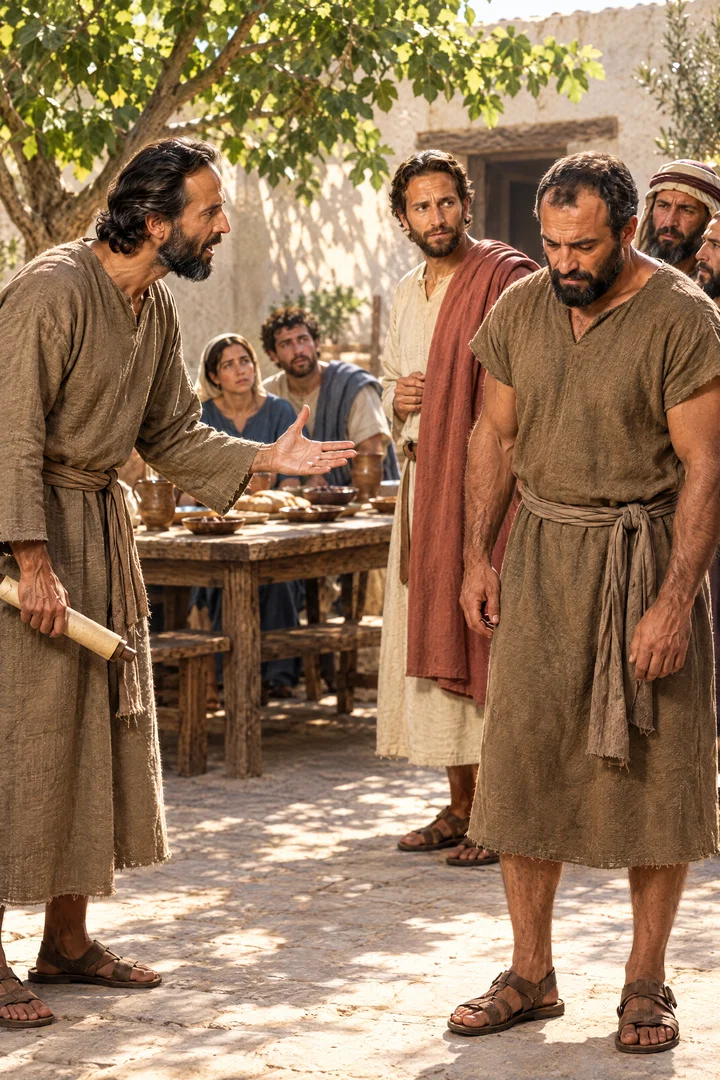
But when Peter was come to Antioch, I withstood him to the face, because he was to be blamed.
Translations
American King James Version, King James Version, KJV Cambridge Paragraph Bible
But when Peter was come to Antioch, I withstood him to the face, because he was to be blamed.
But when Peter had come to Antioch, I withstood him to the face, because he was to be blamed.
Revised Version, American Standard Version
But when Cephas came to Antioch, I resisted him to the face, because he stood condemned.
And when Peter came to Antioch, to the face I stood up against him, because he was blameworthy,
But when Peter came to Antioch, I withstood him to [ the] face, because he was to be condemned:
But, when Cephas came unto Antioch, to the face, [even], him, I resisted, because he stood condemned;
When Cephas came to Antioch, however, I opposed him to his face, because he stood to be condemned.
When Peter came to Antioch, however, I opposed him to his face, because he stood condemned.
But when Peter came to Antioch, I resisted him to his face, because he stood condemned.
But when Cephas came to Antioch, I made a protest against him to his face, because he was clearly in the wrong.
And when Peter was come to Antiochia, I withstood him to his face: for he was to be condemned.
Douay-Rheims (Challoner revision)
But when Cephas was come to Antioch, I withstood him to the face, because he was to be blamed.
Pictures
Cross-references 20 of 27
- Acts 15:1-2
And certain men which came down from Judæa taught the brethren, and said, Except ye be circumcised after the manner of Moses, ye cannot be saved.
The council was called to settle the circumcision question.
- Acts 10:28
And he said unto them, Ye know how that it is an unlawful thing for a man that is a Jew to keep company, or come unto one of another nation; but God hath shewed me that I should not call any man common or unclean.
Peter learned that he should not treat Gentiles as unclean.
- Acts 11:3
Saying, Thou wentest in to men uncircumcised, and didst eat with them.
Peter was criticized for entering and eating with uncircumcised Gentiles.
- Acts 15:7-11
And when there had been much disputing, Peter rose up, and said unto them, Men and brethren, ye know how that a good while ago God made choice among us, that the Gentiles by my mouth should hear the word of the gospel, and believe.
Peter testified that God accepted Gentile believers without imposing the disputed yoke.
- Galatians 2:1-3
Then fourteen years after I went up again to Jerusalem with Barnabas, and took Titus with me also.
Grouped with the circumcision requirements.
- Ephesians 2:14-16
For he is our peace, who hath made both one, and hath broken down the middle wall of partition between us;
Christ breaks down the barrier between Jews and Gentiles, making both one.
- Acts 10:34-35
Then Peter opened his mouth, and said, Of a truth I perceive that God is no respecter of persons:
Peter testified that God accepts people from every nation.
- Acts 15:19-20
Wherefore my sentence is, that we trouble not them, which from among the Gentiles are turned to God:
The council’s decision about Gentile converts was the ruling Peter later faced at Antioch.
- John 21:15-17
So when they had dined, Jesus saith to Simon Peter, Simon, son of Jonas, lovest thou me more than these? He saith unto him, Yea, Lord; thou knowest that I love thee. He saith unto him, Feed my lambs.
Peter professed his love for Jesus after his earlier failure and was restored.
- Luke 22:31-34
And the Lord said, Simon, Simon, behold, Satan hath desired to have you, that he may sift you as wheat:
Jesus warned Peter of his weakness and coming failure.
- Acts 15:5
But there rose up certain of the sect of the Pharisees which believed, saying, That it was needful to circumcise them, and to command them to keep the law of Moses.
Believers argued that Gentiles must be circumcised and keep Moses’ law.
- Matthew 16:18
And I say also unto thee, That thou art Peter, and upon this rock I will build my church; and the gates of hell shall not prevail against it.
Peter’s claimed foundational role is contrasted with his later correction.
- Acts 15:10
Now therefore why tempt ye God, to put a yoke upon the neck of the disciples, which neither our fathers nor we were able to bear?
Peter describes the disputed requirements as a burdensome yoke.
- Colossians 2:16-17
Let no man therefore judge you in meat, or in drink, or in respect of an holyday, or of the new moon, or of the sabbath days:
Food practices and holy days are shadows, while the substance belongs to Christ.
- Acts 2:14
But Peter, standing up with the eleven, lifted up his voice, and said unto them, Ye men of Judæa, and all ye that dwell at Jerusalem, be this known unto you, and hearken to my words:
Peter publicly preached the gospel at Pentecost.
- Acts 10:15
And the voice spake unto him again the second time, What God hath cleansed, that call not thou common.
God’s cleansing vision taught Peter the free gospel, yet he later faltered.
- Acts 15:22-23
Then pleased it the apostles and elders, with the whole church, to send chosen men of their own company to Antioch with Paul and Barnabas; namely, Judas surnamed Barsabas, and Silas, chief men among the brethren:
The Jerusalem council sends delegates and a message to Antioch.
- Matthew 26:69-75
Now Peter sat without in the palace: and a damsel came unto him, saying, Thou also wast with Jesus of Galilee.
Peter’s earlier denial of Christ arose from sudden fear.
- Acts 15:9
And put no difference between us and them, purifying their hearts by faith.
God made no distinction between Jewish and Gentile believers and purified hearts by faith.
- Luke 22:54-62
Then took they him, and led him, and brought him into the high priest’s house. And Peter followed afar off.
Peter’s earlier failure under pressure is recalled.
Commentary
Each commentary is drawn from primary sources: the writings of Ellen G. White and Adventist pioneers and periodicals. Each commentary is separate. Its own words are not a quotation; follow the references to read the source passages.
Ellen G. White
11 sources
Paul openly confronted Peter face to face at Antioch because Peter was at fault and blameworthy.8RED 34.2–35.1SLP 71.2–72.13SP 377.1–2ST Jun 26, 1879SLP 213.2–214.1 Before that confrontation Peter had overcome his natural prejudice and sat at table and eaten with the Gentile converts in harmony with the light given him from heaven and the decision of the council.8RED 34.2–35.1SLP 71.2–72.13SP 377.1–2ST Jun 26, 1879 When Jewish believers zealous for the ceremonial law came from Jerusalem, Peter withdrew from the Gentiles and changed his conduct toward the converts from paganism.8RED 34.2–35.1SLP 71.2–72.13SP 377.1–2ST Jun 26, 1879 In doing so he dissembled and acted a double, two-sided part that disguised his true convictions and sentiments and evaded the principles of the gospel.8RED 34.2–35.1SLP 71.2–72.1ST Jun 26, 1879Ms 122, 1897, par. 14–15SLP 213.2–214.1
He wavered in doing right from fear of men and desire for their approval, esteem, and to gain esteem.AA 199.2Ms 122, 1897, par. 14–15 His marked change of conduct made the converts from paganism feel rejected and left a most painful impression on their minds.8RED 34.2–35.1ST Jun 26, 1879 His example exerted a subverting influence in failing the principles of integrity and violating gospel principles, doing wrong to the church.ST Jun 26, 1879AA 199.2Ms 122, 1897, par. 14–15 That influence was followed by many others, even Barnabas, and threatened division in the church.8RED 34.2–35.1SLP 71.2–72.13SP 377.1–2ST Jun 26, 1879
Paul took a firm stand for the truth he had received from God and held to it despite opposition from Peter, a leading apostle and fellow worker, and others who thought it contradicted their teachings.Ms 18, 1897, par. 5–7 That truth was that God gives his gifts to all who seek him whether circumcised or uncircumcised and Gentile Christians must not be bound by unnecessary burdens.Ms 18, 1897, par. 5–7 Peter recognized his error and tried to repair the harm he had done.8RED 34.2–35.1SLP 71.2–72.13SP 377.1–2ST Jun 26, 1879
The incident shows that even the best of men and leading apostles will make grave blunders and err when left to themselves and not under the Spirit's direct influence.AA 199.2Ms 122, 1897, par. 14–15SLP 213.2–214.1ST May 1, 1884 Peter did so despite his previous fall and restoration, his long course of service, his intimate acquaintance with Christ and knowledge of Christ's pure straightforward practice of principle, and despite all the instruction, gifts, knowledge, and great influence he had received in preaching and teaching the Word.AA 199.2Ms 122, 1897, par. 14–15 His failure therefore reveals human weakness and fallibility, leaving no grounds for boasting and showing he stood no higher than the other apostles and was entitled to no prerogatives belonging only to God.8RED 34.2–35.1SLP 71.2–72.13SP 377.1–2ST Jun 26, 1879
The verse shows Peter could be publicly opposed and held responsible for his conduct, and his example instead supports equality with his fellow believers rather than an authoritative position over them.ST Jun 26, 18793SP 374.3 It gives no support to the claim that he was the church's supreme head or that he or his successors hold authority belonging only to God.ST Jun 26, 18793SP 374.3 His inability to steer himself safely despite his advantages teaches every man's own personal helplessness to steer his own vessel straight and safely into the harbor alone and continuing dependence on God.AA 199.2Ms 122, 1897, par. 14–15 The grace of Christ is essential every day and His matchless grace alone can save feet from falling.Ms 122, 1897, par. 14–15
The confrontation is recorded so others may profit by it, as a solemn warning to men in high places not to fail in integrity but to keep close to principle and carefully follow the way of the Lord.Ms 122, 1897, par. 14–15 The more responsibility placed on a man and the higher his position to dictate and control, the more mischief he will do in perverting minds and hearts if he does not do so.Ms 122, 1897, par. 14–15
Sources
Pioneers and periodicals
62 sources
When Peter came to Antioch he had been eating with Gentile believers but withdrew and separated himself when men from James arrived, because he feared those who insisted on circumcision and Jewish customs.ST Jul 22, 1913ST Aug 22, 1900ST Dec 22, 1898 Paul withstood him to the face and rebuked him openly before them all, because he was to be blamed and was not walking uprightly according to the truth of the gospel.ST Jul 22, 1913ST Aug 22, 1900RH Dec 27, 1853 By that separation Peter pressured Gentiles to live as Jews, implying that faith in Christ alone was not enough and that circumcision or works of the law were needed for salvation.ST Jul 22, 1913ST Aug 22, 1900RH Jun 10, 1875 The dispute concerned the ceremonial law and circumcision which the gospel abolished, not any precept of the Ten Commandments or the moral law.RH Jun 10, 1875ST May 27, 1875RH Apr 15, 1873 Peter was fallible and could seriously err even as an apostle, with no authority above the others and not above correction, while Paul's authority was wholly independent of him and equal to his.ST Mar 20, 1884ST Dec 3, 1894ST Jun 28, 1883ST Apr 13, 1915
Incident at Antioch
When Peter came to Antioch he had been eating freely with Gentile believers, but withdrew and separated himself when men from James, associated with circumcision, arrived, because he feared those who insisted on circumcision and Jewish customs.ST Jul 22, 1913ST Aug 22, 1900ST Dec 22, 1898RH Jun 10, 1875RH Dec 27, 1853 His change of conduct was dissimulation, acting a double part that disguised his true sentiments and hid what he really believed about fellowship with Gentiles.ST Jun 26, 1879ST Sep 6, 1883ST Aug 22, 1900 It was driven by fear of people and of criticism, by pride, and by deeply rooted Jewish prejudice against Gentiles that was difficult to throw off, not by a desire to keep a weak believer from stumbling and not by any biblical law forbidding such meals.ST Sep 6, 1883ST Dec 21, 1888ST Aug 22, 1900ST Dec 21, 1888 Peter had overcome his natural prejudice and sat at table in harmony with light given him from heaven, with his earlier practice, and with the decision of the council, then changed so markedly when Jews zealous for the ceremonial law came from Jerusalem.ST Jun 26, 1879ST Sep 6, 1883
His example drew other Jewish believers into the same hypocrisy, and even Barnabas was carried away with their dissimulation.ST Jul 22, 1913ST Aug 22, 1900ST Dec 22, 1898RH Dec 27, 1853 That conduct shook the faith of the Gentile converts, left a most painful impression on their minds, and threatened division in the church.ST Jun 26, 1879ST Jul 22, 1913 Paul withstood Peter to the face and rebuked him openly before them all, because Peter was to be blamed and stood condemned.ST Jul 22, 1913ST Aug 22, 1900RH Dec 27, 1853ST Sep 15, 1887ST Sep 15, 1909 They were not walking uprightly according to the truth of the gospel, and such public faults affecting others were to be reproved publicly, with decisive rebuke that Paul also used to secure unity by correcting conduct.ST Aug 22, 1900RH Dec 27, 1853ST Sep 15, 1887RH Jan 13, 1874
The confrontation came after the Jerusalem council and concerned the same question considered in Acts 15, whether anything besides faith in Christ, such as circumcision and the ceremonial law, was necessary for salvation.ST Aug 8, 1900 Peter was acting contrary to that decision and to his earlier light and practice, with danger of leading converts away from the gospel.ST Jun 26, 1879ST Sep 6, 1883 The verse stands in the first four chapters of Galatians, a strong letter addressed to a group of churches among the Gauls or Celts who entered Asia Minor about the third century before Christ and settled west of Pontus and Cappadocia and north of Phrygia, in territory that became a Roman province about 189 B.C. and by 25 B.C. included Lycaonia, Pisidia, Pamphylia and a large part of Phrygia.ST Nov 18, 1913 During Paul's absence Judaizing teachers had found access to them, some were falling back into old idolatry and treating circumcision as important under the former law system, and Paul wrote with exceptional sympathy to set forth in condensed, strong argument the relation of Christ to the law with emphasis upon justification by faith in Christ.ST Nov 18, 1913RH Oct 8, 1857
Paul wrote this about eight years before Peter wrote his second epistle, so Peter knew he had been placed in this light before the church and the world.ST Apr 17, 1907 Paul's sharp contention with Peter was a disagreement with one apostle, not opposition to the church as a body.ST Nov 25, 1889
Gospel Truth at Stake
At Antioch Peter had been eating freely with Gentile believers but withdrew and separated himself when men from James associated with circumcision arrived, because he feared those who insisted on circumcision and Jewish customs.ST Jul 22, 1913ST Aug 22, 1900RH Dec 27, 1853ST May 27, 1875RH Apr 15, 1873 His dissembling drew other Jewish believers after him, even Barnabas, shook the faith of the Gentile converts, and was not upright according to the truth of the gospel.ST Jul 22, 1913ST Aug 22, 1900RH Dec 27, 1853ST May 27, 1875ST Sep 6, 1883 Paul therefore withstood him to the face and rebuked him openly before them all, because he was to be blamed.ST Jul 22, 1913ST Aug 22, 1900RH Dec 27, 1853ST May 27, 1875RH Apr 15, 1873 By that separation Peter pressured Gentiles to live as Jews, to live according to Jewish ceremonial customs, as if that ceremonial distinction about eating were still binding.ST Jul 22, 1913ST Aug 22, 1900RH Jun 10, 1875ST May 27, 1875RH Apr 15, 1873 If a Jewish Christian could disregard it and live after the manner of Gentiles, Gentile Christians had still less reason to observe it and must not be compelled to keep it.RH Jun 10, 1875ST May 27, 1875RH Apr 15, 1873
Such withdrawal implied that faith in Christ alone was not enough and that circumcision or works of the law were needed for salvation.ST Aug 22, 1900ST Dec 22, 1898 Done during a live controversy over circumcision and salvation, withdrawing from uncircumcised believers publicly denied Christ even when unintentional, confused believers, and contradicted salvation by faith alone.ST Dec 22, 1898 Justification comes through faith in Jesus Christ, not by works of the law, and faith in Christ rather than forms and ceremonies is central.ST Aug 22, 1900ST Sep 6, 1883
Paul treated this apparently small change in conduct as violation of a fundamental gospel principle, showing that faithfulness in small actions matters when truth is at stake.RH Jun 11, 1908 To rebuild the Jew-Gentile division the gospel broke down makes one a transgressor.RH Mar 25, 1873RH Mar 25, 1873 No promise can now be claimed by one born a Jew that cannot be claimed by one born a Gentile, for all God's promises are through Christ, mediator of the new covenant, so restoration cannot be claimed by Moab or Ammon as a separate people any more than by Israel according to the flesh.RH Mar 25, 1873RH Mar 25, 1873 The same confrontation rebukes the spirit of pride and disregard for others, connecting correction of Peter to correction of neglect and contempt for the poor and common people.RH Jun 30, 1863
Ceremonial Law Settled
The clash at Antioch turned on the ceremonial law, circumcision, and separation in eating with Gentiles, which the gospel abolished, not on any precept of the Ten Commandments or the moral law.RH Jun 10, 1875ST May 27, 1875RH Apr 15, 1873ST Mar 20, 1879ST May 27, 1875 Peter first ate freely with Gentile believers, then withdrew and separated himself when men associated with circumcision and with James arrived, fearing those of the circumcision.RH Jun 10, 1875ST May 27, 1875RH Apr 15, 1873 That withdrawal pressured Gentiles to live according to Jewish ceremonial customs and treated that law as still binding on Christians.RH Jun 10, 1875ST May 27, 1875RH Apr 15, 1873ST May 27, 1875 By his example he led the other Jews and even Barnabas to dissemble with him, so that they did not walk uprightly according to the truth of the gospel.ST May 27, 1875ST May 27, 1875 The incident has no bearing on the moral law but is directly to the point if the ceremonial law is meant, proving the law under discussion in Galatians is that ceremonial law.ST May 27, 1875ST May 27, 1875
Peter, though a Jew, had lived after the manner of Gentiles by disregarding ceremonial distinctions about eating with Gentiles.ST May 27, 1875ST May 27, 1875 Then by withdrawing he acted as if that ceremonial law were still binding and compelled the Gentiles to live as Jews.ST May 27, 1875ST May 27, 1875 If a Jewish Christian could disregard that law, Gentile Christians had still less reason to observe it.ST May 27, 1875 They are not to be compelled to keep that law which is no longer to be kept.ST May 27, 1875ST May 27, 1875
The incident illustrates that the code creating national distinction between Jews and Gentiles — the circumcision requirement and the ceremonial law — was to be removed and abolished so God could make them one people.ST Jan 30, 1879ST Feb 22, 1883 Peter knew the Gentiles' place in the church and their relation to the law, yet acted against what he knew.RH Jan 4, 1906 Paul therefore opposed Peter because of Peter's conduct, not because of the teaching in his God-given epistles.ST Jan 23, 1912RH Jan 4, 1906 Peter acknowledged that his conduct was wrong while his apostolic teaching remained true.RH Jan 4, 1906
Peter Not Infallible Head
Peter at Antioch proves that an apostle could seriously err and be at fault, for though highly gifted by the Spirit he failed to stand openly for what was right and was blameworthy, and Paul opposed him openly because he was at fault.ST Mar 20, 1884ST Dec 3, 1894RH Jun 11, 1901ST Apr 15, 1875 His inconsistency with his earlier position after his conversion and after his earlier fall shows that spiritual gifts do not make a person infallible or keep that person from error, and that even the most gifted remain dependent on God for help and strength through faith and prayer, in contrast with the boldness he later showed when filled with the Holy Spirit.ST Mar 9, 1882RH Jun 11, 1901ST Apr 15, 1875 His acting dissimilarly and deviating from Christ's teaching and example when he was culpable shows that apostolic office itself did not confer infallibility.ST Jun 28, 1883
His failure demonstrates that he was no more than a human being, with human weakness and no grounds for boasting or standing above the other apostles.ST Jun 26, 1879ST Mar 20, 1884ST Mar 20, 1884 He had no authority or prerogatives above those of the other apostles or belonging only to God, was not superior to the other apostles, and was not above correction even though one of the pillars, so that no leader is above open rebuke when wrong and no human rule is to be established in the church.ST Mar 20, 1884ST Jul 5, 1910RH Mar 5, 1901 Paul could openly correct him because his ministry rested on direct calling from God, and Peter recognized his error and tried to repair the harm.ST Jun 26, 1879RH Mar 5, 1901
Apostolic practice is not binding when it departs from Christ, and apostolic teaching has authority only insofar as it agrees with his teaching and example.ST Jun 28, 1883 The example of the apostles, including their mistakes, conflicts, and withdrawal from Gentile believers under pressure, is not itself a rule for Christian practice, and their teaching is to be followed only when it agrees with Scripture.ST Jun 28, 1883ST Sep 6, 1883 No human religious authority is infallible, but a person is reliable only when in harmony with God's infallible Word.ST May 4, 1904
Paul's authority was wholly independent of Peter and equal to Peter's, for Paul did not acknowledge Peter's supremacy, did not defer to Peter or regard him as pope or head of the church, but withstood him to the face and rebuked him openly for hypocrisy in the church raised up by Paul and Barnabas, while Peter deferred to James the brother of the Lord.ST Apr 13, 1915 When Peter was at Antioch he did not act as pope, vicar of Christ on earth, or supreme infallible head of the church, and if he had been pope and had known it he would have acted as pope at Antioch, just as he would have at Pentecost, at the council of Jerusalem, and in his two epistles, which he did not.RH Jun 13, 1871 During the lifetime of the apostles the church never thought of a pope, and Peter's willingness to receive reproof and profit by it shows he did not consider himself head of the church or above reproof.ST Apr 13, 1915RH Jun 13, 1871
Peter accepted the reproof as just, made no defense of his conduct, never found fault with Paul for giving it, and later called him beloved brother, and the confrontation did not leave lasting hard feelings.ST Sep 6, 1883ST Apr 13, 1915 He acknowledged that his conduct was wrong while his apostolic teaching was true, though he knew the Gentiles' place in the church and their relation to the law yet acted against what he knew.ST Jun 26, 1879RH Jan 4, 1906 He accepted Paul's rebuke with the humility of a sincere Christian, showing he was not the prince of the apostles or a pope and that no church leader has lordship over other believers.ST Dec 22, 1898
Peter did not retaliate, though he could have pointed to Paul having Timothy circumcised because of the Jews and consenting to purify himself and have an offering offered for him according to the ritual law while for years preaching that circumcision was nothing and the ceremonial law was abolished and its services vain.ST Apr 17, 1907 His dissembling in eating with Gentile disciples when Jewish disciples were absent but declining to do so when they were present was blameworthy, unlike Paul's participation in the Jerusalem purification rite, and Paul wrote this about eight years before Peter wrote his second epistle, so Peter knew he had been placed in this light before the church and the world.ST Apr 17, 1907RH Aug 19, 1873 Peter only said Paul's writings contain some things hard to be understood, and would not wrest them nor take unjust advantage, which shows great victory over his naturally impetuous temper and full development of faith, virtue, knowledge, temperance, patience, godliness, brotherly kindness and charity by which the diligent follower steps into the everlasting kingdom.ST Apr 17, 1907
Paul's withstanding Peter to the face because Peter was to be blamed proves that not all apostles were prophets and not all prophets were apostles and not all held the same position.RH Aug 10, 1916 All other prophets were subject to the one leading prophet at a time, who possessed both the gift of apostleship and the gift of prophecy.RH Aug 10, 1916
Pattern for Faithful Reproof
When a fault is public and draws others into it, it is to be reproved publicly.RH Dec 27, 1853 Paul withstood Peter to the face at Antioch because Peter was to be blamed, having eaten with Gentile believers and then withdrawn and separated himself when men associated with James arrived, from fear of those pressing circumcision, with other Jewish believers following his dissimulation until even Barnabas was carried away.RH Dec 27, 1853 Paul saw they were not walking in line with the truth of the gospel and rebuked Peter before them all for pressuring Gentiles to live as Jews.RH Dec 27, 1853ST Sep 12, 1900 Such open, direct, face-to-face confrontation without trembling reserve or complimenting error is right and necessary, and decisive rebuke of conduct or teaching that subverts the gospel is not in itself evidence of a bad spirit nor to be passed over with indifference as a harmless difference of opinion.ST Apr 1, 1889ST Dec 1, 1887ST May 27, 1913
Paul's course is plain, faithful preaching set against cowardly, flattering dissimulation.RH Jul 6, 1868ST Oct 28, 1875 Cowardice in a minister is baser than in a soldier because the warfare is more honorable, and a fawning minister who dares not deal plainly with conscience is a man's worst enemy, wronging souls more by oil-like praise than by salt-like reproof, while faithful reproof gains more love and honor at the last.RH Jul 6, 1868 His rebuke was not driven by self-importance but by humility, a sense of unworthiness and duty to God, by hatred of sin that calls wrong by its right name and vindicates the right despite wounded feelings or consequences, and by fidelity to the faith.RH Mar 31, 1868RH Jul 22, 1873 Humility therefore does not silence needed correction but leads a person to speak plainly for God's cause with self-effacement rather than self-exaltation, so that the one corrected may recognize the wrong and repent, as Peter afterward praised Paul's wisdom.RH Jul 6, 1868RH Mar 31, 1868ST Oct 28, 1875 Adapting conduct to reach others never meant compromising integrity or yielding to unholy practice, in contrast to Peter's blameworthy compromise of hiding the gospel by withdrawing from Gentile believers.RH Jul 15, 1862ST Jul 28, 1909
Paul kept the faith even while correcting an erring fellow believer, though Peter was one of the pillars and foremost among the apostles.RH Mar 5, 1901ST Feb 3, 1881RH Aug 10, 1876RH Jul 22, 1873 He sought to establish no human rule in the church, showing that no leader is above open rebuke when wrong.RH Mar 5, 1901 He could so rebuke because his ministry rested on direct calling from God.RH Mar 5, 1901
The same withstanding to the face condemns keeping one standard of reform among friends and an altogether different standard among strangers.ST Nov 19, 1902 Peter yielded to that temptation to a double standard, and it was blameworthy and called for plain, face-to-face reproof.ST Nov 19, 1902
Peter's dissimulation came from pride and fear of people, a weakness that his earlier fall and later spiritual service had not removed.ST Dec 21, 1888ST Dec 21, 1888 He had not fully taken to heart the lesson of Christ's earlier reproof, so God mercifully allowed him to fall again when standing against the powers of darkness, and through this second failure and Paul's open reproof he learned more fully how weak and sinful the failing was.ST Dec 21, 1888 Yet his erring after conversion does not prove he had never been converted.ST Mar 9, 1882
The apostles secured Christian unity not only by teaching but also by correcting conduct.RH Jan 13, 1874 The religion of Christ is not mere concession and yielding compliance for the sake of peace, love, and harmony.RH Nov 7, 1912 Peace, love, and harmony are greatly to be desired, but never at the sacrifice of vital principle, and when great principles are at stake duty demands a firm, open stand so all may know clearly where allegiance lies.RH Nov 7, 1912
Sources