2 Corinthians 11:25
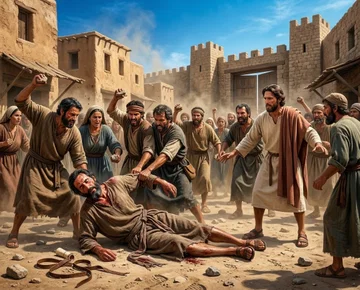
Thrice was I beaten with rods, once was I stoned, thrice I suffered shipwreck, a night and a day I have been in the deep;
Translations
American King James Version, King James Version
Thrice was I beaten with rods, once was I stoned, thrice I suffered shipwreck, a night and a day I have been in the deep;
Thrice was I beaten with rods, once was I stoned, thrice I suffered shipwrack, a night and a day I have been in the deep;
Thrice was I beaten with rods, once I was stoned, thrice I suffered shipwreck, a night and a day I have been in the deep;
Revised Version, American Standard Version
Thrice was I beaten with rods, once was I stoned, thrice I suffered shipwreck, a night and a day have I been in the deep;
thrice was I beaten with rods, once was I stoned, thrice was I shipwrecked, a night and a day in the deep I have passed;
Thrice have I been scourged, once I have been stoned, three times I have suffered shipwreck, a night and day I passed in the deep:
Thrice, have I been beaten with rods, once, have I been stoned, thrice, have I been shipwrecked, a day and night, in the deep, have I spent;
Berean Standard Bible, Majority Standard Bible
Three times I was beaten with rods, once I was stoned, three times I was shipwrecked. I spent a night and a day in the open sea.
Three times I was beaten with rods. Once I was stoned. Three times I suffered shipwreck. I have been a night and a day in the deep.
Three times I was whipped with rods, once I was stoned, three times the ship I was in came to destruction at sea, a night and a day I have been in the water;
I was thrise beaten with roddes: I was once stoned: I suffered thrise shipwracke: night and day haue I bene in the deepe sea.
Douay-Rheims (Challoner revision)
Thrice was I beaten with rods, once I was stoned, thrice I suffered shipwreck, a night and a day I was in the depth of the sea.
Pictures

Cross-references 20 of 22
- Acts 14:19
And there came thither certain Jews from Antioch and Iconium, who persuaded the people, and, having stoned Paul, drew him out of the city, supposing he had been dead.
Paul is stoned at Lystra and left for dead while carrying out his ministry.
- Acts 9:16
For I will shew him how great things he must suffer for my name’s sake.
Foretells the suffering Paul later lists for Christ’s name.
- Acts 16:22-23
And the multitude rose up together against them: and the magistrates rent off their clothes, and commanded to beat them.
Paul and Silas are beaten with rods and imprisoned.
- Hebrews 11:36-38
And others had trial of cruel mockings and scourgings, yea, moreover of bonds and imprisonment:
Both describe faithful servants enduring severe suffering, violence, and hardship.
- 2 Corinthians 12:10
Therefore I take pleasure in infirmities, in reproaches, in necessities, in persecutions, in distresses for Christ’s sake: for when I am weak, then am I strong.
Paul’s hardships for Christ are infirmities in which he takes pleasure.
- Acts 27
And when it was determined that we should sail into Italy, they delivered Paul and certain other prisoners unto one named Julius, a centurion of Augustus’ band.
Describes the later shipwreck on Paul’s voyage to Rome.
- Acts 7:58
And cast him out of the city, and stoned him: and the witnesses laid down their clothes at a young man’s feet, whose name was Saul.
Paul recalled Stephen’s stoning while suffering a similar attack.
- Galatians 6:17
From henceforth let no man trouble me: for I bear in my body the marks of the Lord Jesus.
Paul bears bodily marks from his service to Christ.
- Acts 21:13
Then Paul answered, What mean ye to weep and to break mine heart? for I am ready not to be bound only, but also to die at Jerusalem for the name of the Lord Jesus.
Paul is ready to die for the name of Jesus.
- Acts 20:24
But none of these things move me, neither count I my life dear unto myself, so that I might finish my course with joy, and the ministry, which I have received of the Lord Jesus, to testify the gospel of the grace of God.
Paul persists in his ministry despite hardship.
- 2 Corinthians 4:8-11
We are troubled on every side, yet not distressed; we are perplexed, but not in despair;
Paul’s afflictions embody Jesus’ dying and reveal his life.
- Acts 27:41-44
And falling into a place where two seas met, they ran the ship aground; and the forepart stuck fast, and remained unmoveable, but the hinder part was broken with the violence of the waves.
Paul survives a shipwreck while traveling to Rome.
- 1 Corinthians 4:11-13
Even unto this present hour we both hunger, and thirst, and are naked, and are buffeted, and have no certain dwellingplace;
Paul’s hardships and treatment as an outcast are also described.
- Acts 22:24
The chief captain commanded him to be brought into the castle, and bade that he should be examined by scourging; that he might know wherefore they cried so against him.
Paul’s earlier beatings precede threatened examination by scourging.
- 2 Corinthians 11:29-30
Who is weak, and I am not weak? who is offended, and I burn not?
Paul’s hardships prompt sympathy for the weak and glorying in his infirmities.
- 2 Timothy 3:11
Persecutions, afflictions, which came unto me at Antioch, at Iconium, at Lystra; what persecutions I endured: but out of them all the Lord delivered me.
Paul recalls the persecutions he endured, including the hardships described here.
- 2 Corinthians 6:4-5
But in all things approving ourselves as the ministers of God, in much patience, in afflictions, in necessities, in distresses,
Paul describes enduring afflictions, including beatings and shipwrecks.
- Acts 20:23
Save that the Holy Ghost witnesseth in every city, saying that bonds and afflictions abide me.
Paul endured severe afflictions and knew further bonds and afflictions awaited him.
- Acts 28
And when they were escaped, then they knew that the island was called Melita.
Paul’s journey to Rome is also offered as an example of his labor and sacrifice.
- Acts 5:40
And to him they agreed: and when they had called the apostles, and beaten them, they commanded that they should not speak in the name of Jesus, and let them go.
Both describe beating for preaching Christ.
Commentary
Each commentary is drawn from primary sources: the writings of Ellen G. White and Adventist pioneers and periodicals. Each commentary is separate. Its own words are not a quotation; follow the references to read the source passages.
Ellen G. White
18 sources
Paul recounts being struck with rods three times, stoned once, wrecked at sea three times, and adrift in the open water for a full night and day.RH Sep 14, 1911Lt 1, 1883, par. 40–41ST May 19, 1914 The stoning took place at Lystra, where a furious crowd battered him until he appeared dead, dragged his senseless body outside the city and abandoned it, yet he rose up, praised God, went back into the city and carried on with his work.3SP 366.1–2SLP 60.2–3ST Jun 19, 1879 These afflictions were part of a far wider endurance of whippings and imprisonments, cold and hunger and thirst, and dangers on land and sea, in city and wilderness, from countrymen and heathen and false brethren, all borne for the truth and the gospel.SLP 147.1–3RH Sep 14, 1911AA 296.3–297.1 He gives only an occasional glimpse of such labors and does not linger over his own hardships, but points to Jesus, rejoices even in tribulation, and exalts the grace of God.SLP 147.1–3AA 296.3–297.1Lt 1, 1883, par. 40–41 His steadfastness was upheld by divine power as a witness to God's promises, presence and sustaining grace, showing that Satan could torment and kill the body but could not destroy the life hidden with Christ in God, so that faithful witnesses who suffer reproach for truth become conquerors looking to eternal glory.ST Nov 18, 1889GW 18.1RH Sep 12, 1912AA 575.1ST May 19, 1914
What Paul Suffered
The verse lists three beatings with rods, one stoning, three shipwrecks, and a night and a day spent in the deep amid danger on the sea.RH Sep 14, 1911Lt 1, 1883, par. 40–41ST May 19, 1914 These beatings, stoning, imprisonments and shipwrecks were endured for the sake of the gospel and in faithful work for Christ.RH Sep 14, 1911Lt 1, 1883, par. 40–41ST May 19, 1914 They are examples of the reproach, persecution and severe physical suffering that may accompany service for the truth.ST May 19, 1914
The stoning took place at Lystra, where an enraged mob hurled stones at him.3SP 366.1–2SLP 60.2–3ST Jun 19, 18798RED 23.2–25.1 He was left bruised and battered and apparently dead or lifeless, and his unconscious body was dragged outside the city and left beneath its walls.3SP 366.1–2SLP 60.2–3ST Jun 19, 18798RED 23.2–25.1 Yet he rose again, praised God, returned to the city, and continued his work.3SP 366.1–2SLP 60.2–38RED 23.2–25.1
These sufferings belong to a larger record of stripes and imprisonment, cold and hunger and thirst, and perils by land and by sea, in the city and in the wilderness.SLP 147.1–3RH Sep 14, 1911AA 296.3–297.1 They came from his own countrymen, from the heathen, and from false brethren, and all were endured for the truth's sake and for the sake of the gospel.SLP 147.1–3RH Sep 14, 1911AA 296.3–297.1 They belonged to a ministry of incessant labor, many trials, and deep anguish.SLP 147.1–3
At Ephesus he taught in public and from house to house with tears.SLP 147.1–3 There he met continual opposition from unbelieving Jews and repeated attacks by the mob with insult and abuse.SLP 147.1–3 He bore the burden of all the churches, worked with his own hands to supply his necessities, and pressed on in weariness and painfulness from unceasing toil and constant danger.SLP 147.1–3 Enfeebled by disease and at times depressed in spirits, he spent sleepless nights in prayer over apostasy in churches of his own planting.SLP 147.1–3
Amid the constant storm of opposition, the clamor of enemies, and the desertion of friends, he almost lost heart.AA 296.3–297.1 But looking back to Calvary he pressed on with new ardor to spread the knowledge of the Crucified.AA 296.3–297.1 He trod the blood-stained path Christ had trodden before him and sought no discharge from the warfare till he should lay off his armor at his Redeemer's feet.AA 296.3–297.1
He endured pain, peril, severe burdens, and hardship as a faithful messenger to the Gentiles for preaching Christ and the gospel, for the truth, and to bless others.GW 18.1RH Sep 12, 19124T 525.1AA 575.1 He was imprisoned, beaten with rods, and stoned because he faithfully carried God's message.GW 18.1RH Sep 12, 19124T 525.1AA 575.1 He was finally put to death for that faithfulness, showing that faithful labor for God can involve great physical and mental strain.AA 575.1Lt 18, 1862, par. 18–21
Faithfulness Under Trial
Paul gives in this verse only one of the occasional glimpses found in his epistles of his labors and sufferings for Christ, for he does not dwell on his own trials or make them the focus.SLP 147.1–3AA 296.3–297.1Lt 1, 1883, par. 40–41 He turns attention away from himself to Jesus and remains joyful amid tribulation, turning from his hardships to magnify God's grace.Lt 1, 1883, par. 40–41Lt 1, 1883, par. 10–11 The stripes and imprisonment, cold and hunger and thirst, and perils by land and by sea, in the city and in the wilderness, from his own countrymen, from the heathen, and from false brethren were all endured for the truth's sake and for the sake of the gospel.SLP 147.1–3AA 296.3–297.1 They belonged to a ministry of incessant labor, many trials, and deep anguish, as at Ephesus where he taught in public and from house to house with tears, met continual opposition from unbelieving Jews and repeated attacks by the mob with insult and abuse, bore the burden of all the churches, worked with his own hands to supply his necessities, and pressed on in weariness and painfulness from unceasing toil and constant danger, enfeebled by disease, at times depressed in spirits, and spending sleepless nights in prayer over apostasy in churches of his own planting.SLP 147.1–3 Amid the constant storm of opposition, the clamor of enemies, and the desertion of friends he almost lost heart, but looking back to Calvary he pressed on with new ardor to spread the knowledge of the Crucified, treading the blood-stained path Christ had trodden before him and seeking no discharge from the warfare till he should lay off his armor at his Redeemer's feet.AA 296.3–297.1
His steadfastness as a faithful messenger to the Gentiles, beaten and stoned for preaching Christ, was sustained by divine power.GW 18.1RH Sep 12, 1912 That steadfastness under persecution witnesses to God's faithful promises, abiding presence, and sustaining grace, and stands as an example because he faithfully carried God's message despite imprisonment, beatings with rods, and stoning.GW 18.1RH Sep 12, 1912 His severe persecution and physical suffering show that Satan could torture and kill the body but could not destroy the life kept with Christ in God.ST Nov 18, 1889 Through steadfast faith the persecuted became conquerors who looked beyond present suffering to the glory and reward of the eternal world.ST Nov 18, 1889
The beatings, stoning, imprisonment, and shipwrecks, including repeatedly being shipwrecked and once spending a night and a day in the deep, exemplify the reproach and persecution that God's appointed witnesses in all ages expose themselves to for the truth's sake and that may accompany service for the truth and faithful work as God's messenger.AA 575.1ST May 19, 1914 His account describes severe trials greater than those Brother Andrews had experienced or would be called to endure.Lt 1, 1883, par. 10–11 As part of his relation of his experience in 2 Corinthians 11, the verse is to be studied and made to talk and to speak decidedly, giving a deeper experience that keeps a worker out of controversies and out of seeking to be original with odd notions, and that moves the work in a dignified, elevated, and ennobling manner.13MR 327.1–2
The chapter where the verse stands contains much instruction showing that those who view matters with human eyesight make very grave mistakes when they take up a work God has not appointed but has condemned, the work of criticizing and climbing upon the judgment seat to pronounce sentence.Ms 142, 1897, par. 16 For their own spiritual advancement it is far better to watchfully examine their own hearts and look well to their own shortcomings and defects of character.Ms 142, 1897, par. 16 This self-examination is in order to remove from themselves the beam of faultfinding, evil surmising, evil speaking, bearing false witness, hatred, and accusing of the brethren.Ms 142, 1897, par. 16
Sources
Pioneers and periodicals
110 sources
The verse lists three Roman beatings with rods, one stoning at Lystra where he was left for dead, three shipwrecks before the voyage to Rome, and a night and a day spent in the depths of the sea.ST Aug 21, 1879ST Nov 21, 1892RH Oct 31, 1854ST May 14, 1902ST Jan 29, 1885
He set down these afflictions under necessity to defend his apostleship and call against false apostles, and his glorying was not boasting or egotism.ST Jan 24, 1884RH Nov 24, 1868RH May 25, 1905RH Jun 27, 1871
His sufferings prove his message true, for he gained no honor, wealth or power by preaching Christ but only bonds, afflictions and contempt, leaving him no human motive to invent a falsehood.ST Apr 26, 1883RH Feb 4, 1862RH Oct 7, 1862
They show the severe cost through which the truth was planted and the church built, in whole consecration to Christ without consulting ease, convenience or worldly interest.RH Jul 25, 1871ST Nov 30, 1882ST Aug 29, 1878ST Aug 13, 1902
He counted such afflictions light beside the coming glory, endured them without forsaking God, and found Christ's grace sufficient and made perfect in weakness.RH Mar 27, 1866RH May 19, 1910ST Nov 21, 1911RH Jan 7, 1873
Words and Historical Setting
The verse lists three beatings with rods, one stoning, three shipwrecks, and a night and a day spent in the deep as physical dangers and hardships endured in ministry, involving painful labor, hunger, thirst, and exposure.ST Aug 21, 1879ST May 1, 1901ST Jan 28, 1875RH Aug 23, 1864RH Jul 25, 1871 They were part of sufferings for Christ and the gospel, borne in willingness to suffer for truth rather than counting life and ease more precious than service to God.RH Sep 8, 1904RH Aug 23, 1864RH Jul 25, 1871 They illustrate the severe perils faced by the apostolic church and the perseverance shown in service for the gospel and the Christian mission.ST May 1, 1901ST Jan 28, 1875
The word rendered deep means the depths of the sea where a night and a day was spent after shipwreck, and it is ordinarily translated deep.RH Oct 31, 1854RH Feb 4, 1858 Unlike the emphatic form meaning very deep, it does not itself mean a bottomless pit or place of punishment.RH Oct 31, 1854 The phrase a night and a day denotes a civil or calendar day of twenty-four hours, with the night preceding the daylight.RH Feb 28, 1871 It gives the measure of hardship in the shipwrecks, endured without being frightened by extreme physical danger.RH Feb 4, 1858RH Jan 20, 1916 It is applied to thirty-six hours spent at sea in a typhoon, when the vessel was buffeted by waves and made little progress, which made the hardship of the storm more vivid.RH Jan 7, 1915RH Jan 20, 1916
The three beatings with rods were Roman beatings inflicted with the fasces of Roman lictors, which had already scarred the back before being taken from the temple mob into the Roman barracks to be examined by scourging.ST Jan 29, 1885 Those three Roman beatings were distinct from the five Jewish punishments of thirty-nine strokes with thongs, and both were distinct from the Roman flagellum, the whip used to force confession by torture.ST Jan 29, 1885 That torturing whip was then threatened and had been suffered by Jesus not far from that same spot.ST Jan 29, 1885 The beating at Philippi, suffered with Silas, was one of those three occasions with rods.ST Jun 24, 1897 Those who count five beatings with rods besides the stoning where he was left for dead teach that even a tactful person who seeks to please others may face strong opposition when faithful to what is right.ST Aug 25, 1887
The single stoning was the stoning at Lystra, endured along with beatings, shipwrecks, and a night and day in the deep as evidence of persecution.ST Jun 19, 1879ST Nov 21, 1892RH Feb 4, 1915 There an enraged crowd hurled stones, dragged the apparently lifeless body outside the city, and left it beneath its walls, leaving him for dead.ST Jun 19, 1879RH Feb 4, 1915 Yet it was endured and did not stop pressing on in the work.RH Feb 4, 1915 Three shipwrecks had been suffered personally before the shipwreck on the voyage to Rome described in Acts 27.RH Apr 21, 1903 The journey from the coast to Antioch in Pisidia likely included some of the dangers and sufferings enumerated in the surrounding passage in 2 Corinthians 11:23-27.ST May 14, 1902 The beatings, stoning, and shipwrecks show how the Lord's prediction that suffering would come for Christ's name was fulfilled, even though pardon had been granted for persecuting the church.ST Jan 24, 1884RH Mar 10, 1868
Why Paul Listed Sufferings
The verse belongs to the record of afflictions and persecutions endured for the sake of the gospel, set down under urgent necessity as a defense of apostleship and call to the ministry against false apostles.ST Jan 24, 1884RH Nov 24, 1868RH May 25, 1905 It stands among the perils of an eventful career, including peril from false brethren, reflecting bitter experience with false apostles at Corinth.ST Apr 17, 1884 It is also an important historical record of trials not recorded elsewhere.ST Jan 24, 1884
The account was not boasting or egotism, for after recounting great labors and sufferings the glorying was called foolish.ST Jan 24, 1884RH Nov 24, 1868 Referring to beatings with rods, stoning, shipwrecks, and time in the deep to show labor and sacrifice for the cause was legitimate in defense of ministry when it served the good of the cause.ST Jan 24, 1884RH Jun 27, 1871 The hardships are not grounds for boasting or complaint, since glory is in infirmities so that Christ's power may rest upon the sufferer.RH Sep 8, 1904
Dangers that exceeded human power were faced repeatedly for defended principles, and the briefness of the mention shows courage without boasting and the bravery of a good soldier of Christ.RH Apr 10, 1900 Severe physical danger and suffering, including beatings and stoning, were endured in faithfulness to duty, not as acts for applause or personal glory, exemplifying the courage and endurance required of a Christian soldier.RH Apr 10, 1900 The three beatings with rods, one stoning, three shipwrecks, and a night and a day in the deep therefore display courage without self-display.RH Sep 8, 1904RH Apr 10, 1900RH Apr 10, 1900
The labors and sufferings are presented as a heavy burden borne in ministry, with the sufferer identifying himself as the bearer.RH May 18, 1869 They were extraordinary burdens showing why encouragement, support, and sustaining grace were needed. They formed part of a burden that threatened gloom and discouragement, showing why the encouragement of the vision of Paradise was needed.RH May 18, 1869
Willingness to endure beatings, stoning, shipwrecks, and danger for the message testifies to the call to the ministry and shows complete commitment to God's work in the spirit of an ambassador who puts the cause before self.RH May 25, 1905 Firsthand experience of such severe hardship supports authority to speak about confidence in God's love.ST Jun 18, 1896
Proof of the Gospel Message
The list of three beatings with rods, a stoning, three shipwrecks, and a night and a day in the deep belongs to Paul's proof of his call to the ministry, standing together with labors, imprisonments, perils, weariness, watchings, hunger, thirst, fastings, cold and nakedness.RH Feb 4, 1862 It means the apostles gained no honor, wealth, or power by preaching Christ, but only bonds, afflictions, misery, and contempt.RH Feb 4, 1862
They had no human motive to invent a falsehood, because their doctrine was unpopular and reproved wicked practices.ST Apr 26, 1883 It opposed the habits, prejudices, and dispositions of Romans, Greeks, and Jews and brought persecution from place to place.RH Feb 4, 1862 People enraged by the teaching could not answer its arguments or overthrow its truth.ST Apr 26, 1883
Their honesty is shown because if their testimony were mere contrivance it is strange that they stuck to it and submitted to suffering.RH Feb 4, 1862 They joyfully took the spoiling of goods, willingly were counted fools and the offscouring of all things, rejoiced to suffer shame, and at last died in attestation of the truth when they could have renounced their religion and retrieved their losses.RH Feb 4, 1862 His acceptance of pain and danger rather than abandoning his message supports that he sincerely believed what he preached.RH Feb 4, 1862RH Oct 7, 1862
His example of enduring violence and danger shows that threats and punishment should not keep a person from speaking the truth boldly.RH Apr 23, 1872 The apostles were whipped and stoned under opposition from the Roman state, yet the gospel continued to spread through God's power.ST Sep 11, 1907 Such whippings and other persecution suffered for faith did not stop the gospel work from moving steadily forward.ST Sep 11, 1907RH Sep 17, 1903
Pattern for Faithful Service
The beatings with rods three times, the single stoning, the three shipwrecks, and the night and a day spent in the deep are the severe cost endured in defending the gospel in long work preaching Christ in distant lands amid bitter opposition.RH Jul 25, 1871ST Aug 29, 1878RH Oct 1, 1872RH Aug 19, 1909 They illustrate the sacrifice through which the truth of God was planted and the church was built.ST Aug 29, 1878RH Oct 1, 1872 Endurance under such persecution exemplifies a spirit that could not be stopped, and willingness to face beatings and other serious dangers makes an example of courage in mission work.ST Aug 29, 1878ST Oct 6, 1914
The record belongs to a homeless preacher who endured shipwrecks, stoning, scourgings, imprisonment, and ultimately martyrdom rather than remaining in comfort.ST Dec 22, 1887 That suffering illustrates a life devoted to serving others and doing good for God.ST Dec 22, 1887 His whole active life was crowded with tremendous obstacles, including scourgings, imprisonments, and shipwrecks, along with bodily weakness, hatred, misconception, bonds, and trials.ST Jun 4, 1885 He never had a free field to display his gifts at leisure by deliberate planning but was always in bonds of some sort, yet shackled, cramped, and burdened his life was triumphant and victorious.ST Jun 4, 1885 That march began at Damascus on the borders of the oldest civilization and ended at Rome on the confines of the new world rising in Western Europe, so that the prisoner was more potent than the Roman emperor with the resources of the world in his hand.ST Jun 4, 1885
The verse portrays the noblest missionary spirit as consecration of the whole being to the cause of Christ without consulting ease, convenience, or worldly interest.RH It means giving self to the work without reserve and never growing weary of it while life continued, living much of the time in peril of life yet never standing back from burden and toil.RH It records being whipped, imprisoned, and stoned, and knowing by personal experience hunger and thirst, cold and nakedness, having the name cast out as evil and being counted the filth and offscouring of all things, with bonds and imprisonment awaiting wherever he went, yet never ceasing labor nor abating zeal in performing it.RH That self-denying zeal, unceasing toil, and arduous labor continued despite intense physical suffering in labor and danger in spreading the gospel.ST Nov 30, 1882ST Nov 21, 1892ST Apr 24, 1901 His patient, intense sufferings, together with personal testimony and inspired letters, continued to serve humanity wherever the gospel was preached, and those perils and labors frame determination to carry the gospel far beyond the immediate region, including plans to visit Rome and Spain.ST Aug 13, 1902RH May 16, 1871
Marks borne because of faithful service to Christ are no cause for shame.ST Mar 23, 1904 Bodily scars came from persecution endured while serving Christ.ST Oct 15, 1896 They were marks of the new Master and evidence both of the service and of the suffering it involved.ST Oct 15, 1896
Bodily hardship and physical pain did not prevent preaching, but weakness could become an occasion for Christ's power to accomplish a greater work.ST Nov 21, 1900 The shipwrecks, scourgings, imprisonment, mobs, and stonings show the self-denial and costly faithfulness expected in gospel service, in contrast with religious leaders who seek ease and luxury.ST Oct 19, 1904 Christian ministers should therefore be ready to endure suffering and hardship rather than expect comfort, security, or worldly reward.ST Apr 1, 1886
Imprisonment, beatings with rods, stoning, and shipwrecks were endured while carrying out the preaching work entrusted, faithfully carrying God's message to the Gentiles as an appointed witness despite reproach and persecution.RH Sep 12, 1912ST May 19, 1914RH Aug 19, 1915RH Feb 8, 1912 Such suffering could apparently have been avoided had there been willingness to stop preaching.RH Aug 19, 1915 Being beaten with rods, stoned, and repeatedly shipwrecked, once spending a night and a day in the deep, are examples of the reproach and persecution that may accompany service for the truth.ST May 19, 1914 The stoning of South American colporteurs reflects the same kind of persecution described.RH Jun 16, 1910
The beatings with rods three times, the single stoning, the three shipwrecks, and the night and a day in the deep show sharing in the afflictions of the Christian journey and suffering to save others from sin.ST Mar 4, 1897 They were pain and peril endured for the truth and to bless others, showing the extent of sacrifice and suffering as an apostle in service to others.RH Mar 2, 1905 Being beaten, imprisoned, or stoned did not shake purpose, stop pressing on, or stop laboring abundantly for the gospel.RH Jun 16, 1868ST Nov 25, 1903RH Feb 4, 1915 Such trials did not crush faith nor dim hope or joy.RH Jun 16, 1868
Strength and Hope in Trial
Following Christ can bring severe hardships peculiar to Christians, including beatings, stoning, and shipwreck, and patience is worked in the soul through such trials and cannot be possessed without them.RH Oct 24, 1854ST Sep 6, 1883ST Jun 17, 1886 These hardships are part of the trials through which God's people are tested, and Paul's suffering ended in martyrdom.ST Sep 6, 1883ST Aug 8, 1906 His life, like those of other faithful believers, involved more suffering than ease.ST Jun 17, 1886
His hardships show the cost of serving Christ, yet he regarded such afflictions as light in view of the awaiting glory and could glory in them and bless God for being counted worthy to suffer.RH Mar 27, 1866 Outward suffering can coexist with inward peace and patient faithfulness.RH Mar 27, 1866 Suffering shame and reproach without being daunted or cooled in service is glorious warfare that makes a valiant, victorious soldier of the cross, strong in the Lord and counting it glory to be considered worthy to suffer as Christ was mocked, spit upon and scourged.RH Jan 7, 1873 Despite being cast into the deep, stoned, and scourged, he could look back with cheerful satisfaction, calling his service a good fight and anticipating a crown of life.RH Oct 24, 1871
His hardships belong to a life of persevering service that continues even when strength is spent, the good accomplished seems small, and anguish remains, in steadfast devotion and active obedience.RH Jun 15, 1869 His was a life of great devotion lived amid the severest trials, with stripes, imprisonments, and deaths oft, and afterward he saw a crown of life and immortality laid up for him, and not for him only but for all who love the Saviour's appearing.RH Dec 23, 1873 His endurance is an example and call to holy living, to influence others by holy example and godly life, to press continually toward the mark for the prize of the high calling, and to enter upon an eternal weight of glory at the end of the race.RH Dec 23, 1873
His dark experiences of beatings, stoning, shipwrecks, and a night and a day in the deep did not lead him to forsake God; he sought comfort from Him and received assurance that Christ's grace was sufficient and that divine strength is made perfect in weakness.RH May 19, 1910 In all his sufferings he triumphed by God's grace enabling him.ST Nov 21, 1911 These afflictions did not defeat him; he endured them as a conqueror.RH Sep 16, 1915 Satan could torture and kill the body but could not destroy the life hid with Christ in God, and through steadfast faith the persecuted became conquerors who looked beyond present suffering to the glory and reward of the eternal world, with trials properly endured working out an eternal weight of glory.ST Nov 18, 1889RH May 19, 1910
He endured severe suffering and danger whose benefit he could not reason out by experience and could not understand why God allowed to continue.RH Feb 24, 1916 He held by faith, not by reasoning, that fully committing his ways to God brings God's overruling providence to shape every feature of experience for eternal good to those who love God, and that heavenly grace is provided according to need.RH Feb 24, 1916 Even while undergoing these sufferings he possessed perfect peace from trusting in God.RH Feb 24, 1916 God's presence sustains His people when they suffer for the truth, so they can face beatings, shipwrecks, and other dangers without fear because God is with them.ST Jul 14, 1887RH Dec 3, 1857
Christians can be joyful even amid suffering, and Paul remained a joyful and triumphant believer while enduring repeated physical violence and danger.RH Sep 12, 1871ST Jan 21, 1886 His afflictions were blessed to him. Doing Christ's will and saving souls, rather than seeking comfort or happiness, was his joy, and he was content to suffer for Jesus' sake.RH Feb 20, 1872 These sufferings were endured for Christ whom he loved, so instead of disheartening him they became his joy amid unceasing toil and sacrifice, with perils by land and sea, in weariness, hunger and cold.RH Jan 20, 1910
He mastered painful providences instead of murmuring at them, learning to be content and satisfied in whatsoever state he was.RH Jan 21, 1873RH Dec 16, 1873 He gloried in tribulation because all things work for good to them that love God, and nothing could move him from quiet peace or make him unhappy, even singing in jail when his back was ridged with stripes.RH Dec 16, 1873 Through enduring stripes, perils, sacrifices, hunger, thirst, fastings, cold and nakedness he gained firm trust and unshaken confidence in Christ, declaring he could do all things through Christ who strengthened him, showing the pilgrim's need for God to gird the soul with strength to meet foes and journey heavenward.RH Jan 21, 1873 His contentment proves murmuring, which is dissatisfaction and unreconciliation at God's providence, has no excuse and is downright sin, and his example shows all should be masters of circumstances and not their slaves.RH Dec 16, 1873
His suffering shows how a believer can endure danger and bodily weakness by taking hold of God's strength, and such afflictions can make the life of Jesus visible in mortal life.ST Sep 25, 1893 Yielding to God does not mean an easy or passive life but can involve conflict and danger, while God gives His trusting children support and comfort.ST Oct 16, 1893 Hardship did not prevent God's work from prospering, even amid the severe trials he recounted while glorying in tribulation.RH Sep 13, 1906
His bodily dangers and sufferings were real, yet they were minor compared with his ongoing struggle against spiritual evil.RH Dec 20, 1870 Spending a night and a day in the deep did not mean he lacked the shield of faith.ST Mar 17, 1914 Shipwreck belongs among the hardships in which his faith in Christ remained strong and ready, armed for conflict.
His afflictions are an example of the mourning, fasting, and suffering of Christ's disciples during the period of His absence.RH Feb 27, 1872 His sufferings were sustained by the hope of attaining the resurrection of the dead, not by expecting to go to heaven at death.ST Feb 27, 1879 He counted beatings, stoning, imprisonment, and dangers by sea and land as nothing compared with the prize he hoped to win.RH Mar 7, 1871
His shipwrecks were disciplinary, just like his thorn in the flesh, belonging to the necessary annoyances and sharp troubles of life that keep a Christian humble, wakeful, and prayerful.RH Nov 25, 1873 Trouble must be expected, and Christian character cannot be formed without pins and needles.RH Nov 25, 1873 Beatings and the apostles' nakedness and poverty are natural, accidental infirmities, not moral faults; they were occasions for rejoicing because they humbled the spirit and resisted pride.RH Oct 2, 1866 His danger of becoming a castaway lay not in beatings, stoning, dangers, hunger, thirst, and imprisonment, but in letting the body's carnal appetites and propensities rule; they had to be brought under control by God's grace and sanctified judgment.ST Nov 25, 1886
His service for Christ involved severe affliction and was not pleasurable to his physical feelings, yet these trials required struggle and demonstrate how faith can triumph over suffering.ST Dec 28, 1888 His disasters, and God's sustaining him through being adrift in the deep, encourage faith, for when others see a believer endure trouble and rejoice in God's saving grace, they may fear and trust in the Lord.ST Nov 13, 1884 These sufferings are examples believers should remember and imitate when they grow weary of suffering for Christ, enduring with faith and courage.RH Jul 11, 1871 Instead of retaliating or declining from God's testimonies he wept and prayed for his enemies, an example to scattered commandment-keepers to be faithful and watchful, with assurance that Christ will seek them out as His jewels when He comes.RH Apr 9, 1867
His night and day in the deep was an example of sacrifice and hardship, not a vacation or holiday.ST Mar 18, 1889 Serving God was not convenient, and he accepted beatings, stoning, shipwrecks, and time in the deep so he could save others.RH Oct 22, 1872 The fight of faith means suffering for doing what is right, not fighting a fleshly fight for religion, on the battle ground of a Christian hero.RH Oct 28, 1902 He went unflinchingly through all manner of hardships, out-laboring his fellow apostles and enduring onward to martyrdom itself, proving true earnestness is intelligent zeal in which right purpose is instinct with love for Christ and longing to do His will.RH Jul 8, 1873 Even so, his extraordinary suffering and danger were not to be compared with Christ's sacrifice.ST Aug 4, 1881 The measure of suffering he faced for his faith included severe physical persecution and danger.RH Aug 24, 1916
His sufferings show the practical result of a Spirit-filled life.RH Jan 11, 1912 They belong to a catalogue of severe sufferings and a standard of hardship that believers have not yet experienced in full, while present sufferings are not worth comparing with the joy to come.RH Jun 19, 1860 His repeated persecution for devotion to Jesus, including cruel beatings with rods, illustrates the cost of faithfulness.RH Dec 17, 1901 His being repeatedly beaten with rods while preaching makes one wonder why others who have preached longer have never been whipped, pointing to the severity of apostolic persecution.ST Aug 13, 1894
Sources