Acts 16:13
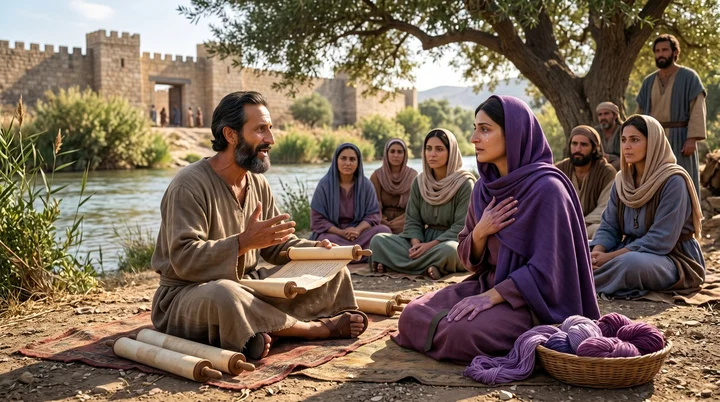
And on the sabbath we went out of the city by a river side, where prayer was wont to be made; and we sat down, and spake unto the women which resorted thither.
Translations
And on the sabbath we went out of the city by a river side, where prayer was wont to be made; and we sat down, and spoke to the women which resorted thither.
King James Version, KJV Cambridge Paragraph Bible
And on the sabbath we went out of the city by a river side, where prayer was wont to be made; and we sat down, and spake unto the women which resorted thither.
And on the sabbath we went out of the city by a river side, where prayer was wont to be made; and we sat down, and spoke to the women who resorted thither.
And on the sabbath day we went forth without the gate by a river side, where we supposed there was a place of prayer; and we sat down, and spake unto the women which were come together.
And on the sabbath day we went forth without the gate by a river side, where we supposed there was a place of prayer; and we sat down, and spake unto the women that were come together.
on the sabbath-day also we went forth outside of the city, by a river, where there used to be prayer, and having sat down, we were speaking to the women who came together,
And on the sabbath day we went outside the gate by the river, where it was the custom for prayer to be, and we sat down and spoke to the women who had assembled.
and on the day of rest, we went forth outside the gate, beside a river, where we supposed there was a place of prayer,—and, sitting down, we went on to speak unto the women who had come together.
On the Sabbath we went outside the city gate along the river, where it was customary to find a place of prayer. After sitting down, we spoke to the women who had gathered there.
On the Sabbath we went outside the city along the river, where it was customary to find a place of prayer. After sitting down, we spoke to the women who had gathered there.
On the Sabbath day we went outside of the city by a riverside, where we supposed there was a place of prayer, and we sat down and spoke to the women who had come together.
And on the Sabbath we went outside the town, by the river, where we had an idea that there would be a place of prayer; and, being seated, we had talk with the women who had come together.
And on the Sabbath day, we went out of the citie, besides a Riuer, where they were wont to pray: and we sate downe, and spake vnto the women, which were come together.
Douay-Rheims (Challoner revision)
And upon the sabbath day, we went forth without the gate by a river side, where it seemed that there was prayer; and sitting down, we spoke to the women that were assembled.
Pictures
Cross-references 20 of 22
- Acts 17:2
And Paul, as his manner was, went in unto them, and three sabbath days reasoned with them out of the scriptures,
Paul customarily reasoned from Scripture on the Sabbath.
- Acts 13:14
But when they departed from Perga, they came to Antioch in Pisidia, and went into the synagogue on the sabbath day, and sat down.
both show Sabbathkeeping among Gentiles
- Acts 18:4
And he reasoned in the synagogue every sabbath, and persuaded the Jews and the Greeks.
Both show Paul keeping Sabbath while teaching Jews and Gentiles.
- Exodus 20:10
But the seventh day is the sabbath of the LORD thy God: in it thou shalt not do any work, thou, nor thy son, nor thy daughter, thy manservant, nor thy maidservant, nor thy cattle, nor thy stranger that is within thy gates:
The commandment identifies the seventh day as the Lord’s Sabbath.
- Luke 4:16
And he came to Nazareth, where he had been brought up: and, as his custom was, he went into the synagogue on the sabbath day, and stood up for to read.
Paul’s Sabbath practice follows Jesus’ customary observance.
- Acts 13:44
And the next sabbath day came almost the whole city together to hear the word of God.
Both describe people gathering on the Sabbath to hear the word.
- Genesis 2:2-3
And on the seventh day God ended his work which he had made; and he rested on the seventh day from all his work which he had made.
God rested on the seventh day and sanctified it, grounding Sabbath observance in creation.
- Luke 23:56
And they returned, and prepared spices and ointments; and rested the sabbath day according to the commandment.
grouped together as calling seventh day the Sabbath
- Mark 2:27-28
And he said unto them, The sabbath was made for man, and not man for the sabbath:
Both affirm Sabbath observance under Christ’s lordship.
- Isaiah 58:13
If thou turn away thy foot from the sabbath, from doing thy pleasure on my holy day; and call the sabbath a delight, the holy of the LORD, honourable; and shalt honour him, not doing thine own ways, nor finding thine own pleasure, nor speaking thine own words:
Calls the Sabbath God’s holy day and describes honoring it as a delight.
- Acts 13:42
And when the Jews were gone out of the synagogue, the Gentiles besought that these words might be preached to them the next sabbath.
Both show the Sabbath as a day for preaching to Gentiles.
- Leviticus 23:3
Six days shall work be done: but the seventh day is the sabbath of rest, an holy convocation; ye shall do no work therein: it is the sabbath of the LORD in all your dwellings.
The Sabbath is identified as a day for sacred assembly.
- Exodus 20:11
For in six days the LORD made heaven and earth, the sea, and all that in them is, and rested the seventh day: wherefore the LORD blessed the sabbath day, and hallowed it.
The Lord blessed and set apart the seventh day as the Sabbath.
- Exodus 31:16-17
Wherefore the children of Israel shall keep the sabbath, to observe the sabbath throughout their generations, for a perpetual covenant.
The Sabbath is described as a perpetual covenant sign.
- Colossians 2:16
Let no man therefore judge you in meat, or in drink, or in respect of an holyday, or of the new moon, or of the sabbath days:
Paul preaches on the Sabbath, while urging believers not to be judged concerning it.
- Acts 16:40
And they went out of the prison, and entered into the house of Lydia: and when they had seen the brethren, they comforted them, and departed.
Lydia’s household gathers with the believing brethren.
- Exodus 16:23
And he said unto them, This is that which the LORD hath said, To morrow is the rest of the holy sabbath unto the LORD: bake that which ye will bake to day, and seethe that ye will seethe; and that which remaineth over lay up for you to be kept until the morning.
Calls the seventh day a holy Sabbath to the Lord.
- Ezekiel 20:12
Moreover also I gave them my sabbaths, to be a sign between me and them, that they might know that I am the LORD that sanctify them.
God’s Sabbaths are His own and a sign between Him and His people.
- Hebrews 4:4
For he spake in a certain place of the seventh day on this wise, And God did rest the seventh day from all his works.
Names God’s rest on the seventh day.
- Exodus 16:28-30
And the LORD said unto Moses, How long refuse ye to keep my commandments and my laws?
Shows Israel commanded to keep the Sabbath in the wilderness.
Commentary
Each commentary is drawn from primary sources: the writings of Ellen G. White and Adventist pioneers and periodicals. Each commentary is separate. Its own words are not a quotation; follow the references to read the source passages.
Ellen G. White
8 sources
This verse marks the beginning of the proclamation of the gospel in Europe during the journey into Macedonia.AA 211.1 It takes place at Philippi, the chief city of that part of Macedonia, and a colony.AA 211.2 Paul arrived there with Silas, Timothy, and Luke by a straight course from Troas to Samothracia and the next day to Neapolis and thence to Philippi.AA 211.2 They came because after the night vision of the man of Macedonia they were assured that the Lord had called them to preach the gospel there, and the call was so imperative that it admitted no delay.AA 211.2
On the Sabbath the apostles went out of the city to a riverside place where prayer was customarily made, sat down, and spoke the gospel to the women who resorted there.AA 212.1CH 454.1CH 542.1SC 98.1 Among the women was Lydia, a seller of purple from Thyatira who worshiped God and whose heart the Lord opened.AA 212.1 She received the truth gladly, and she and her household were converted and baptized, after which she entreated the apostles to make her house their home.AA 212.1
After Paul left, Luke remained in Philippi serving as both physician and gospel minister, and his medical skill helped open hearts to the gospel.CH 542.1 The verse teaches believers to seek out and join customary places of prayer as often as possible for prayer and communion with God.CH 454.1SC 98.120MR 390.1–3 The verse also teaches trust that God cares for Christians in the place where duty requires them to be.20MR 390.1–3 The place where prayer is made is a place for having the Spirit of God, and the Christian spirit that belongs there is just as essential in active business lines.21MR 358.1–3
Sources
Pioneers and periodicals
125 sources
On the Sabbath Paul and his companions went out of the city to a riverside place where prayer was customarily made, and sat down and spoke the gospel with the women who had gathered there.ST Oct 20, 1914ST Jun 17, 1897RH Mar 22, 1864 This was the beginning of gospel work in Europe at Philippi, a Roman colony, where there was no synagogue, so they sought the quiet Jewish place of prayer outside the gate.ST Jun 17, 1897ST Jun 9, 1898RH Nov 11, 1915RH Nov 25, 1852ST Sep 16, 1880 They waited until the Sabbath to seek that place, for preaching and worship on the Sabbath was Paul's manner and custom Sabbath after Sabbath, even in a Gentile city to Gentiles as well as Jews.ST Mar 30, 1888ST Jan 3, 1905ST Jun 8, 1882RH Feb 7, 1916ST Dec 25, 1893 The day so called is the seventh day, Saturday, still named the Sabbath decades after Christ's resurrection, with no hint of its abolition, transfer to the first day, or replacement by Sunday observance.ST Jan 4, 1877RH Jun 23, 1853ST Jun 8, 1882RH Apr 14, 1853RH May 2, 1854 Lydia heard, the Lord opened her heart, and she with her household was baptized at once, becoming with that small Sabbath-keeping company the beginning of the Philippian church, the first church in Europe, whose seventh-day practice remains the example for Christians to follow.ST Oct 20, 1914RH Mar 4, 1862ST Jun 24, 1880RH Jan 24, 1871RH Dec 20, 1853
Words and Historical Setting
On the Sabbath Paul and his companions went out of the city by a riverside where prayer was customarily made, and sat down and spoke with the women who had come together there.ST Oct 20, 1914ST Jun 17, 1897RH Mar 22, 1864RH Mar 4, 1862RH Jun 7, 1864 They had waited in Philippi until the Sabbath and then went forth without the gate to the place of prayer, observing the day by sitting and speaking with the gathered company.ST Oct 20, 1914ST Jun 17, 1897RH Mar 22, 1864RH Mar 4, 1862 The women were a praying group seeking further light, and one woman and her household accepted the teaching and became founding members of the church at Philippi.ST Oct 20, 1914RH Mar 4, 1862RH Jun 7, 1864 The event belongs to the new departure of the gospel from Jerusalem to Europe, when Paul acted at once on the call to Macedonia, crossed to Neapolis, came to Philippi, the first city of the district and a Roman colony, tarried certain days there, and began gospel missionary work in Europe about A.D. 51 or 52.ST Jun 17, 1897ST Jun 9, 1898RH Nov 11, 1915ST Jun 4, 1902ST Nov 29, 1910 Chapter 16 of Acts introduces this new departure on Paul's route and holds two leading features, and the account is used to show people in many lands needing missionary help to learn about Jesus and the truth.ST Jun 9, 1898RH Nov 11, 1915
Paul had with him Silas, Timothy, and Luke on this beginning of the work in Europe.ST Jun 17, 1897RH Oct 23, 1856 Paul and Silas are especially named in the wider visit to Philippi that included imprisonment, singing praises, the jailer's conversion, and encounter with a spirit of divination.ST Dec 3, 1896ST Sep 15, 1898ST Mar 4, 1880 God continued to guide the church by vision after Christ's ascension in directing Paul to Macedonia, and after imprisonment the report of the opened prison doors could spread.RH Jun 26, 1855ST Dec 3, 1896 There was no synagogue in Philippi, so finding no larger preaching opportunity the missionaries sought a place of prayer outside the gate by the river, a proseucha or Jewish place of prayer outside the city, and used that quiet spot to teach when no synagogue was available.RH Nov 25, 1852ST Sep 16, 1880RH Feb 7, 1916ST Mar 20, 1884 In another teaching, the gathering was a missionary use of the customary seventh-day assembly of Jews and proselytes with Gentiles present to proclaim Christ and gather believers, not a stated worship meeting of the Christian church.RH Mar 25, 1873
The exact distance of the prayer place from the city is not stated.ST Jul 4, 1911 The nearby river alone cannot fix it, since the customary place may have been farther than the river's nearest, more public and noisy point.ST Jul 4, 1911 It is described as a quiet place suited to prayer and religious fellowship, regularly used for gathering and speaking together.RH Mar 12, 1872RH Apr 29, 1875 The Greek word for Sabbath here is plural in form but refers to one Sabbath with singular sense.RH Jan 2, 1900RH Jan 5, 1864 Sabbaton means the seventh-day Sabbath, not the week, because the context gives no reason to read it as week, and rendering it day of the week would make the expression meaningless and weaken the evidence for apostolic Sabbath observance.RH Aug 26, 1862RH Aug 26, 1862
The phrase where prayer was wont to be made marks an old, well-established custom of Sabbath prayer at Philippi.RH May 12, 1874RH Dec 12, 1871RH Dec 12, 1871RH Nov 21, 1871 Luke expressly notes custom here and in other Sabbath cases, and his manner was to state such custom expressly, especially for the seventh-day Sabbath.ST Apr 1, 1875RH Dec 12, 1871RH Dec 12, 1871RH Mar 11, 1875 His silence about any custom of meeting on the first day, as at Troas, contrasts with his repeated notings of seventh-day custom in not less than eight references, proving no stated custom of weekly first-day meetings existed.ST Apr 1, 1875RH Dec 12, 1871RH Dec 12, 1871RH Mar 11, 1875RH Nov 21, 1871 Their speaking to the women was conversation about the gospel, talking to and with them rather than preaching a set discourse, as they sought above all a place of worship and true worshipers to join on the Sabbath.ST Jun 4, 1902
Apostolic Sabbath Observance
Paul and his companions waited until the Sabbath to seek the riverside place of prayer at Philippi, went out of the city on that day, and kept it there by prayer, worship, religious conversation, instruction, and speaking with the women who had come together.ST Aug 1, 1878ST Feb 10, 1904ST Aug 8, 1916ST Feb 7, 1911 They sat down and spoke with the gathered women in friendly worship, and the meeting that grew into a church began on the seventh-day Sabbath, which the women continued to meet on with no instruction to change it.ST Aug 1, 1878ST Feb 10, 1904ST Feb 7, 1911RH Jan 23, 1866 Their going outside the city to the customary riverside gathering and speaking there shows observance of the seventh-day Sabbath in a Gentile city after Jesus' death and resurrection.ST Feb 10, 1904ST Aug 8, 1916RH Jan 23, 1866RH Sep 2, 1851RH Sep 25, 1856
Preaching on the Sabbath was Paul's manner and custom Sabbath after Sabbath, as it was also the custom of Jesus and the apostles, resting from travel and preaching on that day.ST Jan 3, 1905RH Feb 7, 1916ST Dec 25, 1893ST Feb 20, 1879ST Jan 6, 1881 This riverside speaking is counted as one of eighty-four Sabbath meetings held by Paul recorded in Acts, against only one recorded Sunday meeting, and as part of his regular practice of reading the Scriptures and preaching publicly on the seventh day to Jews and Gentiles.ST Jan 3, 1905RH Feb 7, 1916ST Feb 20, 1879ST Jan 6, 1881 The Sabbath so kept is the seventh-day Sabbath of the Fourth Commandment, still binding as the holy rest day, always mentioned with respect with nothing abolishing, doing away with, changing it, or permitting common labor on it.ST Jan 3, 1905RH Feb 7, 1916ST Dec 25, 1893ST Feb 20, 1879ST Jan 6, 1881
His Sabbath preaching and worship were not dependent on or limited to synagogues, for at Philippi where there was no synagogue he did not depend on a synagogue opening but withdrew from the tumult and busy scenes of the city to spend the day in sacred devotion by the river.RH Mar 22, 1864ST Mar 30, 1888RH Apr 25, 1854RH Jan 7, 1858RH Nov 25, 1852 He met the people for prayer beside the river away from a synagogue and spoke with the women gathered there, preaching on the Sabbath outside synagogues as well as within them.RH Mar 22, 1864ST Mar 30, 1888RH Apr 25, 1854RH Jan 7, 1858RH Jun 2, 1851 He so kept the Sabbath and preached on it in a Gentile city to Gentiles as well as Jews, including devout Gentile women and God-fearing Gentiles, even after he had turned to the Gentiles where the usual explanation of preaching to a Jewish synagogue congregation did not apply.ST Mar 30, 1888ST Jun 8, 1882RH Sep 2, 1851RH Jun 7, 1864RH Jun 24, 1852 The devout Gentiles meeting for prayer by the river were joined in worship, Lydia's heart was opened to the message, and the gathering became the beginning of the Philippian church with no word that the first day had been sanctified instead.ST Mar 30, 1888ST Jun 8, 1882RH Sep 2, 1851RH Jun 7, 1864RH Sep 25, 1856
The episode is acknowledged as an apostolic gathering on the Sabbath for prayer and mutual worship, and the Sabbath remains the divinely appointed day of rest and worship with no evidence that the first day had replaced it.RH Nov 28, 1871ST Apr 22, 1897RH Mar 25, 1873 In the view held by some, it was a missionary use of the customary seventh-day assembly of Jews and proselytes at the proseucha, the Jewish place of prayer outside the city, with Gentiles also present, to proclaim Christ and gather out believers rather than a stated worship meeting of the Christian church.RH Nov 28, 1871ST Apr 22, 1897RH Mar 25, 1873 In that same minority reckoning the record is cited as Sabbath-day activity but not as a meeting of the Christian church for stated worship.RH Nov 28, 1871ST Apr 22, 1897RH Mar 25, 1873 By that argument preaching on the Sabbath by itself is held not to prove that Paul kept it as a day of rest.RH Mar 22, 1864
Seventh Day Still Sabbath
The day named in the verse is the seventh day of the week, Saturday, the same seventh-day Sabbath kept by the Jews, the day before the first day of the week.ST Oct 7, 1897ST Apr 19, 1883ST Jul 20, 1882ST Sep 25, 1893ST Sep 10, 1896 The other days are known by number, while Sabbath means to cease from work and rest, so the verse cannot be read as a first-day meeting.ST Oct 7, 1897ST Nov 27, 1893 Luke uses this name for the seventh day decades after Christ's death and after the ceremonial institutions ended, showing the Sabbath name still applied to the seventh day in the apostolic era.RH Jun 13, 1854ST Jul 20, 1882
Luke still calls that riverside day the Sabbath twenty years after Christ's resurrection, identifying it as the seventh day and treating this as evidence that the seventh day remained the Sabbath.ST Jan 4, 1877RH Jun 23, 1853RH May 2, 1854 It is identified without qualification as the seventh-day Sabbath on which Jews customarily met, still so called and observed after the resurrection.RH Jun 23, 1853RH May 2, 1854 Christians still called it the Sabbath day about thirty years after Christ's death and crucifixion, and its wording was given for Christians in all ages.RH Jul 1, 1873ST Jan 25, 1910 About thirty years after the crucifixion Paul and his companions are shown observing the seventh-day Sabbath by going outside the city to the riverside place of prayer and speaking with the women gathered there.RH Jul 1, 1873ST Jan 25, 1910
The apostles kept it for about twenty-four years after the resurrection with nothing intimated of a change of day, proving the seventh-day Sabbath was still in force as a day of worship and preaching.ST Sep 13, 1899RH Aug 18, 1868RH Sep 19, 1854 They kept it more than twenty years after Christ's death, and recognized and kept it decades after His death by going outside the city to the riverside place where people customarily prayed.ST Sep 13, 1899RH Aug 18, 1868RH Sep 19, 1854 Luke's use of Sabbath for the seventh day decades after Christ's death and after the ceremonial institutions were nailed to the cross shows the name still belongs to the seventh day.RH Jun 13, 1854RH Aug 18, 1868
Its frequent mention in Acts proves the weekly days and the Sabbath according to the commandment had not been lost, carrying the unbroken Sabbath line from creation to the close of the first century.ST Jun 3, 1886 Paul and the other disciples knew which day was the Sabbath and preached on the Sabbath, and the Sabbath is still known and named by its true weekly place after the death of Christ.ST Jun 3, 1886 The verse is one of eight places in Acts where Sabbath means the seventh day, counted as the eighth mention, proving the Sabbath of the Lord is the seventh day.ST Sep 25, 1893RH Dec 19, 1871RH Dec 12, 1871 It stands as one of not less than eight references noting established Sabbath custom, including the Sabbath custom of the pious Gentile women at Philippi, proving Luke delighted to note Sabbath observance.RH Dec 19, 1871RH Dec 12, 1871
His careful noting of seventh-day custom here and in other cases, while giving not even a distant hint of custom in his single mention of the first day of the week, proves no stated custom of weekly first-day meetings existed.ST Sep 25, 1893RH Dec 12, 1871 The seventh day is always and invariably termed the Sabbath in the New Testament, in all fifty-nine mentions, while the first day is never so called.ST Apr 19, 1883ST Sep 25, 1893ST Sep 9, 1880 All through the Acts period this seventh day observed by the Jews is the only day known by the sacred title of the Sabbath.ST Apr 19, 1883ST Sep 10, 1896 The verse is not a reference to a first-day Sabbath and gives no indication that Paul regarded another day as the Sabbath, sought another place for prayer and worship on another day, or taught that another day should be kept.ST Sep 9, 1880RH Dec 19, 1871
Its use of Sabbath for that day after the resurrection shows the Sabbath had not become obsolete, been abolished, or been transferred to the first day of the week.RH Jun 23, 1853ST Jun 8, 1882RH Apr 14, 1853 The seventh-day Sabbath was a stated day for religious worship in the time of Christ and the apostles, and apostolic example here is keeping the seventh-day Sabbath, not Sunday.ST Dec 21, 1882RH Feb 25, 1862 Paul's manner was to teach out of the Scriptures every Sabbath day both to Jews and Greeks, proving he had done nothing against the customs of the fathers and had not become an observer of Sunday in place of the Sabbath.RH Feb 25, 1862 Devout Gentiles at Philippi met for prayer beside the river on the Sabbath, Paul joined them in worship, the gathering became the beginning of the Philippian church, and he told the worshipers nothing about the first day being sanctified instead, showing first-day observance had not replaced it and the first day had not been gradually sanctified by the apostles after Christ's ascension.ST Jun 8, 1882RH Apr 14, 1853ST Dec 21, 1882
Gospel Beginning at Philippi
The riverside gathering was a praying company, chiefly if not entirely a small group of pious women who regularly met for prayer and sought further light.ST Oct 20, 1914ST Jul 8, 1880RH May 5, 1874ST Jun 21, 1883 They were mostly devout Gentiles and worshipers of God who already kept the Sabbath before receiving the gospel, while some were evidently Jewish, and Lydia is identified as a Jewish proselyte.ST Jul 8, 1880RH May 5, 1874RH Mar 4, 1862ST Apr 1, 1913 The Christian women at Philippi thus held their prayer meeting on the Sabbath outside the city where prayer was customarily made.RH Mar 4, 1862ST Apr 1, 1913
Lydia was a Grecian woman from Thyatira in Asia, nearly three hundred miles by sea and land from Philippi.ST Jun 24, 1880ST Jul 8, 1880RH May 5, 1874 She had been connected with the dyeing trade and sold purple cloth, doing business in Philippi, a heathen city where none but Jewish residents would be expected to observe the Sabbath.ST Jun 21, 1883ST Apr 15, 1889 She knew the God who blessed the Sabbath day and hallowed it when He made the world, so she did not stay in the market carrying on trade and selling her goods or become engrossed with worldly affairs.ST Apr 15, 1889 Instead she sought out those who worshiped God and joined them outside the city by the riverside where prayer was customarily made.ST Apr 15, 1889
Paul and his companions joined the worshipers and, sitting down in a friendly manner, spoke with the women there.ST Mar 31, 1914ST Mar 20, 1884ST Jun 21, 1883 Finding no synagogue and no larger preaching opportunity, they accepted this small opening rather than dismissing it, and this humble meeting became the occasion for proclaiming the message and finding a welcome.ST Oct 29, 1885ST Mar 20, 1884 Lydia heard, worshiping God among them, and the Lord opened her heart to receive the truth spoken by Paul, and she and the people employed in her business observed the Sabbath.ST Mar 31, 1914RH Sep 2, 1851RH Mar 4, 1862ST Jun 21, 1883ST Mar 4, 1880
She was converted during this Sabbath-day ministry and was baptized immediately along with her household when they repented and believed.RH Jan 24, 1871RH Dec 20, 1853RH Jun 16, 1868RH Apr 2, 1857RH Nov 29, 1853 The text says nothing of a husband or of children in her household, her whole family joined her in faith in the things spoken, all were believers baptized in that faith, and they are afterward called brethren, giving no support for infant baptism.ST Jun 24, 1880RH Apr 2, 1857 Baptism there followed turning toward God and becoming fit to receive remission, rather than delaying to see whether converts would later turn away.RH Dec 20, 1853RH Apr 2, 1857 One woman and her household thus accepted the teaching and became founding members, and this Sabbath-keeping company, beginning with Lydia as first convert, became the beginning of the Philippian church.ST Oct 20, 1914ST Jun 8, 1882ST Jul 8, 1880RH May 5, 1874 The gospel was first preached in Europe to this small congregation, making it the first church in Europe, and the women continued to meet on that day with no instruction to change it.RH Mar 4, 1862ST Jun 8, 1882ST Jun 21, 1883
Their worship and prayer for help explain why Paul and his companions were directed to Philippi rather than to the other regions they had wanted to visit, God answering prayer by guiding ministers to them.ST Jun 21, 1883ST Sep 9, 1880 With no larger opening before him, Paul accepted the small opening because the man in his vision had called for help, illustrating that establishing the gospel requires direct personal labor alongside preaching.ST Oct 29, 1885 The apostles did not abandon the place after the first meeting but kept returning there for prayer many days.ST Mar 4, 1880 The meeting led through the converted seller of dye to further opportunities and helped establish the Philippian church.ST Mar 4, 1880
Doctrine Proved From Verse
The riverside Sabbath meeting shows Paul and Timothy keeping the Sabbath day by holding a prayer meeting on that day, a public gathering where they read the Scriptures, preached and spoke to those assembled.RH Jan 28, 1873ST Jan 6, 1881 It is counted as one of eighty-four Sabbath meetings held by Paul recorded in the book of Acts, kept as part of keeping the law.ST Jan 6, 1881 The seventh day still bears the same title the Sabbath day in the New Testament and is always mentioned with respect, oftener than any other of the ten commandments, with not one word derogatory to its honor and sacredness.RH Jan 28, 1873ST Jan 6, 1881 The Sabbath therefore stands in the New Testament just where it stood in the Old, as the holy rest day of the fourth commandment, still binding, with no license given to work on that day or to use it for common labor, no removal of its blessing, no command to stop keeping it, and nothing to abolish, do away with, or change it.RH Jan 28, 1873ST Jan 6, 1881
The Sabbath Paul kept is identical with the Sabbath given to mankind in Eden as a memorial of creation, sacred, unchangeable and eternal.ST Nov 17, 1909 The primitive church observed that Eden Sabbath in the Christian era, and Paul and his companions meeting for prayer and speaking with worshipers, both Jews and Gentiles, followed the example of Jesus in doing so.RH Mar 4, 1875RH Jan 10, 1871ST Nov 17, 1909 His practice of teaching on the Sabbath reflected his delight in God's law, of which the Sabbath is a part, and proclaimed the perpetuity of that law as an inseparable whole not abrogated or changed by Christ's death.RH Jan 10, 1871ST Nov 17, 1909RH Oct 22, 1872 His Sunday-night preaching at Troas and Sunday-morning journey did not make Sunday his Sabbath or day of worship.RH Oct 22, 1872
The apostles honored the Sabbath by religious observance, going out to the riverside place of prayer and speaking to those gathered, following Jesus' example.RH Jan 21, 1858RH Jul 1, 1862 They taught nothing against the Sabbath but kept it as customary, confirming the perpetuity and obligation of the fourth commandment and the whole ten-commandment law taught by Christ, the prophets and apostles.RH Jul 1, 1862 They had no right to observe another day in its place, and Christians even now should follow that apostolic example rather than observe another day.RH Jan 21, 1858RH Jul 1, 1862 Paul's Sabbath observance at Philippi, farther west than Jerusalem, was kept according to local time, beginning more than an hour after it began in Jerusalem, showing the seventh-day Sabbath could be observed in different places at their respective proper times.RH May 26, 1853RH Apr 21, 1851
Paul preaching by the river on the Sabbath to the women gathered there was followed by Lydia hearing, the Lord opening her heart, and her immediate baptism along with her household.RH Dec 20, 1853RH Apr 2, 1857 The account supports baptizing people when they repent and believe and have turned toward God and become fit to receive remission of sins, rather than delaying to see whether they will later turn away, and not baptizing candidates who have not repented and obeyed.RH Dec 20, 1853RH Apr 2, 1857 Paul and Silas preached Bible doctrines including baptism rather than limiting ministry to popular opinions.ST May 15, 1884 The wider account belongs to Paul receiving direction through a vision to go to Macedonia, showing God continued to guide the Christian church by visions after Christ's ascension, and Acts 16:13-17 shows God carrying out His purpose in this dispensation through gospel preaching and conversion of people without promising that the whole world will be converted.ST Jul 19, 1883RH Jun 26, 1855
Paul kept the seventh-day Sabbath of Jehovah with all the enthusiasm of his surrendered life, as a duty and privilege never neglected during all his arduous labors and long journeyings.ST Sep 29, 1909 He lived as Jesus lived and did what Jesus did, since Jesus kept the seventh day commanded in His Father's law, made for mankind in the beginning, and taught its sacredness and perpetual obligation.ST Sep 29, 1909 Christ dwelling in Paul did the same in and through him.ST Sep 29, 1909
Example For Believers Today
Paul sitting down to speak with the women at the riverside shows that men and women are equal in relation to God and in the church and the work of the gospel, with equal standing, equal privileges, and equal accountability in Christ.ST Feb 17, 1888ST Jul 29, 1889 By this the gospel lifts woman from slavery to rightful equality with man, and women are permitted to speak and take part in public assemblies and worship rather than having nothing at all to say in church or meetings.ST Feb 17, 1888ST Jul 29, 1889 The gathering for prayer and worship at Philippi, begun among women including Lydia and others, is the model of earnest praying women whose prayerful devotion prepares effective Bible workers, and of consecration and diligence in missionary work for women to follow.RH Nov 13, 1900RH Mar 18, 1875 Those women who later labored with Paul in the gospel exemplify such service.RH Nov 13, 1900
That riverside gathering was a fitting humble prayer meeting and the place for Sabbath preaching and returning prayer.RH Mar 23, 1869ST Jul 18, 1878 Paul and his companions waited until the Sabbath to seek the customary place of prayer outside the city, and there spoke with the women regularly gathered to worship.RH Mar 23, 1869ST Nov 16, 1876 The Sabbath thus served as a time for worship, instruction, spiritual help, divine worship, preaching, and religious meetings among Gentiles as well as Jews.ST Dec 2, 1886ST Nov 16, 1876RH Feb 7, 1916 The meeting and the church that grew from it began on the seventh-day Sabbath, and the women continued to meet on that day with no instruction to change it.
Christians should regularly assemble together for united prayer, alongside praying to the Father in secret in the closet, erecting a family altar for daily thanksgiving for life and blessings and for asking needed strength and wisdom, and frequently turning thoughts from earthly to divine things during daily work.RH Sep 12, 1871 The regular place set apart for prayer and meeting together is the same as the house of prayer where believers assemble for worship.RH Sep 15, 1868 Needlessly staying away is serious cause for alarm, for it discourages and disheartens those weak in faith and hope, leaves vacant seats that give false testimony before the perishing, and declares by actions truer than words a loss of interest in the cause of Christ and weariness in the service of God.RH Sep 15, 1868 God will not accept a divided heart, and no one can secure his own salvation without laboring for the good of others, so faithful gathering for prayer is duty to Christ and to one's brother.RH Sep 15, 1868
Paul's journey to Macedonia shows people in many lands needing missionaries to teach them about Jesus and the truth, and his crossing into Europe shows being His witness to all men.RH Nov 11, 1915ST Jun 18, 1902 The gospel thus spread from the idolatrous cities of Asia across into Greece to Philippi, where its power turned idolaters into saints and martyrs.RH Oct 16, 1860 The apostles held religious services on the Sabbath after Christ's death, while Sunday observance had not yet taken its place, and the primitive church kept the Sabbath as its customary day of worship in the gospel dispensation and the Christian age.ST Dec 21, 1882ST Nov 16, 1876ST May 16, 1878RH May 2, 1854ST May 16, 1878 This proves they made no change to the seventh-day Sabbath and favors worship on that day as the example for believers to hold and carry to others straightway.ST Dec 21, 1882ST May 16, 1878RH Sep 12, 1854 Going out of the city to a riverside on the Sabbath to baptize those who have decided to keep the Sabbath, after preaching and testimony, with more expected to follow, exemplifies that fruit.RH Sep 11, 1860
Sources