Acts 17:3
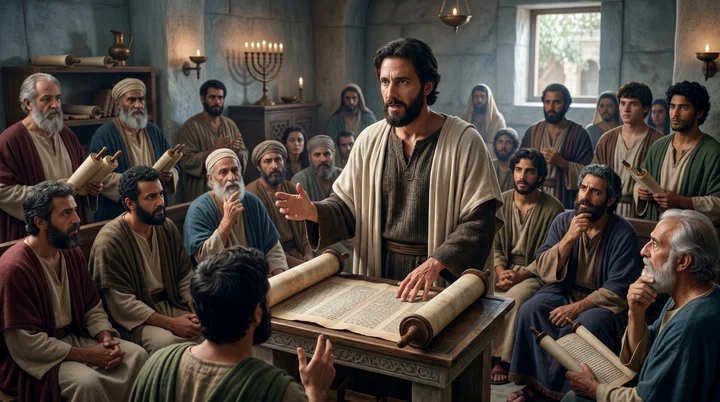
Opening and alleging, that Christ must needs have suffered, and risen again from the dead; and that this Jesus, whom I preach unto you, is Christ.
Translations
Opening and alleging, that Christ must needs have suffered, and risen again from the dead; and that this Jesus, whom I preach to you, is Christ.
Opening and alleging, that Christ must needs have suffered, and risen again from the dead; and that this Jesus, whom I preach unto you, is Christ.
opening and alleging, that Christ must needs have suffered, and risen again from the dead; and that this Jesus, whom I preach unto you, is Christ.
Opening and alledging, that it was needful that Christ should suffer, and rise again from the dead; and that this Jesus, whom I preach to you, is Christ.
opening and alleging, that it behoved the Christ to suffer, and to rise again from the dead; and that this Jesus, whom, said he, I proclaim unto you, is the Christ.
opening and alleging that it behooved the Christ to suffer, and to rise again from the dead; and that this Jesus, whom, said he, I proclaim unto you, is the Christ.
opening and alleging, 'That the Christ it behoved to suffer, and to rise again out of the dead, and that this is the Christ — Jesus whom I proclaim to you.'
opening and laying down that the Christ must have suffered and risen up from among the dead, and that this is the Christ, Jesus whom I announce to you.
opening up, and setting forth, that it was needful for, the Christ, to suffer, and to arise from among the dead; and [saying], This, is the Christ,—Jesus, whom, I, am declaring unto you.
Berean Standard Bible, Majority Standard Bible
explaining and proving that the Christ had to suffer and rise from the dead. “ This Jesus I am proclaiming to you is the Christ,” he declared.
explaining and demonstrating that the Christ had to suffer and rise again from the dead, and saying, “ This Jesus, whom I proclaim to you, is the Christ.”
Saying to them clearly and openly that Christ had to be put to death and come back to life again; and that this Jesus, whom, he said, I am preaching to you, is the Christ.
Opening, and alleadging that Christ must haue suffered, and risen againe from the dead: and this is Iesus Christ, whom, said he, I preach to you.
Douay-Rheims (Challoner revision)
Declaring and insinuating that the Christ was to suffer, and to rise again from the dead; and that this is Jesus Christ, whom I preach to you.
Pictures
Cross-references 20 of 33
- Acts 18:4
And he reasoned in the synagogue every sabbath, and persuaded the Jews and the Greeks.
Paul reasoned and persuaded in the synagogue every Sabbath.
- Acts 17:18
Then certain philosophers of the Epicureans, and of the Stoicks, encountered him. And some said, What will this babbler say? other some, He seemeth to be a setter forth of strange gods: because he preached unto them Jesus, and the resurrection.
Athenians recognize Paul’s preaching about Jesus and the resurrection.
- Luke 24:26-27
Ought not Christ to have suffered these things, and to enter into his glory?
Jesus explains from Scripture that the Messiah must suffer and enter glory.
- Isaiah 53
Who hath believed our report? and to whom is the arm of the LORD revealed?
The prophecy of the Messiah’s suffering is fulfilled in Jesus.
- Acts 17:32
And when they heard of the resurrection of the dead, some mocked: and others said, We will hear thee again of this matter.
The Athenians react to Paul’s teaching about the resurrection of the dead.
- Acts 13:27-37
For they that dwell at Jerusalem, and their rulers, because they knew him not, nor yet the voices of the prophets which are read every sabbath day, they have fulfilled them in condemning him.
Paul shows from Scripture that Jesus is the promised Savior who suffered and rose again.
- 1 John 2:22
Who is a liar but he that denieth that Jesus is the Christ? He is antichrist, that denieth the Father and the Son.
Both condemn denying that Jesus is the Christ.
- 1 John 5:1
Whosoever believeth that Jesus is the Christ is born of God: and every one that loveth him that begat loveth him also that is begotten of him.
Both require belief that Jesus is the Christ.
- Romans 1:2
( Which he had promised afore by his prophets in the holy scriptures,)
The gospel was promised beforehand through the prophets.
- 2 Timothy 3:15
And that from a child thou hast known the holy scriptures, which are able to make thee wise unto salvation through faith which is in Christ Jesus.
The Scriptures make one wise unto salvation through faith in Christ.
- Acts 8:35
Then Philip opened his mouth, and began at the same scripture, and preached unto him Jesus.
Both show preaching Jesus from the Scriptures.
- Luke 24:45-46
Then opened he their understanding, that they might understand the scriptures,
Jesus explains that Scripture foretold Christ’s suffering and resurrection.
- Luke 24:44
And he said unto them, These are the words which I spake unto you, while I was yet with you, that all things must be fulfilled, which were written in the law of Moses, and in the prophets, and in the psalms, concerning me.
Jesus says the Law, Prophets, and Psalms must be fulfilled concerning him.
- Genesis 3:15
And I will put enmity between thee and the woman, and between thy seed and her seed; it shall bruise thy head, and thou shalt bruise his heel.
The promise foretells the Redeemer’s victory through suffering.
- Isaiah 50:6
I gave my back to the smiters, and my cheeks to them that plucked off the hair: I hid not my face from shame and spitting.
Foretells the Promised One being beaten and shamed.
- John 10:18
No man taketh it from me, but I lay it down of myself. I have power to lay it down, and I have power to take it again. This commandment have I received of my Father.
Christ freely laid down his life and had power to take it again.
- Numbers 21:8-9
And the LORD said unto Moses, Make thee a fiery serpent, and set it upon a pole: and it shall come to pass, that every one that is bitten, when he looketh upon it, shall live.
The brazen serpent symbolized Christ lifted up.
- Acts 9:22
But Saul increased the more in strength, and confounded the Jews which dwelt at Damascus, proving that this is very Christ.
increased strength confounding Jews by proof
- Acts 2:23
Him, being delivered by the determinate counsel and foreknowledge of God, ye have taken, and by wicked hands have crucified and slain:
Both affirm that Christ’s suffering was necessary and foreknown by God.
- Acts 18:28
For he mightily convinced the Jews, and that publickly, shewing by the scriptures that Jesus was Christ.
Apollos proves from the Scriptures that Jesus is the Christ.
Commentary
Each commentary is drawn from primary sources: the writings of Ellen G. White and Adventist pioneers and periodicals. Each commentary is separate. Its own words are not a quotation; follow the references to read the source passages.
Ellen G. White
15 sources
Paul reasoned in the synagogue at Thessalonica for three successive Sabbaths out of the Scriptures, from Moses and the prophets, about the life, death and resurrection of Christ, and some Jews, a great multitude of devout Greeks, and chief women believed.Ms 142, 1897, par. 3–88RED 45.1–46.1 To open and allege was to open the Messianic prophecies and set forth their agreement with the life of Jesus, giving inspired proof that Jesus of Nazareth who was crucified is the promised Messiah, the Christ, the Son of God, whose suffering, death, resurrection and ascension were foretold.AA 221.28RED 45.1–46.13SP 321.2 Prophecy made it necessary that Christ must suffer and rise again from the dead, so His death and resurrection were not a defeat or an unforeseen failure but the fulfillment of what was written, which the disciples understood only after He rose.GC88 404.2–405.2GC 404.2–405.24SP 253.2 Those prophecies showed the promised Christ coming in humility and poverty, to be struck, mocked, despised, rejected, slain, and to suffer reproach and humiliation, with which the Jewish expectation of the Messiah did not accord.SLP 83.1–2AA 225.1 The same proof calls for wisdom in presenting truth, dwelling first on Old Testament prophecies of Christ, His mission and His work and leading minds along step by step before opening that Jesus of Nazareth is the true Messiah who suffered and rose, lest beginning with the most objectionable point stir up prejudice and close ears.Lt 12, 1887, par. 8–917MR 67.2–3Lt 48, 1886, par. 2–3
Paul's Reasoning at Thessalonica
At Thessalonica Paul reasoned in the synagogue for three Sabbath days, three successive Sabbaths, out of the Scriptures, from Moses and the prophets, about the life, death, and resurrection of Christ.Ms 142, 1897, par. 3–88RED 45.1–46.1 After this reasoning some of the Jews believed, and a great multitude of the devout Greeks, and of the chief women not a few.Ms 142, 1897, par. 3–8 To open and allege meant to open the Messianic prophecies and allege their agreement with the life and teachings of Jesus.8RED 45.1–46.1 It was to give inspired proof of His mission, suffering, death, resurrection, and ascension, and to prove clearly that Jesus of Nazareth, who was crucified, is the promised Messiah, the Christ, the Son of God, whose birth, sufferings, death, resurrection, and ascension the Scriptures foretold.AA 221.28RED 45.1–46.13SP 321.2
The same proof of Jesus and the resurrection was carried to the Epicurean and Stoic philosophers and to all on Mars' Hill.Ms 142, 1897, par. 3–8 In this way every class was met, from men of renown to heathen idolaters, with evidences of Christianity that are not of human invention but come from God.Ms 142, 1897, par. 3–8 Those evidences bear divinity's stamp and heaven's origin, which no earthly power can quench.Ms 142, 1897, par. 3–8 Christ was presented as the key unlocking the Old Testament, whose voice had spoken through the prophets and patriarchs from the days of Adam.8RED 45.1–46.1
The passover cannot be explained without Christ, and the brazen serpent lifted up in the wilderness symbolized Jesus lifted up on the cross.8RED 45.1–46.1 All Jewish religious services and ceremonies are valueless if the Saviour represented in them is rejected.8RED 45.1–46.1 The Messiah proclaimed is not one whose work is to destroy the old dispensation, but one who came to develop the Jewish economy in accordance with the truth.Lt 12, 1887, par. 8–9Ms 87, 1907, par. 4 He showed the importance of honoring the law of God and gave due honor to the ceremonial law, which Christ Himself instituted in the whole Jewish sacrificial economy, while alongside preaching to Jews in their own place of worship he preached to Gentiles before their own temples in the very presence of their gods as part of combining home and foreign missions.Lt 12, 1887, par. 8–9Ms 87, 1907, par. 4
Christ's Suffering Foretold by Prophecy
The verse teaches that prophecy foretold the necessity that Christ must suffer and rise again from the dead, and that Jesus is the Christ, which the disciples understood only after Jesus rose from the dead.GC88 404.2–405.2GC 404.2–405.24SP 253.2SLP 83.1–2AA 225.1 His death and resurrection were not a defeat or an unforeseen failure, but the fulfillment of prophecy.4SP 253.2 The prophecies Paul reasoned from describe the promised Christ coming in humility and poverty, being struck, mocked, despised, rejected, and slain, and suffering reproach and humiliation at the hands of people.SLP 83.1–2AA 225.1 With this the Jewish expectation of the Messiah did not accord.SLP 83.1–2
At Christ's first advent the disciples did not perceive this.GC88 404.2–405.2GC 404.2–405.2 When Jesus rode triumphantly into Jerusalem they believed He was about to ascend the throne of David and deliver Israel and free Israel, honoring Him with high hopes, with outer garments spread in the path, palm branches, and glad acclaim to the Son of David.GC88 404.2–405.2GC 404.2–405.2 In this they were accomplishing God's purpose in fulfilling prophecy.GC 404.2–405.2 Yet a few days later they watched His agonizing death and laid Him in the tomb, with their expectations realized in not a single particular and their hopes dying with Jesus.GC88 404.2–405.2GC 404.2–405.2 Only after their Lord came forth triumphant from the grave could they perceive that all had been foretold.GC88 404.2–405.2GC 404.2–405.24SP 253.2
Their bitter disappointment over a misunderstood fulfillment parallels the disappointment of Miller and his associates.GC 404.2–405.2 In connection with proving that the suffering Messiah is the Christ, Paul also taught that Christ would come again in power and glory to establish His kingdom on earth and rule over all nations.SLP 83.1–2
Wisdom in Presenting Truth
Saul's reasoning from the Scriptures began in the synagogues immediately after receiving sight and being baptized.SG1 91.2 After his conversion a divine light shone upon the prophecies concerning Jesus, and with his prior knowledge of the Scriptures now opened and the Spirit of God resting upon him he presented the truth clearly, forcibly, and boldly.EW 167.2SG1 91.2 He corrected perversions of the Scriptures and confounded opposing Jews with powerful influence.EW 167.2SG1 91.2 Many were convinced by his own testimony of hunting believers unto death and then learning on the Damascus road from Jesus Himself that He is the Son of God.SG1 91.2 He carried hearers down through the prophecies to the time of Christ's first advent to show that what was written about His sufferings, death, and resurrection was fulfilled in Jesus.EW 167.2SG1 91.2
His habit when laboring for Jewish people was to dwell upon the prophecies and bring minds down step by step, and only after some time to open the subject of Christ as the true Messiah proved from prophecy to have suffered and risen.Lt 12, 1887, par. 8–917MR 67.2–3Lt 48, 1886, par. 2–3 He did not begin by telling them they must believe in Jesus of Nazareth, which would stir up prejudice and make enemies.Lt 12, 1887, par. 8–9 He began with Old Testament prophecies testifying of Christ, His mission, and His work, leading them along step by step.Lt 12, 1887, par. 8–917MR 67.2–3Lt 48, 1886, par. 2–3 He showed the importance of honoring the law of God and gave due honor to the ceremonial law, showing that Christ Himself instituted the whole Jewish sacrificial economy.Lt 12, 1887, par. 8–9 Only after establishing this clear understanding did he bring them to the first advent of Christ and show that in the crucified Jesus every specification of prophecy was fulfilled.Lt 12, 1887, par. 8–9 With Gentiles his order was reversed, exalting Christ first and then showing the binding claims of the law, always shaping the message to the hearers so as not to raise prejudice.Lt 12, 1887, par. 8–9
Great wisdom must be used in evangelistic work when truth comes directly in opposition to the opinions and practices of the people.17MR 67.2–3Lt 48, 1886, par. 2–3 Subjects must not be gone through too rapidly, and the most objectionable features of faith must not be brought forward too early.17MR 67.2–3Lt 48, 1886, par. 2–3 Less objectionable truths that do not involve so great a cross should be kept before minds day after day and even weeks to gain confidence as men who understand the Scriptures with clear, forcible arguments.17MR 67.2–3Lt 48, 1886, par. 2–3 Hearers are to be carried step by step through important events in the prophecies and the practical teachings of Christ, and only then are testing truths such as the Sabbath and immortality to be publicly introduced.17MR 67.2–3Lt 48, 1886, par. 2–3 Advancing those questions too soon closes ears that careful, faithful, apt, and wise labor could have kept open and carried along.17MR 67.2–3Lt 48, 1886, par. 2–3
Sources
Pioneers and periodicals
66 sources
Paul reasoned in the synagogue at Thessalonica for three Sabbath days from the Old Testament Scriptures, Moses and the prophets, that the promised Messiah had to come.ST Jan 7, 1903ST Mar 18, 1903RH Mar 4, 1862RH Apr 10, 1900ST Oct 17, 1895
Opening and alleging means opening the Scriptures and setting forth proof by explanation and demonstration of fulfillment, presenting fact resting on scriptural evidence rather than human opinion.ST Sep 20, 1883ST Dec 19, 1878ST Jul 11, 1878ST Sep 20, 1883RH Nov 27, 1866
What he proved was that the Christ must suffer as foretold in Isaiah 53 and rise again from the dead, and that Jesus of Nazareth is the Christ, the divine Son of God.ST May 21, 1885ST Jul 1, 1897ST Jul 1, 1897ST Jan 21, 1886ST Jun 19, 1884
This preaching was done on the seventh-day Sabbath years after the resurrection, with Luke still calling it the Sabbath, showing it remains holy and binding with no regard for the first day.RH Jul 1, 1873ST Jan 4, 1877RH Jun 23, 1853ST Jul 20, 1882
The resurrection is the burden of the preaching and the Christian hope of future life, giving hope of salvation to be revealed at Christ's second coming from heaven, so the gospel is incomplete without that coming.ST Jun 9, 1898ST Oct 11, 1883ST Jul 13, 1882RH Mar 13, 1879
Thessalonica Setting and Scriptures
Acts 17:3 belongs to Paul's work in the synagogue at Thessalonica, where as his custom was he reasoned from the Scriptures for three Sabbath days, opening and alleging that the Christ must suffer and rise again from the dead and that this Jesus whom he proclaimed is the Christ.ST Jan 7, 1903ST Mar 18, 1903ST Oct 20, 1914ST Jan 4, 1877ST May 10, 1905 The surrounding account places the beginnings of the Thessalonian church among Sabbath worshipers, with some Jews and many devout Greeks, that is Gentiles who worshiped God with the Jews, receiving the gospel after that reasoning, and with some listeners believing and Paul's regular Sabbath worship and preaching helping form the church.RH Mar 4, 1862ST Oct 20, 1914ST May 10, 1905 These meetings took place on the Sabbath understood as the seventh day, long after Christ's resurrection.ST Jan 4, 1877
Thessalonica was the metropolis of Macedonia, a Macedonian city at the head of the Thermaic Gulf, where Jews were numerous and had a synagogue and were full of zeal for maintaining their own worship.ST Mar 1, 1883ST Oct 24, 1911 Paul and Silas labored there on the second missionary tour after their cruel beating and imprisonment, with their afflictions coming before their work bore fruit there.RH Aug 11, 1863 Paul was driven from Thessalonica before his work there was finished, and being unable to return he wrote 1 Thessalonians to that church, giving teaching on Christians' conduct toward one another and on the personal appearing of Jesus Christ.ST Jul 22, 1897 God worked wonderfully through Paul in that place, and the word of God triumphed there notwithstanding persecution in the course running from Acts 17 through Acts 20 covering Thessalonica, Berea, Athens, Corinth, Ephesus, Troas and Paul's farewell talk to the elders of Ephesus, establishing churches at Thessalonica and Berea where the truth once shone forth.ST Jul 7, 1909 Acts 17:1-9 records the founding of the church at Thessalonica by Paul's preaching that Christ must suffer and rise again and that Jesus is Christ.ST Mar 1, 1883ST Jul 22, 1897
The Scriptures from which Paul reasoned were the Old Testament Scriptures available to him, Moses and the prophets, including types and shadows.ST May 21, 1885RH Apr 10, 1900ST Oct 17, 1895 They teach the same gospel preached in the New Testament and point to Christ, showing that the Messiah had to suffer and rise from the dead and that Jesus of Nazareth is the promised Messiah.ST May 21, 1885ST Oct 17, 1895ST May 15, 1884 The New Testament affirms their divine authority, and Paul treated them over three successive Sabbaths in Thessalonica as divinely authoritative in demonstrating that Jesus whom he preached is the Christ.RH Nov 8, 1853ST Mar 9, 1888 His preaching there also included the prophetic events later described in 2 Thessalonians: the falling away, the revelation of the man of sin, the mystery of iniquity, and the destruction of the wicked at Christ's coming.RH Apr 10, 1900
Luke wrote this account about thirty years after the death of Christ in inspired language, the language of Christians, written for the use of Christians in all coming ages.RH Jul 1, 1873 His phraseology is unchanged from before the death of Christ, still calling the day when the Jews met in the synagogue the Sabbath day, which directly acknowledges that the Sabbath day still existed then and proves there is a Sabbath day in the gospel age.RH Jul 1, 1873ST Jul 20, 1882 The seventh day there can mean no other than the seventh day, and since Luke positively affirms it was the Sabbath, it either was the Sabbath or it was not, and it must be the Sabbath now.ST Jul 20, 1882 The account thus describes Paul preaching Christ and the resurrection in the Thessalonian synagogue on three Sabbath days, twenty years after Christ's resurrection, calling the seventh day the Sabbath.RH Jun 23, 1853
Reasoning from Scripture
Opening and alleging means reasoning out of the Scriptures themselves, not merely reasoning about them, opening their meaning and setting forth proof by citations and demonstration of fulfillment that the Messiah had to suffer and rise from the dead and that Jesus is the Christ.ST Sep 20, 1883ST Dec 19, 1878ST Jul 11, 1878ST Apr 3, 1879ST Apr 9, 1894 It is studying and explaining the Bible with the hearers, going subject by subject through the different books to search out hidden treasure and the deep things of God, rather than taking a text as a pretext for an unrelated speech, essay or oration.ST Sep 20, 1883ST Mar 13, 1901ST Sep 20, 1883 Preaching from Scripture in this sense explains and argues the necessity of Christ's suffering and resurrection and identifies Jesus as the Christ.ST Sep 20, 1883ST Dec 19, 1878ST Apr 3, 1879
What was thus opened was presented as fact, not as guess or apologetic opinion, resting on scriptural evidence and historical fact rather than inference or human opinion.ST Sep 20, 1883RH Nov 27, 1866 The same method appears in the sermon at Antioch in Pisidia, where appeal to Scripture and to historical facts shows that Jesus fulfilled God's promises that the Messiah must suffer and rise.RH Nov 27, 1866RH Nov 27, 1866 This showing that Christ had to suffer and rise and that Jesus is the Christ was the burden and center of the preaching at Thessalonica, the point specially dwelt upon, namely Jesus Christ crucified and risen proved from the Scriptures.ST Jun 9, 1898ST Mar 18, 1903ST Jan 7, 1903ST Jan 20, 1898 Preaching Christ in this way, by opening the Scriptures and proving suffering, resurrection and identity, is how the cause of Christ advances.ST Jul 1, 1897ST Jun 9, 1898
The method calls for using the Scriptures with their types and shadows to explain that the Christ they foretold had already come.ST Mar 13, 1901ST Nov 24, 1887 True hearing answers true preaching by testing what is heard through prayerful, diligent searching and comparison of Scripture under the guidance of the Holy Spirit and principles of righteousness. The manner of this work is calm and unimpulsive, taking the Holy Scriptures as textbook and going from city to city into the synagogues to reason firmly, answer opposition, and dispute in defense of truth.RH Jun 16, 1874RH Dec 6, 1853 It is direct scriptural preaching of Christ, the apostolic method, by which people are brought out by the word alone and not by amusement or pleasant entertainment for the ungodly, a method so powerful that those reached said the preachers had turned the world upside down.RH Jun 16, 1874ST Apr 9, 1894
Christ Suffered and Rose
The Scriptures establish that the Messiah, the Christ, had to suffer and rise from the dead in fulfillment of prophecy.ST Jul 1, 1897ST Jul 1, 1897ST Jul 1, 1897 Paul set out reasons and arguments from Scripture to prove this necessity, including the prophecy of Christ's sufferings in Isaiah 53.ST Jul 1, 1897ST Jul 1, 1897 One who claimed to be the Christ but did not suffer as predicted could not be the promised Messiah, and Paul described Christ's sufferings as the literal fulfillment of the prophets' words.ST Jul 1, 1897 His suffering and resurrection were literal fulfillments at the first advent, showing that the suffering Jesus was the Messiah Israel awaited and that Jesus is that Christ.ST Jul 1, 1897ST Jul 1, 1897ST Jan 21, 1886
His suffering was necessary for humanity's salvation.ST Oct 29, 1894 Yet no one had to betray him, since Christ freely laid down his life.ST Oct 29, 1894
Great importance is attached to the resurrection, for the message of the suffering and resurrection of Christ and the identity of Jesus as Christ was the burden of Paul's preaching.ST Jun 9, 1898 It is connected with the Christian hope of future life through the resurrection of the dead promised in Scripture.RH Mar 13, 1879 Heathen philosophers mocked the resurrection as unreasonable and unphilosophical, while Platonists instead argued for future life through the soul's immortality.RH Mar 13, 1879
Christ's death and resurrection give hope of salvation to be revealed at his second coming from heaven, for the preaching also included waiting for Christ to come from heaven.ST Oct 11, 1883 The gospel is incomplete if it omits that coming.ST Oct 11, 1883 The preaching about his death and resurrection does not state that either the day of his death or the day of his resurrection should be observed.ST Jul 13, 1882
Jesus Is the Christ
The declaration at the heart of the verse is that the Jesus being preached is the Christ, with Jesus of Nazareth established as the promised Messiah proved from Moses and the prophets.ST May 21, 1885ST Jun 19, 1884 The proof rested on showing that the Messiah had to suffer and rise from the dead, and then identifying Jesus as that Christ.ST May 21, 1885ST Jun 19, 1884 This was the doctrine proclaimed first in Thessalonica and then in Berea, where it came as new teaching to many hearers.ST Jun 19, 1884
Jesus and Christ are one and the same divine Son of God, and Jesus remains His name even after the ascension, as shown when He spoke that name to Saul.ST Sep 8, 1909 The wording affirms that Jesus is the Christ in a present continuing sense, not merely that He was the Christ.ST Sep 8, 1909 It therefore gives no warrant for separating the human Jesus from the Christ or for impugning the name of Jesus, and it stands directly against any teaching that denies that Jesus is the Christ.ST Sep 8, 1909 The identification was made by reasoning out of the Scriptures for three Sabbath days and demonstrating their fulfillment in Jesus.ST Jul 11, 1878ST Sep 8, 1909 By that demonstration both Jews and Greeks were convinced that Jesus is Christ, an example of godlike virtue and victorious warfare as a soldier of the cross.ST Jul 11, 1878RH Jan 7, 1873
Sabbath Witness After Cross
The meetings were on the seventh-day Sabbath, the Sabbath of the commandment, years after the resurrection, twenty years after it, which Luke positively affirms to be the Sabbath.ST Jan 4, 1877RH Jun 23, 1853RH May 20, 1909 Paul kept that day in the Christian dispensation, calling the day the Sabbath and holding religious services upon it with both Jewish and Gentile converts, attending meeting upon it, reading the Scriptures, praying and preaching Christ and the resurrection there.ST Jan 4, 1877RH Jun 23, 1853RH May 20, 1909ST Dec 10, 1902 There is no record of his disregarding it and no suggestion of regard for the first day of the week as a Sabbath day, and with no Bible evidence for Sunday-keeping this proves the Sabbath as part of the law of God is still holy and binding and held as hallowed with no change to Sunday.RH May 20, 1909ST Dec 10, 1902 Holding religious meetings on the seventh-day Sabbath was thus the customary practice of the followers of Christ, proving primitive Christians regarded the Sabbath and remembered it to keep it holy after the cross.RH May 10, 1860 On this testimony keeping the seventh-day Sabbath is a matter of obeying God, so that one must either keep the Sabbath or give up all claim to Christianity.ST Dec 10, 1902
Paul's regular manner and custom, in the same manner as Christ himself, was to go to the Lord's house on the Sabbath for religious services and public worship.RH Oct 29, 1914ST Jun 29, 1876RH Oct 13, 1874 He entered the synagogue at Thessalonica on the Sabbath as his manner was and reasoned from the Scriptures there for three successive Sabbaths, explaining that the Christ had to suffer and rise from the dead and proclaiming that Jesus is that Christ.ST May 10, 1905RH Oct 29, 1914RH Nov 16, 1914RH Apr 9, 1872 This regular Sabbath worship and preaching, distinct from ceremonial observances pointing forward to Christ, helped form and lay the foundation of the church at Thessalonica while saying nothing concerning a new day.ST May 10, 1905 The apostles' Sabbath preaching is an example of keeping the Sabbath, not merely a way to accommodate Jewish listeners, treating it as their regular day of religious worship.RH Oct 13, 1874RH Apr 9, 1872
Jews and devout Greeks, Gentile worshipers with the Jews, worshiped together on the same day in Thessalonica, and the Thessalonian church began among those Sabbath worshipers.RH Mar 4, 1862RH Aug 10, 1869 Some Jews and many devout Greeks received the gospel after Paul reasoned in the synagogue on three Sabbaths, and many Gentiles who became Christians continued to keep the Sabbath.RH Mar 4, 1862RH Aug 10, 1869 The preaching was regular Christian worship directed to Gentiles as well as to Jews, in public work for the Gentiles as well as in labor for the Jews, which disproves the claim that meetings on the seventh day were only to gain access to the Jews.RH May 10, 1860RH Oct 13, 1874RH May 20, 1909RH Nov 9, 1911 Paul spoke in the synagogue at Thessalonica on the Sabbath while preaching to Jews and Gentiles, and some hearers believed including devout Greeks.RH Oct 13, 1874RH Nov 9, 1911
At Athens Paul declared to the worshipers of the Unknown God that he is the God who made the world and all things therein, using creative power and the work of creation to distinguish the true God from the multitude of false gods.RH Sep 10, 1872 That distinguishing work of creation is the same work of which the creation Sabbath is the sign or memorial.RH Sep 10, 1872 The argument criticized from the passage identifies that Sabbath as Thursday and claims Paul preached on it before the Christian church was established at Pentecost.RH Mar 23, 1869
Second Coming and Prophecy
Paul’s reasoning that the Messiah had to suffer and rise and that Jesus is the Messiah also carried the call to wait for that risen one to come from heaven, since his death and resurrection give hope of a salvation to be revealed at his second coming and the gospel is incomplete without that coming.ST Oct 11, 1883 Driven out of Thessalonica before his work there was finished and unable to return, he wrote 1 Thessalonians to the church founded by that preaching in Acts 17:1-9, giving instruction on Christians’ conduct toward one another and on the personal appearing of Jesus Christ.ST Jul 22, 1897
That same synagogue preaching from the Old Testament Scriptures included the prophetic sequence later set out in 2 Thessalonians: the falling away, the revelation of the man of sin, the mystery of iniquity, and the destruction of the wicked at Christ’s coming.RH Apr 10, 1900 It warned that Rome would fall, that ten kingdoms would arise in its place, and that another power would destroy three of them and become the man of sin, the son of perdition, and the mystery of iniquity, with Christ returning and the world ending during the time of that power and the remaining seven kingdoms.RH Nov 20, 1900 Those warnings about Rome were true, and faithfulness required proclaiming them even under charges of treason.RH Nov 20, 1900
Preaching Pattern and Response
After God revealed His Son in Paul that he might preach Him among the heathen, his manner was to reason out of the Scriptures that Christ must suffer and rise again from the dead and that Jesus is the Christ.ST Jul 1, 1897RH Apr 9, 1914 Preaching Christ in this way, by showing from the Scriptures these truths, is how the cause of Christ advances, through preaching and the use of the Scriptures.ST Jul 1, 1897 At Thessalonica at the beginning of the course running from Acts 17 through Acts 20, covering Thessalonica, Berea, Athens, Corinth, Ephesus, Troas, and the farewell to the elders of Ephesus, God worked wonderfully through him and the word of God triumphed there notwithstanding persecution.ST Jul 7, 1909 That preaching at Thessalonica that Jesus suffered and rose again and is Christ was one step in the gospel spreading from Jerusalem through Judea and Asia into Greece, and its power there turned idolaters into saints and martyrs, reforming character and molding diverse peoples and nations.RH Oct 16, 1860
He is an example for gospel workers in making the pious Hebrews among the Gentiles the first objects of attention and the nucleus of the churches established among the heathen.RH Nov 5, 1901 This is rightly directed effort, watching the indications of providence and working where He is manifestly working and has already opened the way.RH Nov 5, 1901 Such work produces a hundredfold greater results than can be accomplished with the same means and facilities in another channel.RH Nov 5, 1901
Where the gospel was received in purity with power and the Holy Ghost and much assurance, some Jews, a great multitude of devout Greeks and Jewish proselytes, and not a few chief and leading women believed and joined Paul and Silas.RH Oct 14, 1873RH Dec 24, 1867RH Jun 16, 1874RH Jan 7, 1873 They followed the Lord, received the word in much affliction with joy of the Holy Ghost, turned from idols to serve the living and true God, and broke up former unions in city, houses, and families, forming a church of Jews, proselytes, and converts from heathenism. The doctrine proclaimed in Thessalonica and then in Berea, that Christ had to suffer and rise from the dead and that Jesus is the Christ, was new to many hearers.ST Jun 19, 1884 In convincing both Jews and Greeks out of the Scriptures that Jesus is Christ, the work is victorious warfare as a soldier of the cross.RH Jun 16, 1874RH Jan 7, 1873
Where rejected, the numerous zealous Jews who were full of zeal for maintaining their own worship became the persecutors of the disciples at Thessalonica.ST Mar 1, 1883 Unbelieving Jews moved with envy and hatred joined with lewd fellows of the baser sort to set the city in uproar, assault the house of Jason, and drag believers before the rulers crying that those who have turned the world upside down have come there also.RH Dec 24, 1867RH Jun 16, 1874 That cry proves the power of the method, for Paul's regular manner was to reason with people out of the Scriptures themselves, not merely about them, opening their meaning and setting forth proof that the Messiah had to suffer and rise from the dead, and bringing people out is done by the word alone and not by providing amusement or pleasant entertainment for the ungodly.ST Apr 9, 1894 Faithful preaching of timely truth with special rebuke for sin always brings the same brand of troubler of Israel and the same opposition from the powers of darkness.RH Jun 16, 1874
Sources