Acts 18:4
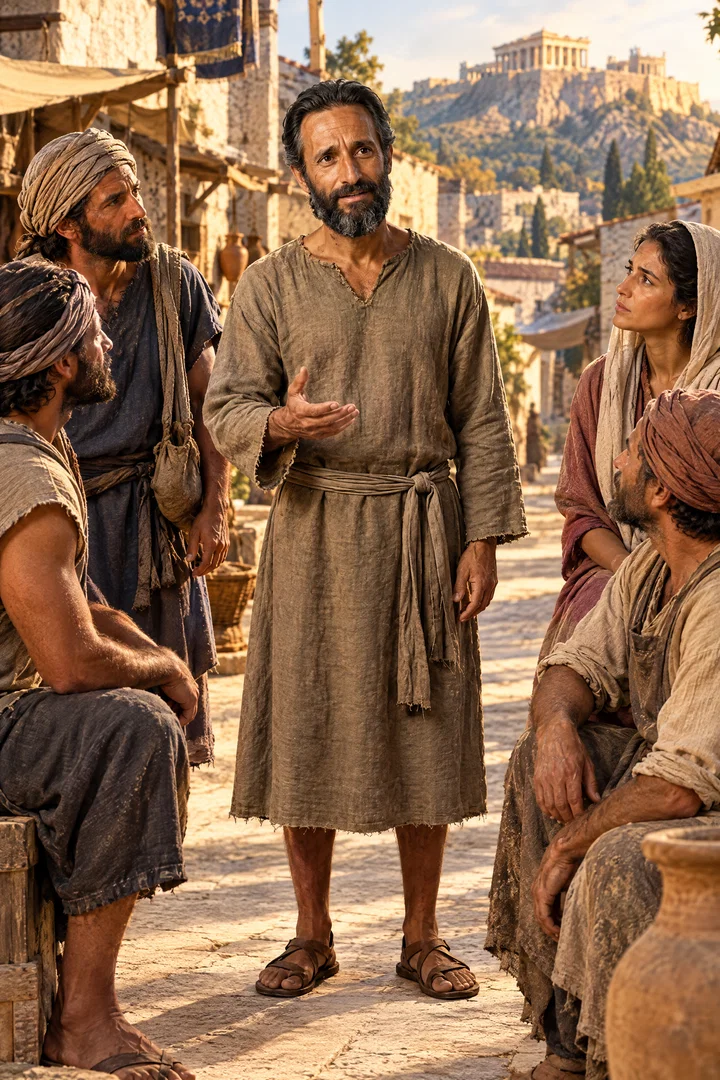
And he reasoned in the synagogue every sabbath, and persuaded the Jews and the Greeks.
Translations
American King James Version, King James Version, KJV Cambridge Paragraph Bible, Webster Bible
And he reasoned in the synagogue every sabbath, and persuaded the Jews and the Greeks.
Revised Version, American Standard Version, Darby Translation
And he reasoned in the synagogue every sabbath, and persuaded Jews and Greeks.
and he was reasoning in the synagogue every sabbath, persuading both Jews and Greeks.
And he began reasoning in the synagogue every sabbath, and was persuading both Jews and Greeks.
Berean Standard Bible, Majority Standard Bible
Every Sabbath he reasoned in the synagogue, trying to persuade Jews and Greeks alike.
He reasoned in the synagogue every Sabbath and persuaded Jews and Greeks.
And every Sabbath he had discussions in the Synagogue, turning Jews and Greeks to the faith.
And he disputed in the Synagogue euery Sabbath day, and exhorted the Iewes, and the Grecians.
Douay-Rheims (Challoner revision)
And he reasoned in the synagogue every sabbath, bringing in the name of the Lord Jesus; and he persuaded the Jews and the Greeks.
Pictures
Cross-references 20 of 36
- Acts 17:2
And Paul, as his manner was, went in unto them, and three sabbath days reasoned with them out of the scriptures,
Paul’s customary Sabbath preaching is also cited.
- Acts 13:42-44
And when the Jews were gone out of the synagogue, the Gentiles besought that these words might be preached to them the next sabbath.
Gentiles ask to hear Paul again the next Sabbath, when many gather.
- Acts 13:14
But when they departed from Perga, they came to Antioch in Pisidia, and went into the synagogue on the sabbath day, and sat down.
Paul attended and preached in the synagogue on the Sabbath.
- Acts 18:11
And he continued there a year and six months, teaching the word of God among them.
Gives the year-and-a-half duration of Paul’s teaching ministry at Corinth.
- Acts 16:13
And on the sabbath we went out of the city by a river side, where prayer was wont to be made; and we sat down, and spake unto the women which resorted thither.
Paul met and spoke with worshipers on the Sabbath.
- Exodus 20:8-11
Remember the sabbath day, to keep it holy.
The commandment identifies the seventh day as the Sabbath and grounds it in creation.
- Luke 4:16
And he came to Nazareth, where he had been brought up: and, as his custom was, he went into the synagogue on the sabbath day, and stood up for to read.
Jesus’ regular Sabbath synagogue attendance is compared with Paul’s practice.
- Acts 13:42
And when the Jews were gone out of the synagogue, the Gentiles besought that these words might be preached to them the next sabbath.
Gentiles ask to hear Paul preach again on the following Sabbath.
- Acts 15:21
For Moses of old time hath in every city them that preach him, being read in the synagogues every sabbath day.
Moses is read in synagogues every Sabbath.
- Genesis 2:2-3
And on the seventh day God ended his work which he had made; and he rested on the seventh day from all his work which he had made.
The creation account establishes and blesses the seventh-day Sabbath.
- Isaiah 58:13
If thou turn away thy foot from the sabbath, from doing thy pleasure on my holy day; and call the sabbath a delight, the holy of the LORD, honourable; and shalt honour him, not doing thine own ways, nor finding thine own pleasure, nor speaking thine own words:
Calls the Sabbath the Lord’s holy day and describes honoring it.
- Acts 18:19
And he came to Ephesus, and left them there: but he himself entered into the synagogue, and reasoned with the Jews.
Paul reasons with hearers in the synagogue.
- Acts 19:8
And he went into the synagogue, and spake boldly for the space of three months, disputing and persuading the things concerning the kingdom of God.
Paul reasons and persuades in the synagogue, continuing the practice described in Acts 18:4.
- Acts 14:1
And it came to pass in Iconium, that they went both together into the synagogue of the Jews, and so spake, that a great multitude both of the Jews and also of the Greeks believed.
Paul and Barnabas preached in a synagogue to Jews and Greeks.
- Acts 13:27
For they that dwell at Jerusalem, and their rulers, because they knew him not, nor yet the voices of the prophets which are read every sabbath day, they have fulfilled them in condemning him.
Another Acts reference identifying the ancient Sabbath.
- Isaiah 66:23
And it shall come to pass, that from one new moon to another, and from one sabbath to another, shall all flesh come to worship before me, saith the LORD.
Both describe the Sabbath as continuing beyond redemption.
- Acts 13:5
And when they were at Salamis, they preached the word of God in the synagogues of the Jews: and they had also John to their minister.
Both describe preaching in Jewish synagogues.
- Acts 17:17
Therefore disputed he in the synagogue with the Jews, and with the devout persons, and in the market daily with them that met with him.
Paul reasoned and disputed in synagogues with Jews and others.
- Exodus 20:11
For in six days the LORD made heaven and earth, the sea, and all that in them is, and rested the seventh day: wherefore the LORD blessed the sabbath day, and hallowed it.
Creation and God’s rest establish the seventh day as the Sabbath.
- Acts 18:8
And Crispus, the chief ruler of the synagogue, believed on the Lord with all his house; and many of the Corinthians hearing believed, and were baptized.
Many Corinthians believed after Paul’s preaching and were baptized.
Commentary
Each commentary is drawn from primary sources: the writings of Ellen G. White and Adventist pioneers and periodicals. Each commentary is separate. Its own words are not a quotation; follow the references to read the source passages.
Ellen G. White
12 sources
Corinth was dominated by idolatry and marked by gross immorality and concern for immediate pleasure, and this was the setting for the work to persuade Jews and Greeks.AA 243.3 While there he reasoned in the synagogue every Sabbath and persuaded both the Jews and the Greeks.AA 243.3GW 234.3–235.1Ms 142, 1897, par. 1–2AA 243.1AA 350.2–3 The Sabbath meetings in the synagogue were thus made occasions for reasoning and persuasion.GW 234.3–235.1Ms 142, 1897, par. 1–2AA 243.1AA 350.2–38RED 61.2–3 Alongside tentmaking he preached there, teaching regularly on the Sabbath and reasoning with both groups.GW 234.3–235.18RED 61.2–3
In that reasoning he proclaimed the truth as it is in Jesus, persuading about the gospel.Ms 142, 1897, par. 1–28RED 61.2–3 His teaching focused on Jesus as the Messiah, following his custom of preaching in the synagogue every Sabbath to Jews and Greeks.Ms 142, 1897, par. 1–28RED 61.2–38RED 62.2 He was one of the most effectual missionary workers, a clear, eloquent speaker able to meet his adversaries on almost any ground they chose and not behind the chiefest apostles.Ms 142, 1897, par. 1–2
While abiding with Aquila and Priscilla he worked with his hands at the humble occupation of tent-making because he was of the same craft.GW 234.3–235.1Ms 142, 1897, par. 1–2AA 350.2–3 He taught during the day and worked at night making tents, sharing the way of salvation with fellow workers.8RED 61.2–3 His trade supported him as he faithfully proclaimed the gospel.GW 234.3–235.1AA 350.2–38RED 61.2–3 He chose not to claim support from his hearers so that suspicion that he preached for money would not weaken his message, and so he would not burden the believers there.GW 234.3–235.1AA 350.2–3 He held himself ready to set aside his trade when an opportunity arose to oppose resistance to the gospel or win people to Jesus.GW 238.1 His willingness to work and his zeal in preaching rebuke idleness and the desire for ease.GW 238.1
At Corinth he labored for a year and six months preaching the truth to people in error and in the darkness of error.7T 268.1Lt 96, 1902, par. 4–5 By this he proved the divine character of his mission, raising up a flourishing church composed of Jews and Gentiles.7T 268.1Lt 96, 1902, par. 4–5 The Gentile converts were more numerous than the Jewish converts, and many were truly converted, brought from darkness into the light of the gospel.Lt 96, 1902, par. 4–5 The Gentiles were in a more favorable condition than the Jews to receive the truth, for they were not walled in by the maxims and traditions of priests and elders.Lt 96, 1902, par. 4–5 After Christ's ascension he still preached to both Jews and Gentiles on the Sabbath, continuing the practice of honoring the Sabbath day.ST Nov 12, 1894
In that Corinthian labor confusion and strife were spread among the church there.SLP 209.2–210.2 When he later reported this work to the elders at Jerusalem he spoke with great gentleness and courtesy, avoiding everything that would unnecessarily wound his brethren and dwelling especially on topics where they could harmonize.SLP 209.2–210.2 His account showed the progress of the gospel and the evidence that the power of God was working with his efforts.SLP 209.2–210.2 This softened feelings toward him, convinced the brethren that prejudice against him was unfounded, and led them to glorify God for the wonders of his grace.SLP 209.2–210.2 His example means preaching was not to be confined to one place or only to church members but carried to people throughout the world, so workers today must branch out more and make the world their field of labor rather than working for the churches only, because the Lord God of Israel is hungry for fruit.7T 268.1Lt 96, 1902, par. 4–5
Sources
Pioneers and periodicals
115 sources
At Corinth Paul supported himself by tentmaking during the week and reasoned from the Scriptures in the synagogue every Sabbath to persuade both Jews and Greeks that Jesus is Christ.ST Jan 28, 1886RH May 2, 1854RH Mar 22, 1864ST Jul 15, 1897RH Nov 13, 1866 The Sabbath he kept there was the seventh day of the week, Saturday, the customary day of synagogue worship which Luke calls the Sabbath without qualification as the only weekly Sabbath then existing.ST Jan 28, 1886RH May 2, 1854RH Jan 5, 1860ST May 27, 1880RH Dec 5, 1871 He made it his regular practice and manner of public worship and preaching, resting from ordinary work and using the day for instruction, following the example of Christ and in harmony with the divine commandment.ST Feb 15, 1877RH Dec 9, 1915ST Mar 18, 1889ST Jul 5, 1910 He continued this at Corinth a year and six months, seventy-eight successive Sabbaths of worship and gospel work that planted a Sabbath-keeping church of Jews and Greeks.RH Mar 4, 1862ST Feb 7, 1911ST Sep 26, 1911RH Feb 3, 1852ST Jul 8, 1880 This proves the seventh-day Sabbath of the fourth commandment remained binding and observed for religious purposes years after the cross and Pentecost, while the first day was not the Sabbath, was not established in its place, and remained an ordinary working day.ST Jan 28, 1886RH Jan 5, 1860ST May 27, 1880RH Jan 1851RH Apr 7, 1851
Corinth Ministry Setting
At Corinth Paul lived and worked with Aquila and Priscilla at tentmaking through the week and used every Sabbath to discuss in the synagogue in order to convince both Jews and Greeks.ST Jan 28, 1886RH May 2, 1854RH Nov 13, 1866ST Mar 18, 1889 The fact that this could be done every Sabbath shows a day still called the Sabbath existed for religious purposes after the cross and had not ceased.ST Jan 28, 1886RH Nov 13, 1866 That Sabbath was the seventh day, Saturday, the accustomed day of Jewish synagogue assembly, observed there by unbelieving Jews who had not changed to Sunday, and it was the only Sabbath then existing.ST Jan 28, 1886RH May 2, 1854ST Mar 18, 1889 It was not the first day of the week, for Paul did not meet the Jews in the synagogue every Sunday, and the institution of a first-day Sabbath came after his travels.ST Jan 28, 1886RH May 2, 1854ST Sep 26, 1911 His year and a half at Corinth is thus evidence that about twenty-five years after the resurrection he observed the seventh-day Sabbath and worked at his trade on the other six days rather than making the first day his Sabbath.ST Mar 18, 1889ST Sep 26, 1911
To reason was to teach, discuss the Scriptures, and seek to convince hearers at the regular Sabbath gathering of Jews and Gentiles.RH Mar 22, 1864ST Jul 10, 1893RH Jun 7, 1864RH Jun 12, 1860ST Jun 28, 1877 To persuade was to labor to win conviction, including direct testimony that Jesus is the Christ.RH Jun 7, 1864ST Jun 28, 1877 This was regular public preaching and instruction, generally no more frequent than once a week.RH Mar 22, 1864RH Jun 12, 1860ST Jun 28, 1877
He carried on this Sabbath preaching in the synagogue for as long as he was permitted to use it, a comparatively short period, and then continued his work nearby after opposition arose.ST Jul 15, 1897RH Dec 9, 1915ST Aug 8, 1916ST Jun 3, 1897ST Oct 31, 1906 After Jews opposed and blasphemed he turned to the Gentiles, leaving the synagogue and opening services in the nearby private house of Justus, where he continued teaching the word of God without changing day, purpose, or Sabbath custom.ST Aug 8, 1916RH Jun 7, 1864RH Feb 26, 1857ST Oct 31, 1906ST Jun 28, 1877 The move changed the place of preaching, not its day or purpose.ST Oct 31, 1906ST Jun 28, 1877 The verse by itself therefore does not fix the total number of Sabbath meetings held in Corinth and its surroundings during the whole ministry, and that number cannot be deduced from this verse alone.RH Dec 9, 1915ST Aug 8, 1916
This synagogue work began before Silas and Timothy arrived from Macedonia.ST Sep 27, 1883 It followed weak results at Athens with resolve to make Christ crucified central, founded the Corinthian church about A.D. 52 while Paul was in physical weakness, and turned voluptuous people into self-denying disciples in order to establish an apostolic church.RH Feb 27, 1908ST Jul 10, 1893RH Oct 16, 1860 Romans was probably written at Corinth in 57 or 58.ST Oct 29, 1912 Aquila and Priscilla took Paul into their own house, which they owned, and belonged to the class of helpers whose humble, self-denying office was privately counseling, advising, and instructing young disciples from house to house and church to church rather than serving as apostles, prophets, or preachers.RH Apr 4, 1871 Their shared tentmaking trade built common interest and made personal ministry possible.RH Apr 4, 1871RH Nov 28, 1912 That Paul was allowed to enter the Jewish houses of assembly at their regular worship and argue his cause proves the ancient Pharisees, despite bigotry and hatred of Christians, freely gave the apostles the use of their synagogues and even invited them to preach.RH Feb 7, 1871
Time and Number
Paul continued at Corinth a year and six months teaching the word of God, reasoning in the synagogue and persuading Jews and Greeks every Sabbath.ST Feb 7, 1911RH Feb 3, 1852ST Aug 27, 1885ST Mar 15, 1910 During the week he worked at his trade making tents and stopped that ordinary work on the Sabbath to preach, worship, and do gospel work for instruction and spiritual help.ST Sep 26, 1911RH Feb 3, 1852ST Aug 27, 1885ST Mar 15, 1910 Counted as seventy-eight Sabbaths of worship in succession, at least seventy-eight Sabbaths observed for religious teaching while establishing a Sabbath-keeping church, this regular practice is evidence that he kept the seventh-day Sabbath and taught no change to the first day.ST Feb 7, 1911RH Feb 3, 1852ST Aug 27, 1885ST Mar 15, 1910 His Sabbath observance was obedience to God rather than a requirement of local law or custom, and it records no regular worship by him on Sunday.RH Feb 3, 1852
With his Sabbath preaching in other places the recorded total is put at eighty-four Sabbaths in all, described as more than seventy Sabbath days and at least seventy-eight to eighty-four Sabbaths of apostolic example.RH Jan 1851RH Jan 24, 1871RH Sep 25, 1856RH Jul 20, 1911 This reckoning joins the seventy-eight successive Sabbaths at Corinth with his Sabbath preaching elsewhere, including many consecutive Sabbath services as part of at least eighty-four Sabbath observances in Acts by Paul and the Christians with him, Jews and Gentiles together.RH Jan 1851RH Sep 25, 1856ST Feb 25, 1913 Many Gentiles believed and were baptized there, and the repeated Sabbath-keeping is set against the single first-day gathering at Troas as outweighing any evidence for changing the Sabbath to the first day.RH Jan 1851 Together these meetings prove continued marked Christian observance of the seventh-day Sabbath after the resurrection, following the custom of Jesus in going into the synagogue on the Sabbath day, and that the Christian Sabbath is Saturday.RH Jan 24, 1871RH Sep 25, 1856RH Jul 20, 1911ST Feb 25, 1913
The Corinthian ministry falls about A.D. 52 to 54, in A.D. 54 about twenty to twenty-five years after the resurrection.RH Dec 19, 1871ST May 27, 1880RH Nov 13, 1866ST Jun 3, 1897RH Jan 1851 In some reckonings it is put at about twenty-one years after the resurrection and twenty-three years after the cross, with Luke writing Acts about A.D. 63, about thirty years after the resurrection.ST Jan 4, 1877RH Jan 1851RH Sep 25, 1856 The day is called the Sabbath without explanation or qualification, showing a day still known and observed for religious purposes, kept by Jews and Christians alike, while Paul worked as a tentmaker on the other days.ST May 27, 1880RH Nov 13, 1866ST Jun 3, 1897ST Jan 4, 1877 As late as about A.D. 54 the first day was therefore not the Sabbath nor a day of worship established in its place.RH Dec 19, 1871
The verse covers the comparatively short period he was permitted to teach in the synagogue, and it does not by itself fix the total number of Sabbath meetings he held in Corinth and its surroundings during his entire ministry.RH Dec 9, 1915ST Aug 8, 1916 After opposition he left the synagogue and continued teaching the word of God in the nearby house of Justus through the year and six months, so the exact number of Sabbaths held inside the synagogue cannot be known.ST Aug 8, 1916RH Jun 7, 1864 Those who hold the minority position treat this verse as his last seventh-day meeting before turning to the Gentiles, with later worship meetings of believers held on the first day.RH Dec 19, 1871RH Jun 7, 1864 The weight of teaching holds that his turn to the Gentiles concerned his turn in ministry and did not end his Sabbath meetings, abolish the Sabbath, or mark the end of New Testament mention of Sabbath worship.RH Jun 7, 1864RH Jul 5, 1864
Identity of Sabbath
The Sabbath met with at Corinth was the seventh day of the week, Saturday, the same day kept by the Jews.ST Jan 28, 1886RH May 2, 1854RH Jan 5, 1860ST Mar 18, 1889RH Oct 23, 1856 While working at tentmaking with Aquila on the other days, Paul reasoned in the synagogue every Sabbath for a year and six months and persuaded both Jews and Greeks, making that day his regular day of preaching and religious worship by custom in synagogues and in other places, to Jews and to Gentiles also.ST Jan 28, 1886RH May 2, 1854ST Mar 18, 1889ST Jun 3, 1897RH Oct 23, 1856 Since the synagogue met every Sabbath and the Jewish Sabbath was the seventh day, the day so called in Scripture is identified as the seventh-day Sabbath, kept by Jews and Christians alike in A.D. 54, and it was the only Sabbath existing at that time.ST Jan 28, 1886RH Jan 5, 1860ST Mar 18, 1889ST Jun 3, 1897 His later move to another place shows he did not preach in the synagogue throughout his entire stay.ST Jun 3, 1897
It was the customary Jewish day of synagogue assembly for worship and for Moses to be read every Sabbath, observed there by unbelieving Jews who were accustomed to meet on that day and had not changed their meeting to Sunday.ST Jan 28, 1886RH May 2, 1854ST Sep 29, 1909RH Jun 23, 1853ST Aug 4, 1898 At that time there were no Sabbaths other than those the Jews observed, the seventh day on which the Jews met in synagogues for worship being no other than the seventh day of the week.ST Sep 29, 1909ST Aug 4, 1898 The day is still called the Sabbath day with no hint that it was kept only in condescension to the weakness of others, and its always being so spoken of shows the recognition given this day by Christian writers in the Christian era writing under direction and inspiration.RH Sep 2, 1851ST Aug 4, 1898 Every Sabbath means every seventh day, the same days the Jews always met in their synagogue for worship by strict Jewish custom, which Luke about A.D. 63, thirty years after the resurrection, still calls the Sabbath.RH Sep 2, 1851RH Jun 23, 1853ST Aug 4, 1898
Luke names the day Sabbath without explanation or qualification, and without calling it old or Jewish, showing it was recognized as the weekly day set apart for religious use.ST May 27, 1880RH Nov 13, 1866RH Dec 5, 1871RH Dec 5, 1871 He uses every Sabbath for the day sanctified by the Hebrews, the established Jewish Sabbath, not for an alleged new first-day Sabbath, giving no recognition to a separate first-day Sabbath unless the Jews were observing it.RH Dec 5, 1871RH Dec 5, 1871 Its use of Sabbath decades after Christ's death shows the New Testament continues to apply the name to the seventh day, not to the first day of the week.RH Oct 21, 1851RH Apr 14, 1853 The inspired name Sabbath still belongs to the seventh day after the resurrection, proving seventh-day observance did not become suddenly obsolete at the resurrection and was not changed to the first day, which is not identical with the old Sabbath.RH Oct 21, 1851RH Apr 14, 1853
Every Sabbath means every seventh day, Saturday, and excludes every first day, Sunday, for otherwise the first day would have been included.RH Aug 16, 1870ST May 27, 1880RH Nov 13, 1866RH Dec 19, 1871 During the labor at Corinth in A.D. 54 every Sabbath meeting fell on that seventh day, so Sunday was not the Sabbath then, and Paul did not meet with Jews in the synagogue every Sunday.ST Jan 28, 1886ST May 27, 1880RH Nov 13, 1866 The expression honors the ancient Sabbath and identifies the seventh day as the Christian Sabbath in Paul's time at Corinth, the day on which Jews worshiped in the synagogues then and still worship in the same way, not Sunday.RH Dec 19, 1871ST May 27, 1880RH Nov 13, 1866
Paul's Sabbath Observance
Paul kept the seventh-day Sabbath as his regular practice, custom and manner wherever he went, in synagogues and also in other places such as a riverside place of prayer, and not to Jews alone but to Gentiles also.ST Feb 15, 1877RH Dec 9, 1915ST Mar 18, 1889 At Corinth he went to the synagogue every Sabbath for a time, reasoning with and persuading both Jews and Greeks about the gospel, with Jews and Gentiles assembling there every Sabbath to hear him.ST Feb 15, 1877RH Dec 9, 1915RH Oct 23, 1856 He made the Sabbath a regular day of preaching and religious worship, continuing there a year and six months teaching the word of God, though after he left the synagogue and opened services in the private home of Justus near the synagogue the exact number of Sabbaths held in the synagogue cannot be known.ST Mar 18, 1889ST Aug 8, 1916RH Jun 5, 1860 During that year and a half he preached on seventy-eight Sabbaths, with no change to the first day of the week taught, and the Sabbath he so kept, still called Sabbath in Scripture without hint of condescension to weakness, was the seventh-day Sabbath, the same day kept by the Jews.ST Mar 18, 1889ST Feb 7, 1911RH Sep 2, 1851 This faithful Sabbath observance was the custom of Christ and His apostles, while the New Testament gives no intimation that they ever observed Sunday.ST Aug 8, 1916RH Oct 23, 1856
He made the Sabbath his regular day of public worship and preaching, attending divine service and worship in the synagogue and reasoning with Jews and Greeks every Sabbath.ST Sep 29, 1909ST Jul 5, 1910 At Corinth he worked making tents during the rest of the week but stopped that work on the Sabbath to preach, resting every Sabbath even though he labored at tent-making on other days.ST Jul 5, 1910RH Sep 2, 1851 He set aside his tentmaking on the Sabbath, closing his business from Friday sundown, and devoted the day to religious work, reasoning in the synagogue and persuading Jews and Greeks.ST Jul 5, 1910ST Jan 1, 1885 He honored the Sabbath by using it each week to instruct and give spiritual help to others, while working at his trade on the other six days, which gave him seventy-eight Sabbaths for gospel work and for establishing a Christian church that kept the seventh-day Sabbath.ST Dec 2, 1886ST Dec 2, 1886 The day he honored was the seventh-day Sabbath, the same Sabbath of Moses and Isaiah and Jesus, not Sunday, made for man universally to be kept holy by God's people everywhere and in all times for the same reasons, ends and spirit as required of ancient Israel, as a day of holy delight in the worship of God rather than idleness, pleasure-seeking or dissipation, divested of cumbersome human traditions to be a source of spiritual blessing and joy.ST Dec 2, 1886 In the New Testament the weekly Sabbath never means any other day than the seventh day meant in the Old Testament, so Scripture knows no distinct Jewish Sabbath and Christian Sabbath, and Sunday as a holy day is wholly unknown to Scripture.ST Dec 2, 1886
In this he followed the example of his Master Jesus, whose custom was to teach on the Sabbath and attend divine worship on the Sabbath day reasoning with the people out of the Scriptures, and his manner and custom with the continued example of the disciples proves the Sabbath was not abrogated, changed or done away.RH Jan 1851ST Sep 29, 1909RH Jan 24, 1871 Together with the other Sabbath references in Acts, his reasoning and preaching in the synagogue every Sabbath, persuading both Jews and Gentiles, is evidence that Sabbath observance was Paul's regular practice and that the Sabbath of the Fourth Commandment remained binding and was observed by the early Christian church.ST Jan 3, 1905RH Jun 5, 1860RH Jan 24, 1871 At Corinth he reasoned in the synagogue every Sabbath for a year and a half, which is seventy-eight Sabbaths in succession, making eighty-four Sabbaths in all with his Sabbath preaching in other places, and many Gentiles believed and were baptized there.RH Jan 1851RH Jun 5, 1860ST Sep 29, 1909 Some of these worshipers became the first converts at Corinth, so the church began among people who already worshiped God on the Sabbath, while Luke continued to call the day the Sabbath decades later despite claims that it had been abolished or changed.RH Jan 1851ST Jul 8, 1880 This Sabbath-keeping was in A.D. 54, twenty-three years after the cross, proving the Sabbath was not nailed to the cross and remains binding as part of the holy, just, good and spiritual law of God that Paul delighted in and served by keeping all the commandments, in harmony with the divine commandment and as apostolic example.RH Jan 1851RH Jun 5, 1860RH Jan 24, 1871
Gentiles and Church
Paul reasoned in the synagogue every Sabbath with Jews and Greeks together, and both Gentiles as well as Jews were present to hear, believe, and be persuaded by his Sabbath teaching.ST Oct 8, 1912ST Dec 5, 1892ST Oct 7, 1897ST Jun 29, 1876 The day was the seventh-day Sabbath, Saturday, used as his regular time for public worship and his regular preaching day, with no other regular preaching day and no indication that Jews met on Saturday while Gentiles met on Sunday.ST Dec 5, 1892ST Oct 7, 1897ST Jun 29, 1876 He continued this work at Corinth for a year and six months, which proves apostolic example favors keeping the seventh day and gives no support for Sunday-keeping.RH Jun 2, 1851 This disproves the claim that he preached on the Sabbath only because Jews were assembled in synagogues on that day, since he preached to Gentiles as well as Jews and also preached on the Sabbath outside synagogues, where Jews and many Gentiles spent the Sabbath in the Lord's house.RH Jun 2, 1851ST Jun 29, 1876
Jews and Gentiles attended Sabbath worship at Corinth, and the first members and converts of the Corinthian church observed the Sabbath when they received the gospel.RH Mar 4, 1862ST Jul 8, 1880RH May 5, 1874 Some of these worshipers became the first converts, so the church began among people who already worshiped God on the Sabbath and was planted through Sabbath preaching while Paul observed the Sabbath.ST Jul 8, 1880RH May 5, 1874RH Dec 19, 1871 This was Paul's regular practice in the places where he preached, and his regular Sabbath meetings helped establish the church at Corinth.ST Jul 8, 1880RH Oct 14, 1873 Gentiles in Corinth joined Paul and other Jews in worshiping God every seventh-day Sabbath, and Gentiles who accepted the gospel received it without contestation, so the believers could keep the fourth commandment.RH Dec 19, 1871RH Oct 21, 1873 Luke continued to call the day the Sabbath decades later, despite claims that the Sabbath had been abolished or changed.ST Jul 8, 1880RH May 5, 1874
His Sabbath activity at Corinth was part of his customary public worship and not merely an accommodation to Jews or to Jewish customs.ST May 10, 1905RH Nov 28, 1871RH Apr 9, 1872 He preached and worshiped then because the Sabbath remained in force and he delighted to keep it holy, and he continued to preach on the seventh-day Sabbath after Christ's resurrection.RH Nov 28, 1871RH Apr 9, 1872RH Oct 14, 1873 His Sabbath preaching cannot be explained only as an effort to reach Jews, since he also preached to Gentiles, and his ministry there helped establish a church made up principally of Gentiles.ST May 10, 1905RH Jun 2, 1851 The apostles thus made the Sabbath their preaching day, presenting an example supporting continued Sabbath observance.ST May 10, 1905RH Apr 9, 1872
Continued Obligation Proved
The verse proves a Sabbath still existed and was kept for worship and teaching years after the cross and Pentecost, down to the time of Luke's writing, and had not been ended by Christ's teaching, death or resurrection.ST Jan 28, 1886RH Jan 5, 1860ST May 27, 1880RH Jan 23, 1866RH Aug 18, 1868 What could not be done every Sabbath if no Sabbath existed was done every Sabbath at Corinth, with work at tentmaking on other days and reasoning in the synagogue every Sabbath to persuade both Jews and Greeks.ST Jan 28, 1886RH Jan 5, 1860ST May 27, 1880RH Jan 24, 1871 The day so named without explanation or qualification was the recognized weekly day set apart for religious use, the seventh day, Saturday, the Jewish day of synagogue assembly, and the only Sabbath then existing.ST Jan 28, 1886RH Jan 5, 1860ST May 27, 1880RH Jan 24, 1871 Paul's manner and custom in this followed Jesus' custom of entering the synagogue on the Sabbath day and the continued example of the disciples, extending through a year and six months, more than seventy Sabbath days, so that to say it was abrogated, changed or done away is without warrant.RH Jan 23, 1866RH Aug 18, 1868RH Jan 24, 1871
It proves the seventh-day Sabbath of the fourth commandment, made in Eden at creation for mankind and spoken at Sinai, remains binding in the gospel dispensation.RH Jan 1851RH Apr 18, 1871RH Oct 13, 1874RH Sep 12, 1854 At Corinth, about A.D. 54, twenty-three years after the cross, Paul kept seventy-eight Sabbaths in succession, eighty-four in all with his Sabbath preaching in other places, while many Gentiles believed and were baptized and God declared He had much people in that city.RH Jan 1851RH Apr 7, 1851 As the specially chosen messenger to the Gentiles to declare the whole truth, he intimated no change or abolition and never taught or implied any other day, which proves the day perpetual.RH Apr 7, 1851RH Oct 13, 1874RH Sep 12, 1854 His delight in the law of God included delight in the Sabbath of the Lord, for the law remains holy, just, good and spiritual, and apostolic practice confirms the weekly Sabbath, which is only the seventh day, in continued binding obligation like the other commandments and against the first-day institution.RH Jan 1851RH Apr 7, 1851RH Apr 18, 1871RH Sep 12, 1854
His own observance proves he did not teach that keeping is optional, abolished, or vain labor, as some infer from Romans 14:5-6, Colossians 2:16 and Galatians 4:10.RH Sep 10, 1872RH Jan 21, 1915 The Sabbath he recognized every Sabbath at Corinth is the Lord's rest day, distinct from the ceremonial observances pointing forward to Christ that were abolished at the cross.RH Sep 10, 1872RH Jan 21, 1915 His practice therefore proves the Sabbath need not be left to convenience, is not abolished and no longer holy, and is not wrong to observe.RH Sep 10, 1872RH Jan 21, 1915
Gentiles in populous Corinth joined Paul and other Jews in worshiping God every seventh-day Sabbath, so Christians in New Testament times kept one and the same seventh-day Sabbath with uniform practice.RH Apr 18, 1871RH Oct 21, 1873 Gentiles who received the gospel received the Sabbath without contest.RH Apr 18, 1871RH Oct 21, 1873 The absence of special New Testament reproof against Sabbath-breaking is evidence of this observance, since there was no painful necessity to say much on the subject.RH Apr 18, 1871
No Sunday Change
As late as about A.D. 54 the first day of the week was not the Sabbath, not a day of worship established in its place, and not observed by Paul or his converts.ST Jan 28, 1886RH Dec 19, 1871RH May 2, 1854ST Aug 8, 1916ST Feb 7, 1911 During the week at Corinth he labored at tentmaking on the other days and reasoned in the synagogue every Sabbath, persuading both Jews and Greeks, which means the Sabbath still existed after the cross and had not ceased.ST Jan 28, 1886RH May 2, 1854ST Aug 8, 1916ST Sep 26, 1911 That Sabbath was the seventh day, Saturday, the Jewish day of assembly in the synagogue, kept there by unbelieving Jews who had not changed their meeting to Sunday, and it was the only Sabbath then existing.ST Jan 28, 1886RH Dec 19, 1871RH May 2, 1854RH Dec 5, 1871 He continued there a year and six months teaching the word of God, preaching on seventy-eight Sabbaths, though after leaving the synagogue he opened services in a private home near it so the exact number held in the synagogue cannot be known.ST Aug 8, 1916ST Feb 7, 1911ST Sep 26, 1911 Those eighteen months contain no Sunday meetings, and Sunday remained an ordinary tentmaking working day, with the New Testament giving no intimation that Christ and His apostles ever observed Sunday.ST Jan 28, 1886RH May 2, 1854ST Aug 8, 1916ST Sep 26, 1911
Even when the ruler of the synagogue and many Corinthians believed, giving an excellent opportunity to introduce Sunday, Paul remained silent about any new first-day institution and gave no approval to keeping the first day.ST Jul 16, 1902RH Nov 21, 1871ST Apr 5, 1883RH Apr 7, 1851RH Sep 27, 1853 Changing from a mostly Jewish audience in the synagogue to one mainly Gentile in the adjoining house, he continued a year and six months teaching the Word of God without a single reference to any other Sabbath day than that enjoined in the commandment.ST Jul 16, 1902RH Apr 7, 1851RH Sep 27, 1853 That silence at the very time and place a change would have had to be announced proves there was no change, since so important and far-reaching a change in the law would have been a prominent feature of apostolic discourse.ST Jul 16, 1902ST Aug 4, 1898RH Nov 21, 1871 He who declared himself free from the blood of all men because he had not shunned to declare the whole counsel of God gave in the historical record and in his epistles not one word regarding a change in the Lord's Sabbath, proving he attached no sacredness to the first day and assumed no authority to change the Sabbath commandment.ST Jul 16, 1902ST Aug 4, 1898
Repeated every-Sabbath preaching is contrasted with the single recorded sermon at Troas on the first day of the week, which was occasioned by departure the next morning and not marked as custom.ST Mar 22, 1883ST Apr 1, 1875ST Jul 13, 1882RH Jan 30, 1866 Luke's habit of noting customary actions proves no established custom of weekly first-day meetings in Acts, because he does not identify first-day meetings as customary.ST Mar 22, 1883ST Apr 1, 1875ST Jul 13, 1882RH Jan 30, 1866 Together with the year and six months at Corinth the record accounts for many consecutive Sabbath services, part of at least eighty-four Sabbath observances recorded in Acts, and this repeated Sabbath-keeping outweighs the single first-day gathering as evidence for changing the Sabbath to the first day.ST Jul 13, 1882RH Jul 20, 1911 It was his manner to preach on the Sabbath to all classes, and this record stands with the other Sabbath meetings as proof the apostles did not change the Sabbath to Sunday.RH Jul 20, 1911RH Jan 30, 1866
Luke uses every Sabbath for the day sanctified by the Hebrews, the established seventh-day Sabbath, showing he knew of no new Sabbath day and no distinct Jewish and Christian Sabbaths.RH Dec 5, 1871RH Apr 14, 1853RH Jun 5, 1860RH Nov 13, 1866 The inspired name Sabbath still belongs to the seventh day after the resurrection, proving seventh-day observance did not become suddenly obsolete at the resurrection and was not changed to the first day, and to rob the seventh day of its inspired name and appropriate it to Sunday is presumption deserving rebuke.RH Dec 5, 1871RH Apr 14, 1853RH Jun 5, 1860 Paul and his traveling companions, his partners in the tentmaking work, and the Jews and the Greeks all observed the same day, with none complaining of having to keep two Sabbaths or of losing one day's labor in a week.RH Nov 13, 1866ST May 27, 1880RH Nov 13, 1866 If any day at that time is to be called the Christian Sabbath, that day is the seventh day, Saturday, the day Jews worshiped in the synagogues then and still worship in the same way, not Sunday.RH Jun 5, 1860RH Nov 13, 1866ST May 27, 1880RH Nov 13, 1866
Local Time and Application
At Corinth Paul kept the Sabbath though the day began there nearly an hour later than at Jerusalem, about forty-eight minutes later by a reckoning of twelve degrees westward and more than an hour later by a reckoning of nine hundred miles or more than fifteen degrees westward.RH Oct 27, 1868RH May 26, 1853RH Apr 21, 1851RH Feb 28, 1856RH Feb 24, 1863 He reasoned in the synagogue every Sabbath and persuaded Jews and Greeks there for seventy-eight Sabbaths in succession, a year and six months, beginning the day when it came to Corinth from 6 P.M. to 6 P.M. local time.RH Oct 27, 1868RH May 26, 1853RH Apr 21, 1851RH Feb 28, 1856 That observance so far west of Jerusalem, twenty-three years after the ordinances under the law of Moses were nailed to the cross, proves the seventh-day Sabbath was still binding on Gentiles and could be strictly kept by the same rule in any place on earth, however far east or west.RH May 26, 1853RH Apr 21, 1851ST Aug 2, 1877 His lawful keeping there shows the difference in local time did not prevent observance, but supported keeping the Sabbath according to the day as it comes in each place with the earth's rotation rather than by identical hours everywhere.RH Feb 28, 1856ST Aug 2, 1877RH Feb 24, 1863RH Jan 19, 1860
Sabbath keeping therefore does not require the same absolute time as Jerusalem or Asia, but follows the seventh day as brought by the natural succession of day and night in whatever longitude a person is, from evening to evening by local time.RH Feb 28, 1856RH Feb 24, 1863RH Jan 19, 1860RH Jan 19, 1860 The difference in longitude meant the Sabbath began at Corinth about an hour later than in Jerusalem, yet keeping it as the earth's rotation and revolution brought it to each place was keeping it according to the commandment.RH Feb 28, 1856RH Feb 24, 1863RH Jan 19, 1860RH Jan 19, 1860 For that reason it can be kept farther west still, including in America, each person keeping it as the day comes where he is.RH Feb 28, 1856ST Aug 2, 1877 By the same rule it can be kept even at the North Pole.RH Feb 28, 1856
The verse models leading hearers by reason and judgment to examine truth and choose it, with public Sabbath preaching joined to personal house-to-house work, since either method without the other is weak.RH May 2, 1912RH Aug 9, 1864 Its regular public preaching was generally no more frequent than once a week, reasoning and persuading Jews and Greeks in the synagogue on the Sabbath.RH May 2, 1912RH Aug 9, 1864RH Feb 16, 1869 The minister's business is sowing only the pure seed of the word, with reward in faithful sowing and with increase and harvest left to God, whether preaching to the idle and curious Athenians with no apparent result or reasoning every Sabbath at Corinth until a promising church was gathered.RH Feb 7, 1871ST Oct 25, 1877 That gathering was faithful and acceptable duty before God, no more and no less than the fruitless-seeming labor at Athens, and a minister is not to claim credit for conversions or measure faithfulness by visible success.RH Feb 7, 1871ST Oct 25, 1877 Such growth of Gentiles into the church, as at Corinth with like work at Antioch, Athens, and Rome, requires increased effort and skill in the church at home to care for a growing church and to give direction in grave matters pertaining to the kingdom, even apostolic gifts and skill.ST Jun 16, 1898
It also models self-supporting labor that does not degrade gospel ministry, for while living and working with Aquila and Priscilla as tent-makers and sharing their trade, Paul preached the gospel and reasoned in the synagogue every Sabbath.RH Apr 4, 1871RH Nov 28, 1912ST Oct 24, 1895ST Oct 20, 1914 Working day after day at ordinary manual labor, not merely occasionally, proves manual labor is not degrading to a minister and that he should not be ashamed or afraid to soil his hands with work while preaching.RH Nov 28, 1912ST Oct 24, 1895ST Oct 20, 1914 Shared work built common interest and made personal ministry possible, while Aquila and Priscilla, who owned their own house, belonged to the class of helpers in Christ whose humble, self-denying office was privately counseling, advising, and instructing young disciples from house to house and church to church rather than serving as apostles, prophets, or preachers.RH Apr 4, 1871RH Nov 28, 1912 The fruit of that self-supporting Sabbath work at Corinth ripened into the church there, and the reasoning and persuading of Jews and Greeks every Sabbath provides a pattern for reasoning with people about the Sabbath.ST Oct 20, 1914RH Feb 16, 1869
Sources