Translations
American King James Version, King James Version, KJV Cambridge Paragraph Bible
After these things Paul departed from Athens, and came to Corinth;
After these things, Paul departed from Athens, and came to Corinth;
Revised Version, American Standard Version
After these things he departed from Athens, and came to Corinth.
And after these things, Paul having departed out of Athens, came to Corinth,
And after these things, having left Athens, he came to Corinth;
After these things, withdrawing from Athens, he came unto Corinth;
Berean Standard Bible, Majority Standard Bible
After this, Paul left Athens and went to Corinth.
After these things Paul departed from Athens and came to Corinth.
After these things, he went away from Athens, and came to Corinth.
After these thinges, Paul departed from Athens, and came to Corinthus,
Douay-Rheims (Challoner revision)
After these things, departing from Athens, he came to Corinth.
Pictures
Cross-references
- Acts 18:11
And he continued there a year and six months, teaching the word of God among them.
Paul taught God’s word in Corinth for a year and six months.
- Acts 17:16-34
Now while Paul waited for them at Athens, his spirit was stirred in him, when he saw the city wholly given to idolatry.
Paul’s preaching in Athens precedes his departure for Corinth.
- Acts 18:7-8
And he departed thence, and entered into a certain man’s house, named Justus, one that worshipped God, whose house joined hard to the synagogue.
After synagogue opposition, Paul preached nearby, and Corinthians believed and were baptized.
- 1 Corinthians 2:1-5
And I, brethren, when I came to you, came not with excellency of speech or of wisdom, declaring unto you the testimony of God.
Paul describes his approach and preaching when he came to Corinth.
- Acts 17:15
And they that conducted Paul brought him unto Athens: and receiving a commandment unto Silas and Timotheus for to come to him with all speed, they departed.
Paul’s companions are instructed to join him after he reaches Athens.
- Acts 18:18
And Paul after this tarried there yet a good while, and then took his leave of the brethren, and sailed thence into Syria, and with him Priscilla and Aquila; having shorn his head in Cenchrea: for he had a vow.
Paul’s later departure follows his extended stay in Corinth.
- 1 Corinthians 8
Now as touching things offered unto idols, we know that we all have knowledge. Knowledge puffeth up, but charity edifieth.
Paul’s teaching addresses the church he founded at Corinth.
- 1 Corinthians 16:1-4
Now concerning the collection for the saints, as I have given order to the churches of Galatia, even so do ye.
Paul gives the Corinthian church instructions for collecting funds for the saints.
- Acts 17:16
Now while Paul waited for them at Athens, his spirit was stirred in him, when he saw the city wholly given to idolatry.
Paul waits in Athens for his companions.
- 1 Corinthians 1:1-3
Paul, called to be an apostle of Jesus Christ through the will of God, and Sosthenes our brother,
These chapters shed light on Paul’s work among the Corinthians.
- Acts 18:9-10
Then spake the Lord to Paul in the night by a vision, Be not afraid, but speak, and hold not thy peace:
The Lord encourages Paul to keep speaking in Corinth.
- 1 Thessalonians 3:1-2
Wherefore when we could no longer forbear, we thought it good to be left at Athens alone;
Paul’s account of sending Timothy from Athens clarifies the chronology.
- Acts 18:8
And Crispus, the chief ruler of the synagogue, believed on the Lord with all his house; and many of the Corinthians hearing believed, and were baptized.
Many Corinthians believed and were baptized.
- Acts 18:5-6
And when Silas and Timotheus were come from Macedonia, Paul was pressed in the spirit, and testified to the Jews that Jesus was Christ.
Paul testified that Jesus was the Christ and turned to the Gentiles after opposition.
- 1 Thessalonians 1:7-8
So that ye were ensamples to all that believe in Macedonia and Achaia.
The Thessalonians’ example and spreading faith reached Achaia, where Corinth was located.
- Acts 16:6-10
Now when they had gone throughout Phrygia and the region of Galatia, and were forbidden of the Holy Ghost to preach the word in Asia,
Paul’s route was redirected toward Macedonia before he came to Corinth.
- 1 Corinthians 1:10-13
Now I beseech you, brethren, by the name of our Lord Jesus Christ, that ye all speak the same thing, and that there be no divisions among you; but that ye be perfectly joined together in the same mind and in the same judgment.
Paul addresses confusion and strife within the Corinthian church.
- Acts 17:2-4
And Paul, as his manner was, went in unto them, and three sabbath days reasoned with them out of the scriptures,
Paul reasons from Scripture in the synagogue, and many Greeks believe.
- 1 Corinthians 3:1-4
And I, brethren, could not speak unto you as unto spiritual, but as unto carnal, even as unto babes in Christ.
The Corinthians are described as carnal and unable to bear solid teaching.
- 2 Corinthians 11:9
And when I was present with you, and wanted, I was chargeable to no man: for that which was lacking to me the brethren which came from Macedonia supplied: and in all things I have kept myself from being burdensome unto you, and so will I keep myself.
Paul’s needs at Corinth were supplied by fellow believers.
Commentary
Each commentary is drawn from primary sources: the writings of Ellen G. White and Adventist pioneers and periodicals. Each commentary is separate. Its own words are not a quotation; follow the references to read the source passages.
Ellen G. White
16 sources
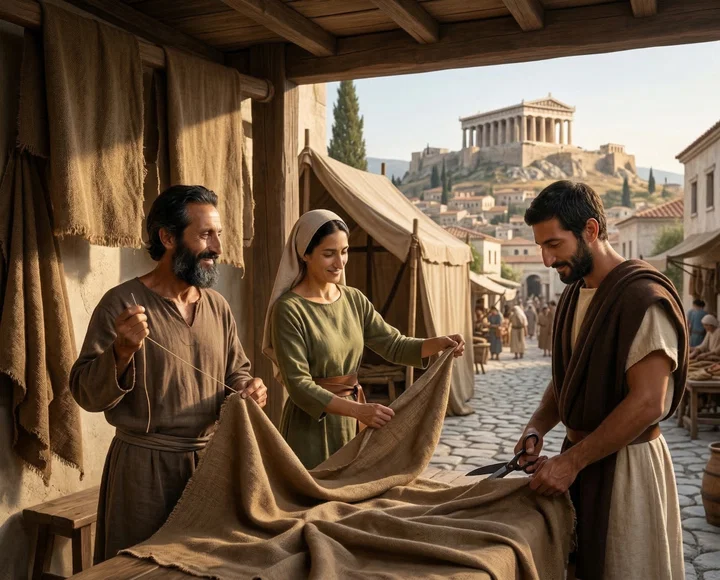
After his work in Athens Paul traveled on alone to Corinth, leaving word for Silas and Timothy to follow him there.SLP 98.18RED 60.1–61.1 He entered a leading commercial city crowded with people from many lands, yet almost wholly given to idolatry and gross immorality.AA 243.3AA 243.18RED 61.2–3Lt 96, 1902, par. 4–5SLP 304.1–2 Its position as a busy thoroughfare within easy reach of Rome made it a strategic place from which the truth could spread widely.AA 243.18RED 61.2–3SLP 98.1 There he joined Aquila and Priscilla, fellow tentmakers lately expelled from Rome, living and laboring with them while preaching the Scriptures and supporting himself by night work with his hands.AA 243.28RED 61.2–3RH Mar 6, 1900 Remaining a year and six months he raised up a flourishing church of Jews and Gentiles, showing that religion is not to be divided from business and that humble manual toil in no way lowers the ministry.7T 268.1Lt 96, 1902, par. 4–5Ms 58, 1890, par. 17Ms 93, 1899, par. 6–8
Journey and Corinthian Setting
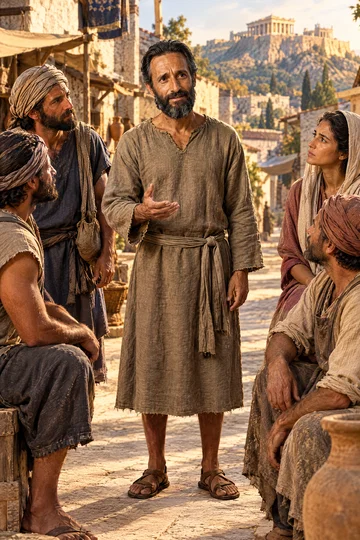
After these things Paul departed from Athens and came to Corinth without waiting for Silas and Timothy, leaving word for them to follow him there.SLP 98.18RED 60.1–61.1 His move took him out of a setting of philosophical debate into a busy, diverse commercial city whose people were largely focused on business and pleasure.SLP 98.1 Having judged that his approach at Athens had borne little fruit, he changed on coming to Corinth to focus on salvation through Christ rather than extended discussions and arguments.8RED 60.1–61.1
Corinth was almost wholly given to idolatry, with Venus as its favorite goddess and demoralizing rites connected with her worship.AA 243.3 Its people were known even among the heathen for gross immorality and were largely absorbed in immediate pleasures and gaieties.AA 243.3SLP 304.1–2 It was a city of pleasure-loving merchants in the darkness of error, to whom Paul came to preach the truth.Lt 96, 1902, par. 4–5SLP 304.1–2
Corinth was a leading city of Greece and the wider world, a major commercial thoroughfare within easy reach of Rome where people from many lands gathered.AA 243.1SLP 98.1ST Mar 27, 1884 Its streets brought together Greeks, Jews, Romans, and travelers from many lands, largely occupied with business and pleasure rather than spiritual concerns.SLP 98.1ST Mar 27, 1884 Its importance as a large commercial center closely connected with Rome made it a strategic place to establish memorials for God and his truth and a place from which the gospel could spread widely.AA 243.18RED 61.2–3
Jews had taken up residence in Corinth, including Aquila and Priscilla, who afterward became earnest workers for Christ, and Paul on becoming acquainted with their character abode with them.AA 243.28RED 61.2–3RH Mar 6, 1900 They had recently been expelled from Rome and had settled in Corinth, where they established a business as manufacturers of tents.8RED 61.2–3RH Mar 6, 1900Ms 95, 1899, par. 1–2 The banishment came about twenty years after the crucifixion, when there was a live, earnest, strong, zealous church in Rome for which the Lord worked.RH Mar 6, 1900 Because Christians preached that Jesus was the Messiah, Jewish envy and rage knew no bounds, leading to complaints that the Christian Jews were disorderly and dangerous to the public good and were constantly stirring up strife.RH Mar 6, 1900Ms 95, 1899, par. 1–2
Labor and Present Application
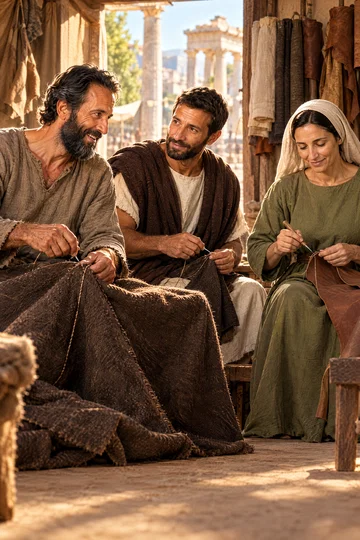
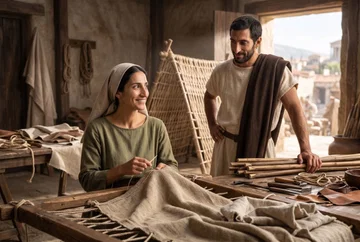
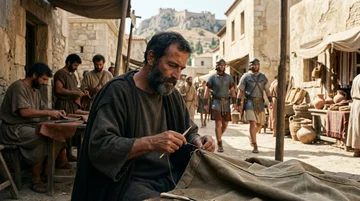
On coming to Corinth Paul became acquainted with Aquila and Priscilla, Jews lately expelled from Rome who had established a tentmaking business there, and because they shared his trade he abode with them and solicited work from them.AA 243.28RED 61.2–3RH Mar 6, 1900Ms 95, 1899, par. 1–2 He preached by day and worked with them making tents at night, supporting himself rather than burdening others and using daily labor as a way to reach fellow workers with salvation.8RED 61.2–3RH Mar 6, 1900 While living and laboring with them he also taught the Scriptures and instructed Aquila and Priscilla more perfectly in the truth, and they afterward became earnest workers for Christ.AA 243.28RED 61.2–3Ms 93, 1899, par. 6–8
He labored in Corinth for a year and six months and proved the divine character of his mission by raising up a flourishing church composed of Jews and Gentiles.7T 268.1Lt 96, 1902, par. 4–5 Many were truly converted and brought from darkness into the light of the gospel, with Gentile converts more numerous than Jewish converts.Lt 96, 1902, par. 4–5 The Gentiles were in a more favorable condition to receive the truth because they were not walled in by the maxims and traditions of priests and elders.Lt 96, 1902, par. 4–5
While staying in Corinth he became seriously concerned about the churches in Galatia, where false teaching was causing division, heresy, and sensualism.AA 383.1–2 The work at Corinth later became one of the results he reported to the Jerusalem brethren, including the confusion and strife some had stirred up in the Corinthian church.SLP 209.2–210.2 Christ thus had tent-makers as co-laborers in the work of salvation, showing that religion is not to be divided from business.Ms 58, 1890, par. 17 Those tent-makers were sturdy, humble toilers from whom went forth a power that will be felt through all eternity.Ms 58, 1890, par. 17
His course in Corinth proves that manual work brings no shame and in no way lowers the work of the ministry, and that a minister should not be afraid of work.Ms 93, 1899, par. 6–8 The same example calls workers today to branch out more and to make the world their field of labor rather than working for the churches only.Lt 96, 1902, par. 4–5 Working men and women who are willing to bear responsibilities with faith and hope find that which is great and good in life.Ms 58, 1890, par. 17
Sources
Pioneers and periodicals
70 sources
After Athens Paul left that city and came to Corinth to carry on an extended work of preaching the gospel.RH Jun 7, 1864ST Jul 15, 1897 There he reasoned in the synagogue every Sabbath, persuading Jews and Greeks, continuing a year and six months for seventy-eight Sabbaths in succession.ST Mar 18, 1889ST Feb 7, 1911RH Feb 3, 1852 The day he kept and preached on was the seventh-day Sabbath kept by the Jews, while the working days of the week he spent in manual labor at tentmaking, with no stated worship on Sunday.ST Mar 18, 1889RH Feb 3, 1852ST Jul 13, 1882ST Sep 29, 1909RH Feb 3, 1916 His continued keeping of the Sabbath among Jews and Gentiles long after the death of Christ shows no change to first-day observance was taught or practiced, and proves the Sabbath of the Decalogue remains binding.ST Feb 7, 1911ST Jul 13, 1882ST Oct 31, 1906ST Dec 2, 1886 At Corinth, about twelve degrees west of Jerusalem, he kept it by local time from evening to evening, each place observing the seventh day as it comes in its own succession of day and night.RH Feb 28, 1856RH Feb 24, 1863ST Aug 2, 1877
Journey and Chronology
After the events at Athens Paul departed from Athens and came to Corinth, where he began an extended gospel work.RH Jun 7, 1864ST Jul 15, 1897ST Jun 28, 1877ST Dec 16, 1889 The arrival placed him with Aquila and Priscilla, working as a tentmaker, reasoning in the synagogue every Sabbath with Jews and Greeks, and after Jewish opposition turning to the Gentiles.RH Jun 7, 1864ST Dec 16, 1889ST Aug 8, 1906 That Corinthian preaching and Sabbath meeting continued a year and six months, reckoned as seventy-eight consecutive Sabbaths.ST Jun 28, 1877ST Aug 8, 1906
The move belonged to the second missionary journey from Antioch.ST Jul 15, 1897ST Jul 7, 1909ST Jul 15, 1897 After being forbidden to preach in Asia and prevented from entering Bithynia, Paul was directed to Macedonia, and after brief earlier stops Corinth was the destination for sustained work.ST Jul 15, 1897ST Jul 15, 1897 It stands as one stage in labor through Thessalonica, Berea, Athens, Corinth, Ephesus and Troas, a course in which God wrought wonderfully and in which, notwithstanding persecutions, the word triumphed in every place.ST Jul 15, 1897ST Jul 7, 1909
The departure from Athens followed his discussions with Jews and philosophers, his speech at the Areopagus, and the gaining of converts.ST Sep 27, 1883 It was neither abrupt nor forced by persecution, for he had stayed as long as he chose.ST Sep 27, 1883 By the time Silas and Timothy joined him in Corinth he had already begun working with Aquila and Priscilla and preaching in the synagogue, supporting the conclusion that Timothy first came to him in Athens and was sent back to Thessalonica though Acts does not explicitly record it.ST Sep 27, 1883
Paul came to Corinth around A.D. 52, founded the Corinthian church in A.D. 52-53, and his stay there is dated 52 to 54.ST Jul 29, 1897ST Oct 24, 1911ST Jul 10, 1893 His work there was later continued by Apollos.ST Oct 24, 1911 While at Corinth he received help from Silas and Timothy and a contribution from the Philippians, and wrote the letters to the Thessalonians there.ST Jul 15, 1897ST Jul 10, 1893 According to the chronology cited he later wrote Galatians and Romans from Corinth, with Romans placed in 57 or 58.ST Jul 15, 1897ST Oct 29, 1912
Corinth City Described
Corinth was Greece's political capital and a major commercial center on the isthmus, known for trade and government.ST Jan 28, 1903RH May 19, 1904 It held a strategic position and had about 400,000 inhabitants.ST Jul 15, 1897 Its streets brought together a large, varied and changing population of Greeks, Jews, Romans and travelers from many lands.ST Mar 27, 1884ST Jul 15, 1897ST Jan 28, 1903 That location and population made it a center from which the gospel could spread.ST Jul 15, 1897ST Jan 28, 1903
It was a busy place largely occupied with business and pleasure rather than spiritual concerns.ST Mar 27, 1884 It was very wicked and exceedingly wicked, deeply immoral, idolatrous and grossly immoral and licentious in worship.ST Jul 15, 1897ST Jul 10, 1893ST Jan 28, 1903RH May 19, 1904 Its pleasure-seeking people greatly needed the gospel.ST Jan 28, 1903RH Oct 16, 1860 The gospel there changed such lives and made them self-denying disciples.RH Oct 16, 1860
That former great commercial center where one of the apostolic churches was labored for and established contrasts with the small, diminished town of modern times.RH Feb 27, 1908 The ancient city was great in commerce and influence.RH Feb 27, 1908 The modern town is small and diminished by comparison.RH Feb 27, 1908
Work in Corinth
At Corinth Paul met Aquila, a Jew born in Pontus lately come from Italy with his wife Priscilla because Claudius had commanded all Jews to depart from Rome.RH Mar 6, 1900RH Apr 4, 1871 Among those banished from Rome were Aquila and Priscilla, who went to Corinth and there established a business as manufacturers of tents.RH Mar 6, 1900 Priscilla and Aquila took Paul into their house, which they owned, so they were not of the poor class working merely to make a living.RH Apr 4, 1871
He stayed with Aquila and Priscilla and worked with them at his trade as a tentmaker, soliciting work from them.ST Aug 8, 1906RH Oct 23, 1856ST Sep 26, 1911RH Jun 5, 1860 The working days of the week were spent in manual labor at tentmaking in contrast to the Sabbath, with ordinary work showing the seventh day kept as Sabbath and the other days used for labor.ST Sep 26, 1911ST Apr 19, 1883 There he joined Aquila in the tentmaking trade while reasoning in the synagogue every Sabbath and continuing a year and six months.ST Aug 8, 1906RH Oct 23, 1856ST Apr 19, 1883
He reasoned in the synagogue every Sabbath, persuading both Jews and Greeks.RH Jun 7, 1864RH Oct 23, 1856RH Jun 5, 1860 Corinth was the setting for his work with Aquila and Priscilla and for his Sabbath discussions in the synagogue with Jews and Greeks.RH Jun 7, 1864 After opposition from the Jews he turned to the Gentiles, preaching to them in the house of Justus.RH Jun 5, 1860 His move from the synagogue to the nearby house did not mean he left Corinth.RH Feb 26, 1857
He remained in Corinth a year and six months teaching the word of God.RH Apr 15, 1862RH Sep 4, 1866 There he preached, faced opposition, and then tarried yet longer after that period.RH Sep 4, 1866 His ministry there illustrates that an itinerant preacher could remain in a city long enough to establish believers before moving on to another field.RH Apr 15, 1862
Paul was present in Corinth on the Sabbath as usual, so his direction to lay by in store beforehand meant there would be no gatherings for the collection when he came.RH Jul 31, 1856 In this way he could be ready to leave without hindrance on the first day of the week.RH Jul 31, 1856
Sabbath Observance Proved
After coming to Corinth Paul reasoned and preached Christ in the synagogue every Sabbath to Jews and Greeks for a year and six months, amounting to seventy-eight Sabbaths in succession, with the reckoning given as seventy-eight times and at least seventy-eight.ST Mar 18, 1889ST Feb 7, 1911RH Feb 3, 1852RH Jun 5, 1860ST Mar 15, 1910 During the week he worked at tentmaking with Aquila and Priscilla and then taught the word of God on the Sabbath, continuing this pattern through opposition from the Jews and his turn to preach to the Gentiles in the house of Justus.RH Jun 5, 1860ST Oct 31, 1906ST Mar 15, 1910 His Sabbath preaching was his regular practice in synagogues and other places, among Jews and Gentiles.ST Mar 18, 1889
The Sabbath he kept and preached on was the seventh day, the same Sabbath kept by the Jews.ST Mar 18, 1889ST Apr 19, 1883 At that time there were no Sabbaths other than those the Jews observed, Moses was read in the synagogues every Sabbath day, and the synagogues were opened for worship on that day, and Scripture identifies the day on which he taught as the Sabbath.ST Sep 29, 1909RH Feb 3, 1916 Through the week he worked at tentmaking and set work aside for worship on the Sabbath.ST Jul 5, 1910ST Dec 25, 1893 Not one word is said of stated or any worship by him on Sunday, no preaching every first day or instruction to honor the resurrection is recorded, and Sunday was likely one of the days on which he worked, showing Sunday was a working day not set apart for religious observance.RH Feb 3, 1852ST Jul 13, 1882ST Apr 19, 1883
His continued Sabbath practice among Jews and Gentiles, about twenty years after Christ's ministry and in the later part of the New Testament after Christ's death, shows he did not adopt another day, teach or practice a change to first-day observance, or disregard the day.ST Feb 7, 1911ST Jul 13, 1882ST Oct 31, 1906ST Jul 5, 1910ST Jan 18, 1905 Had he done so the Jews could have challenged his claim that he had done nothing against their customs.RH Jan 13, 1910 The account is apostolic example and evidence that he and the disciples and the church followed Christ's example in keeping the seventh-day Sabbath, that the apostles continued to observe it, and that Paul as the apostle to the Gentiles held religious meetings on it with Gentiles as well as Jews.RH Jun 5, 1860ST Mar 15, 1910RH Jan 7, 1858RH Jan 21, 1858RH Jul 20, 1911 His Sabbath preaching was not merely accommodation to Jewish custom; with the fourth commandment still in force he and his hearers worshiped on that day because they delighted to keep it holy, in harmony with Jewish customs.RH Jun 24, 1852RH Jan 13, 1910RH Oct 14, 1873
The Corinthian church began through his work among people who already worshiped God on the Sabbath in the synagogue, including devout Gentiles; some Jews and Greeks who worshiped there became the first converts, so the church was founded by a Sabbath-keeping preacher and by people already worshiping on that day.ST Jul 8, 1880RH May 5, 1874RH Aug 10, 1869 Its fruit ripened into a Sabbath-keeping body like the Lord, Paul and the churches of God in Judea, belonging to the network in Macedonia and Achaia that followed the Thessalonian example.ST Oct 20, 1914RH Mar 4, 1862 That regular custom, described also in Acts 13, 16, 17 and 18, proves the perpetual obligation of the Sabbath in the Decalogue taught by Nehemiah, Isaiah, Jeremiah and Jesus that the Sabbath was made for man.ST Dec 2, 1886 To deny the binding Sabbath makes Paul's conduct in coming to Corinth and laboring there grossly inconsistent.ST Dec 2, 1886
Its presence there in the later part of the New Testament after Christ's death proves Christ did not abolish it by his teaching or death and what his death did not abolish has never been abolished. Joined with his other Sabbath meetings it totals eighty-four Sabbaths kept by Paul, and with at least eighty-four times preaching on the seventh-day Sabbath, proving the Sabbath was not changed by Christ or his apostles and is as binding today as at Sinai, so the Christian Sabbath is Saturday.ST Feb 25, 1913RH Feb 6, 1879 Paul kept seventy-eight Sabbaths in succession among the Gentiles twenty-three years after the ordinances under the law of Moses were nailed to the cross, proving the Sabbath was not changed at Corinth where no word of introducing a new Sabbath day is on record.RH Apr 21, 1851RH Nov 21, 1871
Sabbath Time Locally
Paul kept the Sabbath after coming to Corinth, about twelve degrees west of Jerusalem where local time differed by roughly forty-eight minutes.RH Feb 28, 1856 The distance is also reckoned as thirteen degrees west with about fifty-two minutes difference in local time, and he kept at least seventy-eight Sabbaths there.ST Aug 2, 1877 Coming more than fifteen degrees or nine hundred miles west of Jerusalem, he kept seventy-eight Sabbaths in succession among the Gentiles, twenty-three years after the ordinances under the law of Moses were nailed to the cross, from 6 P.M. to 6 P.M. by local time, beginning more than one hour later than in Jerusalem.RH Apr 21, 1851
The Sabbath was kept in Corinth as well as in Palestine even though Corinth lay far enough west for its Sabbath to begin about an hour later.RH Feb 24, 1863 It does not have to be observed at identical clock hours everywhere, but is kept according to the local succession of days marked by the earth's revolution.RH Feb 28, 1856RH Feb 24, 1863 Each place observes the seventh day as it comes in its own succession of day and night, so observance did not require keeping the same absolute time as in Jerusalem.RH Feb 28, 1856
He did not begin the Sabbath day until it came to Corinth in its exact time on the part of the earth where he was located, as brought by the sun.RH Apr 21, 1851RH May 26, 1853 That sun God divided unto all nations under heaven and gave to rule the day and for signs and seasons and days and years.RH May 26, 1853 This proves God's one law requiring every individual to keep the seventh-day Sabbath inviolate as a perpetual covenant in both the mortal and immortal state is to be obeyed everywhere mankind has been scattered abroad upon the face of the whole earth by commencing the Sabbath locally.RH May 26, 1853 The same rule holds strictly in any place east or west, five, ten, fifteen, or twenty thousand miles apart.RH Apr 21, 1851RH May 26, 1853
Pattern for Workers
After the limited fruit at Athens, where the learned were addressed and their poets quoted yet no remarkable result followed, the move to Corinth brought a deliberate change to center all preaching on Jesus Christ and him crucified, trusting the Spirit and God's power rather than persuasive rhetoric or human wisdom.RH Oct 3, 1907RH May 19, 1904 There disputing was joined with persuading in the synagogue and teaching was carried on in a school, suited to the hearers, and many believed and were baptized so that a strong church was established.RH May 19, 1904 The setting thus shows that when beginning a new undertaking the parts of the work that proved weak should be strengthened.RH Oct 3, 1907
Faithful labor among idle and curious hearers at Athens with no apparent result was no less acceptable to God than gathering a promising church at Corinth.ST Oct 25, 1877RH Feb 7, 1871 A minister's duty is only to sow the pure seed of the word, while God gives the increase and determines the harvest.ST Oct 25, 1877RH Feb 7, 1871 The reward is the same whether the seed falls by the wayside, in stony places, among thorns, or upon good ground.RH Feb 7, 1871
At Corinth self-supporting labor was joined with preaching from Sabbath to Sabbath, working six days a week making tents to support himself and his companions, and the fruit ripened into a Sabbath-keeping church.RH Feb 4, 1862ST Oct 20, 1914 This manual labor belongs to the witness of the apostles who twenty years after the crucifixion went everywhere preaching the Word with the Holy Spirit attending them as teacher and healer in Jerusalem, in Rome, and in other places.RH Mar 6, 1900 Aquila, a Jew born in Pontus lately come from Italy with his wife Priscilla because Claudius had commanded all Jews to depart from Rome, took Paul into a house they owned, showing they were not of the poor class, and being tent-makers by occupation they worked together with him.RH Apr 4, 1871
Helpers in Christ are thus shown to fill a different but useful sphere from the prominent sphere of Paul, as subordinate assistants who are neither apostles nor prophets nor evangelists nor teachers nor preachers, giving their lives in a humble, hard, self-denying, laborious office going from house to house and church to church privately counseling, advising, and instructing young disciples, babes in Christ.RH Apr 4, 1871ST Sep 16, 1875 The introduction of Aquila and Priscilla here, including Priscilla's instruction of Apollos, shows that women could help teach publicly.ST Jun 15, 1915 Those who cannot serve as Paul did can still serve as Aquila did.ST Sep 16, 1875
The visit to Corinth came about five years before the Corinthians were addressed as still unable to bear strong spiritual teaching, and the stay of a year and six months, dated 52 to 54, founded the Corinthian church.ST Oct 16, 1893ST Oct 24, 1911 Despite physical weakness a large church was founded in about a year and a half in a major, wealthy, deeply immoral city, and he later wrote letters to that church and wrote two letters to the Thessalonians while there.ST Jul 10, 1893ST Jul 10, 1893 The gospel changed the city's pleasure-seeking people into self-denying disciples, the word triumphed in every place notwithstanding persecutions, and the work there was later continued by Apollos.ST Oct 24, 1911RH Oct 16, 1860
The journey from Athens to Corinth along lines of trade illustrates how the gospel could spread along routes of commercial intercourse, applied to missionary work centered in Canton and extending to surrounding provinces. Mighty work in Corinth and Ephesus proves that a longer ministry in a great city can accomplish good.ST Jun 27, 1900 The coming of Gentiles into the church at Antioch, Athens, Corinth, and Rome required increased effort and apostolic gifts and skill at home to give direction in grave and important matters pertaining to the kingdom.ST Jun 16, 1898
Sources