Acts 23:32
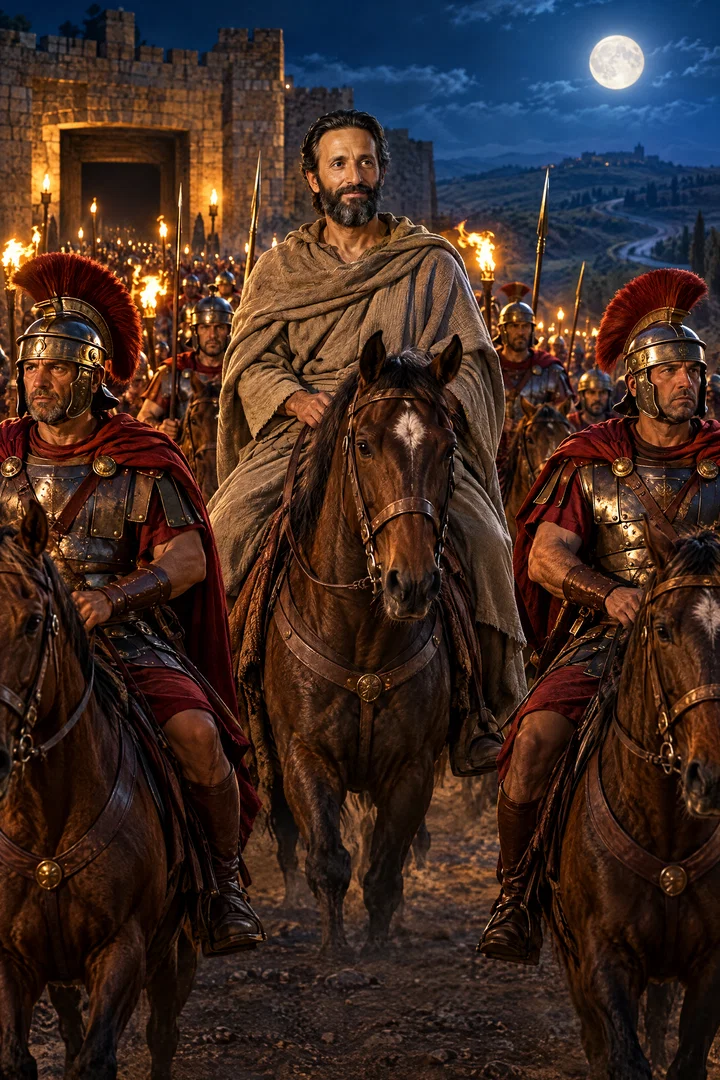
On the morrow they left the horsemen to go with him, and returned to the castle:
Translations
American King James Version, King James Version, KJV Cambridge Paragraph Bible, Webster Bible
On the morrow they left the horsemen to go with him, and returned to the castle:
Revised Version, American Standard Version
But on the morrow they left the horsemen to go with him, and returned to the castle:
and on the morrow, having suffered the horsemen to go on with him, they returned to the castle;
and on the morrow, having left the horsemen to go with him, returned to the fortress.
and, on the morrow, leaving the horsemen to go on with him, returned to the castle,—
Berean Standard Bible, Majority Standard Bible
The next day they returned to the barracks and let the horsemen go on with him.
But on the next day they left the horsemen to go with him, and returned to the barracks.
But on the day after, they sent the horsemen on with him, and went back to their place:
And the next day, they left the horsemen to goe with him, and returned vnto the Castel.
Douay-Rheims (Challoner revision)
And the next day, leaving the horsemen to go with him, they returned to the castle.
Pictures
Cross-references
- Acts 23:23-24
And he called unto him two centurions, saying, Make ready two hundred soldiers to go to Cæsarea, and horsemen threescore and ten, and spearmen two hundred, at the third hour of the night;
Lysias arranges Paul’s armed escort to Caesarea before the night departure.
- Acts 23:16-22
And when Paul’s sister’s son heard of their lying in wait, he went and entered into the castle, and told Paul.
Paul’s nephew exposes the plot that leads to the guarded journey.
- Acts 23:12-13
And when it was day, certain of the Jews banded together, and bound themselves under a curse, saying that they would neither eat nor drink till they had killed Paul.
Paul’s enemies swear an oath to kill him.
Commentary
Each commentary is drawn from primary sources: the writings of Ellen G. White and Adventist pioneers and periodicals. Each commentary is separate. Its own words are not a quotation; follow the references to read the source passages.
Ellen G. White
3 sources
Paul had been brought by night as far as Antipatris, and this verse follows that night removal.AA 415.1–416.1 On the next morning after the night journey the foot soldiers left Paul and returned to the fortress at Jerusalem.SLP 228.2–4AA 415.1–416.1SLP 227.1–228.1 Their return marked the end of their part in the escort, once the danger of the first stage was past.SLP 228.2–4AA 415.1–416.1SLP 227.1–228.1
The horsemen did not return but continued with him onward to Caesarea.SLP 228.2–4AA 415.1–416.1SLP 227.1–228.1 They kept escorting him through the following day's journey until the transfer was complete.SLP 228.2–4AA 415.1–416.1SLP 227.1–228.1 There at Caesarea he was delivered safely to Felix the governor.SLP 228.2–4SLP 227.1–228.1
Sources
Pioneers and periodicals
12 sources
Under the order of Claudius Lysias a large guard of soldiers, horsemen and spearmen brought Paul by night from Jerusalem toward Felix at Caesarea to keep him safe through dangerous country from those seeking to kill him.RH Oct 14, 1862ST Apr 14, 1898ST Mar 29, 1883 After reaching Antipatris, the escort divided on the next day in the morning, with the foot soldiers and spearmen returning to the castle at Jerusalem while the horsemen were left to go on with him.RH Oct 14, 1862ST Apr 14, 1898ST Apr 14, 1898 The horsemen continued with Paul to Caesarea and brought him safely into the city in daylight, where they delivered the chief captain's letter to the governor and presented Paul before him.ST Apr 14, 1898ST Apr 14, 1898ST Feb 12, 1885 This transfer from Jerusalem to Caesarea for trial before the Roman governor was a step toward fulfilling God's promise that he would preach in Rome, illustrating that all things work together for good to those who love God. The phrase on the morrow means the daylight portion following a night, so that both the night march to Antipatris and the daylight return to the castle can fall within the same day reckoned from sunset to sunset, which proves that the same phrase in the account of the meeting at Troas does not require Roman reckoning from midnight.RH Mar 11, 1862RH Dec 12, 1871
Escort to Caesarea
Under the order of Claudius Lysias a large guard of soldiers, horsemen and spearmen brought Paul by night from Jerusalem toward Felix at Caesarea to take him safely there.RH Oct 14, 1862ST Apr 14, 1898ST Feb 12, 1885 This military protection was given against those seeking to kill him, carrying him safely through dangerous country under Roman guard.RH Oct 14, 1862ST Mar 29, 1883ST Feb 12, 1885 The dangerous nighttime journey followed the prudent action of Paul's nephew.ST Mar 29, 1883
After the soldiers brought Paul by night to Antipatris, the escort divided on the next day, in the morning.RH Oct 14, 1862ST Apr 14, 1898ST Aug 7, 1893ST May 8, 1884 The foot soldiers with the spearmen and lancers then finished their part and ended their escort there.ST Apr 14, 1898ST Apr 14, 1898ST Feb 12, 1885 They returned to the castle at Jerusalem while the horsemen were left to go on with him toward Caesarea.RH Oct 14, 1862ST Apr 14, 1898ST Aug 7, 1893ST Feb 12, 1885ST May 8, 1884
The horsemen continued with Paul to Caesarea and brought him safely into the city under Roman guard in daylight.ST Apr 14, 1898ST Feb 12, 1885ST May 8, 1884 There they delivered the chief captain's letter to the governor and presented Paul before him.ST Apr 14, 1898ST Apr 14, 1898 He entered escorted by seventy horsemen, and was recognized there by Philip and other Christian companions who had recently traveled with him.ST May 8, 1884
Place in Acts
Acts 23:32 belongs to Acts 23, which is studied together with Acts 15-28 by noting the places that were the scenes of its events and the chief thing reported in each chapter.ST Jun 9, 1898 It stands in the history of how Paul fell into the hands of the Romans, of his appearances before Roman rulers, and of his wonderful deliverances throughout his ministry.ST Jun 9, 1898 It belongs to the record of Paul's dispatch to Felix, coming after the close of his voyage to Jerusalem, his reception at Jerusalem, his arrest in the temple, and his defenses before the Jews and before the Sanhedrin. It comes before his defense before Felix, which consists of the preaching of the gospel, and his appearance before Festus.
It forms part of the transfer of Paul from Jerusalem to Caesarea for trial before the Roman governor. The events leading to that transfer were steps toward fulfilling God's promise that he would preach in Rome, even when their purpose was not clear to those involved. They illustrate that all things work together for good to those who love God. It is part of the book of Acts, which concludes with Paul's arrival in Rome, his reception there, and his efforts to reach his own people, without recounting his final imprisonment and death.ST Oct 29, 1912
Meaning of Morrow
On the morrow can mean the daylight portion following a night when spoken of from the standpoint of the previous evening, so that the morning is called the morrow.RH Mar 11, 1862 The Greek epaurion so translated means the next period of daylight, not necessarily another day of the week.RH Dec 12, 1871 The soldiers brought Paul by night to Antipatris, and in the morning the foot soldiers returned to the castle while the horsemen went on with him.RH Dec 12, 1871 Both the night march and the daylight return can fall within the same day reckoned from sunset to sunset, which is compatible with Jewish custom where the day begins at sunset.RH Mar 11, 1862RH Dec 12, 1871
This use proves that the same phrase in Acts 20:7 concerning the meeting at Troas does not require Roman reckoning from midnight. Being ready to depart on the morrow can mean leaving in the morning daylight of the same first day whose evening beginning held the night meeting.RH Dec 12, 1871 The morning therefore does not necessarily mean a different day of the week when days are reckoned from evening to evening.RH Mar 11, 1862RH Dec 12, 1871
Sources