Acts 25:9
But Festus, willing to do the Jews a pleasure, answered Paul, and said, Wilt thou go up to Jerusalem, and there be judged of these things before me?
Translations
But Festus, willing to do the Jews a pleasure, answered Paul, and said, Will you go up to Jerusalem, and there be judged of these things before me?
King James Version, KJV Cambridge Paragraph Bible
But Festus, willing to do the Jews a pleasure, answered Paul, and said, Wilt thou go up to Jerusalem, and there be judged of these things before me?
But Festus, willing to do the Jews a pleasure, answered Paul, and said, Wilt thou go to Jerusalem, and there be judged concerning these things before me?
But Festus, desiring to gain favour with the Jews, answered Paul, and said, Wilt thou go up to Jerusalem, and there be judged of these things before me?
But Festus, desiring to gain favor with the Jews, answered Paul and said, Wilt thou go up to Jerusalem, and there be judged of these things before me?
And Festus willing to lay on the Jews a favour, answering Paul, said, 'Art thou willing, to Jerusalem having gone up, there concerning these things to be judged before me?'
But Festus, desirous of obliging the Jews, to acquire their favour, answering Paul, said, Art thou willing to go up to Jerusalem, there to be judged before me concerning these things?
But, Festus, wishing, with the Jews, to gain, favour, answered Paul, and said—Art thou willing, unto Jerusalem, to go up, and, there, concerning these things, be judged before me?
Berean Standard Bible, Majority Standard Bible
But Festus, wishing to do the Jews a favor, said to Paul, “ Are you willing to go up to Jerusalem to stand trial before me on these charges?”
But Festus, desiring to gain favor with the Jews, answered Paul and said, “ Are you willing to go up to Jerusalem and be judged by me there concerning these things?”
But Festus, desiring to get the approval of the Jews, said to Paul, Will you go up to Jerusalem, and be judged before me there in connection with these things?
Yet Festus willing to get fauour of the Iewes, answered Paul and saide, Wilt thou goe vp to Hierusalem, and there be iudged of these things before mee?
Douay-Rheims (Challoner revision)
But Festus, willing to shew the Jews a pleasure, answering Paul, said: Wilt thou go up to Jerusalem, and there be judged of these things before me?
Pictures
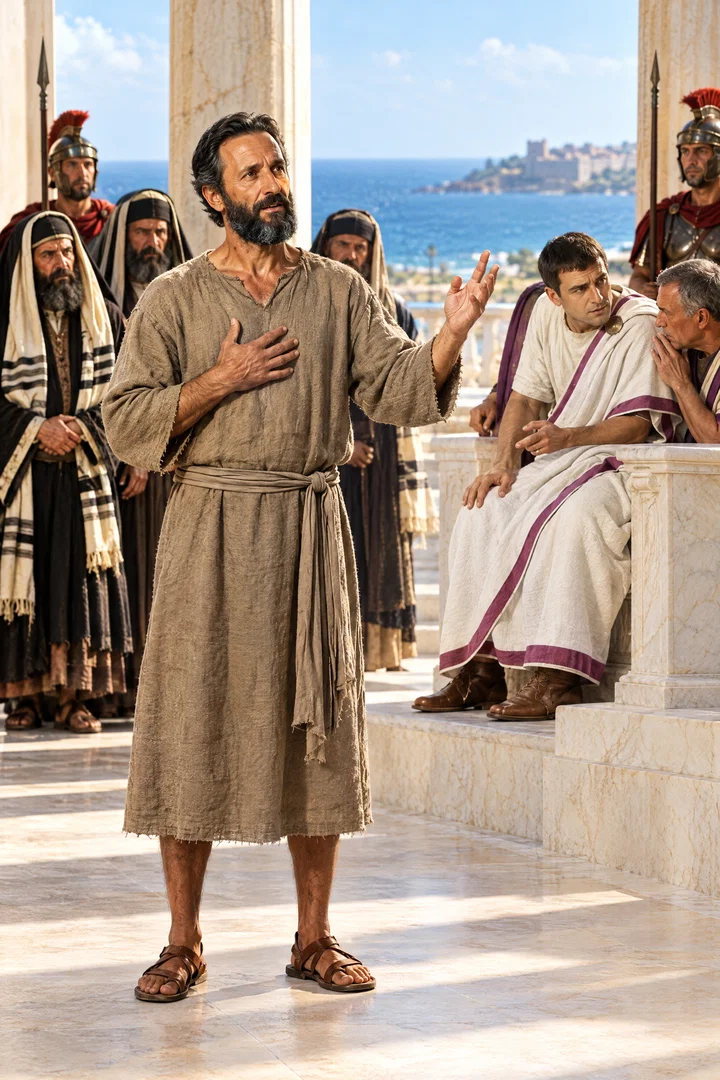
Cross-references
- Acts 24:27
But after two years Porcius Festus came into Felix’ room: and Felix, willing to shew the Jews a pleasure, left Paul bound.
Paul remained imprisoned under Felix before Festus took office.
- Acts 23:29
Whom I perceived to be accused of questions of their law, but to have nothing laid to his charge worthy of death or of bonds.
Lysias reports that Paul faced no charge deserving death or imprisonment.
- Acts 25:2-3
Then the high priest and the chief of the Jews informed him against Paul, and besought him,
The Jewish leaders asked Festus to bring Paul to Jerusalem.
- Acts 25:16
To whom I answered, It is not the manner of the Romans to deliver any man to die, before that he which is accused have the accusers face to face, and have licence to answer for himself concerning the crime laid against him.
Festus says the accused must face accusers and answer the charge.
Commentary
Each commentary is drawn from primary sources: the writings of Ellen G. White and Adventist pioneers and periodicals. Each commentary is separate. Its own words are not a quotation; follow the references to read the source passages.
Ellen G. White
10 sources
Before the question was put, the Jewish leaders had asked that Paul be brought to Jerusalem for trial, intending to kill him on the way.ST May 22, 1884AA 428.1–429.2 Festus at first refused that request and kept the case at Caesarea for a fair hearing where Paul could face his accusers and answer the charges.ST May 22, 1884AA 428.1–429.2 That just refusal preserved justice and, under God's providence, preserved Paul's life.ST May 22, 1884AA 428.1–429.2
Festus understood that the accusations concerned questions of Jewish doctrine and gave no ground for Roman imprisonment or death.RH Nov 9, 1911ST May 22, 1884AA 429.3–430.3SLP 248.2 Despite that understanding, he feared the anger of the Jews if he neither condemned Paul nor handed him over to them.RH Nov 9, 1911 To please the Jewish leaders and to quiet their uproar and angry accusations, he asked Paul about going to Jerusalem.RH Nov 9, 1911ST May 22, 1884ST May 22, 1884AA 429.3–430.3SLP 248.2 The proposal was for Paul to go up to Jerusalem under Festus's protection and authority and there be judged before Festus by the Sanhedrin.RH Nov 9, 1911ST May 22, 1884SLP 248.2SLP 249.1ST May 22, 1884 This would in effect move the case from Roman to Jewish jurisdiction.ST May 22, 1884ST May 22, 1884ST May 22, 1884
Paul knew he could expect no justice from that tribunal, which was hostile to the gospel and had repeatedly condemned him without proving guilt.ST May 22, 1884AA 429.3–430.3SLP 249.1ST May 22, 1884 Though himself under Roman authority, he was safer under heathen magistrates than before that court.ST May 22, 1884 He therefore asserted his right as a Roman citizen to be judged at Caesar's tribunal and appealed to Caesar.ST May 22, 1884AA 429.3–430.3 The episode shows the pressure to satisfy others despite known truth, the danger of trusting justice to those opposed to the gospel, and how human power and policy can be turned against those who remain faithful to God.AA 429.3–430.3SLP 248.2ED 254.2–3
Sources
Pioneers and periodicals
11 sources
The verse belongs to Paul's imprisonment at Caesarea under Festus, who succeeded Felix in the government of Judea, after Paul had already been held prisoner there for two years before the events leading to his defense before Agrippa.ST Oct 7, 1897ST May 15, 1884 It follows the Jews' request to have Paul tried in Jerusalem, which Festus at first refused, promising instead a fair hearing at Caesarea, a decision that preserved justice and under God's providence protected Paul's life.ST May 22, 1884 Festus then asked Paul whether he would go up to Jerusalem to be judged there, and he did so in order to please the Jews and their leaders.RH Nov 9, 1911ST May 22, 1884ST May 22, 1884ST Aug 14, 1893ST Apr 28, 1898 He understood that the charges concerned Jewish doctrine and could not be proved, giving no basis for a Roman conviction and not warranting imprisonment or death.RH Nov 9, 1911ST May 22, 1884ST Aug 14, 1893
He feared the Jews' anger if Paul was neither condemned nor handed over to them.RH Nov 9, 1911 He also wanted to end the uproar over the case.ST May 22, 1884 The proposal was that Paul go up to Jerusalem and be judged there before Festus and under his authority and protection, but in effect it would transfer the case from Roman to Jewish jurisdiction and put Paul before the Sanhedrin.RH Nov 9, 1911ST May 22, 1884ST May 22, 1884ST May 22, 1884ST Apr 28, 1898 The proposal was an irregular and unjust procedure that made the trial a sham.ST Apr 28, 1898 Paul knew he could not expect justice from the Jewish authorities, who had repeatedly condemned him without proving his guilt, and that he was safer under heathen magistrates.ST May 22, 1884ST May 22, 1884ST Aug 14, 1893
He therefore asserted his right as a Roman citizen to be judged at Caesar's tribunal and appealed to Caesar rather than be tried by the Jews, appealing from Festus's tribunal in proceedings that ended with that appeal, which Festus allowed.ST May 22, 1884ST May 22, 1884ST Aug 14, 1893ST May 15, 1884 "Caesar" was an imperial title, not the emperor's personal name, and the emperor at that time was Nero.ST May 22, 1884 Festus waited for the coming of King Agrippa and Bernice to hear Paul with him so he would have something more definite to write to Caesar. Paul's being held before the governors of Judea served God's missionary plan to bring His name and truth before kings and others in authority and great influence, whose endorsement helps create a favorable impression among the lower classes, even if His children must be driven through oppression or chastisement to bear the message.ST Oct 12, 1904
Sources