Acts 25:8
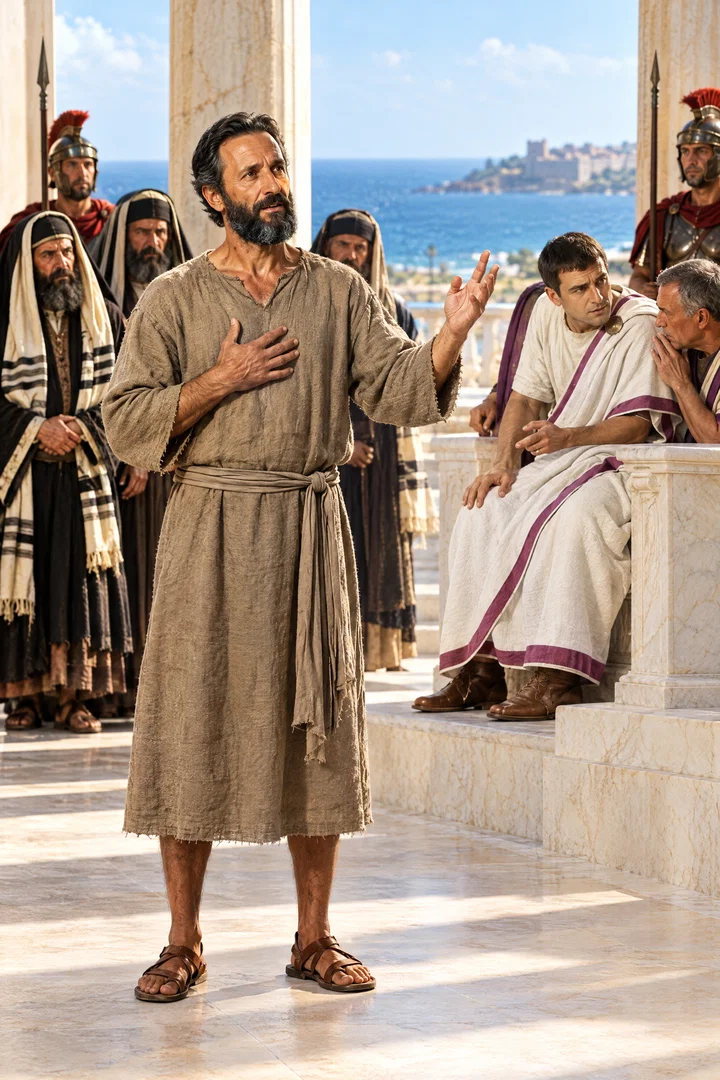
While he answered for himself, Neither against the law of the Jews, neither against the temple, nor yet against Cæsar, have I offended any thing at all.
Translations
While he answered for himself, Neither against the law of the Jews, neither against the temple, nor yet against Caesar, have I offended any thing at all.
While he answered for himself, Neither against the law of the Jews, neither against the temple, nor yet against Cæsar, have I offended any thing at all.
While he answered for himself, Neither against the law of the Jews, neither against the temple, nor yet against Cesar, have I offended any thing at all.
While he answered for himself, Neither against the law of the Jews, neither against the temple, nor yet against Cesar have I committed any offense.
while Paul said in his defence, Neither against the law of the Jews, nor against the temple, nor against Caesar, have I sinned at all.
while Paul said in his defence, Neither against the law of the Jews, nor against the temple, nor against Cæsar, have I sinned at all.
he making defence — 'Neither in regard to the law of the Jews, nor in regard to the temple, nor in regard to Caesar — did I commit any sin.'
Paul answering for himself, Neither against the law of the Jews, nor against the temple, nor against Caesar, have I offended [ in] anything.
Paul saying in defence—Neither against the law of the Jews, nor against the temple, nor against Caesar, have I in anything sinned.
Berean Standard Bible, Majority Standard Bible
Then Paul made his defense: “ I have committed no offense against the law of the Jews or against the temple or against Caesar.”
while he said in his defense, “ Neither against the law of the Jews, nor against the temple, nor against Caesar, have I sinned at all.”
Then Paul, in his answer to them, said, I have done no wrong against the law of the Jews, or against the Temple, or against Caesar.
Forasmuch as he answered, that he had neither offended any thing against the lawe of the Iewes, neither against ye temple, nor against Caesar.
Douay-Rheims (Challoner revision)
Paul making answer for himself: Neither against the law of the Jews, nor against the temple, nor against Caesar, have I offended in any thing.
Pictures
Cross-references
- Acts 28:17
And it came to pass, that after three days Paul called the chief of the Jews together: and when they were come together, he said unto them, Men and brethren, though I have committed nothing against the people, or customs of our fathers, yet was I delivered prisoner from Jerusalem into the hands of the Romans.
Paul says he committed nothing against his people or their customs.
- Acts 24:2-9
And when he was called forth, Tertullus began to accuse him, saying, Seeing that by thee we enjoy great quietness, and that very worthy deeds are done unto this nation by thy providence,
Records the accusations against Paul that his defense answers.
- Acts 24:13
Neither can they prove the things whereof they now accuse me.
Paul says his accusers cannot prove their charges.
- Acts 25:12
Then Festus, when he had conferred with the council, answered, Hast thou appealed unto Cæsar? unto Cæsar shalt thou go.
Festus responds to Paul’s appeal.
- John 19:12
And from thenceforth Pilate sought to release him: but the Jews cried out, saying, If thou let this man go, thou art not Cæsar’s friend: whosoever maketh himself a king speaketh against Cæsar.
Accusers invoke loyalty to Caesar to pressure the governor.
- Acts 6:13
And set up false witnesses, which said, This man ceaseth not to speak blasphemous words against this holy place, and the law:
The charges against Stephen are compared with the charges against Paul.
- Acts 24:16
And herein do I exercise myself, to have always a conscience void of offence toward God, and toward men.
Paul seeks to keep a clear conscience toward God and people.
- Acts 25:16
To whom I answered, It is not the manner of the Romans to deliver any man to die, before that he which is accused have the accusers face to face, and have licence to answer for himself concerning the crime laid against him.
Festus describes the accused person’s right to face and answer the accusers.
- Philippians 3:5-6
Circumcised the eighth day, of the stock of Israel, of the tribe of Benjamin, an Hebrew of the Hebrews; as touching the law, a Pharisee;
Both present Paul as still a Jew.
Commentary
Each commentary is drawn from primary sources: the writings of Ellen G. White and Adventist pioneers and periodicals. Each commentary is separate. Its own words are not a quotation; follow the references to read the source passages.
Ellen G. White
7 sources
Paul answered for himself by denying that he had committed any offense at all against the law of the Jews, against the temple, or against Caesar.ST May 22, 1884SLP 248.2SLP 248.1ED 254.2–3 He gave this answer calmly and plainly.RH Nov 9, 1911AA 428.1–429.2ST May 22, 1884SLP 248.1 His answer exposed the accusations as false and unsupported, for his accusers merely repeated charges of heresy, treason, and sacrilege without bringing any witnesses to prove them.RH Nov 9, 1911AA 428.1–429.2ST May 22, 1884SLP 248.1
The dispute behind the charges concerned Jewish doctrine.RH Nov 9, 1911ST May 22, 1884SLP 248.2 Even if the charges had been proved, they did not make him deserving of death or imprisonment under Roman law, as Festus recognized.RH Nov 9, 1911ST May 22, 1884SLP 248.2 This defense took place amid accusations driven by hostility and a plot to kill him, when he was entitled to a fair hearing face to face with his accusers, and Festus helped preserve his life by refusing to hand him over.ST May 22, 1884 As a prisoner facing death, his witness in this defense stands as an example of faith in God's word resisting human power when it is used to support evil.ED 254.2–3
Sources
Pioneers and periodicals
19 sources
Paul answering for himself before Festus denied any offense at all against the religious law of the Jews, against the temple and its worship, and against Roman authority.RH Nov 9, 1911ST May 20, 1908ST Aug 14, 1893 His plain denial was enough, for his accusers brought charges of heresy, treason and sacrilege without witnesses and could not prove them, and even Festus saw they warranted neither death nor imprisonment.RH Nov 9, 1911ST Aug 14, 1893ST Apr 28, 1898 His claim means he kept the Ten Commandments, including the fourth, keeping the seventh day as the Sabbath after Christ's resurrection, since the Sabbath was God's law and not merely Jewish law.RH Jul 20, 1869ST Jan 6, 1881 He therefore taught no Sunday observance in place of the Sabbath, for had he done so he would have had to justify the change rather than deny acting against Jewish law and custom.RH Jun 22, 1911ST Jul 13, 1882ST Jul 13, 1904 So too the early Christians remained in harmony with Jewish law and practice, and were never accused of abandoning the Sabbath for another day, which they could not have truthfully denied if they had left seventh-day observance for first-day observance.RH Feb 5, 1867ST Sep 3, 1894
Trial Before Festus
The verse belongs to the record of Paul's appearances before Roman rulers after he fell into the hands of the Romans, with chapter 25 introducing two prominent men.ST Jun 9, 1898 In that setting he was a prisoner at Caesarea before Festus, who had succeeded Felix in governing the province, two years after Felix, while Nero was emperor.ST Oct 7, 1897 His appeal to Caesar refers to the Roman emperor, and Augustus was an imperial title rather than a personal name.ST May 22, 1884 He defended himself before Festus against the accusations of the Jews, maintaining that he had committed no offense against Jewish law, the temple, or Caesar, and appealed from Festus's tribunal to Caesar.ST May 15, 1884
He made this answer when Festus opened his court to hear the charges the Jews brought against him.ST Apr 28, 1898 The accusations were driven by hostility and a plot to kill him, and he was entitled to a fair hearing before his accusers.ST May 22, 1884 Festus refused to hand him over to the Jews, which helped preserve his life.ST May 22, 1884 He appealed to Caesar rather than be tried by the Jews, and Festus allowed the appeal while waiting for the coming of King Agrippa and Bernice so that they with him might hear Paul and he might have something more definite to write to Caesar.
He calmly and plainly answered for himself and demonstrated the falsity of the accusations.RH Nov 9, 1911ST May 22, 1884 This simple denial was all that was necessary.ST Apr 28, 1898 The Jews repeated charges of heresy, treason, and sacrilege concerning Jewish doctrines but offered no witnesses to support them and could not prove them.ST May 22, 1884ST Aug 14, 1893 Festus saw that the dispute concerned Jewish doctrine and that even if the charges were proved they did not make Paul deserving of death or imprisonment.RH Nov 9, 1911ST May 22, 1884
The threefold denial means he claimed no offense at all against Jewish religious law, against the temple and its worship, and against Roman authority.ST May 20, 1908
Paul Kept Sabbath Law
Paul's claim to have offended nothing against the law of the Jews and the temple means he remained a Jew by birth, rearing, and teaching who kept the law and customs and taught nothing other than what was written in the law of Moses, the prophets, the Psalms, and according to the customs of the people.ST Jul 13, 1904 His claim of innocence toward the temple supports his obedience to the commandments associated with its worship.RH Jul 20, 1869 To have broken the Sabbath would have offended against Jewish law, which prescribed death for its violation, as well as against God's law.RH Jul 20, 1869
The law of the Jews is the Ten Commandments, so his denial means he kept the fourth commandment and kept the seventh day as the Sabbath. The Sabbath commandment was God's law and not merely a Jewish law, still binding and still kept by him after Christ's resurrection, and he kept it along with the other commandments of the Decalogue.RH Jul 20, 1869 His declaration that he had kept the law would be inconsistent with not observing the Sabbath.ST Jan 6, 1881 That proves he did not keep Sunday.
His denial shows he did not teach observance of Sunday in place of the Sabbath.RH Jun 22, 1911 Had he done so he would have justified the change rather than deny acting against Jewish law.RH Jun 22, 1911 His defense gives no indication of teaching replacement of the seventh day with the first day as a holy day.ST Jul 13, 1882 For he was not raised up to teach that the Sabbath of the Lord and the customs of the Jews were past or to bring in a new era and dispensation with first-day observance, and his gospel could teach the church only what was already manifest in the Scriptures.ST Jul 13, 1904
His defense reflects the early Christians' harmony with Jewish law and practice, including Sabbath observance.ST Sep 3, 1894 The early Christians were not accused of abandoning the Sabbath or treating another day as the Sabbath.RH Feb 5, 1867 If the apostles and primitive Christians had left seventh-day observance for first-day observance, persecuting unbelieving Jews would have accused them of being violators of the Sabbath, and Paul could not have truthfully claimed complete innocence toward the Jewish law, so Jews did not accuse Christians of neglecting the Sabbath.ST Sep 3, 1894 The verse is evidence that the apostles had not abolished God's law; the law remains unchanged, and God's sanctified rest day is to be set before sinners as they are shown their sin and called to repentance.
Witness Before Rulers
Paul's being carried before the governors of Judea and onward to the emperor at Rome belonged to God's plan of missionary work.ST Oct 12, 1904 The purpose was to set the truth before persons of great influence.ST Oct 12, 1904 If such persons accept it, their endorsement goes far toward creating a favorable impression upon the lower classes.ST Oct 12, 1904 God will have His name and His truth brought to the attention of kings and others in authority.ST Oct 12, 1904 Even if His children must be forced through oppression or chastisement, they will still be made to bear the message to such rulers.ST Oct 12, 1904
His answer for himself, denying any offense against the law of the Jews, against the temple, or against Caesar, provides the pattern for those later accused over religious practice.RH May 2, 1907 Like him, they can maintain that they have broken no law.RH May 2, 1907
Sources