Acts 25:10
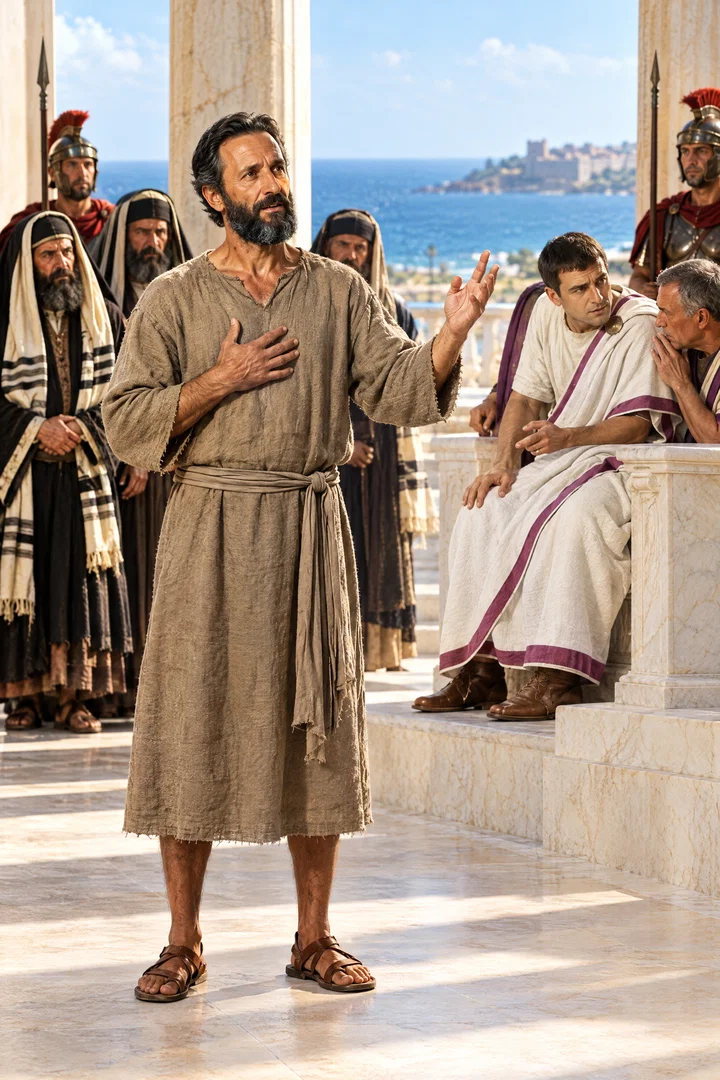
Then said Paul, I stand at Cæsar’s judgment seat, where I ought to be judged: to the Jews have I done no wrong, as thou very well knowest.
Translations
Then said Paul, I stand at Caesar’s judgment seat, where I ought to be judged: to the Jews have I done no wrong, as you very well know.
Then said Paul, I stand at Cæsar’s judgment seat, where I ought to be judged: to the Jews have I done no wrong, as thou very well knowest.
Then said Paul, I stand at Cesar’s judgment seat, where I ought to be judged: to the Jews have I done no wrong, as thou very well knowest.
Then said Paul, I stand at Cesar's tribunal, where I ought to be judged: to the Jews have I done no wrong, as thou very well knowest.
But Paul said, I am standing before Caesar’s judgment-seat, where I ought to be judged: to the Jews have I done no wrong, as thou also very well knowest.
But Paul said, I am standing before Cæsar’s judgment-seat, where I ought to be judged: to the Jews have I done no wrong, as thou also very well knowest.
and Paul said, 'At the tribunal of Caesar I am standing, where it behoveth me to be judged; to Jews I did no unrighteousness, as thou dost also very well know;
But Paul said, I am standing before the judgment-seat of Caesar, where I ought to be judged. To the Jews have I done no wrong, as thou also very well knowest.
But Paul said—Standing before the judgment-seat of Caesar, am I, where, I, ought to be judged. Unto the Jews, have I done no wrong, as, even thou, right well, art discovering.
Berean Standard Bible, Majority Standard Bible
Paul replied, “ I am standing before the judgment seat of Caesar, where I ought to be tried. I have done nothing wrong to the Jews, as you yourself know very well.
But Paul said, “ I am standing before Caesar’s judgment seat, where I ought to be tried. I have done no wrong to the Jews, as you also know very well.
And Paul said, I am before the seat of Caesar's authority where it is right for me to be judged: I have done no wrong to the Jews, as you are well able to see.
Then said Paul, I stand at Caesars iudgment seate, where I ought to be iudged: to the Iewes I haue done no wrong, as thou very well knowest.
Douay-Rheims (Challoner revision)
Then Paul said: I stand at Caesar’s judgment seat, where I ought to be judged. To the Jews I have done no injury, as thou very well knowest.
Pictures
Cross-references
- Acts 25:21
But when Paul had appealed to be reserved unto the hearing of Augustus, I commanded him to be kept till I might send him to Cæsar.
Paul appeals to Caesar and is held for transfer to Rome.
- Acts 26:32
Then said Agrippa unto Festus, This man might have been set at liberty, if he had not appealed unto Cæsar.
shows Paul to be sent to Caesar
- Acts 23:29
Whom I perceived to be accused of questions of their law, but to have nothing laid to his charge worthy of death or of bonds.
Lysias judged that Paul’s charges merited neither death nor imprisonment.
- Acts 24:27
But after two years Porcius Festus came into Felix’ room: and Felix, willing to shew the Jews a pleasure, left Paul bound.
Paul had remained a prisoner at Caesarea for two years.
- Acts 27:1
And when it was determined that we should sail into Italy, they delivered Paul and certain other prisoners unto one named Julius, a centurion of Augustus’ band.
shows voyage to Rome for trial
- Acts 26:19-23
Whereupon, O king Agrippa, I was not disobedient unto the heavenly vision:
Paul’s case before Festus connects with his testimony before Agrippa.
- Acts 23:1-5
And Paul, earnestly beholding the council, said, Men and brethren, I have lived in all good conscience before God until this day.
Paul’s earlier trial also exposes the accusations against him.
- Acts 24:10-21
Then Paul, after that the governor had beckoned unto him to speak, answered, Forasmuch as I know that thou hast been of many years a judge unto this nation, I do the more cheerfully answer for myself:
Paul denies the charges before the Roman governor Felix.
- Acts 28:16
And when we came to Rome, the centurion delivered the prisoners to the captain of the guard: but Paul was suffered to dwell by himself with a soldier that kept him.
Paul’s appeal to Caesar results in his being brought to Rome.
- Acts 25:16
To whom I answered, It is not the manner of the Romans to deliver any man to die, before that he which is accused have the accusers face to face, and have licence to answer for himself concerning the crime laid against him.
Festus explains the Roman rule requiring an accused person to face the accusers and answer the charge.
- Acts 18:12-16
And when Gallio was the deputy of Achaia, the Jews made insurrection with one accord against Paul, and brought him to the judgment seat,
Gallio refused to condemn Paul in a dispute over Jewish teaching.
- Acts 24:22-23
And when Felix heard these things, having more perfect knowledge of that way, he deferred them, and said, When Lysias the chief captain shall come down, I will know the uttermost of your matter.
Felix recognizes the dispute concerns Jewish law and does not convict Paul.
- John 19:12
And from thenceforth Pilate sought to release him: but the Jews cried out, saying, If thou let this man go, thou art not Cæsar’s friend: whosoever maketh himself a king speaketh against Cæsar.
Accusers invoke Caesar’s honor to pressure a Roman governor.
- Luke 21:12-15
But before all these, they shall lay their hands on you, and persecute you, delivering you up to the synagogues, and into prisons, being brought before kings and rulers for my name’s sake.
Jesus foretells believers being brought before rulers.
Commentary
Each commentary is drawn from primary sources: the writings of Ellen G. White and Adventist pioneers and periodicals. Each commentary is separate. Its own words are not a quotation; follow the references to read the source passages.
Ellen G. White
13 sources
Paul asserts as a Roman citizen that the imperial court is his rightful place of trial and refuses to be sent to Jerusalem to be judged by the Sanhedrin.ST May 22, 1884RH Nov 9, 1911AA 428.1–429.2 He maintains that he has done no wrong to his countrymen, that the charges of heresy, treason and sacrilege are unproved without witnesses and concern Jewish doctrine that carries no penalty of death or imprisonment under Roman law, and that Festus himself knows this.ST May 22, 1884RH Nov 9, 1911AA 428.1–429.2SLP 248.2 He is willing to suffer even death if guilty of an offense against the emperor, but he will not be handed over to his accusers as a favor and without proof.ST May 22, 1884SLP 249.3–250.1 His firm stand exposes the false accusations and, amid the danger that Festus would yield to enraged accusers from whom no justice could be expected, secures providential protection when Festus keeps him at Caesarea for a fair hearing and accepts his appeal to Caesar as lawful, thereby stopping the proceedings and keeping him from murderous power.ST May 22, 1884ST May 22, 1884ST May 22, 1884 That same stand carries him to answer for his faith before Nero under threat of death, where he is at first acquitted and freed yet later dies as a criminal under that cruel rule, remaining calm and fearless through faith in God's word as an example of unshakable service to Christ.RH Dec 28, 1911ED 254.2–3GW 107.3
Paul's Defense Before Festus
Standing at Caesar's judgment seat, Paul as a Roman citizen declares that this Roman tribunal, court and authority is where he ought to be judged, the proper place for his judgment, rather than being handed over to his Jewish accusers or sent to Jerusalem for trial by the Sanhedrin.ST May 22, 1884RH Nov 9, 1911ST May 22, 1884ST May 22, 1884SLP 249.3–250.1 He denies that he has done any wrong to the Jews, insists that no charge against him has been proved, and appeals to Festus as very well knowing this, while his calm and candid defense exposes the accusations as false.ST May 22, 1884RH Nov 9, 1911AA 428.1–429.2ST May 22, 1884SLP 249.3–250.1 The Jewish leaders accused him of heresy, treason and sacrilege, also described as sedition and heresy, but produced no witnesses.SLP 248.2 The dispute concerned Jewish doctrines, and even if the charges had been proved they would not have made him deserving of death or imprisonment under Roman law.SLP 248.2
If he were guilty of a crime against the emperor he declares he would accept the penalty, even death and willingness to die, but he cannot be handed over to his accusers as a favor or without proof.ST May 22, 1884SLP 249.3–250.1 He spoke amid the danger that Festus might yield to the accusers' rage and hand him over to them.SLP 248.2 He knew he could not expect justice from Jewish tribunals and leaders that had condemned him without proving his guilt, while heathen magistrates had recognized his innocence.ST May 22, 1884
Festus refused to send him to Jerusalem where he would be exposed to murder, promised him a fair hearing at Caesarea, and thereby preserved his life through God's providence.ST May 22, 1884 His appeal to Caesar prevented his enemies from taking him into their power, stopped the proceedings, and was accepted as legally admissible.ST May 22, 1884ST May 22, 1884AA 429.3–430.3
Later Trial and Faithful Example
His appeal carried his case to Nero, for as one entitled to be judged at Caesar's judgment seat he claimed that right while affirming he had done no wrong to the Jews.RH Dec 28, 1911 He was thus brought from a dungeon to stand before Roman authority to answer for his faith under judgment and possible death. Though judged by a cruel ruler, he was at that time acquitted and released and his bonds were removed.RH Dec 28, 1911
Even so he later endured chains and a criminal's death under Nero's rule.ED 254.2–3 At his trial he remained calm as he answered accusations of sedition and heresy and proclaimed the Gospel. Faith in God's word enabled him to stand against the power of a worldly empire.ED 254.2–3
His standing before Roman authority to plead his case without shame or fear remains an example of commitment to serving Christ that opposition and persecution could not turn aside.GW 107.3 The faith that upheld him had been strengthened through effort and sacrifice.GW 107.3 To threaten to take fellow believers before that same secular judgment seat where he ought to be judged shows careless disregard for right behavior and contempt for the good and true and righteous.Lt 299, 1903, par. 6–8 Such threatening is disgusting to God and casts the threatener wholly on Satan's side, proving an unconverted mind set on accusing the brethren that has no place with God and will be left outside heaven lest it spoil its happiness, and unless God cuts his life short he will only learn in the great day how fully he chose Satan, while doing the opposite brings the overcomer's reward.Lt 299, 1903, par. 6–8
Sources
Pioneers and periodicals
19 sources
Paul stands before the emperor's court as the lawful place for his trial, having done no injury to the Jews as his judge well understands, and he rejects removal to Jerusalem as irregular and unjust.ST May 22, 1884ST May 22, 1884ST Aug 14, 1893ST May 15, 1884ST Apr 28, 1898 As a Roman citizen he claims his right to imperial justice rather than surrender to hostile tribunals that condemned without proof, while heathen magistrates recognized his innocence.RH Nov 9, 1911ST May 22, 1884ST May 22, 1884ST May 22, 1884ST Aug 14, 1893 His appeal to Caesar is ruled admissible, stops the proceedings against him, shields him from murder at Jerusalem, and carries his case to Nero at Rome where he answers for his faith and is set free.ST May 22, 1884ST May 22, 1884RH Dec 28, 1911 That stand is a witness to the head of the Roman world, part of God's purpose to set truth before kings and persons of great influence that their hearing may impress others.ST Dec 29, 1887ST Oct 12, 1904RH Dec 4, 1913 It is an example for Christians to use civil law to protect the cause of truth and their temporal concerns.RH Aug 28, 1860
Words and Historical Setting
In this setting Caesar and Augustus are titles borne by the Roman emperors after Julius Caesar, not personal names, and the emperor then reigning was Nero, so the references to Caesar and to Augustus identify him by title.ST May 22, 1884 The events lie two years after the previous lesson, with Porcius Festus as governor of Judea and Nero as emperor of Rome.ST Oct 7, 1897 Festus had succeeded Felix in the government of the province, and when Paul was brought before him he appealed unto Caesar rather than be tried by the Jews; Festus allowed the appeal but waited for the coming of King Agrippa and Bernice, that they with him might hear Paul so he should have something more definite to write to Caesar.
The verse stands in Acts 25 as part of Paul's appearances before Roman rulers, in a chapter that introduces two prominent men and whose outline belongs with Acts 15-28.ST Jun 9, 1898 It belongs to the course leading from his imprisonment at Caesarea to his defense before Agrippa.ST Oct 7, 1897 It stands in the closing part of Acts that brings his arrival in Rome, his reception in that city, and his effort to reach his own people with a twofold result, without going on to his last imprisonment and death, as an inspiring record of the work of men who trusted God.ST Oct 29, 1912
The meaning is that Paul is standing at Caesar's judgment seat where he ought to be judged, which is the proper tribunal for his case, and that he has done the Jews no wrong, a fact Festus already knew.ST May 15, 1884 His proper place of judgment is Caesar's judgment seat, where he stands and where he ought to be judged, and Festus' proposal that he be judged at Jerusalem is rejected as irregular in procedure and unjust.ST Apr 28, 1898
Paul's Appeal and Defense
Paul as a Roman citizen insisted on his right to be judged before Caesar's tribunal and the Roman court rather than handed over to his Jewish accusers or judged by the Sanhedrin.RH Nov 9, 1911ST May 22, 1884ST May 22, 1884 The Roman court was the proper place for his case, and there he declared he had done the Jews no wrong, a fact Festus knew.RH Nov 9, 1911ST May 22, 1884ST May 22, 1884 He maintained the charges had not been proved, and if he were guilty of a crime against the emperor he would accept the penalty, but he could not be handed over to his accusers as a favor.ST May 22, 1884 His appeal to Caesar prevented his enemies from taking him into their power, stopped the proceedings, and was accepted as legally admissible.ST May 22, 1884ST May 22, 1884
Festus knew the charges could not be proved, yet anxious to please the Jews he asked whether Paul would go to Jerusalem to be judged.ST May 22, 1884ST Aug 14, 1893 Paul refused because he knew he would not receive justice from the Jews.ST May 22, 1884ST Aug 14, 1893 Their tribunals had condemned him without proving his guilt, while heathen magistrates had recognized his innocence.ST May 22, 1884
Festus had succeeded Felix in the government of the province, and when Paul was brought before him Paul appealed unto Caesar rather than to be tried by the Jews.ST May 22, 1884 Festus refused to send him to Jerusalem for a trial that would expose him to murder, promised him a fair hearing at Caesarea, and thereby preserved his life through God's providence.ST May 22, 1884 Festus allowed the appeal but waited for the coming of King Agrippa and Bernice that they with him might hear Paul so he would have something more definite to write to Caesar.
The appeal brought his case before Nero, where he was brought from a dungeon to face Nero's judgment and possible death to answer for his faith.RH Dec 28, 1911 Despite the danger of being judged by a cruel ruler he remained calm while answering accusations of sedition and heresy and proclaiming the Gospel. He was acquitted and released, and his bonds were removed.RH Dec 28, 1911
His statement that he stands at Caesar's judgment seat where he ought to be judged proves that the throne of the Caesars, the seat of imperial Roman power, was at Rome in Italy.RH Feb 20, 1855 With the decree in Luke 2:1 and the account of his being sent and brought to Rome, this establishes Rome as the seat of the dragon that ruled the world at Christ's birth and therefore the same seat of the beast.RH Feb 20, 1855 For this reason Rome cannot also be the woman seated upon the beast.RH Feb 20, 1855
Witness and Present Application
Paul's declaration before Festus that he stood at Caesar's judgment seat and had done the Jews no wrong was a bearing of witness before the Roman authorities to the head of the Roman world.ST Dec 29, 1887 His standing before Roman authority belonged to God's missionary plan to set the truth before those of great influence, because if they accept it their endorsement goes far toward a favorable impression upon the lower classes.ST Oct 12, 1904 God will have His name and His truth brought to the attention of kings and others in authority, even if His children have to be forced through oppression or chastisement to bear the message, and Paul was used as His agent to manifest God's power to the rulers just as the captive maid was used to bring God's name to Naaman and through him to all Syria.ST Oct 12, 1904 Before the tribunal he acted wisely as he opposed Jezebel's scheme against God's people.RH Dec 4, 1913
His use of his rights as a Roman citizen in appealing to Caesar rather than submitting to the Jews' judgment is an example for Christians to use civil law to protect the cause of truth and their temporal concerns.RH Aug 28, 1860 The verse records his appeal unto Caesar, after which the book of Acts breaks off abruptly in the midst of his imprisonment without hinting anything about the result of that appeal.RH Apr 11, 1871 This shows the abrupt, fragmentary, incomplete, raw character of the Scripture narratives, which assume and suggest much that is not said and leave much unsaid rather than fitting events together into a finished, adjusted history.RH Apr 11, 1871 That character proves them to be original contemporary documents and raw material for history.RH Apr 11, 1871
Sources