Acts 4:5
And it came to pass on the morrow, that their rulers, and elders, and scribes,
Translations
American King James Version, King James Version, KJV Cambridge Paragraph Bible, Webster Bible
And it came to pass on the morrow, that their rulers, and elders, and scribes,
Revised Version, American Standard Version
And it came to pass on the morrow, that their rulers and elders and scribes were gathered together in Jerusalem;
And it came to pass upon the morrow, there were gathered together of them the rulers, and elders, and scribes, to Jerusalem,
And it came to pass on the morrow that their rulers and elders and scribes were gathered together at Jerusalem,
And it came to pass, upon the morrow, that there were gathered together of them, the rulers and the elders and the scribes, in Jerusalem;
Berean Standard Bible, Majority Standard Bible
The next day the rulers, elders, and scribes assembled in Jerusalem,
In the morning, their rulers, elders, and scribes were gathered together in Jerusalem.
And on the day after, the rulers and those in authority and the scribes came together in Jerusalem;
And it came to passe on the morow, that their rulers, and Elders, and Scribes, were gathered together at Hierusalem,
Douay-Rheims (Challoner revision)
And it came to pass on the morrow, that their princes, and ancients, and scribes, were gathered together in Jerusalem;
Pictures
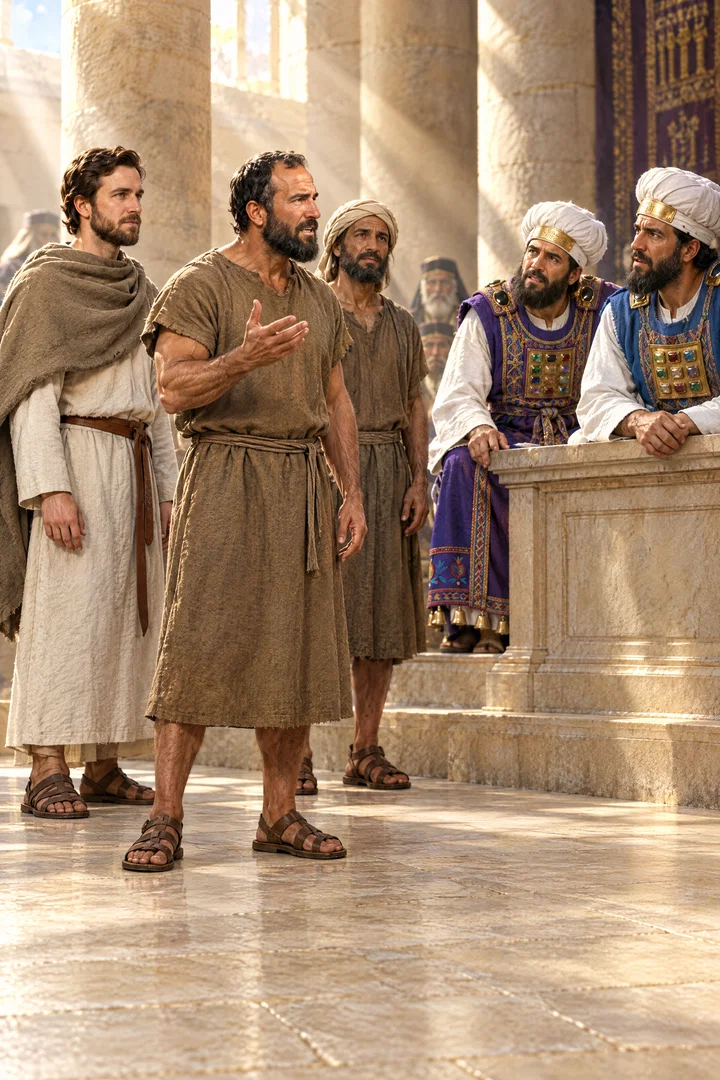
Cross-references
- Acts 4:19-20
But Peter and John answered and said unto them, Whether it be right in the sight of God to hearken unto you more than unto God, judge ye.
Peter and John insist they must obey God and speak what they have seen and heard.
- Acts 4:13
Now when they saw the boldness of Peter and John, and perceived that they were unlearned and ignorant men, they marvelled; and they took knowledge of them, that they had been with Jesus.
The council marvelled at Peter and John’s boldness.
- Acts 5:27-32
And when they had brought them, they set them before the council: and the high priest asked them,
Peter answers the council and witnesses to Jesus, insisting the apostles must obey God rather than men.
- Luke 22:66
And as soon as it was day, the elders of the people and the chief priests and the scribes came together, and led him into their council, saying,
Uses the same Greek word for the people’s elders.
- Acts 3:1-10
Now Peter and John went up together into the temple at the hour of prayer, being the ninth hour.
The temple-gate healing precedes the events that follow.
- Acts 4:17
But that it spread no further among the people, let us straitly threaten them, that they speak henceforth to no man in this name.
The council threatens to stop them preaching in Jesus’ name.
- Acts 4:23
And being let go, they went to their own company, and reported all that the chief priests and elders had said unto them.
Also refers to elders among the authorities.
- Acts 4:10
Be it known unto you all, and to all the people of Israel, that by the name of Jesus Christ of Nazareth, whom ye crucified, whom God raised from the dead, even by him doth this man stand here before you whole.
The healing is declared to have been done through Jesus of Nazareth.
- Acts 4:11
This is the stone which was set at nought of you builders, which is become the head of the corner.
Peter's answer before the council
Commentary
Each commentary is drawn from primary sources: the writings of Ellen G. White and Adventist pioneers and periodicals. Each commentary is separate. Its own words are not a quotation; follow the references to read the source passages.
Ellen G. White
9 sources
On the morrow means on the morning of the day after Peter and John were seized at Jerusalem, following the healing of the cripple and the preaching and healing that drew attention.SPBC 139.2Ms 22, 1900, par. 11–16AC1 15.3–16.1ST Nov 14, 1878Ms 47, 1886, par. 5–9 Those who gathered then were the Jewish rulers, elders, and scribes, the Sanhedrin and temple leading authorities, including the high priest with the high-priestly family, Annas and Caiaphas and other dignitaries of the temple.Ms 22, 1900, par. 11–16AA 57.1AC1 15.3–16.1ST Nov 14, 1878RH Feb 2, 1911
They assembled to examine and try the prisoners about the healing of the impotent man and their preaching through Jesus the resurrection of the dead, asking by what name the miracle was done.Ms 22, 1900, par. 11–16RH Feb 2, 1911Ms 47, 1886, par. 5–9 The Sadducees had been grieved by that teaching and had laid hands on the apostles and put them in hold, though the disciples were giving truth for that time and had committed no error.Ms 47, 1886, par. 5–9
The hearing took place in that very room at Jerusalem and before those very men where Peter had shamefully denied his Lord at Jesus' trial, which came distinctly to Peter's mind.AC1 15.3–16.1ST Nov 14, 18787RED 15.3RH Feb 2, 1911 It stood before him as an opportunity to redeem his former wicked cowardice and to remove the stain of his apostasy by honoring the name he had once disowned.AC1 15.3–16.1ST Nov 14, 18787RED 15.3 The Peter who stood there was no longer the impulsive, self-confident disciple and proud boaster who denied Christ in His greatest need, but a converted man, distrustful of self, filled with the Holy Spirit and through its power firm as a rock, courageous yet modest in magnifying Christ.AC1 15.3–16.1ST Nov 14, 18787RED 15.3
Though confronted and opposed by the religious authorities, Peter and John bore bold witness to Christ under the Holy Spirit's direction, with words and deeds reflecting Jesus' teaching and work.SPBC 139.2Ms 22, 1900, par. 11–16Ms 32, 1898, par. 13–14 Boldly declaring before the council, they testified that the miracle was done through Jesus of Nazareth.Ms 22, 1900, par. 11–16Ms 32, 1898, par. 13–14Ms 47, 1886, par. 5–9
Sources
Pioneers and periodicals
29 sources
On the morning after Peter and John were arrested and held overnight, the Jewish authorities assembled at Jerusalem to examine them over their teaching and the healing of the lame man.ST Jan 29, 1902ST Jan 14, 1897ST Mar 11, 1897ST Apr 23, 1912 The gathering was a formal action of the Sanhedrin, the highest Jewish council, made up of rulers who were chief priests, elders who were family heads, and scribes, including Pharisees and Sadducees.ST Jan 29, 1902ST Jan 14, 1897ST Mar 11, 1897ST Sep 11, 1884RH Jan 9, 1855 Among those present were Annas, still regarded as high priest, and Caiaphas his son-in-law who held the office by Roman appointment, with other temple dignitaries and members of the high priest's family, in the same place where Jesus had been tried and Peter had denied Him.ST Nov 14, 1878ST Jan 22, 1885ST Jan 14, 1897 Filled with the Holy Spirit after Pentecost, Peter no longer trusted in himself but stood before that powerful assembly with modest and patient courage, honoring the name he had once disowned.ST Nov 14, 1878ST Jan 22, 1885ST Mar 11, 1897 Their testimony shows the power of Jesus' name in the healing of the lifelong cripple, while the attempt of rulers to forbid preaching in that name shows the limits of human authority when conscience and obedience to God are at stake.ST Apr 23, 1912ST Sep 11, 1884ST Feb 13, 1901RH Oct 22, 1908
Words and Historical Setting
On the morrow, the day after Peter and John were arrested and put in prison, their rulers and elders and scribes assembled to hear and examine and question them.ST Jan 29, 1902ST Jan 14, 1897ST Apr 23, 1912ST Jan 29, 1902ST Jan 14, 1897 The gathering was the formal council action that followed their preaching and arrest.ST Sep 11, 1884ST Jan 29, 1902 It dealt with them over their teaching and the healing.ST Mar 11, 1897ST Jan 29, 1902
The gathering belongs to the account of the apostles' work after Pentecost, when the power of the Holy Spirit had been restored to them.RH Feb 10, 1916ST Jul 17, 1901 It came the day after the healing of the lame man and the preaching described in the preceding chapter, as the apostles faced trial before the Jewish council for that work.ST Mar 11, 1897ST Mar 11, 1897 It was part of the disciples' public witness after Pentecost, the harvest of the seed sown in the conversation with the Samaritan woman.ST Jul 17, 1901
The assembly took place at Jerusalem, with the rulers and elders and scribes gathered together.ST Jan 29, 1902ST Jan 14, 1897ST Jan 14, 1897 It was a trial before the Jewish council, before the Sanhedrin, the highest Jewish authority.ST Mar 11, 1897ST Mar 11, 1897RH Feb 16, 1911 The high priest and members of his family were among those gathered to examine the apostles.ST Jan 14, 1897
The rulers were the chief priests, heads of the twenty-four priestly courses, and the elders were family heads with seats in the Sanhedrin.ST Jan 14, 1897 The word elders renders the Greek presbuteros, listed here among the rulers and scribes.RH Jan 9, 1855 The council included leading rulers, elders, scribes, Pharisees, Sadducees, and the high priest, before whom the apostles were summoned and brought several times after Pentecost.ST Sep 11, 1884RH Feb 16, 1911 Joseph of Arimathea and Nicodemus also seem to have been members, while John and Alexander were influential members whose offices are unknown.ST Jan 14, 1897RH Feb 16, 1911
Annas and Caiaphas and other temple dignitaries were present when the rulers and elders and scribes assembled the day after the arrest and the day after the cripple was healed.ST Nov 14, 1878ST Jan 22, 1885ST Feb 7, 1884RH Feb 2, 1911ST Jan 14, 1897 Annas, though deposed by the Romans, was still regarded by the Jews as high priest, while Caiaphas his son-in-law held the office by Roman appointment.ST Jan 14, 1897 The trial took place in the same room and before the same men where Jesus had been tried and where Peter had denied him.ST Nov 14, 1878ST Jan 22, 1885ST Feb 7, 1884RH Feb 2, 1911
The hearing was held the day after the arrest because the Sanhedrin could lawfully meet only in daylight.ST Jan 14, 1897
Opposition and Faithful Witness
The morrow brought a formal hearing before the Jewish leadership, when the rulers, elders, and scribes gathered as the Sanhedrin to try the apostles after the healing and preaching of the preceding chapter.ST Mar 11, 1897RH Apr 7, 1863 Peter and John stood before this powerful assembly and bore witness to the truth.ST Mar 11, 1897RH Apr 7, 1863 The trial was held in the same room and before the same men where Jesus had been tried and where Peter had denied Him, with Annas, Caiaphas, and other temple dignitaries present.ST Nov 14, 1878ST Jan 22, 1885ST Feb 7, 1884 Converted and filled with the Holy Spirit, no longer trusting himself, Peter now faced them with modest courage and stood firm, with opportunity to honor the name he had once disowned and to make good his earlier denial by boldly honoring Christ.ST Nov 14, 1878ST Jan 22, 1885ST Feb 7, 1884 The council expected him to be frightened by threats of imprisonment and death, but he remained patient and earnest, bold and kind, showing in a limited way what Spirit-filled men can do in speaking and suffering.ST Jan 22, 1885
In its wider setting the gathering belongs to the showing of the power of Jesus' name through the healing of the lifelong cripple found at the temple gate.ST Feb 13, 1901 The rulers, elders, and scribes were assembled against the followers of Jesus, joining the priests and Sadducees in opposing the preaching about Jesus and his resurrection.ST Sep 11, 1884RH Apr 7, 1863RH Jun 27, 1865 This gathering expressed the Sanhedrin's hostility to the apostles and their work, as Christ's murderers persecuted the apostles for preaching Christ and after His resurrection condemned and persecuted His apostles and people.RH May 10, 1915RH Jun 8, 1916RH Jun 27, 1865 It was part of the testimony that influential religious leaders rejected Jesus while only a few ordinary people received Him, and that this persecution helped fill up Jerusalem's guilt before its destruction.RH Jul 25, 1854RH May 10, 1915 Their opposition to the gospel and its ministers paralleled the priesthood's opposition to Christ and the apostles and the resistance faced by Luther and the Reformation.RH Apr 7, 1863
The authority of these religious rulers over the apostles is contrasted with the limits of human rule when conscience and obedience to God are at stake.ST Apr 23, 1912 Forbidding speech and teaching in Jesus' name restricts religious practice even when belief and worship are not expressly prohibited.ST Sep 11, 1884 The episode is thus a Bible example of law or civil authority interfering with religious duty.ST Apr 23, 1912ST Sep 11, 1884RH Oct 22, 1908 The appearance belongs to the early church's record of opposition and God's deliverance, following Peter and John's imprisonment and the healing of the lame man and connected with the rulers' threats and the apostles' continuing witness.ST Jun 2, 1909ST Jul 29, 1897 It sets an example for those who face opposition for doing God's work, with lessons applying to individual Christians, families, and the church, while the account, including John's presence with Peter, contains no mention of Sunday keeping or an apostolic example for it.RH Apr 7, 1863ST Sep 15, 1887ST Dec 24, 1912
Sources