Translations
American King James Version, King James Version, KJV Cambridge Paragraph Bible, Webster Bible
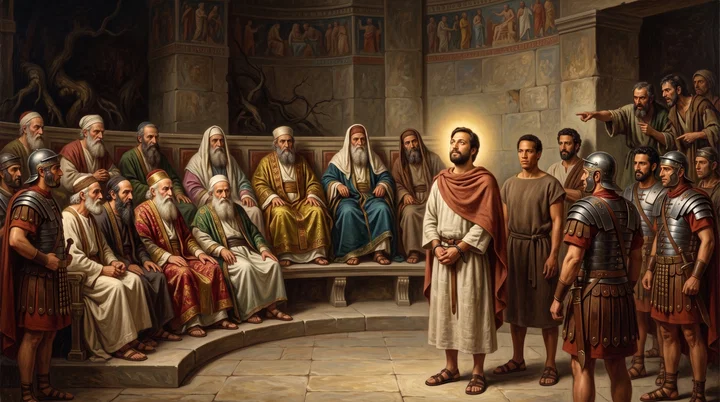
Then said the high priest, Are these things so?
Revised Version, American Standard Version
And the high priest said, Are these things so?
And the chief priest said, 'Are then these things so?'
And the high priest said, Are these things then so?
And the High-priest said—Are these things, so?
Berean Standard Bible, Majority Standard Bible
Then the high priest asked Stephen, “ Are these charges true?”
The high priest said, “ Are these things so?”
Then the high priest said, Are these things true?
Then sayd the chiefe Priest, Are these things so?
Douay-Rheims (Challoner revision)
Then the high priest said: Are these things so?
Pictures
Cross-references
- Acts 6:13-14
And set up false witnesses, which said, This man ceaseth not to speak blasphemous words against this holy place, and the law:
These are the charges the high priest asks about.
- Acts 7:51-53
Ye stiffnecked and uncircumcised in heart and ears, ye do always resist the Holy Ghost: as your fathers did, so do ye.
Stephen concludes his defense by confronting his hearers' sins.
- Acts 7:55-60
But he, being full of the Holy Ghost, looked up stedfastly into heaven, and saw the glory of God, and Jesus standing on the right hand of God,
Stephen’s testimony before the authorities continues with his vision and death.
- Acts 8:1-4
And Saul was consenting unto his death. And at that time there was a great persecution against the church which was at Jerusalem; and they were all scattered abroad throughout the regions of Judæa and Samaria, except the apostles.
Stephen’s death is followed by persecution and the scattering of disciples.
- Exodus 2:1-15
And there went a man of the house of Levi, and took to wife a daughter of Levi.
Acts recounts Moses’ early life, including his rescue and flight from Pharaoh.
- Genesis 46:26-27
All the souls that came with Jacob into Egypt, which came out of his loins, besides Jacob’s sons’ wives, all the souls were threescore and six;
Counts Jacob’s household entering Egypt as seventy, compared with Acts’ seventy-five.
- Luke 21:14-15
Settle it therefore in your hearts, not to meditate before what ye shall answer:
Stephen’s defense fulfills the promise of wisdom when witnessing before rulers.
- Acts 6:1-7
And in those days, when the number of the disciples was multiplied, there arose a murmuring of the Grecians against the Hebrews, because their widows were neglected in the daily ministration.
Describes the deacons’ service and Stephen’s selection.
- Acts 6:8
And Stephen, full of faith and power, did great wonders and miracles among the people.
Stephen is described as full of faith and power.
Commentary
Each commentary is drawn from primary sources: the writings of Ellen G. White and Adventist pioneers and periodicals. Each commentary is separate. Its own words are not a quotation; follow the references to read the source passages.
Ellen G. White
5 sources
The question is put by the high priest to Stephen on trial before the council and its judges, calling on him to answer whether the charges against him are true.AA 97.1Ms 22, 1900, par. 31–327RED 32.37RED 31.1–23SP 297.2 The Stephen so questioned was the foremost of the seven deacons, a Jew by birth of deep piety and broad faith.AA 97.1 He spoke the Greek language and knew Greek customs, which gave him opportunity to preach the gospel in the synagogues of the Greek Jews.AA 97.1
He had been very active in the cause of Christ and bold in proclaiming his faith, and learned rabbis and doctors of the law engaged him in public discussion expecting an easy victory.AA 97.1 They were not able to resist the wisdom and the spirit by which he spoke, so that he ably defended the truths he advocated and utterly defeated his opponents, fulfilling in him the promise of a mouth and wisdom which adversaries cannot gainsay nor resist.AA 97.1 Afterward he was seized and brought before the Sanhedrin, whose leaders sought to refute his teaching, with Saul taking a leading role in arguing against him.7RED 31.1–2
His answer recounts Israel's religious history from Abraham through Solomon, showing his knowledge of that history and his learning as a student of the prophecies and of all matters of the law.AA 97.17RED 32.3 He explained its spiritual meaning in light of Christ, using key events to defend himself.7RED 32.3 His words were spoken in the power of the Holy Spirit and directed by the Holy Ghost, and he knew it was his final testimony amid the turmoil and resistance of his hearers.AA 97.13SP 297.2
That defense ends with the countercharge that his hearers are stiff-necked and uncircumcised in heart and ears and always resist the Holy Spirit as their fathers did.Ms 22, 1900, par. 31–32 As their fathers persecuted and killed the prophets who foretold the coming of the Just One, so they had now betrayed and murdered Him.Ms 22, 1900, par. 31–32 The address leads to Stephen, full of the Holy Spirit, seeing the glory of God and Jesus standing at the right hand of God, and then being cast out of the city and stoned while praying for Jesus to receive his spirit and not to lay the sin to his murderers' charge.Ms 22, 1900, par. 31–32
Sources
Pioneers and periodicals
24 sources
The high priest's question put to Stephen before the council asks whether the charges against him are true, and it opens his formal reply and martyrdom in Acts 7.ST Nov 28, 1878ST Aug 19, 1897ST Sep 20, 1910 It was feigned impartiality in a mock trial, for the accusations were false and repeated the charge once used to condemn Christ, yet Stephen answered though condemnation was likely.ST Feb 19, 1902 He does not deny the charge but reviews Israel's history and God's dealings from Abraham and the covenant with Abraham, Isaac, and Jacob through Moses and the Exodus, connecting them to Christ as the Messiah.ST Nov 28, 1878ST Aug 19, 1897ST Apr 13, 1904ST Jan 22, 1902ST Aug 19, 1897 His hearing and stoning occurred in the very last part of the seventieth week, in the autumn of A.D. 34, bringing the 490 years to its end.ST Jun 26, 1907RH Oct 11, 1915ST That martyrdom was the formal public rejection of Christ and the Gospel by the Jewish people and Sanhedrin, closing Israel's probation as God's recognized nation and the time when the Gospel went especially to the Jews, so the persecution that followed scattered the disciples to preach the word wherever they went and to the Gentiles.STST Sep 20, 1910ST Jun 26, 1907RH Oct 11, 1915
Trial and Defense
The high priest's question to Stephen before the council and Sanhedrin and the Jewish authorities, asking whether the charges against him are true, opens Stephen's formal reply and discourse and address and martyrdom in Acts 7.ST Nov 28, 1878ST Aug 19, 1897ST Sep 20, 1910RH Aug 27, 1901 The question was feigned impartiality in a mock trial, for the high priest knew the accusations were false and hired witnesses repeated the charge once used to condemn Christ, and though Stephen understood condemnation was likely he still answered.ST Feb 19, 1902 Stephen was one of the seven deacons, full of faith and power and doing great wonders and miracles among the people, with Saul present at the trial, and his example shows that a deacon could preach the gospel when the Lord led and opened the way.RH Aug 27, 1901CO 34.2 He does not deny the charge but proceeds to answer, beginning Brethren and fathers, hearken, and turning at once to the God of glory appearing to Abraham in Mesopotamia and calling him out of his land and kindred.ST Aug 19, 1897ST Aug 19, 1897
His defense reviews Israel's history and God's dealings and connects them to Christ, rehearsing events recorded in Exodus such as the rule of a king who did not know Joseph, Moses' early life, and his call at the burning bush, which shows the New Testament confirms the historical record in Exodus and is unintelligible without the record in Genesis of Abraham and the everlasting covenant with Abraham, Isaac, and Jacob.ST Nov 28, 1878RH Nov 16, 1916ST Apr 13, 1904 He first refers favorably to the ancestors, especially Abraham, Isaac, and Jacob, to address hearers prejudiced against his message, then turns from his own defense to bear witness to Jesus as the Messiah, making a masterly, pointed defense of the faith of Jesus and of the truth, pleading with the council while reading his fate in their faces, seeking the salvation of his persecutors, and connecting prophecy with the Gospel to support that Jesus was the Messiah.RH Aug 27, 1901ST Jan 22, 1902ST Feb 19, 1902ST Sep 19, 1900ST Jan 24, 1906
His preaching exposed the sins of Jews who had resisted much light, so the hearers were cut to the heart, became enraged, and put him to death, and his stoning while Saul cared for the garments at his feet made a deep impression on Saul that could not be effaced.RH Apr 7, 1868RH Aug 27, 1901 His sermon greatly excited the Jews yet says nothing about a change of the Sabbath, which shows the Sabbath was not changed at the resurrection of Christ, for he would have known of the change by that time and would have mentioned it.RH Apr 3, 1879
Prophecy and Israel's Probation
The high priest's question opens Stephen's hearing before the Jewish Sanhedrin, which ended in his martyrdom in the very last part of the seventieth week, in the autumn of A.D. 34.ST Jun 26, 1907RH Oct 11, 1915 That martyrdom brings the seventy weeks and the seventy-week period to its end in A.D. 34.RH Oct 11, 1915ST It brings the final half-week of the 490 years to its close.ST Sep 2, 1913
His martyrdom was the formal and public rejection of the Gospel by the Jewish Sanhedrin.ST Jun 26, 1907ST Oct 25, 1905 It was the Jews' second rejection of Christ, carried out through their rejection and stoning of Stephen, and their actions echoed their rejection of Christ at the crucifixion.STST This closed Israel's probation as God's representative nation and brought the allotted period for them as God's recognized people to its close.ST Sep 20, 1910ST Oct 25, 1905 It closed the time when the Gospel was carried especially and exclusively to the Jewish people and marked the end of the gospel's exclusive work for the Jews.ST Jun 26, 1907RH Oct 11, 1915
The persecution that followed scattered his followers and the disciples and Christians beyond Judea.ST Oct 25, 1905STST Sep 2, 1913 They preached the word wherever they went and began winning people from other nations.STST Oct 25, 1905 This marked the call of Paul as apostle to the Gentiles and the going of believers among the Gentiles preaching the word, and the beginning of its wider preaching to the Gentiles.ST Jun 26, 1907RH Oct 11, 1915STST Sep 2, 1913
Doctrine and Christian Living
The question opens the defense that turns to Abraham and shows God gave him and his seed none of this present world, not so much as to set foot on, but they sojourned in the land as in a strange country looking to the world beyond for fulfillment.RH May 16, 1907ST Feb 20, 1879 God had promised the land to Abraham and to his seed forever, yet Abraham died without receiving the promised inheritance in his lifetime.ST Feb 20, 1879 The promise therefore was not fulfilled then but waits to be fulfilled afterward.ST Feb 20, 1879
Its fulfillment comes through Christ as Abraham's seed, to whom the land and indeed the whole earth as the first dominion will finally be given forever. This proves the land promised with long days for honoring father and mother belongs to the future new earth where the rewards for keeping the commandments are really meted out.RH May 16, 1907 So the promise remains true and forceful when applied to unending life there.RH May 16, 1907
Because the promise to Abraham to be heir of the world was not fulfilled in his lifetime, Abraham and all who are heirs with him who have died or may yet die must be raised from the dead so it can be fulfilled.ST Jul 22, 1886 Abraham's hope of receiving it therefore rested on the resurrection.ST Feb 20, 1879 From that promise Stephen argued both the resurrection and the Messiahship of Christ.ST Jul 22, 1886
The address is to be read with Acts 8, for it reviews God's dealings so that reviewing God's dealings brings strength.RH Nov 16, 1916 The long chapter is to be read carefully and thoughtfully with Acts 2 to 8.ST Sep 23, 1908 Those chapters show God's power with the apostolic church coming through consecration on the part of the disciples and simple trust in the power of God's word.ST Sep 23, 1908 That simple trust gave boldness despite threatened persecution, and such preaching of the word brought persecution and also brought saved souls into the church, showing that souls are saved to serve.ST Sep 23, 1908
Sources