Acts 6:13
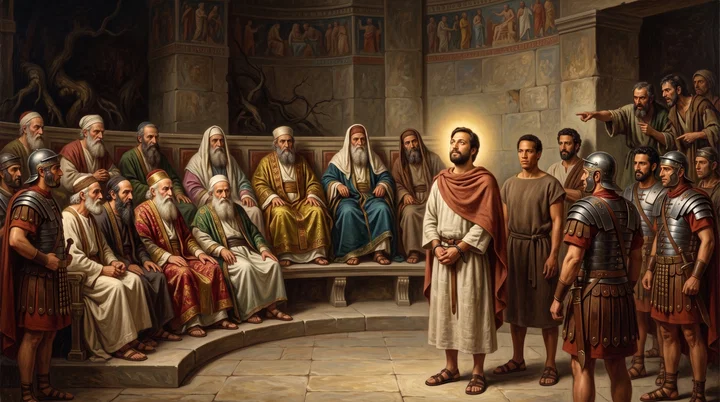
And set up false witnesses, which said, This man ceaseth not to speak blasphemous words against this holy place, and the law:
Translations
And set up false witnesses, which said, This man ceases not to speak blasphemous words against this holy place, and the law:
And set up false witnesses, which said, This man ceaseth not to speak blasphemous words against this holy place, and the law:
and set up false witnesses, which said, This man ceaseth not to speak blasphemous words against this holy place, and the law:
And set up false witnesses, who said, This man ceaseth not to speak blasphemous words against this holy place, and the law:
and set up false witnesses, which said, This man ceaseth not to speak words against this holy place, and the law:
and set up false witnesses, who said, This man ceaseth not to speak words against this holy place, and the law:
they set up also false witnesses, saying, 'This one doth not cease to speak evil sayings against this holy place and the law,
And they set false witnesses, saying, This man does not cease speaking words against the holy place and the law;
And they set up false witnesses, who said—This man, ceaseth not speaking things against this holy place and the law;
where they presented false witnesses who said, “ This man never stops speaking against this holy place and against the law.
where they presented false witnesses who said, “ This man never stops speaking blasphemies against this holy place and against the law.
and set up false witnesses who said, “ This man never stops speaking blasphemous words against this holy place and the law.
And they got false witnesses who said, This man is for ever saying things against this holy place and against the law:
And set forth false witnesses, which sayd, This man ceasseth not to speake blasphemous wordes against this holy place, and the Law.
Douay-Rheims (Challoner revision)
And they set up false witnesses, who said: This man ceaseth not to speak words against the holy place and the law.
Pictures
Cross-references
- Acts 7:54-60
When they heard these things, they were cut to the heart, and they gnashed on him with their teeth.
Stephen’s trial leads to his death after the accusation.
- Matthew 26:59-61
Now the chief priests, and elders, and all the council, sought false witness against Jesus, to put him to death;
Jesus was also condemned through false testimony.
- Acts 7:1
Then said the high priest, Are these things so?
The high priest asks Stephen to answer the charges.
- Acts 7:51-52
Ye stiffnecked and uncircumcised in heart and ears, ye do always resist the Holy Ghost: as your fathers did, so do ye.
Stephen confronts his accusers for rejecting Christ and persecuting the prophets.
- John 2:19
Jesus answered and said unto them, Destroy this temple, and in three days I will raise it up.
Jesus’ saying about the temple is echoed in the accusation.
- Acts 7:48
Howbeit the most High dwelleth not in temples made with hands; as saith the prophet,
Stephen answers the temple charge by saying God does not dwell in temples made by human hands.
- Acts 8:1
And Saul was consenting unto his death. And at that time there was a great persecution against the church which was at Jerusalem; and they were all scattered abroad throughout the regions of Judæa and Samaria, except the apostles.
Backing gained led to persecution and scattering.
- Romans 7:12
Wherefore the law is holy, and the commandment holy, and just, and good.
The law is affirmed as holy, against the charge that it was opposed.
- Exodus 20:16
Thou shalt not bear false witness against thy neighbour.
Stephen’s accusers bore false witness against him.
- Deuteronomy 19:15
One witness shall not rise up against a man for any iniquity, or for any sin, in any sin that he sinneth: at the mouth of two witnesses, or at the mouth of three witnesses, shall the matter be established.
Requires two witnesses to establish a charge.
- Leviticus 24:16
And he that blasphemeth the name of the LORD, he shall surely be put to death, and all the congregation shall certainly stone him: as well the stranger, as he that is born in the land, when he blasphemeth the name of the LORD, shall be put to death.
Sets death as the penalty for blasphemy.
- Luke 21:15
For I will give you a mouth and wisdom, which all your adversaries shall not be able to gainsay nor resist.
Jesus promises wisdom that adversaries cannot resist.
- Matthew 18:16
But if he will not hear thee, then take with thee one or two more, that in the mouth of two or three witnesses every word may be established.
Also states the two-witness principle.
- Acts 21:20-21
And when they heard it, they glorified the Lord, and said unto him, Thou seest, brother, how many thousands of Jews there are which believe; and they are all zealous of the law:
Uses “the law” for circumcision and customs associated with Moses.
- Acts 25:8
While he answered for himself, Neither against the law of the Jews, neither against the temple, nor yet against Cæsar, have I offended any thing at all.
Paul denied offending against the Jewish law, in a related defense.
Commentary
Each commentary is drawn from primary sources: the writings of Ellen G. White and Adventist pioneers and periodicals. Each commentary is separate. Its own words are not a quotation; follow the references to read the source passages.
Ellen G. White
16 sources
The charge belongs to the trial of Stephen before the council, where hired witnesses accused him of unceasingly speaking against the temple and the law by saying Jesus of Nazareth would destroy the holy place and change the customs delivered by Moses.AA 97.1Ms 22, 1900, par. 29–30Ms 11, 1900, par. 1–5SG1 87.1
The priests and rulers brought him there from bitter hatred because they could not withstand his wisdom and Spirit, and they pressed the accusation in imposing form with learned opponents and Saul taking a leading part against him.3SP 295.3RH Feb 23, 1911AC1 32.17RED 31.1–2SLP 16.1
The testimony was false and furnished only a pretext for condemnation, for no true violation of the law could be fastened upon him, just as the case against Christ rested on falsehood.ST May 1, 1884SLP 213.1Ms 4, 1883, par. 63–64
The need to hire false witnesses is decisive proof that Christ and His followers did not break the Sabbath of the fourth commandment, since one proven transgression would have placed them in the power of their enemies without need for lies.ST May 1, 1884SLP 213.1
Even unreliable accusations can prevail with unsanctified hearts that wish them true, as Saul was persuaded the blasphemy charge was true and joined in condemning Stephen on false testimony.3SP 305.2AA 112.2–113.1Ms 4, 1883, par. 63–64
Stephen's Trial and Accusation
Acts 6:13 belongs to the trial of Stephen, who was learned in the prophecies and the law and boldly defended his faith, while his opponents could not withstand the wisdom and the Spirit with which he spoke.AA 97.1 The priests and rulers were filled with bitter hatred after witnessing the power attending his ministry, and they refused to yield to the weight of evidence he presented.7RED 31.1–23SP 294.2 Though they opposed him vehemently, they prevailed nothing against his clear, calm wisdom.3SP 295.37RED 32.1
Rather than yield, they determined to silence his voice by putting him to death.7RED 31.1–2SLP 16.13SP 294.2 They determined to make an example of him to satisfy their revengeful hatred and to keep others through fear from adopting his belief.3SP 295.3RH Feb 23, 1911AC1 32.17RED 32.1 The charges against him were brought in a most imposing manner for that purpose.3SP 295.37RED 32.1
They were confident they could try, condemn, and execute prisoners according to their national custom without danger to themselves, because on several occasions they had bribed the Roman authorities to overlook the Jews taking the law into their own hands.7RED 31.1–23SP 294.2 Determined to risk the consequences at all events, they seized Stephen and brought him before the Sanhedrin council for trial.7RED 31.1–2SLP 16.13SP 294.2 Learned Jews from surrounding countries were summoned to refute the arguments of the accused, and Saul, already distinguished as a zealous opponent of the doctrine of Christ and a persecutor of all who believed in Him, was present and took a leading part against Stephen.7RED 31.1–2 He brought the weight of eloquence and rabbinic logic to convince the people that Stephen was preaching delusive and dangerous doctrines.7RED 31.1–2
They set up hired false witnesses who testified that they had heard him speak blasphemous words against the temple, the holy place, and the law, saying that he ceased not to speak against them.Ms 22, 1900, par. 29–30SG1 87.13SP 295.3RH Feb 23, 1911AC1 32.1 The witnesses claimed they had heard him say that Jesus of Nazareth would destroy the place and change the customs which Moses had delivered.Ms 22, 1900, par. 29–30AC1 32.1 Thus his testimony about Jesus was presented as a threat to the temple and to the customs Moses had given.Ms 11, 1900, par. 1–5SG1 87.1 The charge was part of the hostile response to his preaching, to his reproof of unbelieving leaders, and to priests accepting Jesus.Ms 11, 1900, par. 1–5
Lessons From False Testimony
The witnesses set up against Stephen were hired and false, charging him with speaking against the holy place or temple and the law because no true violation of the law could be fastened upon him, and their charge supplied only a pretext for his condemnation.ST May 1, 1884SLP 213.1Ms 4, 1883, par. 63–64 Like the arguments made against Christ, the arguments made against him rested on falsehood.SLP 213.1Ms 4, 1883, par. 63–64 If Sabbath breaking could have been proved against Christ or Stephen or others who died for their faith, their enemies would have used that real transgression to condemn them instead of relying on false testimony, and would not have needed to suborn false witnesses to furnish a pretext.ST May 1, 1884SLP 213.1 One proven transgression would have placed Christians in the power of their enemies.SLP 213.1 The need to resort to false testimony is decisive proof that Christ and His apostles did not violate the Sabbath of the fourth commandment.SLP 213.1 Their carefulness to show the utmost respect even for customs and ceremonies of minor importance shows how seriously they regarded the Sabbath, and it would have been impossible for them to violate it without suffering the severest penalty.ST May 1, 1884SLP 213.1
Even weak and unreliable accusations could influence people whose hearts were unsanctified and who wanted the accusations to be true.Ms 4, 1883, par. 63–64 Saul was persuaded by the priests' and rulers' arguments that the blasphemy accusation against Stephen was true.3SP 305.2AA 112.2–113.1 He was persuaded that Jesus was an impostor and that the religious leaders were right.AA 112.2–113.1 On that false testimony he took part in Stephen's trial and conviction as a blasphemer.3SP 305.2AA 112.2–113.1
Sources
Pioneers and periodicals
34 sources
They hired and set up men to give false testimony against Stephen because they could not withstand his wisdom, stirring up the people and bringing him before the council about seven years after the church began.RH Feb 23, 1911ST Feb 12, 1902ST Feb 12, 1902ST Feb 4, 1897ST May 24, 1883 The charge was that he never stopped speaking blasphemous words against the holy temple and the law, meaning they claimed to have heard him teach that Jesus of Nazareth would destroy the place and change the customs Moses had delivered.ST Feb 4, 1897RH Sep 17, 1908ST Mar 11, 1897ST Sep 19, 1900 The testimony was false and distorted to supply a pretext for condemnation in a mock trial whose outcome was assured, to satisfy hatred, stop the turning to Jesus, and frighten others from his belief.ST Mar 3, 1914RH Feb 23, 1911ST Feb 12, 1902ST Feb 4, 1897ST Sep 19, 1900 God vindicated his innocence before the council by a heavenly radiance on his face as the face of an angel, yet pride and the spirit of persecution kept their hearts from turning back.ST Feb 12, 1902ST Feb 12, 1902ST Feb 4, 1897 In this charge the law means the ceremonial law, and the need for false witnesses who knew it was not true is virtual acknowledgment that no fault could be found concerning the Ten Commandments, since determined opponents would have seized on any real Sabbath-breaking as a popular charge.ST May 1, 1884RH Jun 22, 1911RH Sep 17, 1908ST Jul 16, 1902
Stephen's False Accusation
Acts 6:13 belongs to the case against Stephen after disputants could not withstand the wisdom and the Spirit by which he spoke, so they suborned men, stirred up the people and the elders and the scribes, seized him and brought him before the council or Sanhedrin.ST Feb 12, 1902ST Feb 12, 1902ST Feb 4, 1897 This use of perjured testimony came about seven years after the church began, until which time the apostles and their followers had been treated carefully and guardedly for fear of the common people.ST Feb 11, 1897 By false witnesses the leaders gained the sympathy of many and thus stirred up the people, giving themselves substantial backing behind them.ST Feb 11, 1897
The witnesses were set up and hired to testify falsely, giving prejudicial false testimony to make conviction certain and secure his condemnation before he had spoken, since truthful men might have let him escape.RH Feb 23, 1911ST May 24, 1883ST Sep 19, 1900ST Feb 12, 1902ST Feb 19, 1902 Leaders did this to satisfy hatred, to stop the people turning to the faith of Jesus, to frighten others from accepting his belief, to inflame those devoted to the traditional teaching of Moses and zealous for God, and to gain sympathy and backing from the people.RH Feb 23, 1911ST Sep 19, 1900ST Feb 12, 1902ST Feb 11, 1897 They had first spread an underhanded report by distorting his teaching, then brought him before the Sanhedrin on fabricated charges.ST May 24, 1883ST Sep 19, 1900
The charge was that he ceased not to speak blasphemous words against the holy place or temple and the law.ST Feb 4, 1897ST Sep 3, 1912ST Mar 11, 1897ST Aug 19, 1897 It was explained as the claim that they had heard him teach that Jesus of Nazareth would destroy the place and change the customs Moses had delivered or handed down.ST Mar 3, 1914ST Feb 4, 1897ST Feb 12, 1902ST Sep 19, 1900ST Feb 12, 1902 The accusation was made because of his bold stand for Christ.ST Mar 11, 1897
The charge was false and distorted his words.ST Mar 3, 1914ST Feb 12, 1902ST Feb 4, 1897ST May 24, 1883 It supplied a pretext for condemnation through a mock trial whose outcome was assured from the first, with hired, priest-paid witnesses giving pitiless falsehood.ST May 1, 1884ST May 24, 1883ST Feb 19, 1902 The high priest listened with mock seriousness though he knew it was not true and only feigned impartiality.ST Feb 19, 1902
In answer to the charge God vindicated Stephen's true character and innocence by a heavenly radiance on his face, seen by all who sat in the council as the face of an angel and revealing him as a child of the Most High, even while in the hands of murderous enemies.ST Feb 12, 1902ST Feb 12, 1902ST Feb 4, 1897ST Feb 12, 1902ST Feb 12, 1902 Yet even that testimony could not melt hearts held under supreme control by the spirit of persecution, showing the utter futility of all opposition to the wisdom and power of the Word of God.ST Feb 12, 1902 Pride of opinion kept the council from turning back, for they had divorced themselves from God's grace so that the power to repent was absent, a warning of how many become entangled in Satan's snares until overtaken by the judgment of the great day.ST Feb 12, 1902
The accusation was the means by which he was brought before the council.ST Aug 19, 1897 It treated changing the customs delivered by Moses as deserving death.ST Sep 3, 1912 It led to his being cast out of the city and stoned, making him the first Christian martyr.ST Mar 11, 1897 With that support the leaders acted out the hostility in their hearts, putting Stephen to death and bringing great persecution on the church at Jerusalem that scattered the disciples, which became another way the church achieves victory through the opposition of her foes.ST Feb 11, 1897
Law, Sabbath, and Prophecy
In this charge the law means the ceremonial law, since the accusation explains itself as the claim that Jesus of Nazareth would destroy the temple and change the customs Moses had delivered.RH Sep 17, 1908 The formal charge that Stephen spoke against the holy place and the law was untrue, made by false witnesses who knew it was not true.ST May 1, 1884RH Jun 22, 1911ST Jul 16, 1902 The need to set up false witnesses is virtual acknowledgment that no fault could be found with the disciples so far as the law of the Ten Commandments was concerned.ST Jul 16, 1902 Like their Master the apostles were accused of disregarding Jewish traditional customs, but there was no true complaint that they broke the Sabbath or substituted another day for it, and the charge did not accuse Stephen of teaching Sunday observance in place of the Sabbath.RH Jun 22, 1911ST Jul 16, 1902 Since their Jewish opponents were determined to stamp out preaching in the name of Jesus and would have seized on any real Sabbath violation as a popular and conspicuous occasion against them, the absence of any real charge of Sabbath-breaking and the resort to a false charge proves the apostles made no change in the day of the Sabbath or in the law of the Ten Commandments.ST Jul 16, 1902 If Stephen or other Christians had actually broken the Sabbath commandment, their enemies could have used that offense against them instead of relying on false testimony to supply a pretext for condemnation, and their care to respect even lesser customs and ceremonies shows how seriously they regarded the Sabbath.ST May 1, 1884 The unproved accusation against Stephen is the same kind of false testimony as that used to claim that Paul violated the Sabbath and the law.RH Feb 3, 1852RH Jun 24, 1852
Setting up false witnesses against Stephen was a wilful, persistent, violent trampling of the ninth commandment, done by false-headed and false-hearted professors of religion to get rid of the testimony of truth.ST Jan 29, 1902 Such religious false witness breaks that commandment more wilfully, persistently and violently than in any other sphere of life, and stands in one line with false witnesses against Paul and against the martyrs of Christ through all following ages.ST Jan 29, 1902 Stephen's death on that false charge of speaking against the holy place and the law, like Jesus' arrest and condemnation, was an act of lawlessness by people taking the law into their own hands rather than a rightful human execution for an offense against God.ST Aug 13, 1902 Though given a semblance of legality, as when Stephen like Naboth was condemned through false testimony of blasphemy, it shows how the law can be perverted to serve evil purposes.ST Aug 13, 1902ST Jul 14, 1898
The trial and condemnation of Stephen to death by the official act of the Jewish elders completed old Israel's rejection of Christ and closed the last three and one-half years given to confirming the everlasting covenant among the first witnesses for the truth.ST Jul 17, 1901 Counted from the spring of A.D. 31, it brings the reckoning to the autumn of A.D. 34, ending the seventy weeks allotted to Israel as the chosen people.ST Jul 17, 1901 Its immediate result was the scattering abroad of the church which was at Jerusalem.ST Jul 17, 1901 This persecution of Christ's apostles and followers after His resurrection helped fill Jerusalem's cup of iniquity and led to the city's destruction.RH May 10, 1915ST Feb 11, 1897 Jewish leaders used perjured testimony against Stephen about seven years after the church began, after until then treating the apostles and their followers carefully and guardedly for fear of the common people, and by false witnesses gained sympathy and substantial backing to act out the hostility in their hearts, putting Stephen to death and bringing great persecution that scattered the disciples, which became another way the church achieves victory through the opposition of her foes.ST Feb 11, 1897
Parallels and Faithful Witness
The same evil done to Stephen had been done to Jesus, for the council had no true testimony that would condemn Him, so they sought men who would speak falsely.ST Mar 6, 1901ST Feb 19, 1902 The charge laid against Stephen was the very same story employed to condemn Christ to the cross.ST Feb 19, 1902 His hearing before the Jewish council was only a mock trial, with hired false witnesses giving prejudicial false testimony against him so that his condemnation was assured from the first.ST Feb 19, 1902 The high priest listened with mock seriousness to the pitiless falsehood of the priest-paid witnesses, though he knew it was not true and only feigned impartiality.ST Feb 19, 1902
Like Naboth, Stephen stands as an innocent person condemned by perjured witnesses accusing him of blasphemy against the holy place and the law.RH Apr 14, 1874ST Jul 14, 1898 The charge had a semblance of legality, but it illustrates how the law can be perverted to serve evil purposes.ST Jul 14, 1898
The setting of the accusation shows the apostles treating preaching and prayer as their chief work, appointing deacons so they could devote themselves to the ministry of the word.RH Dec 25, 1913 Stephen as a deacon both served in practical ministry and preached the gospel.ST Jun 3, 1908CO 34.2 That manual labor or service in another capacity is no bar to preaching is proved by his example, though his preaching brought the false accusations that he spoke against the holy place and the law.RH Dec 25, 1913ST Jun 3, 1908CO 34.2
His witness is a later example of the Pentecostal Spirit's work, for the heavenly fire that accompanies the Spirit was meant to brighten the faces of God's messengers and give power to their words, as it did in his case.ST May 3, 1910 In his trial and death the Holy Spirit gave him faith, fervor, and foresight as he faced death.ST Jan 9, 1912 His heroism displayed wisdom and courage, self-denial and fidelity, showing beyond question that the disciples were being led by a superhuman power, with an all-seeing eye and a master hand at the helm of the gospel ship.ST Jun 26, 1901
The seeking of false witness is the result of refusing to walk in the light, for he who rejects truth does not know the depth of depravity to which he will come, and the lesson is to walk in the light.ST Mar 6, 1901 Even in the hands of murderous enemies Stephen was not deserted by God, for while they spoke God's glory shone full in his face, revealing to all in the council that he was a child of the Most High, and God thus attested his true character by a heavenly radiance displayed in his countenance.ST Feb 12, 1902ST Feb 12, 1902 Yet that testimony could not melt hearts held under supreme control by the spirit of persecution, showing the utter futility of all opposition to the wisdom and power of the Word of God.ST Feb 12, 1902 The sight did not stop the council, because pride of opinion kept them from turning back, having divorced themselves from God's grace so that the power to repent was absent, a warning of how many become entangled in Satan's snares until overtaken by the judgment of the great day.ST Feb 12, 1902
Sources