Acts 7:40
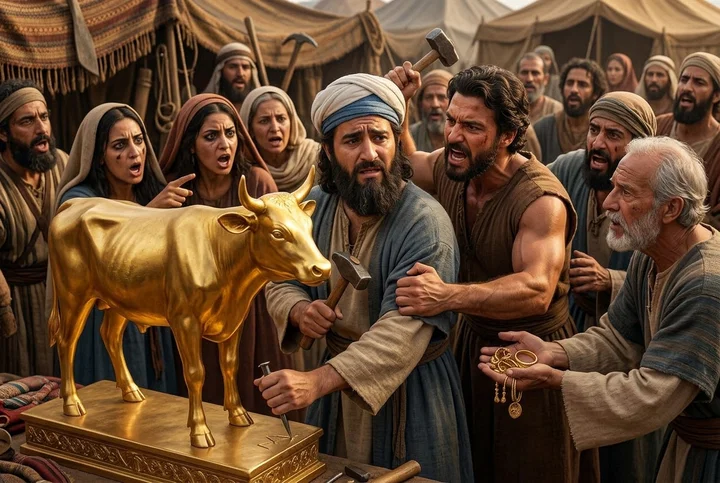
Saying unto Aaron, Make us gods to go before us: for as for this Moses, which brought us out of the land of Egypt, we wot not what is become of him.
Translations
Saying to Aaron, Make us gods to go before us: for as for this Moses, which brought us out of the land of Egypt, we know not what is become of him.
Saying unto Aaron, Make us gods to go before us: for as for this Moses, which brought us out of the land of Egypt, we wot not what is become of him.
saying unto Aaron, Make us gods to go before us: for as for this Moses, which brought us out of the land of Egypt, we wot not what is become of him.
Saying to Aaron, Make us gods to go before us: for as for this Moses, who brought us out of the land of Egypt, we know not what is become of him.
saying unto Aaron, Make us gods which shall go before us: for as for this Moses, which led us forth out of the land of Egypt, we wot not what is become of him.
saying unto Aaron, Make us gods that shall go before us: for as for this Moses, who led us forth out of the land of Egypt, we know not what is become of him.
saying to Aaron, Make to us gods who shall go on before us, for this Moses, who brought us forth out of the land of Egypt, we have not known what hath happened to him.
saying to Aaron, Make us gods who shall go before us; for this Moses, who brought us out of the land of Egypt, we know not what has happened to him.
Saying unto Aaron—Make as gods who shall go before us; for, as for this Moses who brought us forth out of Egypt, we know not what hath befallen him!
Berean Standard Bible, Majority Standard Bible
They said to Aaron, ‘ Make us gods who will go before us! As for this Moses who led us out of the land of Egypt, we do not know what has happened to him.’
saying to Aaron, ‘ Make us gods that will go before us, for as for this Moses who led us out of the land of Egypt, we don’ t know what has become of him.’
And saying to Aaron, Make us gods to go before us: as for this Moses, who took us out of the land of Egypt, we have no idea what has become of him.
Saying vnto Aaron, Make vs gods that may goe before vs: for we knowe not what is become of this Moses that brought vs out of the land of Egypt.
Douay-Rheims (Challoner revision)
Saying to Aaron: Make us gods to go before us. For as for this Moses, who brought us out of the land of Egypt, we know not what is become of him.
Pictures
Cross-references
- Exodus 32:1
And when the people saw that Moses delayed to come down out of the mount, the people gathered themselves together unto Aaron, and said unto him, Up, make us gods, which shall go before us; for as for this Moses, the man that brought us up out of the land of Egypt, we wot not what is become of him.
Israel asks Aaron to make gods while Moses is away.
- Amos 5:25-27
Have ye offered unto me sacrifices and offerings in the wilderness forty years, O house of Israel?
Israel’s wilderness rebellion included idolatry and led to exile.
- Exodus 32:23
For they said unto me, Make us gods, which shall go before us: for as for this Moses, the man that brought us up out of the land of Egypt, we wot not what is become of him.
The people ask for gods to lead them because they do not know what became of Moses.
- Exodus 20:3-5
Thou shalt have no other gods before me.
The demand for an image defies the commandments against other gods and graven images.
- Acts 7:35
This Moses whom they refused, saying, Who made thee a ruler and a judge? the same did God send to be a ruler and a deliverer by the hand of the angel which appeared to him in the bush.
Stephen recalls that Israel rejected Moses even though God appointed him as deliverer.
- Exodus 24:18
And Moses went into the midst of the cloud, and gat him up into the mount: and Moses was in the mount forty days and forty nights.
Moses enters the cloud and remains on the mountain while the people wait.
- Deuteronomy 18:15
The LORD thy God will raise up unto thee a Prophet from the midst of thee, of thy brethren, like unto me; unto him ye shall hearken;
Moses had directed Israel to heed a future prophet like himself.
Commentary
Each commentary is drawn from primary sources: the writings of Ellen G. White and Adventist pioneers and periodicals. Each commentary is separate. Its own words are not a quotation; follow the references to read the source passages.
Ellen G. White
11 sources
Acts 7:40 belongs to Stephen's review of Israel's history and God's dealings with them, given as his final testimony before the council amid resistance to his words.EW 164.27RED 34.1 It recalls that while Moses was absent on the mount, the people grew weary of waiting for the instruction he would bring, though they had already been given what God wanted them to have.Ms 170, 1904, par. 13–15 Because he had not returned when they expected they concluded something had happened to him, even that he had been killed.ST May 13, 18803SP 297.2
The demand was pressed by men who were not truly converted, who invented groundless reasons for Moses' continued absence and spread deceptive ideas about his detention.Ms 170, 1904, par. 13–15 Leaders in self-assurance joined the call.Ms 170, 1904, par. 13–15 Wanting something visible to represent God under Egyptian idolatrous influence, they told Aaron to make gods to lead them.Ms 170, 1904, par. 13–15ST May 13, 1880
Despite their promise to obey all the Lord had said, by that demand they virtually threw off the charter by which they were incorporated as a nation.Ms 170, 1904, par. 13–15 By that demand they exchanged the living God for gods produced by apostasy, and in heart returned toward Egypt.Ms 170, 1904, par. 13–15 They even considered returning there with the image.ST May 13, 1880
Stephen used the incident to show Israel's idolatry and resistance to God and that the law in which the people trusted had not kept them from it.7RED 34.13SP 297.2 He charged that his hearers repeated their fathers' pattern by rejecting and crucifying Christ, the Just One foretold by the prophets.EW 164.2 His discourse reasoned from the Old Testament Scriptures beginning with Moses and the prophets to give inspired proof that the Scriptures and ceremonies point to Christ, who is the key to understanding them.3SP 388.1–28RED 45.1–46.1
It proved from Moses and the prophets that the crucified Jesus is the Son of God, the Messiah, in His mission, suffering, death, resurrection and ascension, which fulfilled what was foretold.3SP 307.2–308.1AC1 53.28RED 45.1–46.1 It revealed the voice of Christ speaking through the prophets and patriarchs from Adam's day.8RED 45.1–46.1 The witness ended in Stephen's stoning, in which Saul, later Paul, took part and gave approval before his conversion and before becoming a persecutor of Jesus' followers.RH Mar 6, 1900Ms 17, 1908, par. 18–28
After Christ was revealed to him Saul remembered Stephen's sermon, recognized its words as truth, and understood its fulfillment in Jesus, including His rejection, crucifixion, resurrection, and ascension as fulfilling what the prophets had foretold.3SP 307.2–308.1 He himself presented its prophetic evidence to show that the crucified Jesus was the Son of God.AC1 53.2
Sources
Pioneers and periodicals
18 sources
While Moses was on Mount Sinai with the angel receiving living oracles for the people, the fathers refused obedience, thrust him from them, turned back in heart to Egypt, and spoke of him as absent and gone they knew not where, demanding that Aaron make gods to go before them.ST Aug 26, 1897STRH May 10, 1915 They made the demand because Moses had not returned when they expected and they thought him killed, wanting something visible to represent God under the influence of Egyptian idolatry and with thoughts of returning to Egypt.ST May 13, 1880 Their words led at once to making a calf to worship instead of the Lord, offering sacrifice to the idol and rejoicing in the works of their own hands, even taking up the tabernacle of Moloch and the star of the god Remphan, so that God turned and gave them up to serve the host of heaven and declared He would carry them away beyond Babylon.ST Sep 2, 1897ST Sep 2, 1897ST Aug 26, 1897 Their disloyalty to Moses was unfaithfulness to God Himself, turning from Christ their invisible leader and benefactor to false gods, which proves that though outwardly brought out of Egypt they were still inwardly in bondage.ST Jun 14, 1883ST Aug 26, 1897ST Feb 19, 1902 Stephen took up this Scripture in reasoning about Jesus and proving He is the Christ, showing that the law in which Israel trusted had not kept the people from idolatry, and identifying their rejection of Moses on the mountain with the nation's rejection of Christ repeated in its rejection of himself.ST Nov 28, 1878STST May 21, 1885 His pointed witness cut his hearers to the heart and provoked the anger that ended in his stoning while he called upon the Lord Jesus and prayed for his persecutors, marking the Jewish leaders' formal rejection of mercy through the crucified and risen Christ, the end of their role as God's representatives, and the close of the seventieth week.ST Feb 19, 1902RH Apr 7, 1868ST Sep 20, 1910ST Jun 26, 1907
Israel's Rebellion in Wilderness
In the wilderness Moses was in the church with the angel on Mount Sinai and received living oracles to give to the people, but the fathers would not be obedient to him, thrust him from them, and turned back in their hearts to Egypt.ST Aug 26, 1897 While Moses was on the mountain the people rejected his leadership and spoke of him as absent and gone they knew not where.ST Aug 26, 1897STRH May 10, 1915ST Jun 14, 1883ST Feb 19, 1902 In that rejection they said to Aaron to make gods to go before them because they did not know what had become of Moses who had brought them out of the land of Egypt.ST Aug 26, 1897STRH May 10, 1915ST Jun 14, 1883ST Feb 19, 1902
They made the demand because Moses had not returned when they expected and they thought he had been killed.ST May 13, 1880 Wanting something visible to represent God, they were influenced by Egyptian idolatry and considered returning to Egypt with the image.ST May 13, 1880 Their words led at once to making a calf and figures to worship instead of the Lord, bringing sacrifice to the idol and rejoicing in the works of their own hands.ST Sep 2, 1897ST Sep 2, 1897ST Aug 26, 1897 With those figures they took up the tabernacle of Moloch and the star of the god Rephan.ST Sep 2, 1897ST Sep 2, 1897
Though God had brought them out of Egypt to serve Him and keep His statutes, they continued in idolatry by worshiping what they had made.ST Sep 2, 1897ST Sep 2, 1897 For this God turned and gave them up to serve the host of heaven and declared He would carry them away beyond Babylon.ST Sep 2, 1897ST Sep 2, 1897 Their disloyalty to Moses was part of a deeper unfaithfulness to God, turning from Christ their invisible leader and benefactor to worship false gods.ST Jun 14, 1883ST Feb 19, 1902 Their turning proves they had not really been delivered from bondage, for while delivered from Egypt outwardly they were still in bondage inwardly.ST Aug 26, 1897 Stephen's retelling confirms the Exodus account of Israel asking Aaron to make gods to lead them when Moses was absent, showing that episode is part of the reliable, inspired record.ST Apr 13, 1904
Stephen's Witness and Aftermath
The verse belongs to the Old Testament Scriptures Stephen took up in reasoning about Jesus and proving that He is the Christ.ST May 21, 1885 His use of it shows that the law in which Israel trusted for salvation had not kept the people from idolatry.ST Nov 28, 1878 Israel's rejection of Moses while he was on the mountain, when the people asked Aaron to make gods to lead them because they did not know what had happened to Moses, is the nation's rejection of Christ, repeated in its rejection of Stephen.ST The chapter to which the verse belongs is the account of Stephen's stoning, which marks the Jewish nation's rejection of mercy offered through the crucified and risen Christ and the end of its role as God's representative to the world.ST Sep 20, 1910 His martyrdom, with the Jewish leaders' formal rejection of the gospel, marks the close of the seventieth week.ST Jun 26, 1907
The verse stands in Stephen's pointed sermon to Jews who had resisted much light, a sermon that set their sins before them and shows that preaching with God's power can provoke anger and hostility that ended in his death.RH Apr 7, 1868 His testimony cut them to the heart so that they gnashed on him with their teeth, cried out, stopped their ears, rushed upon him, cast him out of the city, and stoned him while he called upon the Lord Jesus to receive his spirit and prayed for his persecutors' forgiveness.ST Feb 19, 1902 Paul acted a part in that stoning before his conversion.RH Mar 6, 1900
The demand for gods to lead the people when they did not know what had happened to Moses is reckoned among the events after Christ's resurrection that added to Jerusalem's guilt, when the people condemned and persecuted the apostles and Christ's followers.RH May 10, 1915 Stephen's sermon stirred the Jews, and its failure to mention a change of the Sabbath is evidence that no change had occurred.RH Apr 3, 1879
Sources