Exodus 24:18
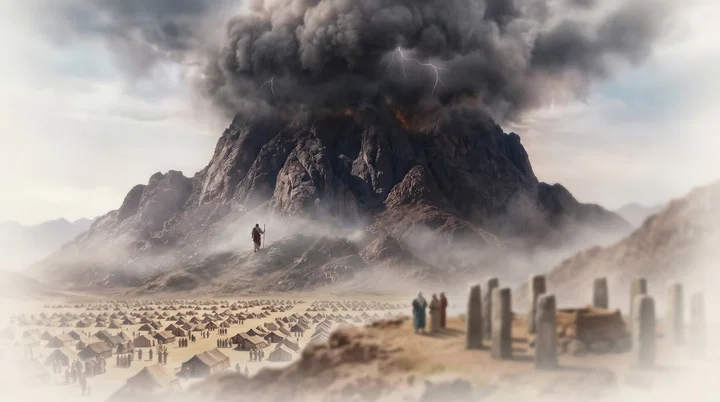
And Moses went into the midst of the cloud, and gat him up into the mount: and Moses was in the mount forty days and forty nights.
Translations
And Moses went into the middle of the cloud, and got him up into the mount: and Moses was in the mount forty days and forty nights.
King James Version, KJV Cambridge Paragraph Bible
And Moses went into the midst of the cloud, and gat him up into the mount: and Moses was in the mount forty days and forty nights.
And Moses went into the midst of the cloud, and ascended the mount: and Moses was on the mount forty days and forty nights.
Revised Version, American Standard Version
And Moses entered into the midst of the cloud, and went up into the mount: and Moses was in the mount forty days and forty nights.
and Moses goeth into the midst of the cloud, and goeth up unto the mount, and Moses is on the mount forty days and forty nights.
And Moses went into the midst of the cloud, and ascended the mountain. And Moses was on the mountain forty days and forty nights.
And Moses entered into the midst of the cloud and ascended into the mountain. And it came to pass that Moses was in the mountain forty days and forty nights.
Berean Standard Bible, Majority Standard Bible
Moses entered the cloud as he went up on the mountain, and he remained on the mountain forty days and forty nights.
Moses entered into the middle of the cloud, and went up on the mountain; and Moses was on the mountain forty days and forty nights.
And Moses went up the mountain, into the cloud, and was there for forty days and forty nights.
And Moses entred into the middes of the cloude, and went vp to the mountaine: and Moses was in the mount fourtie dayes and fourty nightes.
Douay-Rheims (Challoner revision)
And Moses, entering into the midst of the cloud, went up into the mountain: and he was there forty days, and forty nights.
Pictures
Cross-references 20 of 57
- Exodus 32:1-6
And when the people saw that Moses delayed to come down out of the mount, the people gathered themselves together unto Aaron, and said unto him, Up, make us gods, which shall go before us; for as for this Moses, the man that brought us up out of the land of Egypt, we wot not what is become of him.
During Moses’ absence on the mountain, Israel makes and worships the golden calf.
- Exodus 31:18
And he gave unto Moses, when he had made an end of communing with him upon mount Sinai, two tables of testimony, tables of stone, written with the finger of God.
God gives Moses the stone tablets at the end of their communion on the mount.
- Exodus 19:3-8
And Moses went up unto God, and the LORD called unto him out of the mountain, saying, Thus shalt thou say to the house of Jacob, and tell the children of Israel;
Israel promises obedience before Moses’ time on the mountain and the covenant’s ratification.
- Exodus 24:12
And the LORD said unto Moses, Come up to me into the mount, and be there: and I will give thee tables of stone, and a law, and commandments which I have written; that thou mayest teach them.
God calls Moses up the mountain to receive the written law and commandments.
- Exodus 25:8-9
And let them make me a sanctuary; that I may dwell among them.
Moses receives sanctuary instructions on the mountain during his forty days there.
- Exodus 34:28
And he was there with the LORD forty days and forty nights; he did neither eat bread, nor drink water. And he wrote upon the tables the words of the covenant, the ten commandments.
Moses stays on the mountain forty days and nights without food or water.
- Exodus 24:3-8
And Moses came and told the people all the words of the LORD, and all the judgments: and all the people answered with one voice, and said, All the words which the LORD hath said will we do.
Israel pledges obedience, and Moses ratifies the covenant with blood.
- Exodus 20:1-17
And God spake all these words, saying,
The Ten Commandments were proclaimed just before Moses’ forty days on the mountain.
- Deuteronomy 9:9
When I was gone up into the mount to receive the tables of stone, even the tables of the covenant which the LORD made with you, then I abode in the mount forty days and forty nights, I neither did eat bread nor drink water:
Recalls Moses’ forty days and nights on the mountain.
- Exodus 32:15-16
And Moses turned, and went down from the mount, and the two tables of the testimony were in his hand: the tables were written on both their sides; on the one side and on the other were they written.
Moses brings down the God-written tablets after his forty days on the mountain.
- Deuteronomy 4:12-13
And the LORD spake unto you out of the midst of the fire: ye heard the voice of the words, but saw no similitude; only ye heard a voice.
God speaks the covenant commandments at Sinai and writes them on stone.
- Exodus 20:19
And they said unto Moses, Speak thou with us, and we will hear: but let not God speak with us, lest we die.
The people fear God’s voice and ask Moses to hear and speak for them.
- Exodus 19:16-20
And it came to pass on the third day in the morning, that there were thunders and lightnings, and a thick cloud upon the mount, and the voice of the trumpet exceeding loud; so that all the people that was in the camp trembled.
God descends in cloud and fire at Sinai, calling Moses up before his forty-day absence.
- Exodus 34:1
And the LORD said unto Moses, Hew thee two tables of stone like unto the first: and I will write upon these tables the words that were in the first tables, which thou brakest.
God commands replacement stone tablets and promises to write the commandments on them.
- Hebrews 8:5
Who serve unto the example and shadow of heavenly things, as Moses was admonished of God when he was about to make the tabernacle: for, See, saith he, that thou make all things according to the pattern shewed to thee in the mount.
The earthly tabernacle follows the heavenly pattern shown to Moses on the mountain.
- Exodus 25:40
And look that thou make them after their pattern, which was shewed thee in the mount.
Moses is instructed to build the sanctuary according to the pattern shown on the mountain.
- Hebrews 9:18-20
Whereupon neither the first testament was dedicated without blood.
Identifies the blood-dedicated first covenant as the covenant ratified in Exodus 24.
- Exodus 34:29-30
And it came to pass, when Moses came down from mount Sinai with the two tables of testimony in Moses’ hand, when he came down from the mount, that Moses wist not that the skin of his face shone while he talked with him.
Moses came down from the mountain with a shining face, and the people feared to approach him.
- Deuteronomy 10:1-4
At that time the LORD said unto me, Hew thee two tables of stone like unto the first, and come up unto me into the mount, and make thee an ark of wood.
Moses receives replacement stone tablets bearing the same commandments.
- Exodus 24:10
And they saw the God of Israel: and there was under his feet as it were a paved work of a sapphire stone, and as it were the body of heaven in his clearness.
Israel’s leaders behold God’s presence and glory on the mount.
Commentary
Each commentary is drawn from primary sources: the writings of Ellen G. White and Adventist pioneers and periodicals. Each commentary is separate. Its own words are not a quotation; follow the references to read the source passages.
Ellen G. White
31 sources
Moses entered the midst of the cloud and ascended the mount, where he remained forty days and forty nights fasting without hunger, sustained above human strength by the glory of God surrounding him.PP 313.2Ms 170, 1904, par. 2–32RED 32.3 Those forty days do not include six days beforehand, during which the cloud covered the mount while Moses sanctified himself by meditation and prayer until he could endure God's presence, and then on the seventh day, the Sabbath, God called him out of the cloud.PP 313.2Lt 160, 1906, par. 3–9Ms 93, 1908, par. 31–351SP 241.1–242.1ST May 13, 1880 In the mount he received instruction from God after the law had been given, including His law and judgments and the specifications and pattern for the tabernacle to be borne from place to place from whence He could reveal Himself.Lt 160, 1906, par. 3–9Ms 97, 1899, par. 3–4SG3 272.1–273.1Ms 170, 1904, par. 2–3Ms 170, 1904, par. 4–6 While he was on the flaming summit, the people below corrupted themselves in one of the greatest apostasies, as the mixed multitude grew impatient at his delay, demanded visible gods, and bowed before a golden image in open defiance of the commands he was bringing, through which Satan sought to cause God to destroy the seed through whom Christ would come.ST May 13, 18804T 514.1–2Ms 1, 1865, par. 8PP 335.1–2 God's bid, Come up unto Me into the mount, is still given, teaching that communion with God in meditation and prayer must come before great work for God as the appointed preparation giving continual light, virtue, and moral power.STPW91 37.2ST Jul 27, 1915Ms 80, 1899, par. 1–6
The Ascent Into Glory
The cloud covered the mount six days, and on the seventh day, the Sabbath, God called Moses out of the midst of the cloud.PP 313.2Lt 160, 1906, par. 3–9ST May 13, 1880 The sight of the glory of the Lord on the top of the mount was like devouring fire in the eyes of Israel.PP 313.2Lt 160, 1906, par. 3–9ST May 13, 1880 That cloud and glory revealed God's presence, from which the people could reason from cause to effect.Ms 93, 1908, par. 31–35
The forty days and forty nights do not include the six days beforehand.PP 313.2 During those six days Moses did not at once draw near to God's immediate presence because he could not yet endure the exhibition of His glory.1SP 241.1–242.1ST May 13, 1880SG3 272.1–273.1 He put away common thoughts and feelings and sanctified himself by meditation and prayer until prepared to converse with God.1SP 241.1–242.1ST May 13, 1880SG3 272.1–273.13T 296.1–3 Six days thus passed before he was received into the cloud and the immediate presence of God.3T 296.1–3
During the six days Joshua was with Moses, and together they ate manna and drank of the brook that descended out of the mount.PP 313.2 Joshua did not enter the cloud with Moses but remained outside eating and drinking daily while awaiting his return.PP 313.2 Moses by contrast fasted during the entire forty days and nights.PP 313.2 He went without food yet felt no hunger because he was raised above ordinary human strength and sustained by the glory of God surrounding him.PP 313.22RED 32.3 God concealed His great glory in the cloud so that mortal Moses could be strengthened to behold as much as he could endure and to hear God so he could give the people the full message.Ms 170, 1904, par. 2–3
The cloud marked God's immediate presence and the summit shone with His glory.RH Jul 29, 1873 Israel's princes who ascended received the privilege of communion with God and the light of His glory.SLP 36.1–2 After the forty days Moses descended and told the people the Lord's words and judgments, wrote their pledge to obey, and the covenant was formally ratified through sacrifices and sprinkling of blood, with its conditions read aloud so the people could choose whether to accept them.PP 311.5–312.2
What God Gave There
During the forty days and nights in the mount after the law had been given, Moses met with God and received instruction from Him, including God's law, judgments, and the details of Israel's service and obligations.SG3 272.1–273.1Ms 170, 1904, par. 2–3Ms 170, 1904, par. 4–6 God concealed His great glory in the cloud so that mortal Moses could be strengthened to behold as much as he could endure and to hear God so he could give the people the full message.Ms 170, 1904, par. 2–3 Those forty days stand immediately before God's requirements for making a tabernacle to be borne from place to place from whence He could reveal Himself.Lt 160, 1906, par. 3–9 There Moses was given specifications and a pattern for the tabernacle work to follow, to be carried out according to what was revealed, and leaders and responsible workers who seek God's presence and wisdom are likewise to follow the pattern God gives.Lt 160, 1906, par. 3–9Ms 97, 1899, par. 3–4STPW91 37.25T 549.216MR 137.1–3
The directions on Mount Sinai in Exodus 19-24, written in a book, were given by Christ Jesus Himself, the same Teacher who afterward spoke in human flesh, veiled in the pillar of cloud while Moses was enshrouded in the veil of cloud so that His glory would not extinguish the human instrument who was to voice His words to the people.Lt 160, 1906, par. 3–9Lt 124, 1900, par. 25–293MR 258.3–259.1 They are the same principles Christ presented in His own teaching and the apostles present in plain statements to counter Satan's sophistries, plainly specified principles of God's government over the multitude brought out from slavery to be cherished in all the relations of life, by which the people were to form characters that would enable them to compose the family of God in the heavenly courts.Lt 124, 1900, par. 25–29 That instruction belongs to what men should obey and is needed now just as verily as by Israel then, to be studied and presented before the people in jots and tittles, to end all contention and lead to loving as brethren with softened and subdued hearts.Lt 160, 1906, par. 3–9 The laws guard against doing injustice and guide dealing one with another, and God's chosen people are still to represent them in all their works, practice, and teaching as Christ's representatives while separate from the world.Lt 160, 1906, par. 3–9Lt 124, 1900, par. 25–29
The words God gave Moses in the mount are the law in the ark, the ten holy precepts engraved by the finger of Omnipotence, God's flawless standard that shall be brought forth in the day of judgment for every person's deeds to be compared with them.Ms 135, 1906, par. 27–30 Every business transaction, especially among church members, must be performed in accordance with them in high, holy, sanctified rectitude, with no unrighteousness in judgment and not one vestige of oppression or selfishness, and before carrying out a transaction one in responsible position must inquire whether he will be unashamed to have it appear when weighed in unerring scales in the light of God's law.Ms 135, 1906, par. 27–30 The meaning of these laws is not yet fully understood and will be unfolded in the future life.3MR 258.3–259.1 Paul repeated these chapters to his fellow workers while working skillfully with his hands at tentmaking, for his own benefit and theirs, teaching from them that supreme honor is to be given to God and that the skill, genius, and wisdom brought into the tabernacle work were given by God to be used for His glory.Ms 97, 1899, par. 3–4
Israel Below and Present Call
While Moses was on the flaming summit in the cloud receiving instruction through forty days and forty nights, the people below corrupted themselves.ST May 13, 1880 The mixed multitude that came up from Egypt with Israel, so called because Hebrews had intermarried with Egyptians, were the principal movers in the departure.ST May 13, 1880 The people had watched Moses go up and waited for his return, but grew impatient at his delay and insisted he had been slain by the burning flame and would never return, and that the guiding cloud now rested on the mount and would no longer direct their route through the wilderness.ST May 13, 1880 A large company gathered around Aaron's tent demanding something visible to resemble God, with the gods of Egypt in their minds, and the delay was used to tempt them to imitate Egyptian idolatry, even to the suggestion that they could return to Egypt and find favor by carrying such an image before them as their god.ST May 13, 1880 In his absence under Aaron's leadership they complained and turned to idol worship, showing how quickly they abandoned allegiance after the signs of God's presence had ceased.4T 514.1–2
During that absence Israel should have meditated on the commandments and taught their children about the covenant, and should have sought God with humility, reverence, searching of heart, and godly fear.Ms 170, 1904, par. 4–6RH Jul 29, 18733T 296.1–3 They should have humbled themselves in awe before Jehovah after seeing His delivering power, His judgments on Egypt, the passage through the Red Sea, and His glory upon the mount.Ms 2, 1904, par. 20–27 Instead they complained, grew discontented and murmured, turned to Aaron to make gods for them, and with Aaron's aid demanded and worshiped a golden calf.Ms 170, 1904, par. 4–6RH Jul 29, 18733T 296.1–3Ms 2, 1904, par. 20–27 The forty days were a testing time in which God tested whether the people could be trusted, and their disobedience and idolatry were exposed.Ms 170, 1904, par. 10–11Ms 83, 1907, par. 4–8 Their failure showed weakness and instability, turning the covenant's conditions of faithfulness and obedience into grounds for self-importance instead of relying humbly on God, and losing faith that Moses would return they neglected their covenant and turned toward idolatry, jealousy, and envy.Ms 170, 1904, par. 4–6Ms 170, 1904, par. 10–11
Though gone only forty days, that short time was long enough for one of the greatest apostasies, illustrating how common rebellion was.Ms 1, 1865, par. 8 Despite special favors and having recently heard God's voice from Sinai in awful grandeur speaking the Ten Commandments until they feared, trembled, and pleaded that God speak no more but Moses speak to them, they turned to the lowest idolatry and worshiped the work of their own hands.Ms 1, 1865, par. 8 During the same forty days in which God wrote His law to commit to His covenant people, Satan at the foot of Sinai carried forward his war against God's law begun in heaven by exciting doubt, apostasy, and rebellion, leading Israel to deny loyalty to Jehovah, demand gods of gold, and bow before a golden image in open defiance of the commands Moses was bringing from the divine glory.PP 335.1–2 By this daring insult Satan planned to cause God to divorce Israel and devote them to destruction and thus extinguish the seed of Abraham meant to preserve knowledge of the living God and through whom Christ the true seed would come to conquer Satan, but the plan was defeated, for though those who stubbornly sided with Satan were cut off, the humbled repentant were pardoned, so the sin stands as perpetual testimony to the guilt and punishment of idolatry and to God's justice and long-suffering mercy.PP 335.1–2
God's bid, Come up unto Me into the mount, is still given, and Moses' call into the mount to commune with God and behold His glory before receiving God's law as representative of His people teaches that communion with God must come before great work for God.ST Jul 27, 1915 Such communion is appointed preparation giving continual progress in knowledge, virtue, and moral power, so all need times set apart for meditation, prayer, and spiritual refreshing to receive continual light for new scenes and trials, for prayer and faith do what no earthly power can accomplish.ST Jul 27, 1915 When by faith His people behold Him who is invisible their speech and pen come under the Holy Spirit and cease to be cheap and common.Ms 80, 1899, par. 1–6 The mountain encounter is the pattern for leaders and responsible workers who seek God's presence and wisdom to follow the pattern God gives and to carry out His work according to what He reveals.STPW91 37.25T 549.216MR 137.1–3 Like Moses coming into the mount with God, those who trust God through earnest prayer and make His Word their guide are kept by His power calm and composed above boisterous accusations and shocks that ruffle men, swayed from no right principle, continually asking what is written in the law and what God has said, so that no word from men or ministers in highest position can turn their feet into questionable paths.Ms 66, 1898, par. 1817MR 226.3–227.1
Sources
Pioneers and periodicals
71 sources
Moses went up into Mount Sinai into the midst of the cloud into God's immediate presence, where he remained forty days and forty nights after a hazardous climb. ST Mar 3, 1914RH Dec 31, 1861RH Dec 9, 1852 During those forty days and nights he was miraculously sustained without food or drink and kept in full strength and vigor to the close. ST Jun 10, 1880RH Mar 25, 1902ST Jun 19, 1907 On the mount he received the Ten Commandments written and engraved on two stone tables by God's own finger, together with the pattern and detailed instructions for the earthly sanctuary that God might dwell among Israel. ST Mar 3, 1914RH Dec 31, 1861ST Mar 25, 1889ST Dec 24, 1894 He went up to receive them only after the first covenant with Israel had already been made and sealed with blood, upon the people's pledge to obey God's voice. RH Jun 26, 1900ST Jan 3, 1878ST Mar 25, 1889 His prolonged absence opened the way for Israel in less than forty days to grow impatient, lose confidence, and turn to the golden calf, while his going up still teaches that communion with God must come before great work for God. ST Apr 17, 1907ST Sep 22, 1914RH Jan 13, 1859
Entering Cloud on Sinai
Moses went into the midst of the cloud and up into Mount Sinai into God's immediate presence, where he remained forty days and forty nights in connection with the giving of the Ten Commandments.ST Mar 3, 1914RH Dec 31, 1861ST Mar 11, 1889ST Apr 15, 1886ST Jun 25, 1894 Into the mount means up into it, not merely near it, after answering God's call to commune with Him while God prepared to give the stone tablets containing the law and commandments with instruction for teaching Israel.RH Dec 31, 1861RH Dec 9, 1852ST Jun 25, 1894 This period was for God to give the laws of Israel and the ceremonies of its religion, which Moses recorded in the book of the law, also called the book of the covenant, with the stone tablets given at the end of the forty days.RH Dec 9, 1852ST Mar 11, 1889 The cloud and the Lord's glory marked this as a solemn occasion in which God honored His law.RH Dec 31, 1861
The cloud covered the mountain six days and on the seventh day God called Moses from within it, while the Lord's glory appeared to Israel as devouring fire on the flaming summit.ST May 13, 1880ST Mar 25, 1903 God veiled His presence from sinful humanity in the cloud, for since sin He has mercifully veiled Himself in His dealings because sinners cannot survive His unveiled glory.ST Mar 11, 1903 The cloud at Sinai with God's voice giving instruction and encouragement is one of the scenes that teaches believers to look toward Christ's return in the clouds.ST Mar 25, 1903 The Sinai setting of six days within that glory, followed on the seventh day by God teaching His law, shows the law to be the Ten Commandments written by God's own finger on stone so His precepts would not be forgotten.RH Jun 16, 1868
Moses first spent six days preparing to meet God by setting aside ordinary thoughts and feelings and devoting himself to meditation and prayer so he could be ready to converse with his Maker.ST May 13, 1880 Some of the rebels had recently been privileged to approach near God with Moses and witness His majesty, and had seen Moses come down with his face shining with God's glory, yet their rebellion showed privileges and signs had not kept them faithful.ST Sep 16, 1880 The stay occurred in the third month after Israel left Egypt, when Moses was called up into the mount at Sinai to an audience with God.ST May 20, 1880 Israel was encamped at Sinai for eleven months and five days, and Moses spent nearly three months of that time in the mountain, shut in with God in sweet retirement alone with God for forty days and yet another forty days.RH Nov 17, 1863
God usually chooses mountains to commune with His servants, and Sinai is one peak of Horeb, the mountain of God, where He manifested His glory and presence and twice called Moses up and communed with him there forty days and nights.ST Sep 20, 1899 The instruction concerning the sanctuary recorded in Exodus 25-31 belongs in chronological order after the events of Exodus 19-32 and before the building and setting up in Exodus 33-40, with about forty days on this visit and twice forty days in all.ST Dec 10, 1896RH Nov 17, 1863 The stay came after the people had twice promised obedience and after Moses had read the book of the covenant to them, preparing the way for God to commit to human hands His law as written by Himself as a signal honor conferring solemnity upon the law.RH Mar 17, 1863 It fixes the time from which to infer the day on which the Ten Commandments were given.RH Mar 17, 1863
The Sinai giving came forty days after God honored the seventh day in the giving of the manna, so the Sabbath there is the same creation seventh-day Sabbath and not a new and different Sabbath made that much later.ST Oct 26, 1904 After the covenant had been ratified with blood Moses went up to receive the stone tables, law and commandments, his forty days beginning after the people had already made and confirmed their covenant to obey, so the commandments were the basis to which that covenant related and the people did not yet have a written copy when it was ratified.RH Jun 26, 1900 After Moses broke the first tables he went up for another forty days, so Israel received a written copy at least eighty days after the covenant was ratified.RH Jun 26, 1900 During the forty days and nights Moses was miraculously sustained without food or drink, engaged in active work the whole time yet kept in full strength and vigor with his usual strength at the close, proving God can sustain human life in full strength without eating and designs man for a far superior and more abundant life than food alone can give.RH Mar 25, 1902ST Jun 19, 1907 The law received in the Spirit was life to him, unlike the law received only in the letter which brought condemnation.ST Jun 19, 1907
Gifts Received on Mountain
On the mountain Moses received the Ten Commandments, the Ten Words on two tablets of testimony written and engraved by God's own finger during his forty days and forty nights in the cloud on Sinai in connection with the giving of the law.ST Mar 3, 1914RH Dec 31, 1861ST Apr 17, 1907ST Jan 31, 1911 This Ten-Commandment law is the only law God ever spoke to His people and the only law He ever wrote with His own hand, the same Decalogue spoken at Sinai and not a different one.ST Mar 3, 1914RH Dec 31, 1861RH Mar 29, 1864 While Moses was away the people had time to consider the covenant and prepare to receive further instruction, but they neglected this and became impatient, inattentive and lawless, and his prolonged absence opened the way for their sin in worshipping the golden calf.ST Apr 17, 1907 During this same stay in closer fellowship with God he also received instructions for building the sanctuary and its service and for teaching Israel, with the cloud and the Lord's glory marking the solemn occasion in which God honored His law.RH Dec 31, 1861ST Jan 31, 1911
The committing of that self-written law into human hands was a signal honor conferred upon the law, fixing the time from which to infer the day on which the Ten Commandments were given after the people had twice promised obedience and after Moses had read the book of the covenant to them.RH Dec 31, 1861RH Mar 17, 1863 It came after Israel asked that God not speak to them anymore but that Moses speak to them, and before the preliminary instruction for building the sanctuary.ST Feb 11, 1913RH Mar 17, 1863 While Israel was unwilling to listen to God and to put away what brought the terror of God upon them, Moses went in to God and God shined His law into Moses's heart.RH Dec 31, 1861ST Feb 11, 1913
During the same interview Moses received the detailed instructions for the worldly sanctuary recorded in Exodus 25-31, given to him on the mount when he went into the midst of the cloud and remained there forty days and forty nights.ST Mar 25, 1889ST Dec 24, 1894RH Aug 21, 1856RH Mar 28, 1854 God showed him the sanctuary's pattern and sacred vessels and gave him instructions for them, including the pattern for the tabernacle and its furnishings, the offering to be brought, the furniture and construction, and the command to make it exactly after the pattern shown him.ST Mar 25, 1889RH Oct 20, 1863RH Aug 21, 1856RH Mar 28, 1854 The sanctuary was to be God's dwelling among Israel, and Exodus 24 gives part of the first instructions respecting it before the command in the next chapter to erect it for God to dwell in.RH Oct 20, 1863RH Mar 28, 1854 The interview concluded with God giving him the law on two stone tablets engraved by God's finger.ST Mar 25, 1889RH Aug 21, 1856
Moses also received and wrote out by hand in the book of the law, also called the book of the covenant, the other laws of Israel and the ceremonies of its religion, remaining on the mountain several weeks for this work as the means through whom the Lord made it known.RH Dec 9, 1852ST May 20, 1875ST May 20, 1875 That law of Moses includes civil, sacrificial, interpersonal, health, ceremonial and moral laws, not only the Ten Commandments, with its statutes and judgments encompassing the Ten Commandments and the other precepts.RH Dec 9, 1852 It regulated the typical service, including sacrifices, the altar, the temple and the priesthood, and served the ceremonial system as the Ten Commandments served the moral law, with the laws about offerings, sacrifices and types tracing through the shadows of the old the realities of the new dispensation.ST May 20, 1875 This distinguishes the law associated with Moses, written in a book and placed beside the ark, from the moral law which God spoke and wrote on stone and placed inside the ark.ST May 20, 1875ST Mar 20, 1879
The covenant book included the Ten Commandments and the additional precepts in Exodus 21-23, to which the people agreed to do what the Lord had said.ST Apr 15, 1886RH Jul 9, 1901 The Ten Commandments are distinguished as the words of the Lord, while the additional precepts are called the judgments, and Moses' reception of God's written law on stone tablets came after the covenant had been ratified and after he had already written the Lord's words in the book of the covenant which the people had heard read.ST Apr 15, 1886RH Jul 9, 1901ST Nov 11, 1886 His writing of the Lord's words in the book is thus distinguished from God's writing of the commandments on the stone tables, which were seen by Moses during his stay on the mountain and by others only after he came down.ST Oct 19, 1888ST Nov 11, 1886ST Jun 30, 1914 The same setting describes Moses going up to receive the Ten Commandments and instruction written in the book of the law, and provides the setting for the Jewish theory that he also received additional instruction that was not written and passed it orally to Joshua.ST Jun 30, 1914
Among the moral precepts restated in that instruction on the mount God made mention of the Sabbath.RH Dec 31, 1861RH Mar 17, 1863 When God was about to commit His law written by Himself into human hands during those forty days and forty nights, that Sabbath testimony is to be compared with another Sabbath testimony.RH Dec 31, 1861RH Mar 17, 1863 Neither teaches that the Sabbath was made for Israel alone nor that it was made after the coming out of Egypt, nor contradicts the texts that place the institution of the Sabbath at creation.RH Mar 17, 1863 Since the Sinai giving came forty days after God honored the seventh day in the giving of the manna, if a new and different Sabbath was to be given from Sinai that much later there would have been no need to make known the Sabbath of Exodus 20 at all, since the manna Sabbath was already good enough, so the Sinai Sabbath is the same creation seventh-day Sabbath.RH Mar 17, 1863ST Oct 26, 1904
Covenant Ratified with Israel
Exodus 24 together with Exodus 19 records the first mutual agreement God made with the house of Israel after leading them out of Egypt.ST Jan 3, 1878RH Oct 22, 1861 It was the old or first covenant made at Mount Sinai and Horeb before entering Canaan.RH Oct 22, 1861RH Jan 7, 1862 Its completion and ratification are recorded in Exodus 24, and it ushered in the Levitical dispensation.ST Mar 4, 1889ST Sep 23, 1889 The covenant was ratified before God wrote the commandments on the tablets, to which the people had personally pledged themselves to obey God's precepts.ST Jan 3, 1878RH Jan 7, 1862
The covenant was a solemn contract concerning God's law, not the law itself.ST Mar 15, 1883ST Jan 3, 1878ST Feb 20, 1879 The people pledged to obey God's voice and words, and God pledged to accept them as His people and be their God.ST Sep 17, 1885ST Mar 15, 1883ST Feb 20, 1879 God promised to care for them as His people and made Himself their husband.ST Sep 17, 1885ST Mar 15, 1883 The covenant rested on God's law, the Ten Commandments, which was distinct from the ritual and ceremonial system.ST Jan 3, 1878ST Mar 4, 1889
Moses acted as mediator and returned to the people and related the judgments.RH Jun 26, 1900RH Oct 22, 1861 The people twice promised obedience to do all the Lord required and all that the Lord had said.RH Oct 22, 1861ST Apr 15, 1886RH Mar 17, 1863 Moses wrote the laws and judgments in the book of the covenant and read it to the people.RH Jun 26, 1900RH Oct 22, 1861 He signed and sealed the agreement by sprinkling half the blood on the altar and half on the people as the blood of the covenant.ST Sep 17, 1885RH Oct 22, 1861 The covenant book included the Ten as the words of the Lord and the additional precepts of Exodus 21-23 as the judgments.ST Mar 8, 1883ST Apr 15, 1886
Moses went up into the mount into the midst of the cloud for forty days and forty nights only after the covenant had been made, ratified and confirmed with blood.RH Jun 26, 1900ST Jan 3, 1878ST Mar 25, 1889 His forty days began after the people had already made and confirmed their covenant to obey God's words, and after Moses had read the book of the covenant to them.RH Jun 26, 1900RH Mar 17, 1863 He went up to receive the stone tables, law and commandments, concluding the interview by receiving the law on two stone tablets engraved by God's finger.RH Jun 26, 1900ST Mar 25, 1889RH Jul 9, 1901 The people did not yet have a written copy of the commandments when the covenant was ratified.RH Jun 26, 1900ST Jan 3, 1878 The commandments were therefore not themselves the first covenant, but were the basis to which that covenant to obey related.RH Jun 26, 1900ST Jan 3, 1878
The people remained obligated to obey the voice they heard from the mount, whether or not they had promised to do so.ST Sep 17, 1885 Israel as a nation could remain in the land only upon obedience to the voice of God, the Ten Commandments and the judgments.ST Sep 17, 1885RH Oct 22, 1861 Their disobedience broke their promise and forfeited their claim to God's promised care.ST Sep 17, 1885RH Oct 22, 1861
Their promise could not give them power to keep the law, and their later fear of hearing God speak showed that the law was not written in their hearts.ST Apr 22, 1913 The national covenant could not save individuals, but salvation belonged to those who trusted God and obeyed from the heart.ST Apr 22, 1913 The law was given in love to draw the people near to God and write it on their hearts.ST Jan 27, 1909ST Apr 22, 1913
Absence and Golden Calf
Moses' stay of about forty days on Sinai left the people without his presence while he received the tables of stone and instruction for the tabernacle and its furniture, and that prolonged absence opened the way for their sin.ST Jul 16, 1902RH Jun 13, 1854 In less than forty days the majority forgot God and the solemn revelation of His law, growing impatient, inattentive, lawless, and weary of waiting until they lost confidence in Moses and turned to idolatry.ST Apr 17, 1907ST Sep 24, 1896RH Jul 8, 1858RH Jul 18, 1907 Having no further visible signs or word from him, they failed to trust God without a visible leader and turned from idleness to pleasure and then to unbelief.ST Jul 16, 1902RH Jun 13, 1854
A large company gathered around Aaron's tent demanding something visible to resemble God, with the gods of Egypt in their minds.ST May 13, 1880RH Jun 13, 1854 Aaron yielded to their wishes and made the golden calf, which the people worshiped and credited with their deliverance from Egypt, insulting God.RH Oct 7, 1862RH Oct 28, 1873RH Jul 18, 1907 This they did though they were bound to God by miracles through Moses and Aaron, the plagues on Egypt, the parting of the Red Sea, the dry passage of the host, and the drowning of their pursuers.RH Oct 7, 1862
The mixed multitude that came up from Egypt with Israel, sprung from intermarriage of Hebrews with Egyptians, were the principal movers in the departure.ST May 13, 1880 The people had watched Moses go up and waited for his return, then grew impatient when he did not come as soon as expected and insisted he had been slain by the burning flame and would never return.ST May 13, 1880 They reasoned that the cloud that had led them now rested on the mount and would no longer direct their route through the wilderness.ST May 13, 1880 Satan used the delay and summoned his legions to hover about them in their leader's absence to tempt them to imitate Egyptian idolatry, even suggesting they could return to Egypt and find favor by carrying such an image before them as their god.ST May 13, 1880RH Oct 7, 1862
Their rapid return to idolatry after promising to obey shows that people cannot keep God's law by their own strength and shows the danger of relying on sight rather than faith in the invisible God.ST Jul 16, 1902 The complete revolution in only forty days, which in outward things would take forty years, is astonishing and shows brief experience left them ill prepared to stand trial, illustrating mortal weakness, the dangers of inexperience and of moral weakness even after witnessing God's mighty acts, and the power of the devil.RH Oct 7, 1862RH Oct 28, 1873 Privileges and signs had not kept them faithful, for some who had been privileged to approach near with Moses and witness His majesty and see His glory still rebelled, and self-deceived confidence in a good outward condition left them blind and apostate.ST Sep 16, 1880RH Oct 7, 1862 The setting warns that impatience and forgetting what God has revealed can lead to apostasy, whereas Israel should instead have sought God with humility and reverence during Moses' absence.RH Jul 29, 1873RH Jul 8, 1858
Moses returned with the tables of the law, saw the apostasy, and in hot anger born of coming fresh from God's presence with a high sense of pure worship cast down the tables and broke them, and in this he did not sin and was not reproved.RH Oct 7, 1862 A long stay on the mount did not prevent this forceful response to wrongdoing. That season of high communion was followed at once by his return to the plain to meet the golden calf, proving that mountaintop fellowship is succeeded by painful lowland trial.
Sanctuary Prophecy and Christ
On the mount Moses entered the cloud and went up Sinai where he remained forty days and forty nights, and there he saw God's heavenly sanctuary and was shown the pattern for Israel's tabernacle and its furnishings.ST Jun 10, 1889 The sanctuary commanded by God to be made had two apartments, the holy place and the most holy place.RH Aug 31, 1911 Its services were an object lesson and a miniature representation of heavenly things, teaching how sin would ultimately be dealt with throughout the universe.RH Aug 31, 1911
Moses spent the forty days and nights with the Lord on the mount in the cloud, and during this time he received the patterns for the sanctuary built there.RH Sep 2, 1852 Moses' sanctuary and David's later pattern for Solomon's sanctuary were prophetic visions of the heavenly New Jerusalem, its sanctuary, and Christ as its ministering Priest.RH Sep 2, 1852 The stay falls within the laws given through Moses that are included in the law of Moses, which includes civil, sacrificial, interpersonal, health, ceremonial, and moral laws, not only the Ten Commandments, with its statutes and judgments encompassing the Ten Commandments and the other precepts. The laws about offerings, sacrifices, and types also show how the realities of the new dispensation are traced through the shadows of the old.
The vision pointed beyond the earthly sanctuary to Christ, with its sacrifices and sacred objects representing him as humanity's substitute, the bread of life, the one who makes prayer acceptable, the light, and the great High Priest who bears his people.ST Jun 10, 1889 Moses returned to tell of the heavenly sanctuary and the tabernacle God wanted them to build while Israel lived in wilderness conditions under his leadership after hearing the law proclaimed from the mount, which called for the willing-hearted service of men and women in the work described in Exodus 35.RH May 27, 1902
God's voice came from within the cloud on Mount Sinai, where He gave His chosen people instruction and encouragement, and the cloud at Sinai is one of the scenes that teaches believers to look toward Christ's return in the clouds.ST Mar 25, 1903 The going up of Moses to receive the Ten Commandments and instruction written in the book of the law provides the setting for the Jewish theory that he also received additional instruction that was not written and passed it orally to Joshua.ST Jun 30, 1914
Communion and Holy Living
God's invitation to come up into the mountain is still extended, and Moses going up shows that communion with God must come before great work for God.ST Jul 27, 1915 He was called into the mount to commune with God and behold His glory before receiving God's law as the representative of His people.ST Jul 27, 1915RH Jan 13, 1859 His continual communion through forty days and forty nights in the cloud of God's presence preceded his great request to be shown God's glory.RH Jan 13, 1859
Such set-apart communion is the appointed preparation for God's work, giving continual progress in knowledge, virtue, and moral power.ST Jul 27, 1915 It gives continual light from God for new scenes and trials, for prayer and faith accomplish what no power on earth can accomplish, and all need times set apart for meditation, prayer, and spiritual refreshing.ST Jul 27, 1915 The mountain and cloud are a place of encounter for drawing near to God, hearing His voice, and receiving spiritual vision.RH Sep 24, 1908 Its lesson is to remain after returning to ordinary life and to shape a life of love and mercy.RH Sep 24, 1908 One who goes aside with God in this way returns with divine power to serve others.RH Sep 5, 1871
To be shut in with God in sweet retirement alone with Him means shutting the doors about oneself by meditation and reflection upon holy themes.RH Nov 17, 1863 It means opening the soul to the influence of the Holy Spirit and holding sweet intercourse with God while sitting present before the Lord.RH Nov 17, 1863 Such meditation and communion impresses His image upon the soul until the face shines as Moses' face shone.RH Nov 17, 1863RH Jan 13, 1859 Meditation should therefore be not so little and so seldom, but longer and more frequently, waiting calmly before God until the likeness is good.RH Nov 17, 1863 A former closeness to God and claimed experience of holiness is pictured by remaining on the mount forty days and nights and coming down with a shining face like Moses.RH Jan 13, 1859
During that long communion his face reflected the glory of the divine presence, and the brightness did not cease when he descended.ST Jun 10, 1880 It shone unknown to himself with such dazzling unearthly light that Aaron and all the people shrank from him.ST Jun 10, 1880 On learning the cause of their terror he covered his face with a veil and continued to do so when coming from such heavenly communings.ST Jun 10, 1880 The law received in the Spirit in God's presence for forty days and nights, twice and without food and without suffering, was life to him, and when he came down his face shone with God's glory, unlike the law received only in the letter which brought condemnation.ST Jun 19, 1907 That time of many days in nearness to God in the mountain enlarged his aim, purpose, and endeavor for the rest of his life, expanded his ideas toward God, rapidly increased his ability to comprehend God, and lessened the drawing power of this world, with results too great for imagination to conceive.ST Jun 10, 1908
Sources