Acts 7:41
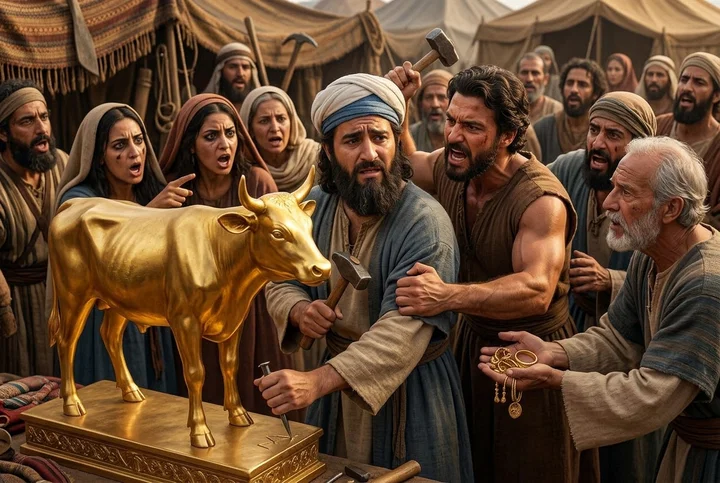
And they made a calf in those days, and offered sacrifice unto the idol, and rejoiced in the works of their own hands.
Translations
American King James Version, Webster Bible, Darby Translation
And they made a calf in those days, and offered sacrifice to the idol, and rejoiced in the works of their own hands.
King James Version, KJV Cambridge Paragraph Bible
And they made a calf in those days, and offered sacrifice unto the idol, and rejoiced in the works of their own hands.
Revised Version, American Standard Version
And they made a calf in those days, and brought a sacrifice unto the idol, and rejoiced in the works of their hands.
'And they made a calf in those days, and brought a sacrifice to the idol, and were rejoicing in the works of their hands,
And so they fell to calf-making in those days, and offered sacrifice unto the idol, and rejoiced in the works of their hands.
Berean Standard Bible, Majority Standard Bible
At that time they made a calf and offered a sacrifice to the idol, rejoicing in the works of their hands.
They made a calf in those days, and brought a sacrifice to the idol, and rejoiced in the works of their hands.
And they made the image of a young ox in those days, and made an offering to it, and had joy in the work of their hands.
And they made a calfe in those dayes, and offered sacrifice vnto the idole, and reioyced in the workes of their owne handes.
Douay-Rheims (Challoner revision)
And they made a calf in those days, and offered sacrifices to the idol, and rejoiced in the works of their own hands.
Pictures
Cross-references
- Exodus 32:1-6
And when the people saw that Moses delayed to come down out of the mount, the people gathered themselves together unto Aaron, and said unto him, Up, make us gods, which shall go before us; for as for this Moses, the man that brought us up out of the land of Egypt, we wot not what is become of him.
Israel makes and worships the golden calf.
- Amos 5:25-27
Have ye offered unto me sacrifices and offerings in the wilderness forty years, O house of Israel?
Israel’s wilderness idolatry and neglected sacrifices lead to God’s judgment.
- Ezekiel 20:7-8
Then said I unto them, Cast ye away every man the abominations of his eyes, and defile not yourselves with the idols of Egypt: I am the LORD your God.
Israel’s rebellion included refusing to forsake idols.
- Acts 7:58
And cast him out of the city, and stoned him: and the witnesses laid down their clothes at a young man’s feet, whose name was Saul.
gives outcome of Stephen's defense
- Acts 7:51
Ye stiffnecked and uncircumcised in heart and ears, ye do always resist the Holy Ghost: as your fathers did, so do ye.
Israel’s idolatrous rebellion exemplifies resistance to God and his messengers.
- Psalms 106:19-20
They made a calf in Horeb, and worshipped the molten image.
Retells Israel’s making of the calf and exchanging God’s glory for an image.
- Exodus 24:7
And he took the book of the covenant, and read in the audience of the people: and they said, All that the LORD hath said will we do, and be obedient.
The people promised obedience, then broke that promise by worshipping the calf.
- Psalms 81:11-12
But my people would not hearken to my voice; and Israel would none of me.
Israel refused God’s voice and was given over to its own desires.
- Romans 1:23-25
And changed the glory of the uncorruptible God into an image made like to corruptible man, and to birds, and fourfooted beasts, and creeping things.
They exchanged worship of God for idols and served created things.
- Joshua 24:2
And Joshua said unto all the people, Thus saith the LORD God of Israel, Your fathers dwelt on the other side of the flood in old time, even Terah, the father of Abraham, and the father of Nachor: and they served other gods.
Recalls Israel’s earlier service to other gods.
Commentary
Each commentary is drawn from primary sources: the writings of Ellen G. White and Adventist pioneers and periodicals. Each commentary is separate. Its own words are not a quotation; follow the references to read the source passages.
Ellen G. White
6 sources
The verse records that in those days Israel made a calf, offered sacrifice to the idol, and rejoiced in the works of their own hands.7RED 34.1 It belongs to Stephen's review of Israel's history.EW 164.23SP 296.23SP 297.2 That review traced the chosen people of God from Abraham down through generation after generation in the national records of Israel to Solomon.3SP 296.2
Stephen gave it as his defense before the council in answer to the charges of blasphemy against him, selecting the most impressive points of history to vindicate his cause.3SP 296.2 He spoke it in a clear, thrilling voice that rang through the council hall and held the assembly entranced and spell-bound.3SP 296.2 The survey showed thorough knowledge of the Jewish system and economy and of its spiritual interpretation now made manifest through Christ.3SP 296.2
Through this history Stephen rebuked leaders whose outward religious observance covered corrupt hearts and who rejected Christ.EW 164.2 The calf episode shows that the law Israel trusted for salvation had not kept the people from idolatry.7RED 34.13SP 297.2 It was Spirit-directed testimony to his judges, and its time, place, and circumstances, and the resistance of his hearers, give it its full and urgent significance.7RED 34.13SP 297.2
This witness ended in Stephen's stoning, in which Saul participated by consenting and taking part.RH Mar 6, 1900Ms 17, 1908, par. 18–28 Saul was a rabbi, statesman, and member of the Sanhedrin zealous to suppress Christianity, who continued in threatenings and slaughter against the disciples until he was stopped near Damascus on the way there by Jesus in a light from heaven, and was converted and called Paul.RH Mar 6, 1900Ms 17, 1908, par. 18–28
Sources
Pioneers and periodicals
22 sources
After turning away from Moses and turning back in their hearts to Egypt, the people asked Aaron to make gods to lead them because they did not know what had become of Moses, and in those days they fashioned a calf, sacrificed to the idol and delighted in what their own hands had made instead of worshiping the Lord who had brought them out to serve Him.ST Aug 26, 1897RH Jan 7, 1862RH Dec 31, 1861ST Sep 2, 1897ST Aug 26, 1897 Only a short time after promising obedience to the law spoken by the voice of God at Sinai, they fell into the idolatry of Egypt because their long sojourn among idolaters had dimmed their sense of the spiritual character of the law and of their own inability to obey it.ST Nov 28, 1878RH Sep 24, 1908 Their calf-making proves the helplessness of humanity and the utter uselessness of a covenant resting wholly in the power of the flesh, showing entire dependence on power from without and a constant supply of assisting grace to render acceptable obedience.RH Sep 24, 1908ST Aug 26, 1897 When they rejected the worship of God He gave them over to idolatry, to serve the host of heaven and take up the tabernacle of Moloch and the star of the god Rephan, so that He would carry them away beyond Babylon.ST Sep 2, 1897ST Dec 2, 1886 The account belongs to Stephen's pointed sermon setting the sins of light-resisting Jews before them, in which Israel's rejection of God in making the calf is repeated in the rejection of Christ and of Stephen himself, marking the close of the seventy weeks in A.D. 34 as the nation's final rejection of mercy and filling up Jerusalem's measure of iniquity.RH Apr 7, 1868STST Sep 20, 1910ST Oct 25, 1905RH May 10, 1915
Wilderness Calf Worship
After refusing to obey Moses and thrusting him from them, Israel turned back in their hearts to Egypt and said to Aaron to make gods to go before them because they did not know what had become of Moses who had led them out of Egypt, and in those days they made a calf and brought sacrifice to the idol and rejoiced in the works of their hands.ST Aug 26, 1897ST Aug 26, 1897 Their idolatry proves they had not been really delivered from bondage.ST Aug 26, 1897
While Moses was on Sinai the people were disloyal to both Moses and God by turning to idolatry, showing that their later claim of allegiance to Moses was false.ST Jun 14, 1883 In those days they made a calf, offered sacrifice to the idol, and rejoiced in the works of their own hands, neglecting true sacrifices and rebelling against God.RH Jan 7, 1862RH Dec 31, 1861
Although God had brought Israel out of Egypt to serve Him and keep His statutes, they continued in idolatry instead of worshiping the Lord.ST Sep 2, 1897 They turned away from Christ as their invisible leader and benefactor to worship false gods.ST Feb 19, 1902 The phrase in those days uses the Greek word for day in the sense of a full twenty-four hours embracing night and day, not only the hours of light.RH Dec 12, 1871
Stephen's account retells the history recorded in Exodus, supporting the accuracy of the Exodus record.ST Apr 13, 1904 It depends on the record in Genesis, without which the reference to Abraham would be unintelligible. It belongs to his account of the giving of the law in which angels had a role in its delivery, and the verse itself recounts Israel making and worshiping a calf in rebellion against God.RH Dec 31, 1861
Failure of Fleshly Covenant
Israel turned to making a calf and offering sacrifice to it and rejoicing in what their own hands had made despite the law they trusted for salvation, and the law did not keep them from that sin.ST Nov 28, 1878 Only a short time after promising obedience at Sinai to the law spoken by the voice of God, they fell into the idolatry prevalent in Egypt.RH Sep 24, 1908 Their long sojourn among idolaters had taken away their perception of the spiritual character of God's law and their realization of their own inability to obey it, so they readily promised conformity without a due sense of sin and human weakness.RH Sep 24, 1908 Their calf-making proves the helplessness of humanity, the absolute need of a power from without to change the heart, and entire dependence upon a constant supply of assisting grace to render acceptable obedience.RH Sep 24, 1908 It fully demonstrates the utter uselessness of a covenant resting wholly in the power of the flesh, which had no power in itself to deliver from the self-life, and their idolatry proves they had not really been delivered from bondage.RH Sep 24, 1908ST Aug 26, 1897
When the people rejected the worship of God, He gave them over to idolatry.ST Dec 2, 1886 That giving over included worship of the host of heaven and figures representing heavenly bodies.ST Dec 2, 1886 This continued worship of false gods instead of the Lord caused God to turn and give them up to serve the host of heaven, taking up the tabernacle of Moloch and the star of the god Rephan, so that He said He would carry them away beyond Babylon.ST Sep 2, 1897
Stephen's Witness and Rejection
The calf-making belongs to Stephen's pointed sermon to Jews who had resisted much light, in which their sins were set before them until rage drove them to kill him.RH Apr 7, 1868 In that sermon from Acts 7:2-53 Stephen found Christ in the Old Testament Scriptures and proclaimed Him to his hearers.ST Jul 22, 1886ST May 15, 1884 So taught through the Holy Spirit, Old Testament lessons including the calf and idolatry can point to Christ.ST May 15, 1884
His argument includes that God's promise to Abraham remained unfulfilled because Abraham did not receive his inheritance.ST Jul 22, 1886 Abraham and the other heirs who die must therefore be raised from the dead.ST Jul 22, 1886 This points to the resurrection and to the Messiahship of Christ.ST Jul 22, 1886
Israel's making and worshiping the calf was part of its rejection of God.ST Stephen's rejection by the Jews repeats that rejection, now of Christ.ST It clearly marks the end of the seventy weeks in A.D. 34.ST That stoning was the Jewish nation's final rejection of the mercy offered through Christ and the close of its role as God's representative.STST Sep 20, 1910
Stephen's murder in autumn A.D. 34 was the Jews' emphatic rejection of Christ.ST Oct 25, 1905 Together with the rejection and crucifixion of Christ and the condemnation and persecution of the apostles and believers after the resurrection, it filled up Jerusalem's measure of iniquity.ST Oct 25, 1905RH May 10, 1915 The persecution that followed dispersed Christians and scattered the disciples, who carried the gospel beyond Judea.ST Oct 25, 1905RH May 10, 1915ST Sep 2, 1913
That stoning ended Stephen's witness, and Saul took part in it.RH Mar 6, 1900 At the time he was a rabbi, statesman, and member of the Sanhedrin zealous for the suppression of Christianity.RH Mar 6, 1900 Jesus stopped him on the way to Damascus, and he was converted and called Paul.RH Mar 6, 1900
Sources