Exodus 24:7
And he took the book of the covenant, and read in the audience of the people: and they said, All that the LORD hath said will we do, and be obedient.
Translations
And he took the book of the covenant, and read in the audience of the people: and they said, All that the LORD has said will we do, and be obedient.
King James Version, Webster Bible
And he took the book of the covenant, and read in the audience of the people: and they said, All that the LORD hath said will we do, and be obedient.
And he took the book of the covenant, and read in the audience of the people: and they said, All that the Lord hath said will we do, and be obedient.
And he took the book of the covenant, and read in the audience of the people: and they said, All that the LORD hath spoken will we do, and be obedient.
And he took the book of the covenant, and read in the audience of the people: and they said, All that Jehovah hath spoken will we do, and be obedient.
and he taketh the Book of the Covenant, and proclaimeth in the ears of the people, and they say, 'All that which Jehovah hath spoken we do, and obey.'
And he took the book of the covenant, and read [ it] in the ears of the people; and they said, All that Jehovah has said will we do, and obey!
then took he the book of the covenant, and read in the ears of the people. And they said, All that Yahweh hath spoken, will we do, and will hearken,
Berean Standard Bible, Majority Standard Bible
Then he took the Book of the Covenant and read it to the people, who replied, “ All that the LORD has spoken we will do, and we will be obedient.”
He took the book of the covenant and read it in the hearing of the people, and they said, “ We will do all that the LORD has said, and be obedient.”
And he took the book of the agreement, reading it in the hearing of the people: and they said, Everything which the Lord has said we will do, and we will keep his laws.
After he tooke the booke of the couenant, and read it in the audience of the people: who said, All that the Lord hath said, we will do, and be obedient.
Douay-Rheims (Challoner revision)
And taking the book of the covenant, he read it in the hearing of the people: and they said: All things that the Lord hath spoken we will do, we will be obedient.
Pictures
Cross-references 20 of 99
- Exodus 19:5-8
Now therefore, if ye will obey my voice indeed, and keep my covenant, then ye shall be a peculiar treasure unto me above all people: for all the earth is mine:
Sets out the covenant condition referred to alongside the covenant ceremony.
- Hebrews 9:19-20
For when Moses had spoken every precept to all the people according to the law, he took the blood of calves and of goats, with water, and scarlet wool, and hyssop, and sprinkled both the book, and all the people,
Moses reads the covenant and ratifies it by sprinkling blood.
- Exodus 20:1-17
And God spake all these words, saying,
The commandments given at Sinai form the covenant context.
- Deuteronomy 4:13
And he declared unto you his covenant, which he commanded you to perform, even ten commandments; and he wrote them upon two tables of stone.
The Ten Commandments are identified as God’s covenant, distinct from the covenant book.
- Hebrews 8:9
Not according to the covenant that I made with their fathers in the day when I took them by the hand to lead them out of the land of Egypt; because they continued not in my covenant, and I regarded them not, saith the Lord.
Israel did not continue in the covenant God made when he led them from Egypt.
- Exodus 24:3
And Moses came and told the people all the words of the LORD, and all the judgments: and all the people answered with one voice, and said, All the words which the LORD hath said will we do.
Israel first promises to obey the Lord’s words before the written covenant is read.
- Jeremiah 31:32
Not according to the covenant that I made with their fathers in the day that I took them by the hand to bring them out of the land of Egypt; which my covenant they brake, although I was an husband unto them, saith the LORD:
Refers to the covenant God made with Israel after the exodus.
- Exodus 32:1-6
And when the people saw that Moses delayed to come down out of the mount, the people gathered themselves together unto Aaron, and said unto him, Up, make us gods, which shall go before us; for as for this Moses, the man that brought us up out of the land of Egypt, we wot not what is become of him.
The people later break their pledge by worshiping an idol.
- Galatians 4:24
Which things are an allegory: for these are the two covenants; the one from the mount Sinai, which gendereth to bondage, which is Agar.
Identifies the Sinai covenant Israel pledged to keep as a covenant of bondage.
- Exodus 24:12
And the LORD said unto Moses, Come up to me into the mount, and be there: and I will give thee tables of stone, and a law, and commandments which I have written; that thou mayest teach them.
After the covenant is ratified, God calls Moses to receive the commandments written on stone.
- Exodus 19:8
And all the people answered together, and said, All that the LORD hath spoken we will do. And Moses returned the words of the people unto the LORD.
Israel first promises to do all the Lord has spoken.
- Deuteronomy 5:2-3
The LORD our God made a covenant with us in Horeb.
Moses identifies the covenant made with Israel at Horeb, distinct from the one made with their fathers.
- Exodus 20:19
And they said unto Moses, Speak thou with us, and we will hear: but let not God speak with us, lest we die.
The people ask Moses to speak to them instead of God after hearing the law.
- Exodus 21:1-23
Now these are the judgments which thou shalt set before them.
These judgments are included in the covenant book read to the people.
- 2 Kings 23:3
And the king stood by a pillar, and made a covenant before the LORD, to walk after the LORD, and to keep his commandments and his testimonies and his statutes with all their heart and all their soul, to perform the words of this covenant that were written in this book. And all the people stood to the covenant.
The people pledge to keep the commandments written in the covenant book.
- 2 Corinthians 3:7-11
But if the ministration of death, written and engraven in stones, was glorious, so that the children of Israel could not stedfastly behold the face of Moses for the glory of his countenance; which glory was to be done away:
The glory of the covenant written on stone belonged to a ministry that passed away.
- Exodus 34:28
And he was there with the LORD forty days and forty nights; he did neither eat bread, nor drink water. And he wrote upon the tables the words of the covenant, the ten commandments.
The commandments written on the tablets are called the words of the covenant.
- Jeremiah 11:3-4
And say thou unto them, Thus saith the LORD God of Israel; Cursed be the man that obeyeth not the words of this covenant,
Restates the covenant made at the exodus and Israel’s duty to obey God’s voice.
- Jeremiah 31:33
But this shall be the covenant that I will make with the house of Israel; After those days, saith the LORD, I will put my law in their inward parts, and write it in their hearts; and will be their God, and they shall be my people.
Contrasts the people's covenant pledge with God writing his law in their hearts.
- Deuteronomy 5:22
These words the LORD spake unto all your assembly in the mount out of the midst of the fire, of the cloud, and of the thick darkness, with a great voice: and he added no more. And he wrote them in two tables of stone, and delivered them unto me.
God speaks the commandments and writes them on stone as the covenant basis.
Commentary
Each commentary is drawn from primary sources: the writings of Ellen G. White and Adventist pioneers and periodicals. Each commentary is separate. Its own words are not a quotation; follow the references to read the source passages.
Ellen G. White
34 sources
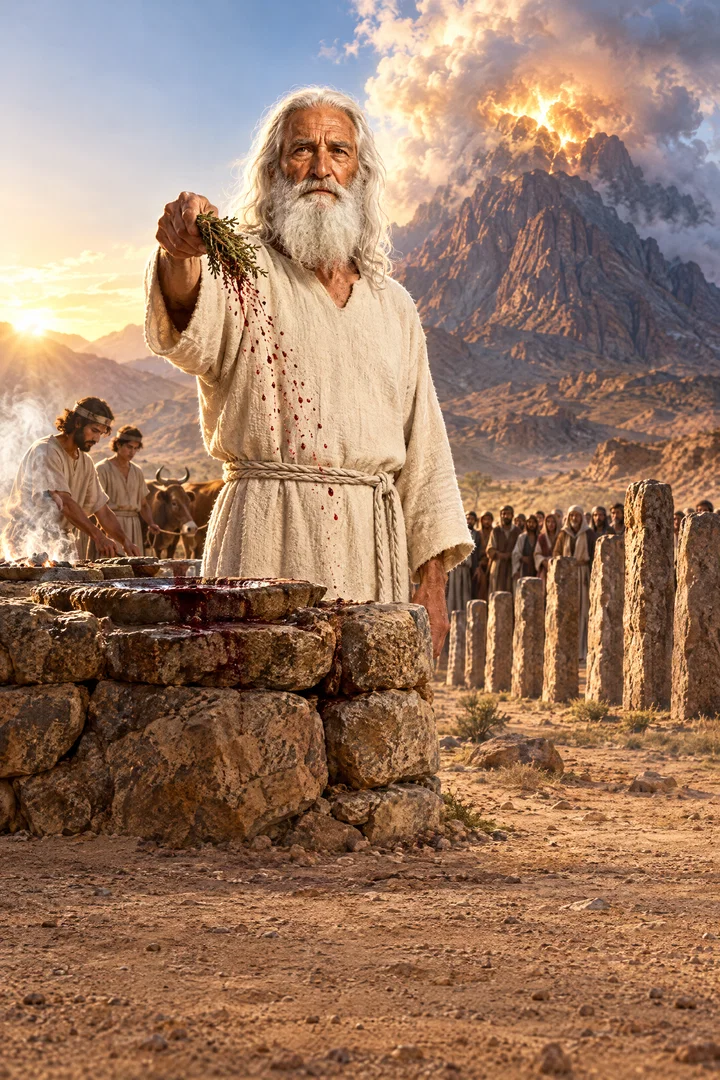
Moses read the book of the covenant aloud in the hearing of the people to lay its conditions plainly before them and give them opportunity to accept them, and the whole people answered together with one voice that they would do all the Lord had said and be obedient, thereby ratifying their solemn covenant with Him.1MR 114.1Ms 119, 1903, par. 11–12SG3 270.1–2 This took place at the foot of Sinai a few days after the law was spoken and additional statutes and judgments were given through Moses, after he had told the people all the words and judgments, written them down, built an altar with twelve pillars, and offered sacrifices with half the blood sprinkled on the altar.RH Feb 19, 1914Ms 58, 1900, par. 23–25Ms 65, 1906, par. 17–18RH Jul 29, 1873ST May 6, 1880 The book he read contained God's judgments to be observed and His promises conditional on obedience, with specifically defined particulars dictated by Christ Himself so the people would know how much was involved.SG3 270.1–2Ms 126, 1901, par. 52–561SP 239.2–240.11MR 114.2 By that pledge Israel entered into covenant relation with God as His special treasure, kingdom of priests and holy nation, with the blood on the altar signifying their consecration of body, mind and soul and the blood on the people signifying His gracious acceptance of them through the shed blood of Christ.Ms 119, 1903, par. 11–12Ms 126, 1901, par. 52–56PK 293.1Ms 65, 1906, par. 17–18 They promised readily without realizing the sinfulness of their hearts and their utter inability in themselves to render obedience and need of a Saviour, and within a few weeks broke their covenant by worshiping the golden calf, which proved they could not gain favor by a broken covenant and brought them to feel their need of pardon and of the Saviour revealed in the Abrahamic covenant.RH Oct 17, 1907PP 371.2–41SP 248.2–249.1
Reading and Ratification Ceremony
The ratification took place at the foot of Sinai only a few days after the law had been spoken from Sinai and additional statutes and judgments had been communicated through Moses.RH Feb 19, 1914 It came before Moses left the people to go up the mountain and before their unbelief was revealed when he delayed to come down.Ms 58, 1900, par. 23–25RH Jul 29, 1873
Before the reading Moses told the people all the words of the Lord and all the judgments, then wrote them down.Ms 58, 1900, par. 23–25Ms 65, 1906, par. 17–18ST May 6, 1880 He built an altar under the hill with twelve pillars for the twelve tribes of Israel, had young men offer burnt offerings and peace offerings of oxen, and divided the blood with half in basins and half sprinkled on the altar.Ms 65, 1906, par. 17–18RH Aug 16, 1906 After first telling them all God's words and after offering sacrifices for them, he took the book of the covenant in which he had written God's judgments and promises and read it aloud in the hearing of the people.Ms 58, 1900, par. 23–25ST May 6, 1880RH Aug 16, 1906 The reading laid its conditions plainly before them and gave them opportunity to choose whether to accept them.1MR 114.1Ms 126, 1901, par. 52–56 The whole people answered together with one voice in a public, unanimous, renewed pledge that all that the Lord had said they would do and be obedient, by which answer they ratified their solemn covenant with the Lord.1MR 114.1Ms 119, 1903, par. 11–12SG3 270.1–2Ms 126, 1901, par. 52–56Ms 58, 1900, par. 23–25
The book read contained God's judgments required to be observed and His promises conditional on obedience, not the Ten Commandments.SG3 270.1–21SP 239.2–240.1 The laws and ordinances in the book were dictated by Christ Himself with specifically defined particulars and explained in specific detail so the people could refer to them afterward and know how much was involved.Ms 126, 1901, par. 52–561MR 114.2 Having already agreed to obey God's commandments, they accepted those defined requirements.Ms 126, 1901, par. 52–561MR 114.2 The book also included God's detailed instructions for the sanctuary, written down and read to the leading people.1SP 269.1
After the reading, pledge, and sprinkling of the blood of the covenant concerning all these words, Moses with Aaron, Nadab, Abihu, and seventy of the elders of Israel went up and saw the God of Israel.Ms 58, 1900, par. 23–25 Under His feet was as a paved work of sapphire stone clear as heaven itself, and God laid not His hand upon the nobles but they saw God and ate and drank.Ms 58, 1900, par. 23–25 Then Moses with his minister Joshua was called farther up into the mount of God to receive tables of stone and a law and commandments written by God that he might teach them, and received directions for building a sanctuary and the pattern of the ark.Ms 58, 1900, par. 23–25
Covenant Meaning and Aftermath
By that pledge Israel entered into covenant relation with God, choosing Him as King and accepting Jehovah as sovereign after His wonders in bringing them from Egypt.PK 293.1RH Feb 19, 1914PP 376.3 They were thereby set apart and sealed to God as His special, peculiar treasure above all people, a kingdom of priests and a holy nation, the chosen people of the Most High.Ms 119, 1903, par. 11–12Ms 126, 1901, par. 52–56Lt 188, 1903, par. 21–26RH Feb 19, 1914Ms 65, 1906, par. 17–18 The blood sprinkled on the altar signified their consecration of body, mind, and soul to God.Ms 126, 1901, par. 52–561MR 115.1 The blood sprinkled on the people signified God's gracious acceptance of them as His special treasure through the sprinkled blood of Christ, representing the shedding of Jesus' blood by which human beings are cleansed from sin.Ms 119, 1903, par. 11–12Ms 126, 1901, par. 52–56Ms 65, 1906, par. 17–181MR 115.1FE 506.8–507.1
The people's solemn covenant with God typifies the covenant between God and every believer in Jesus Christ.Ms 126, 1901, par. 52–561MR 114.2 Together with the next verse it shows the forming of the old covenant between God and Israel at Sinai and its ratification by the blood of a sacrifice.RH Oct 17, 1907 That sacrificial blood was shed before the blood of Christ by which the Abrahamic covenant was ratified, which is why the Abrahamic covenant existing by promise since Adam and Abraham is called the second or new covenant.RH Oct 17, 1907
The people readily promised without realizing the sinfulness of their own hearts, their utter inability in themselves to render obedience to God's law, and their need of a Saviour.RH Oct 17, 1907PP 371.2–4 Feeling able in themselves to keep the law, they attempted to establish their own righteousness under the old covenant formed at Sinai.RH Oct 17, 1907PP 371.2–4 Though they had trembled with terror before the mount at the proclamation of the law in awful majesty, only a few weeks passed before they broke their covenant by bowing down to worship a graven image in the calf.RH Oct 17, 1907PP 371.2–4 The broken tables of stone represented that broken covenant made only a short time before.1SP 248.2–249.1
Their failure proved they could not hope for God's favor through a broken covenant.RH Oct 17, 1907PP 371.2–4 It brought them to feel their sinfulness and need of pardon and of the Saviour revealed in the Abrahamic covenant and shadowed forth in the sacrificial offerings.RH Oct 17, 1907PP 371.2–4 So by faith and love they would be bound to God as deliverer from bondage of sin and prepared to appreciate the new covenant and its blessings.RH Oct 17, 1907 The unanimous pledge made Aaron's later sin especially grievous because he had joined it and then led the people into idolatry.3T 297.1–3RH Jul 29, 1873 He should have reminded them of the covenant that bound them to obedience when they asked him to make gods for them, and standing firmly by that commitment could have helped prevent their apostasy.3T 298.3 Remembering that covenant and the dangers witnessed at Sinai should have checked the apostasy.RH Feb 4, 1909
The pledge was not carried out but became pretense without the spirit that leads to obedience, as later Jewish leaders rejected Christ and the law's principles despite evidence of His authority.COL 276.1 To the pledge of obedience God in return made a pledge promising blessing as reward for obedience.RH Jan 30, 1908Lt 100, 1907, par. 9 Their loyalty was linked to His covenant promises of safe guidance to the promised land and prosperity and protection among the nations.Ms 80, 1903, par. 1–21MR 311.1–312.1 That covenant standing was the ground for expecting blessings as they left Sinai for Canaan.PP 376.3 During the wilderness years He remained faithful and those who obeyed received the promised blessings, and the covenant remains in force so that obedience brings heaven's richest blessings.1MR 311.1–312.1
The verse sets forth the duties of God's denominated people and joins them to God's law whose principles are love for God and love for neighbor.RH Jan 30, 1908ST Apr 15, 1875 The first four commandments teach duty to God and the last six duty to others, stated more explicitly after the fall with particular precepts clarifying and protecting them so the law would not be forgotten.ST Apr 15, 1875 The laws in the covenant book are to be studied and obeyed to guard against injustice and guide dealings with one another.Lt 160, 1906, par. 3–9 God's word is to be followed implicitly after being shown the right way and the wrong way with its benefits, leaving people to choose whether to meet the conditions.Ms 64, 1903, par. 107MR 91.1–2 If they had kept what they bravely promised they would have been practical Christians happy in keeping God's ways instead of following their own natural hearts.Ms 126, 1901, par. 52–56
Sources
Pioneers and periodicals
97 sources
At Sinai Moses read aloud the book in which he had written all the Lord's words, and the whole congregation unitedly promised to do all that the Lord had said and be obedient.ST May 16, 1878ST Apr 17, 1907ST Dec 16, 1897ST Feb 6, 1879 That reading and promise stood between the dividing and the sprinkling of sacrificial blood, by which the agreement was then sealed and made binding.RH Jun 26, 1900ST Oct 1, 1885STRH May 13, 1862ST Oct 25, 1883 The covenant so confirmed was the mutual compact concerning God's words, not the Ten Commandments themselves, which with their related judgments were its basis, terms and conditions.RH Jun 26, 1900ST Oct 1, 1885ST Sep 17, 1885ST Aug 13, 1885 The people pledged in ignorance of their sinfulness and inability to keep the law without Christ, trusting in the flesh without provision for forgiveness or divine power, and within weeks broke both the commandments and their promise by worship of the calf.RH Jul 3, 1900RH Oct 17, 1907RH Jul 29, 1873RH Jun 12, 1900RH Sep 24, 1908 The fault lay in the people and not in God's law, which was not abolished by their failure but remains binding, and which in the new covenant is promised to be written by the Spirit in hearts and minds with forgiveness for its transgression.ST Sep 23, 1913RH Jun 25, 1872ST Jan 29, 1908ST Oct 23, 1884ST Jun 12, 1879
Reading and Promise at Sinai
Exodus 24:7 belongs to the giving of the Ten Commandments and covenant dealings with Israel at Mount Sinai.ST Mar 3, 1914RH Dec 24, 1861 It records the ratification at the foot of Sinai a few days after the law was spoken from Sinai and additional statutes and judgments were communicated through Moses.RH Feb 19, 1914 It stands in the chapter immediately before the first instructions respecting the sanctuary beginning in the next chapter.RH Oct 20, 1863 It stands in Israel's wilderness journey after the Wilderness of Sin and the giving of manna as a moral test marking the Sabbath by a threefold weekly miracle, wars with Amalek as a bitter foe, the counsel of Jethro, preparation for God's law, and the giving of the holy law itself.ST Feb 11, 1913 The tables of the law had not yet been given.ST Dec 18, 1893
Moses first told the people all the Lord's words, wrote them in the book of the covenant, and then took the book and read it aloud in the audience of the whole congregation so they would hear and understand the full terms before assenting.ST Feb 6, 1879ST Mar 8, 1883 After Moses wrote down the covenant terms and read them aloud, the people had another opportunity to reconsider their commitment.ST May 16, 1878 The book contained the covenant as it had then been made, with the written statutes as its terms, and the public reading ensured the people understood what they were agreeing to.ST Dec 16, 1897ST Mar 8, 1883 This public reading came after their first answer and writing, and prepared the way for ratification and for honor to the law.ST May 16, 1878ST Oct 10, 1895 Their response followed hearing the covenant's words in full, and this reading and promise took place before Moses ratified the covenant by sprinkling blood on the people.ST Dec 16, 1897ST Oct 10, 1895
After hearing every word read, the whole people unitedly answered together that all the Lord had said they would do and be obedient.RH Feb 19, 1914 Their response marked their acceptance of the covenant condition and their binding to Jehovah. It renewed earlier pledges and is counted as the second, third, or final unreserved assent, closing the contract on their part.ST Apr 17, 1907ST Dec 16, 1897ST Feb 6, 1879ST Mar 8, 1883 It was the third time the people promised to obey, with the covenant's conditions thus solemnly repeated, and because everything was now recorded it could not afterward be forgotten or changed.ST Apr 17, 1907 This reading and promise finished the making of the agreement, leaving it ready to be sealed with blood.
The promise was national and voluntary, as Israel as a people collectively heard, freely accepted or could refuse, and pledged themselves to obey God's law.ST Apr 17, 1907ST Nov 4, 1897 By this Israel entered into covenant relation with God as His peculiar treasure above all people, a kingdom of priests and a holy nation, with God choosing Israel as His people and they choosing Him as their King, and His favor toward them conditional on obedience.RH Feb 19, 1914 The covenant helped preserve Israel as a nation, along with the promises, law, truth, and records connected with the coming Messiah.ST Feb 17, 1890 After hearing God speak the law and recognizing Moses as God's mouthpiece, the people repeatedly pledged obedience and agreed to receive further instruction through Moses.RH Jul 18, 1907 Their pledge to obey was not the people enacting the laws themselves, for God chose Moses as leader and gave Israel its laws while the people could choose whether to obey them, making Israel a God-ruled theocracy and not a democracy, with the agreement made through its elders and most influential men.RH Sep 23, 1909ST Dec 25, 1893
One account presents the book read here as holding God's devised plan and particular directions for the tabernacle.ST Jun 24, 1880 It held the plan God Himself devised and gave to Moses, with particular directions as to size and form, materials to be used, and every article of furniture it was to contain, taken from the miniature model of the heavenly sanctuary presented before Moses in the mount with the command to make all things according to the pattern shown him there.ST Jun 24, 1880 Moses wrote down God's directions for the sanctuary and read them to the people's leaders and most influential men.ST Jun 24, 1880ST Mar 21, 1911
Ratification by Sacrificial Blood
The reading of the book and the people's promise completed the making of the agreement and belong to its formal confirmation and dedication with blood.RH Jun 26, 1900ST Oct 1, 1885STRH Dec 7, 1916ST Aug 13, 1885 The promise recorded here came between the dividing of the sacrificial blood and the sprinkling of it, and the covenant was then sealed, approved, finished and made binding by that sprinkling, having no force until the sacrifice was slain.RH Jun 26, 1900ST Oct 1, 1885RH Dec 7, 1916RH May 13, 1862ST Oct 10, 1895 After the people had heard God's voice from Sinai and had promised to obey, Moses wrote all the words of the Lord, took the book of the covenant and read it in their hearing, and they answered together with a renewed promise of full obedience to all the Lord had spoken.RH Jun 26, 1900ST Oct 1, 1885RH Dec 7, 1916ST Aug 13, 1885ST Oct 10, 1895 Their response formed their part of the mutual agreement, contract and covenant, which was put in writing, read to them, accepted by them as its conditions, and then dedicated with blood sprinkled on the people as the blood of the covenant concerning all these words.ST Oct 1, 1885STRH Dec 7, 1916ST Aug 13, 1885ST Oct 10, 1895 The Ten Commandments were not yet in Israel's possession in written form and were never dedicated with blood, but were no part of the first covenant except as its basis, the thing to which the promise of obedience related.RH Jun 26, 1900ST Aug 13, 1885
Moses divided the blood with half in basins and half on the altar representing God, then after the reading and promise sprinkled the blood on the book and on all the people.RH Jun 26, 1900RH May 13, 1862ST Oct 25, 1883RH Dec 31, 1861RH Oct 22, 1861 In doing so he declared it the blood of the covenant made concerning all these spoken words.RH Jun 26, 1900RH May 13, 1862RH Dec 31, 1861RH Oct 22, 1861ST Jun 4, 1902 That sprinkling on both book and people was the signing and sealing of the agreement, made by Moses acting as mediator with the written conditions of laws and judgments read in the audience of the people.RH Jun 26, 1900RH May 13, 1862RH Dec 31, 1861RH Oct 22, 1861ST Jun 4, 1902 The tables of stone are not mentioned at all in this sprinkling, which shows they were not dedicated in this way.RH Jun 26, 1900RH May 13, 1862 The verse thus means Israel as a nation could remain in Canaan and be a peculiar treasure and a holy nation only upon obedience to God's voice.RH Oct 22, 1861
The sacrifice confirming the covenant was a peace-offering from unblemished animals of the herd or the flock, fit to represent the Prince of Peace.RH Jun 6, 1912 Peace-offerings were made in token of thanksgiving, to confirm a vow or contract, and as voluntary offerings.RH Jun 6, 1912
This dedication with animal blood was a one-time act distinct in purpose and form from the yearly cleansing of the sanctuary.ST Oct 25, 1883 It is compared with the dedication of the new covenant through Christ's blood, as the first covenant was dedicated with blood when the people heard its terms and pledged to do what the Lord had said.RH Oct 17, 1907ST Oct 25, 1883RH Jul 7, 1874RH Jan 12, 1911RH Feb 19, 1861 In the ceremony Moses ratified the agreement between God and Israel by sprinkling blood on the people, while Christ ratifies the covenant of grace by shedding his own blood.RH Oct 17, 1907RH Jan 12, 1911RH Feb 19, 1861 That sacrificial blood was shed before the blood of Christ by which the Abrahamic covenant was ratified, which is why the Abrahamic covenant is called the second or new covenant even though it existed by promise since Adam and Abraham, while already in force to provide redemption through Christ.RH Oct 17, 1907RH Jan 12, 1911
Covenant Distinct From Law
The covenant made in this verse is the mutual agreement, contract and solemn compact between God and Israel concerning God's words, not the Ten Commandments themselves.ST Oct 1, 1885ST Sep 17, 1885ST Mar 15, 1883RH Jun 25, 1872 After the book of the covenant was read in the hearing of the people, they answered together with a promise of full obedience to do and obey all that had been spoken.ST Oct 1, 1885ST Sep 17, 1885ST Jan 3, 1878RH Jun 25, 1872 In that compact the people pledged obedience, and God pledged on that condition to accept them as His people, to be their God and husband, to make them a peculiar treasure, a kingdom of priests and a holy nation, to do great things by them and to make them a great nation.ST Oct 1, 1885ST Sep 17, 1885ST Mar 15, 1883RH Jun 25, 1872 The commandments were given by God, but the covenant was made with the people and was ratified before God wrote the Ten Commandments, and when the people broke their agreement they forfeited claim to its conditional promises without abolishing God's law or His claim to their obedience.ST Sep 17, 1885ST Jan 3, 1878RH Jun 25, 1872ST Jun 16, 1914
The Ten Commandments, called the Lord's words, with related precepts called judgments, are the basis, terms and conditions to which the promise related and about which the covenant was made.RH Jun 26, 1900ST Aug 13, 1885ST Aug 13, 1885ST Jul 1, 1875ST Apr 15, 1886 The covenant was finished and dedicated with blood concerning those spoken words, while the Ten Commandments were not yet in Israel's possession in written form and were never dedicated with blood.RH Jun 26, 1900ST Aug 13, 1885RH May 13, 1862ST Aug 13, 1885ST Jul 1, 1875 The commandments were its conditions, not the covenant itself, though associated with it as written terms, and the covenant depended on the Decalogue, not the Decalogue on the covenant.RH Jun 26, 1900ST Aug 13, 1885ST Aug 13, 1885ST Jun 16, 1914ST Feb 13, 1879 The people made this solemn promise before hearing those words and reaffirmed it after hearing them, and their duty to obey God's voice did not depend on making the promise, but breaking it through disobedience forfeited their claim to the covenant promises and carried the penalty of death for transgression.RH Jun 26, 1900ST Sep 17, 1885ST Jul 1, 1875ST Jun 16, 1914ST Feb 13, 1879
The book of the covenant written by Moses and read here is distinct from the tables of stone written by God's finger.RH May 13, 1862ST Oct 19, 1888RH Aug 19, 1852ST Feb 22, 1883ST Dec 23, 1897 It contained the covenant terms, laws, judgments, ordinances of divine service, sanctuary, priesthood and sacrifices, including additional instructions explaining the commandments, how to avoid breaking them and what to do after transgression, and a copy of the commandments with other duties, while the tablets held only the commandments.RH May 13, 1862ST Oct 19, 1888RH Aug 19, 1852RH May 13, 1862ST Dec 23, 1897 Moses himself read and spoke every precept of the book to the people, whereas God Himself spoke the Ten Commandments, and both the book and the people were sprinkled with blood while the tables of stone are not mentioned at all.RH May 13, 1862ST Oct 19, 1888ST Feb 22, 1883RH May 13, 1862ST Dec 23, 1897 This book law, given through Moses, used types and shadows to point to Jesus who takes away sin, prescribed temporal punishments for breaking God's law, and belonged to a system with blood sacrifices that could not take away sin, offered no sacrifices in itself to define sin, did not make sin known but was introduced as a temporary remedy pointing to the new covenant that truly takes away sin.RH May 13, 1862RH Aug 19, 1852ST Feb 22, 1883RH May 13, 1862ST Dec 23, 1897
Those who present the book differently hold that it contained the Ten Commandments as written by Moses after God spoke them, together with the additional precepts of Exodus 21-23, the commandments being called the Lord's words and the additional precepts being called judgments.ST Dec 30, 1889ST Sep 20, 1899ST Apr 15, 1886RH Feb 7, 1854ST Jan 30, 1901 On that showing the covenant they were required to keep was the Lord's covenant consisting of the Ten Commandments, with ritual and judicial laws to accord with the form of the law written on stone.ST Dec 30, 1889ST Sep 20, 1899ST Apr 15, 1886RH Feb 7, 1854ST Jan 30, 1901 Their promise to do all that had been said and obey was the human basis of the old covenant to keep those commandments, and their later failure showed inability to keep the law by their own power, not a fault in the law.ST Dec 30, 1889ST Sep 20, 1899ST Apr 15, 1886RH Feb 7, 1854ST Jan 30, 1901 Others present the terms as all these words — the Ten Commandments together with their amplification in the three following chapters — now abolished so that its conditions ceased, with Exodus 19 as only a preliminary interview and not the old covenant itself, and with Deuteronomy 5 in full accord.RH Mar 25, 1873RH Feb 4, 1873 On that showing the Mosaic code is one covenant or law rather than two separate laws, including commandments about sacrifices, so that Jeremiah's call to obey God's voice refers to keeping this covenant and not only to the Ten Commandments.RH Mar 25, 1873RH Feb 4, 1873
Self-Reliance and Certain Failure
Israel readily gave its promise because the people did not know their own sinfulness, the holiness of God, their utter inability without Christ to keep the law, and their need of a Saviour.RH Jul 3, 1900RH Oct 17, 1907RH Sep 24, 1908 Long dwelling among idolaters in Egypt had taken away perception of the spiritual character of the law, and after hearing the commandments they drew back in fear and asked that God not speak to them, yet still felt able to establish their own righteousness.RH Jun 12, 1900RH Sep 24, 1908 In that condition they acted according to the flesh, and the fleshly mind is hostile to God and cannot submit to His law, so they could not truly keep His covenant.RH Jun 12, 1900RH Sep 24, 1908 Their promise followed witnessing the proclamation of the law in awful majesty while trembling with terror before the mount, with its power and glory.RH Oct 17, 1907ST Sep 24, 1896
The pledge to do what God alone could accomplish in them rested wholly on human effort, expediency and confidence in the flesh, without acknowledging need of God's strength, wisdom, Spirit and Christ dwelling in the heart.ST Apr 17, 1907ST Sep 23, 1913ST Jan 29, 1908ST Dec 16, 1897 After Moses read the book aloud the people had the choice to accept or refuse, and they pledged themselves to perfect obedience though already sinful and unable to fulfill it in their own strength.ST Apr 17, 1907ST Jun 3, 1886 The old covenant as they took it offered no provision for forgiveness or divine power to obey, so it left them under condemnation, brought guilt and just condemnation home to them, and did not create the obligation to obey which already existed.ST Jun 3, 1886 For that reason it was faulty, weak, and a bond of bondage like Hagar's child born according to the flesh, exposing the deceitfulness of the heart and the helplessness of humanity apart from assisting grace and a constant supply of grace from without to change the heart.RH Sep 24, 1908ST Sep 28, 1915 Human weakness and lack of reverence kept them from fulfilling the promise, and they soon forgot God's works and rebelled.ST Sep 22, 1914
Only a few weeks later, in less than forty days and within six weeks amid Sinai's glory, most turned to the calf.RH Oct 17, 1907RH Sep 24, 1908ST Sep 24, 1896 That calf was Apis the Egyptian sun-god, set up as a rival god as a feast to Jehovah, with violation of God's law and pollution of the Sabbath.ST Sep 24, 1896RH Jan 7, 1862 Moses had read the covenant words before going up the mountain and the people had unanimously pledged to do and obey, which made Aaron's leading them into idolatry especially grievous.RH Jul 29, 1873 They thus broke both the commandments and their promise, forfeited claim to the conditional blessings, and proved they could not hope for favor through a broken covenant.RH Oct 17, 1907
God allowed them to enter the covenant though He knew they could not do what they promised, because they did not know it and must be taught, and the sure way to cause them to learn was to have them try and fail and so learn by experience that they could not of themselves establish their own righteousness as the righteousness of God. By seeing their sinfulness and need of pardon they were to be brought to feel their need of the Saviour revealed in the Abrahamic covenant and shadowed forth in the sacrificial offerings, so that by faith and love they would be bound to God as deliverer from the bondage of sin and prepared to appreciate the blessings of the new covenant.RH Oct 17, 1907ST Dec 16, 1897 They could have accepted Christ there and given themselves to God so His power would come in to help and save them as it did Moses, Joshua and Caleb, but they could not look beyond the glory, and that glory condemned them.ST Sep 28, 1915 Since the fall, the perfect obedience God requires can be rendered only through faith in Christ dwelling in the heart and working what pleases God, and the covenant's purpose was to lead Israel to those blessings which could be realized only through faith in Christ and acceptance of the gospel.ST Dec 16, 1897
The fault was in the people, not in the Lord or in the covenant's divine principles, which were adopted in the wrong way for worldly ends.ST Nov 11, 1897ST Mar 17, 1909 A covenant made with an entire people cannot save individuals, and the old covenant served to keep Israel together as a nation until Christ came, with its promises, law, truth and records connected with the coming Messiah, but it saved no one as a nation or as individuals.ST Sep 23, 1913ST Jan 29, 1908ST Feb 17, 1890ST Apr 22, 1913 Those who obeyed God from the heart in that era were saved by faith in the coming Christ and God's saving power, not by relying on their own strength.ST Apr 22, 1913 The old covenant resting on the people's promises was only as strong as their promise, whereas the everlasting new covenant rests on God's promises, received by yielding faith, with God placing His law in hearts and minds so men desire to obey.ST Nov 11, 1897ST Mar 17, 1909
Breaking the agreement forfeited its blessings and brought the bond against them, but it did not abolish God's law, weaken it, free them from duty, or affect the Sabbath which existed before Horeb.RH Jun 25, 1872RH Jun 25, 1872RH Mar 25, 1873ST Mar 4, 1889 The covenant was the mutual agreement between God and Israel concerning those words, with promises on both sides — the people pledging obedience and God promising to make them His treasured people — not the Ten Commandments themselves, though the law was called a covenant and the people's pledge formed another covenant.RH Jun 25, 1872RH Jun 25, 1872ST Aug 19, 1875 Their promise to obey did not create or give authority to God's law, which was already binding whether or not they agreed to keep it.RH Mar 25, 1873 Disobedience could render the agreement ineffective and end it, even a thousand times repeated, without affecting the commandments themselves, which stand forever perpetually binding upon all mankind.ST Nov 2, 1915ST Aug 19, 1875ST Nov 11, 1897
Law Endures and New Covenant
Obedience to the divine voice did not begin with this pledge and was not created by it, for the law was already binding whether the people agreed to keep it or not.RH Mar 25, 1873RH Mar 24, 1863 The Sabbath in particular already existed and was binding before it was publicly proclaimed at Sinai, and it was restated among the moral precepts and included among the covenant commands.RH Dec 31, 1861RH Mar 24, 1863 The ceremony formally espoused the people to God and espoused His law and Sabbath to the people, yet connection with Israel did not make the law or Sabbath merely Jewish.RH Dec 17, 1861 The agreement was the first mutual compact with the house of Israel after the exodus from Egypt, a voluntary contract in which God promised to make them a favored people above all nations on condition they obey His voice and keep His commandments, confirmed by Moses as mediator writing the laws and judgments in the book, reading them aloud, receiving the united answer, and sealing it with sprinkled blood, so that as a nation they could remain in Canaan and continue a peculiar treasure and holy nation only upon obedience to the Ten Commandments and law of God.RH Oct 22, 1861RH Mar 25, 1873
The law publicly proclaimed at Horeb was written on two tables of stone, placed in the ark, with the blood of the sin offering sprinkled over it, showing that with respect to this law Israel were sinners.ST Oct 23, 1884ST Jun 12, 1879 That stone-written law was the condition concerning which the covenant was made, and its transgressions made them sinners and required forgiveness.ST Oct 23, 1884ST Jun 12, 1879ST Nov 11, 1897 The same law is the one promised in the new covenant to be put in hearts and minds and forgiven because those sins were transgressions of that law, written in the old covenant on tables of stone and in the new on fleshly tables of the heart by the Spirit, so that people desire to obey.ST Oct 23, 1884ST Jun 12, 1879ST Mar 17, 1909RH Jan 13, 1852 The Ten Commandments are not themselves the mutual covenant but are called the words of the covenant because the covenant was made respecting them, and the covenant depended on the Decalogue rather than the Decalogue on the covenant, so that even a thousand breaches by Israel do not abolish or affect God's law.ST Oct 23, 1884ST Nov 11, 1897 The Sinai covenant was only as strong as the people's promise and was faulty because weak, sinful Israel failed and came under condemnation to death, whereas the everlasting new covenant rests on God's promises received by yielding faith, with God placing the same law within.ST Nov 11, 1897ST Mar 17, 1909ST Jan 27, 1890 The ordinances of divine service connected with the covenant were not part of the covenant itself but acknowledged the justice of that condemnation and expressed faith in the Mediator of the new covenant.ST Oct 23, 1884ST Jan 27, 1890
The covenant laws were given in love, not to drive the people away, but to write the law upon their hearts and draw them into close fatherly fellowship.ST Jan 27, 1909ST Jan 27, 1909 At Sinai the people were joined to a law whose principles are love to God and love to neighbor, the first four commandments teaching duty to God and the last six teaching duty to fellow men.ST Apr 15, 1875ST Jan 27, 1909 Those principles were stated more explicitly after the fall, and particular precepts clarified, guarded, and protected them lest the law be forgotten.ST Apr 15, 1875ST Jan 27, 1909
The mutual pledge reestablished God's rule on earth after Satan broke man's connection with the Maker, God refusing to let the interloper triumph by calling out a people to acknowledge His rule, hear His voice, learn His requirements from His revealed purpose and written law, and covenant to keep His commandments, walk in His ways, and be obedient, while He covenanted to bless them with all spiritual and temporal blessings.RH Sep 23, 1909RH Nov 2, 1911 That reestablished theocracy meant God ruling through deputized agents and dwelling among them in the Shekinah between the cherubim over the mercy seat, where righteousness, love, and justice dwell.RH Nov 2, 1911 God chose the leader and gave the laws while the people could choose whether to obey, so Israel was a God-ruled theocracy and not a democracy in which the people enacted the laws, and not a joint church-state covenant in which church and state together covenant with God and cooperate, though some have presented it as a shared bond sworn by both nation and church.RH Sep 23, 1909RH Nov 2, 1911ST Nov 11, 1889 Israel repeatedly broke its pledge, the theocratic system instituted at Sinai was later brought to an end, and promises conditioned on that covenant cannot be fulfilled under its provisions after it ceased to be in force.RH Sep 23, 1909ST Sep 9, 1889
The first covenant included divinely appointed ordinances of service, ushering in the Levitical dispensation.ST Mar 4, 1889ST Jan 27, 1890 The book law written by Moses and read to the people is distinguished from God's law written on stone, for God Himself spoke the Ten Commandments while Moses read and spoke every precept of the book, making the first covenant and the Ten Commandments separate; the Ten Commandments as rule of life were the basis of the covenant but were not part of the ritual or ceremonial system.RH Aug 19, 1852RH May 13, 1862ST Mar 4, 1889 The Mosaic book contained the Ten Commandments together with statutes and judgments, encompassing moral, civil, health, ceremonial, and sacrificial laws, with additional instructions, rites, services, and ceremonies explaining the meaning of the commandments, how to avoid breaking them, and what to do after transgression.ST Jun 13, 1906 That system with blood sacrifices could not take away sin, offered in itself no sacrifice defining sin nor making sin known, but was introduced as a temporary remedy and miniature type of heavenly things, using types and shadows to point to Jesus who takes away sin and to trace the realities of the new dispensation for the final disposition of sin.RH Aug 19, 1852RH May 13, 1862ST Jun 13, 1906
Call to Present Obedience
The verse gives an excellent motto for life and work, to do all the Lord has said and be obedient by working in harmony with the mind and Spirit of God and conforming to His beforehand perfect plan.RH Feb 6, 1879 In labor to advance present truth this means speaking the right word at the right time in the right place and doing duty always when and where God would have it done.RH Feb 6, 1879 The same obedience applies to building individual character and to preparing material, for self and for others, for the spiritual temple soon to be reared without the sound of ax or hammer.RH Feb 6, 1879 Because God's design is perfect and laid out beforehand, working in harmony with His plan ensures success every time, while any deviation mars the work, costs time and labor to correct, and may end in utter ruin.RH Feb 6, 1879
Each person should make the pledge his own in order to find his true life-work, standing reverently in God's presence and promising to do whatever God requires.RH Nov 11, 1862RH Sep 23, 1858 It is a firm, binding commitment to active service of God as Master, stronger than an apprentice's articles to his earthly master.RH Nov 11, 1862 Duty must not remain stern and joyless, but the pledge calls each one to do his own assigned labor joyfully, whether arduous or humble, following the Master's own life of doing good.RH Nov 11, 1862 It stands as a willing personal declaration to do and obey all that the Lord has said and to hold up God's commandments.RH Nov 11, 1862RH Sep 23, 1858
The public promise to do and obey all that the Lord commanded warns against professing obedience without practicing His commands, statutes, and laws. Willingness to follow godly counsel expresses the right response, in contrast with ancient Israel's failure through unbelief, and obedience is linked with hope of possessing the goodly land.RH Sep 6, 1870 Remembering that solemn covenant and the dangers witnessed at Sinai should have checked apostasy.RH Feb 4, 1909
The verse sets forth the duties of God's denominated people in their solemn pledge to obey the words of the Lord.RH Jan 30, 1908 To this pledge of obedience God in return made a pledge, promising His blessing as a reward of obedience.RH Jan 30, 1908
Sources