Acts 7:60
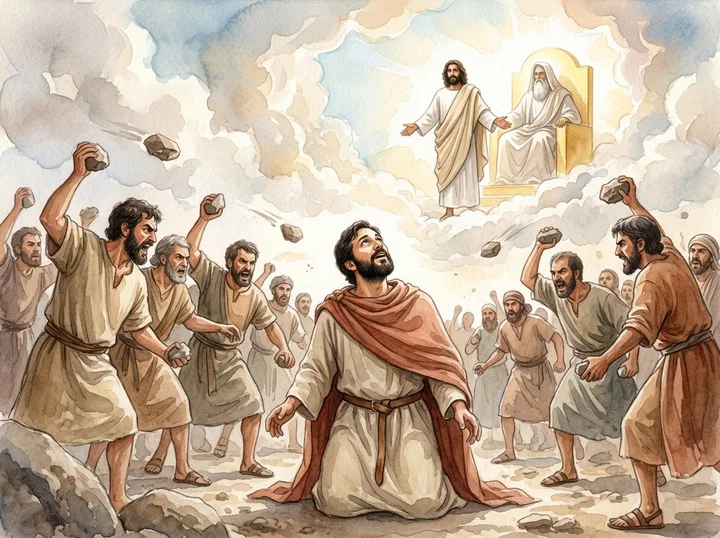
And he kneeled down, and cried with a loud voice, Lord, lay not this sin to their charge. And when he had said this, he fell asleep.
Translations
American King James Version, King James Version, KJV Cambridge Paragraph Bible, Revised Version, American Standard Version
And he kneeled down, and cried with a loud voice, Lord, lay not this sin to their charge. And when he had said this, he fell asleep.
And he kneeled down and cried with a loud voice, Lord, lay not this sin to their charge. And when he had said this, he fell asleep.
and having bowed the knees, he cried with a loud voice, 'Lord, mayest thou not lay to them this sin;' and this having said, he fell asleep.
And kneeling down, he cried with a loud voice, Lord, lay not this sin to their charge. And having said this, he fell asleep.
And, kneeling down, he cried out with a loud voice—Lord! do not charge against them, this sin. And, having said this, he fell asleep.
Berean Standard Bible, Majority Standard Bible
Falling on his knees, he cried out in a loud voice, “ Lord, do not hold this sin against them.” And when he had said this, he fell asleep.
He kneeled down and cried with a loud voice, “ Lord, don’ t hold this sin against them!” When he had said this, he fell asleep.
And going down on his knees, he said in a loud voice, Lord, do not make them responsible for this sin. And when he had said this, he went to his rest.
And he kneeled downe, and cried with a loude voyce, Lord, laye not this sinne to their charge. And when he had thus spoken, he slept.
Douay-Rheims (Challoner revision)
And falling on his knees, he cried with a loud voice, saying: Lord, lay not this sin to their charge. And when he had said this, he fell asleep in the Lord. And Saul was consenting to his death.
Pictures
Cross-references 20 of 78
- Luke 23:34
Then said Jesus, Father, forgive them; for they know not what they do. And they parted his raiment, and cast lots.
Jesus prayed for forgiveness for those killing him, as Stephen does.
- Acts 8:1-4
And Saul was consenting unto his death. And at that time there was a great persecution against the church which was at Jerusalem; and they were all scattered abroad throughout the regions of Judæa and Samaria, except the apostles.
Stephen’s death is followed by persecution that scatters believers who preach the gospel.
- Acts 9:4
And he fell to the earth, and heard a voice saying unto him, Saul, Saul, why persecutest thou me?
Christ confronts Saul over persecuting his followers after Stephen’s death.
- 1 Thessalonians 4:13-16
But I would not have you to be ignorant, brethren, concerning them which are asleep, that ye sorrow not, even as others which have no hope.
Both describe the dead as asleep and connect their hope with resurrection at Christ’s coming.
- Acts 22:20
And when the blood of thy martyr Stephen was shed, I also was standing by, and consenting unto his death, and kept the raiment of them that slew him.
Paul recalls standing by and consenting to Stephen’s death.
- Acts 7:56
And said, Behold, I see the heavens opened, and the Son of man standing on the right hand of God.
Stephen sees the exalted Christ in heaven shortly before his death.
- Acts 6:15
And all that sat in the council, looking stedfastly on him, saw his face as it had been the face of an angel.
Stephen’s face appeared angelic before his accusers.
- Matthew 5:44
But I say unto you, Love your enemies, bless them that curse you, do good to them that hate you, and pray for them which despitefully use you, and persecute you;
Stephen exemplifies Jesus’ command to pray for persecutors.
- John 11:11
These things said he: and after that he saith unto them, Our friend Lazarus sleepeth; but I go, that I may awake him out of sleep.
Both describe death as sleep.
- Acts 13:36
For David, after he had served his own generation by the will of God, fell on sleep, and was laid unto his fathers, and saw corruption:
Both describe death as falling asleep.
- 1 Corinthians 15:51
Behold, I shew you a mystery; We shall not all sleep, but we shall all be changed,
Both describe death as sleep before the dead are raised and changed.
- Acts 8:4
Therefore they that were scattered abroad went every where preaching the word.
Persecution after Stephen’s death scattered believers, who preached the word wherever they went.
- Job 14:12
So man lieth down, and riseth not: till the heavens be no more, they shall not awake, nor be raised out of their sleep.
Both describe death as sleep until awakening.
- Daniel 12:2
And many of them that sleep in the dust of the earth shall awake, some to everlasting life, and some to shame and everlasting contempt.
Both describe the dead as sleeping until they awake.
- 1 Corinthians 15:18
Then they also which are fallen asleep in Christ are perished.
Stephen’s death is described as falling asleep, as are the dead in Christ.
- Luke 22:41
And he was withdrawn from them about a stone’s cast, and kneeled down, and prayed,
Both show kneeling while praying.
- 1 Corinthians 15:20
But now is Christ risen from the dead, and become the firstfruits of them that slept.
Both describe the dead as asleep, linking their hope to Christ’s resurrection.
- Matthew 27:24-25
When Pilate saw that he could prevail nothing, but that rather a tumult was made, he took water, and washed his hands before the multitude, saying, I am innocent of the blood of this just person: see ye to it.
Both show a mob demanding the death of an innocent person.
- Luke 23:46
And when Jesus had cried with a loud voice, he said, Father, into thy hands I commend my spirit: and having said thus, he gave up the ghost.
Both commit their spirit to God at death.
- Acts 11:19
Now they which were scattered abroad upon the persecution that arose about Stephen travelled as far as Phenice, and Cyprus, and Antioch, preaching the word to none but unto the Jews only.
Persecution over Stephen’s death scattered believers and spread the Gospel.
Commentary
Each commentary is drawn from primary sources: the writings of Ellen G. White and Adventist pioneers and periodicals. Each commentary is separate. Its own words are not a quotation; follow the references to read the source passages.
Ellen G. White
82 sources
Stephen kneeled while being stoned to death outside the city by priests, rulers and people who rushed on him and silenced his testimony with stones, and cried aloud asking the Lord not to charge his murderers with the sin of killing him, after which he died.ST Dec 5, 18787RED 35.1RH Feb 23, 1911SLP 19.1AA 101.1 In the agony of a cruel death he showed mercy, compassion and forgiveness toward his persecutors rather than seeking their condemnation, following the example of his divine Master who prayed for His murderers.ST Dec 5, 18787RED 35.13SP 298.2–3 His death is described as falling asleep, presenting death as sleep.ST Dec 5, 18787RED 35.1RH Feb 23, 1911 His Christlike forbearance and glorified face became a sharp arrow of conviction to Saul who consented to his death, pressing upon him through nights of struggle until on the road to Damascus he saw his error, so that the martyrdom that seemed a triumph for Satan resulted in Saul's conversion to preach Jesus and more than fill Stephen's place.3SP 299.2ST Dec 5, 1878SLP 24.1–23SP 309.1–2 His stoning in A.D. 34 at the close of the seventy weeks, with the persecution that followed, marked the Jewish nation's final rejection of the gospel, after which salvation went to the wider world as scattered disciples preached the word elsewhere.GC88 328.1PK 699.1–2
Martyrdom Setting
The verse records Stephen being stoned to death outside the city by a furious mob of priests, rulers and people.SLP 19.1AA 101.1 Unable to answer his testimony about seeing God's glory and Christ standing ready to sustain him in martyrdom, they gnashed their teeth, stopped their ears, cried out loudly and rushed upon him with one accord.SLP 19.1AA 101.1 They dragged him from the judgment hall and from the sacred enclosure, cast him out, and silenced him with stones rather than answering him from Scripture.AA 101.1SLP 215.1–216.3 The same murderous intent to drag God's servant out and stone him to death was years later turned against Paul when a violent Jerusalem mob seized him in the temple, beat him, dragged him into the court of the Gentiles and shut the gates behind to keep blood from polluting the holy place.SLP 215.1–216.3
The execution was carried out without any legal sentence passed upon him, making the killing unjust.AA 101.17RED 36.1SLP 20.1 The Roman authorities were bribed with large sums of money to make no investigation of the case.7RED 36.1SLP 20.1RH Feb 23, 1911 As required, the witnesses who had accused him cast the first stones.SLP 19.13SP 299.1 Laying off their garments, they laid them at the feet of Saul, who kept the garments of those who stoned him.SLP 19.1SG1 98.1AC1 54.2SLP 218.1–219.2
Saul was present at the trial and death with frenzied zeal, having taken active part in the dispute, consenting to the death and approving it.SLP 19.1SG1 98.1SLP 20.1 At the time he was a rabbi and statesman and member of the Sanhedrin, educated by Gamaliel and the most learned teachers, and very zealous for suppressing Christianity.SLP 20.1 Angered by his own secret conviction that Stephen was honored of God at the very time he was dishonored by men, he stood by while Stephen's blood was shed.SLP 20.1AC1 54.2 As he died Stephen's face stayed calm without fear and shone with angelic light and heavenly glory, with the signet of God upon him.SLP 19.1ST Dec 5, 1878SLP 19.2
The earthly scene faded as heaven opened to him, and wrapped in God's glory he was honored by God while dishonored by men.SLP 19.1SG1 101.1RH Feb 23, 1911 He was a man loved by God who labored to win souls to Christ and lost his life because he bore triumphant testimony of the crucified and risen Saviour.Ms 11, 1900, par. 1–5 By the Holy Spirit he proclaimed from Scripture and the evidences of prophecy that Jesus crucified is the Son of God, and he sealed what he had witnessed with his blood as the first Christian martyr.Ms 11, 1900, par. 1–5SG1 101.1EW 173.3AC1 53.2 As he asked the Lord Jesus to receive his spirit his murderers mocked him by repeating his words.Ms 11, 1900, par. 1–5
The verse belongs to his final testimony delivered before a hostile audience as opposition grew.AA 100.13SP 297.2 He knew his voice would soon be silenced and abruptly ended his sermon.AA 100.1 The time, place and occasion give his words their full significance.3SP 297.2
Forgiving Prayer
Kneeling down while the stones were falling, Stephen cried with a loud voice asking the Lord not to hold or charge against his killers the sin of murdering him by stoning.ST Dec 5, 18787RED 35.1RH Feb 23, 19113SP 298.2–3Ms 11, 1900, par. 1–5 His kneeling prayer was offered aloud in the very act of being stoned to death.ST Dec 5, 1878RH Feb 23, 19113SP 298.2–3AC1 35.1–2SG1 88.2 The request was that the guilt of putting him to death in this way should not be counted against those who were doing it.7RED 35.1RH Feb 23, 19113SP 298.2–3AC1 35.1–27RED 35.2
In the agony of a cruel death he prayed thus for his persecutors and murderers, pleading for mercy upon them rather than calling for their condemnation.ST Dec 5, 18787RED 35.13SP 298.2–3AC1 35.1–2SG1 88.2 His prayer breathed mercy, divine compassion, forbearance and forgiveness toward the men who were taking his life.ST Dec 5, 18787RED 35.13SP 298.2–3AC1 35.1–27RED 35.2 In this he followed the example of his divine Master, who prayed for His murderers.ST Dec 5, 18787RED 35.13SP 298.2–3AC1 35.1–23SP 299.1 As Christ had interceded for those who slew Him, so Stephen interceded for those who stoned him.7RED 35.13SP 298.2–3AC1 35.1–23SP 299.17RED 35.2
The words of this cry stand as a prayer of forgiveness to be offered for people whose actions have caused suffering, asking God not to hold their sin against them.Lt 16g, 1892, par. 3
Death as Sleep
After praying aloud while kneeling that God would not hold or charge against those stoning him the sin of murdering him, Stephen died.ST Dec 5, 18787RED 35.1RH Feb 23, 19113SP 298.2–3AC1 35.1–2 In the agony of a cruel death he prayed for his persecutors and murderers with mercy, following the example of his divine Master who prayed for his murderers.ST Dec 5, 18787RED 35.1RH Feb 23, 19113SP 298.2–3AC1 35.1–2 His death is then described as falling asleep, presenting death as sleep.ST Dec 5, 18787RED 35.1RH Feb 23, 19113SP 298.2–3AC1 35.1–2 That falling asleep in death was a martyrdom marked by faith, constancy and glorification, with the signet of God upon his face.SLP 19.2 The same description of falling asleep applies also to a peaceful death, as when breathing grows shorter until one falls asleep, as in Nathaniel's peaceful death.LSEGW 147.3
Kneeling in Prayer
Stephen kneeled down as he prayed to the Lord at his death, crying with a loud voice for his murderers to be forgiven.21MR 59.1–60.1Ms 84b, 1897, par. 1–8RH Nov 30, 1905 His kneeling as he prayed shows that kneeling is a proper posture for prayer.21MR 59.1–60.1Ms 84b, 1897, par. 1–8RH Nov 30, 1905 It proves that kneeling is the proper position always when offering prayer to God, in both public and private worship.21MR 59.1–60.1Ms 84b, 1897, par. 1–8 Kneeling before God in prayer is illustrated by him as an expression of humility and reverence.21MR 59.1–60.1Ms 84b, 1897, par. 1–8RH Nov 30, 1905
The act of bowing the knees always, in both public and private worship, expresses dependence upon God.21MR 59.1–60.1Ms 84b, 1897, par. 1–8 It expresses reverence and dependence upon God.21MR 59.1–60.1Ms 84b, 1897, par. 1–8RH Nov 30, 1905 It expresses humility and reverence in prayer.21MR 59.1–60.1Ms 84b, 1897, par. 1–8RH Nov 30, 1905
Conviction of Saul
Stephen died in faith and constancy and glorification, with the signet of God upon his face and a glory that could not be effaced from memory.3SP 299.27RED 35.3RH Feb 23, 1911ST Dec 5, 1878AC1 35.3 His glorified face, his soul-piercing words, and his reasoning from Scripture that could not be controverted made a deep impression on all who witnessed his death except those hardened by resisting light.ST Dec 5, 1878AA 101.3 Those words and that glory remained in memory as testimony to the truth he had proclaimed.3SP 299.27RED 35.3RH Feb 23, 1911AC1 35.3AA 101.3
His Christlike forbearance and forgiveness toward his killers, with divine compassion in place of condemnation, and the light of Christ's glory reflected in his face like an angel's, became a sharp arrow of conviction to the Sanhedrists who witnessed it and especially to Saul.3SP 309.1–27RED 40.2–41.1AC1 40.2–41.1 Through that witness Christ spoke to Saul and pressed conviction upon him through nights of struggle.SLP 24.1–2 It showed that in persecuting the followers of Jesus Saul struck directly against the Lord of heaven, and in falsely accusing and testifying against them he accused and testified against the Saviour of the world, because Christ suffers in the person of His saints, and it helped convince him that Jesus was the Messiah.SLP 24.1–2
His triumphant death greatly stirred Saul's mind and shook his prejudice against Christianity.3SP 305.2SLP 21.17RED 37.2AC1 37.2ST Dec 12, 1878 Yet Saul's education and prejudice, his respect for the religious leaders, and his pride led him to resist conscience and reject Jesus as Messiah.SLP 24.1–2 The priests and rulers afterward convinced him that Stephen was a blasphemer and that Jesus was an impostor, turning him to bitter opposition and to voluntary, more bitter persecution of believers.3SP 305.2SLP 21.17RED 37.2
On the road to Damascus the memory of Stephen's death as a saint who had looked upon the kingdom of glory was brought forcibly to Saul's mind with clear but terrible light.SLP 23.1 In the flood of light that revealed Christ as come in fulfillment of His mission, rejected, abused, condemned and crucified by those He came to save, and as risen from the dead and ascended into heaven, Saul saw his ignorance and error.SLP 23.1 While thinking he zealously served God in persecuting the followers of Christ, with consent to Stephen's sacrifice and instrumental through cruel persecution in the death of many worthy saints, he had been doing the work of Satan.SLP 23.1
The martyrdom was a sore trial to the church, appearing to give Satan a triumph and to let wicked men triumph while the disciples grieved.ST Dec 5, 1878SG1 89.1SLP 19.2Lt 10, 1879, par. 4–9 But it resulted in the conversion of Saul, whom God later chose to preach Jesus and strengthen the disciples, more than filling Stephen's place.3SP 299.2ST Dec 5, 1878SG1 89.1SLP 19.2 Through Paul's preaching thousands heard the gospel.Lt 10, 1879, par. 4–9
Paul's Lifelong Memory
Paul had taken an active and cruel part in the martyrdom in which Stephen's blood was shed for vindicating that Jesus who was crucified is the Son of God, standing by consenting to his death, keeping the raiment of those who slew him, and helping those who killed him.AC1 54.13SP 322.2AC1 54.2 That involvement left a stain upon him and a fearful account against himself.AC1 54.13SP 322.1AC1 54.2 He later remembered it with bitterness, anguish, horror and shame as guilt for allowing himself to be controlled by the malice and prejudice of the priests and rulers.AC1 54.1AA 118.2–3 In doing so he had shut his eyes and ears against the evidence of heaven's radiance on Stephen's face and of a power higher than earthly strength sustaining him in faithfulness.AA 118.2–33SP 311.2
That guilt broke up his plans, changed his life, and pressed him to reflection, repentance and earnest prayer.AC1 54.13SP 322.2 He became deeply anxious to wipe out the stain and settle the account by boldly vindicating the same truth that had cost Stephen his life.AC1 54.13SP 322.17RED 54.13SP 322.2AC1 54.2 That truth was the cause Stephen had presented from the evidences of prophecy, that the crucified Jesus is the Son of God, which Paul afterward fearlessly proclaimed in that same synagogue where his own voice had earnestly disputed with Stephen, relating his own wonderful experience and presenting the same prophetic evidences with a heart yearning for his brethren and former associates.ST Dec 19, 1878AC1 53.2AC1 54.1 He was unwilling to leave Jerusalem, seeing flight as cowardice, and was willing to yield up his own life if his Jewish brethren might be brought to the truth, hoping that risking his life to persuade them would make amends for his part in standing by and consenting to Stephen's death.ST Dec 19, 1878AC1 54.17RED 54.1
Stephen's kneeling prayer not to hold the sin of his killers against them, and his death and martyrdom by stoning, came vividly to Paul's mind when he himself was violently stoned at Lystra, bruised, battered, fainting and feeling his end had come.AA 183.1–3SLP 60.2–33SP 366.1–2 The memory of his own cruel part and of seeking Stephen's condemnation also came vividly to him when he stood before the council that had condemned Stephen.SLP 221.2–223.1 Years later the same murderous intent to drag God's servant from the sacred enclosure and stone him to death was turned against Paul, when a violent Jerusalem mob seized him in the temple, beat him and dragged him into the court of the Gentiles with the gates shut behind to keep blood from polluting the holy place, as Stephen had been stoned years before by a violent Jerusalem mob.SLP 215.1–216.3 The definite spot in Jerusalem where Stephen shed his blood as a witness for Christ could still be gazed upon afterward, and it recalled Paul's former life of bitter prejudice against the followers of Christ, bringing remorse over his part in that past and pity for his deluded countrymen still filled with the same blind wrath.SLP 206.2–207.1
Prophecy and Mission
Stephen's stoning occurred in A.D. 34 at the close of the seventy weeks.GC88 328.1PK 699.1–2 Together with the persecution that followed, it marked the Jewish nation's final rejection of the gospel.GC88 328.1PK 699.1–2 After that point the message of salvation went to the wider world, and the scattered disciples preached the word elsewhere.GC88 328.1PK 699.1–2
He was one of the Lord's messengers bearing to the Jewish nation after Christ's crucifixion the gospel invitation to the marriage in the power of the Holy Spirit.COL 308.2–3Ms 29, 1898, par. 14–15 That message offered salvation and pardon for rejecting the Lord of life and glory.COL 308.2–3Ms 29, 1898, par. 14–15 The nation turned upon the bearers of that message with scorn and exasperation, stoning Stephen, slaying James by the sword, and thrusting many men and women into prison.COL 308.2–3Ms 29, 1898, par. 14–15 This killing sealed the people's rejection of God's mercy and brought upon them the judgment foretold in the parable in the destruction of Jerusalem and the scattering of the nation.COL 308.2–3
Yet the pardon he offered remained open even to his killers.Ms 29, 1898, par. 14–15 Even those who stoned him, who taunted Christ on the cross, and who abused Him in the judgment hall would have been forgiven if they had repented as Saul did when Christ arrested him.Ms 29, 1898, par. 14–15
After the martyrdom a fierce persecution raged in Jerusalem that drove the apostles and disciples out of the city to preach Christ in the cities round about, confining their labors to Hebrew and Greek Jews.8RED 3.1 Stephen was one of the foremost and noble builders of the church of Christ who fell at his work by the hand of the enemy when he was stoned.AA 596.3–597.28RED 79.1–3 His death belongs with James slain by the sword, Paul beheaded, Peter crucified, and John exiled.8RED 79.1–3 Even so stone after stone was still added to the building, the church increased in the midst of terrible persecutions, and new workers on the wall took the place of the fallen.AA 596.3–597.2SLP 157.18RED 79.1–3
Example for Believers
Stephen was stoned because he would preach Christ and Him crucified, and he remained steadfast and faithful even to death.GW 18.14T 525.1RH Sep 12, 1912Lt 10, 1879, par. 4–9ST Feb 5, 1902 His steadfastness in the might of divine power is a witness to the world of the faithfulness of God's promises, of His abiding presence and sustaining grace.GW 18.1GW92 25.2–26.2 His endurance in martyrdom was striking evidence that he was sustained by a power higher than human strength, higher than earth.3SP 311.2ST Dec 12, 1878AC1 43.1–3 His death shows that those who stay closely connected with God may not prosper in the things of this life but may be sorely tried and afflicted for their faithfulness.4T 525.1ST Feb 5, 1902GW92 25.2–26.2 It proves that it is through much tribulation that believers enter the kingdom of God, and that through such trial God leads His children to perfect trust and to peace in Christ amid tribulation in the world.ST Feb 5, 1902
His enemies could take his bodily life, but they could not take away his hope or eternal life.Ms 16, 1895, par. 18 Though the world cannot discern his moral value with God, his calm repose in God in the darkest hour shows faith looking beyond time and sense to eternal riches.GW92 25.2–26.2 He has the promise of an inheritance of greater value than any earthly riches, an inheritance that will satisfy the longings of the soul.GW92 25.2–26.2 Though unknown and unacknowledged by the world, he is enrolled as a citizen in the record books of heaven, and an exalted greatness, an enduring eternal weight of glory, will be his final reward as one whom God has made an heir of all things.GW92 25.2–26.2
He was the first Christian martyr, put to death by stoning because his opponents hated Christ and could not overcome his arguments from Scripture.Ms 17, 1885, par. 12–13 He was the first to win the martyr's crown in the kingdom of glory.Lt 45, 1896, par. 3–4 His death shows the cost of standing firm for the truth, a test that Christian workers may also face, even to the point of giving their lives.Ms 17, 1885, par. 12–13 His dying testimony so affected and overawed the priests and rulers that they recognized their treatment of him had harmed their cause among the people.3SP 300.27RED 36.2AC1 36.2 For a time, they did not dare arrest the apostles.7RED 36.2AC1 36.2 His death identifies him as a Christian who died as a martyr for his faith, an example of the persecution Christians suffered for their faith and one among the Lord's messengers killed for bearing the gospel.7MR 362.1DA 629.1–630.1
Sources
Pioneers and periodicals
140 sources
Stephen kneeled down and cried with a loud voice in earnest prayer that the Lord would not lay the sin of his murder to his killers' charge, and when he had said this he fell asleep in death.ST Dec 5, 1878RH Feb 23, 1911ST Oct 25, 1910ST Aug 29, 1878RH Sep 19, 1854 In the agony of death under the stones he followed the example of Jesus on the cross, showing forgiveness rather than vengeance and love toward enemies by blessing persecutors and entrusting justice to God.ST Dec 5, 1878RH Jul 18, 1865RH Nov 2, 1869ST Nov 16, 1876ST Mar 11, 1897 Falling asleep means he died into an unconscious sleep in the grave without remembrance, thought, reward or suffering, where he rests in the dust until awakened in the resurrection when Jesus comes.ST Nov 18, 1886RH Sep 22, 1859ST Dec 8, 1914ST Aug 19, 1875ST Aug 29, 1878 His stoning in autumn A.D. 34, three and a half years after the crucifixion, closed the seventieth week of the 490 years cut off upon the Jews and ended the gospel's exclusive work for them as God's special people, turning the message to Samaria and the uttermost parts.STST Jun 26, 1907RH Oct 11, 1915STST Sep 2, 1913 His faith, glorified face, unanswerable reasoning and forgiving prayer made a deep impression that could not be effaced, bearing fruit long after in Saul who consented and kept the garments and became Paul the defender of the same truths.RH Feb 23, 1911ST Dec 5, 1878ST Mar 3, 1914ST Feb 4, 1897ST Jun 27, 1900
Words and Circumstances
As he was being stoned Stephen knelt down and cried out with a loud voice in earnest prayer that the Lord would not lay this sin to the charge of his killers, and when he had said this he fell asleep in death.ST Dec 5, 1878RH Feb 23, 1911ST Oct 25, 1910ST Feb 4, 1897ST Mar 11, 1897 The kneeling was the bodily posture of his praying aloud under the stones.ST Dec 5, 1878ST Feb 4, 1897RH Dec 21, 1905 His crying with a loud voice for his murderers was like Christ's prayer on the cross.ST Mar 11, 1897
Falling asleep means dying; after praying for his attackers Stephen died.ST Aug 29, 1878RH Sep 19, 1854ST Aug 23, 1899 The nearby account says he was buried, and what is recorded is not that he appeared with Christ in heaven.ST Aug 19, 1875ST Aug 29, 1878 It is the same sleep Jesus speaks of when He says Lazarus sleeps before stating plainly that Lazarus is dead.ST Aug 23, 1899 When he asked the Lord Jesus to receive his spirit he was committing his whole life to Him, with God to keep it until Christ appears.ST Aug 29, 1878RH Sep 19, 1854
Stephen was the first Christian martyr and the first deacon, one of the seven chosen to serve the church, yielding his life as a sacrifice for Christ.ST Aug 19, 1875RH Aug 27, 1901ST Mar 11, 1897RH Sep 18, 1856 He was a deacon who also preached the gospel when the Lord opened the way, so that service in the diaconate does not exclude preaching.CO 34.2 He was full of faith and of grace and power, doing great wonders and miracles and signs among the people that opposers with their wisdom could not withstand, and he took a bold stand for Christ faithful unto death.RH Aug 27, 1901ST Mar 11, 1897ST Feb 4, 1897 His is the Bible's one beautiful record of a martyr's death-bed scene, praying for his countrymen as he died that their sin not be held against them.RH Sep 18, 1856
His death followed his pointed sermon to Jews who had resisted much light and his dispute with the synagogues of the Libertines, Cyrenians, Alexandrians, Cilicians and Asians.RH Apr 7, 1868ST Feb 4, 1897 Full of grace and power he wrought great wonders and signs among the people with wisdom and the Spirit that his opposers could not withstand, so they suborned men, stirred up the people, elders and scribes, seized him, and set up false witnesses.ST Feb 4, 1897 He was seized and tried before the council and Sanhedrin on false charges of speaking blasphemous words against Moses, God, the holy place, the law, and the customs delivered by Moses, including that Jesus of Nazareth would destroy the place and change the customs.ST Feb 4, 1897 There his face was seen as the face of an angel and shone with heavenly glory, and he meekly declared the gospel and presented Christ to prejudiced Jewish hearers by beginning with their interest in the fathers, especially Abraham, Isaac, and Jacob.ST Jan 22, 1902ST Feb 4, 1897ST Aug 20, 1896 When he spoke truth that the priests and elders could not answer they dragged him from the judgment hall and silenced him with stones rather than answering him from Scripture, showing how prejudice shuts people off from truth and drives to intolerance and violence.ST Aug 20, 1896
He was cast out of the city and stoned to death outside it by enraged priests, rulers and mob who gnashed on him like beasts of prey, stopped their ears, cried out, and rushed on him with one accord.ST Mar 3, 1914ST Mar 11, 1897 He died without a legal sentence passed, the angry cry of a mob rather than the deliberate decision of a court, after the Roman authorities were bribed not to investigate.ST Mar 3, 1914ST Feb 19, 1902 The Jewish council had no authority to put anyone to death without sanction of the Roman governor, but emboldened by success in securing Christ's condemnation by intimidating the governor they now disregarded Roman authority altogether, like the lawless arrest and condemnation of Jesus.ST Aug 13, 1902ST Feb 19, 1902 The stoning was mob law, always unreasonable and unjust, controlled by passion and sentiment and never by law or justice, with revenge generally the object, so that if justice is done it is incidental and not objective.ST Nov 11, 1897 The witnesses laid down their garments at the feet of Saul, who stood by consenting to the death and keeping the clothing of those who killed him, and so shared guilt for the killing, though he threw no stones himself.ST Dec 5, 1878ST Feb 19, 1902RH Oct 22, 1872
He thus sealed his testimony to Christ with his blood at the beginning of persecution against Christians soon after Christ's resurrection, amid the persecution of the church in Jerusalem after which believers were scattered and carried the gospel elsewhere.ST Nov 5, 1896ST Jan 23, 1893ST Oct 24, 1900 His death illustrates the suffering believers faced for their faith when put to death by wicked Jews because he told them the truth, which raised their anger against him.RH Jan 15, 1861 Preaching with God's power can provoke rage as well as conversion, yet opposition from the rulers did not prevent the church from being established.RH Apr 7, 1868RH Mar 31, 1863
His testimony argued that Abraham's promise to inherit the world remained unfulfilled, so that Abraham and all who share that promise must be raised from the dead for it to be fulfilled.ST Jul 22, 1886 This argument is connected with the resurrection and Messiahship of Christ.ST Jul 22, 1886 His reference to Abraham in Acts 7 would be unintelligible without the record in Genesis.
His martyrdom was a special honor and a visible sign of divine approval of his character and work.ST Feb 14, 1884
Forgiving Prayer for Killers
Dying under the stones, Stephen prayed that the Lord would not hold the sin of his murder against his killers, and his last prayer breathed forgiveness rather than a call for vengeance.RH Jul 18, 1865ST May 1, 1901RH Jun 16, 1863ST Nov 16, 1876 He did not ask God to avenge him for his violent death, and his forgiving plea stands against the notion that martyrs pass at death into heaven and there plead for punishment upon their persecutors.RH Nov 2, 1869ST Nov 16, 1876 To treat the souls under the altar in Revelation who cry for vengeance as the same kind of conscious dead would require explaining how Stephen's forgiving disposition was turned into a plea for vengeance.ST Feb 26, 1902
In the agony of death he followed the example of Jesus on the cross, dying with the same forgiving spirit his Master showed toward those who took His life.ST Dec 5, 1878ST Nov 16, 1876ST Feb 19, 1902ST Feb 4, 1897 Kneeling at the place of execution after first committing his life to Jesus, he cried aloud while the murderous stones struck his body, offering fervent prayer for his tormentors that their sin might not be laid to their charge, testifying under torture that Christ's Spirit was in him.ST Dec 5, 1878ST Mar 11, 1897ST Feb 19, 1902 As the first Christian martyr, full of grace and power and doing great signs and wonders, he took a bold stand for Christ until the Jews gnashed on him with their teeth, cast him out of the city, and stoned him, yet his prayer for his murderers was like Christ's prayer on the cross.ST Mar 11, 1897ST Oct 10, 1895 That prayer expressed the same love Christ expressed toward those who took His life, and revealed the glory of God which is His character of justice and mercy.ST Oct 10, 1895 That glory shone in Stephen's face as the face of an angel, as God's character written in stone had shone in Moses' face when he came down from the mount, and as God's glory was veiled in Christ's human nature as Emmanuel, God with us, so that men could look upon it.ST Oct 10, 1895 His death in that spirit bore fruit in the conversion of Saul, who consented to his death yet afterward became a staunch defender of the same truths Stephen preached.ST Feb 4, 1897
The prayer expresses love even toward those killing him, fulfilling the law's requirement to love enemies.ST Feb 14, 1906 It teaches meeting injury with patience, compassion and love, blessing rather than cursing, praying for persecutors rather than seeking revenge, and entrusting justice to God rather than inflaming hostility.ST Mar 6, 1901ST Apr 7, 1898RH Feb 25, 1915 It is held up as the example Christians are to follow in forgiving enemies and interceding for the forgiveness of those who sin against them.ST Apr 7, 1898RH Feb 25, 1915
Filled with the Holy Ghost, which is the power and mind of Jehovah, his dying prayer was dictated by that Spirit out of pity for murderers whose minds were blinded by Satan.ST Feb 19, 1902 In ignorance they really believed they were doing God service in putting him to death, and God pitied them for that blindness, so Stephen being filled with God's Spirit felt the same pity and made this his last earthly request.ST Feb 19, 1902 The prayer meant that their murderous act, though done in the face of the Spirit's mighty protest, might not hinder them from receiving forgiveness if they repented, so desiring their salvation that he wished their sin might not be counted as unpardonable.ST Feb 19, 1902 The verse thus shows the mind of God toward his murderers, who professed to be God's children while lending themselves to the work of Satan, the sworn enemy of God and of all loyal to Him.ST Feb 19, 1902 It warns against repeating their sin, for the Jewish church used its power to visit corporal punishment on those counted heretics to suit the carnal feelings of its members, and the same power in the hands of the church now would bring the same results because unregenerate human nature is unchanged and many influential church members show no regenerate life.ST Feb 19, 1902 The church should not exchange what little of God's power it has for the power of civil law, for God's power converts hearts and alone suffices for the guidance and maintenance of the church, while civil power controlled by the church cannot convert men but only persecutes.ST Feb 19, 1902
His words become a pattern for praying that others be forgiven, saved, and enlightened by grace, expressing a love willing to suffer and even die for others.ST Dec 12, 1892ST Nov 28, 1878 His prayer for his orthodox murderers became an example and inspiration to Christ's followers, and his death helped spread the truths of the gospel.RH Nov 27, 1913 The plea is applied even to those who oppose Christ by teaching that His law is abolished, judging the law and speaking evil of it, dissolving obligation and teaching men to untie all the commandments at once by claiming believing is the only duty so that no one must obey any demand of the law.ST Jul 3, 1884RH Dec 3, 1861RH Jan 13, 1859 Intercession is still to be made for those who in this high-handed way withstand Christ to the face, asking forgiveness for them because they do not know what they do.ST Jul 3, 1884RH Dec 3, 1861RH Jan 13, 1859
Though a raging mob stoned him, he was undisturbed because his eyes were fixed on Jesus in heaven, with fear of death gone and heaven opened before him in the sight of God's glory and Christ standing ready to sustain him.RH Mar 19, 1914 As his persecutors attacked him God gave him a vision of the saints' reward and the glories awaiting overcomers, and after catching that glimpse of heaven's glories he prayed to the Saviour, encouraging believers to pray as they await Christ's appearing.RH Mar 19, 1914RH Dec 11, 1866 God's presence and protection do not always prevent suffering, but sustain faith and courage in its midst, and Stephen's calm witness under the stones illustrates that God can be a person's comfort even when the heart is sorrowful and outward danger remains.RH Oct 4, 1853 Faith and the Holy Spirit can thus sustain Christians through adverse circumstances, and relying on this sustaining power is both privilege and duty.
Kneeling and crying with a loud voice in earnest prayer in behalf of his persecutors, asking the Lord not to lay the sin of stoning him to their charge, he then fell asleep in death, fulfilling the command to pray for them which despitefully use and persecute.ST Feb 19, 1902 After seeing heaven's glory and Jesus at God's right hand, he gave his life for Christ, his appeal about his spirit expressing the offering of his life in Christ's cause and trust that God would keep it unto eternal life.RH Mar 10, 1868 He retained Christian liberty even while dying as a martyr, his freedom in Christ enduring persecution and death as he prayed for forgiveness for those responsible. Submitting to God while being stoned, praying for his attackers rather than seeking revenge, his death exemplifies the perfect submission expressed in Jesus' words, Not as I will, but as Thou wilt.ST Jan 15, 1885 As a Spirit-filled man, when rebuffed and ill-requited and buffeted and ill-treated, with those he had helped and blessed becoming his accusers and persecutors, he did not curse them but blessed them, praying for their forgiveness, and so kept on helping to the end, fulfilling helpfulness as the law of Christ.RH Mar 27, 1900
Death as Unconscious Sleep
Falling asleep describes dying, for death is sleep in the grave, an unconscious state without remembrance, praise, thought or power of mind until awakening in the resurrection.ST Nov 18, 1886RH Sep 22, 1859ST Dec 8, 1914ST Mar 21, 1906RH Nov 19, 1872 Stephen's death is called falling asleep after he had seen Christ and was stoned, like people in sound sleep who are unaware until they awake when all in the graves hear Christ's voice.RH Nov 19, 1872RH Jun 12, 1860
When Stephen died he did not go to heaven to Jesus whom he had seen standing on the right hand of God, nor enter conscious reward in heaven nor hell fire.RH Sep 22, 1859ST Aug 19, 1875RH Jun 12, 1860ST Jan 24, 1884 Fell asleep refers to Stephen himself, not merely his body, and he was then buried to rest in the dust until the dead live and come forth.ST Aug 29, 1878ST Jan 24, 1884ST Mar 27, 1879 Though he yielded his life as a sacrifice with the prayer, Lord Jesus, receive my spirit, what is recorded is not that he went to heaven but that he fell asleep.ST Aug 19, 1875ST Aug 29, 1878
Because the dead have no thoughts or awareness of time, the interval between death and waking will seem like no delay at all, a moment's sleep or wink of the eye.ST Jun 5, 1879RH Dec 22, 1868RH Jun 16, 1874ST Sep 22, 1881 Stephen died while his attention was fixed on heaven's glory, yet the time in death will seem to him like an instant, with no awareness that Christ had disappeared from view.RH Dec 22, 1868RH Jun 16, 1874ST Sep 22, 1881 His next conscious experience will be seeing Jesus come to rescue him from death and give him eternal life, so that waking to heaven will be as though he entered it immediately on the day he died.ST Jun 5, 1879RH Sep 22, 1910RH Jun 15, 1911
The original word carries the sense of being hushed or lulled to rest, and he was undisturbed though stoned because his eyes were fixed on Jesus. Calling a burial place a cemetery, or sleeping place, reflects this Christian view of death as sleep.ST Feb 5, 1885
Death is like sleep because the dead are unconscious and unaware of what happens around them, and the image also points to their future awakening in the resurrection.ST Sep 22, 1881 Calling death sleep makes the Christian hope clear, in contrast to the belief that the dead will never rise, for it is a temporary rest looking forward to waking when Jesus comes with the trump of God.RH Apr 19, 1864 The resurrection at Christ's coming removes death's terror and gloom, and the hope of rising rather than going to heaven at death sustained Stephen through his trial and martyrdom.ST Sep 22, 1881RH Apr 19, 1864
When Stephen asked the Lord Jesus to receive his spirit, he was committing his life and whole person to him who can restore it and give eternal life.RH Sep 19, 1854RH Oct 30, 1855RH Nov 18, 1858 The spirit returns to God when life leaves the body, while the person is asleep, which is the condition of all the dead when life has left them.ST Mar 18, 1903ST Mar 27, 1879 It was reserved until the Lord's appearing, and neither the prayer nor the vision of heaven shortly before death proves conscious existence apart from the body after death.ST Mar 27, 1879RH Oct 30, 1855RH Nov 18, 1858
Close of Prophetic Probation
Stephen's falling asleep marks his stoning in the autumn of A.D. 34, three and a half years after the crucifixion in the spring of A.D. 31.ST Jun 26, 1907ST Oct 25, 1905RH Nov 12, 1901 That date closes the seventieth week, the 490 years cut off upon Jerusalem and the Jews from 457 B.C.STRH Oct 11, 1915ST The last seven years confirm the covenant by three and a half years of Christ's ministry plus three and a half years of witness after the ascension, ending in the final part of Daniel's seventieth week.ST Jun 26, 1907RH Nov 12, 1901 His death completes the last week and ends the first great dispensational section of the 2300 days.RH Nov 12, 1901
The stoning was the Jews' second rejection of Christ after the crucifixion.STSTST Sep 2, 1913 It was the formal rejection of the risen Christ's invitation through witnesses by the same council that rejected the Messiah, when the Jewish council again rejected the appeal of the Holy Ghost.RH May 23, 1912ST Mar 2, 1882ST Dec 19, 1892 That appeal shone on Stephen's face, and his death marks the climax of rejection of Christ and persecution of His disciples.RH May 23, 1912RH May 7, 1872 The Sanhedrin's condemnation of him represented the people's formal and final rejection of the gospel.RH Jan 7, 1858RH Sep 20, 1870ST Dec 19, 1892
It ended the gospel's exclusive work for the Jews and their standing as God's special people and standard-bearers.STRH Oct 11, 1915RH Jan 7, 1858 As a people they rejected the gospel, though salvation remains for them as for all nations.STST Sep 20, 1910 The message passed beyond Jerusalem to Samaria, to the Ethiopian on the road to Gaza, and to the uttermost parts, and began to be preached to the Gentiles as it had not been before.RH Oct 11, 1915RH May 23, 1912ST Mar 18, 1889 Peter preached to Cornelius about seven years later.ST
The persecution that followed drove most Christian believers out of Jerusalem and scattered them to preach everywhere, carrying the truth as they went.ST Sep 20, 1910ST Oct 8, 1912RH May 23, 1912 That scattering opened the way for the Gentiles to hear the gospel and for the gospel to extend to all nations.ST Sep 20, 1910RH May 23, 1912ST Dec 19, 1892 Saul's conversion and commission as apostle to the Gentiles the next year began a new era, raising up Paul and breaking down the middle wall of partition between Jews and the world.ST Sep 2, 1913ST Mar 18, 1889RH Nov 12, 1901 The persecution surrounding Stephen's death also helped spread the gospel to many places and made a lasting impression on Paul.
The crucifixion with Stephen's martyrdom and James's martyrdom helped fill up Jerusalem's cup of iniquity and preceded its judgment.RH May 10, 1915ST Mar 13, 1893 After Stephen the Jews as a people were given over to unbelief and blindness of mind, distinguishing them from Christ's elect disciples.RH May 7, 1872ST Mar 13, 1893 That path led toward their destruction by Rome about forty years later, when Jerusalem and its temple were destroyed.RH May 7, 1872ST Mar 13, 1893 Because the 490 years end at Stephen's death, the whole 2300 years end in the autumn of 1844, leaving 1810 years after A.D. 34.RH Nov 12, 1901
Impression on Saul
Stephen's faith and constancy in death, with the signet of God upon him and heaven's light on his face like an angel's, made a deep impression on all who witnessed it.RH Feb 23, 1911ST Dec 5, 1878ST Mar 3, 1914 His clear reasoning from the Scriptures could not be controverted, and his soul-piercing words reached to the very soul of all who heard except those hardened by resisting the light.ST Dec 5, 1878 That glorified face, those words, and the truth he proclaimed testified to the truth and could not be effaced from memory, remaining to press conviction through nights of struggle and to help bring about Saul's conversion.RH Feb 23, 1911ST Dec 5, 1878ST Mar 3, 1914 The striking evidences of God's presence with him as he died deeply stirred Saul's mind and led him to doubt the rightness of opposing the followers of Jesus, though for a time the arguments of priests and rulers persuaded him that Stephen was a blasphemer, that the Christ he preached was an impostor, and that those in holy office must be right.ST Mar 10, 1914 His forgiving endurance was striking evidence that he was sustained by a power higher than earth, evidence of divine support.ST Dec 12, 1878
Saul of Tarsus took a prominent part in the trial, conviction and martyrdom, standing by and consenting to the death while others stoned Stephen and he cared for their garments at his feet.ST Dec 19, 1878ST Mar 10, 1914RH Aug 27, 1901 As a member of the council he tried to secure that condemnation, and the death was a sacrifice given by his consent.ST May 8, 1884 He then relentlessly led the persecution of believers in Christ, by whom many worthy saints were put to death.ST Dec 12, 1878 He later recalled his part with bitterness, horror, anguish and sadness, and on the road to Damascus the memory was brought forcibly to his mind, where in the flood of light that revealed his ignorance and error he saw that in thinking he zealously served God he had been doing the work of Satan.ST Dec 12, 1878 That broke up his plans and changed the current of his life, pressing him to reflection, repentance and earnest prayer through three days of soul agony without sight or food, and afterward he hoped that risking his own life to persuade his Jewish brethren would make amends for his guilt.ST Dec 19, 1878ST Dec 12, 1878
Saul heard Stephen's tender words of forgiveness and saw his love and gentle mercy for his killers, but they did not then move him, and he went on to persecute Christians.ST Jan 22, 1885ST Jan 22, 1885 Carried away by the malice and prejudice of the priests and rulers, he closed his eyes and ears against the evidence and persecuted with fierce rage and joy.ST Dec 12, 1878 Later he remembered that prayer with remorse and shame over his role and sought to vindicate the truth for which Stephen had been falsely accused and killed.RH Mar 30, 1911ST Jan 22, 1885 When he himself was stoned at Lystra, Stephen's martyrdom and the cruel part he had played came vividly to his mind.ST Jun 19, 1879ST May 7, 1885RH Aug 26, 1902 Remembering his own past as a persecutor and his present dependence on the grace of Christ helped him feel for those who persecuted and reviled him and gave him courage to keep laboring even for the most violent opposers.RH Aug 26, 1902
In persecuting the followers of Jesus Saul struck directly against the Lord of heaven, for Christ suffers in the person of His saints, and in falsely accusing and testifying against them he accused and testified against the Saviour of the world. By wrongly attributing Stephen's Spirit-work to the enemy he blasphemed the Holy Spirit, though he received mercy because he acted ignorantly in unbelief.ST Aug 19, 1913 Those who stoned Stephen acted conscientiously, yet their sincerity did not make the action right, showing that conscience can be mistaken and is not a safe standard for moral action.
Stephen's faithful witness ended in death by stoning with no immediate visible result, yet patient service for Christ can bear fruit long after it appears fruitless, for his work influenced Saul who later became his successor in preaching.ST Jun 27, 1900 Though his stoning was a dark day that took one ardent, brave, eloquent and the hope of the early church, God brought choicest fruit out of it to His own glory and the good of man, and the persecution that arose about him ravaged the disciples yet produced worldwide preaching of the gospel. The Saul who took part in the stoning was later made holy through Jesus' blood, becoming Paul the staunch defender of the same truths Stephen preached, with the same forgiving spirit Jesus showed on the cross.ST Feb 4, 1897RH Jul 6, 1868 Even a zealous opponent who heard the discourse was not beyond salvation, and martyr and persecutor, saved by the same love of Christ, will meet in the heavenly kingdom and worship together.ST May 25, 1915
Example for Believers
Stephen kneeled down to pray as he was being stoned, and his kneeling gives the proper bodily attitude for prayer, one in harmony with the humility of soul with which the humble suppliant should approach the great Creator.RH Nov 30, 1905RH Jan 11, 1912RH Dec 21, 1905 The kneeling posture expresses humbleness and reverence before God, in contrast to sitting upright in a stiff manner while prayer is offered.RH Nov 30, 1905RH Jun 10, 1915 Stephen's kneeling leaves an example to be followed by believers when they come together for worship, with adverse surroundings giving no excuse for a different posture, and those who so worship receive the Lord's presence with them.RH Jun 10, 1915 He was one of the first deacons of the Christian church and a martyr for Jesus, and his death is the first martyr witness among the seven chosen to serve the church.RH Jan 11, 1912
He kneeled down and cried with a loud voice while being stoned, praying for his slayers that the Lord would not lay this sin to their charge, and when he had said this he fell asleep in death, an example of being faithful unto death to receive a crown of life.ST Feb 4, 1897 He resisted unto blood striving against sin and suffered even to death without murmuring.RH Aug 17, 1905 Like the sinless Redeemer who walked the same thorny path and prayed for his murderers, Stephen forgave his murderers, endured contradiction of sinners against himself, and rejoiced in hope of a resurrection among the just.RH Aug 17, 1905 His death rebukes murmuring over light afflictions which are but for a moment and teaches keeping the eyes continually fixed upon the prize to forget the discomforts of the way.RH Aug 17, 1905 His stoning to death for his faithfulness was a real trial, far greater than being spoken ill of, basely slandered, or led into temptation and left mortified and ashamed.RH Mar 15, 1860 Christians should compare their own little trials with his stoning and with the nails driven through Jesus' hands and feet and the contempt Jesus endured in Herod's judgment hall, stop pitying self and complaining, say nothing about their afflictions, praise the goodness of God, count their afflictions light and not to be spoken of, and hold their hearts open for peace and love in view of the eternal weight of glory in store for the righteous.RH Mar 15, 1860
He was stoned for preaching Christ and Him crucified and remained steadfast in his witness to God, bearing witness to Christ and laying down his life during the Gospel's first preaching in Jerusalem.RH Sep 12, 1912ST May 19, 1914ST Jan 6, 1909 His death shows that gospel workers carry on their work amid storms of persecution, bitter opposition, and unjust reproach, and that God does not prevent the plottings of wicked men but causes their devices to work for good to those who in trial and conflict maintain faith and loyalty.RH Feb 8, 1912 The furnace of trial and affliction is used to bring His children near to Him, show them their weakness and His strength, teach them to lean on Him, and prepare them to meet emergencies, fill positions of trust, and accomplish the great purpose for which their powers were given.RH Feb 8, 1912 His death proves that followers of Christ will often be sorely tried and afflicted, that it is through much tribulation that we enter the kingdom of God, and that through such trial God leads His children to perfect trust and to peace in Christ amid tribulation in the world.ST Feb 5, 1902 His martyrdom bore fruit for the church, since persecution can drive the insincere from it and make the work of sincere believers a powerful instrument for good.ST Feb 4, 1897
His death was a powerful revelation of pure, unselfish Christian character, and though it appeared to his friends to be a terrible calamity, his martyrdom displayed the divine power of Christ's religion, encouraged believers, and pointed ahead to its final victory. His courage and faithfulness under persecution is evidence that the disciples were being led by a power beyond themselves.ST Jun 26, 1901 Enduring persecution through God-given power, he is a model for believers facing persecution for their faith.ST Sep 10, 1894 God's presence and protection do not always prevent suffering, but sustain faith and courage in its midst, and Stephen's calm witness under the stones illustrates that God can be a person's comfort even when the heart is sorrowful and the outward danger remains.RH Oct 4, 1853 The Spirit's presence was to lighten the faces of God's earthly messengers and give power to their message, as shown through Stephen.ST May 3, 1910 He is an example of a believer brought before people for Christ's sake: he preached Christ rather than defending himself or asking for favors, so the rulers could hear the truth.ST Oct 8, 1894 In such trials, believers are not to plan a self-defense but to trust Christ to give them words through the Spirit, and that trust must be learned beforehand by faithfully studying God's word.ST Oct 8, 1894
His dying as a martyr while praying for the people who stoned him, asking that their sin not be held against them, is an example of religious persecution carried out by those who used political power against people whose beliefs differed from their own.ST Jun 16, 1914 He meekly declared the gospel before the council and was stoned to death, showing how prejudice can shut people off from truth and drive them to intolerance and violence.ST Aug 20, 1896 His death took place after the resurrection of Christ when Satanic malice worked to crush the hope of the race, as the religion of ceremony warred against the religion of the soul through persecution in Palestine, and he paid with his life for exercising his Gospel-given freedom to worship God in accordance with his belief.ST Jul 6, 1904 He was put to death by the Jews on a false charge of blasphemy, and his execution was a lawless act, like the arrest and condemnation of Jesus.ST Aug 13, 1902 His death amid the mob's violence is part of the same hostile spirit that moved the crowd against Jesus and remains active in the world.RH Sep 7, 1911 He was put to death because people could not resist the wisdom and spirit with which he spoke, and his martyrdom is a parallel to the future killing of those who refuse to observe Sunday.ST Nov 2, 1915
His sermon in Acts 7 was preached after the resurrection of Christ when he would have known if the Sabbath had been changed to the first day, yet he says nothing about any such change even while delivering a message that greatly angered the Jews who were ready to accuse the apostles of breaking the law.RH Apr 3, 1879 The Jews in rejecting Stephen and the testimony of God's Spirit chose spiritual darkness rather than light.ST Feb 21, 1906 The stoning of Stephen was the result of rejecting clear evidence of the power of the Holy Spirit in Gospel preaching.ST Jan 13, 1898 The same preaching that pricks some hearts to repentance hardens others to mock, contradict, blaspheme, persecute, and kill.ST Jan 13, 1898 Those who reject the mercy and love of God do not remain unchanged but increase in wickedness until they fill up the cup of their iniquity and destruction follows, while believers grow in grace.ST Jan 13, 1898 One persecuted for righteousness' sake receives blessing, but the blessing rests on the one who is persecuted, not on those who persecute. No blessing is given to a persecutor, no matter how sincere the motive, even when he thinks he is doing duty and honoring God, and the persecutor becomes only the indirect instrument of the blessing that comes to the one he persecutes.
His death is the first martyrdom mentioned after Christ's ascension, and Christ's appearing at his death does not make each saint's death another coming.RH Nov 17, 1863 He was a member of Christ's church and therefore part of the we for the whole church, including Christians who would be alive when Christ returns.ST Dec 12, 1892 He was stoned in consequence of his confession of Jesus as the One who had been crucified, and his death was a persecution of Christ himself, because Christ identifies himself with his followers and counts persecution of another for worshiping God according to conscience as persecution of himself.ST Feb 25, 1897 In persecuting the followers of Jesus, Saul struck directly against the Lord of heaven, and in falsely accusing and testifying against them he accused and testified against the Saviour of the world, because Christ suffers in the person of his saints. He paid with his life for exercising the gospel-given freedom to worship according to his belief.ST Jul 6, 1904RH Oct 31, 1912 His death marks the end of his life after he was stoned, an example of a leading builder of the church falling at the hands of its enemies while the church's work continued.ST Jun 2, 1914
Sources