Matthew 27:24
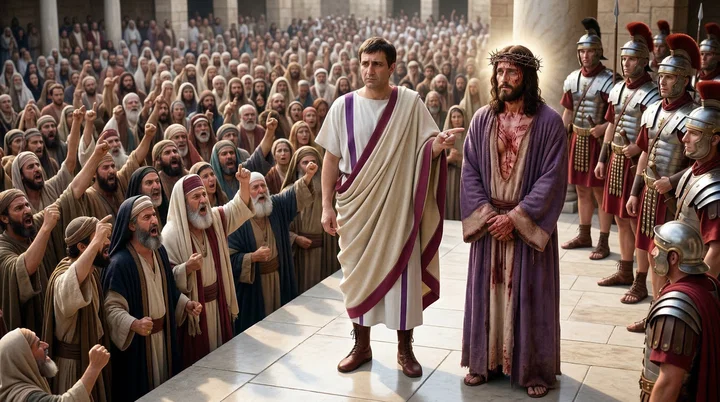
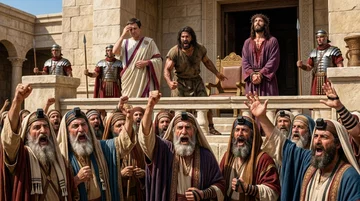
When Pilate saw that he could prevail nothing, but that rather a tumult was made, he took water, and washed his hands before the multitude, saying, I am innocent of the blood of this just person: see ye to it.
Translations
When Pilate saw that he could prevail nothing, but that rather a tumult was made, he took water, and washed his hands before the multitude, saying, I am innocent of the blood of this just person: see you to it.
King James Version, KJV Cambridge Paragraph Bible
When Pilate saw that he could prevail nothing, but that rather a tumult was made, he took water, and washed his hands before the multitude, saying, I am innocent of the blood of this just person: see ye to it.
When Pilate saw that he could not prevail at all, but that rather a tumult was made, he took water, and washed his hands before the multitude, saying, I am innocent of the blood of this just person: see ye to it.
So when Pilate saw that he prevailed nothing, but rather that a tumult was arising, he took water, and washed his hands before the multitude, saying, I am innocent of the blood of this righteous man: see ye to it.
So when Pilate saw that he prevailed nothing, but rather that a tumult was arising, he took water, and washed his hands before the multitude, saying, I am innocent of the blood of this righteous man; see ye to it.
And Pilate having seen that it profiteth nothing, but rather a tumult is made, having taken water, he did wash the hands before the multitude, saying, 'I am innocent from the blood of this righteous one; ye — ye shall see;'
And Pilate, seeing that it availed nothing, but that rather a tumult was arising, having taken water, washed his hands before the crowd, saying, I am guiltless of the blood of this righteous one: see ye [ to it].
And Pilate, seeing, that, nothing, it availed, but rather, a tumult, was arising, taking water, washed his hands of it before the multitude, saying—Innocent, am I, of the blood of this man,—Ye, shall see to it for yourselves.
When Pilate saw that he was accomplishing nothing, but that instead a riot was breaking out, he took water and washed his hands before the crowd. “ I am innocent of this man’s blood,” he said. “ You bear the responsibility.”
When Pilate saw that he was accomplishing nothing, but that instead a riot was breaking out, he took water and washed his hands before the crowd. “ I am innocent of this righteous man’s blood,” he said. “ You bear the responsibility.”
So when Pilate saw that nothing was being gained, but rather that a disturbance was starting, he took water and washed his hands before the multitude, saying, “ I am innocent of the blood of this righteous person. You see to it.”
So when Pilate saw that he was able to do nothing, but that trouble was working up, he took water and, washing his hands before the people, said, The blood of this upright man is not on my hands: you are responsible.
When Pilate saw that he auailed nothing, but that more tumult was made, he tooke water and washed his hands before the multitude, saying, I am innocent of the blood of this iust man: looke you to it.
Douay-Rheims (Challoner revision)
And Pilate seeing that he prevailed nothing, but that rather a tumult was made; taking water washed his hands before the people, saying: I am innocent of the blood of this just man; look you to it.
Pictures
Cross-references 20 of 50
- Luke 23:18-25
And they cried out all at once, saying, Away with this man, and release unto us Barabbas:
The crowd chooses Barabbas and demands Jesus’ crucifixion despite Pilate declaring him innocent.
- John 19:12-16
And from thenceforth Pilate sought to release him: but the Jews cried out, saying, If thou let this man go, thou art not Cæsar’s friend: whosoever maketh himself a king speaketh against Cæsar.
Pilate yields to pressure and delivers Jesus to be crucified to protect his position.
- Mark 15:6-15
Now at that feast he released unto them one prisoner, whomsoever they desired.
Pilate yields to the crowd, releases Barabbas, and delivers Jesus to be crucified.
- Matthew 27:19
When he was set down on the judgment seat, his wife sent unto him, saying, Have thou nothing to do with that just man: for I have suffered many things this day in a dream because of him.
Pilate’s wife warns him not to harm Jesus, whom she calls just.
- Luke 23:4
Then said Pilate to the chief priests and to the people, I find no fault in this man.
Pilate declares Jesus innocent, finding no fault in him.
- John 18:39-40
But ye have a custom, that I should release unto you one at the passover: will ye therefore that I release unto you the King of the Jews?
The crowd chooses Barabbas instead of Jesus, whom Pilate found without fault.
- John 19:4
Pilate therefore went forth again, and saith unto them, Behold, I bring him forth to you, that ye may know that I find no fault in him.
Pilate declares Jesus innocent while facing the demand to crucify him.
- Luke 23:15
No, nor yet Herod: for I sent you to him; and, lo, nothing worthy of death is done unto him.
Pilate and Herod find no grounds for a death sentence.
- John 19:10
Then saith Pilate unto him, Speakest thou not unto me? knowest thou not that I have power to crucify thee, and have power to release thee?
Pilate claims authority to release or crucify Jesus, making himself responsible.
- Luke 23:18
And they cried out all at once, saying, Away with this man, and release unto us Barabbas:
The crowd demands Barabbas’s release instead of Jesus.
- Acts 2:23
Him, being delivered by the determinate counsel and foreknowledge of God, ye have taken, and by wicked hands have crucified and slain:
Jesus’ death fulfilled God’s purpose, yet those who crucified him remained culpable.
- Luke 23:8-11
And when Herod saw Jesus, he was exceeding glad: for he was desirous to see him of a long season, because he had heard many things of him; and he hoped to have seen some miracle done by him.
Herod questions and mocks Jesus, then sends him back to Pilate.
- Acts 3:14-15
But ye denied the Holy One and the Just, and desired a murderer to be granted unto you;
The people rejected and killed Jesus, choosing a murderer instead.
- Luke 23:24
And Pilate gave sentence that it should be as they required.
Pilate gives in to the crowd and sentences Jesus.
- John 18:38
Pilate saith unto him, What is truth? And when he had said this, he went out again unto the Jews, and saith unto them, I find in him no fault at all.
Pilate declares that he finds no fault in Jesus.
- Matthew 27:17
Therefore when they were gathered together, Pilate said unto them, Whom will ye that I release unto you? Barabbas, or Jesus which is called Christ?
The crowd chooses Barabbas over Jesus for release.
- John 19:1
Then Pilate therefore took Jesus, and scourged him.
Pilate orders Jesus to be scourged before washing his hands.
- Isaiah 53:7
He was oppressed, and he was afflicted, yet he opened not his mouth: he is brought as a lamb to the slaughter, and as a sheep before her shearers is dumb, so he openeth not his mouth.
sacrificial Lamb becomes wrathful Judge
- Luke 23:16
I will therefore chastise him, and release him.
Pilate offers to chastise Jesus and release him.
- Matthew 27:37
And set up over his head his accusation written, THIS IS JESUS THE KING OF THE JEWS.
The inscription identified Jesus as king of the Jews at his execution.
Commentary
Each commentary is drawn from primary sources: the writings of Ellen G. White and Adventist pioneers and periodicals. Each commentary is separate. Its own words are not a quotation; follow the references to read the source passages.
Ellen G. White
56 sources
Pilate washed his hands before the crowd in a public show of clearing himself, declaring he was free from blame for the death of the righteous one and leaving the decision to them.3SP 146.2–35RED 66.2RH Jan 23, 1900 He did this when he saw he could do nothing to free Jesus and a riot was breaking instead, so he gave way to the demand to crucify Him and released Barabbas.5RED 66.2Ms 29, 1909, par. 12–17Ms 136, 1899, par. 30–33 His display did not free him, for he knew Jesus was innocent and had been handed over from envy, yet to save his position and honor he condemned a just man he had authority to protect.3SP 146.2–3ST Jun 3, 1889Ms 40, 1897, par. 7–10RH Jan 23, 1900ST Jul 11, 1878 The people took the blame upon themselves and their children, but their answer did not remove his guilt as the judge who handed Jesus to scourging and death.5RED 66.2Ms 23, 1900, par. 7–9ST Feb 5, 1880
Trial Context and Sequence
Matthew 27:24 belongs to the judgment of Jesus before Pilate, after the Sanhedrin had condemned Him and brought Him to the Roman governor to have the sentence confirmed and carried out.DA 723.1–724.1 Before washing his hands Pilate had made repeated efforts to avoid condemning Him, for Herod had refused to ratify the condemnation, Pilate himself had stated that the charges were unsubstantiated and that no crime could be proved against Him, his wife had warned him not to harm the just man, and he had proposed to chastise Jesus and release Him.ST Jun 3, 18895RED 62.3 In terrible conflict over his conviction that Jesus was innocent and possessed power not of a common man but of God, and that the priests had brought Him from envy to a maddened power Pilate dared not openly oppose, he tried to save Him by the pagan invention without justice of setting at liberty one prisoner condemned to death at the great national festival.Ms 112, 1897, par. 33–34
He set the true and innocent Christ side by side with the notable Barabbas, flattering himself that the contrast between innocence and guilt would be so convincing that the people would choose Jesus of Nazareth.Ms 112, 1897, par. 33–34 Barabbas was a notorious character who pretended to be Christ and did great wickedness through satanic agencies, claiming under satanic delusion that whatever he could get by theft and robbery and murder was his own, and claiming religious power and a right to establish a different order of things and to set the world right.Ms 112, 1897, par. 33–34 The priests and rulers urged the crowd to choose Barabbas and to call for Jesus to be crucified, despite the warning that Jesus was just.Ms 136, 1899, par. 30–33Ms 22, 1900, par. 17–20ST Aug 8, 1878
Pilate saw that he could prevail nothing to release Jesus, but that rather a tumult was being made that he could not quiet, stop, or overcome, and he yielded to the crowd's demand.5RED 66.2Ms 29, 1909, par. 12–17Ms 136, 1899, par. 30–33ST Nov 2, 1882DA 735.1–5 He recognized that the uproar was defeating his efforts even though he had found no fault in Him.ST Jul 11, 1878 Yielding to the tumult, he released Barabbas and, after having Jesus scourged, handed Jesus over to be crucified.Ms 136, 1899, par. 30–33 The multitude thus took upon themselves responsibility for the death of Jesus as a criminal when at the urging of the priests and rulers they demanded His crucifixion, echoing Caiaphas and accepting His blood upon themselves and their children.5RED 66.2Ms 22, 1900, par. 17–20ST Aug 8, 1878
Handwashing Declaration Explained
When he saw he could prevail nothing but that a tumult was being made, Pilate took water and in an imposing manner washed his hands before the multitude.5RED 66.2RH Jan 23, 1900Ms 129, 1897, par. 10 In that public act he declared himself innocent of the blood of this just person and left the people to see to it and answer for the decision.3SP 146.2–35RED 66.2Ms 23, 1900, par. 7–9 The priests joined the mob in accepting that responsibility for Jesus' blood, echoing Caiaphas and calling it upon themselves and their children.5RED 66.2Ms 23, 1900, par. 7–9
In the declaration Pilate called Jesus just, innocent, faultless and righteous.3SP 146.2–3ST Jul 11, 1878AA 42.3 His words and his appeal reveal his settled conviction that Jesus was innocent and his fear about the judgment of God.3SP 146.2–35RED 66.3 He himself declared what his own reason told him, that no fault could be found in Him and that He had been delivered up from envy.RH Jan 23, 1900ST Nov 25, 1889
The washing of the hands was a declaration disavowing responsibility.Ms 29, 1909, par. 12–17Ms 129, 1897, par. 10TBC1882 29.1 It showed his unwillingness to let responsibility for the act rest on his own shoulders.Ms 129, 1897, par. 10 It was an attempt to avoid the appearance of guilt when he saw he could not stop the tumult, though his official duty was to uphold justice.Ms 29, 1909, par. 12–17
Pilate's Inescapable Guilt
Pilate's washing of his hands before the multitude and his public declaration that he was innocent of the blood of this just person did not make him guiltless, clear him, or undo his decision.3SP 146.2–3ST Jun 3, 1889Ms 40, 1897, par. 7–10RH Jan 23, 1900ST Nov 2, 1882 The washing was an empty farce that could not wash terrible guilt from his convicted conscience for this cowardly deed, for a public disclaimer cannot erase responsibility for choosing wrongly under pressure after compromising what conscience and duty require.RH Jan 23, 1900ST Jul 11, 1878ST Nov 2, 1882 He yielded to the mob rather than act on his conviction that Jesus was innocent, choosing to protect his position at the cost of an innocent life.3SP 146.2–3ST Jul 11, 1878ST Nov 2, 1882
He knew Jesus was innocent and just, knew He had been delivered up from envy, had received warning from the Lord, and his own reason told him Jesus was innocent, which he himself declared.Ms 40, 1897, par. 7–10RH Jan 23, 1900 Herod had refused to ratify the condemnation, Pilate himself had stated the charges were unsubstantiated, and his wife had warned him not to harm the just man, yet he failed to act on that knowledge when pressured by the crowd and its leaders.ST Jun 3, 1889 Jesus was completely innocent and Pilate found no fault in Him, publicly washing his hands to disclaim responsibility while the multitude demanded crucifixion.ST Nov 25, 1889
Through fear of losing his power, authority and life, and for selfish interest and love of honor from the great men of earth, Pilate consented to the death of an innocent man he knew to be just.3SP 146.2–3ST Jun 3, 1889ST Jul 11, 1878COS 152.8–153.1SG1 56.1 He chose to sacrifice an innocent life rather than risk his position and honor, choosing to protect his position and honor rather than act firmly on what he knew was right.3SP 146.2–3ST Jun 3, 1889ST Jul 11, 1878COS 152.8–153.1 His words did not match his action, for though convinced of Jesus' innocence he yielded to the mob to protect himself.ST Nov 2, 1882
Satan and his angels tempted Pilate toward his own ruin by suggesting that others would condemn Jesus if he did not, that the multitude was thirsting for His blood, and that if he did not deliver Jesus to be crucified he would lose his power and worldly honor and be denounced as a believer in an impostor.SG1 56.1 If Pilate had followed his conviction he would have had nothing to do with condemning Jesus.SG1 56.1
As one chosen and appointed to administer justice whose official duty was to uphold justice, and who claimed authority to release or crucify, Pilate made himself responsible for the unjust sentence, for handing Jesus over to a cruel death, and for the cruel scourging and insults offered before any wrong was proved.Ms 40, 1897, par. 7–10RH Jan 23, 1900Ms 29, 1909, par. 12–17ST Jul 11, 1878 His act was an attempt to avoid the appearance of guilt, but he failed in his official duty to uphold justice.Ms 29, 1909, par. 12–17 He had authority to uphold justice but yielded to the mob and allowed an innocent man to be condemned.ST Jul 11, 1878
Had Pilate exercised his power and position to protect Christ and had nothing to do with condemning Him, he would not have been accountable for His death, though Christ would still have been crucified.Ms 40, 1897, par. 7–10RH Jan 23, 1900 His wavering, indecision and refusal to act on conscience allowed the mob to overrule him and dictate his decision.COS 152.8–153.1ST Nov 2, 18823SP 147.1 He chose self-interest over conscience and duty and sacrificed a just man rather than risk personal loss, showing how compromising with evil to avoid consequences brings guilt, darkness, sorrow and ruin.ST Nov 2, 1882DA 737.2–738.53SP 147.1
Pronouncing Jesus innocent and then delivering Him to His murderers to the most ignominious and cruel death left guilt that ever oppresses the soul and darkened his after-history.RH Jan 23, 1900 The power he tried to preserve was later taken from him, and in remorse, despair, anguish and wounded pride over the full gravity of his guilt he lost his office and ended his life.RH Jan 23, 1900COS 152.8–153.1DA 737.2–738.5SG1 70.2 After Jesus' resurrection and the testimony that He was the Son of God, Pilate was convinced of the full gravity of his guilt and lived in despair and anguish.SG1 70.2 Those who compromise with sin gain sorrow and ruin.DA 737.2–738.5
The crowd's acceptance of responsibility for Jesus' blood did not clear Pilate, for he was guilty of Jesus' blood because, fearing loss of power and honor, he consented to the death of an innocent man despite his own convictions.DA 735.1–5EW 142.3 The guilt of those who delivered Jesus to him was greater because they had received greater light, though he knowingly surrendered an innocent man to the mob.DA 735.1–5 God's overruling of the outcome to make Christ the Redeemer and Saviour of the world did not lessen the heinousness of the crime.ST Feb 5, 1880
Crowd's Choice and Consequences
When Pilate washed his hands and left the decision to them, the multitude took the guilt upon themselves and their children, echoing Caiaphas and joined by the priests in accepting responsibility for the blood of the just and faultless One whom Pilate had declared righteous.5RED 66.2Ms 23, 1900, par. 7–9AA 42.3COL 293.1–3ST Nov 25, 1889 In doing so they made their choice against Him, demanding His death and His crucifixion, and that recorded decision will confront them when the judgment book is opened.Ms 23, 1900, par. 7–9AA 42.3Ms 22, 1900, par. 17–20 Having chosen Barabbas once for all and demanded Christ's crucifixion, the priests and rulers afterward resisted the evidence that Jesus was the Messiah and sought to hide the guilt of their cruel act.Ms 22, 1900, par. 17–2012MR 411.3–4 Even while imposing religious rites they covered selfish, fraudulent, discontented and unholy hearts, contradicting their grand ceremonies by life and character.12MR 411.3–4
Their invocation of His blood upon themselves and their children indeed brought that blood upon them, fixing upon them a Barabbas-like character.12MR 411.3–4 Those words never cease to torture the speakers, and the blight of God's curse rests upon them, for the true penitent is received but hypocrisy cloaked by religious profession is hated.12MR 411.3–4 By rejecting Christ the people of Jerusalem chose their own course, and God permitted them to carry out the purposes of their unsanctified hearts, so that continued rebellion brought humiliation and the withdrawal of His protection.Lt 98, 1900, par. 31–33 Those guilty of His blood face retribution, of which the scene of Judas's death stands as an early sign.DA 722.5
Many who had swelled the cry for crucifixion at the urging of the priests and rulers soon realized the calamity that had fallen upon them, mourned the loss of His teaching and healing, and would have eagerly called for Jesus had He still been alive.ST Aug 8, 1878 Those who had helped put Him to death as a criminal then spread false statements about it, while those He had healed and comforted told the terrible truth.ST Aug 8, 1878 The priests and rulers who had influenced the people against Him became ill at ease under the grief, mourning and censure of the people and avoided those who were calling for Jesus of Nazareth.ST Aug 8, 1878 Yet those who had taken part in that condemnation and joined the mob in calling for crucifixion were afterward among those listening to the apostles preach Jesus as the Son of God.AA 42.3
When sinners are compelled at the final judgment to look upon Jesus clothed in humanity, the choice of Barabbas the murderer and robber in the stead of Jesus, with the crowning with thorns and scourging and crucifying, will be as fresh in recollection as when the deeds were done.21MR 349.6–350.3 Their confusion will be indescribable as they remember how His love was slighted and His compassion abused.21MR 349.6–350.3 The scene will make them realize what they might have been had they received Christ and improved the opportunities granted them.21MR 349.6–350.3
Broader Lessons and Applications
The judgment-hall scene belongs to the closing scenes of earth's history, when every person must choose between Christ the Truth and Satan and his falsehoods by rejecting or accepting the message of mercy concerning God's commandments and the faith of Jesus, and the condemnation enacted there was the rejection of the Son whom God sent to save the people.RH Apr 23, 1901 That rejection centered on choosing Barabbas instead of Jesus and demanding that Jesus be crucified, so that rejecting the light presented about Christ is rejecting Christ Himself. The same choice between Barabbas and Christ is repeated in the world today, with each person demonstrating by choices whether Christ is chosen, while Jesus stands as the innocent and perfect sacrifice for the sins of the whole world rejected in favor of Barabbas the robber and murderer.16MR 259.3–260.1Ms 56, 1894, par. 3–4 Pilate declared to the maddened throng that he found no fault in Christ yet delivered Him to be crucified, while the crowd put Christ to open shame, demanded His death, and called for the release of Barabbas, with angels witnessing and Satan standing at the head of those who reviled Him.Lt 132, 1910, par. 4–9
Although no fault could be found in Christ, the multitude chose a thief and murderer instead, testifying to the moral taste of the world, and the same choice still stands for every person whether to have Christ Jesus to rule over them or to have Barabbas.Lt 31, 1898, par. 33–35 The world cast Christ out but heaven received Him, finite man rejected the Prince of life but God the sovereign Ruler received and exalted Him, man crowned Him with thorns but God crowned Him with royal majesty.Lt 31, 1898, par. 33–35 His death brings wrath and judgments of God unmixed with mercy to the rejector of His mercy, but hope and eternal life to all who receive Him and believe in Him.Lt 31, 1898, par. 33–35
The scenes done in sight and hearing of Heaven make manifest to angels and principalities the power of Satan over the human mind, for Satan led the Jewish priests and rulers as his agents to stir the passions of the murderous mob against the Prince of life, raising the hoarse cry for crucifixion, scourging Him, plaiting the crown of thorns, mocking and deriding Him, and setting Him aside for a robber and murderer.ST Mar 26, 1894 Men under the dominion of the deceiver become liars and murderers, and their railings and beastlike cries reach God and holy angels and make their record for time and eternity, yet those who instigated the suffering He endured as a malefactor will yet behold Him in glory as King of kings and Lord of lords.ST Mar 26, 1894ST Mar 12, 1885 The cry for His blood was decided in counsel by Satan and his angels together, with Christ's own nation inspired to demand it and heap cruelty and scorn upon Him in the hope that He would resent such treatment and fail to maintain humility and meekness, but their cunning and hatred did not break up the plan of salvation.EW 131.1SG1 39.1
The Jewish scribes and elders crucified Christ while professing great zeal for the honor of God, deceived by Satan's delusive power into believing they were serving God while following their own will in opposition to God's will.PP 635.2 As those who rejected Moses rejected Christ and insulted the Spirit of God, so in rejecting Christ they rejected God and insulted the Spirit of God.PP 635.2 Those who chose Barabbas yoked up with Satan, and while the Son of God hung on the cross bearing the insults of Satan and his agencies, His revilers proved themselves whited sepulchers deceiving the people by outward sanctity while reviling One in whose heart zeal for right and justice and for God's glory was highest.Ms 106, 1897, par. 5 Their choice gave evidence that profession of piety and love for God and claim to know the Scriptures neither make men sons of God nor lead them to represent His character, and to spectators of true religion it appeared as if Satan were linked with the men triumphantly shouting blasphemy against the Commander of all heaven.Ms 106, 1897, par. 5 This history of the professedly pious Jews directs lawyers and church members alike to consider that history in connection with the same divine law that judges all.Ms 150, 1906, par. 1–3
Jesus was completely innocent and Pilate knew it, finding no fault in Him and publicly washing his hands to disclaim responsibility while the multitude demanded crucifixion and took the guilt upon themselves and their children, yet His innocence did not protect Him from being mocked, spit upon, scourged and maltreated because the evil one controlled the minds of His tormentors.ST Nov 25, 1889 His endurance under unjust condemnation is a pattern showing that His followers must pass through similar scenes of unjust judgment and persecution.ST Nov 25, 1889 Jesus on the cross, yielded by Pilate to the pressure and will of the priests and rulers though innocent, stands as an example of faith against human power and policy used to support evil.RH Nov 11, 1915
The trial formed the most trying ordeal of betrayal, agony in Gethsemane, condemnation in the judgment hall, humiliation and crucifixion, when the multitude that had hailed Him as king turned to hiss, revile and scorn Him as doomed to the cross, the cruel jeering crowd crying for crucifixion while professed lovers turned from Him in His trouble.4RED 102.2–103.1 Jesus deliberately brought about an earlier crisis of defection while still present to comfort and strengthen His chosen, so the twelve would not be overwhelmed with surprise at this insult to their Master, would not hang faith on inconstant favor and opinions of others, and would not be carried away when faint-hearted ones sank beneath fear and disappointment.4RED 102.2–103.1 The condemnation when Pilate could not quiet the tumult brought grief and disappointment that tested the disciples as their Lord was condemned and the crowd reviled Him, marking their coming trial as they watched their beloved Teacher condemned and crucified.DA 394.2–3ST Jul 7, 1898 Professed sympathy and love for Jesus are thereby tested, since those who condemn His rejecters may themselves reject Him when faith is put to the test in shameful abuse, rejection and crucifixion.SG1 170.1
Washing the hands declares disavowal of responsibility, as when responsibility for cruel treatment of a fellow believer accused and judged is refused.TBC1882 29.1 The Jewish clamor for the blood of Jesus parallels the Roman zealots' demand for Luther's death and the papal enemies' eagerness to shed Luther's blood, since opponents of truth clamored for death as the crowd clamored for Christ's blood.ST Jun 21, 1883SG4 275.3–276.3 Pilate letting pride and concern for popularity close his heart against the world's Redeemer parallels the rejection of the light of truth under worldly pride and policy, as under the pressure brought upon Charles V.GC88 164.2–3
Sources
Pioneers and periodicals
98 sources
Pilate saw his efforts to free Jesus overcome by rising uproar, so he washed his hands in public before the crowd and declared himself clear of the blood of a just and innocent man, leaving the matter to them, and they took that blood upon themselves and their children.ST Oct 7, 1886ST May 19, 1898ST Jan 17, 1911RH Jun 30, 1904ST Jun 26, 1893 He knew by examination and by his own declaration that no fault worthy of death had been proved, yet to save his office, honor and standing he yielded to clamor and handed Jesus over to crucifixion.ST Jun 3, 1889ST Jul 11, 1878RH Jun 23, 1868ST Mar 28, 1911 That washing was an empty show that left his guilt unremoved, for water cannot cleanse sin and shifting blame to others cannot escape responsibility.RH Jan 23, 1900ST Nov 2, 1882ST May 19, 1898ST Apr 29, 1897 The judge's own testimony joined with other witnesses to prove Jesus suffered faultless for a guilty world, and though God overruled the crime for redemption, the wrongful sentence remained fully blameworthy.ST Feb 5, 1880RH Apr 22, 1862ST Jun 4, 1912 The scene warns that majorities and rulers allied with religious power can still condemn the right, and every person must choose between Christ and Barabbas rather than try to wash hands of the choice.ST Mar 28, 1906ST Feb 12, 1894RH Jun 4, 1908
Words and Immediate Setting
Pilate perceived that he could prevail nothing against the demand for condemnation, but that instead a tumult was being made as the crowd's uproar defeated his efforts to release Jesus, whom he had found without fault.ST Jul 11, 1878ST May 19, 1898ST Jun 26, 1893 He had condemned Christ only because he feared the mad, thoughtless mob stirred up by the priests, and without that popular clamor he would not have condemned him.ST Jun 26, 1893 When he saw this condition before him he took water and washed his hands before the multitude, a public act done in the sight of the crowd.ST Nov 2, 1882ST Oct 7, 1886ST May 19, 1898ST Jan 17, 1911ST Nov 1, 1910 The washing was performed before the people as he shifted responsibility to them in an attempt to throw off responsibility for the death.ST May 19, 1898ST May 10, 1905
With that act he declared himself innocent of the blood of this just person, calling Jesus just, righteous, and innocent.RH Jan 23, 1900ST Oct 7, 1886ST Jan 17, 1911ST Nov 1, 1910RH Jul 16, 1861 The word person denotes an individual human being, and his use of just person testifies to the righteousness of the one he was sentencing.RH Jun 23, 1868RH Nov 18, 1862ST Aug 23, 1877 That declaration was made after conflicting testimony had failed to establish guilt and after examination had found no fault worthy of death.RH Jun 23, 1868ST Mar 13, 1901 He added, see ye to it, leaving the decision and the answer for what would happen to the crowd.ST Oct 7, 1886RH Jun 30, 1904ST Nov 1, 1910ST May 10, 1905RH Jul 16, 1861 His attempt to leave the fate of an innocent man to his avowed enemies was inconsistent with his own judgment, and it belonged to his offering the crowd a choice between releasing Jesus and releasing Barabbas.
The crowd accepted the responsibility he left to them, answering that his blood should fall on them and on their children.ST Oct 7, 1886ST Jan 17, 1911RH Jun 30, 1904 Those fateful words were spoken without realizing their awful significance, yet they became a terrible legacy bequeathed to unborn posterity.RH Nov 16, 1905 The multitude thus took on themselves responsibility for the death of Jesus as a criminal when they demanded his crucifixion at the urging of the priests and rulers.ST Aug 8, 1878
The setting was an unjust and illegal trial in which the Jewish leaders used threats and intimidation to secure the Roman governor's sanction for condemning an innocent man.ST Jun 9, 1898 Power of life and death was vested in the Roman governor, so his sentence was necessary before execution when Jesus was brought before Pontius Pilate as governor of Judea.RH Feb 11, 1862 The council's charge of blasphemy was not a Roman crime, so Pilate would not carry out their death sentence on that ground, but he delivered Jesus to be crucified after the leaders accused him of treason against Caesar.ST Mar 15, 1877 Matthew's record of Jesus before Pilate tells the same events as Luke 23:13-24, where Pilate gathered the chief priests and rulers and people, declared after examination that he found no fault worthy of death, proposed to chastise and release him, and after the crowd demanded Barabbas and shouted for crucifixion, yielded and gave sentence that what they asked should be done.ST Mar 13, 1901 Amid scourging intended to excite pity, mockery in which his noble character was contrasted with the robber's hardened appearance, and the demand for Barabbas, Pilate released Barabbas and delivered Jesus to crucifixion.ST Oct 7, 1886
Pilate Knew and Yielded
Pilate knew and himself declared that Jesus was innocent and just, after conflicting testimony failed to establish guilt and after examination found no fault worthy of death.ST Jun 3, 1889ST Jul 11, 1878ST Nov 2, 1882RH Jun 23, 1868ST Jul 11, 1878 The majority pressed for death while the truth was held by only a few who received Jesus, yet Pilate was troubled and believed Him innocent.RH Jun 8, 1869 His public words did not match his action, for though convinced of that innocence he chose to surrender an innocent life rather than risk his position and honor.ST Jun 3, 1889ST Jul 11, 1878ST Nov 2, 1882ST Jul 11, 1878
Though so convinced, when he could not quiet the crowd or prevail against its demand and tumult, he yielded, gave the death warrant, and handed Jesus over to be crucified while releasing Barabbas.ST May 19, 1898ST Mar 28, 1911ST Aug 17, 1904ST Mar 13, 1901 His washing of hands before the multitude and declaring himself innocent did not remove responsibility but expressed his attempt to disclaim it.ST Mar 28, 1911ST Aug 17, 1904RH Sep 28, 1911 The willingness of others to take the responsibility did not take away his or cleanse his hands.ST Aug 17, 1904ST Mar 13, 1901 The act is presented as a failure to stand by the truth when faced with fear and pressure from the crowd.RH Sep 28, 1911
He did so to protect his position, honor, office, influence, wealth, and standing before Caesar, fearing the people and fearing that refusal would endanger him and cost his office.ST Jun 3, 1889ST Nov 2, 1882ST Mar 28, 1911ST Apr 29, 1897ST Apr 11, 1878 He chose to sacrifice an innocent life rather than risk position and honor, bartering away principle for momentary compromise and expediency.ST Jun 3, 1889ST Jul 11, 1878ST Apr 29, 1897 His wavering, fear of man, and compromise with error strengthened his accusers to press their demand with more urgency, weakened his control and conscience, and left him constrained to please them and nearly helpless before those he should have restrained.ST Nov 2, 1882ST May 25, 1904ST Mar 13, 1901ST Mar 13, 1901ST Oct 7, 1886 By appealing to the people he had placed himself in their hands, and his refusal to act on conscience allowed others to dictate his decision and led to his ruin.ST Nov 2, 1882ST May 25, 1904
He disregarded converging warnings and findings: his wife Claudia Procula's dream warning to have nothing to do with that righteous Man, Herod's refusal to ratify condemnation, his own statement that the charges were unsubstantiated, Christ's dignified unresentful bearing under false charges, scourging and insult, and the contrast with Barabbas the malignant criminal chosen instead.ST Jun 3, 1889ST Oct 27, 1898ST Oct 27, 1898 God had done everything to save him by presenting the gospel in perfection in Jesus Christ, calling him to do right whatever the consequences, yet he remained undecided from fear of the Jews and would not stand with Christ.ST Oct 27, 1898 Being chosen and appointed to administer justice and claiming power to crucify and to release, he made himself responsible for the condemnation.RH Jan 23, 1900 He even added of his own volition the humiliation of cruel scourging and insults before any wrong was proved, which emphasizes his subserviency, and had he exercised his power and position to protect Christ he would not have been accountable for His death, though Christ would still have been crucified.RH Jan 23, 1900ST May 25, 1904ST Oct 7, 1886
His handwashing followed failed evasions, each compromise only feeding the tumult and making the situation more difficult.ST May 25, 1904RH Jul 16, 1861ST Mar 13, 1901 He appealed to the people, schemed to pass judgment to Herod only to have Jesus returned to his hands, attempted to shift responsibility through the Passover custom of pardon, offered the crowd a choice between releasing Jesus and releasing Barabbas, a noted criminal charged with insurrection and murder, made a third appeal with the compromise offer to chastise and then release, and had Jesus scourged hoping the people would pity Him and decide that was enough punishment.ST May 25, 1904ST Oct 7, 1886RH Jul 16, 1861ST Mar 13, 1901 His attempt to leave the fate of an innocent man to His avowed enemies was inconsistent with his own judgment of Jesus.
Washing Cannot Remove Guilt
The washing was a farce, an empty ceremony and vain show of innocence that did not make him guiltless and could not wash terrible guilt from his convicted conscience.RH Jan 23, 1900ST May 19, 1898RH Aug 25, 1868ST Mar 13, 1901ST Oct 28, 1889 He publicly declared himself innocent of the blood of the just person Jesus when he saw he could prevail nothing and a tumult was made, yet in yielding to the crowd and handing Him over to be crucified he remained responsible for the death, and his disavowal did not undo his responsibility for allowing the execution.RH Jan 23, 1900ST Mar 28, 1906ST Aug 17, 1904 He knew Jesus had been delivered for envy and had received warning from the Lord, and his own reason told him Jesus was innocent, which he himself declared and three times pronounced, yet he condemned a man he knew to be just.RH Jan 23, 1900ST Aug 17, 1904 Because he was chosen and appointed to administer justice and claimed power to crucify and to release, he made himself responsible for the condemnation and for the cruel scourging and insults offered before any wrong was proved, and had he exercised his power and position to protect Christ he would not have been accountable for His death, though Christ would still have been crucified.RH Jan 23, 1900 No judge can be innocent in handing over for execution a prisoner he has so pronounced innocent.ST Aug 17, 1904
Water could no more wash away sin than evasion could relieve responsibility.ST May 19, 1898ST Mar 13, 1901 Only the blood of Jesus could cleanse that stain of consenting to the shedding of innocent blood.ST May 19, 1898ST Aug 17, 1904 By that act he became guilty of shedding the very blood that alone could wash away his sin, delivering to a vengeful assembly for death the One whose blood alone can wash away sin.ST Aug 17, 1904ST Mar 13, 1901 He still gave the death warrant after his wavering had strengthened his accusers, trying once more to throw off duty and to wash the stain from his hands with water before the people.ST Mar 13, 1901
A public disclaimer cannot erase responsibility for choosing wrongly under pressure.ST Jul 11, 1878ST Nov 2, 1882ST Apr 29, 1897 Trying to throw off duty and shift it to others fails, and washing hands before the multitude and leaving the matter to others does not wash hands of evil.ST Jul 11, 1878ST Apr 29, 1897ST Mar 13, 1901 He knew Jesus was innocent and just and publicly declared Him so, yet chose to surrender Him to crucifixion to protect his position and honor, acting from fear of the people and fear for his position, influence, wealth, honor, and standing before Caesar, bartering away eternal principle, character, and life for momentary compromise, policy, and expediency, and losing even the influence over the people he hoped to strengthen.ST Jul 11, 1878ST Nov 2, 1882ST Apr 29, 1897 Responsibility for decision cannot be placed on someone else, and refusal to decide for the right is decision against God, so a person must stand positively against evil as in the sight of God without respect to others, deciding for the right in the now, and then Christ will wash heart and hand free from all stain of sin.ST Apr 29, 1897
The willingness of others to take the blood on themselves added to their own guilt without lessening his in any degree.ST Apr 29, 1897ST Aug 17, 1904ST Mar 13, 1901 Even though the multitude accepted the bloodguilt and were more deeply involved than he, their greater guilt and prominence did not clear him or take away his responsibility or cleanse his hands.ST Apr 29, 1897ST Aug 17, 1904 His protest and regret did not undo his unjust decision or excuse his responsibility, for he had yielded his authority and honor to popular pressure and only afterward tried to signal that he had not acted willingly.ST Oct 12, 1876 This outward gesture expresses indifference and an attempt to disclaim responsibility without defending Christ.ST Oct 12, 1876RH Jun 16, 1863
By repeatedly yielding to wrong influences he grieved away the Spirit who had been sustaining him, leaving him unable to resist those he should have restrained.ST May 19, 1898 Morality not grounded in love for God and regard for His law can fail under pressure, leading even a reluctant person to sanction evil and still sign the death-warrant of virtue, and outward gestures cannot erase responsibility for wrongdoing.ST May 19, 1898RH Aug 25, 1868ST Oct 28, 1889 Pronouncing Him innocent and then delivering Him up to His murderers to the most ignominious and cruel death left guilt that ever oppresses his soul and darkened his after-history.RH Jan 23, 1900 His name remained bound to the crucifixion and became a lasting byword for having condemned the just man, living only in infamy and written in black characters of hopeless doom, where it would have been lost in oblivion had it not been associated with opposition to truth.ST Jul 15, 1908 It was a stain and curse costing early joy, connected with judicial authorization of a grave crime from fear of displeasing the Jews and losing office, with loss of office, humiliation and disgraceful death, with his lot cast far from Rome beneath the skies of Gaul, and with a tradition that he later died by suicide from a guilty conscience.ST Oct 27, 1898ST Apr 11, 1878ST Jul 15, 1908
Innocence Atonement and Controversy
The very judge who sentenced him to a dreadful death publicly declared him innocent and righteous, and that testimony stands together with the matching testimonies of his betrayer, Herod, the centurion at the cross, and the failure of his accusers to produce any valid charge.RH Apr 22, 1862 God so ordered these circumstances to give all incontestable evidence that Jesus suffered for no fault of his own but for the sins of a guilty world, so that offending man might through him be reconciled to God.RH Apr 22, 1862 His enemies' crime remained heinous even though God overruled its outcome to make Christ the Redeemer and Saviour of the world, and God's providential purpose did not lessen their guilt.ST Feb 5, 1880 Prophecy does not turn a wrongful act into a just one or excuse those who commit it, so Pilate's judgment, like Judas's betrayal, remained blameworthy though it held a place in events foretold beforehand.ST Feb 5, 1880ST Jun 4, 1912
Satan worked through human instrumentalities, chiefly combinations of men in world-powers, to destroy Christ, failing first to destroy him as a babe through Herod as the creature and representative of the Roman government and then using the authority of Pilate the Roman governor to crucify him on a Roman cross and bury him out of sight in a tomb sealed with the Roman seal.ST Oct 25, 1905 He led the Jewish priests and rulers as his agents to stir the passions of the murderous mob against the Prince of life, raising the hoarse cry to crucify him, scourging him, plaiting the crown of thorns, mocking and deriding him, and setting him aside for a robber and murderer, while Judea with her heart turned against her Lord demanded the death of the Harmless One amid jeers from throats that had before praised him.ST Mar 26, 1894ST Mar 12, 1885ST Mar 11, 1903 These scenes make manifest to angels and principalities the power of Satan over the human mind, showing that men under the dominion of the deceiver become liars and murderers, with their railings and beastlike cries reaching God and holy angels and making their record for time and eternity.ST Mar 26, 1894 Even this final effort, so far as himself and the power of this world could go, failed, for from death and the sealed Roman tomb Christ was caught up unto God and to his throne, watched in reverent suspense by circling orbs peopled by countless millions, and it sealed the doom of evil and its king.ST Oct 25, 1905ST Mar 11, 1903 It stands in the lurid history of evil written with tears and streaming heart-blood from the first fratricide onward, and it forever shows what cherished thoughts of self produce even in one endowed with glory, beauty and wisdom and familiar with the love and peace of heaven, inspiring dread of evil and loathing and fear of transgressing by even a thought the perfect law of love.ST Mar 11, 1903 Those who instigated the suffering Jesus endured as a malefactor will yet behold him in all his glory and see that he whom they derided and rejected and crucified is the King of kings and Lord of lords.ST Mar 26, 1894
His complete innocence did not protect him from being mocked, spit upon, scourged, crowned with thorns and maltreated, because the evil one controlled the minds of his tormentors.ST Nov 25, 1889 His endurance under unjust condemnation is a pattern, showing that his followers will have to pass through similar scenes of unjust judgment and persecution.ST Nov 25, 1889 The scene marks the climax and culmination of Israel's rejection of God's Son and the final effort to save the nation, when religious leaders led Jesus before Pilate and urged his crucifixion and the crowd accepted responsibility for his blood.RH May 7, 1872ST Mar 28, 1906RH Jun 30, 1904 They did not recognize Jesus as the Messiah because they were unwilling to know and preferred their sins to his correction, persisting in unbelief despite his innocence, compassion, and works, and their response brought grave consequences.RH Apr 23, 1901RH May 7, 1872ST Mar 28, 1906
The history of the trial and execution and burial is told in minute circumstantial detail, together with derision of the prisoner, scourging before crucifixion, writing of the accusation in three languages and affixing it to the cross, bearing of the cross, and giving of the body for burial at the request of friends, when power of life and death was vested in the Roman governor whose sentence was necessary before execution.RH Feb 11, 1862 All these subordinate circumstances agree with the customs, opinions, political events and institutions of that time, flowing naturally and undesignedly out of the narrative with nothing forced or out of place, and that minute accuracy proves the history true and leaves no room for invention or blending of truth with falsehood.RH Feb 11, 1862 As a Roman governor pronouncing sentence of condemnation and death upon Jesus, Pilate's act is Rome magnifying itself even to the Prince of the host and standing up against the Prince of princes.ST Mar 5, 1912
History Prophecy and Scripture
The condemnation belongs to the crucifixion on Friday, the fifteenth day of Abib.RH Feb 5, 1914 That crucifixion took place at the last Passover he attended, in A.D. 31.ST Dec 23, 1897 That date closes a three-and-one-half-year public ministry begun at thirty years of age six months before the first Passover of his ministry, which places his birth in the autumn fruit season about September rather than December 25.ST Dec 23, 1897 Nailed to the cross as the great sacrifice for human sin, his death occurred in the middle of the seventieth week and caused the sacrificial offerings to cease.
Matthew's record of Jesus before Pilate tells the same events as Luke 23:13-24.ST Mar 13, 1901 There Pilate gathered the chief priests and rulers and people, declared after examination that he found no fault worthy of death in Jesus, and proposed to chastise and release him.ST Mar 13, 1901 After the crowd demanded Barabbas and shouted for crucifixion, he yielded and gave sentence that what they asked should be done.ST Mar 13, 1901 As Zedekiah yielded Jeremiah to the princes saying the king could do nothing against them and Jeremiah was let down into the miry dungeon, so Pilate from fear shifted responsibility while declaring himself innocent of the blood of a just person.ST Nov 11, 1897
The word person denotes an individual human being, and Pilate calls Jesus a just person while declaring himself innocent of his blood.ST Aug 23, 1877 The Greek eidon translated saw means to know and be acquainted, so Pilate's seeing that he could prevail nothing was perceiving and knowing the condition before him.ST Aug 28, 1898 Seeing there is knowing facts, not only sight with the eyes, and so seeing the signs of Christ's coming is knowing in the light of prophecy that they have been and are being fulfilled and that his coming is near, even at the doors.ST Aug 28, 1898 The Gospel accounts stand as testimony against the claim that Jesus was crucified by the Jews rather than by the Romans.RH Mar 8, 1906
In that trial Jesus remained undaunted and steadfast in truth, while his courage was joined with innocence, gentleness, and peace.RH May 5, 1863 He did not yield to the mob or answer cruelty with angry pride.RH May 5, 1863 Though Pilate as judge appeared to prevail, Christ's faithful endurance for a high cause is the true victory, not failure. The scene contrasts the crowd that hailed him at entry into Jerusalem with the same city turning to the cry Crucify, showing rejection of its Master after earlier praise.ST In the same scene Barabbas is presented as an alternative deliverer while Jesus is rejected, as Pilate declares Jesus innocent while the crowd's tumult prevails.ST Oct 4, 1910
The judgment-hall scene symbolizes the closing scenes of earth's history, when people must choose Christ, the Truth, or Satan and his falsehoods. That choice turns on rejecting or accepting the message of mercy about God's commandments and the faith of Jesus. In that hall Jesus showed calm self-possession, an example of repose as a steady mind under pressure sustained by faith in the heavenly Father and confidence in his promises.ST Jul 29, 1886 If Jesus was not divine, Pilate and the Jews were right to condemn him as an impostor.ST Dec 9, 1880
Warnings and Present Applications
The scene sets before every person the choice between Christ and Barabbas, between Christ and the world and sin.ST Mar 28, 1906RH Jul 2, 1861ST Oct 11, 1899 To choose Christ is to surrender earthly pleasures, riches, and fame in order to follow him and seek eternal life. To reject the light presented about Christ is to reject Christ himself, and the world shows its blindness when it rejects and harms its best friend while favoring its foe.RH Jul 2, 1861RH Feb 14, 1854 The crowd chose a murderer to be released and called for the Prince of Life to be slain, who went willingly to suffering so that even his enemies might be freed.ST Mar 28, 1906ST Oct 11, 1899
It stands as warning that religious authority allied with civil power can use misrepresentation, tumult, and coercion to make rulers enforce its aims.ST Feb 12, 1894ST Oct 9, 1907RH Feb 21, 1854 The religious leaders condemned Jesus for rejecting their traditions and brought him before Pilate, and by threat and tumult overcame his judgment though he recognized Jesus was innocent.ST Feb 12, 1894 In that day the corrupt church controlled the civil power and caused the death of the Lord, compelling the Roman governor to condemn Christ.ST Oct 9, 1907RH Feb 21, 1854 When civil authority claims power to define and punish sin it takes God's place and rebels against his authority, and the same pattern appears when ministers by political pressure and threats secure national religious legislation and Sunday-law enforcement, while yielding politicians who grant those demands to protect themselves again crucify Christ in the persons of his saints.ST Feb 12, 1894ST Oct 9, 1907ST Aug 6, 1894
A majority, even among the religious community, can rule against the truth held by only a few who receive Jesus.RH Jun 8, 1869RH Sep 15, 1868 Pilate, though troubled and believing Jesus innocent, ratified the people's demand and surrendered Christ to be crucified for political reasons under pressure from popular clamor.RH Jun 8, 1869RH Jun 4, 1908ST Mar 24, 1914 Popular voice and government response cannot make an unjust decision right, and rulers must follow reason and justice rather than clamor, since the approval of prominent or religious people is no proof that a cause is true.RH Jun 4, 1908ST Mar 24, 1914RH Sep 15, 1868
Pilate's yielding to persecutors rather than releasing an innocent man parallels a judge who seemed inclined to free a Sabbathkeeper but gave way to those demanding punishment, resulting in imprisonment and death.ST Jan 1, 1894 His attempt to disown responsibility by washing his hands, though he knew Jesus was the Son of God and neither condemned him outright nor accepted him, illustrates cowardice and the futility of evading responsibility.ST Sep 9, 1930 Fear of rejection, lost position, and lost popularity that leads people to reject what they know to be right is the same spirit shown by religious leaders who knowingly reject God's Sabbath for popularity.ST Sep 9, 1930
Washing hands is rightly applied to refusing partnership in the harms of the saloon and the liquor-license business.ST Sep 1, 1914ST Jul 3, 1884 Voting to support it makes a person answerable for the resulting crimes and suffering, while opposing it rejects that partnership.ST Sep 1, 1914 To wash hands clean means refusing involvement in, and responsibility for, officially permitting and sanctioning it.ST Jul 3, 1884
No follower can wash hands of the duty to make Christ known to others.ST Apr 29, 1897ST Dec 4, 1901 Intense love and loyalty to Jesus compels extensive witness to every person who needs him, to the last man to the uttermost part of the earth, so claiming devotion while refusing to share Christ is a broken love trying to escape an inescapable claim.ST Dec 4, 1901 Refusal to decide between right and wrong when Jesus the Righteous One stands forth does not remove guilt, and washing hands and leaving the matter to others does not wash hands of evil, for responsibility for decision cannot be placed on someone else and refusal to decide for the right is decision against God.ST Apr 29, 1897 Christians who oppose wickedness in the church must protest it and separate themselves from its stain even when they cannot stop it.RH Aug 3, 1876 A person must stand positively against evil as in the sight of God without respect to others, deciding for the right now, and then Christ will wash heart and hand free from all stain of sin.ST Apr 29, 1897
The scene marks the disciples' coming trial as they watched their beloved Teacher condemned and crucified.ST Jul 7, 1898 Christian perfection is shown not in rare spiritual ecstasies but in resolutely taking up the cross and following Christ through the judgment hall to Calvary.RH Jul 30, 1867RH Aug 14, 1860 Mere willingness to accompany him through suffering and judgment is contrasted with complete consecration, represented by giving one's life as the sacrificial animal gave its blood and flesh upon the altar.ST Sep 12, 1900
The clamoring for the blood of the innocent Savior at the priests' stirring shows deliberate rebellion that rejects and kills the Son while religion without obedience serves injustice and opposes God.RH Jul 10, 1860RH Dec 15, 1863RH Oct 14, 1862 Pilate consenting to the wrong while trying to disclaim responsibility is like a guardian of the law who puts human interests above God's and seeks to wash his hands of innocent blood. That pattern of condemning Jesus while Barabbas is released illustrates the spirit of those who slander and persecute preachers of present truth.RH Mar 15, 1860 The chief priests and elders rejected the light before them and misled the people, and still greater is the rejection by Protestant churches of greater light now shining on religious reform, God's holy law, and the fulfillment of prophecy for the last perilous days, who by ignoring those truths, covering them with error and confusion, and warning people to avoid those who spread them as heresy and fanaticism commit a like crime that eats out the vitality of popular Christianity while leaving a nearly perfect counterfeit.RH Oct 14, 1862RH Jun 13, 1865
Roman zealots demanding Luther's death are like the crowd demanding Christ's blood, for opponents of truth clamored for the death of those they opposed.ST Jun 21, 1883 The Pharisees who murdered Christ were hypocrites who made great show of placing texts of God's word conspicuously upon their persons, yet that outward display did not make them better nor keep them from murder.RH Nov 5, 1901 A thing is not good or bad simply because it mentions God or makes no mention of God.RH Nov 5, 1901
The people's choice of Barabbas brought the cruelty associated with him into the judgment they later suffered when Jerusalem was destroyed.ST Aug 18, 1909 The answer, His blood be on us and on our children, was fateful beyond their understanding, and that blood came upon the men who crucified him and has not ceased to be upon their children as a terrible legacy bequeathed to unborn posterity, reaped in murder and slaughter of Jews by the thousand regardless of age or sex, as seen in news from Russia.RH Nov 16, 1905 Many who swelled the cry soon realized the calamity, mourned the loss of his teaching and healing, and would eagerly have called for Jesus had he still been alive, while the priests and rulers who influenced them grew ill at ease under grief, mourning, and censure and avoided those calling for Jesus of Nazareth.ST Aug 8, 1878
The verse belongs to the solemn final scene when Jesus stood before Pilate and Herod and endured mockery and abuse before crucifixion, part of the account of the cruelty and folly of sin.RH Jun 10, 1862 Pilate yielded to the pressure of the priests and rulers and carried out their will though Jesus was innocent, and Jesus on the cross is an example of faith standing against human power and policy used to support evil.RH Nov 11, 1915 Pilate's readiness to shed blood is also seen in violent suppression of a Galilean uprising, with massacre at the feast amid unrest in which Barabbas was arrested and later released instead of Jesus.ST Feb 16, 1882
Sources