Acts 8:27
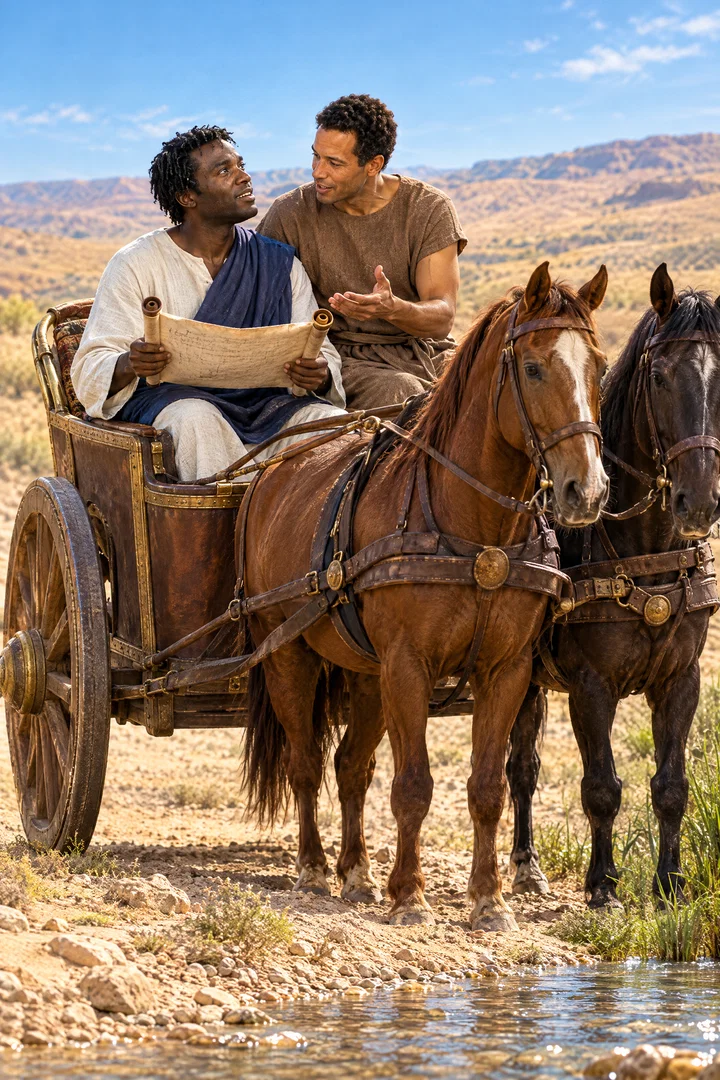
And he arose and went: and, behold, a man of Ethiopia, an eunuch of great authority under Candace queen of the Ethiopians, who had the charge of all her treasure, and had come to Jerusalem for to worship,
Translations
American King James Version, King James Version
And he arose and went: and, behold, a man of Ethiopia, an eunuch of great authority under Candace queen of the Ethiopians, who had the charge of all her treasure, and had come to Jerusalem for to worship,
And he arose and went: and behold, a man of Ethiopia, an eunuch of great authority under Candace queen of the Ethiopians, who had the charge of all her treasure, and had come to Jerusalem for to worship,
And he arose, and went: and behold, a man of Ethiopia, a eunuch of great authority under Candace queen of the Ethiopians, who had the charge of all her treasure, and had come to Jerusalem to worship,
And he arose and went: and behold, a man of Ethiopia, a eunuch of great authority under Candace, queen of the Ethiopians, who was over all her treasure, who had come to Jerusalem for to worship;
And he arose and went: and behold, a man of Ethiopia, a eunuch of great authority under Candace, queen of the Ethiopians, who was over all her treasure, who had come to Jerusalem to worship;
And having arisen, he went on, and lo, a man of Ethiopia, a eunuch, a man of rank, of Candace the queen of the Ethiopians, who was over all her treasure, who had come to worship to Jerusalem;
And he rose up and went. And lo, an Ethiopian, a eunuch, a man in power under Candace queen of the Ethiopians, who was over all her treasure, who had come to worship at Jerusalem,
And, arising, he journeyed. And lo! a man of Ethiopia, a eunuch, one in power under Candace queen of the Ethiopians, who was over all her treasure [who] had come to worship in Jerusalem;
So he started out, and on his way he met an Ethiopian eunuch, a court official in charge of the entire treasury of Candace, queen of the Ethiopians. He had gone to Jerusalem to worship,
So he started out, and on his way he met an Ethiopian eunuch, a court official in charge of the entire treasury of Candace, the queen of the Ethiopians. He had gone to Jerusalem to worship,
He arose and went; and behold, there was a man of Ethiopia, a eunuch of great authority under Candace, queen of the Ethiopians, who was over all her treasure, who had come to Jerusalem to worship.
And he went and there was a man of Ethiopia, a servant of great authority under Candace, queen of the Ethiopians, and controller of all her property, who had come up to Jerusalem for worship;
And hee arose and went on: and beholde, a certaine Eunuche of Ethiopia, Candaces the Queene of the Ethiopians chiefe Gouernour, who had the rule of all her treasure, and came to Hierusalem to worship:
Douay-Rheims (Challoner revision)
And rising up, he went. And behold a man of Ethiopia, an eunuch, of great authority under Candace the queen of the Ethiopians, who had charge over all her treasures, had come to Jerusalem to adore.
Pictures
Cross-references
- Isaiah 53:7-8
He was oppressed, and he was afflicted, yet he opened not his mouth: he is brought as a lamb to the slaughter, and as a sheep before her shearers is dumb, so he openeth not his mouth.
The eunuch was reading Isaiah’s prophecy of the suffering servant when Philip met him.
- Acts 8:35-38
Then Philip opened his mouth, and began at the same scripture, and preached unto him Jesus.
Philip preaches Jesus, and the eunuch believes and is baptized.
- Acts 8:35
Then Philip opened his mouth, and began at the same scripture, and preached unto him Jesus.
Philip explains the Scripture to the Ethiopian and preaches Jesus.
- Acts 8:5
Then Philip went down to the city of Samaria, and preached Christ unto them.
Philip preached Christ successfully in Samaria before being sent to the eunuch.
- Acts 8:39
And when they were come up out of the water, the Spirit of the Lord caught away Philip, that the eunuch saw him no more: and he went on his way rejoicing.
The Ethiopian rejoices after baptism as Philip is carried away.
- Psalms 68:31
Princes shall come out of Egypt; Ethiopia shall soon stretch out her hands unto God.
Ethiopia reaching out to God is reflected in the eunuch’s conversion.
- Isaiah 56:4-5
For thus saith the LORD unto the eunuchs that keep my sabbaths, and choose the things that please me, and take hold of my covenant;
Isaiah promises eunuchs a place and an enduring name in God’s house.
- Acts 8:31
And he said, How can I, except some man should guide me? And he desired Philip that he would come up and sit with him.
The eunuch’s searching required Philip to explain the Scripture.
- Acts 9:1-19
And Saul, yet breathing out threatenings and slaughter against the disciples of the Lord, went unto the high priest,
paired event showing gospel going to Gentiles
- Acts 6:5
And the saying pleased the whole multitude: and they chose Stephen, a man full of faith and of the Holy Ghost, and Philip, and Prochorus, and Nicanor, and Timon, and Parmenas, and Nicolas a proselyte of Antioch:
Philip is named among the seven chosen to serve.
- Deuteronomy 23:1
He that is wounded in the stones, or hath his privy member cut off, shall not enter into the congregation of the LORD.
Eunuchs were excluded from the congregation of the LORD.
- Acts 21:8
And the next day we that were of Paul’s company departed, and came unto Cæsarea: and we entered into the house of Philip the evangelist, which was one of the seven; and abode with him.
identifies Philip as the evangelist
- Genesis 2:13
And the name of the second river is Gihon: the same is it that compasseth the whole land of Ethiopia.
both contain the word Ethiopia
- Zechariah 8:22
Yea, many people and strong nations shall come to seek the LORD of hosts in Jerusalem, and to pray before the LORD.
The Ethiopian eunuch is a notable instance of people coming to Jerusalem to seek the LORD.
- Genesis 10:6
And the sons of Ham; Cush, and Mizraim, and Phut, and Canaan.
Cush is named as Ham’s son in the tradition about Ethiopia’s origins.
- Isaiah 18:1
Woe to the land shadowing with wings, which is beyond the rivers of Ethiopia:
both contain the word Ethiopia
- Romans 6:3-11
Know ye not, that so many of us as were baptized into Jesus Christ were baptized into his death?
defines the meaning of the eunuch's baptism
Commentary
Each commentary is drawn from primary sources: the writings of Ellen G. White and Adventist pioneers and periodicals. Each commentary is separate. Its own words are not a quotation; follow the references to read the source passages.
Ellen G. White
35 sources
The man was an Ethiopian eunuch of great authority under Candace queen of the Ethiopians, with charge of all her treasure, who had come to Jerusalem to worship and was returning in his chariot reading Isaiah the prophet.8T 57.5–58.4AA 107.2–108.1Ms 46, 1900, par. 10–13Lt 100, 1909, par. 6–13 He was an honest-hearted, inquiring seeker after light, a Gentile of wide influence whose acceptance of the Saviour still hung in the balance as he prayed for understanding.Ms 17, 1908, par. 14–173SP 303.2Ms 126, 1902, par. 1–2SLP 39.2Ms 17, 1909, par. 7–11 God saw his case and angels ministering to heirs of salvation worked for him, directing Philip by the Spirit to go to the desert way to Gaza, join his chariot, and teach him.Ms 46, 1900, par. 10–13Lt 100, 1909, par. 6–13Ms 8, 1900, par. 4–8Ms 11, 1900, par. 9–12RH Mar 2, 1911 Heavenly messengers do not themselves preach the gospel, but God uses men to explain the Word, for he could not comprehend the prophecies by reading alone and needed one with knowledge of God to lead him to Jesus and baptism.SPBC 163.6–7Ms 8, 1900, par. 4–8Ms 126, 1902, par. 1–2Ms 11, 1900, par. 9–12Lt 5, 1895, par. 9–11 Great effort is made to reach even a single precious soul, and his conversion is the pattern for personal labor for souls under conviction, carrying the light of truth through him to others of his class and to Ethiopia.8T 57.5–58.4AA 107.2–108.1Ms 46, 1900, par. 10–13Ms 8, 1900, par. 4–8Lt 5, 1895, par. 9–11
The Eunuch and Meeting
The man is an Ethiopian, a eunuch of great authority under Candace queen of the Ethiopians, with charge of all her treasure.8T 57.5–58.4AA 107.2–108.1Ms 46, 1900, par. 10–13SPBC 163.6–7ST Dec 5, 1878 He is a high-ranking official trusted with the queen's treasury, holding a high position of wide responsibility.AA 107.2–108.1SPBC 163.6–7ST Dec 5, 1878RH Apr 20, 1905RH Mar 2, 1911 He had come to Jerusalem to worship and was now returning, seated in his chariot reading Isaiah the prophet.AA 107.2–108.1Ms 46, 1900, par. 10–13Lt 100, 1909, par. 6–133SP 303.2Ms 8, 1900, par. 4–8 He was met on the desert way from Jerusalem to Gaza, where Philip arose in obedience to angelic direction and went south to join him.Ms 46, 1900, par. 10–13Lt 100, 1909, par. 6–13Ms 8, 1900, par. 4–8Ms 11, 1900, par. 9–12ST Dec 5, 1878
He is a man of good repute, high standing and wide influence, doing a great work.ST Dec 5, 1878RH Apr 20, 1905RH Mar 2, 1911RH Apr 20, 1905Ms 17, 1909, par. 7–11 His standing and influence meant that after receiving the gospel he could share its light with others, including others of the same class.AA 107.2–108.1Ms 46, 1900, par. 10–13RH Apr 20, 1905RH Mar 2, 1911RH Apr 20, 1905 God was guiding him toward the Saviour and arranging for Philip to explain the Scriptures to him.AA 107.2–108.1SPBC 163.6–7ST Dec 5, 1878RH Mar 2, 1911Ms 17, 1909, par. 7–11
He is an honest-hearted seeker after light, half converted, with a newly awakened and inquiring mind searching the Scriptures and desiring understanding.Ms 17, 1908, par. 14–17Ms 126, 1902, par. 1–2Ms 52, 1900, par. 40–41Ms 126, 1902, par. 7Ms 11, 1900, par. 13 His acceptance of the Saviour still hung in the balance, so that without immediate guidance he might never accept Him.Ms 17, 1908, par. 14–17Ms 11, 1900, par. 9–12Ms 11, 1900, par. 13 After finding the explanations of the priests and scribes confusing, he prayed for light, and he had become interested by hearing Christ's sermons to the people.Ms 17, 1908, par. 14–173SP 303.2Ms 52, 1900, par. 40–41 He could not comprehend the written prophecies by reading alone and needed someone to teach him and lead him into full light.SPBC 163.6–73SP 303.2Ms 8, 1900, par. 4–8Ms 126, 1902, par. 1–2Ms 126, 1902, par. 7
He belongs to the earnest seekers outside Judaism, a Gentile who longed and prayed for light from heaven.Ms 52, 1900, par. 40–41SLP 39.2Ms 17, 1909, par. 7–11COL 116.1ST Mar 9, 1915 He is a man of the colored race especially recognized by God in the time of the apostles, seen in his interest in the Scriptures.SLP 39.2Ms 17, 1909, par. 7–11COL 116.1 When Christ was revealed to him he received Him gladly, and his conversion helped convince the apostles that God granted Gentiles repentance unto life.ST Dec 5, 1878SLP 39.2COL 116.1ST Mar 9, 1915
Heaven Guides Human Witness
God looked down upon the Ethiopian as he tried to understand the message of salvation, knowing his case and his interest in the Scriptures.Ms 17, 1909, par. 13–14Ms 17, 1909, par. 7–11 Angels who minister to those who shall be heirs of salvation took notice of him as an honest seeker for light and enlightenment, working in his behalf and cooperating with a human worker to win him to Christ.Ms 8, 1900, par. 4–8Ms 11, 1900, par. 9–12RH Mar 2, 1911 He was being drawn to the Saviour without resisting the drawing, and did not make his high position and wide influence an excuse for refusing the Crucified One.Ms 11, 1900, par. 9–12RH Mar 2, 1911
By angelic direction Philip arose in obedience and went toward the south to the desert way going down from Jerusalem to Gaza, where he met the treasurer returning in his chariot reading Isaiah.Ms 46, 1900, par. 10–13Lt 100, 1909, par. 6–13RH Mar 2, 1911 By the Spirit's direction he was to join himself to the chariot, be invited up into it, and teach the seeker whom he could not have reached otherwise.Ms 8, 1900, par. 4–8 The encounter shows the close connection between heaven and earth, and that the Lord still has angels in the earth today, ministering although unseen and sometimes in human form, to connect His servants with seekers.Ms 17, 1908, par. 14–17AA 152.3 An angel directed Philip to find the one who was ready to receive the truth, giving precious instruction and the highest education in evangelistic work for students to study and follow.Lt 100, 1909, par. 6–13HMW 22.3–4
Heavenly messengers do not themselves undertake the work of preaching the gospel, but God requires men to connect with fellow men as His instrumentality.Ms 8, 1900, par. 4–8Ms 11, 1900, par. 9–12 Through the ministration of angels God sends light to His people, and through His people this light is to be given to the world, with the Holy Spirit guiding and placing men and women where they can communicate what they have received.Ms 8, 1900, par. 4–8 In providence He brings those with special knowledge and fitness into contact with inquirers according to their individual needs, so that knowledge of heavenly things is communicated from the informed to the uninformed.Ms 126, 1902, par. 1–2Ms 126, 1902, par. 7 God guides willing messengers to those who seek spiritual light and are ready to receive the gospel, while assigning to human beings the work of sharing it with one another.AA 109.1–2
The Ethiopian could not comprehend the written prophecies by reading alone, but needed someone with knowledge of God to explain the Word to him and lead him to Jesus and baptism.SPBC 163.6–7Ms 8, 1900, par. 4–8Ms 126, 1902, par. 1–2 His story was given for workers to study as the pattern for personal labor for souls under conviction, showing that God has a special work to be done for a few souls in needy, out-of-the-way fields.Ms 17, 1908, par. 14–17Ms 15, 1909, par. 27–28 He represents a large class who read the Scriptures without understanding their meaning and need missionaries like Philip who hear God's voice and go where He sends them.Lt 5, 1895, par. 9–11AA 109.1–28T 58.5 Such seekers are starving for the Word of the Lord yet ignorant of the Scriptures, as sheep having no shepherd because their shepherds feed themselves and feed not the flock, so teachers must go to new territories to present the truth with the Holy Spirit accompanying it.Ms 158, 1899, par. 8–11
While angels from heaven were working for him, Satan was interposing obstacles to confuse his inquiring, newly awakened mind, and evil angels were waiting for opportunity to press in falsehoods and divert him from seeking after truth.Ms 11, 1900, par. 13 His acceptance of the Saviour still hung in the balance, so that if left without immediate guidance he might never accept Him.Ms 11, 1900, par. 13 Philip was therefore sent as God's representative to bring divine help, enlighten his understanding, and teach the grace of God to draw him to Christ.MH 472.4–473.1Ms 15, 1909, par. 27–28Ms 11, 1900, par. 13
Pattern for Gospel Work
Heaven counts one seeking soul worth a special mission, and Philip was turned aside into the desert to meet a single traveler because every soul is precious and the Spirit was waiting to enlighten and convert him.8T 57.5–58.4Ms 8, 1900, par. 4–8Lt 5, 1895, par. 9–11 God keeps His eye upon every soul, looking down upon the inquirer as he tries to understand the message of salvation.Ms 17, 1909, par. 13–14 He has a special work to be done for a few souls in needy, out-of-the-way fields, and provision is still made to raise up workers to carry truth to those who greatly need it.Ms 17, 1909, par. 13–14Ms 15, 1909, par. 27–28
The record stands as the pattern for personal labor for souls under conviction and the highest education in evangelistic work for students and workers to study and follow.Lt 100, 1909, par. 6–13Ms 17, 1908, par. 14–17 It teaches consecrated watchfulness, to be on watch and ready to help every case brought to notice, quick to understand, wholly consecrated, wise to use every circumstance.Ms 46, 1900, par. 10–134MR 135.2–136.2 This is true Christian home missionary labor, the kind of personal work now needed.Lt 80, 1889, par. 7
The traveler was a man of the higher classes, of good standing, high rank and wide influence with charge of treasure, and his conversion through Philip's preaching of the gospel carried the light of truth to others of the same class.Ms 46, 1900, par. 10–13RH Apr 20, 1905RH Mar 2, 1911RH Apr 20, 19054MR 135.2–136.2 After receiving the gospel he shared it with others, so that its light spread in Ethiopia where many accepted Christ and turned from heathenism to Christianity.AA 107.2–108.1ST Dec 5, 18783SP 305.1 His reception of truth helped convince the apostles that God had granted to the Gentiles repentance unto life.ST Dec 5, 1878
His experience calls those who know God to hear His voice and go where He sends them to explain the Word to those who read Scripture without understanding its meaning.Lt 5, 1895, par. 9–118T 58.5 Teachers must go to new territories to present the truth with the Holy Spirit accompanying it, for seekers are starving for the Word as sheep having no shepherd.Ms 158, 1899, par. 8–11 The way is to begin where unity is possible on temperance principles and then, by request, lead to Bible light such as the Sabbath, so that receivers will work to give it to others.4MR 135.2–136.2 White people and colored people are called to engage together as laborers with God, and those seeking preparation for service in the byways and hedges in places where there are only a few should be given encouragement and support, while neglect of this heritage brings judgment.Lt 5, 1895, par. 9–11Ms 17, 1909, par. 13–14Ms 15, 1909, par. 27–28
Sources
Pioneers and periodicals
99 sources
He was a man of Ethiopia, a eunuch of great authority under Candace queen of the Ethiopians, with charge of all her treasure as secretary of the treasury and head of the financial department.RH Feb 18, 1909ST Mar 11, 1897 He was a high-ranking, well-informed and highly cultured man of wide influence, who had come to Jerusalem to worship and was returning on the desert way going down from Jerusalem to Gaza.ST Dec 5, 1878RH Feb 18, 1909ST Feb 14, 1884 Philip the evangelist, one of the seven, was directed by angel and Spirit to leave the work in Samaria and join him at just the right moment, showing that one soul was worth this personal effort.CO 34.2ST Jan 22, 1902ST Jul 8, 1886RH Apr 24, 1900ST Jun 26, 1901 Beginning at Isaiah 53 about the suffering servant, Philip preached Jesus to him as the promised Messiah and Son of God, and upon wholehearted belief he was baptized without delay by going down into the water and coming up out of it.RH Dec 17, 1901ST Jan 17, 1878RH Apr 9, 1914ST Apr 4, 1900ST Mar 23, 1915 He went on his way rejoicing and carried the good news south into Ethiopia where many turned from heathenism, marking the turn from ministry focused on the Jews toward the Gentiles and the beginning of the churches of Abyssinia where the seventh-day Sabbath was observed.RH Feb 18, 1909ST Mar 11, 1897RH Apr 18, 1871ST Sep 20, 1910RH May 13, 1862
Ethiopian Official's Rank
The man is an Ethiopian, a eunuch of great authority under Candace queen of the Ethiopians, who had charge of all her treasure and had come to Jerusalem to worship.RH Feb 18, 1909ST Mar 11, 1897ST Mar 5, 1902 He was secretary of the treasury and head of the financial department of the ancient Ethiopian kingdom, like the chancellor of the exchequer in the English government. As treasurer of the queen he had already accepted the Hebrew Scriptures before he met Philip, and through Philip he also received the Christian faith. He reads Isaiah's prophecy about the suffering servant, receives Philip's explanation that it points to Jesus, and is baptized.ST Nov 14, 1906 After Philip taught him about Jesus he accepted Christ, was baptized, and went on his way rejoicing.RH Feb 18, 1909
He was a high-ranking, well-informed and highly cultured man who had come to Jerusalem to worship, whose earnest study of Scripture showed that learning and status did not remove his need to understand the spiritually discerned word.ST Feb 14, 1884 He was a man of good repute and high responsibility who was seeking God and seeking light from Scripture and needed help to understand it.ST Dec 5, 1878ST Dec 5, 1878 He was a man of good standing and wide influence, and his high position under the queen with responsibility for her treasure gave him wide influence so that when converted he could bring the gospel's light to others and share it with them.RH Apr 20, 1905RH Mar 2, 1911 His position helps explain why he could carry the gospel message to the Ethiopian court and its spread in Ethiopia, where many accepted Christ and turned from heathenism to Christianity.ST Dec 5, 1878RH Feb 18, 1909 God cared for him by sending Philip across the desert to meet him.ST Dec 5, 1878
That kingdom was the ancient kingdom of Meroe, identical with the present Abyssinian kingdom, representing western Ethiopia in Central Africa where the Abyssinian churches were afterward located.RH Jun 10, 1873 It was governed by queens as late as three hundred years after Christ. Abyssinian tradition named Menilek as the son and successor of the queen of Sheba, placing this account about eleven hundred years after his traditional reign.RH May 6, 1909 Its ruler Menelik claims direct descent from King Solomon and the Queen of Sheba, and the Abyssinians are held to be descendants of Abraham through Ishmael and therefore of Semitic extraction, with a Semitic language. Candace is queen of Ethiopia, whose ambassadors came to Augustus at Samos in 21 B.C. seeking peace and then returned to Ethiopia.ST Oct 29, 1885 The word Ethiopia occurs in only a few places in the Bible, including this verse, which does not say that Ethiopia shall rise up and be a nation, and no verse of the Bible reads to that effect.ST
Worship Journey and Setting
He had come to Jerusalem to worship and was returning on the desert way going down from Jerusalem to Gaza, where Philip met him in obedience to the command to go south. That meeting took place in the uncultivated region of Judea southwest of Jerusalem in the early summer of A.D. 37, as one result of the dispersion of the Christians. He was returning in his chariot reading Isaiah's prophecy, which prepared the setting for Philip to explain it to him.ST Mar 5, 1902 He had traveled to Jerusalem to worship and learn from the Jewish teachers, whom he recognized as God's people, but he was disappointed and was searching the Scriptures for himself.ST Mar 5, 1902ST Mar 5, 1902 He was acquainted with the Old Testament and knew God's commandments, and Philip was sent to prepare him to preach the gospel in Ethiopia.ST Jun 1, 1882
The word desert means an uninhabited region, not necessarily a dry barren plain.ST May 20, 1880 The route from Jerusalem toward Gaza had hills, valleys, springs and pools that could provide suitable places for immersion, so the setting does not rule out the availability of water.ST May 20, 1880
His journey as a truth-seeker was very long and very expensive for those days. Philip obeyed the call to leave his successful work in Samaria and travel about three days on foot into a desert region to meet that one man.ST Mar 5, 1902 He had become acquainted with Jewish worship in Ethiopia through association with one of the Jewish communities of the dispersion found in various countries, which usually had a following of God-fearing Gentiles. The light he had seen in Ethiopia increased his desire for more light, a characteristic of the true child of God of every color and every place, so he sought Jerusalem as what should have been the fountainhead of light. God overruled so he received what he had journeyed so far to find, even though the Shekinah had left the sanctuary of Israel and her lamp had gone out.
He was an unenlightened proselyte to the Jewish religion who had been to worship at the temple at Jerusalem, the place Jews looked to as the dwelling-place of God.ST Jun 7, 1883 His adopted religion was a long step in advance of the superstition of his native country, yet he still felt only a learner.ST Jun 7, 1883 His example of traveling with Scripture as a companion teaches that God provides help to understand the Bible.RH Dec 17, 1903 On his journey he was diligently searching the Scriptures even though they conveyed no meaning to his mind, taking the Bible with him to read by the way as commanded.ST Jun 7, 1883 Because he willed to do God's will he was given knowledge of the doctrine, and because he was reading Philip was sent to instruct him.ST Jun 7, 1883
He was earnestly and diligently studying and devoutly reading Isaiah the prophet in his chariot though he did not understand it.ST Feb 14, 1884RH Sep 27, 1870ST Jun 7, 1883 He desired light, and God sent Philip to explain the truth he needed, which he received and thereby became a Christian.RH Sep 27, 1870 His honest purpose was shown by his readiness to obey when he learned his duty, with honest, humble heart.ST Feb 14, 1884 He is an example of a heart made fully ready as soil for the gospel seed before the human seed-sower was sent, God having done His part in preparing the ground in advance so that when Philip came the sowing fell on soil already prepared.ST Oct 23, 1901 He was a seeker for light being drawn to the Saviour and noticed by angels, who did not make his high position and wide influence an excuse for refusing to accept the Crucified One.ST Dec 5, 1878RH Mar 2, 1911
What he was reading was Isaiah 53 about the suffering servant led like a sheep to slaughter and remaining silent, applied to Jesus' sufferings at Gethsemane and Calvary. The quotation follows the Septuagint wording, which transposes sheep and lamb compared with the Hebrew, reflecting New Testament writers' use of the Greek translation. It was not Isaiah 52:15 but the next chapter, Isaiah 53, from which Philip began at that same scripture to preach Jesus to him, and Isaiah 52:15 contains nothing about baptism.RH Mar 28, 1871
Philip's Divinely Guided Meeting
Philip was still in Samaria when direction came by an angel, the Spirit, and a heavenly messenger to go toward the south to the way going down from Jerusalem to Gaza, and he arose and went in obedience.RH Mar 2, 1911RH May 30, 1907 The meeting took place in the uncultivated region of Judea southwest of Jerusalem in the early summer of A.D. 37, as one result of the dispersion of the Christians, and illustrates how God led the workers in the early church and what God is willing to do for those who with honest, humble hearts seek His truth.RH Mar 2, 1911 The Ethiopian was a seeker for light being drawn to the Saviour and noticed by angels, who did not make his high position and wide influence an excuse for refusing to accept the Crucified One.RH Mar 2, 1911
The Philip who met him is Philip the evangelist, one of the seven, not Philip the apostle, since all the apostles remained in Jerusalem while Peter and John were afterward sent to Samaria.CO 34.2ST Jun 7, 1883 His preaching shows that a deacon may preach the gospel when the Lord leads him and opens the way, though the duties of deacons are largely temporal as assistants of elders and servants of the church, and faithfulness in that office brings great spiritual strength and great boldness in the faith which is in Christ Jesus.CO 34.2 Jesus Christ Himself continued after Pentecost to lead the gospel work by the Holy Spirit as His delegated representative, directing Philip to a particular person at just the right time to compass the salvation of a wandering lost soul.RH Apr 24, 1900ST Jun 26, 1901 That individual direction in daily work was not chance but proves the disciples were led by a superhuman power with an all-seeing eye and a master hand at the helm, with the Lord Himself directing the work and knowing the nearest way home for every lost one through intricate difficult paths.RH Apr 24, 1900ST Jun 26, 1901
Philip was called to leave a large work in Samaria for a smaller field in a desert region to meet one man, showing that the place God sends is better than a larger or more promising field chosen by human judgment and that one soul was worth this personal effort.ST Jan 22, 1902ST Jul 8, 1886 That one convert became the means of opening a new continent to the gospel, and the work included seeking and winning people one by one away from the crowds.ST Jan 22, 1902ST Jul 8, 1886 God prepared the hearer as He sent the messenger and providentially brought them together at the right moment on the road from Jerusalem to Gaza, where the official was reading a prophecy about the Lord and wondering what it meant.RH Nov 28, 1912RH Aug 22, 1912RH Mar 19, 1914RH Mar 19, 1914 The meeting came through the Spirit's guidance and timing to give Philip opportunity to explain the Scripture and preach Christ, and Philip's prompt obedience without hesitation brought blessing and conversion and baptism, while delay might have meant the loss of a soul.RH Nov 28, 1912RH Aug 22, 1912RH Mar 19, 1914
The Lord Himself directs individual workers where to go, so no man or set of men has the right to say to this man or that man, go here or go there, without his consent, nor to cut him off from Christ for not following a human decision unsanctioned by the Spirit of God.RH May 30, 1907 Such divine leading does not set aside order, for people thus instructed are always in harmony with the body of the church and the spirit of prophecy, while those at variance are out of harmony, showing God lives to direct His people now as willingly as in the past.RH May 30, 1907 Gospel work directed by the Spirit is likewise free from limits of human-assigned district or territory, for to require exclusive denominational control of territory would have obliged Philip to refuse the call to join the chariot as outside his legitimate field, and such restriction curtails the freedom of the Spirit and hinders its work.ST Sep 11, 1907 God has chosen human agents of like passions and similar experience and environment to communicate light by personal contact rather than working alone by His Holy Spirit or using angels as laborers, illustrating the principle and value of personal labor in missionary work.RH May 4, 1911ST Aug 25, 1898 An angel could have instructed the Ethiopian desiring enlightenment, but the Lord sent Philip on a journey of many miles to do this part of the work and honors human servants with that privilege, since angels personally reveal themselves as helpers only to those who are by faith the children of God, while messages of comfort and love and instruction come by angels to the church and the church must bear them to souls in need and travail in soul for children born into the kingdom.RH May 4, 1911ST Aug 25, 1898
Conversion and Baptism Account
Philip listened while the official read Isaiah 53:7-8, then opened his mouth and began at that same scripture to preach Jesus to him.RH Apr 9, 1914ST Apr 4, 1900 That scripture centers on Christ, and the preaching set forth Jesus as the promised Messiah and the Son of God.RH Apr 9, 1914ST Apr 4, 1900RH Jun 29, 1911 This faith in Jesus Christ as the promised Messiah was the great testing truth of the early church, upon which all the world was proved, the glad tidings first announced by angels to the shepherds.RH Jun 29, 1911 The eunuch heard under special direction of Providence, accepted Jesus as the promised Messiah, and believed with all his heart that Jesus Christ is the Son of God.RH Dec 17, 1901RH Jun 29, 1911RH Jul 4, 1907 His wholehearted belief with repentance from sin showed his readiness for baptism as a newly enlightened hearer of the message about Jesus.ST Apr 9, 1912ST Feb 7, 1878RH Jul 4, 1907
Philip’s preaching of Jesus included water baptism, and that preaching enlightened the eunuch on baptism.ST May 27, 1880RH Mar 28, 1871 The eunuch requested baptism and received it without delay, without having to wait months to prove faithfulness, as a prompt baptism following belief in the gospel.ST May 27, 1880RH Dec 20, 1853 His rejoicing came after baptism.ST Jan 17, 1878 He was baptized in water by going down into the water with Philip and coming up out of it, consistent with immersion only as administered in the apostles’ time and long afterward.RH Dec 17, 1901ST Mar 23, 1915ST Jun 13, 1878 Going down into the water was a necessary step before baptism, not the baptism itself, for Philip baptized the eunuch after both had gone down.ST Mar 6, 1884 It was one immersion, not three immersions in separate pools, and not baptism by sprinkling, for Isaiah 52:15 contains nothing about baptism and the scripture he was reading was not Isaiah 52:15 but the next chapter, Isaiah 53.ST Mar 19, 1885RH Mar 28, 1871
The detailed account mentions no laying on of hands to confer the Holy Ghost, showing that act was not presented as a required step after baptism.ST Jan 1, 1885 His conversion came quietly and simply through the written Word of God and its explanation by God’s minister, without great outward demonstration.RH Dec 30, 1915 Unlike Paul’s conversion with bright shining light and an audible voice, his experience proves the Spirit leads and affects people in different ways, and a quiet conversion through Scripture is no less real.RH Dec 30, 1915 After baptism he went on his way rejoicing in the new light he had received.RH Feb 18, 1909ST Jun 7, 1883 He preached the word to those he met and carried the good news of the Saviour and of salvation through Christ south of Egypt into Ethiopia, into the region later known as Abyssinia and to his own people and the Ethiopian court.RH Feb 18, 1909ST Mar 11, 1897ST Jun 7, 1883ST Jul 29, 1913 There many accepted Christ and turned from heathenism to Christianity, so that by the trip to the desert was accomplished what a mission to Ethiopia would have accomplished.ST Dec 5, 1878ST Jun 7, 1883
Gospel Turning to Gentiles
The account stands in the time when persecution following Stephen's death and martyrdom scattered the church from Jerusalem, ending a ministry focused upon the Jews and turning the gospel toward the Gentiles and the nations.ST Sep 20, 1910STRH Sep 28, 1905 After the scattering of believers from Jerusalem and the Jewish rejection of the gospel, the message on the road to Gaza and in Samaria shows it beginning its course toward all nations.RH May 23, 1912RH Jan 20, 1916 That work beyond the Jews prepared the way for Paul's ministry to the Gentiles.ST Sep 2, 1913 This turning is dated to A.D. 34, when the 490 years ended and the gospel first went beyond the Jewish people to the nations.RH Feb 18, 1902ST Nov 28, 1895 Then Israel's probation as a nation ended, the Jewish nation was cut off as God's special people, and the gathering of a people for God's name from among the Gentiles began.RH Feb 18, 1902ST Nov 28, 1895
Even colored people and strangers in far countries heard of the true God and His temple, for the man of Ethiopia of great authority under Candace who had charge of all her treasure had come to Jerusalem to worship and was returning reading Esaias the prophet.RH Dec 17, 1901 Such strangers in far countries accepted the gospel and the Lord accepted them, for when Jesus was preached from that scripture the eunuch believed with all his heart that Jesus Christ is the Son of God and was baptized by going down into the water.RH Dec 17, 1901 His coming up to Jerusalem to worship and pray fulfills the promise that many people and strong nations would come to Jerusalem to pray before the Lord.ST Jun 21, 1883 As one of many pious Gentiles who did so, he proves that God's house was to be a house of prayer for all nations.ST Jun 21, 1883
The account helps prove that Jesus was the Messiah through the exact fulfilment of prophecies about Him and His work.ST Sep 13, 1905 It belongs to the setting in which the disciples preached Christ from the Old Testament, which was the only Scripture they had, as Philip taught the Ethiopian official from Scripture.ST Aug 6, 1894 His conversion shows that the gospel can change people across different nations and conditions.RH Dec 17, 1901 In this way it displays the message beginning its course toward every nation and kindred and tongue and people.RH Dec 17, 1901
Sabbath and Ethiopian Church
The official went up to Jerusalem to worship and then returned to Ethiopia converted to Christianity and keeping the seventh-day Sabbath.RH Apr 18, 1871 He was already acquainted with the Old Testament and knew God's commandments, and Philip was sent to prepare him to preach the gospel in Ethiopia.ST Jun 1, 1882 Philip gave him no instruction about sanctifying the first day of the week.ST Jun 1, 1882
His instruction contained no hint of a new Sabbath, and the instruction of the Samaritans in the same chapter contained none either, though each would have needed it if such a Sabbath had yet been made.RH Nov 21, 1871 That silence proves that no change of the Sabbath had taken place at that time.RH Nov 21, 1871 The fact that the record of the apostles preaching the gospel writes down no command to keep the Sabbath does not prove that not a single convert was commanded to keep it, nor does it show that the apostles failed under the Holy Spirit to instruct their converts.RH Nov 9, 1911 Philip's work of preaching and baptizing is set forth as preaching Bible doctrine.ST May 15, 1884
His conversion perhaps marks the beginning of the churches of Abyssinia and Ethiopia in Central Africa in the first part of the Christian era.RH May 13, 1862 Those churches were never subjected to the Roman pontiff, and among them the Bible Sabbath was observed from age to age.RH May 13, 1862 They lived in Central Africa where the Abyssinian churches were afterward located, and they kept the seventh-day Sabbath until the early part of the seventeenth century, when they were brought under papal rule which the masses then threw off.RH Jun 10, 1873 That people shared in the apostasy that molded the whole church in the first four centuries, so Sunday crept in as a festival day, a sister day to the Sabbath, yet observance of the Sabbath continued.ST Oct 1, 1896 Cut off from the nations of Europe about the time the Roman bishop gained supremacy and left for near a thousand years encompassed by enemies of their religion, they took in error and darkness but not the gross errors of the great apostasy.ST Oct 1, 1896 They rejected transubstantiation, adoration of the consecrated bread, purgatory, extreme unction, and graven images, while keeping both Saturday and Sunday, and their continued keeping of the Sabbath stands as a living testimony of a whole people to the perpetuity of the Sabbath in the Christian church for eighteen centuries.ST Oct 1, 1896
The treasurer of Queen Candace, representing Abyssinia as the western Ethiopia, had already accepted the Hebrew Scriptures before he met Philip, and through Philip he also received the Christian faith. His conversion marks the beginning of Abyssinian Christianity, which has remained firm in the faith first received. It continued to hold the duty of observing Old Testament rites together with New Testament rites even after Jewish converts ceased that observance following the fall of Jerusalem. That an Ethiopian official had come to Jerusalem to worship the true God indicates that knowledge and worship of God were present in ancient Ethiopia at an early date.RH Nov 3, 1910 As a eunuch of high authority who managed the queen's treasury and went to Jerusalem to worship, he is an example of one excluded from Israel's assembly under the old dispensation but included among those promised a place and an everlasting name in Isaiah's prophecy.RH Oct 15, 1872
Missionary Pattern and Application
The meeting on the desert road is an example of winning people to Christ through conduct as well as words, by personally leading an individual toward Christ.ST Apr 2, 1896ST Mar 30, 1882 Believers should be ready to share the Word when opportunity opens, and a brief Bible study in a chariot can bring the light of Scripture to a seeker.RH Mar 13, 1913 His conversion stands as a prominent result of personal work, showing that individual direct contact wins souls.RH Jun 20, 1912 That pattern calls ministers to make special efforts to reach as many as possible by personal contact both at meetings and in house-to-house visitation, and by example as well as precept to encourage all believers to engage in personal soul-saving effort.RH Jun 20, 1912 His story also serves as an encouraging example of one person reached and baptized through missionary work.RH Jan 7, 1915
A man full of the Holy Ghost and wisdom and able to preach to a city congregation was sent off into the wilderness to preach to one man, going without hesitation without knowing he would find even that one man.ST Jun 7, 1883 Preaching to small congregations is just as important as preaching to large ones, since converting only one out of a large congregation is no more than preaching to that one alone.ST Jun 7, 1883 Heaven's help is given as readily to one seeker as to a great crowd, because he desired to understand God's Word.ST Mar 5, 1902 Jesus would give His life for one person as freely as for the whole world, and no one however isolated lacks His sympathy and care.ST Mar 5, 1902
God showed equal concern for this receptive, high-ranking official of good standing and wide influence who managed the treasure and had traveled to Jerusalem to worship, sending Philip a great distance and many miles to teach him while he was reading Isaiah's prophecy of Christ.RH Mar 2, 1911RH Apr 20, 1905ST Sep 13, 1905 When converted he could bring the light of the gospel to others and share that truth with them, and he likely helped establish the gospel in Ethiopia after he was baptized and returned rejoicing.RH Mar 2, 1911RH Apr 20, 1905ST Sep 13, 1905 Although many were listening in Samaria, God knew this spiritually hungry worshiper's need for Jesus, which illustrates God's care for seekers and His concern for Ethiopia and the South and His call to carry the gospel there.RH Mar 2, 1911RH Oct 19, 1905 Christ's individual care for the inquiring traveling soul worked through angel, Spirit, and Philip together to bring him to God. God still guides servants directly to sincere seekers, can send a teacher like Philip to one earnestly seeking truth, and sends people to serve those needing help even when the destination or work is not their own choice.ST Dec 8, 1914RH Nov 26, 1903RH Dec 1, 1904
Like him, people who read Scripture but cannot grasp its meaning need someone sent to explain it, and they welcome the light when it is explained.RH Apr 4, 1912ST Mar 27, 1907 He was an unenlightened proselyte whose adopted religion was a long step in advance of his native superstition, yet he felt only a learner after worshiping at the temple looked to as God's dwelling place.ST Jun 7, 1883 On his journey he diligently searched the Scriptures and took the Bible to read by the way even though it conveyed no meaning to his mind, and because he willed to do God's will he was given knowledge of the doctrine and Philip was sent to instruct him because he was reading.ST Jun 7, 1883 His example teaches diligence in studying the Word even when beyond comprehension, with assurance that the Spirit is ever ready to enlighten attentive students, while failure to study attentively loses great opportunities for light.ST Jun 7, 1883 The Spirit prepares people to receive the gospel, God must have teachers like Philip ready to show the way of life, and He can use willing workers to help those the Holy Spirit is leading toward greater understanding.RH May 4, 1905RH Dec 18, 1913
That one Ethiopian convert became the means of opening a new continent to the gospel, for he went on his way rejoicing in new light and preached the word to those he met so the Ethiopians heard the truth through him.ST Jun 7, 1883ST Jan 22, 1902 The trip to the desert thus accomplished what a mission to Ethiopia would have accomplished, showing the place God sends is better than a larger or more promising field chosen by human judgment.ST Jun 7, 1883ST Jan 22, 1902 God carries on His work by miracle, taking Philip from the Gaza road where they met to Azotus, and He is able to do His work without human help by feeding laborers, keeping clothes from wearing out, transporting them, providing money, and converting souls.RH Jan 7, 1909 Yet He graciously gives those who love the truth but cannot go to the front the privilege of furnishing supplies for those who go, so giving is a privilege and not mere obligation, that they may share the workers' future joy over saved souls.RH Jan 7, 1909
His search in Isaiah's prophecy while traveling led to personal salvation, placing him among sincere seekers outside Israel and outside the Jewish people who longed and prayed for light from heaven.ST Mar 9, 1915RH Apr 8, 1909 When Christ was revealed to him he received Him with gladness.ST Mar 9, 1915 The Spirit directed Philip to meet the traveling official in his chariot on the road south toward Gaza, where Philip rightly joined him and preached Christ and he confessed faith and was baptized in water.ST Jun 14, 1905ST Feb 14, 1884 Philip was guided by the Spirit in order to meet him, connecting the story with being guided to understand Scripture.ST Jun 23, 1909RH Apr 5, 1906 He was diligently reading Scripture and seeking understanding, at that moment reading a prophecy about Christ which gave Philip opportunity to preach Jesus through the Spirit's guidance and timing, and prompt obedience brought blessing where delay might have meant loss of a soul.RH Jun 1, 1916RH Aug 22, 1912 His example of traveling with Scripture as a companion teaches that God provides help to understand the Bible, and God brought him to the desert place where through preaching from Isaiah he was changed, baptized, and carried the gospel to his own people.RH Dec 17, 1903ST Jul 29, 1913
Sources