Translations
Was returning, and sitting in his chariot read Isaiah the prophet.
Was returning, and sitting in his chariot read Esaias the prophet.
was returning, and sitting in his chariot read Esaias the prophet.
Was returning; and sitting in his chariot, read Isaiah the prophet.
Revised Version, American Standard Version
and he was returning and sitting in his chariot, and was reading the prophet Isaiah.
he was also returning, and is sitting on his chariot, and he was reading the prophet Isaiah.
was returning and sitting in his chariot: and he was reading the prophet Esaias.
And was returning, and, sitting in his chariot, and was reading the prophet Isaiah.
Berean Standard Bible, Majority Standard Bible
and on his return was sitting in his chariot reading Isaiah the prophet.
He was returning and sitting in his chariot, and was reading the prophet Isaiah.
He was going back, seated in his carriage, and was reading the book of the prophet Isaiah.
And as he returned sitting in his charet, he read Esaias the Prophet.
Douay-Rheims (Challoner revision)
And he was returning, sitting in this chariot, and reading Isaias the prophet.
Pictures
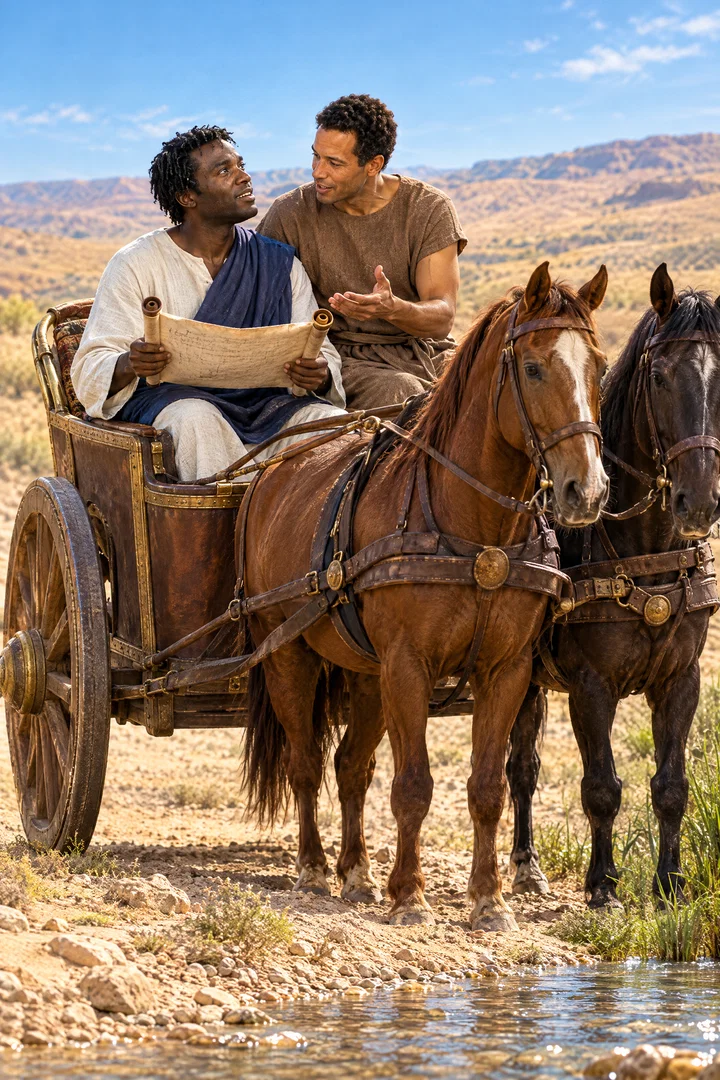
Cross-references
- Isaiah 53:7-8
He was oppressed, and he was afflicted, yet he opened not his mouth: he is brought as a lamb to the slaughter, and as a sheep before her shearers is dumb, so he openeth not his mouth.
The Ethiopian reads Isaiah’s prophecy of the servant led silently to slaughter, which Philip explains as Jesus.
- Acts 8:35
Then Philip opened his mouth, and began at the same scripture, and preached unto him Jesus.
Philip explains the Scripture the eunuch is reading and preaches Jesus.
- Acts 8:36-38
And as they went on their way, they came unto a certain water: and the eunuch said, See, here is water; what doth hinder me to be baptized?
The Ethiopian responds to the gospel by confessing faith and being baptized.
- Acts 6:5
And the saying pleased the whole multitude: and they chose Stephen, a man full of faith and of the Holy Ghost, and Philip, and Prochorus, and Nicanor, and Timon, and Parmenas, and Nicolas a proselyte of Antioch:
Philip was one of the seven appointed to serve.
- Acts 8:39
And when they were come up out of the water, the Spirit of the Lord caught away Philip, that the eunuch saw him no more: and he went on his way rejoicing.
After the encounter, the baptized Ethiopian continues on his way rejoicing.
- Acts 21:8
And the next day we that were of Paul’s company departed, and came unto Cæsarea: and we entered into the house of Philip the evangelist, which was one of the seven; and abode with him.
Identifies Philip, who later lived in Caesarea after meeting the eunuch near Gaza.
- Isaiah 52:13-15
Behold, my servant shall deal prudently, he shall be exalted and extolled, and be very high.
The prophecy concerns the suffering Saviour whom the Ethiopian was reading about.
- Isaiah 56:3-5
Neither let the son of the stranger, that hath joined himself to the LORD, speak, saying, The LORD hath utterly separated me from his people: neither let the eunuch say, Behold, I am a dry tree.
The promise of a place and everlasting name for eunuchs connects with the Ethiopian eunuch’s admission.
- Acts 8:4
Therefore they that were scattered abroad went every where preaching the word.
Scattered believers preached the word wherever they went.
- Acts 8:5
Then Philip went down to the city of Samaria, and preached Christ unto them.
same Philip preached Christ in Samaria
- Deuteronomy 23:1
He that is wounded in the stones, or hath his privy member cut off, shall not enter into the congregation of the LORD.
It contrasts the eunuch’s exclusion among the Jews with his later admission.
Commentary
Each commentary is drawn from primary sources: the writings of Ellen G. White and Adventist pioneers and periodicals. Each commentary is separate. Its own words are not a quotation; follow the references to read the source passages.
Ellen G. White
35 sources
The verse pictures the Ethiopian treasurer of great authority under Candace, returning from worship at Jerusalem and sitting in his chariot reading Isaiah on the desert road south toward Gaza.8T 57.5–58.4AA 107.2–108.1Ms 46, 1900, par. 10–13Ms 17, 1908, par. 14–17Lt 100, 1909, par. 6–13 Though influential, he was a sincere seeker who believed what light he had, prayed and searched the prophecies, yet could not fully understand and was only half converted.8T 57.5–58.4AA 107.2–108.13SP 303.2 His reading without understanding shows that heavenly truth is learned through human fellowship, so God answered his desire by attending him with angels and the drawing of the Spirit and by sending Philip through angel and Spirit to join his chariot and explain the Word.AA 107.2–108.1SPBC 163.6–73SP 303.2Ms 126, 1902, par. 1–2Ms 11, 1900, par. 9–12 Beginning at the prophecy of the sheep led to slaughter, Philip preached Jesus as its fulfillment until the eunuch gladly believed Jesus Christ is the Son of God and was baptized without letting rank hinder him.Ms 46, 1900, par. 10–13SPBC 163.6–7Lt 100, 1909, par. 6–13Ms 11, 1900, par. 9–12RH Mar 2, 1911 He stands for the large class who read Scripture without grasping its meaning, whom God still joins to informed, consecrated believers to teach them, through whom the light then shines to others even to Ethiopia.AA 107.2–108.1Ms 46, 1900, par. 10–13Lt 5, 1895, par. 9–11AA 109.1–28T 58.5
The Reader and Journey
The reader was a man of Ethiopia, an eunuch of great authority under Candace queen of the Ethiopians, who had charge of all her treasure.Ms 46, 1900, par. 10–13Ms 17, 1908, par. 14–17Lt 100, 1909, par. 6–13Ms 8, 1900, par. 4–8Ms 11, 1900, par. 9–12 He was an Ethiopian official holding high office, a man of great authority and influence.8T 57.5–58.4AA 107.2–108.1SPBC 163.6–7Ms 126, 1902, par. 1–2
He had come to Jerusalem to worship and was returning home, sitting in his chariot reading Isaiah the prophet.8T 57.5–58.4AA 107.2–108.1Ms 46, 1900, par. 10–13Ms 17, 1908, par. 14–17Lt 100, 1909, par. 6–13 He was seated in his chariot reading Esaias while traveling the desert way south from Jerusalem to Gaza.Ms 46, 1900, par. 10–13SPBC 163.6–7Lt 100, 1909, par. 6–13Ms 8, 1900, par. 4–8
Seeking, Guidance and Conversion
Though high-ranking and influential, the man in the chariot was a sincere, honest-hearted seeker after light who believed the Scriptures, held fast what light he had, prayed for understanding, and diligently searched the prophecies.AA 107.2–108.13SP 303.2Ms 11, 1900, par. 9–12ST Dec 5, 1878Lt 80, 1889, par. 7 He had charge of all the treasure under Candace queen of the Ethiopians and had come to Jerusalem to worship, yet he was only half converted and could not fully understand what he read.8T 57.5–58.43SP 303.2Ms 126, 1902, par. 1–2Ms 11, 1900, par. 9–12Ms 126, 1902, par. 7 His reading while returning showed an honest heart wanting clearer light rather than groping in darkness.Ms 126, 1902, par. 7Lt 80, 1889, par. 7ST Mar 9, 1915
His confusion was increased by conflicting priestly interpretations and by troubled reports about Jesus, so that diligent belief was mixed with perplexity about the Messianic prophecies.ST Dec 5, 1878 He had become interested by hearing Christ's preaching to the people, and he searched the Scriptures because he desired light and was interested and inquiring.Ms 52, 1900, par. 40–41 While he studied with an inquiring, newly awakened mind his acceptance of the Saviour hung in the balance.Ms 11, 1900, par. 13
The verse shows that a person may read Scripture without understanding it, because God has ordained that people learn heavenly things through communicating with one another.SPBC 163.6–7Ms 126, 1902, par. 1–2Ms 11, 1900, par. 9–12 He represents a large number who read but cannot understand the import of what they read and need someone knowledgeable to explain the Word.SPBC 163.6–7AA 109.1–28T 58.5 In God's providence the uninformed, honest-hearted one is brought into connection with informed believers fitted by knowledge and training to meet individual needs, and this work continues in every age.Ms 11, 1900, par. 9–12Ms 126, 1902, par. 7
Heaven was closely connected with earth in his case, for this is an example of that close connection.AA 107.2–108.1AA 152.3 Angels who minister to those who shall be heirs of salvation attended him, took notice of him, and watched him, cooperating with human workers to win him to Christ.AA 107.2–108.1Ms 8, 1900, par. 4–8Ms 11, 1900, par. 9–12RH Mar 2, 1911 The Holy Spirit drew him to the Saviour, and God answered his prayer and desire for light and knowledge by sending help to explain the truth about Christ.AA 107.2–108.13SP 303.2ST Dec 5, 1878 At the decisive moment evil angels also worked to draw his mind elsewhere, interpose obstacles, confuse him, press in falsehoods, and divert him from truth, so that if left at that critical point he might never have accepted the Saviour.Ms 11, 1900, par. 13
God directed Philip by an angel toward the south to the desert way and by the Spirit to go near and join the chariot as God's representative.Ms 46, 1900, par. 10–13Ms 8, 1900, par. 4–8HMW 22.3–4 A heavenly messenger showed Philip his work for the Ethiopian and directed him to go to him where he would be invited into the chariot.Ms 11, 1900, par. 9–12Ms 52, 1900, par. 40–41 That reading gave the opening to ask whether he understood, to be invited up to sit with him and guide him, and to be recognized as the sent helper.Ms 46, 1900, par. 10–13HMW 22.3–4ApRGC 26.1–4
Beginning at that same scripture about the sheep led to slaughter, Philip explained that Isaiah's prophecy concerning Christ pointed to Jesus and His mission to save sinners.Ms 46, 1900, par. 10–13ST Dec 5, 1878ApRGC 26.1–4 His diligent search prepared him to receive that teaching, and Philip preached Jesus to him from that scripture until the question of whom the prophecy described was answered.SPBC 163.6–7ST Dec 5, 1878RH Apr 20, 1905RH Mar 2, 1911 The preaching led to confession of belief that Jesus Christ is the Son of God and to baptism upon that belief.Ms 46, 1900, par. 10–13Lt 100, 1909, par. 6–13ApRGC 26.1–4
He did not resist the drawing to the Saviour, did not make his high position an excuse for not accepting the crucified One, and did not let standing and wide influence keep him from receiving truth.Ms 11, 1900, par. 9–12RH Mar 2, 1911 He held fast what light he had and held the truth he believed unyieldingly, yet was not satisfied to grope in darkness and wanted clearer light.Lt 80, 1889, par. 7 When Christ was revealed to him from the prophecy he received Him with gladness and accepted the Crucified One.RH Mar 2, 1911ST Mar 9, 1915COL 116.1
His prompt acceptance led to conversion through the gospel of the Word preached to him.Ms 46, 1900, par. 10–13ST Dec 5, 18783SP 305.1 God saw that because of high standing and wide influence his conversion would enable him to share the gospel with others.AA 107.2–108.1RH Mar 2, 1911 Through him the light of truth shone to the higher classes and was carried to others, and it reached Ethiopia, where many accepted Christ.Ms 46, 1900, par. 10–13ST Dec 5, 18783SP 305.1RH Apr 20, 1905
Pattern for Mission Work
The man in the chariot represents a large class who read the Scriptures yet cannot grasp their import and need someone to teach them their true meaning.Lt 5, 1895, par. 9–11AA 109.1–28T 58.5 They need missionaries like Philip who hear God's voice, go where He sends them, explain His Word, guide such readers, and preach Jesus from it.Lt 5, 1895, par. 9–118T 58.5 Doing this work is God's call to His people, and neglecting that heritage brings His judgment.Lt 5, 1895, par. 9–11
God puts forth great effort for even one person, and workers are to be on watch and ready to help every case that comes to their notice.Ms 46, 1900, par. 10–13Ms 11, 1900, par. 9–124MR 135.2–136.2 God does not do the work without human instrumentality but works through men connecting with fellow men as His instruments in behalf of others, with heavenly angels watching and cooperating to win seekers to Christ.Ms 46, 1900, par. 10–13Ms 11, 1900, par. 9–12 In His providence He brings uninformed, honest-hearted ones into connection with informed believers who by special knowledge and training are best fitted to reach the individual needs of each case, and this work continues in every age.Ms 11, 1900, par. 9–12Ms 126, 1902, par. 7 Today just as much as then angels lead and guide those who will be guided and led.Ms 11, 1900, par. 9–12
His mind was inquiring and newly awakened, seeking to understand the Word, with acceptance of the Saviour hanging in the balance.Ms 11, 1900, par. 13 At that moment heavenly angels were working for his enlightenment while Satan and evil angels were working to draw his mind elsewhere, interpose obstacles, confuse him, press in falsehoods, and divert him from truth.Ms 11, 1900, par. 13 If left at that critical point he might never have accepted the Saviour and his mind could be lost, so God's human agents must be wholly consecrated, quick to understand their work, and take advantage of every circumstance to teach the grace of God and draw men to Christ.Ms 11, 1900, par. 13
The chapter containing the traveler sitting in his chariot reading Isaiah is to be carefully studied as the pattern for missionary work in unworked cities.Lt 189, 1909, par. 19–20 Simple Bible reading and Bible lessons open the way for personal instruction, with much spreading about by division and subdivision instead of centering workers and means in a few places, large schools, and extravagant buildings.Lt 189, 1909, par. 19–20 Small schools are to be established in new places to prepare workers, and workers are to be educated by being taken along to be instructed in different lines of work.Lt 189, 1909, par. 19–20 Unpretentious buildings are to be put up in the cities, books and papers dealing more fully with the simplicity of Bible lessons are to be dispensed, and physicians and humble workers are to be used in ways that can do a far greater work than is supposed, beginning missionary work in several places and merging in one city and then dividing to enter the next city, until several cities are being worked and earnest effort joined by the Holy Spirit makes the truth a converting power to thousands.Lt 189, 1909, par. 19–20
God has a special work for servants to do for even a few souls in needy, out-of-the-way fields who have never heard the last gospel message.Ms 15, 1909, par. 27–28 To them the precious light of Bible truth is to be presented in obedience to the will of God, as Philip was sent by God to enlighten the understanding of the returning reader.Ms 15, 1909, par. 27–28 Men and women seeking preparation for service in the byways and hedges should be given hearty encouragement and support to go where there are only a few, because God may have sent them there as He sent Philip to the Ethiopian.Ms 15, 1909, par. 27–28
The same divine care reaches those starving for the Word from Cooranbong to Queensland who search the Scriptures while ignorant of them and as sheep having no shepherd, needing someone to come and explain the truth to them.Ms 158, 1899, par. 8–11 It reaches colored people, for as God looked down upon the seeking Ethiopian of the colored race, a man of influence whose interest in the Scriptures He saw, and sent His servant to his help to bring the gospel light given for all mankind to him, so He will raise up workers today to carry the message of truth to those who greatly need it, calling both white people and colored people to engage in His service as laborers together with Himself.Ms 17, 1909, par. 13–14Ms 17, 1909, par. 7–11 It provides the pattern for opening doors to enter new fields among people who have an advanced acquaintance with temperance principles, by uniting with them on temperance and then by their own request leading them to the Bible and to light on the Sabbath, doing a special work for this time rather than entangling the work of God in a supposed beneficent work that consumes means and closes doors.4MR 135.2–136.2
Philip going to the man sitting in his chariot reading the prophet on his return journey is true Christian home missionary labor.Lt 80, 1889, par. 7 It shows that the Lord does not leave in darkness a sincere seeker who pleads with the Father in heaven for light to know the truth, holds fast what light he has and the truth he believes unyieldingly, is not satisfied to grope in darkness, and wants clearer light.Lt 80, 1889, par. 7 God's people should be earnest seekers for the truth and do this kind of personal home missionary work, and workers are urged to read this record of how wonderfully the Lord worked for one who was seeking after light.Ms 17, 1908, par. 14–17Lt 80, 1889, par. 7
Sources
Pioneers and periodicals
76 sources
The verse pictures a high-ranking Ethiopian official on his way home from worship in Jerusalem, seated in his chariot and reading the prophet Isaiah aloud in his own language.RH Feb 18, 1909ST Mar 5, 1902RH Dec 17, 1901ST Jun 14, 1905 He was an earnest seeker of truth, diligently searching the Scriptures and praying for light though still unable to understand what he read.ST Feb 14, 1884RH Sep 27, 1870ST Mar 5, 1902 God directed Philip by His Spirit to meet him at the appointed hour on the desert road, join his chariot, and beginning at that same scripture preach Jesus and the plan of salvation.RH Feb 18, 1909ST Mar 5, 1902ST Mar 11, 1897RH May 30, 1907ST Jun 23, 1909 The traveler believed with all his heart that Jesus Christ is the Son of God, was baptized without delay upon confession of that faith, and went on his way rejoicing.RH Feb 18, 1909RH Dec 17, 1901ST Jan 17, 1878RH Nov 28, 1912 Through his conversion the gospel passed beyond the Jewish people to Ethiopia and a new continent, showing that sincere seekers in far countries are heard, accepted, and given Spirit-led teachers.ST Dec 5, 1878ST Mar 11, 1897RH Feb 18, 1902ST Sep 20, 1910ST Jun 7, 1883
The Traveler and Journey
The man in the chariot was an Ethiopian eunuch, a Black man of great authority under Candace queen of the Ethiopians, with charge over all her treasure.RH Dec 17, 1901 He is also called an officer and the Abyssinian treasurer, an Abyssinian from the western Ethiopia divided from the eastern Ethiopia by the Red Sea.RH May 13, 1862 He had heard of the true God and His temple, and had become acquainted with Jewish worship in Ethiopia through association with one of the Jewish communities of the dispersion found in various countries, which usually had a following of God-fearing Gentile followers.RH Dec 17, 1901 He had become a proselyte from the superstition of his native Ethiopia to the Jewish religion, yet still counted himself only a learner.ST Jun 7, 1883
He had come to Jerusalem to worship, a very long and very expensive journey for those days undertaken at great length and expense by this truth-seeker.ST Sep 23, 1897 The light he had seen in Ethiopia had only increased his desire for more light, so he had sought what should have been the fountainhead of light at Jerusalem. He found it even though the Shekinah had left the sanctuary of Israel and her lamp had gone out. He was now returning home from that worship in Jerusalem, seated in his chariot and reading Esaias the prophet Isaiah.RH Feb 18, 1909ST Mar 5, 1902ST Jun 14, 1905RH Sep 27, 1870 He read as he rode and traveled, reading aloud and in his own language, searching the Scriptures for truth after disappointment with Jewish teachers.RH Sep 27, 1870ST Mar 5, 1902ST Sep 23, 1897
He traveled the desert way going down from Jerusalem to Gaza, in the uncultivated region of Judea southwest of Jerusalem.ST Jan 22, 1902 Desert here can mean uninhabited region rather than necessarily an arid wasteland.ST May 20, 1880 The road from Jerusalem toward Gaza crossed hills and valleys with numerous springs and pools, making water available along the way.ST May 20, 1880 The setting is in the early summer of A.D. 37 after the dispersion of the Christians. It is also dated to A.D. 34, at the close of the 490 years cut off from the 2,300 days, when after Stephen was stoned and Israel's national probation ended, persecution scattered believers from Jerusalem and the gospel turned outward to the nations.RH Feb 18, 1902ST Sep 20, 1910ST Nov 28, 1895ST Sep 2, 1913RH May 23, 1912
The Philip who met him was Philip the evangelist, not Philip the apostle.ST Jun 7, 1883 He was one of the seven chosen in Acts 6 and is called Philip the evangelist in Acts 21:8.ST Jun 7, 1883 His work as deacon, though largely temporal as assistant to elders and servant of the church, did not exclude preaching the gospel when the Lord led and opened the way.CO 34.2 He had preached in Samaria while the apostles remained in Jerusalem, and after that preaching met and baptized the eunuch on the desert road southward toward Gaza as an active and efficient worker led by the Spirit.ST Feb 14, 1884ST Jun 7, 1883
The Prophecy Being Read
He was pondering Isaiah's prophecy about the suffering servant while returning, specifically Isaiah 53:7-8 about one led like a sheep to slaughter and like a lamb silent before its shearers.RH Apr 9, 1914ST Nov 14, 1906 That prophecy concerned Christ's mission, suffering, and death, and as he read he was wondering whom it described and what it meant.RH Feb 18, 1909ST Jan 17, 1878RH Nov 28, 1912 Philip listened to the reading and, beginning at that same scripture, opened his mouth to preach Jesus from it, turning the reading into direct preaching of Christ including His death, burial, and resurrection.RH Feb 18, 1909ST Jan 17, 1878RH Apr 9, 1914 That preaching led to the eunuch's acceptance of Jesus as Saviour and to his baptism.RH Feb 18, 1909ST Jan 17, 1878RH Nov 28, 1912
The wording in Acts follows the Septuagint, where sheep and lamb are transposed from their order in the Hebrew text. The passage he read was the chapter after Isaiah 52, not Isaiah 52:15.RH Mar 28, 1871 From that same scripture Philip enlightened him on baptism, leading to his baptism.RH Mar 28, 1871
The disciples preached Christ from the Old Testament because it was the Scripture available to them, showing the Old Testament remained a source for teaching about Christ after His resurrection.ST Aug 6, 1894 The instruction of the Samaritans and of the eunuch while returning gives no hint of the existence of a new Sabbath.RH Nov 21, 1871 Though the Samaritans and the eunuch each would have needed the new Sabbath if one had yet been made, nothing of it was given to them, showing no change of the Sabbath had taken place by that time.RH Nov 21, 1871
Conversion Baptism and Aftermath
The reading in the chariot gave Philip the opening to draw near, listen to what was being read, sit with the traveler, and beginning at that same scripture open his mouth to preach Jesus.ST Mar 5, 1902RH Apr 9, 1914ST Apr 4, 1900 That preaching turned the prophecy of the suffering servant into direct proclamation of Christ, setting forth His mission to save sinners, His suffering and death, His burial and resurrection, and the whole plan of salvation centered on Him.RH Feb 18, 1909ST Jan 17, 1878ST Apr 4, 1900 The Scripture read centered on Christ and so supplied the text from which the good news could be taught.ST Apr 4, 1900
The traveler believed with all his heart that Jesus Christ is the Son of God, accepting Him as Saviour and as the promised Messiah.RH Feb 18, 1909RH Dec 17, 1901 His embracing of the light was a genuine conversion and change, making him a Christian.RH Nov 28, 1912RH Sep 27, 1870 He then went on his way rejoicing in the new light received.ST Jan 17, 1878ST Jun 7, 1883
Preaching Jesus in that encounter included enlightening him on baptism from that same scripture, so that water baptism belonged to the gospel instruction he received.ST Jan 17, 1878ST May 27, 1880 Having accepted Christ and the teaching about baptism, he himself requested baptism, and when they came to water he was baptized without delay.ST Jan 17, 1878ST Apr 9, 1912 His example shows that readiness for baptism rests on wholehearted belief in Jesus and repentance from sin.ST Apr 9, 1912
The surrounding account is evidence for baptism by immersion.ST Feb 7, 1878ST Jun 13, 1878 It cannot be assumed from the narrative that they came to a little rill or that sprinkling took place, for those details are not stated.ST Feb 7, 1878 The verse itself does not specify where or how the baptism was performed.ST Feb 7, 1878 The later description of going down into the water concerns the setting and manner of that baptism.ST Mar 6, 1884 The road itself was not necessarily an arid wasteland, since desert can mean an uninhabited region, and the way from Jerusalem toward Gaza crossed hills and valleys with numerous springs and pools where water for immersion was available along the way.ST May 20, 1880
The account relates the conversion and baptism in detail without mentioning any laying on of hands to give him the Holy Ghost, showing such an act was not presented as a required step in his baptism.ST Jan 1, 1885 His baptism followed his acceptance of Christ, for baptism is an outward sign of the inward work of the Holy Spirit and does not itself forgive sin or prevent sin.RH Jun 29, 1911
Through him, changed and baptized into the faith, the gospel reached Ethiopia, what is now Abyssinia south of Egypt.ST Mar 11, 1897ST Jul 29, 1913 As a man of influence he carried the light of truth to others and to his own people, bearing the good news of salvation through Christ into a new continent.ST Dec 5, 1878RH Apr 20, 1905ST Mar 11, 1897 What was accomplished by the desert meeting was as much as a mission to Ethiopia would have done.ST Jun 7, 1883
Gospel Reaching the Nations
Acts 8 belongs to the turning of the gospel outward to the nations in A.D. 34, at the close of the 490 years cut off from the 2,300 days.RH Feb 18, 1902ST Jun 26, 1907ST Nov 28, 1895 For three and one half years after the crucifixion the gospel was preached to the Jews only, but when Jewish leaders rejected mercy and Stephen was stoned the probation of Israel as a nation closed and Israel ceased to be God's representative to sinful men.ST Sep 20, 1910ST Sep 2, 1913 Then persecution scattered believers from Jerusalem in every direction, Paul was raised up as apostle to the Gentiles, and from that scattering the Gentiles heard the gospel.ST Sep 20, 1910ST Jun 26, 1907ST Sep 2, 1913 That outward movement led to the first Gentile church at Antioch and the sending of Paul and Barnabas to the Gentiles, while the Ethiopian treasurer receiving the gospel on the road to Gaza marked its advance toward all nations in keeping with the commission to reach the ends of the earth.ST Sep 20, 1910RH May 23, 1912
The man returning and reading Isaiah was an Ethiopian, a Black eunuch of great authority under Candace queen of the Ethiopians with charge of all her treasure, who had heard of the true God and His temple and had come to Jerusalem to worship.RH Dec 17, 1901 His hearing, coming, believing with all his heart that Jesus Christ is the Son of God, and being baptized in water upon Philip preaching Jesus to him beginning at that same scripture shows that strangers in far countries, even colored people in Ethiopia, accepted the gospel and were accepted by the Lord.RH Dec 17, 1901 His inclusion shows that in the gospel dispensation eunuchs, like Jews, are admitted to God's promised favor.RH Oct 15, 1872
His reading in his chariot while returning shows him as an Abyssinian from the western Ethiopia divided from the eastern Ethiopia by the Red Sea, and his reading proves the Abyssinians had already accepted the Hebrew Scriptures. Through Philip he then received the Christian faith, and that conversion began the firm Abyssinian Christianity that continued to observe both Old and New Testament rites. From the time of that conversion of the officer of great authority the churches of Abyssinia and Ethiopia have existed in Central Africa, continuing from the first part of the Christian era.RH May 13, 1862 The conversion recorded in Acts 8:26-40 was the beginning of the Christian people of Abyssinia in Ethiopia.ST Oct 1, 1896
On his return journey reading Isaiah he returned converted to Christianity and keeping the seventh-day Sabbath, explaining how the gospel could spread with Sabbath observance to Ethiopia.RH Apr 18, 1871 He lived in Central Africa in the land afterward occupied by the Abyssinian churches, which kept the seventh-day Sabbath until the early part of the seventeenth century.RH Jun 10, 1873 Their religious life was later molded by the apostasy affecting the whole church when Sunday crept in as a festival day, a sister day to the Sabbath, while Sabbath observance continued and Saturday is still observed along with Sunday.ST Oct 1, 1896 After the Roman bishop gained supremacy they lay hidden from Europe for nearly a thousand years, imbibing error and darkness but not the gross errors of the great apostasy, and they stand as a living testimony of a whole people to the perpetuity of the Sabbath in the Christian church for eighteen centuries.ST Oct 1, 1896
God's Leading of Workers
Philip was told by the Spirit of God and by an angel to go south to the road going down from Jerusalem to Gaza, called away from the larger work in Samaria to meet one man in the desert.RH May 30, 1907ST Jun 23, 1909ST Jan 22, 1902RH Oct 19, 1905 The Spirit timed the hour of the journey, knowing how fast the traveler would go in his chariot and how fast Philip would come from Samaria, so that Philip reached the road at the exact moment the Ethiopian was reading a prophecy of Christ.RH Aug 22, 1912ST Jan 22, 1902RH Oct 19, 1905 Seeker and bearer of light were thus brought together at the right time with hearts prepared, and the reading gave Philip a scripture from which he could easily preach Jesus, so that prompt obedience brought blessed results where delay might have meant loss of a soul.ST Jun 23, 1909RH Aug 22, 1912 Sending a man full of the Holy Ghost and wisdom and capable of preaching to a city congregation into the wilderness to preach to one hearer without knowing he would find even that one shows that preaching to a small congregation is as important as preaching to a large one, for converting only one out of a large congregation accomplishes no more than preaching to that one alone.ST Jun 7, 1883ST Jan 22, 1902 Its value was proved by the consequences, for the new convert went on his way rejoicing and carried the gospel to a new continent, accomplishing by the desert meeting what a mission to Ethiopia would have done, just as two of Christ's most instructive sermons were preached to an audience of a single individual.ST Jun 7, 1883ST Jan 22, 1902
An angel, the Spirit, and Philip worked together to bring this inquiring soul reading Isaiah in his chariot to salvation, God caring for him individually.ST Aug 25, 1898 An angel was at work in bringing help but did not instruct him though he could have, for the Lord sent a human servant to do that part of the work.ST Aug 25, 1898 This honors human servants by giving them a share in labor for souls, reserving personal instruction for man to give to man, while the Lord still sends messages of comfort and love and instruction by angels to His church which must then bear them to souls in need and travail in soul for children born into the kingdom.ST Aug 25, 1898
The calling of Philip by divine direction to instruct the traveler proves the disciples after Pentecost were led by a superhuman power, with an all-seeing eye and a master hand at the helm of the gospel work continuing Christ's personal leadership through the Holy Spirit.ST Jan 22, 1902ST Jun 26, 1901 In this the apostle stands in the relation of the Lord's representative to those with whom he has to do, and when he speaks by the direction of the Spirit it is the word of God through him and carries with it the power of God's command.ST Jan 22, 1902ST Jun 26, 1901 God Himself thus directs individual workers in their labor, and those led in this way are always in harmony with the body of the church, showing God lives and is as willing to lead His people now as in the past.RH May 30, 1907ST Sep 11, 1907 Church order therefore does not destroy individuality and gives no man or set of men the right to order another to go here or there without his consent nor to cut him off from Christ for not following a decision of men unsanctioned by the Spirit of God.RH May 30, 1907 Gospel workers are directed by the Spirit to go where He sends without regard to fixed denominational territory, for to parcel out exclusive districts would have obliged Philip to refuse the Spirit because the chariot was outside his legitimate territory, and such restriction curtails the freedom of the Spirit and the liberty there is in Christ to work in the sphere to which God calls.RH May 30, 1907ST Sep 11, 1907
God miraculously transported Philip from the way that goes down to Gaza to Azotus, which proves He is able to move His laborers, feed them with manna, keep their clothes from wearing out, and supply their money without human help.RH Jan 7, 1909 Yet He gives those who love the truth but cannot go to the front the privilege of furnishing supplies for those who go, so that in the future life they may enter into the joy of the Lord over the salvation of souls.RH Jan 7, 1909 The encounter of Philip and the Ethiopian provides an example of the Lord's way of advancing His work, whose method in that case differs somewhat from the present process but is effective.RH May 3, 1906
Seeking Understanding Through Teachers
The traveler was a well-informed and highly cultured man of high standing and wide influence, yet an earnest, diligent and sincere seeker who was searching the Scriptures for truth, believing them, praying for light and longing for understanding.ST Dec 5, 1878ST Dec 5, 1878ST Feb 14, 1884RH Sep 27, 1870ST Mar 5, 1902 His heart was prepared before the sower was sent, his diligent search readying him to receive teaching about Christ and to accept it promptly.ST Oct 23, 1901ST Dec 5, 1878ST Dec 5, 1878 He had been disappointed by Jewish teachers, confused by priests' interpretations and troubled by conflicting reports about Jesus, and was pondering the Messianic prophecies when help came.ST Dec 5, 1878ST Mar 5, 1902
The word is spiritually discerned, so even faithful reading in his own language left him unable to understand without instruction.ST Feb 14, 1884ST Mar 27, 1907RH May 21, 1908 When readers cannot grasp part of Scripture, God may send a fellow believer to help them understand, as his reading of a chapter he did not comprehend was met by guidance that opened its meaning.ST Feb 14, 1884ST Mar 27, 1907RH May 21, 1908RH Apr 5, 1906
God manifests care for honest seekers by sending a minister out into the desert to meet and teach them, for He knows where sincere seekers are and brings them into contact with Spirit-led teachers.ST Feb 14, 1884RH Jun 1, 1916RH Dec 1, 1904 His desire for light led to Philip being sent to explain the passage as pointing to Jesus, and he embraced the light and became a Christian, being converted and baptized.RH Sep 27, 1870RH Jun 1, 1916 Such help reaches one seeking person as readily as a crowd, and no one is too isolated for sympathy.RH Dec 1, 1904RH Nov 26, 1903ST Mar 5, 1902
God communicates light by personal contact through human agents with like passions and similar experiences and environment rather than working alone by His Spirit or by angels.RH May 4, 1911ST Aug 25, 1898 An angel was at work but did not instruct him, the Lord reserving personal instruction for man to give to man and honoring human servants with a share in soul labor.ST Aug 25, 1898 His conversion makes prominent the results of personal work and gives the pattern for ministers and all believers in personal contact both at meetings and in house-to-house visitation, and by example as well as precept in personal soul-saving effort.RH Jun 20, 1912RH Jul 4, 1907
Believers should be ready to use opportunities, even unexpected ones, to share light from God's Word with those seeking understanding, for such instruction can bring them to eternal life.RH Mar 13, 1913 Philip listened to the reading and turned it into direct preaching of Jesus, beginning at that same scripture in Isaiah 53:7-8 and opening his mouth to preach Christ.RH Apr 9, 1914 The Spirit timed the hour, knowing how fast each would travel, so Philip reached the road just as the reading was underway and had a scripture from which he could easily preach the Lord Jesus; improving God's time by prompt obedience brought blessed results, while delay might have meant loss of a soul.RH Aug 22, 1912
Sending a man full of the Holy Ghost and wisdom and capable of preaching to a city congregation into the wilderness to preach to one man, without hesitation though he did not know he would find even that one hearer, shows preaching to a small congregation is just as important as preaching to a large one.ST Jun 7, 1883 Obedience to God's direction matters more than the apparent size of a field, even when called from the larger work in Samaria to a desert road.ST Jan 22, 1902 Converting only one out of a large congregation accomplishes no more than preaching to that one alone, and its value is proved by consequences, for the new convert went on his way rejoicing and his influence carried the gospel to a new continent, accomplishing by the desert trip what a mission to Ethiopia would have done, just as two of Christ's most instructive sermons were preached to an audience of a single individual.ST Jun 7, 1883ST Jan 22, 1902ST Jul 8, 1886
His was a genuine conversion with no great demonstration, no bright shining light and no audible voice as in Paul's conversion.RH Dec 30, 1915 The Spirit worked upon him quietly and unseen simply through the written Word he was reading and its explanation by God's minister.RH Dec 30, 1915 This proves the Spirit leads and affects people in different ways, and inability to tell the exact time, place and circumstances does not prove a person unconverted, because Christ constantly works upon the heart little by little, perhaps unconsciously, through meditating, reading the Scriptures or hearing the word from the living preacher, until with more direct appeal the soul gladly surrenders after long wooing.RH Dec 30, 1915
His example teaches diligence in studying the word, taking the Bible on journeys and reading by the way as commanded, and continuing to read even portions beyond comprehension that convey no meaning to the mind.ST Jun 7, 1883 He was a proselyte from superstition to the Jewish religion who still counted himself only a learner and searched the Scriptures diligently while traveling, and because he was doing God's will as far as he knew, help was sent to instruct him, which likely would not have been sent had he not been reading.ST Jun 7, 1883 God gives great light to attentive seekers either by a teacher or by His Spirit, and traveling with Scripture brings the reader near one who can help him understand it, as with a Javanese man who had often read without understanding and gladly received light.ST Jun 7, 1883RH Dec 17, 1903RH Apr 4, 1912
He did not let his high standing and wide influence keep him from receiving truth and accepting the Crucified One, though he was a man of great authority with charge of all treasure under Candace who had come to Jerusalem to worship and was drawn to the Saviour.RH Mar 2, 1911 He was a man of influence and receptive to truth, his reading reflecting sincere search though he needed guidance.RH Mar 2, 1911RH Apr 20, 1905 When he was convinced, converted and baptized through Philip's ministry, he could share its light with others and carry the light of truth to others.RH Mar 2, 1911RH Apr 20, 1905
Sources