Daniel 3:16
Shadrach, Meshach, and Abed-nego, answered and said to the king, O Nebuchadnezzar, we are not careful to answer thee in this matter.
Translations
Shadrach, Meshach, and Abednego, answered and said to the king, O Nebuchadnezzar, we are not careful to answer you in this matter.
King James Version, KJV Cambridge Paragraph Bible, Webster Bible
Shadrach, Meshach, and Abed-nego, answered and said to the king, O Nebuchadnezzar, we are not careful to answer thee in this matter.
Shadrach, Meshach, and Abed-nego, answered and said to the king, O Nebuchadnezzar, we have no need to answer thee in this matter.
American Standard Version, Darby Translation
Shadrach, Meshach, and Abed-nego answered and said to the king, O Nebuchadnezzar, we have no need to answer thee in this matter.
Shadrach, Meshach, and Abed-Nego have answered, yea, they are saying to the king Nebuchadnezzar, 'We have no need concerning this matter to answer thee.
Shadrach, Meshach, and Abed-nego answered, and said to the king: O Nebuchadnezzar! we are not accounting it needful, concerning this, to answer thee.
Berean Standard Bible, Majority Standard Bible
Shadrach, Meshach, and Abednego replied to the king, “ O Nebuchadnezzar, we have no need to answer you in this matter.
Shadrach, Meshach, and Abednego answered the king, “ Nebuchadnezzar, we have no need to answer you in this matter.
Shadrach, Meshach, and Abed-nego, answering Nebuchadnezzar the king, said, There is no need for us to give you an answer to this question.
Shadrach, Meshach, and Abednego answered and said to the King, O Nebuchad-nezzar, we are not carefull to answere thee in this matter.
Douay-Rheims (Challoner revision)
Sidrach, Misach, and Abdenago answered and said to king Nabuchodonosor: We have no occasion to answer thee concerning this matter.
Pictures
Cross-references 20 of 28
- Acts 5:29
Then Peter and the other apostles answered and said, We ought to obey God rather than men.
God must be obeyed rather than human rulers when their commands conflict.
- Daniel 3:25
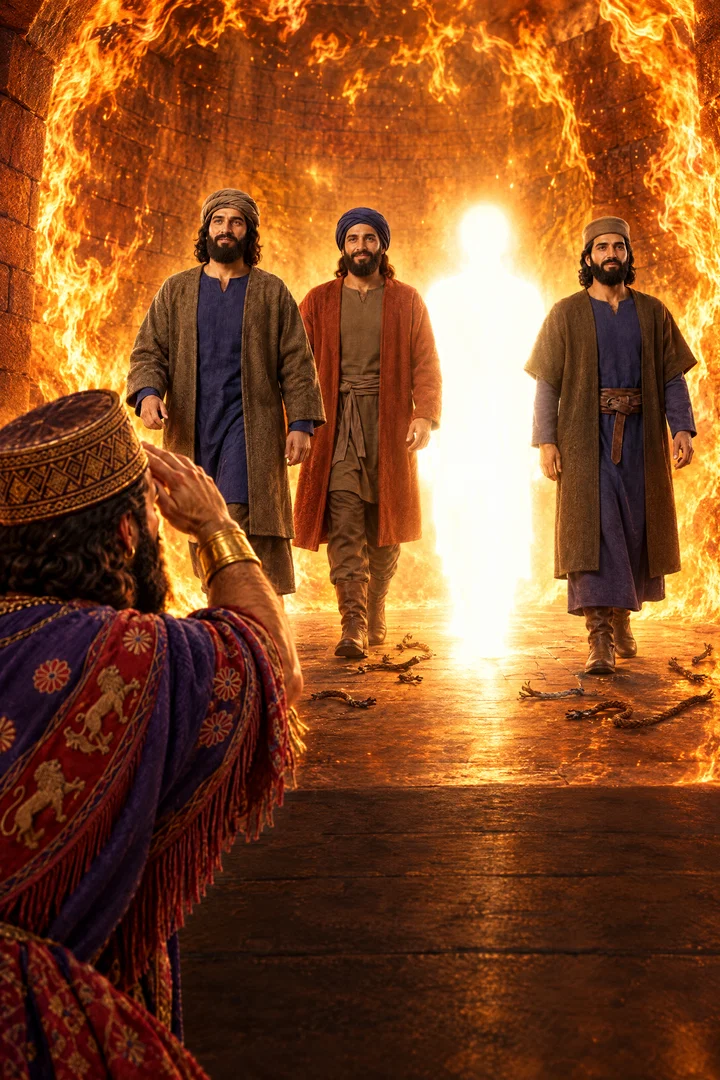
He answered and said, Lo, I see four men loose, walking in the midst of the fire, and they have no hurt; and the form of the fourth is like the Son of God.
The Son of God is seen walking with them in the furnace after their refusal.
- Acts 4:19-20
But Peter and John answered and said unto them, Whether it be right in the sight of God to hearken unto you more than unto God, judge ye.
Both show that God must be obeyed rather than human rulers when their commands conflict.
- Daniel 6:16-23
Then the king commanded, and they brought Daniel, and cast him into the den of lions. Now the king spake and said unto Daniel, Thy God whom thou servest continually, he will deliver thee.
Daniel remains faithful despite the decree and is miraculously delivered from the lions.
- Exodus 20:4-5
Thou shalt not make unto thee any graven image, or any likeness of any thing that is in heaven above, or that is in the earth beneath, or that is in the water under the earth:
God’s prohibition against bowing to images conflicted with the king’s command.
- Daniel 3:28
Then Nebuchadnezzar spake, and said, Blessed be the God of Shadrach, Meshach, and Abed-nego, who hath sent his angel, and delivered his servants that trusted in him, and have changed the king’s word, and yielded their bodies, that they might not serve nor worship any god, except their own God.
The king later praises their refusal to obey his command over God.
- Jeremiah 27:5-8
I have made the earth, the man and the beast that are upon the ground, by my great power and by my outstretched arm, and have given it unto whom it seemed meet unto me.
God calls Nebuchadnezzar his servant while setting limits on his rule.
- Daniel 3:4-6
Then an herald cried aloud, To you it is commanded, O people, nations, and languages,
The king commands worship of the image under threat of death.
- Daniel 4:34-37
And at the end of the days I Nebuchadnezzar lifted up mine eyes unto heaven, and mine understanding returned unto me, and I blessed the most High, and I praised and honoured him that liveth for ever, whose dominion is an everlasting dominion, and his kingdom is from generation to generation:
Nebuchadnezzar’s affliction humbles him, and he publicly acknowledges God’s sovereignty.
- Daniel 6:10
Now when Daniel knew that the writing was signed, he went into his house; and his windows being open in his chamber toward Jerusalem, he kneeled upon his knees three times a day, and prayed, and gave thanks before his God, as he did aforetime.
Both refuse a royal decree to obey God in worship, despite the death penalty.
- Hebrews 11:34
Quenched the violence of fire, escaped the edge of the sword, out of weakness were made strong, waxed valiant in fight, turned to flight the armies of the aliens.
Faith enabled them to face the threat of fire with courage.
- Daniel 3:27
And the princes, governors, and captains, and the king’s counsellors, being gathered together, saw these men, upon whose bodies the fire had no power, nor was an hair of their head singed, neither were their coats changed, nor the smell of fire had passed on them.
The men emerge from the fire unharmed, without even the smell of smoke.
- Revelation 13:15
And he had power to give life unto the image of the beast, that the image of the beast should both speak, and cause that as many as would not worship the image of the beast should be killed.
Refusal to worship the image brings a death threat, paralleling the Hebrews’ test of faith.
- Daniel 3:29
Therefore I make a decree, That every people, nation, and language, which speak any thing amiss against the God of Shadrach, Meshach, and Abed-nego, shall be cut in pieces, and their houses shall be made a dunghill: because there is no other God that can deliver after this sort.
The king confessed that no other God could deliver as their God did.
- Jeremiah 25:9
Behold, I will send and take all the families of the north, saith the LORD, and Nebuchadrezzar the king of Babylon, my servant, and will bring them against this land, and against the inhabitants thereof, and against all these nations round about, and will utterly destroy them, and make them an astonishment, and an hissing, and perpetual desolations.
Nebuchadnezzar’s rule is under God’s providence, though his command demands disobedience to God.
- Daniel 1:8
But Daniel purposed in his heart that he would not defile himself with the portion of the king’s meat, nor with the wine which he drank: therefore he requested of the prince of the eunuchs that he might not defile himself.
Daniel’s resolve not to defile himself with the king’s food anticipates his companions’ stand before the king.
- Daniel 2:31-45
Thou, O king, sawest, and behold a great image. This great image, whose brightness was excellent, stood before thee; and the form thereof was terrible.
Nebuchadnezzar’s dream revealed God’s sovereignty and kingdom.
- Daniel 3:1
Nebuchadnezzar the king made an image of gold, whose height was threescore cubits, and the breadth thereof six cubits: he set it up in the plain of Dura, in the province of Babylon.
They refused to worship the golden image Nebuchadnezzar set up.
- Daniel 3:22
Therefore because the king’s commandment was urgent, and the furnace exceeding hot, the flame of the fire slew those men that took up Shadrach, Meshach, and Abed-nego.
The persecutors are destroyed by their own cruel enactment.
- Daniel 3:30
Then the king promoted Shadrach, Meshach, and Abed-nego, in the province of Babylon.
king promotes them after their stand
Commentary part 1 of 2
Each commentary is drawn from primary sources: the writings of Ellen G. White and Adventist pioneers and periodicals. Each commentary is separate. Its own words are not a quotation; follow the references to read the source passages.
Ellen G. White
54 sources
They answered the king without hesitation, calmly and resolutely, respectfully refusing to argue or defend themselves because their loyalty was already settled.ST Dec 24, 1912ST Sep 2, 1897SPBC 160.5–161.1Ms 32, 1898, par. 15–1712MR 218.2–220.1 Bowing to the golden image on the plain of Dura was worship, and they would give such worship to the God of heaven alone, so obedience to God outweighed obedience to a human command against His law even under threat of death.ST Dec 24, 1912SPBC 160.5–161.1Ms 16, 1896, par. 31–34Lt 90, 1897, par. 19–20BS 32.1–3 Their answer was the language of faith, declaring that God was able to deliver them from the furnace and from the king's hand, yet resolving to remain faithful even if He did not.ST Dec 24, 1912Lt 132, 1901, par. 7–15Ms 16, 1896, par. 31–34 For that refusal they were cast into the fiery furnace, but Christ Himself walked with them in the flames and brought them forth unharmed, making their stand a public witness to the whole nation that He alone is the true and living God.STE 212.2–214.1SPBC 161.2Ms 168, 1898, par. 1–3Lt 109a, 1898, par. 5–8Ms 40a, 1890, par. 101–102 The same stand will be taken when civil and religious power unite to enforce a false sabbath in place of God's holy Sabbath, and God's people refuse to bow in the patience of keeping the commandments of God and the faith of Jesus.Ms 32, 1898, par. 15–17PK 512.112MR 218.2–220.1Lt 90, 1897, par. 13–18Ms 100, 1893, par. 10
Historical Setting on Dura
The answer is given to Nebuchadnezzar's command to fall down and worship the golden image he had set up on the plain of Dura, an exceedingly costly and magnificent idolatrous image that represented the kingdom of Babylon and especially Nebuchadnezzar himself and the glory of himself and his kingdom.ST Nov 5, 1896Ms 168, 1898, par. 1–3Lt 109a, 1898, par. 5–8Ms 47a, 1898, par. 2–513MR 60.1–61.2 The three who refused to bow the knee were Hebrew exiles and captives who cherished the knowledge of the true God, and their principles forbade homage to the idol as a rival to the God of heaven to whom they owed every faculty they possessed.ST Nov 5, 1896Ms 168, 1898, par. 1–3Lt 109a, 1898, par. 5–813MR 60.1–61.2 Because of that refusal they were cast into the burning fiery furnace, but Christ Himself, the Lord Jesus, walked with them in the flames and preserved them from all harm, and they came forth without even the smell of fire upon their garments.Ms 168, 1898, par. 1–3Lt 109a, 1898, par. 5–8Ms 40a, 1890, par. 101–102Ms 47a, 1898, par. 2–513MR 60.1–61.2 The wonderful miracle so worked upon Nebuchadnezzar's heart that he believed in God, was convinced that the God of the three Hebrews was the living God, and acknowledged Him as more powerful than any other kingdom and superior in power over earthly kings.Ms 168, 1898, par. 1–3Lt 109a, 1898, par. 5–8Ms 47a, 1898, par. 2–513MR 60.1–61.2 Because he did not continue to walk in the light he lost the holy impression made upon his mind, so God gave him another dream recorded in the fourth chapter of Daniel.13MR 60.1–61.2
The image had been set up after God had revealed Himself to the king in the dream of the great image explained by Daniel, in which his kingdom was the head of gold, and after that light was perverted.Ms 47a, 1898, par. 2–513MR 60.1–61.2 He and his counselors were flattered by that honor, and heathen counselors caused him to place himself before the people as an object of worship, commanding all men to bow down before the image.13MR 60.1–61.2 His advisers thus ensnared the Hebrew captives by leading the king to decree that every knee should bow.12MR 218.2–220.1 The command was renewed idolatry, for although he had acknowledged God's power and was for a time influenced and restrained by the fear of God, worldly ambition and pride remained in his heart.PK 503.2 He later ceased to honor God and returned to idol-worship with greater zeal.PK 503.2
The speakers are Shadrach, Meshach and Abed-nego, Daniel's three companions set over the province of Babylon, brought before Nebuchadnezzar after refusing to worship his golden image and threatened with the burning fiery furnace heated seven times hotter than it was wont to be heated.BS 32.1–35T 453.1–4Ms 40a, 1890, par. 101–102 Their history belongs to the Lord's wonderful deliverance of the three Hebrew worthies, setting forth important principles regarding the working out of the Lord's purpose for the children of obedience and the children of disobedience.Lt 118, 1910, par. 2 It stands against the background of Nebuchadnezzar's earlier dream and its prophecy of God's everlasting kingdom.PK 503.1 Their trial tested the integrity of the young Hebrews and showed an idolatrous nation the power and faithfulness of Israel's God, since the attempted enforcement of idolatry brought knowledge of the true God before Babylon's assembled rulers.5T 453.1–4BS 29.1
Their refusal continued a broader exile faithfulness under persecution and threat of death, in which the Hebrew exiles refused to disregard the Sabbath and refused to observe heathen festivals.DA 28.3 That faithfulness brought them face to face with kings and rulers so that the rulers and their people might receive the light, and time after time the greatest monarchs were led by it to proclaim the supremacy of the God whom the Hebrew captives worshiped.DA 28.3 It is of one piece with Daniel standing firm before the king in a position of danger in a duty appointed by God, rather than pursuing high station for personal distinction or seizing a role through ambition.STSE 113.2–3
Manner of Their Answer
They answered the king without hesitation, without fear, calmly, resolutely, and plainly, looking with calmness on the furnace and the idolatrous throng.ST Dec 24, 1912ST Sep 2, 1897SPBC 160.5–161.1Lt 132, 1901, par. 7–15Ms 16, 1896, par. 31–34 Their loyalty to God outweighed obedience to a human command against His law, and they trusted that He could deliver them yet would remain faithful even if He did not.ST Dec 24, 1912Lt 132, 1901, par. 7–15Ms 16, 1896, par. 31–3419MR 119.1–120.2 Their calm reply expressed firm faithfulness to God in the face of coercion, determined to honor Him at any cost rather than worship the golden image even under threat of death.ST Sep 2, 1897SPBC 160.5–161.1Lt 132, 1901, par. 7–15STE 212.2–214.1
To be not careful to answer means a respectful but decided refusal to argue, dispute, or defend themselves.Ms 32, 1898, par. 15–17BS 32.1–312MR 218.2–220.1 They would not dispute with the king, knowing it would only increase his fury, but took the Word of God for their guide.Ms 32, 1898, par. 15–17BS 32.1–3 They stood before a king determined to silence them without anxiety and care for themselves and without seeking their own ease.BS 32.1–3SG4 275.3–276.3 Their great anxiety was that the truth be not exposed to insult, and they were ready to die rather than allow their enemies to triumph.SG4 275.3–276.3
Their minds were already made up and their loyalty was settled before the threat.Lt 132, 1901, par. 7–15STE 212.2–214.1Ms 163, 1898, par. 5–11 Guided by duty and conscience, and educated that the fear of the Lord is the beginning of wisdom to worship and serve God only, they would not bow to the image of gold representing his kingdom.Lt 132, 1901, par. 7–15Ms 163, 1898, par. 5–11Ms 2b, 1895, par. 25–26 They did not turn aside even when given another opportunity to bow, but openly refused the king's requirement even in the face of death because loyalty to God comes before pleasing men.Ms 163, 1898, par. 5–11Ms 2b, 1895, par. 25–26 Such settled refusal grew from an earlier determination to be true at any cost and let no influence come between them and their Maker.Ms 2b, 1895, par. 25–26
Their answer is the language of faith, declaring God is able to deliver from the burning fiery furnace and from the king's hand.ST Dec 24, 1912Ms 16, 1896, par. 31–3419MR 119.1–120.2Ms 32, 1898, par. 15–17 Yet they resolved even if He does not to refuse to serve false gods or worship the golden image.Ms 32, 1898, par. 15–17STE 212.2–214.1 Their faithfulness did not depend on whether God delivered them or on certainty of rescue.ST Dec 24, 1912Lt 132, 1901, par. 7–15STE 212.2–214.1 They were willing to die rather than dishonor God, holding fast at any cost whether or not He delivered them from the furnace.ST Dec 24, 1912Lt 132, 1901, par. 7–15Ms 16, 1896, par. 31–3419MR 119.1–120.2
Loyalty to God Alone
Bowing to the image was an act of worship, and refusal to bow rested on loyalty to the God of heaven as King of kings and Lord of lords, to whom alone such worship is due, with no honor to be given to an idol or false god.SPBC 160.5–161.1Ms 16, 1896, par. 31–3419MR 119.1–120.2PK 507.13MR 95.4 When threatened with death for refusing to worship the golden image, Shadrach, Meshach, and Abed-nego answered the king without hesitation and without fear, plainly refusing because to worship would violate conscience.ST Dec 24, 1912SPBC 160.5–161.1Ms 16, 1896, par. 31–343MR 95.4Ms 44, 1886, par. 8–10 They would not yield to the king's demand even under threat of death, trusting that God could deliver them yet resolved to remain faithful and obedient even if He did not.ST Dec 24, 1912SPBC 160.5–161.1Ms 16, 1896, par. 31–3419MR 119.1–120.2 Loyalty to God outweighed obedience to a human command against God's law, for conscience in matters of God is stronger than the king's authority and must not be violated even when refusal brings the threat of death.ST Dec 24, 1912Lt 90, 1897, par. 19–20Ms 15, 1896, par. 33–34 Obedience to the laws of Babylon was therefore only so far as they did not conflict with the claims of God, with no swerving a hair's breadth from duty owed to the Creator.BS 32.1–3Ms 15, 1896, par. 33–34Ms 2b, 1895, par. 17–18 Principle must never be sacrificed even in the slightest particular, so they openly refused the king's requirement even in the face of death, because loyalty to God and service to Jesus Christ with undivided heart come before pleasing men and before human claims.Ms 2b, 1895, par. 25–26Ms 15, 1896, par. 33–34Ms 2b, 1895, par. 17–18
They would not violate conscience or be untrue to God to escape the fiery furnace, holding fast to the fear of God regardless of consequences.Ms 44, 1886, par. 8–105T 42.2–43.2Ms 8a, 1891, par. 2–5 Integrity means defending truth without being moved by opposition, human praise or blame, or reward, preferring death to violating conscience.5T 42.2–43.23T 22.3Ms 8a, 1891, par. 2–5 Though utterly helpless and powerless in themselves against the throne and the power of the whole world, they withstood human power and policy in support of evil through trust in God's word.RH Dec 24, 1908ED 254.2–3RH Nov 11, 1915 Their answer to the king belongs to the triumph of righteousness by faith, by which faith in God's word enables resistance to the world's power used against God.RH Dec 24, 1908ED 254.2–3RH Nov 11, 1915 They had learned from the history of their fathers that disobedience to God is dishonor, disaster, ruin, and death, and that the fear of the Lord is the beginning of wisdom and the foundation of all true prosperity.PK 507.3BS 32.1–3Ms 163, 1898, par. 5–11 Educated to worship and serve God only, their minds were already made up, so threats could not turn them from loyalty, and they would not bow to Nebuchadnezzar's image of gold representing his kingdom even when given another opportunity to bow.PK 507.3BS 32.1–3Ms 163, 1898, par. 5–11
Public Witness and Deliverance
Filled with the Holy Spirit, their answer began a public witness to the whole nation that the God they worshiped is the only true and living God.STE 212.2–214.1SPBC 161.2ST Nov 5, 1896Ms 16, 1896, par. 35 It was the most eloquent presentation of their principles, manifesting that He alone is the object of honor and worship and that no consideration, not even the preservation of life itself, can induce the least concession to idolatry.STE 212.2–214.1SPBC 161.2ST Nov 5, 1896Ms 16, 1896, par. 35 To impress idolaters with the power and greatness of the living God, His servants must reveal their own reverence for God.SPBC 161.2 Their principles forbade homage to the idol because it was a rival to the God of heaven, and their faithfulness did not depend on whether God would deliver them from the furnace.STE 212.2–214.1ST Nov 5, 1896
Their great anxiety was that the truth be not exposed to the insults of the ungodly, and they were ready to die rather than allow their enemies to triumph.SG4 275.3–276.3 While full of generous sympathy toward all men, they aspired to prove themselves entirely loyal to God, to whom they owed every faculty they possessed.ST Nov 5, 1896 They stood without anxiety and care for themselves and without seeking their own ease.SG4 275.3–276.3
For their refusal they were cast into the fiery furnace heated seven times hotter than usual, but they were not forsaken of God.Ms 168, 1898, par. 1–3Lt 109a, 1898, par. 5–8Ms 40a, 1890, par. 101–102Ms 47a, 1898, par. 2–513MR 60.1–61.2 Christ Himself, the form of the Fourth, was with them and walked with them in the flames and preserved them from all harm.Ms 168, 1898, par. 1–3Lt 109a, 1898, par. 5–8Ms 47a, 1898, par. 2–513MR 60.1–61.2Ms 83, 1886, par. 12–14 They came forth without even the smell of fire upon their garments, the fire did not consume them, as He promises to manifest Himself to him who has His commandments and keeps them and loves Him.Ms 40a, 1890, par. 101–10213MR 60.1–61.2Ms 83, 1886, par. 12–14
God manifested His power for servants who so trusted Him, and He can preserve His faithful people through deadly persecution.ST Nov 5, 18964SP 120.1 He does not promise exemption from trials but promises strength equal to the day and grace sufficient, made perfect in weakness. Jesus was by the side of the faithful three in the fire, and He stands beside everyone called to go through a fiery furnace for Christ's sake. Those who love their Redeemer rejoice at every opportunity to share His humiliation and reproach, and love for Him makes suffering for His sake sweet, while faithfulness does not depend on being certain of rescue, for they were willing to die rather than dishonor God.4SP 120.1
The attempted enforcement of idolatry brought knowledge of the true God before Babylon's assembled rulers.5T 453.1–4 Their refusal brought them face to face with kings and rulers so that rulers and their people might receive the light, and time after time the greatest monarchs were led by such faithfulness to proclaim the supremacy of the God whom the Hebrew captives worshiped.DA 28.3 God honored their faithfulness, vindicated His servants who openly refused to compromise truth even in the slightest particular, and used it to spread the knowledge of the true God throughout the length and breadth of Babylon, accomplishing the very purpose for which He had permitted them to be carried captive to that heathen land.Ms 2b, 1895, par. 25–26
The wonderful miracle so worked upon Nebuchadnezzar's heart that he believed in God, acknowledged Him as more powerful than any other kingdom and superior over earthly kings, and was convinced that the God of the three Hebrews was the living God.Ms 168, 1898, par. 1–3Lt 109a, 1898, par. 5–8Ms 47a, 1898, par. 2–513MR 60.1–61.2 Because he did not continue to walk in the light he lost the holy impression made upon his mind, so God gave him another dream recorded in the fourth chapter of Daniel.13MR 60.1–61.2
The same trust in the same God gives a fearless advocate of truth the same calm firmness and readiness to seal his testimony with his blood before emperors and great men.SG4 275.3–276.3
Prophetic Parallels to Come
The same stand taken on the plain of Dura will be taken again in the test over the Sabbath question, when those who obey God's commandments refuse the idol sabbath exalted by Christendom, which has no sanctity, and hold fast to the day God sanctified and blessed.Ms 32, 1898, par. 15–17 Especially the wrath of man will be aroused against those who hallow the Sabbath of the fourth commandment, until at last a universal decree denounces them as deserving of death.PK 512.1 Their refusal to bow pictures God's people refusing to bow when church and state unite to enforce worship of an idol Sunday sabbath in place of God's holy Sabbath, for as Nebuchadnezzar's advisers ensnared the Hebrew captives by leading the king to decree that every knee should bow to the image, so men today strive to turn God's people from allegiance by human Sunday laws that put human power where God should be.12MR 218.2–220.1 Their answer without hesitation, refusing to surrender allegiance to God under human command, exemplifies faithfulness to conscience when civil power demands worship and applies directly to laws enforcing a false sabbath in place of God's Sabbath.Lt 90, 1897, par. 13–18 Human rulers cannot rightly force the conscience, which God alone controls, and when authorities make laws against His commandment-keeping people, God will intervene for those who remain loyal to Him, while those who make cruel enactments to destroy the faithful will be destroyed by the recoil of their own actions, as those who sought to destroy the three were themselves destroyed.12MR 218.2–220.1Ms 78, 1897, par. 40
Their example applies to a future time in the Southern States when people must decide whether to obey God's commandments, and until that time believers should not act presumptuously or encourage defiance and resistance.Lt 35, 1895, par. 1–3 Their firm stand under threat parallels the Reformers' refusal to give up liberty of conscience and individual judgment, even when they knew that faithfulness could bring condemnation and death.4SP 160.1 Their trust and preservation in the fiery furnace gave Luther confidence that God could preserve him as he faced danger for the truth.1T 373.2–375.1
They stood with fixed purpose to be true to principle and loyal to the truth, let come what may, not turning aside from allegiance to God when threatened with the flaming fiery furnace heated seven times hotter than it was wont to be heated.Ms 40a, 1890, par. 101–102 They stood firm in the time of trial and were cast into the furnace, but they were not forsaken, for the form of the Fourth was seen walking with them in the flames, and they came forth without even the smell of fire upon their garments, a pattern for steadfastness in the continual sharp contests until the controversy between good and evil ends.Ms 40a, 1890, par. 101–102 The same self-denial and self-sacrifice, ruling animal passions, appetites, and hereditary and cultivated habits rather than living in bondage to them, controlling circumstances by inwrought principle without waiting for will and circumstances to be adjusted, and pressing together in unity with Jesus Christ always ready and composed with the kingdom of God within, must mark God's people in the final collision between those on the Lord's side and those united under Antichrist until the Lord appears to set up a kingdom that shall stand forever.Lt 73, 1896, par. 39–42
Faithful Living Today
Their example teaches that God's favor matters more than the praise of rulers, for they openly stood by their faith before the king and would not turn from integrity to obey a human command that dishonored God.MYP 27.4–28.1 Faith is to be confessed through words, habits, and actions even in a royal court, and God honored them before the people for their determination to honor Him above every human power.MYP 27.4–28.1
Their stand grew from an earlier determination to be true at any cost and to let no influence come between them and their Maker.Ms 2b, 1895, par. 25–26 Because loyalty to God comes before pleasing men, they openly refused the king's requirement even in the face of death, and principle must never be sacrificed even in the slightest particular.Ms 2b, 1895, par. 25–26 Such faithfulness becomes visible when truth is opposed, when human authority requires violation of God's law.Ms 2b, 1895, par. 25–26Ms 15, 1896, par. 33–34 God vindicated His servants for their steadfast refusal to compromise truth, was honored by their faithfulness, and used it to spread the knowledge of the true God throughout the length and breadth of Babylon, accomplishing the very purpose for which He had permitted them to be carried captive to that heathen land.Ms 2b, 1895, par. 25–26
To live this answer means being true to principle, with service to Jesus Christ first and obedience to human claims only where it does not conflict with that service.Ms 2b, 1895, par. 17–18 It means letting no one come between the soul and God, serving the Lord with undivided heart, praying for grace to live Christ's religion, and remaining faithful to God even when meeting opposition and temptation.Ms 2b, 1895, par. 17–18 It means holding firm convictions of duty to observe the Sabbath and keeping it the best possible under all circumstances, and loving the Lord with all heart and soul without swerving from allegiance whatever the situation.Ms 2b, 1895, par. 17–18 This refusal is the patience of the saints, keeping the commandments of God and the faith of Jesus when decrees of earthly rulers oppose the authority of the King of heaven.Ms 100, 1893, par. 10
The three stand as examples of self-denial and self-sacrifice with the attributes of Christ, refusing to be enslaved or ruled by circumstances, appetites, passions, or hereditary and cultivated habits.Lt 73, 1896, par. 39–4220MR 113.3–114.1STMW9 56.1–2 They ruled the animal passions instead of living in bondage to habit, made all circumstances, appetites and passions servants rather than masters, and passed like a plowshare through hereditary and cultivated habits and all surroundings.Lt 73, 1896, par. 39–42 They controlled circumstances by an inwrought principle learned from the greatest Teacher, without waiting for will and circumstances to be adjusted.Lt 73, 1896, par. 39–42 God's people in the final collision between those on the Lord's side and those united under Antichrist must have the same self-denial and self-sacrifice, pressing together in unity one with Jesus Christ, always ready and composed, with the kingdom of God within them, until the Lord appears to set up a kingdom that shall stand forever.Lt 73, 1896, par. 39–42
Their settled refusal is the lesson for facing trials when Satan comes in great power as a roaring lion, keeping reason under God's control instead of disconnecting from God to serve Satan.Ms 163, 1898, par. 5–11 Though utterly helpless in themselves, they withstood the throne and the power of the whole world through trust in the word of God, and their answer belongs to the triumph of righteousness by faith against human power and policy in support of evil.ED 254.2–3 Educated that the fear of the Lord is the beginning of wisdom to worship and serve God only, they would not bow even when given another opportunity to bow.Ms 163, 1898, par. 5–11 By such trust the youth of today are called to join the world's true nobility and royal line.ED 254.2–3
Sources