Daniel 1:7
Unto whom the prince of the eunuchs gave names: for he gave unto Daniel the name of Belteshazzar; and to Hananiah, of Shadrach; and to Mishael, of Meshach; and to Azariah, of Abed-nego.
Translations
To whom the prince of the eunuchs gave names: for he gave to Daniel the name of Belteshazzar; and to Hananiah, of Shadrach; and to Mishael, of Meshach; and to Azariah, of Abednego.
Unto whom the prince of the eunuchs gave names: for he gave unto Daniel the name of Belteshazzar; and to Hananiah, of Shadrach; and to Mishael, of Meshach; and to Azariah, of Abed-nego.
unto whom the prince of the eunuchs gave names: for he gave unto Daniel the name of Belteshazzar; and to Hananiah, of Shadrach; and to Mishael, of Meshach; and to Azariah, of Abed-nego.
To whom the prince of the eunuchs gave names: for he gave to Daniel the name of Belteshazzar; and to Hananiah, of Shadrach; and to Mishael, of Meshach; and to Azariah, of Abed-nego.
Revised Version, American Standard Version
And the prince of the eunuchs gave names unto them: unto Daniel he gave the name of Belteshazzar; and to Hananiah, of Shadrach; and to Mishael, of Meshach; and to Azariah, of Abed-nego.
and the chief of the eunuchs setteth names on them, and he setteth on Daniel, Belteshazzar; and on Hananiah, Shadrach; and on Mishael, Meshach; and on Azariah, Abed-Nego.
And the prince of the eunuchs gave them names: to Daniel he gave [ the name] Belteshazzar, and to Hananiah, Shadrach, and to Mishael, Meshach, and to Azariah, Abed-nego.
and the ruler of the eunuchs gave them names,—yea he gave to Daniel the name of Belteshazzar, and to Hananiah of Shadrach, and to Mishael of Meshach, and to Azariah of Abed-nego.
Berean Standard Bible, Majority Standard Bible
The chief official gave them new names: To Daniel he gave the name Belteshazzar; to Hananiah, Shadrach; to Mishael, Meshach; and to Azariah, Abednego.
The prince of the eunuchs gave names to them: to Daniel he gave the name Belteshazzar; to Hananiah, Shadrach; to Mishael, Meshach; and to Azariah, Abednego.
And the captain of the unsexed servants gave them names; to Daniel he gave the name of Belteshazzar, to Hananiah the name of Shadrach, to Mishael the name of Meshach, and to Azariah the name of Abed-nego.
Vnto whome the chiefe of the Eunuches gaue other names: for hee called Daniel, Belteshazzar, and Hananiah, Shadrach, and Mishael, Meshach, and Azariah, Abednego.
Douay-Rheims (Challoner revision)
And the master of the eunuchs gave them names: to Daniel, Baltassar: to Ananias, Sidrach: to Misael, Misach: and to Azarias, Abdenago.
Pictures
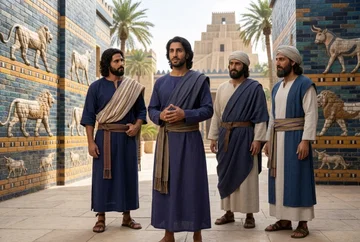
Cross-references
- Daniel 1:20
And in all matters of wisdom and understanding, that the king enquired of them, he found them ten times better than all the magicians and astrologers that were in all his realm.
God-given wisdom and understanding made them ten times better than the king’s other advisers.
- Isaiah 39:7
And of thy sons that shall issue from thee, which thou shalt beget, shall they take away; and they shall be eunuchs in the palace of the king of Babylon.
Foretells the royal sons’ removal to serve in Babylon’s palace.
- Daniel 1:17
As for these four children, God gave them knowledge and skill in all learning and wisdom: and Daniel had understanding in all visions and dreams.
God gave the four young men knowledge, skill, and understanding.
- Daniel 5:12
Forasmuch as an excellent spirit, and knowledge, and understanding, interpreting of dreams, and shewing of hard sentences, and dissolving of doubts, were found in the same Daniel, whom the king named Belteshazzar: now let Daniel be called, and he will shew the interpretation.
Belshazzar calls Daniel by the Babylonian name given to him.
- Daniel 1:12-15
Prove thy servants, I beseech thee, ten days; and let them give us pulse to eat, and water to drink.
The ten-day food test continues Daniel’s response to his circumstances in Babylon.
- 2 Kings 20:18
And of thy sons that shall issue from thee, which thou shalt beget, shall they take away; and they shall be eunuchs in the palace of the king of Babylon.
Hezekiah’s descendants are prophesied to serve in Babylon, where Daniel was taken captive.
- Daniel 1:18-19
Now at the end of the days that the king had said he should bring them in, then the prince of the eunuchs brought them in before Nebuchadnezzar.
After three years of training, they were presented to the king and found exceptional.
- Daniel 3:12-18
There are certain Jews whom thou hast set over the affairs of the province of Babylon, Shadrach, Meshach, and Abed-nego; these men, O king, have not regarded thee: they serve not thy gods, nor worship the golden image which thou hast set up.
The renamed captives refuse the king’s demand to worship the image and remain faithful to God.
- Daniel 2:48
Then the king made Daniel a great man, and gave him many great gifts, and made him ruler over the whole province of Babylon, and chief of the governors over all the wise men of Babylon.
shows Daniel's promotion under Babylon
- Jeremiah 25:9-11
Behold, I will send and take all the families of the north, saith the LORD, and Nebuchadrezzar the king of Babylon, my servant, and will bring them against this land, and against the inhabitants thereof, and against all these nations round about, and will utterly destroy them, and make them an astonishment, and an hissing, and perpetual desolations.
foretells the capture fulfilled in them
- Daniel 5:30-31
In that night was Belshazzar the king of the Chaldeans slain.
Both accounts are confirmed by Babylonian records.
- Daniel 6:1-3
It pleased Darius to set over the kingdom an hundred and twenty princes, which should be over the whole kingdom;
shows Daniel's service under Medo-Persia
- Daniel 6:13
Then answered they and said before the king, That Daniel, which is of the children of the captivity of Judah, regardeth not thee, O king, nor the decree that thou hast signed, but maketh his petition three times a day.
identifies Daniel as of the captivity of Judah
Commentary
Each commentary is drawn from primary sources: the writings of Ellen G. White and Adventist pioneers and periodicals. Each commentary is separate. Its own words are not a quotation; follow the references to read the source passages.
Ellen G. White
40 sources
Daniel and his three companions were carried captive to Babylon early in the reign of Jehoiakim when about fifteen or sixteen years old, and placed under the prince of the eunuchs to be taught the learning and tongue of the Chaldeans for three years that they might stand in the king's palace.PK 476B.1Ms 122, 1897, par. 25–26PK 428.1Lt 55, 1895, par. 16–17 The officer changed their valued Hebrew names to Belteshazzar, Shadrach, Meshach, and Abed-nego, names referring to the worship of heathen deities, as part of a policy of changing familiar conditions to gain control over their minds.Ms 85, 1910, par. 1–3Ms 110, 1904, par. 17–18PK 480.3–481.1Ms 85, 1910, par. 4 The renaming was an underhanded, gradual attempt to lead worshipers of the true God to worship idols and become one with the Babylonians in religion through daily exposure to idolatrous customs, rites, and display.Ms 110, 1904, par. 17–18PK 480.3–481.1Ms 110, 1904, par. 7 At the start of that life they faced a decisive test of loyalty when food from the king's table and his wine would count as homage to Babylon's gods, and Daniel purposed with his companions not to defile themselves but to honor God through temperance on simple fare.Ms 175, 1898, par. 3–4Ms 71, 1910, par. 1PK 481.2Ms 132, 1901, par. 11 God honored their loyalty by giving them wisdom, knowledge, and intellectual power, so that at the end of the three years none were found like them and they stood ten times better than all the magicians and astrologers, making the true God known among heathen nations.Ms 71, 1910, par. 1PK 479.2CTBH 26.3–27.28T 153.1–3
Babylonian Captivity Setting
The renaming took place early in the reign of Jehoiakim, when Nebuchadnezzar for the first time besieged and captured Jerusalem and carried away Daniel and his companions with others specially chosen for service in the court of Babylon.PK 428.1 Daniel was about fifteen or sixteen years old when taken captive, and his being described as a child means he was in his youth, along with Hananiah, Mishael, and Azariah, the four Hebrew youth receiving an education for the king's court.Ms 122, 1897, par. 25–26Lt 55, 1895, par. 16–17 They did not enter the court by their own pride or ambition but were carried there in warfare and placed there by Infinite Wisdom for a trial of loyalty, brought into companionship with those who neither knew nor feared the true God.CTBH 26.3–27.2Ms 132, 1901, par. 1–2Ms 35, 1890, par. 7
They were set in the palace among heathen people under the prince of the eunuchs, the officer who had them in charge.PK 476B.1 There they were selected to be taught the learning and tongue of the Chaldeans over three years so that they might stand in the king's palace, young men of perfect form and fine mental qualities held under the king's three-year plan to assimilate them.Ms 110, 1904, par. 7 The king did not use an imposing display of absolute power or direct compulsion, but worked by a gradual method of daily familiarity at table with idolaters.Ms 110, 1904, par. 7
The chapter to which the verse belongs reveals the spirit at work in those under the control of God's enemy, yet it is full of valuable instruction and shows consistency.Ms 71, 1910, par. 5–6Lt 29, 1900, par. 1–2 Daniel and his fellows endured when tested, and afterward when the king threatened to kill all the wise men and astrologers for not telling it, an angel of God gave Daniel the king's forgotten dream and its interpretation so he could give it to the people.Ms 71, 1910, par. 5–6 Daniel is listed first among the four whose names were changed, reflecting his strong influence as their leader, and the four were bound together in close fellowship so that his firm stand for what was right helped his companions stand with him, for had he yielded to self-pleasing they too might have failed and would not have been honored by God.4MR 129.1
Meaning of the Renaming
The officer set over the captives exchanged their familiar Hebrew names — Daniel, Hananiah, Mishael, and Azariah — for Belteshazzar, Shadrach, Meshach, and Abed-nego, as part of a deliberate policy of altering the conditions they had known in order to gain control over their minds.Ms 85, 1910, par. 1–3Ms 85, 1910, par. 4 The change struck at what Hebrew parents prized highly, for the names they gave their children carried peculiar significance and often expressed traits of character they hoped the children would develop.Ms 110, 1904, par. 17–18PK 480.3–481.1 The names imposed in their place referred to the worship of heathen deities and represented Chaldean gods, so that worshipers of the true God would constantly hear and answer to the gods of Babylon.Ms 110, 1904, par. 17–18PK 480.3–481.1
The renaming was another underhanded attempt by the king to lead them to worship idols, carried out not by an imposing display of absolute power or by direct compulsion to renounce their faith, but by a gradual and insidious method.Ms 110, 1904, par. 17–18Ms 110, 1904, par. 7 That method was to make the youths familiar with Babylon during three years of sitting at table with idolaters, with daily exposure to idolatrous customs and to the display connected with its charming, seductive rites.PK 480.3–481.1Ms 110, 1904, par. 7 The hope was that familiarity would induce them fully to apostatize and become one with the Babylonians in matters of religion.PK 480.3–481.1Ms 110, 1904, par. 7
Though their new names and their circumstances bore the mark of captivity, they were to retain their faith and honor their identity as worshipers of the living God.PK 479.16T 219.1–2CH 205.1–2 That name remained an honor they were to bear, refusing all compromise with idolaters while representing God among heathen nations in both prosperity and adversity.PK 479.16T 219.1–2CH 205.1–2
Loyalty and Temperance Test
At the very start of life in Babylon the four youths faced a decisive test of loyalty, for to eat the food and drink the wine from the king's table would have counted as homage to Babylon's gods, since that food had been offered to idols.PK 481.2 Daniel purposed in his heart not to defile himself with the portion of the king's meat nor with the wine, and with Hananiah, Mishael, and Azariah he declined the wine and the luxuries of the table, including swine's flesh and other meats forbidden by the law of Moses.Ms 132, 1901, par. 11 When the officer in charge hesitated from fear of the king's displeasure, they requested simple fare and obtained a ten days' trial, at the end of which they were found far healthier in appearance than those who ate the king's dainties, and thereafter they continued on pulse and water.
They refused the appointed food and wine because they believed it would weaken mind and body and hinder God's service, seeking clear minds and sound health so they could gain knowledge, honor God, and represent true religion among a heathen people.Ms 132, 1901, par. 11 Their resolve to honor God through temperance in eating and drinking preserved their physical powers and strengthened their mental and spiritual understanding, supporting clear intelligence and the pursuit of knowledge of God and truth that they could then bring before the king and his associates.Ms 175, 1898, par. 3–4Ms 71, 1910, par. 1Ms 132, 1901, par. 11 They carefully considered the dangers and difficulties of their position in companionship with those who neither knew nor feared the true God, and then in the fear of God decided that even at the risk of the king's displeasure they would be true to the religion of their fathers.CTBH 26.3–27.2 In doing so they guarded their religious instruction, sought God's guidance so as not to take part in idolatrous practices, and obeyed the divine law both physical and moral.CTBH 26.3–27.2Ms 35, 1890, par. 1
The instruction they had received in the homes of their parents and right education in early life in truth and sound principles made them strong in faith and constant in service of the living God, and helped preserve them when tested and tried in a strange land.Ms 140, 1906, par. 19–20Ms 56, 1895, par. 8PK 428.1 When separated from home influences and sacred associations they honored the instructors of their childhood by putting that instruction into practice.CTBH 26.3–27.2Ms 35, 1890, par. 7 When tested by the king at the end of the three years of training none were found like them for keen apprehension, choice and exact language, and extensive and varied knowledge testifying to unimpaired mental vigor, so that they stood before the king ten times better than all the magicians and astrologers.CTBH 26.3–27.2
Divine Purpose and Blessing
Their captivity and the humiliation it brought became the occasion for God to show to Babylon His supremacy, the holiness of His requirements, and the sure results of obedience through those who remained loyal to Him.PK 479.2 Their being carried captive was permitted by God to serve His purpose that they should make the true God known among heathen nations and represent Him without compromising with idolatry.8T 153.1–3Ms 13, 1900, par. 7–10 Their training in self-control in food and drink supported clear intelligence and their pursuit of the knowledge of God and truth, and their success enabled them to bring that knowledge before the king and his associates and nobles, giving them knowledge of the Creator, the only true God.Ms 71, 1910, par. 18T 153.1–3Ms 13, 1900, par. 7–10
What happened early in the reign of Jehoiakim, when Nebuchadnezzar for the first time besieged and captured Jerusalem and carried away Daniel and his companions with others specially chosen for service in the court of Babylon, shows that conscientious observance of the commands of Holy Scripture brought them opportunities to exalt the true God before the nations of earth.PK 428.1 The instruction they had received in the homes of their parents made them strong in faith and constant in their service of the living God, the Creator of the heavens and the earth.PK 428.1 In a strange land their faith was tried to the utmost, but trust in the promises of God proved all-sufficient in every experience, and the Scriptures proved a guide and a stay, so that the envy and hatred of enemies could not prevail against them because God helped them.PK 428.12T 139.2
They considered their position with its dangers and difficulties and then in the fear of God decided that even at the risk of the king's displeasure they would be true to the religion of their fathers, obeying the divine law both physical and moral.CTBH 26.3–27.2 God honored their loyalty by giving them wisdom, knowledge, and understanding, and the blessing of God gave them strength and comeliness and intellectual power.CTBH 26.3–27.28T 153.1–3 When tested by the king at the end of the three years of training none were found like them for keen apprehension, choice and exact language, and extensive and varied knowledge testifying to unimpaired mental vigor, so that they stood before the king ten times better than all the magicians and astrologers.CTBH 26.3–27.2
God's blessing did not replace the effort their studies required, for they worked diligently, using their abilities and opportunities fully.SPBC 178.1MYP 147.1Lt 55, 1895, par. 16–17 The Lord's eye was upon all their works and He expected fidelity from His servants, and they did not treat the blessing of the Lord as a substitute for the taxing effort required of them.Lt 55, 1895, par. 16–17 They were diligent in study, bringing all their ability to the work, and by close, severe taxation of their powers made the most of their opportunities for study and labor, discerning that through the grace of God their destiny depended upon their own will and action.SPBC 178.1MYP 147.1Lt 55, 1895, par. 16–17
The brief record presents Daniel as an illustrious and holy man, a youth who was tested and stood firm to principle as a pattern of integrity.BS 16.2SCE 23.1 His life is an example of what people may become when united with God, and an encouragement to those who face trial and temptation.BS 16.2SCE 23.1 His education in Babylon, set forth in Daniel 1:3-20, revealed the superiority of heavenly wisdom over the learning of Babylon's highest schools.STE 221.1 His example teaches that God's word, welcomed into practical life, gives understanding and guides the student toward wisdom that endures for this life and for eternity.STE 221.1
Pattern for Believers Today
The history surrounding the renaming belongs to the prophet Daniel and his Hebrew associates in the court of Babylon, and it gives a comprehensive and forcible illustration of true temperance and its attendant blessings.CTBH 25.5–26.2CTBH 26.3–27.2 Daniel controlled his appetite and refused to defile himself with the king's meat and wine, and his conduct stands as an example of pure hygiene.CTBH 189.2 Daniel, Hananiah, Mishael, and Azariah were captives in a strange land brought into the king's court into companionship with those who neither knew nor feared the true God, not by their own pride or ambition but placed there by Infinite Wisdom for a trial of loyalty.CTBH 26.3–27.2 They considered their position with its dangers and difficulties and then in the fear of God decided that even at the risk of the king's displeasure they would be true to the religion of their fathers, obeying the divine law both physical and moral, and the blessing of God gave them strength and comeliness and intellectual power.CTBH 26.3–27.2 Having received right education in early life, when separated from home influences and sacred associations they honored the instructors of their childhood, joining habits of self-denial with earnestness of purpose, diligence, and steadfastness, not actuated by pride or unworthy ambition but seeking to acquit themselves creditably for the honor of their downtrodden people and for the glory of God whose servants they were.CTBH 26.3–27.2 When tested by the king at the end of the three years of training none were found like them for keen apprehension, choice and exact language, and extensive and varied knowledge testifying to unimpaired mental vigor, so they stood before the king ten times better than all the magicians and astrologers, proving that God always honors the right.CTBH 26.3–27.2
Erect form, firm step, fair countenance, undimmed senses, and untainted breath are certificates of good habits and insignia of nobility honoring obedience to nature's laws.CTBH 26.3–27.2 The life and work of Daniel and his fellows placed in Babylon give the pattern for every institution bearing the Seventh-day Adventist name to be to the world, even as Joseph was in Egypt.HPMMW 6.2–3 The account of Daniel and the four Hebrew youths shows that students can follow their example by staying close to God, praying for wisdom, and faithfully meeting their responsibilities under human and heavenly oversight.Ms 51, 1893, par. 33
Daniel placed in Babylon's school under a heathen name yet remaining faithful is the pattern for believers entering worldly colleges and institutions of learning as students.4MR 51.1–53.1 They should enter only when established, rooted and grounded in truth with the Spirit of God wrought into their being, make no pretensions, never sacrifice principle, and respect all rules and regulations of the school.4MR 51.1–53.1 They are to keep the living principles of truth and observe the Sabbath, and live the truth as Daniel and Paul did so that God's power manifested in their lives witnesses more than words.4MR 51.1–53.1 That life will provoke inquiry, and they should then tell inquirers in simple language the simple Bible doctrines, drop seeds of truth in minds and hearts, and welcome questions upon Bible doctrines without starting open controversy.4MR 51.1–53.1 They are to trust the Holy Spirit to arouse investigation, flash light into minds, and spring the seeds up to bear fruit for God's glory in the saving of souls.4MR 51.1–53.1
The record of Daniel and his companions shows that Christ is willing to reveal Himself to children.Ms 62, 1901, par. 17–18 It shows what God expects from children and youth when parents treat them as a sacred responsibility from God.Ms 62, 1901, par. 17–18 Parents are to teach them from babyhood to keep the commandments of God, to be obedient, and to form characters after the divine similitude so Christ may reveal Himself to them.Ms 62, 1901, par. 17–18
Sources
Pioneers and periodicals
59 sources
The chief court official in charge gave Babylonian names to the four Hebrew youths, Daniel becoming Belteshazzar, Hananiah Shadrach, Mishael Meshach, and Azariah Abed-nego.ST Jan 29, 1885ST Nov 28, 1911 Their Hebrew names honored the true God, meaning God is my Judge, graciously given of Jehovah, who is what the Lord is, and helped of Jehovah.RH Jan 12, 1869ST Nov 28, 1911ST Nov 18, 1897 Their new names were drawn from Babylonian gods and court associations, including Bel, the sun, and Nebo, with meanings tied to idolatry and royal favor.RH Jan 12, 1869ST Nov 28, 1911ST Nov 18, 1897 The renaming was a deliberate effort to cut them off from their past history and religion, bind them to idolatry, and make them forget Jehovah.ST Oct 21, 1908RH Jun 4, 1908RH Jun 4, 1908 As captives they had no choice in the matter, and bearing those names did not make them heathen, for an outward label cannot change faith or heart.ST Nov 18, 1897RH Jan 12, 1869RH Jun 4, 1908ST Feb 17, 1904
Names and Their Meanings
The prince of the eunuchs, the chief court official in charge of the captives, gave Babylonian names to the four Hebrew youths, calling Daniel Belteshazzar, Hananiah Shadrach, Mishael Meshach, and Azariah Abed-nego.ST Jan 29, 1885ST Nov 28, 1911RH Jun 4, 1908ST Sep 11, 1901 The renaming belonged to their selection for royal service and their placement for a three-year course of special training in the learning and tongue of the Chaldeans in the king's universities, that at its end they should stand before the king as future servants, officers and ministers of government.ST Nov 28, 1911RH Jun 4, 1908 They were promising royal youths of good form, feature and bearing, chosen by the king's command, about fourteen years old when the education of youths began, without blemish and well-favored in physical appearance and already developed in wisdom, knowledge and science with ability to stand in the palace, because no bodily imperfection would be admitted into his presence and no effort would be spent educating foreigners lacking mental ability.RH Jun 4, 1908 Their selection displayed the complete subjugation of the conquered people and accorded with Babylonian pride and Eastern custom of taking royal and noble youth for court service, and while called children of Israel as descendants of Jacob whose name was changed to Israel, these four were of the children of Judah, of the tribe of Judah.RH Jun 4, 1908ST Sep 11, 1901ST Jun 22, 1915
Their Hebrew names honored the true God and recalled duty to Him, for Daniel means God is my Judge or God will judge, Hananiah means graciously given of Jehovah or the Lord is gracious, Mishael means who is that which God is or who is what the Lord is, and Azariah means helped of Jehovah or the Lord helps.RH Jan 12, 1869ST Nov 28, 1911ST Nov 18, 1897RH Jun 4, 1908ST Jul 27, 1904 The same names are also rendered Daniel as God is my judge, Hananiah as the Lord has been gracious to me and he to whom the Lord is gracious, Mishael as he who comes from God, and Azariah as the Lord is my helper, with Hananiah also given as Jehovah has graciously given and the Lord is gracious, Mishael as Who is what God is and Who is what the Lord is, Azariah as Jehovah helps and The Lord helps, and Daniel as God is judge and God will judge.ST Nov 28, 1911ST Nov 18, 1897RH Jun 4, 1908ST Jul 27, 1904ST Nov 20, 1893 Their old names thus suggested the true God and His service and worship, linking them with Him and His people.RH Jan 12, 1869ST Nov 28, 1911RH Jun 4, 1908ST Nov 20, 1893
Their new names were formed from Babylonian gods and court associations to connect them with the deities and religion of Babylon.RH Jan 12, 1869ST Nov 28, 1911ST Nov 18, 1897RH Jun 4, 1908ST Sep 10, 1894 Belteshazzar is explained as keeper of the hid treasures of Bel, prince whom Bel favors, Bel's prince, treasure or depository of Bel's secrets, or Bel favors, formed from Bel the chief god of the Babylonians with the remainder of its meaning not yet determined.RH Jan 12, 1869ST Nov 28, 1911ST Nov 18, 1897RH Jun 4, 1908ST Jul 27, 1904 Shadrach is explained as inspiration of the sun, rejoicing in the way, little friend of the king, royal, royal one, or circuit of the sun, of wholly unknown origin.RH Jan 12, 1869ST Nov 28, 1911ST Nov 18, 1897ST Jul 27, 1904 Meshach is explained as of the goddess Shaes or Sheshach, guest of the king, guest of the shah, or ram as a name of the Chaldean sun-god, otherwise undeciphered, and Abed-nego is explained as servant of the shining fire, servant of splendor, worshiper of the sun, or slave and servant of Nego or Nebo, the second god of the Babylonians associated with the sun or morning star.RH Jan 12, 1869ST Nov 28, 1911ST Nov 18, 1897RH Jun 4, 1908ST Jul 27, 1904
The renaming was a deliberate effort to disconnect them from their past history, religion and former associations, to loosen their ties to their former life, to assimilate and naturalize them into Babylonian religion, to bind them to idolatry, and to draw them from worship of the true God to worship of false gods.ST Oct 21, 1908RH Jun 4, 1908RH Jun 4, 1908ST Dec 5, 1911 It expressed the king's effort to promote Babylonian religion and its gods among the peoples of his empire and to make them forget Jehovah.ST Jul 27, 1904ST Feb 17, 1904 Despite this renaming, the young men did not forget God or their people.ST Nov 28, 1911
Those who held the other explanation taught that the change may instead have been to keep the Chaldeans from using Jewish names rather than to signal any change in the captives' beliefs or practices.RH Jan 12, 1869 As captives they had no choice in the matter and could not prevent the king from giving whatever names pleased him, and bearing those names did not make them heathen.ST Nov 18, 1897RH Jun 4, 1908 Among themselves they clung to the familiar names of childhood, and Daniel's original name was preserved even to the days of Belshazzar.RH Jun 4, 1908
An outward label or a law cannot change a person's faith or heart.ST Nov 18, 1897 The verse therefore illustrates that civil force cannot make people truly religious, whether it compels Christian observances or assigns a Christian a name associated with heathen worship.ST Nov 18, 1897 The renaming is paralleled to the pagan names given to the days of the week, which were intended to help people forget the Sabbath and the Lord of the Sabbath, as Nebuchadnezzar renamed the Hebrew youths after heathen gods to help them forget Jehovah.ST Feb 17, 1904
Captivity and Historical Setting
Daniel 1:7 belongs to the account of Judah's captivity when Nebuchadnezzar took Jerusalem and carried Daniel, Hananiah, Mishael and Azariah with other captives to Babylon at the beginning of the seventy years of captivity in the first year of Nebuchadnezzar.RH Aug 24, 1916ST Jan 13, 1888 That first taking of Jerusalem is dated to B.C. 605 or 606, and Daniel remained with the captives there through the whole of their sojourn.STRH Nov 19, 1857 Those named in the verse were of the children of Judah among the captives selected to stand before the king in Babylon.RH Feb 20, 1900RH Aug 24, 1916 Daniel was the greatest of God's prophets in that time, living in constant communion with God and jealous for His law.
They were of the children of Judah, of the tribe of Judah as descendants of Jacob whose name was changed to Israel, of the royal seed and leading families at Jerusalem, with Daniel a young prince of the royal family.RH Jun 4, 1908RH Nov 19, 1857 Their seizure as youths for palace service fulfilled the prediction to Hezekiah that his sons and descendants would be taken as eunuchs in the palace of Babylon.ST Aug 9, 1910ST Aug 9, 1910ST It fulfilled also Jeremiah's prophecy that same year of Nebuchadnezzar's coming against Judah and Jerusalem and the seventy years of captivity that would follow.RH Nov 19, 1857 The selection for training for service in the royal palace was further evidence of the complete subjugation of the conquered people and accorded with Babylonian pride and Eastern custom in taking young persons of royal descent and noble families for court service.RH Jun 4, 1908
The lesson falls during Babylon's renewed ascendancy as the dominant power in the Orient under Nebuchadnezzar.ST Nov 28, 1911 Babylon, no longer Hamitic but Shemitic, had risen from ruins and vassalage to Nineveh under Nabopolassar appointed in B.C. 626 into ascendancy. Assyria had yielded to the united power of Media, Egypt and Babylonia and Nineveh had fallen, the kings of Babylon and Media had joined interests by marriage between the royal families, Egypt had been defeated, wealthy Tyre humbled, and Edom and Moab and Philistia brought under Nebuchadnezzar, who in B.C. 607 was joint ruler with his father Nabopolassar. Nebuchadnezzar was Babylon's greatest king, progressive and enlightened, ruling from a city long the seat of ancient learning, and his wife was Amyitis daughter of Cyaxares king of the Medes. Babylon was just beginning its greater glory with ancient buildings and heathen temples repaired and larger ones planned.
Babylon was one of the first great cities of antiquity, founded by Nimrod. Its founders rebelled against God, rejected His law for peopling the earth, and sought their own glory and name, escape from future deluges, concentration of effort, and control of men's destiny. They built with well-burned brick a city they called Bab-il or Bab-ilu meaning Gate of God or Gate of Heaven, which was man's attempt to improve upon God's plan, to put man's work in place of God's free grace and Spirit, and to exalt the creature to the throne of the Creator. But God gives no names without purpose, and He called it Babel or Babylon meaning confusion, so perverse men named the city what they hoped it would be while God named rebellious human effort just what it truly is. From that effort and first false principle has sprung every false system of religion and every perversion of true religion that has cursed nations and the world and put millions of God's children to death, for Babylon has made all the earth drunken.
The book of Daniel was written nearly six hundred years before Christ and foretold the history of the world in outline for thousands of years to come, even to the end and to the second coming of Christ.ST Nov 17, 1914 Its first chapter is largely historical and descriptive and gives a correct record of Nebuchadnezzar and the events involving him.ST Jul 16, 1912ST Nov 17, 1914 That record stands confirmed as true history by clay tablets, cylinders, obelisks and other records of old Babylon, Assyria and Egypt now brought to light, silencing infidels and critics.RH May 13, 1909 The ruins of Babylon likewise present the setting of Daniel and his three companions taken with other Israelite captives into Babylon, where Daniel lived and served amid the empire's idolatry, as historical and not fictional.ST May 13, 1913
The captivity was chastisement that came upon Israel for disobedience and utter apostasy.ST Dec 3, 1894ST Judah failed to make God's goodness known to other nations in prosperity, and Hezekiah displayed his treasures to Babylon's ambassadors and stirred their greed. Israel withheld from other nations the truth God had given them to share and did not regard His Sabbath strictly enough.RH Feb 13, 1900 So God scattered Israel among the nations to carry that truth to them and set up His light and center of illumination on earth in faithful exiles in heathen Babylon, purposing to use that great empire for the promulgation of His truth in the earth.RH Feb 13, 1900STRH Jan 28, 1902 A divine hand shaped events, with divine foresight selecting lessons for later times, divine inspiration penning them, and divine power attending their truths to the lives of all who receive them.ST
Selection and Training for Service
The four were promising royal youths of good form and feature and royal bearing, children and lads in their teens about fourteen years old, chosen from among the children of Judah to stand before the king in Babylon.RH Feb 20, 1900ST Nov 28, 1911RH Jun 4, 1908 They stood at the age when the education of youths began and when surroundings have the most powerful influence upon conduct, in the critical period from thirteen to twenty amid waking powers of mind and body, unrest, conflicting emotions, and questioning of childhood faith, when those not controlled by a living principle within are swayed to and fro by outward pressure.RH Feb 20, 1900RH Jun 4, 1908 Though taken as children of princes and subjected to temptation and personal danger, some remained loyal to God's law and became known for ability and faithfulness.ST Nov 20, 1901
They were chosen by the king's command for the best physical appearance without blemish and well-favored, and for intellectual ability already well developed and above the average, being skilful in wisdom and knowledge and science with ability to stand in the king's palace.RH Feb 20, 1900RH Jun 4, 1908 They had to pass rigid tests, because the king would not admit bodily imperfection into his presence nor spend effort to educate foreigners lacking mental ability for intelligent service.RH Jun 4, 1908 The selection was further evidence of the complete subjugation of the conquered people and accorded with the pride of the Babylonian king and the customs of the East in taking young persons of royal descent and noble families for court service, those chosen being called children of Israel as descendants of Jacob whose name was changed to Israel, while Daniel and his three companions were of the children of Judah and of the tribe of Judah.RH Jun 4, 1908
They were selected by the king to become future servants, officers, and ministers of the government, and the giving of Babylonian names was part of fitting them for those responsibilities.ST Nov 28, 1911 They were placed in his universities for a three years' course of special training in the learning and tongue of the Chaldeans, so that at the end they should stand before the king, being still young men carried into captivity and trained there.ST Nov 28, 1911ST Dec 2, 1897 As captives in Babylon they were deprived of the benefits of religious worship, surrounded with the outward evidences of idolatry, and placed under instruction for the service of a false religion, raising the question of loyalty whether they would yield to Babylonish influences for profit and power or remain true to the religion of their fathers; resisting those combined influences required strength of character, and their training would prepare them to communicate in the king's language the knowledge of the true God and His work among people.RH Jun 4, 1908ST Jul 30, 1902
They were four youths named out of a larger company whose total number is unknown, chosen to be taught the learning of the Chaldeans, and their names are known only because they had the courage to stand upon principle and firm conviction of truth and duty.ST Jan 21, 1886 Daniel is the name by which he is best remembered, the mother-given name replacing the one given in Babylon, and he was their leader and spoke for the others.ST May 13, 1886ST May 13, 1886 God brought him into favor with the chief of the eunuchs among the Israelites of royal and princely families selected for instruction in Chaldean learning.ST Jan 13, 1888 He was set in humble subjection under Melzar, a deputy of Ashpenaz the prince of the eunuchs, in the court of Nebuchadnezzar in a strange city under authority, using tact in dealing with those over him and winning them, and this lowly service came before the exalted sphere God intended for him, showing that humility and obedience, not ambition for greatness, bring a person into the work God has for him.ST Apr 14, 1909
The opening seven verses present the experience of the captivity and introduce the temple or sanctuary and its significance in the worship of God as the real theme dealt with in both the historic and the prophetic portions of Daniel.RH Jul 15, 1902 The names are not the point; the principles involved are, namely the provision God has made through the sanctuary and its service to cleanse the conscience from dead works to serve the living God.RH Jul 15, 1902 The passage gives the proper introduction to what follows in Daniel 1:8-21, where Daniel purposed in his heart not to defile himself with the king's meat and wine and God gave Daniel, Hananiah, Mishael, and Azariah favor, fair appearance, knowledge, skill in learning and wisdom, and standing before Nebuchadnezzar.ST Jun 21, 1899
Faithfulness Education and Health
Daniel and his companions remained faithful to God and His laws in the king's court in a strange city under authority, despite dangers, temptations, and personal risk.ST Mar 2, 1882RH Jun 4, 1908ST Nov 20, 1901 Daniel purposed in his heart not to defile himself with the portion of the king's meat nor with the wine, because he had resolved not to do what he knew was wrong.ST Nov 24, 1898ST Apr 14, 1909 That refusal showed character of real principle and integrity from truth instilled from tender years, and loyalty that did not count the cost of right-doing.ST Nov 24, 1898RH Jun 4, 1908 He used tact in dealing with those over him and won them.ST Apr 14, 1909
They declined the king's wine and refrained from the luxuries of his table, including swine's flesh and other meats forbidden by the law of Moses, knowing the truth about the food God created for man to eat.ST Aug 12, 1880RH Nov 17, 1874 They requested simple fare of pulse and water, and obtained a ten days' trial after the officer hesitated from fear of the king's displeasure.ST Jan 29, 1885 They were found far more healthy in appearance than those who ate the king's dainties, and thereafter continued on pulse and water.ST Jan 29, 1885 Their healthier appearance is attributed to their refusal and vegetable diet, not to a miracle, and demonstrates the effectiveness of the Lord's rule for diet.ST Jan 29, 1885 Their example shows the benefits of temperance, of temperate eating at regular times and simple food as necessary for health, and of keeping to the original plant food given in Eden.ST Aug 12, 1880ST Feb 13, 1896RH Nov 17, 1874
Health of body and vigor of intellect result from living according to God's plan. Diet is connected with righteousness by faith, for both concern receiving God's life in the right way so that He may be honored through faithful service. The remedy for defective education is a properly balanced religious education in which religion possesses the whole man and is a motive power in every act of life.ST
The first chapter is God's object-lesson in education, setting the world's education at its best against His education at its worst and showing the comparative results.ST Dec 12, 1911ST Sep 25, 1901ST Sep 25, 1901 God is shown as Teacher in contrast with the great schools of the world, as the supreme Teacher greater than the finest human schools, whose teaching develops the physical, mental, moral, spiritual life and puts God first.ST Sep 25, 1901ST Jul 16, 1912ST Dec 1, 1914 They were pupils of God's method, taught the Bible as eternal, living truth rather than as mere history of a people and religion.ST Sep 25, 1901 Those taught of God proved ten times better in every matter of wisdom and understanding and excelled in every branch of true science and every useful occupation, even when that plan was practiced under severely adverse conditions.ST Sep 25, 1901ST Sep 25, 1901 Daniel's faithful service to God prepared him for lasting public service and made him a faithful prime minister under Babylon's greatest monarch and under the succeeding Medo-Persian dynasty, a pattern to be repeated in modern Babylon when parents return to God's unmixed method and heed how heaven-taught youth withstood Babylon's flatteries and delusions, in contrast to modern excessive mental study that harms children.ST Dec 12, 1911ST Sep 25, 1901
Their preparation in Babylon was a foundation experience for service to the true God in which they recognized God as their King and served Him faithfully.RH Sep 30, 1902 From their youth they stood out in Babylon as pure, upright examples of sobriety, temperance, and righteousness, and later held prominent positions in the empire. Daniel's noble example stored in the mind gives encouragement and strength to youth in their hour of temptation to stand firm and not make shipwreck for time and eternity. His lowly service in humble subjection under a deputy in the court came before the exalted sphere God intended for him, and God Himself exalted him out of it, teaching that humility and obedience, not ambition for greatness, bring a person into the work God has for him. God's devoted people serving under that ancient pagan power were Sabbath keepers in that service.ST Dec 3, 1902
Prophecy Witness and Application
Daniel and his three companions were among the royal descendants carried to Babylon after Jerusalem fell at the beginning of the captivity. Their exile followed Judah's failure to make God's goodness known to the nations in prosperity, when Hezekiah displayed his treasures to Babylon's ambassadors and stirred their greed, so they would witness in adversity what Judah's rulers had failed to show in prosperity. God made the faithful exiles a center of light in dark Babylon and purposed to use the Babylonian empire for the promulgation of His truth.RH Dec 17, 1914ST Nov 21, 1911 These faithful young men were used to enlighten Nebuchadnezzar so that he could extend the knowledge of the true God to the world.RH Jan 28, 1902 As a captive who let his light shine there, Daniel's example shows that believers taken prisoner in war can be light bearers in captivity by circulating the truth, so that thousands who otherwise could not receive it learn present truth.RH Dec 17, 1914
Their experience in Babylon represents the church in Babylon, giving the history a prophetic application beyond the literal captivity.RH Sep 30, 1902 It shows the indwelling presence of God guiding and ruling a life devoted to the service of the true God.RH Sep 30, 1902 Daniel in Babylon exemplifies what God wants His workers to be in the world in its closing act.RH Dec 20, 1906 Such a worker remains in the world engaged in the medical missionary cause, led by God individually in fulfillment of the new covenant promise.RH Dec 20, 1906
Daniel was among the Jewish captives taken to Babylon at the beginning of the seventy years and remained there with them during the whole of their sojourn. He was the greatest of God's prophets in that time, living in constant communion with God and very jealous for the law of his God. Had the people been in danger of losing or forgetting the Sabbath, he would have corrected them. God sent them into that captivity because they did not regard His Sabbath strictly enough, and He would not then allow the Sabbath to be lost so that they could not keep it and thus frustrate the very object for which He sent them there.
Sources