Daniel 3:12
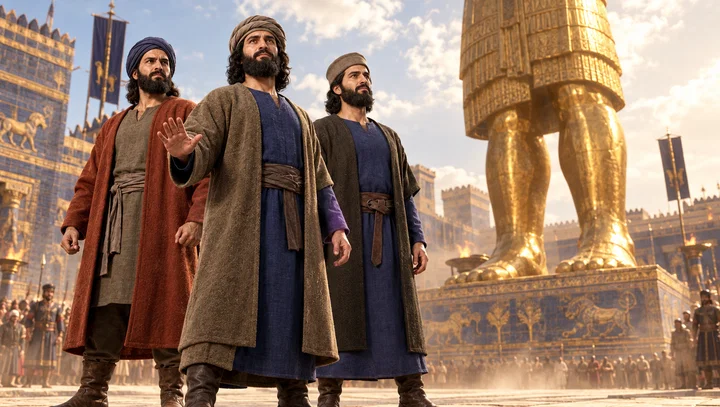
There are certain Jews whom thou hast set over the affairs of the province of Babylon, Shadrach, Meshach, and Abed-nego; these men, O king, have not regarded thee: they serve not thy gods, nor worship the golden image which thou hast set up.
Translations
There are certain Jews whom you have set over the affairs of the province of Babylon, Shadrach, Meshach, and Abednego; these men, O king, have not regarded you: they serve not your gods, nor worship the golden image which you have set up.
King James Version, KJV Cambridge Paragraph Bible, Webster Bible
There are certain Jews whom thou hast set over the affairs of the province of Babylon, Shadrach, Meshach, and Abed-nego; these men, O king, have not regarded thee: they serve not thy gods, nor worship the golden image which thou hast set up.
There are certain Jews whom thou hast appointed over the affairs of the province of Babylon, Shadrach, Meshach, and Abed-nego; these men, O king, have not regarded thee: they serve not thy gods, nor worship the golden image which thou hast set up.
There are certain Jews whom thou hast appointed over the affairs of the province of Babylon: Shadrach, Meshach, and Abed-nego; these men, O king, have not regarded thee: they serve not thy gods, nor worship the golden image which thou hast set up.
There are certain Jews whom thou hast appointed over the work of the province of Babylon — Shadrach, Meshach, and Abed-Nego, these men have not made of thee, O king, [any] regard; thy gods they are not serving, and to the golden image thou hast raised up — are not making obeisance.'
There are certain Jews whom thou hast appointed over the administration of the province of Babylon: Shadrach, Meshach, and Abed-nego: these men, O king, regard thee not; they serve not thy gods, nor worship the golden image that thou hast set up.
There are certain Jews whom thou hast set over the business of the province of Babylon, Shadrach, Meshach, and Abed-nego,—these men, have made thee, O king, of no account, thy god, they serve not, and, the image of gold which thou hast set up, do they not adore.
Berean Standard Bible, Majority Standard Bible
But there are some Jews you have appointed to manage the province of Babylon— Shadrach, Meshach, and Abednego— who have ignored you, O king, and have refused to serve your gods or worship the golden statue you have set up.”
There are certain Jews whom you have appointed over the affairs of the province of Babylon: Shadrach, Meshach, and Abednego. These men, O king, have not respected you. They don’t serve your gods, and don’t worship the golden image which you have set up.”
There are certain Jews whom you have put over the business of the land of Babylon, Shadrach, Meshach, and Abed-nego; these men have not given attention to you, O King: they are not servants of your gods or worshippers of the gold image which you have put up.
There are certeine Iewes whome thou hast set ouer the charge of ye prouince of Babel, Shadrach, Meshach, and Abednego: these men, O King, haue not regarded thy commandement, neither wil they serue thy gods, nor worship the golden image, that thou hast set vp.
Douay-Rheims (Challoner revision)
Now there are certain Jews whom thou hast set over the works of the province of Babylon, Sidrach, Misach, and Abdenago: these men, O king, have slighted thy decree: they worship not thy gods, nor do they adore the golden statue which thou hast set up.
Pictures
Cross-references 20 of 39
- Daniel 3:18
But if not, be it known unto thee, O king, that we will not serve thy gods, nor worship the golden image which thou hast set up.
The three men refuse to worship the golden image, even without assurance of rescue.
- Acts 5:29
Then Peter and the other apostles answered and said, We ought to obey God rather than men.
The apostles obey God rather than human authorities when their commands conflict.
- Daniel 3:24-28
Then Nebuchadnezzar the king was astonied, and rose up in haste, and spake, and said unto his counsellors, Did not we cast three men bound into the midst of the fire? They answered and said unto the king, True, O king.
God preserves the faithful men in the furnace and delivers them before the king.
- Daniel 3:4-6
Then an herald cried aloud, To you it is commanded, O people, nations, and languages,
The king commanded image worship on pain of death, the decree they disobeyed.
- Daniel 6:7-10
All the presidents of the kingdom, the governors, and the princes, the counsellors, and the captains, have consulted together to establish a royal statute, and to make a firm decree, that whosoever shall ask a petition of any God or man for thirty days, save of thee, O king, he shall be cast into the den of lions.
same refusal of royal worship decree
- Exodus 20:3-5
Thou shalt have no other gods before me.
The three Hebrews refused the image in obedience to the command against other gods and idols.
- Daniel 2:31-45
Thou, O king, sawest, and behold a great image. This great image, whose brightness was excellent, stood before thee; and the form thereof was terrible.
The golden image defies the dream’s message of God’s everlasting kingdom.
- Revelation 13:15
And he had power to give life unto the image of the beast, that the image of the beast should both speak, and cause that as many as would not worship the image of the beast should be killed.
Refusal to worship the image brings a death threat, as in Babylon.
- Jeremiah 27:5-8
I have made the earth, the man and the beast that are upon the ground, by my great power and by my outstretched arm, and have given it unto whom it seemed meet unto me.
God gave Nebuchadnezzar authority over nations, but not authority to command worship.
- Daniel 3:1
Nebuchadnezzar the king made an image of gold, whose height was threescore cubits, and the breadth thereof six cubits: he set it up in the plain of Dura, in the province of Babylon.
It describes the golden image the three men refused to worship.
- Revelation 14:9-10
And the third angel followed them, saying with a loud voice, If any man worship the beast and his image, and receive his mark in his forehead, or in his hand,
The warning against worshiping the beast’s image echoes the test of allegiance to Nebuchadnezzar’s image.
- Acts 4:19
But Peter and John answered and said unto them, Whether it be right in the sight of God to hearken unto you more than unto God, judge ye.
Both reject human commands that conflict with obedience to God.
- Daniel 3:28-29
Then Nebuchadnezzar spake, and said, Blessed be the God of Shadrach, Meshach, and Abed-nego, who hath sent his angel, and delivered his servants that trusted in him, and have changed the king’s word, and yielded their bodies, that they might not serve nor worship any god, except their own God.
The king praises their refusal to worship other gods and confesses that their God alone delivers.
- Hebrews 11:34
Quenched the violence of fire, escaped the edge of the sword, out of weakness were made strong, waxed valiant in fight, turned to flight the armies of the aliens.
Faith enabled the three Hebrews to endure the fiery trial.
- Daniel 4:28-37
All this came upon the king Nebuchadnezzar.
The leaders knew of Nebuchadnezzar’s humiliation by God.
- Matthew 4:10
Then saith Jesus unto him, Get thee hence, Satan: for it is written, Thou shalt worship the Lord thy God, and him only shalt thou serve.
Both texts affirm that God alone is to be worshiped and served.
- Daniel 3:20-23
And he commanded the most mighty men that were in his army to bind Shadrach, Meshach, and Abed-nego, and to cast them into the burning fiery furnace.
Their refusal to worship the image led to their being cast into the fiery furnace.
- Daniel 3:28
Then Nebuchadnezzar spake, and said, Blessed be the God of Shadrach, Meshach, and Abed-nego, who hath sent his angel, and delivered his servants that trusted in him, and have changed the king’s word, and yielded their bodies, that they might not serve nor worship any god, except their own God.
Nebuchadnezzar praises God for delivering the three men who refused to worship other gods.
- Daniel 1:7
Unto whom the prince of the eunuchs gave names: for he gave unto Daniel the name of Belteshazzar; and to Hananiah, of Shadrach; and to Mishael, of Meshach; and to Azariah, of Abed-nego.
The names assigned to the young men were meant to turn them from true worship.
- Daniel 3:27
And the princes, governors, and captains, and the king’s counsellors, being gathered together, saw these men, upon whose bodies the fire had no power, nor was an hair of their head singed, neither were their coats changed, nor the smell of fire had passed on them.
The obedient men emerge from the fire unharmed, with no smell of smoke on their garments.
Commentary
Each commentary is drawn from primary sources: the writings of Ellen G. White and Adventist pioneers and periodicals. Each commentary is separate. Its own words are not a quotation; follow the references to read the source passages.
Ellen G. White
20 sources
The verse reports jealous counselors accusing the three Hebrews set over Babylon's affairs of disregarding the king by refusing to serve his gods or bow to the golden image he had raised.PK 503ST Dec 24, 1912ST Sep 2, 1897PK 506.3 That image stood on the plain of Dura, about ninety feet high, costly and magnificent, made to embody Babylon and Nebuchadnezzar himself after he perverted the dream of the great image into an occasion for self-exaltation and universal worship on pain of the fiery furnace.Ms 168, 1898, par. 1–3Lt 109a, 1898, par. 5–8ST Oct 19, 188213MR 60.1–61.2 Their disregard meant they would obey Babylon only so far as its laws did not clash with God, refusing to be moved a hairbreadth from duty to their true King.ST Dec 24, 1912ST Sep 2, 1897ST Dec 24, 1912 For that refusal they were cast into the furnace yet walked unharmed with Christ Himself beside them, until the king was convinced of God's superior power over every kingdom.PK 503Ms 168, 1898, par. 1–3Lt 109a, 1898, par. 5–8Ms 47a, 1898, par. 2–5 Their stand is the pattern for the last days, when church and state will again unite to enforce a rival worship and denounce Sabbathkeepers as worthy of death, demanding the same unyielding loyalty whatever the cost.PK 512.112MR 218.2–220.1Lt 35, 1895, par. 1–3Lt 90, 1897, par. 13–18
Words and Setting in Babylon
The men named are Daniel's three companions, renamed Shadrach, Meshach, and Abed-nego, whom the king had set over the affairs of the province of Babylon, where they were serving in positions of responsibility.ST Dec 24, 1912ST Sep 2, 1897PK 506.3ST Oct 19, 1882 Their standing as appointed rulers over Babylonian affairs made their refusal conspicuous when it was reported to the king.ST Dec 24, 1912ST Sep 2, 1897PK 506.3
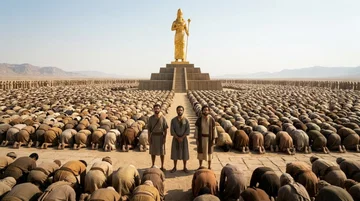
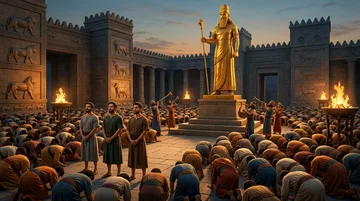
The golden image had been set up in the plain of Dura, about ninety feet high and nine feet broad, exceedingly costly and magnificent, made to represent the one Nebuchadnezzar had seen in his dream.Ms 168, 1898, par. 1–3Lt 109a, 1898, par. 5–8ST Oct 19, 188213MR 60.1–61.2 It was to be dedicated and worshiped at the sound of musical instruments, on pain of being cast into a burning fiery furnace.ST Oct 19, 1882 The image represented the kingdom of Babylon and more particularly Nebuchadnezzar himself, his glory and the excellence of Babylon, magnifying the king who ruled it.Ms 168, 1898, par. 1–3Lt 109a, 1898, par. 5–813MR 60.1–61.2Ms 47a, 1898, par. 2–5 It was set up when heathen counselors flattered him to place himself before the people as an object of worship, with the hope of converting all nations to its worship.Ms 168, 1898, par. 1–3Lt 109a, 1898, par. 5–813MR 60.1–61.2Ms 47a, 1898, par. 2–5
The setting follows Nebuchadnezzar's dream of the great image and its interpretation that God would establish an everlasting kingdom.PK 503.1 After acknowledging God's power for a time, he returned to idolatry with greater zeal and pride.PK 503.2 He perverted the light by reading the interpretation in the light of his own idolatrous mind, human understanding, and ambitions instead of in the light of the Scriptures and living Oracles.Ms 168, 1898, par. 1–3Lt 109a, 1898, par. 5–8Ms 47a, 1898, par. 2–5
The verse records the report that these men had not regarded the king and would neither serve his gods nor worship the golden image he had set up, presented as disobedience, defiance, and disregard for his authority.PK 503ST Dec 24, 1912ST Sep 2, 1897PK 506.3 The charge was brought by jealous wise men and advisers who invented a scheme to ensnare them by leading the king to proclaim that every knee should bow and then accusing the Hebrew captives.PK 506.312MR 218.2–220.1Lt 90, 1897, par. 13–18 Their not regarding the king meant they would obey the laws of Babylon only so far as they did not conflict with the claims of God and would not be swayed a hair's breadth from duty to their Creator, because doing otherwise would dishonor God.ST Dec 24, 1912ST Sep 2, 1897ST Dec 24, 1912ST Oct 19, 1882 They remained loyal to God, their King, whom they recognized as King of kings and Lord of lords, having learned that disobedience to God is dishonor, disaster, and ruin and that the fear of the Lord is the foundation of true prosperity.ST Dec 24, 1912PK 506.2ST Oct 19, 1882
Faithfulness and End-Time Application
For this refusal they were cast into the fiery furnace, but were later seen unharmed in the blazing furnace, for Christ Himself, an angelic presence, walked with them there.PK 503Ms 168, 1898, par. 1–3Lt 109a, 1898, par. 5–813MR 60.1–61.2Ms 47a, 1898, par. 2–5 The Lord Jesus was with them and preserved them from all harm, manifesting Himself to them as He promises to manifest Himself to those who have His commandments and keep them and love Him.Ms 168, 1898, par. 1–3Lt 109a, 1898, par. 5–813MR 60.1–61.2Ms 47a, 1898, par. 2–5 The miracle wrought upon Nebuchadnezzar's heart so that he believed in God and His superior power over every kingdom and every other kingdom.Ms 168, 1898, par. 1–3Lt 109a, 1898, par. 5–8Ms 47a, 1898, par. 2–5 He acknowledged God and His superior power after being so moved by what he witnessed in the furnace.Ms 168, 1898, par. 1–3Lt 109a, 1898, par. 5–8Ms 47a, 1898, par. 2–5
The verse belongs to the history of the Lord's wonderful deliverance of the three Hebrew worthies, Shadrach, Meshach, and Abed-nego.Lt 118, 1910, par. 2BS 29.1Ms 15, 1896, par. 33–34 It teaches the working out of the Lord's purpose for the children of obedience in contrast with the children of disobedience.Lt 118, 1910, par. 2 Their refusal tested the integrity of the youthful Hebrews and showed an idolatrous nation the power and faithfulness of the God of Israel.Lt 118, 1910, par. 2BS 29.1 When a ruler's command to worship opposed their allegiance to God, opposition made their governing principle clear, and their example shows that God's people must not surrender their loyalty to God.Lt 118, 1910, par. 2BS 29.1Ms 15, 1896, par. 33–34
The worship of the image had been made the country's established religion, and the law compelling it opposed Jehovah's law.ST Dec 24, 191212MR 218.2–220.1 The charge that they did not regard the king, serve his gods, or worship his image was an effort to turn God's people from their allegiance to God to obedience to human law.ST Dec 24, 191212MR 218.2–220.1 The three remained loyal to God, their King, whatever the cost, because to do otherwise would dishonor God.ST Dec 24, 191212MR 218.2–220.1 Their stand gives important lessons for this day, when many of God's servants though innocent of wrongdoing will be given over to suffer humiliation and abuse at the hands of those who, inspired by Satan, are filled with envy and religious bigotry.PK 512.1 Especially the wrath of man will be aroused against those who hallow the Sabbath of the fourth commandment, and at last a universal decree will denounce these as deserving of death.PK 512.1
The same pattern is repeated when church and state unite to set up a Sunday idol sabbath in the place where God's Sabbath should be and demand its observance as sacred and holy by human laws.12MR 218.2–220.1Lt 90, 1897, par. 13–18 This shows that civil power joined to religion can compel worship and persecute God's people, as the Sunday law movement is compared to the command to worship the image.12MR 218.2–220.1Lt 90, 1897, par. 13–18 Those who sought to destroy Shadrach, Meshach, and Abed-nego were themselves destroyed, showing that those who make cruel enactments to destroy God's people are destroyed by the recoil of their own actions.12MR 218.2–220.1 That same stand will have to be taken in the Southern States when the period comes to do as they did, and that time will force a decision for or against the commandments of God.Ms 168, 1898, par. 1–3Lt 35, 1895, par. 1–3 Until that period comes the test is not to be forced by presumptuous action.Lt 35, 1895, par. 1–3 Their separation from idolatry is the pattern for the end of the world, when students of God's Word will work away from the customs and appointments of the world's great counselors and be prepared like wise virgins with oil in their vessels.Ms 168, 1898, par. 1–3
Sources
Pioneers and periodicals
153 sources
The verse records the Chaldeans' accusation that the Jews whom the king had set over the affairs of Babylon — Shadrach, Meshach, and Abed-nego — had disregarded the king and refused to serve his gods or worship the golden image he had set up.ST Dec 24, 1912ST Jan 9, 1912RH Aug 6, 1908 Nebuchadnezzar had made the image wholly of gold because he refused to accept that Babylon would fall and be succeeded by other kingdoms, meaning its worship to teach that Babylon should endure forever.ST Oct 11, 1905ST Jun 3, 1913ST Dec 3, 1912 Their refusal was deliberate loyalty to the true God over every human command, for loyalty to God takes precedence when civil law requires disobedience to Him and worship belongs to the Lord alone.ST Oct 13, 1909RH Mar 6, 1900RH Jul 14, 1904ST Jan 23, 1901ST Mar 6, 1907 For this they were cast into the burning fiery furnace heated seven times hotter, but One like the Son of God was with them so that they walked out unharmed without even the smell of smoke, forcing the king to acknowledge their God as Deliverer above all gods.ST Jul 16, 1912ST Nov 8, 1905ST Jul 27, 1904RH Apr 25, 1912ST Oct 7, 1897 Their position when commanded to worship the golden image is precisely the position the church will occupy when the decree goes forth that all must worship the image of the beast on pain of death, exposing the wrong of using government power to compel religious worship.ST May 21, 1912RH May 1, 1855ST Jan 9, 1912RH Aug 6, 1908
Words and Historical Setting
Daniel 3:12 records the Chaldeans' accusation against Shadrach, Meshach, and Abed-nego, certain Jews whom the king had set over the affairs of the province of Babylon, that these men had not regarded the king and would not serve his gods nor worship the golden image he had set up.ST Dec 24, 1912ST Jan 9, 1912RH Aug 6, 1908RH May 9, 1871RH Apr 24, 1900 Their appointment to administer the province was stressed to cast their refusal as ungrateful disregard and contempt for the king, treated as high treason, showing how a ruler's claim to supreme authority can turn religious fidelity into a charge of political disloyalty used to justify persecution.ST Dec 24, 1912RH Apr 13, 1869RH May 9, 1871RH Apr 24, 1900 Though serving in positions of responsibility, they refused obedience because loyalty to God required noncompliance, fearing the true God rather than complying with the king's command even under threat of death.ST Dec 24, 1912RH May 9, 1871RH Aug 6, 1908 Their public service did not mean obedience against loyalty to God, and conscience kept them faithful rather than worship a false god.ST Dec 24, 1912RH May 9, 1871
They had obeyed the summons to be present at the dedication on the plain of Dura, since presence alone could be rendered without compromising religion, but they stood erect alone when the vast throng bowed.RH Apr 13, 1869ST Jan 29, 1908ST Oct 9, 1901 As free witnesses educated in God, they would not serve his gods nor worship the image he set up, and their refusal was watched by hateful false worshipers, enslaved by superstition or fear, who were less concerned for their own souls than for the nonconformity of others.ST Jan 29, 1908ST Oct 9, 1901ST Nov 11, 1886 The accusation described them as certain Jews exalted to rule over Babylon yet ungrateful and disregarding the king and his decree, even though their refusal put them in danger.ST Jan 29, 1908ST Nov 11, 1886
The golden image set up in the plain of Dura was about ninety feet high and nine feet broad, made to represent what Nebuchadnezzar had seen in his dream.ST Oct 19, 1882ST Jun 28, 1899 On the appointed day for its dedication it was to be worshiped at the sound of musical instruments, with a large orchestra playing at the king's command, on pain of being cast the same hour into a burning fiery furnace.ST Oct 19, 1882RH Feb 19, 1914 The image was made all of gold because Nebuchadnezzar resisted the prophecy that Babylon would be followed by other kingdoms, meaning its worship to teach the people that Babylon should endure forever.ST Jun 28, 1899
The word translated image is tzeh-lem, here meaning a physical image made by human hands which the king set up and ordered people to worship.RH Jan 5, 1860 The names of the musical instruments in the chapter do not require a date after Alexander's conquest, since Greek culture and traders were known in the region centuries earlier.ST Jan 11, 1916 The book's Babylonian history is confirmed by records brought to light that silence critics, including an inscribed cylinder of Nebuchadnezzar describing his restoration work and building in Babylon and a cylinder of Cyrus describing the capture of Babylon.RH May 13, 1909 In order the account of the golden image follows the captivity of Judah and Nebuchadnezzar's dream and comes before Nebuchadnezzar's proclamation.ST Dec 12, 1911
Daniel 3:1-30 stands as part of an inspired and correct record concerning Nebuchadnezzar given in Daniel chapters 1, 2, 3, 4.ST Jul 16, 1912 Nebuchadnezzar himself was not inspired as Daniel and the other prophets were, and his words were not inspired.ST Jul 16, 1912 He came to see that God was just and right and his own ways evil, and submitted to God with his own great conception of God's goodness and power, but inspiration belongs to the record that tells this, for in the meaning of the Bible it is the word that is inspired, not the man.ST Jul 16, 1912
Motives of King and Accusers
The image was made entirely of gold because Nebuchadnezzar refused to accept that Babylon would fall and be succeeded by other kingdoms as shown by the declining metals in Daniel 2.ST Oct 11, 1905ST Jun 3, 1913ST Dec 3, 1912RH Oct 22, 1901 Proud, arrogant, and idolatrous, he was pleased with the dream God gave through Daniel yet rejected the interpretation that after him another kingdom would arise, believing his kingdom would never be superseded.ST Jun 3, 1913 He meant its worship to teach that Babylon should endure forever and to be one grand patriotic demonstration to perpetuate his kingdom and to prove God's revelation through Daniel untrue.ST Oct 11, 1905ST Jun 3, 1913ST Dec 3, 1912 The thought of its continued existence was hinted in the Chaldeans' greeting wishing him endless life.ST Jun 3, 1913
Its worship had been made the country's established religion, and the law compelling it stood opposed to Jehovah's law, so that refusal would dishonor God if yielded and loyalty to God as King required refusal whatever the cost.ST Dec 24, 1912 Their dissent was very offensive to the dignified majority, who counted it both irreligious and unpatriotic treason, while all Babylon in its patriotism bowed and was wrong.ST Aug 24, 1904ST Jun 25, 1912 Moved by selfish ambition joined with the coercive spirit of national religion, the accusers went to the king with the flattering address O king, live forever, and that report aroused the anger of the king.ST Aug 24, 1904
The accusers were Chaldean wise men who watched the Hebrews during the public worship, jealous because the Hebrews had been exalted to rule over them and appointed over the affairs of the province of Babylon.ST Jan 9, 1912ST Dec 16, 1897 They were envious of the three Hebrews and desirous of hurting their influence, though they themselves had been saved from death by Daniel's appeal to the king in their behalf.ST May 6, 1897 They stressed the royal appointment to cast refusal as ungrateful disregard and disloyalty, reporting that these men had not regarded the king, served not his gods, and worshiped not the golden image he had set up.ST May 6, 1897ST Jan 9, 1912RH Aug 6, 1908ST Aug 24, 1904
The royal order was general and not specifically aimed at the three Hebrews, but it nevertheless required them to disobey God.RH Oct 21, 1862RH Oct 21, 1862 It established idolatry in direct violation of God's law and was probably made in defiance of that law, and may have been aimed at the Hebrews, though that is not certain.RH Oct 21, 1862 Though they held high positions and the order merely reflected the government's usual idolatry, they refused even the appearance of obedience when obeying civil law would violate God's law, for responsibility cannot be shifted to the government.RH Oct 21, 1862
Nebuchadnezzar's religious zeal was really a demand that others submit to his will, requiring worship not because his god was truly God but because it was his, treating disagreement as worse than an offense against God.ST Oct 10, 1895 He used religious demands to extend the state's power and to test whether his gods were stronger than the Creator worshiped by the Hebrews.ST Dec 12, 1911 Idol worship at Babylon, whose image worship began in its earliest history and was made the national religion on the plain of Dura, also gained much gold through offerings, with money given to the god Bel as an offering to gain mercies for the suppliant worshipers.ST Jan 18, 1883
Faithful Refusal and Deliverance
The three men deliberately refused to serve the king's gods or worship the golden image he had set up, disregarding the king's command because they feared the true God and would not worship a false one.ST Oct 13, 1909RH May 9, 1871ST Jan 9, 1912 Though they held positions of responsibility over the affairs of the province of Babylon, their faithfulness to God took precedence over the royal decree even at the risk of punishment and death.ST Sep 2, 1897ST Jan 9, 1912RH Jul 13, 1916 Their refusal was loyal to principle and conscience, honoring God's command against bowing to idols and refusing even the appearance of obedience to a human command opposed to God.ST Oct 13, 1909RH Jul 13, 1916RH Jan 15, 1867 They stood alone before the assembled multitude and would not yield to pressure from ruler or crowd, choosing fidelity to God over safety or convenience.RH May 9, 1871RH Jul 13, 1916RH Jan 15, 1867
For that disobedience they incurred the terrible penalty of being cast the same hour into the burning fiery furnace heated seven times hotter than usual.ST Nov 8, 1905ST Jul 27, 1904ST Jun 3, 1913 They were thrown in, but Jesus was with them during that trying hour through an angel in the form of the fourth like the Son of God, loosing them walking in the midst of the fire with no hurt.ST Jul 27, 1904ST Jan 9, 1907ST Jun 3, 1913 The fire had no power upon their bodies, so not a hair of the head was singed and there was not even the smell of smoke upon their garments.ST Jul 27, 1904ST Jan 9, 1907ST Jun 3, 1913 The attempt utterly failed, for the king's warriors who tried to carry out the sentence died while the servants of God were miraculously preserved.ST Nov 8, 1905ST Oct 7, 1897ST Aug 13, 1896
The great king was thus forced to acknowledge that the God of the Hebrews is a Deliverer above all other gods.ST Jul 16, 1912ST Nov 26, 1912RH May 4, 1869 Their experience in the furnace taught him that a higher King than himself ruled over him.ST Jul 16, 1912RH Apr 25, 1912ST Nov 26, 1912 Their faithfulness did not cost them their lives or their offices over the province, but was rewarded with increasing temporal honors and promotion in the province.RH Aug 27, 1908ST Nov 26, 1912 Their deliverance became an occasion for Babylon to see God's power and an appeal to the whole kingdom to submit to Him.RH Aug 27, 1908ST Nov 26, 1912
Nebuchadnezzar responded to the report of their refusal with anger and haste to destroy them.RH Oct 22, 1901ST Oct 19, 1904ST Jun 18, 1912 He used civil power to control worship and punished them by the furnace, but God preserved and delivered them and the king had to reverse his decree.RH Oct 22, 1901ST Oct 19, 1904ST Jun 18, 1912 That decree had been coercive rather than religious liberty, seeking to prevent speech against Daniel's God, and the episode shows pride resisting the Spirit of God and obstructing conversion.RH Oct 22, 1901ST Jun 18, 1912
Obedience to God Above Men
Loyalty to God takes precedence when a civil law requires disobedience to Him, and the three men obeyed the laws of Babylon only so far as they did not conflict with the claims of God.ST Oct 19, 1882ST Jan 23, 1901RH Mar 1, 1860ST Oct 3, 1895ST Dec 20, 1899 Though set over the affairs of the province, they would not serve the king's gods nor worship the golden image he had set up, and they would not be swayed a hair's breadth from duty to their Creator.ST Oct 19, 1882RH Jul 14, 1904ST Jan 23, 1901RH Mar 1, 1860ST Dec 20, 1899 Their public service did not mean obedience against loyalty to God, for they had learned that disobedience to God is dishonor, disaster, and ruin, and that the fear of the Lord is not only the beginning of wisdom but the foundation of all true prosperity.ST Oct 19, 1882RH Jul 14, 1904 When human commands conflict with God's law, people must obey God rather than men, refusing the conflicting command while obeying earthly laws that do not conflict with it.ST May 13, 1897ST Jul 24, 1884ST Dec 21, 1888RH Sep 8, 1910 They may disobey and meekly suffer the penalty rather than rebel violently, honoring civil authority, accepting punishment, and seeking lawful change to an unjust law where possible.ST Jul 24, 1884ST Dec 21, 1888RH Sep 8, 1910
Worship belongs to the Lord God alone and not to civil rulers, so refusal to regard the king in commanding worship of the image was right and was honored by deliverance in the furnace.RH Mar 6, 1900ST Mar 6, 1907ST Oct 7, 1913RH Jul 14, 1904 To command worship of the golden image while not forbidding worship of the true God still exalted man in the place of God, made duty to God secondary, and asserted that men need not be servants of God but could show themselves to be gods, which is wholly contrary to the gospel of the kingdom.RH Jul 3, 1900 Refusing in this matter preaches that gospel by obeying God rather than men, for every person has the privilege and duty to serve God which no civil power may take away, and Christians should obey civil government when it does not claim God's place but remain loyal to God when it does.RH Jul 3, 1900RH Jul 14, 1904 Even outward bowing without prayer or inward change of belief would have been public homage acknowledging the image's claim to worship, so they could not seem to bow or give sanction to idolatry and remain faithful.ST Aug 29, 1895ST May 20, 1889ST Jan 22, 1894 Their refusal was a matter of conscience and not of human courtesy or expediency, for they could not worship idols and the true God together, could not serve God and mammon, and to yield even in appearance would have been idolatry whose punishment by violence, fine, or imprisonment is religious persecution.ST Aug 29, 1895ST May 20, 1889ST Jan 22, 1894ST Apr 24, 1893
To bow would have broken allegiance to the true God and disobeyed the first and second commandments forbidding idolatrous worship, specifically the second commandment.RH Jan 15, 1867ST Jun 3, 1913ST Dec 5, 1895 Worshiping the lifeless image would have been sin because it was not according to God's Word, in which they had no faith, while refusal broke the king's law without being sin and proved righteousness.ST Sep 25, 1901ST Dec 5, 1895 Their faithfulness did not depend on knowing they would be delivered, for they would not disobey God to please a ruler even when disobedience brought serious danger.ST Sep 10, 1885 It was rooted in seeking the God of heaven with Daniel to reveal the dream and its interpretation, with implicit faith that God would impart wisdom from above, with fasting and earnest prayer that were answered, bringing increased confidence, great joy, and audience with God.ST Jun 3, 1913 Having thus stood in the audience-chamber with God through the experiences of Daniel 1 and 2, they could never consent to bow, for bowing would have tacitly declared those experiences a farce and done wrong to the Spirit of God.ST Jun 3, 1913
Their stand shows that rulers have no authority to compel religious observance, and that refusal was obedience to God rather than disloyalty even when the command was called merely civil.ST May 12, 1890ST Oct 28, 1889ST Sep 13, 1899 A persecuting power that commands breach of God's law to keep a human code is a perversion of good and therefore evil, and even custom and law cannot make a falsehood true or justify disobedience to God.ST Oct 28, 1889ST Nov 15, 1899 As Jews placed over Babylon's affairs yet accused of refusing the king's authority, they stood as representatives of God's truth who would not bow to human power or national ideals when these opposed God, vindicated when He went with them into the furnace and delivered them unharmed.ST Oct 11, 1905STRH Jan 9, 1900 Their refusal illustrates the demand to honor a rival religious institution after conscientiously observing what God requires, and their course is the pattern for Sabbathkeepers accused of anarchy for refusing Sunday laws commanding a so-called sacred day against God's plain commandment.ST Aug 29, 1895ST Nov 27, 1901 Their violation of the human requirement out of conscientious adherence to God's commandment was not anarchy, for the anarchist is the one who disregards God's commandment to follow human authority and the multitude.ST Nov 27, 1901
Religious Liberty and Government Limits
The accusation against the three Hebrews exposes the wrong of using government power to compel religious worship, for they deliberately refused the king's command to serve his gods and worship the golden image he had set up even though they held responsible appointments over the affairs of Babylon.ST May 21, 1912ST Jan 9, 1912RH Aug 6, 1908 Worship is a matter between a person and God, and God's commands address each person directly and take precedence over earthly rulers, upholding the individual right to worship according to settled belief and conscience even when that faithfulness makes one liable under the law.ST May 21, 1912ST Jan 9, 1912RH Aug 6, 1908ST May 21, 1912 Governments should protect people as people and not dictate their religion, since conscience and conviction can withstand force and loyalty to God reaches beyond patriotic demands for allegiance to an earthly kingdom, and God miraculously upheld and honored those who so obeyed Him.ST May 21, 1912ST Jan 9, 1912ST May 21, 1912
Civil government was ordained of God after sin entered as His servant to restrain evil, prevent incivility, and regulate outward acts concerning life, property and such civil things.ST Jul 11, 1911ST Jul 1, 1903 It was never appointed to touch conscience and soul, to direct belief, to aid religion, or to take God's place by directing and controlling worship.ST Jul 11, 1911ST Jul 1, 1903ST Oct 30, 1901 When Nebuchadnezzar commanded worship of his gods and his image and punished those who would not worship as he decreed, he stepped beyond legitimate civil rule into God's place.ST Jul 11, 1911ST Dec 3, 1896ST Jul 1, 1903ST Oct 30, 1901 For this overreach God humbled him and proud Babylon with him.ST Jul 11, 1911ST Dec 3, 1896ST Jul 1, 1903
Civil authority must not take the place of conscience or of God, for each person is responsible to God and should be free to follow conscience in matters of faith and worship.ST Apr 23, 1912ST Jun 18, 1912 Nebuchadnezzar used civil power to control worship and cast the refusers into the fiery furnace, but God preserved and delivered them so that the king had to reverse his coercive decree.ST Jun 18, 1912 Babylon's principle was to unite religion with the state to supply lack of divine power, enforcing a legal creed by the state through pride and self-exaltation as in the boast over Babylon.ST Dec 24, 1896 Whenever church and state are united and religion is enforced by law, persecution for conscience' sake follows regardless of what church and state are united, as the heathen religion united to the Babylonian government persecuted the three Hebrews for faithfulness to God, and this course ends in destruction.ST Jul 11, 1911ST Dec 24, 1896ST Jul 1, 1903ST Dec 12, 1895
The decree compelled religious worship even though it could be described as a civil law and did not expressly forbid worship of their own God.ST Sep 9, 1889 Its demand was not a neutral added duty that still left them free to worship their God, because worship of God forbids worship of anything besides Him.ST Dec 10, 1885 In the same way a law requiring all to keep Sunday is not a harmless addition that leaves Sabbathkeepers free to also keep the seventh day, since the Sunday institution was designed as a human substitute for the Sabbath of the Lord and it is impossible to keep the Sabbath aright as commanded while also keeping the substitute, for no man can serve two masters.ST Dec 10, 1885 Compulsion to rest on the first day is therefore equivalent to compulsion to labor on the seventh day or be deprived of support, and its direct tendency is to deprive of religious rights or bring pains and penalties for insisting on them.ST Dec 10, 1885
Refusal to obey a government order requiring religious worship contrary to God's law is required duty and justified, and the servants of God are not to be censured for obeying God rather than that mandate even though the ruler had authority over them.ST Apr 14, 1898 Refusing an unjust religious command does not make guilt; the guilt belongs to those who make and enforce the wrong law.RH Jun 10, 1909 The fact that the Hebrews had broken the law commanding worship of the golden image does not justify the persecution, for the punishment was not meant to change their ideas but to exact submission to the king's law.ST Jan 21, 1903 Men may claim duty to execute unrighteous laws, but they will have to give an account to God for it as truly as those they punish.ST Jan 21, 1903
Set over the province yet standing as protesters against the authority of the state in spiritual things, they wore the wide trousers, linen shirts, precious garments and robes of state belonging to their office and came forth conspicuously to confess their God, not ashamed to suffer openly for His sake.RH Aug 20, 1908 Because they feared the King of heaven they were not afraid of what the king of Babylon could do to them, claiming the divine right to worship according to the dictates of conscience and preserving that freedom of mind which is the heritage of man created in the image of God, even permitting their bodies to be bound and committed to the flames.RH Aug 20, 1908 Their case is an example of national interference with religious freedom and of worldly rulers using political power against those who will not submit to state-imposed worship, punished in the furnace though they chose to face death rather than surrender freedom of conscience.ST May 19, 1914ST Nov 5, 1894RH Jun 8, 1916ST Aug 9, 1910RH Oct 22, 1908 This demanding of religious conformity is unlike a government draft intended to defend the people, showing that the purpose behind an action matters when judging it morally, for the state was ordained to keep men civil and regulate outward civil acts, not to coerce worship.RH Sep 23, 1862ST Aug 9, 1910
Sin Distinguished From Crime
Shadrach, Meshach, and Abed-nego were accused of disobeying the king because they would not serve his gods nor bow to the golden image he had set up.ST Jun 11, 1912ST Jan 20, 1898ST Jun 24, 1897 Their refusal transgressed the king's human and civil law, so they were treated as criminals and condemned and sentenced to death.ST Jan 23, 1912ST Jun 11, 1912ST Jan 20, 1898ST Aug 6, 1896ST Jul 23, 1912 That crime against human law was not sin against God, for sin is transgression of God's spiritual law in thought, motive, and intent, and their refusal did not depart from God's principles of right.ST Aug 6, 1896ST Jun 24, 1897ST Jul 23, 1912 To have obeyed the order would have been sin against God.ST Jan 23, 1912ST Jan 20, 1898ST Jul 23, 1912
Obeying an evil human decree that conflicts with God's law would have been sinful and dishonoring to God, so loyalty to God required disobedience to it.ST Jan 23, 1912ST Aug 6, 1896 Obedience to God rather than a human ruler could make them liable to civil punishment without making them guilty of wrongdoing before God.ST Jun 11, 1912ST Jul 23, 1912 When the choice lies between sin and crime it is always better to be a criminal.ST Aug 6, 1896
Prophecy of Final Crisis
The stand of Shadrach, Meshach, and Abed-nego when commanded to worship the golden image is precisely the position the church will occupy when the decree goes forth that all must worship the image of the beast on pain of death.RH May 1, 1855 God saved the three Hebrews by direct interposition, and He has promised to interpose in the same way for His people.RH May 1, 1855 That deliverance will not come until the time of trouble such as never was has fully opened upon the world.RH May 1, 1855
Their refusal to regard the king, to serve his gods, or to worship the golden image he set up is a literal lesson for the present generation facing the same test when the image to the beast is made and those who will not worship it are to be killed.RH Aug 27, 1908 As they learned faith and loyalty in continual service over the affairs of the province of Babylon, so believers now must learn it to pass safely through the final crisis.RH Aug 27, 1908 Their faithfulness did not cost them their lives and positions but was rewarded with increasing temporal honors and promotion in the province.RH Aug 27, 1908 The difference is that in Babylon those who did not worship were cast into the burning fiery furnace, while in the last day those who do worship will perish in the universal conflagration, and the faithful will receive promotion in the kingdom of heaven.RH Aug 27, 1908
Image worship in ancient Babylon foreshadows enforced worship by spiritual Babylon in the latter days.RH Aug 6, 1908 Like ancient Babylon demanding submission to its ruler's religious authority under penalties, the Papacy claims universal spiritual jurisdiction and demands submission under penalties.RH Apr 10, 1916RH Aug 6, 1908 Their refusal, treated as disloyalty to the king, illustrates that worshiping the image meant placing human authority above God and that true worshipers must refuse a decree requiring idolatry.RH Aug 6, 1908RH Oct 11, 1915 Their experience forms part of the pattern of ancient Babylon persecuting those who reject its religious demands, a pattern compared with modern Babylon and with Rome's false worship refused by faithful martyrs even under persecution.RH Oct 11, 1915RH May 28, 1872
The image set up at Babylon means the first day of the week, a common working day possessing no sanctity, set up as a spurious sabbath to exalt false religion and make of no account the day instituted by God and given to the world as a memorial of creation.ST May 6, 1897 The command to all nations and tongues and peoples to worship the image means a decree enforcing worship of Sunday going forth to all the world, already gone forth in a limited degree where civil power speaks with the voice of a dragon just as the heathen king spoke to the Hebrew captives.ST May 6, 1897 The charge of disobedience means trial and persecution coming to all who in obedience to the Word of God refuse this false sabbath.ST May 6, 1897 Force is the last resort of every false religion, first trying attraction as the king of Babylon tried music and outward show invented by men inspired by Satan, then the hungry flames of the furnace, as the Papacy has exercised power to compel obedience and will continue to do so.ST May 6, 1897 God's servants now need the same steadfast spirit with eye single to the glory of God, holding firmly to allegiance to God by the power of the truth, enabled to be loyal only in the power of God alone.ST May 6, 1897
The king's demand was not a neutral added duty that still left them free to worship their God, but a law directly against the law of God, because worship of God forbids worship of anything besides Him.ST Dec 10, 1885ST Dec 5, 1895 In the same way a law requiring all to keep Sunday is not a harmless addition that leaves Sabbathkeepers free to also keep the seventh day, since the Sunday institution was designed as a human substitute for the Sabbath of the Lord.ST Dec 10, 1885ST Dec 5, 1895 No man can serve two masters, and it is impossible to keep the Sabbath of the Lord aright as commanded while also keeping the substitute, to keep the sabbaths of two opposing powers, or to hold the seal of God and the mark of the beast together.ST Dec 10, 1885ST Dec 5, 1895 Compulsion to rest the first day is therefore equivalent to compulsion to labor on the seventh day or be deprived of support, and its direct tendency is to deprive of religious rights or bring pains and penalties for insisting on them.ST Dec 10, 1885 They could not worship idols and the true God at the same time, and they could not worship the image and keep the second commandment; likewise a person cannot observe Sunday in obedience to human power and keep the fourth commandment, and attempting to do so shows lack of intelligent faith.ST Apr 24, 1893ST Dec 5, 1895 God approved their whole-hearted loyalty over a civil decree commanding false worship and delivered them in a remarkable manner from the punishment their persecutors imposed, which proves He will likewise deliver those now who refuse the spurious first-day sabbath and stay loyal to His seventh-day Sabbath.ST Apr 24, 1893
Their refusal shows that loyalty to God takes precedence over commands to worship another object, and their experience illustrates how God's faithful people may face a test of devotion in conflict with an apostate civil government, including in the latter days.RH Jul 14, 1904 Their experience shows that God's people may be brought to a terrible extremity in a conflict over worship before God directly intervenes to save them.ST Oct 5, 1882 Loyalty to God can require refusing a ruler's command to violate God's commandments, as believers in the Southern States would face in decisions for or against God's commandments.RH Apr 13, 1911 They were not to provoke that conflict before the time came or needlessly close the way for their work.RH Apr 13, 1911
Babylon is the first of the seven heads of beast rule and the beginning of all symbolic prophecy, beginning when Jerusalem was overthrown.ST Mar 30, 1915ST Oct 15, 1894 The decree concerning the image on the plain of Dura is an example of Babylon enforcing religious worship by law, illustrating Babylon's hostile attitude toward the people of God.ST Nov 28, 1895ST Oct 15, 1894 Babylon is presented as the first great power to overthrow and persecute God's organized church, showing cruel persecuting power and hostile, cruel oppression of God's people.ST Mar 30, 1915ST Oct 15, 1894 That work of persecution was instigated by fallen Lucifer, the king of Babylon.ST Mar 30, 1915
Babylon demanded worship of the golden image and treated refusal as disobedience to the king, punishable by death in the fiery furnace.ST Jul 13, 1915ST Sep 8, 1914 Babylon demanded worship as service and obedience to its laws even when contrary to God's laws on pain of the furnace, opposing God's people through persecution and oppression.ST Jul 13, 1915ST Sep 8, 1914 The three Hebrews' refusal illustrates that service and obedience to human laws must not override obedience to God.ST Jul 4, 1899 Their breaking of that law was a matter of conscience not courtesy, illustrating the conflict between obedience to God and a ruler's demand for religious worship and compulsory worship of false gods.ST Jul 13, 1915ST Jul 4, 1899
Witness to Nations and Kings
Daniel 3 belongs to another step in the education of the great Babylonian king, teaching the rights of other men as a lesson for statesmen in the present day.ST Jan 29, 1908ST Jan 9, 1912 It stands within men's idea of the kingdom of men, in contrast to God's idea of the kingdoms of men shown to Nebuchadnezzar in a dream and to Daniel in a vision in the previous chapter.ST Jan 9, 1912 Its setting displays Jehovah as the Deliverer, following His display as the Revealer, and the chapter presents God as the one who delivers.ST Jan 9, 1912
Through the deliverance from the furnace the gospel of the kingdom, or righteousness by faith, was made known to Nebuchadnezzar and proclaimed to the world.RH Aug 22, 1907RH May 29, 1900 The refusal to serve the king's gods or worship his golden image belongs to that saving testimony, part of the threefold message proclaimed in Babylon so that people could be saved from Babylon's coming destruction.RH Aug 22, 1907 The lesson thus made known was that the Most High rules human kingdoms and gives them to whom He wills, though it was disregarded.RH May 29, 1900
Scattered Israel could thereby teach the nations the knowledge of God and the truth about religious liberty that Israel had failed to uphold, for refusal of the king's command to worship his golden image was duty to worship God regardless of the king's will.RH Feb 20, 1900ST Jun 21, 1905 God used His servants in Babylon to make knowledge of the true God known beyond Israel, and made His truth known through Gentile kings when Israel failed to carry the gospel to the nations.ST Jun 21, 1905RH Nov 11, 1902 Though holding positions of responsibility in Babylon, Shadrach, Meshach, and Abed-nego refused to worship the image, and their refusal became widely known as the account spread through the empire.RH Feb 20, 1900RH Feb 27, 1900
The image and the refusal contrast human efforts to establish a kingdom with God's warning that earthly kingdoms are insecure, while portraying how human beings view God's rule over earthly kingdoms.ST Oct 21, 1908 The Babylonian names given to Daniel and his companions were intended to draw them from worship of the true God to worship of false gods.ST Oct 21, 1908 The chapter teaches that God has power to deliver His children.ST Oct 21, 1908
Their conduct, along with Daniel's, made them examples of sobriety, temperance, righteousness, and integrity, untouched by the empire's corruption and political plots. Their refusal led to the attempt to execute them in the furnace, but God preserved them, the attempt utterly failed, the king's warriors who tried to carry out the sentence died, and the servants of God were miraculously preserved.STST Aug 13, 1896 This display of God's power showed Babylon the power of the God it later dishonored, yet the lesson was later disregarded by Babylon's leaders.ST Oct 23, 1901 It was a matter of public record that Belshazzar knew or had opportunity to know, for he had learned of this public event and its lesson about loyalty to God, yet he did not take it to heart.STST Aug 13, 1896
Daniel 3 reveals God as able to deliver those who remain faithful and teaches religious liberty as a lesson applicable in every age.ST Aug 9, 1910ST Aug 9, 1910 It shows God as the Deliverer of faithful people who stand against enforced worship of world patriotism and the deification of human ambition.ST Dec 1, 1914 The life of Daniel in Babylon shows how God's workers should serve in the world in its closing act.RH Dec 20, 1906
Example for Christian Living
Their trust under threat calls for faithfulness through danger, with confidence that God may deliver His servants or sustain them through death.RH Oct 25, 1864RH Sep 2, 1862 True servants may face severe trials for faith, yet God remains able to protect and deliver them.RH Oct 25, 1864RH Sep 2, 1862 On the appointed day for dedicating the golden image set up in the plain of Dura, about ninety feet high and nine feet broad and made to represent what Nebuchadnezzar had seen in his dream, to be worshiped at the sound of musical instruments on pain of being cast into a burning fiery furnace, they did not regard the king's decree because they would obey the laws of Babylon only so far as they did not conflict with the claims of God and would not be swayed a hair's breadth from duty to their Creator.ST Oct 19, 1882 Having learned that disobedience to God is dishonor, disaster, and ruin and that the fear of the Lord is not only the beginning of wisdom but the foundation of all true prosperity, they looked with calmness on the furnace and the idolatrous throng, trusting God would not fail them now.ST Oct 19, 1882
God's servants now need the same steadfast spirit with eye single to the glory of God, holding firmly to allegiance to God by the power of the truth.ST May 6, 1897ST Jul 27, 1904 Only in the power of God alone can they be enabled to be loyal to Him.ST May 6, 1897 God stands by faithful servants who stand by Him and obey God rather than men even to the fiery furnace rather than disloyalty, and He was with them in the fire where the form of the fourth was like the Son of God, loosed them walking in the midst of the fire with no hurt, brought them forth at the king's command, and left the fire with no power upon their bodies so that not a hair of the head was singed.ST Jul 27, 1904RH Aug 15, 1907 He is able and willing to deliver His people today from sin when they trust in Him.ST Jul 27, 1904RH Aug 15, 1907
What is right, not what is popular, governs life, because majorities are seldom right and numbers decide neither rectitude nor truth.ST Mar 6, 1893ST Jun 25, 1912 Their refusal came from fearing God rather than man, making God's approval the preeminent concern and the approval of kings and the multitude a minor matter. Though they belonged to a small minority while the multitude bowed, they stood faithful, and though believers may not face a fiery furnace the same stand against compromise belongs in everyday Christian living in relation to truth and error, choosing God's favor with a good conscience over comfort and flattery.ST Mar 6, 1893 The three were right when they would not bow on the plain of Dura while all Babylon was wrong, proving large numbers signify nothing concerning religious truth, which has ever been in the minority.ST Mar 6, 1893ST Jun 25, 1912 Though truth may seem to die in the dungeon or on the cross, right has triumphed, does triumph, or will triumph in the endless years of God, because God keeps watch above His own and the grave has been tunneled by the Prince of Life with eternal victory beyond it, and God's work is wrought not by army nor by power but by His Spirit, so His way of His Word, His Spirit, and prayer, not civil power, is to be used.ST Jun 25, 1912
Convenience, popularity, and fear of punishment are not reasons to disobey God, and circumstances or convenience never excuse abandoning faithfulness even when obedience may bring difficulty and deadly consequences.RH Jan 10, 1871RH May 17, 1860ST Feb 3, 1881 Faithfulness under such pressure is the test of obedience, expressed through obedience despite difficulty.RH Jan 10, 1871RH May 17, 1860 Their stand on the plain of Dura refusing to serve Nebuchadnezzar's gods or worship the golden image he set up is the measure of true Christian faithfulness under civil religious laws, because it was principle and moral courage rather than policy, feeling, and nerveless sentimentalism. No power on earth could compel them to bow, and just as they could not be forced into false worship, a true Christian cannot be forced to break the Sabbath. Demanding a Sunday law to prop up sickly religious profession and to protect the laboring man in his right to one day's rest in seven exposes a religion without that principle, seeking from civil law the virility and moral fiber it lacks.
Their refusal stands as a flash of genuine loyalty to God breaking through Israel's dark record of unfaithfulness while the nation stumbled down into worldliness, taking up the customs of the sinful nations around her, with the spirit of worship dead under endless ritualism.ST Feb 27, 1901 Like the three who faced the fiery furnace rather than worship the golden image, believers must stand firm under severe test and be willing to obey God despite pressure and the risk of being mocked or counted foolish.ST Mar 7, 1878ST Feb 27, 1901 To have obeyed and joined the idolaters in worship would have been moral cowardice and being untrue to religious convictions. Babylon means the world that neglects God, and Daniel means the Christian surrounded by its temptations, and though times change the temptation remains in changed form, including temptation to neglect prayer, to follow personal desires astray, to yield to luxury, and to be unfaithful under pressure.
The chapter encourages young men studying it to remain faithful to God.RH Jul 2, 1908 Their refusal to obey the king's command to worship the golden image was treated as defiance of the ruler and the state and reported as disloyalty, even though the conflict centered on worship and conscience must not be forced into false worship.ST Oct 1, 1896ST Jul 9, 1912 God's people can endure a test by fire, as the three endured the fiery furnace.ST Nov 1, 1905ST Dec 1, 1914 Their choice, when they would not serve the king's gods or worship the golden image he had set up even though disobedience could cost their lives, illustrates the dilemma faced by true believers when a persecuting power demands worship contrary to God, honoring God's command against bowing to idols and showing that loyalty to God must not yield to pressure from a ruler or crowd.ST Nov 1, 1905ST Dec 1, 1914RH Jul 13, 1916 The Chaldeans watched the Hebrews during the public worship and reported their refusal in part because the Hebrews had been elevated above them, and the account silences critics by fulfillment in records brought to light, yet its chief use is moral: steadfast refusal shows loyalty to principle under pressure to conform.ST Jan 9, 1912
Sources