Daniel 11:3
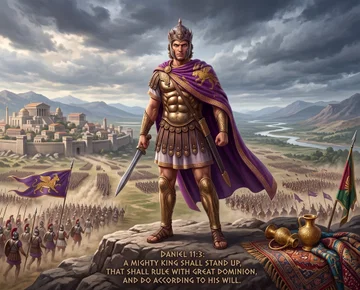
And a mighty king shall stand up, that shall rule with great dominion, and do according to his will.
Translations
American King James Version, King James Version, KJV Cambridge Paragraph Bible, Webster Bible, Revised Version, American Standard Version
And a mighty king shall stand up, that shall rule with great dominion, and do according to his will.
And a mighty king hath stood, and he hath ruled a great dominion, and hath done according to his will;
And a mighty king shall stand up that shall rule with great dominion, and do according to his will.
And so a hero king, will arise,—and wield great authority, and do according to his own pleasure;
Berean Standard Bible, Majority Standard Bible
Then a mighty king will arise, who will rule with great authority and do as he pleases.
A mighty king will stand up, who will rule with great dominion, and do according to his will.
And a strong king will come to power, ruling with great authority and doing whatever is his pleasure.
But a mightie King shall stand vp, that shall rule with great dominion, and doe according to his pleasure.
Douay-Rheims (Challoner revision)
But there shall rise up a strong king, and shall rule with great power: and he shall do what he pleaseth.
Pictures
Cross-references
- Daniel 8:20-22
The ram which thou sawest having two horns are the kings of Media and Persia.
The great horn is Greece’s first king, whose kingdom divides into four.
- Daniel 2:37-45
Thou, O king, art a king of kings: for the God of heaven hath given thee a kingdom, power, and strength, and glory.
Both trace successive kingdoms to God’s everlasting kingdom.
- Daniel 7:13-14
I saw in the night visions, and, behold, one like the Son of man came with the clouds of heaven, and came to the Ancient of days, and they brought him near before him.
Both texts describe a mighty ruler receiving dominion and a kingdom.
- Daniel 11:20-21
Then shall stand up in his estate a raiser of taxes in the glory of the kingdom: but within few days he shall be destroyed, neither in anger, nor in battle.
Both texts use “stand up” for a ruler’s rise to power.
- Daniel 11:7
But out of a branch of her roots shall one stand up in his estate, which shall come with an army, and shall enter into the fortress of the king of the north, and shall deal against them, and shall prevail:
“Stand up” describes a ruler taking power.
- Daniel 8:4
I saw the ram pushing westward, and northward, and southward; so that no beasts might stand before him, neither was there any that could deliver out of his hand; but he did according to his will, and became great.
The ram represents Medo-Persia, a kingdom in the same prophetic sequence.
- Daniel 11:21
And in his estate shall stand up a vile person, to whom they shall not give the honour of the kingdom: but he shall come in peaceably, and obtain the kingdom by flatteries.
Both describe a ruler standing up to begin his reign.
- Daniel 12:1
And at that time shall Michael stand up, the great prince which standeth for the children of thy people: and there shall be a time of trouble, such as never was since there was a nation even to that same time: and at that time thy people shall be delivered, every one that shall be found written in the book.
“Stand up” signifies beginning to reign.
- Daniel 7:6
After this I beheld, and lo another, like a leopard, which had upon the back of it four wings of a fowl; the beast had also four heads; and dominion was given to it.
The leopard’s four heads represent the division of Alexander’s empire.
- Daniel 8:5-8
And as I was considering, behold, an he goat came from the west on the face of the whole earth, and touched not the ground: and the goat had a notable horn between his eyes.
The surrounding account connects Alexander’s swift conquests with Daniel’s vision of the he-goat.
- Daniel 8:22-23
Now that being broken, whereas four stood up for it, four kingdoms shall stand up out of the nation, but not in his power.
Both describe rulers rising in succession.
- Daniel 7:27
And the kingdom and dominion, and the greatness of the kingdom under the whole heaven, shall be given to the people of the saints of the most High, whose kingdom is an everlasting kingdom, and all dominions shall serve and obey him.
Both visions concern dominion and the prophetic kingdom.
Commentary
Each commentary is drawn from primary sources: the writings of Ellen G. White and Adventist pioneers and periodicals. Each commentary is separate. Its own words are not a quotation; follow the references to read the source passages.
Ellen G. White
4 sources
Daniel 11:3 belongs to the revelations of the mysteries of ages to come given to Daniel as God's ambassador and recorded in Daniel 7-12.PK 547.1 Even Daniel himself did not fully understand it.PK 547.1 It was shut up and sealed even to the time of the end.PK 547.1 It belongs to the closing period of this world's history, when it is to be understood, with the blessed assurance that Daniel shall rest and shall stand in his lot and place at the end of the days.PK 547.1
Its prophecy, with the rest of Daniel 11, is nearly fulfilled, and its final fulfillment is nearly reached and nearly complete.9T 14.2–15.4RH Nov 24, 1904Lt 80, 1910, par. 3 Its fulfillment is signaled by a warlike condition of the world, a world stirred by war, and rising international troubles.9T 14.2–15.4RH Nov 24, 1904Lt 80, 1910, par. 3 Those conditions show that its prophesied scenes of trouble will soon take place and are close.9T 14.2–15.4RH Nov 24, 1904Lt 80, 1910, par. 3 They point to the approaching time of trouble before Jesus comes.RH Nov 24, 1904
Sources
Pioneers and periodicals
73 sources
The mighty king is Alexander the Great, the first king of Grecia, who rose up after Persia and overthrew the Medo-Persian kingdom to make Greece the dominant world power.RH Dec 12, 1912RH Nov 14, 1912ST Jan 10, 1878 To rule with great dominion and do according to his will is to hold a vast, universal dominion with exceptional authority and to act as he pleased through unparalleled and successful conquest.ST Jan 10, 1878ST Jun 19, 1884RH Dec 28, 1911 His empire stretched from the Adriatic Sea to the Ganges and from India to Grecia, won by the victories at Granicus, Issus and Arbela, with Arbela decisive for world empire, giving him rule over the then-known world by age thirty-two as the swift leopard and the he-goat whose feet seemed not to touch the ground.RH Nov 16, 1914RH May 11, 1916ST Feb 17, 1904 In the height of his power his kingdom was broken and was not passed to his posterity, but after confusion and warfare among his generals his whole family perished within about fifteen years and the kingdom was divided toward the four winds, to Cassander in the west over Macedon and Greece, to Ptolemy in the south over Egypt, to Lysimachus in the north over Thrace and Asia Minor, and to Seleucus in the east over Babylon and Syria beyond the Euphrates.RH Dec 12, 1912RH Nov 14, 1912ST Jan 10, 1878RH Nov 16, 1914RH May 11, 1916 He is the great and notable horn of the goat in Daniel 8:21, and his fourfold division is the four horns that followed and the four heads of the four-winged leopard, in a literal consecutive prophecy written centuries beforehand whose specifications have been fulfilled with great accuracy.ST Nov 24, 1914RH Dec 14, 1905RH Jan 16, 1913ST Nov 29, 1905ST Dec 24, 1894
Wording and Vision Setting
To stand up is to take the kingdom and begin to reign, manifesting sovereignty in an aggressive act of coming to power and exercising rule.RH Aug 28, 1856ST Jul 13, 1882RH May 16, 1871RH Mar 28, 1907RH Jan 17, 1856 In the verse this standing up brings a mighty king to rule with great dominion and to act according to his own will, and the same standing up in Daniel 12:1 means that Michael takes His kingdom and begins His reign, which will not end when the scattering of the holy people is accomplished.RH Aug 28, 1856ST Jul 13, 1882RH May 16, 1871RH Mar 28, 1907RH Jan 17, 1856 To raise up a king is to bring him to the throne, and God may order events so that a particular ruler reigns at a particular time and the consequences of his character and actions unfold under his rule.ST May 6, 1886
The verse belongs to a literal, consecutive prophecy that gives a graphic and literal account of leading events among the nations, speaking mostly of nations directly rather than representing them by symbols as in the earlier chapters.ST May 25, 1882ST Jul 8, 1897RH Dec 28, 1911ST Nov 28, 1895 It traces the great earthly powers from Daniel's time, beginning with Medo-Persia, continuing through the kingdoms of the earth to the latter part of the chapter, and reaching to Michael standing up to execute judgment at the time of the end, shortly before Christ's second coming, when the king of the north as the earthly representative of God's adversary gives way to Michael, Christ.ST Jul 8, 1897ST Nov 8, 1905ST Nov 28, 1895
It is part of the angel's prophetic words of truth within the great last vision begun in Daniel 10 and continued through Daniel 11 into Daniel 12, Daniel's last recorded vision giving more detailed information about events outlined in his earlier visions and reaching to the end of the world.RH Jan 10, 1856RH Dec 29, 1863RH Dec 20, 1870 That revelation was given in the third year of Cyrus to explain how long the host would be trodden underfoot and what would happen in the latter days, including the end of the appointed time.RH Jan 10, 1856 Its prophetic time periods are treated as symbolic, with each day reckoned for a year.RH Dec 29, 1863
The weight of teaching identifies the mighty king as the Grecian king who follows Persia, while the teaching held by some takes the verse to refer to Xerxes as the Persian king whose reign followed the empire's greatest glory under Darius Hystaspes, under whom Persia began to decline, losing European prestige and territory.ST Mar 5, 1912RH May 11, 1916 On that latter reckoning the prophecy passes directly from Xerxes' disastrous invasion of Grecia over the Persian kings who followed to the rise of Grecia to dominion under its mighty king.RH May 11, 1916 Persian wealth had led the Persians to stop trusting in God and to trust in their riches instead.
Alexander the Mighty King
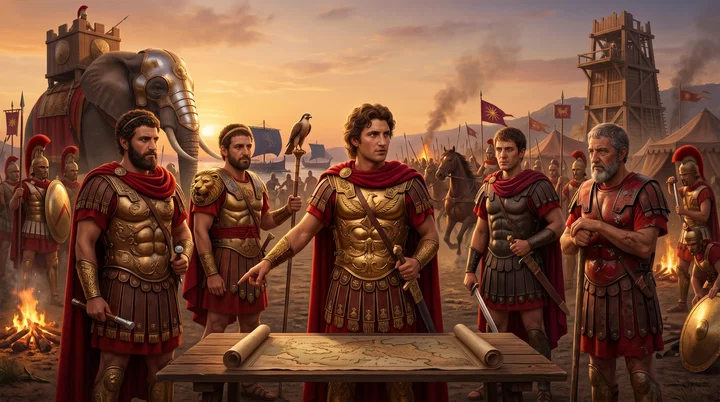
The mighty king is Alexander the Great, the first king of Grecia or Greece, who rises after the Medo-Persian and Persian kingdom, overthrows Persia and makes Greece a dominant world power.RH Dec 12, 1912RH Nov 14, 1912ST Jan 10, 1878ST Jun 19, 1884RH Dec 28, 1911 He conquered Persia in 331 B.C., establishing the Grecian empire that was afterward divided into four parts.RH Dec 12, 1912RH Nov 14, 1912ST Dec 24, 1912 His conquest established a mighty kingdom whose later division and whose failure to pass to his line belong to the following verse.ST Jan 10, 1878ST Jun 19, 1884
To rule with great dominion and do according to his will is to rule a vast, universal dominion with exceptional authority and to act as he pleased through unparalleled, successful conquest.ST Jan 10, 1878ST Jun 19, 1884RH Dec 28, 1911ST Feb 17, 1904ST Apr 6, 1882 His reign was marked by unparalleled conquest, and by age thirty-two he had conquered the then-known world.RH Nov 16, 1914ST Feb 17, 1904ST Feb 17, 1904 His rapid, forceful campaigns fulfilled the prophetic picture of a swift leopard and a he-goat whose feet seemed not to touch the ground.ST Feb 5, 1880
His empire stretched from India to Grecia, from the Adriatic Sea to the Ganges, with kings yet farther west sending embassies to Babylon to make submission.RH Nov 16, 1914RH May 11, 1916ST Feb 5, 1880 His victories at Granicus, Issus, and Arbela, with Arbela decisive for world empire, brought him rulership over the world.ST Apr 16, 1912 He began his career and reign in 336 B.C. and reigned to 323 B.C.ST Apr 16, 1912ST Apr 16, 1912 At the height of his power he was suddenly cut down and died in 323 B.C. at age thirty-two or thirty-three, having been worshiped as a god, of fever after a drunken debauch, before securing a successor.RH Nov 16, 1914RH May 11, 1916ST Feb 5, 1880ST Apr 16, 1912
His conquests transformed the world's language, culture, and thought.ST Apr 30, 1912 During his campaign he stood at Jerusalem's temple and heard Scripture's testimony concerning him, and the Greek language spread through his conquests served to carry witness of God's salvation through Christ's death and resurrection.ST Mar 20, 1907 His conquest ended a world power that could no longer serve the preservation of truth, and afterward Greek rule helped spread Scripture through its translation into Greek, then the world's most widely used language.ST Aug 3, 1904
Death and Fourfold Division
In the height of his power his kingdom was broken, and it was not passed to his posterity or descendants but to others.ST Jan 10, 1878ST Apr 6, 1882RH Apr 11, 1907 After confusion and warfare among his generals for supremacy, his entire line and family perished within about fifteen years.RH Nov 16, 1914RH May 11, 1916ST Apr 6, 1882 At the height of his power he was suddenly cut down by death, and none of his posterity received the kingdom.RH Nov 16, 1914RH May 11, 1916 After his death his heirs were eliminated and his generals took the kingdom, with its division described in the following verse toward the four directions from Palestine.ST Jan 10, 1878ST Apr 6, 1882RH Apr 11, 1907
Out of the generals' struggle for supremacy came division toward the four winds of heaven, dated to 301 B.C. after the Battle of Ipsus and also reckoned around 312 B.C.RH Dec 12, 1912RH Nov 14, 1912RH Nov 16, 1914RH May 11, 1916 The fourfold division was into Macedonia in the west, Egypt in the south, Asia Minor in the north, and Syria stretching eastward beyond the Euphrates.RH May 11, 1916ST Dec 24, 1894 Cassander ruled Macedon and Greece in the west, Ptolemy ruled Egypt in the south, Lysimachus ruled Thrace and Asia Minor in the north, and Seleucus ruled Babylon and Syria stretching eastward beyond the Euphrates.RH May 11, 1916ST Dec 24, 1894 The Grecian empire is thus divided into four parts, and a few years after his death into four parts which are the four heads of the four-winged leopard beast.RH Dec 12, 1912RH Nov 14, 1912ST Nov 29, 1905ST Dec 24, 1894
The four successor kingdoms did not retain his power and had a brief course whose weaknesses prepared the way for Rome's rise.RH Dec 19, 1912ST Nov 29, 1905ST Dec 24, 1894 The four divisions of Grecia later merge into two kingdoms, the northern kingdom under Seleucus and the southern kingdom under Ptolemy, their names deriving from their territories, Syria and Thrace in the north and Egypt in the south.RH Dec 19, 1912ST Dec 24, 1894 Syria, the kingdom of the north, and Egypt, the kingdom of the south, became the chief powers described in the prophecy and fought for control of Palestine.RH Dec 19, 1912ST Dec 24, 1894 The king of the north is any power that reigns over Syria for the time being, defined as the power holding Lysimachus' northern territory of Syria, Asia Minor, and Thrace, later held by the Seleucids for 250 years and by Turkey with its seat at Constantinople since 1453.RH Dec 12, 1854RH Feb 16, 1911 The Turkish Dynasty is now that power, not Russia, and if Russia, Austria, England, or France should become possessed of supreme power over Syria, that power would become the king of the north.RH Dec 12, 1854RH Feb 16, 1911
Ties to Other Prophecies
Daniel 11 parallels and supplements the earlier visions, developing the outlines given in Daniel 2, 7, 8 and 9 and covering the same succession of world powers from Babylon through Medo-Persia and Greece and Rome in its later phases to God's eternal kingdom.ST Dec 24, 1912ST Apr 9, 1912ST Apr 9, 1912ST Apr 30, 1912 It continues and more fully explains Daniel 8, including the 2300 days, tracing earthly rule in minute detail toward its end.ST Dec 24, 1912 It expands the brief notice of the second and third empires, while the seventy weeks bridge to God's people and the Messiah, and it is connected with Paul's teaching about a coming apostasy, which he learned from the Old Testament prophecies and understood more fully through prophetic revelation.RH Jan 10, 1856 Gabriel's explanation begins with the kings of Persia and proceeds through Greece and Rome.RH Jan 10, 1856
The mighty king who rules with great dominion and acts according to his will is Alexander, the first king of Greece, represented by the goat's great and notable horn in Daniel 8:21.RH Jan 16, 1913RH Nov 21, 1854RH Apr 30, 1857 Daniel 11:3-4 gives the literal prophecy corresponding to the four horns that followed Alexander's great horn, and his kingdom divided a few years after his death into four parts which are the four heads of the four-winged leopard beast.ST Nov 29, 1905ST Dec 24, 1894RH Dec 23, 1852 After his power was broken four kingdoms arose from his empire toward the four winds of heaven, though they lacked his power and did not retain it: Macedon and Thrace and Syria and Egypt, reckoned as Thrace to the north, Syria to the east, Egypt to the south, and Macedon to the west.ST Dec 24, 1894RH Dec 23, 1852RH Nov 21, 1854 These divisions explain the later references in Daniel 11 to the king of the north and the king of the south.ST Dec 24, 1894 Greece thus succeeds Persia as the world power, rising to world dominion before Alexander's empire is divided after his death.RH Dec 23, 1852RH Apr 30, 1857
Daniel 11 belongs with Daniel 7 and Daniel 8 as a prophecy of Roman power, pagan and papal, rather than shifted to Antiochus Epiphanes.RH Dec 23, 1852RH Apr 30, 1857RH Feb 15, 1870 Papist interpreters shift its fulfillment to that Syrian king, who could not resist the mandates of Rome, to save their church from any share in its fulfillment.RH Dec 10, 1857RH Apr 30, 1857 The prophecy presents two major powers opposed to God's government, covenant and people, Antiochus Epiphanes and Rome in its pagan and papal forms, and beyond these hostile powers points to the glorious reign of Christ the great Prince.ST Apr 9, 1912 The Roman power, rather than Antiochus, is the power described.RH Dec 10, 1857RH Feb 15, 1870
The verse stands in a prophecy in detail running from Daniel's day to the end of the world, belonging to the sketch of the Grecian kingdom that runs until the rise of the Roman Empire, with the Roman Republic taking its place in verse 14.RH May 29, 1900 Its position in that sequence shows that Rome is the great subject of the last half of the book of Daniel, as Babylon is the great subject of the first half.RH May 29, 1900
Fulfillment and Last Days
The prophecy was given centuries before the Christian era as history written beforehand, and its fulfilled specifications reward careful step-by-step matching of expression to historical fulfillment.ST Nov 24, 1914RH Mar 6, 1900ST Mar 1, 1905 Through nearly all its specifications across twenty-five centuries it has been fulfilled with great accuracy in the rise and fall of great nations, especially Medo-Persia and Greece and the division of Alexander's kingdom into four parts.RH Dec 14, 1905ST Oct 10, 1878ST Mar 1, 1905 That accuracy supports confidence in its remaining declarations about the world's future, while its final steps still lie ahead.ST Nov 24, 1914RH Dec 14, 1905 The only prophetic event then still awaiting fulfillment was the coming of the Son of man.ST Oct 10, 1878
The chapter traces literal history from Persia and Greece through Rome to the time of the end, fixed at 1798 when the 1260 years ended.ST Jan 8, 1880 It belongs to the angel's words of truth within the great vision begun in Daniel 10 and continued into Daniel 12, reaching to the end of the world, to Michael's standing up, the reign of Christ, the time of trouble, deliverance of the saints, resurrection, judgment, and the everlasting kingdom.ST Jan 8, 1880ST Sep 21, 1915 It must be fulfilled before Christ comes, its closing scenes fall in earth's last generation, and with the other great lines in Daniel, Revelation, and the Gospels it focalizes at the second coming.RH Dec 14, 1905ST Oct 10, 1878 It covers all the great political changes through twenty-five centuries in a long and bloody struggle whose consummation ends in glorious promise worthy of the God who rules in the affairs of men, with reward to the saints worthy of their long waiting, showing the world in the closing years with destruction rather than conversion ahead.ST Sep 21, 1915
The same standing up used for the mighty king means to take the kingdom and begin to reign, so when Michael in Daniel 12:1 stands up He takes His kingdom, great power, and coronation to begin reigning as King.RH Aug 28, 1856RH May 16, 1871ST Sep 22, 1914ST Oct 28, 1908RH Mar 28, 1907 Since His ascension to the Father's right hand Christ has pleaded as High Priest and Advocate, having gone to receive the kingdom in heaven before returning to earth to gather the heirs who will reign with Him on His throne.ST Sep 22, 1914 At His standing up He puts off priestly robes, lays down the scepter of peace, puts on garments of vengeance, takes the rod of iron to break the nations in pieces like a potter's vessel, and closes human probation forever.ST Sep 22, 1914 His reign so begun will not end when the scattering of the holy people is accomplished.RH Jan 17, 1856
The latter part of the prophecy brings the Turkish Empire into view as the king of the north and gives the true meaning of the Eastern Question.ST Sep 14, 1882RH Dec 26, 1912ST Aug 3, 1882 Its events stand fulfilled through the chapter's final verse except for two remaining events concerning the king of the north: the Turkish power's transfer of its seat of government to Jerusalem and its coming to an end, just before Michael, who is Christ, stands.RH Feb 17, 1903ST Sep 14, 1882ST Aug 3, 1882 That end comes under the sixth plague belonging to the dragon, whose seat has been Constantinople, held by Rome till 1453 and by the Turks ever since as a buffer-state, to be controlled by Russia as commander of the dragon power in the last part of time, with the last link the Turk and his territory closing just before the final gathering of the nations to give place to the three divisions of the world, the powers in each division eventually standing as a whole yet separate, East against West.RH Nov 6, 1900 The expected driving of the Turk from Europe is a fulfillment of prophecy and a sign of Michael's standing up and the coming time of trouble, and Italy's 1911 seizure of Tripoli continues his decline.RH Feb 17, 1903ST Sep 22, 1914ST Aug 3, 1882 Events taking place in Europe demonstrate the correctness of the interpretation held for many years, and interim retreats will not prevent that end.RH Dec 26, 1912
The verse is linked with Daniel 11:6 and Daniel 12:6-7 to the scattering of God's people, or the indignation, which could not be complete until a government existed where the true Israel, the church, could have civil and religious liberty, identified as the United States.RH Jul 30, 1867 Publicly teaching the prophecy's revelation of the Turkish government's final fate in connection with the Eastern question can be twisted into political opposition to that government and forbidden by civil authorities as sedition, bringing danger of arrest as a seditionist and forcing flight or silence.RH Feb 18, 1904 Teaching it therefore calls for being wise as serpents and harmless as doves, avoiding sensational politico-religious methods and faulting rulers, and instead preaching Christ and Him crucified, praying for rulers, and living peaceably with all.RH Feb 18, 1904
The prophecies of Daniel 11 were described as nearly reaching final fulfillment amid wars and rumors of wars and growing troubles before the final crisis.RH Nov 24, 1904RH Feb 6, 1913RH Aug 3, 1905 Their approaching fulfillment belongs to the period of coming trouble and war before the Lord's second coming and the approaching time of trouble before Jesus comes.RH Nov 24, 1904RH Feb 6, 1913 The final fulfillment of Daniel 11's prophecies about the last phases of history comes during the plagues, after Christ's ministry in the heavenly sanctuary has ceased and probation has closed.RH Dec 14, 1905
Sources