Daniel 8:4
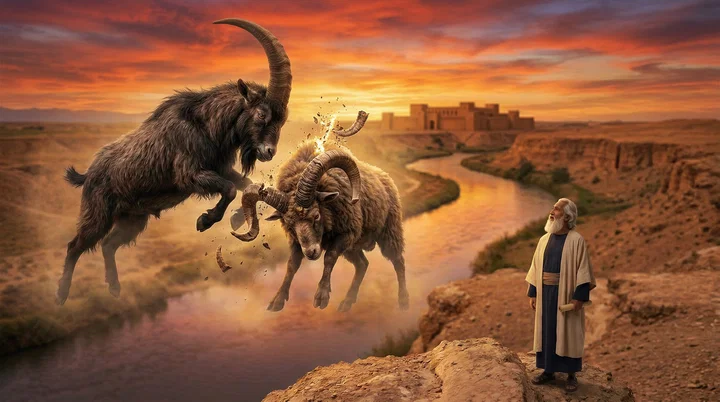
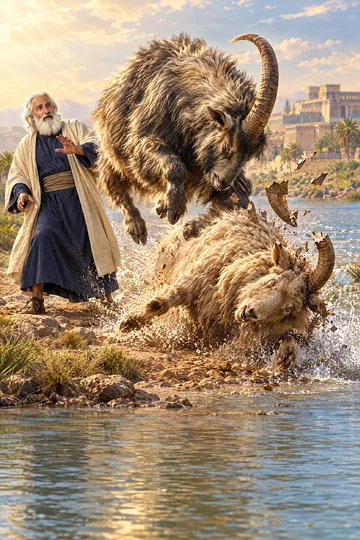
I saw the ram pushing westward, and northward, and southward; so that no beasts might stand before him, neither was there any that could deliver out of his hand; but he did according to his will, and became great.
Translations
American King James Version, King James Version, KJV Cambridge Paragraph Bible, Webster Bible
I saw the ram pushing westward, and northward, and southward; so that no beasts might stand before him, neither was there any that could deliver out of his hand; but he did according to his will, and became great.
Revised Version, American Standard Version
I saw the ram pushing westward, and northward, and southward; and no beasts could stand before him, neither was there any that could deliver out of his hand; but he did according to his will, and magnified himself.
I have seen the ram pushing westward, and northward, and southward, and no living creatures do stand before it, and there is none delivering out of its hand, and it hath done according to its pleasure, and hath exerted itself.
I saw the ram pushing westward, and northward, and southward, and no beast could stand before him, neither was there any that could deliver out of his hand; and he did according to his will, and became great.
I saw the ram, pushing strongly westward and northward and southward, so that no wild beast could stand before him, and none could deliver out of his hand,—but he did according to his own pleasure, and shewed himself great.
Berean Standard Bible, Majority Standard Bible
I saw the ram charging toward the west and the north and the south. No animal could stand against him, and there was no deliverance from his power. He did as he pleased and became great.
I saw the ram pushing westward, northward, and southward. No animals could stand before him. There wasn’t any who could deliver out of his hand, but he did according to his will, and magnified himself.
I saw the sheep pushing to the west and to the north and to the south; and no beasts were able to keep their place before him, and no one was able to get people out of his power; but he did whatever his pleasure was and made himself great.
I sawe the ramme pusshing against ye West, and against the North, and against the South: so that no beastes might stande before him, nor could deliuer out of his hand, but he did what he listed, and became great.
Douay-Rheims (Challoner revision)
I saw the ram pushing with his horns against the west, and against the north, and against the south: and no beasts could withstand him, nor be delivered out of his hand: and he did according to his own will, and became great.
Pictures
Cross-references 20 of 31
- Daniel 8:20
The ram which thou sawest having two horns are the kings of Media and Persia.
Identifies the ram as the kings of Media and Persia.
- Daniel 8:14
And he said unto me, Unto two thousand and three hundred days; then shall the sanctuary be cleansed.
It gives the vision’s 2,300 days and the sanctuary’s cleansing.
- Daniel 7:2-8
Daniel spake and said, I saw in my vision by night, and, behold, the four winds of the heaven strove upon the great sea.
Its beasts symbolically trace the same succession of kingdoms as Daniel’s ram vision.
- Daniel 9:21-23
Yea, whiles I was speaking in prayer, even the man Gabriel, whom I had seen in the vision at the beginning, being caused to fly swiftly, touched me about the time of the evening oblation.
links Gabriel to vision of chapter 8
- Daniel 8:21
And the rough goat is the king of Grecia: and the great horn that is between his eyes is the first king.
Gabriel identifies the goat following the ram as Greece, whose great horn is its first king.
- Daniel 11:2-4
And now will I shew thee the truth. Behold, there shall stand up yet three kings in Persia; and the fourth shall be far richer than they all: and by his strength through his riches he shall stir up all against the realm of Grecia.
Its prophetic sequence continues Daniel 8’s account of the rise of successive kingdoms.
- Daniel 2:31-45
Thou, O king, sawest, and behold a great image. This great image, whose brightness was excellent, stood before thee; and the form thereof was terrible.
The image vision gives a parallel outline of successive empires.
- Daniel 8:16
And I heard a man’s voice between the banks of Ulai, which called, and said, Gabriel, make this man to understand the vision.
Gabriel is commanded to make Daniel understand the vision.
- Daniel 9:24-27
Seventy weeks are determined upon thy people and upon thy holy city, to finish the transgression, and to make an end of sins, and to make reconciliation for iniquity, and to bring in everlasting righteousness, and to seal up the vision and prophecy, and to anoint the most Holy.
Chapter 9 continues and explains the vision of chapter 8.
- Daniel 8:8
Therefore the he goat waxed very great: and when he was strong, the great horn was broken; and for it came up four notable ones toward the four winds of heaven.
The goat’s greater power follows the ram’s greatness, depicting Greece succeeding Medo-Persia.
- Daniel 8:11
Yea, he magnified himself even to the prince of the host, and by him the daily sacrifice was taken away, and the place of his sanctuary was cast down.
The little horn magnifies itself against the Prince and takes away the daily sacrifice.
- Daniel 8:25
And through his policy also he shall cause craft to prosper in his hand; and he shall magnify himself in his heart, and by peace shall destroy many: he shall also stand up against the Prince of princes; but he shall be broken without hand.
The ram’s unchecked power is followed by the little horn’s breaking without human agency.
- Daniel 8:22
Now that being broken, whereas four stood up for it, four kingdoms shall stand up out of the nation, but not in his power.
Four kingdoms arose after Alexander’s death, replacing his rule.
- Daniel 9:21
Yea, whiles I was speaking in prayer, even the man Gabriel, whom I had seen in the vision at the beginning, being caused to fly swiftly, touched me about the time of the evening oblation.
Gabriel returns while Daniel is praying to continue the vision’s explanation.
- Daniel 7:8
I considered the horns, and, behold, there came up among them another little horn, before whom there were three of the first horns plucked up by the roots: and, behold, in this horn were eyes like the eyes of man, and a mouth speaking great things.
The little horn in both visions symbolizes a kingdom.
- Daniel 8:9
And out of one of them came forth a little horn, which waxed exceeding great, toward the south, and toward the east, and toward the pleasant land.
The little horn symbolizes Rome as a nation.
- Daniel 11:16
But he that cometh against him shall do according to his own will, and none shall stand before him: and he shall stand in the glorious land, which by his hand shall be consumed.
Both describe a conqueror acting by his own will, with none able to stand against him.
- Daniel 8:27
And I Daniel fainted, and was sick certain days; afterward I rose up, and did the king’s business; and I was astonished at the vision, but none understood it.
Daniel is astonished by the vision, and none understands it.
- Daniel 7:17
These great beasts, which are four, are four kings, which shall arise out of the earth.
Both texts use beasts as symbols for kingdoms.
- Daniel 10:1-11
In the third year of Cyrus king of Persia a thing was revealed unto Daniel, whose name was called Belteshazzar; and the thing was true, but the time appointed was long: and he understood the thing, and had understanding of the vision.
These chapters give a fuller explanation of Daniel 8 through a parallel prophecy.
Commentary
Each commentary is drawn from primary sources: the writings of Ellen G. White and Adventist pioneers and periodicals. Each commentary is separate. Its own words are not a quotation; follow the references to read the source passages.
Ellen G. White
5 sources
Daniel 8:4 belongs to the wonderful prophecies of Daniel 7-12 given to Daniel as God's representative to reveal the mysteries of future ages.PK 547.1 Its prophetic subject is Rome rather than Antiochus Epiphanes.LS 67.3–69.3 The ram's pushing actions are treated as already explained within Daniel 8 itself.LS 45.2–3 What was left unexplained in the vision was the 2,300-day period, and the later explanation in Daniel 9 does not revisit the ram but resolves that remaining time element.LS 45.2–3
The chapter contains a prophetic period whose historical and chronological reckoning begins in 457 B.C.GC 687.4 Its full meaning was sealed until the time of the end and was not understood even by Daniel himself, but the seal is removed in the closing period of this world's history.PK 547.1 The events it foretells are in process of fulfillment and will soon come to pass.Ms 142, 1901, par. 6 At the end of the days Daniel himself will rest and then rise to receive his assigned place.PK 547.1
Sources
Pioneers and periodicals
123 sources
The ram is Media and Persia, the second world empire after Babylon, explained in Daniel 8:20 as its kings and kingdom before Grecia.ST Dec 24, 1894ST Its two horns are the two nationalities united in one government, with the higher horn that came up last as Persia rising from weakness to predominance over Media.RH Nov 12, 1908ST Feb 10, 1898RH Dec 30, 1915RH Mar 21, 1854RH Mar 18, 1862 Its pushing westward and northward and southward is the spread of its conquests in those directions, westward to Lydia, Babylon, Asia Minor and Thrace, northward to Armenia and peoples to the Caspian Sea, southward to Egypt, Ethiopia and Judea, with no eastward push because Persia lay to the east.RH Jun 21, 1870ST Nov 17, 1881RH Nov 26, 1857ST Jul 27, 1915RH Sep 13, 1915 No beast standing before him and none delivering out of his hand means no other kingdom could resist or rescue its prey, but he did according to his will and became great with irresistible universal dominion from India to Ethiopia over 127 provinces.ST Feb 20, 1912ST Dec 24, 1894RH Jun 21, 1870ST Nov 17, 1881 His being called great begins a rising scale where Grecia is called very great and the little horn is called exceeding great, which is Rome in pagan and papal forms and not Antiochus Epiphanes, and the vision to which the ram belongs carries the 2300 days as 2300 years from 457 B.C. to 1844 when the heavenly sanctuary was to be cleansed for the investigative judgment.LS 67.3–69.3ST Aug 14, 1893SMV 25.1RH May 26, 1853RH Dec 23, 1852
Vision Setting and Date
The vision to which the ram belongs was given in the third year of Belshazzar, about 538 B.C., two years after the vision of Daniel 7.ST Feb 20, 1912RH May 12, 1910ST Mar 11, 1889 That was the last year of Babylon's supremacy, when Babylon was still a great empire but falling, the year Babylon fell and the first year of Darius the Median began.ST Feb 20, 1912ST Dec 24, 1894RH May 12, 1910 Belshazzar was then ruling jointly with his father Nabonadius.ST Mar 11, 1889 The prophecy therefore begins with Medo-Persia, the power just at hand, and this timing stands closely connected with Daniel 9, which explains the time brought to view in the vision.ST Dec 24, 1894RH May 12, 1910 It belongs to a line of prophecy extending from Daniel's time to the end of earthly rule, understood as a 2,300-year timetable beginning in 457 B.C. and ending in 1844, when the cleansing of the heavenly sanctuary began.ST Dec 24, 1894RH May 20, 1909
Daniel saw the ram while in vision in the palace at Shushan near the waters of Ulai, watching it with two very high unequal horns pushing westward and northward and southward, mightily pushing down and subduing all foes.ST Aug 17, 1882 That vision stands in dated sequence with the visions of Daniel 7 and Daniel 10, with measurable intervals between the successive visions.RH Feb 27, 1900 It is a sublime and majestic utterance unfolding the mystery of God concerning His plan and purposes and man's destiny.RH Dec 19, 1912 At first none understood it, for it is deep and seemingly inscrutable, yet it holds precious jewels of truth and is not to be passed by as of no use, but to be dug into with diligent, humble, prayerful study until God makes plain what is apparently difficult and obscure.RH Dec 19, 1912
Babylon is omitted from this vision because its career was finished and passing away.ST Aug 14, 1893RH May 12, 1910 It was already history and assumed to be familiar, so the prophecy does not begin with Babylon as in Daniel 2 and Daniel 7, but with Media and Persia at the height of its power.RH Apr 30, 1857RH Mar 29, 1864RH Feb 15, 1870 The ram is the same power represented by the silver chest and arms in Daniel 2 and the bear in Daniel 7.RH Apr 30, 1857 The vision thus presents the three universal kingdoms that followed Babylon, which was to fall in Daniel's day, continuing till earthly empire is broken without hand.ST Aug 14, 1893 Its chief focus is the sanctuary and its cleansing, spanning the solemn scenes of the day of atonement and judgment and belonging to the appointed time of the end, with its companion predictions about the Messiah and the justifying of the heavenly sanctuary begun in 1844 showing that the closing work of judgment is brief and that Christ will soon come.ST Aug 14, 1893
The ram is shown already at the height of its power and still as an undivided empire.RH Mar 18, 1862RH Dec 29, 1863 Whatever acts are ascribed to a symbolic beast are all accomplished before its horns become divisions or kingdoms growing out of it, and its two horns represent the Medes and Persians as peoples, not Cyrus and Darius personally.RH Mar 18, 1862RH Dec 29, 1863 Its pushing westward and northward and southward, through which the Medo-Persian power rose to great, empire-wide dominion, did not happen all at one time, and the verse portrays the rise of a nation to the height of universal empire rather than a single event.RH Dec 6, 1864RH Dec 6, 1864 Since the vision presents the empire in its strength, the prophetic period covering the vision need not begin in the empire's first, second, or third year.RH Dec 29, 1863 For the same reason the ram's pushing is not the decree to destroy the Jews nor the starting point of the 2300 days, because the Jews were permitted to defend themselves and won a great victory.RH Dec 6, 1864
Ram Identity and Horns
The ram is the kings and the kingdom of Media and Persia, as Gabriel's explanation in Daniel 8:20 declares, the second world empire that succeeded Babylon in world rule in 538 B.C. and preceded Grecia.ST Dec 24, 1894STRH Nov 12, 1908RH Mar 10, 1874 Its westward, northward, and southward advance is the conquering expansion of Media and Persia until no power could resist, withstand, or deliver from its hand, doing according to its will and becoming great unto world supremacy.ST Dec 24, 1894STRH Nov 12, 1908RH Oct 3, 1912 Its two horns are the kings of Media and Persia whose united rule conquered Babylon, and the chapter places this empire within the succession of earthly kingdoms extending from the rise of Persia to the final destruction of earthly kingdoms by God.RH Nov 12, 1908RH Mar 10, 1874RH Oct 3, 1912
In symbolic prophecy beasts represent kingdoms, nations, earthly governments, and the ram as a beast represents a kingdom, with the ram for Medo-Persia and the goat for Greece making future events easier to understand.ST May 27, 1908RH Jun 25, 1857RH May 8, 1916 Horns represent rulers and the powers exercised by the nations they represent, whether civil or ecclesiastical.RH Mar 21, 1854RH May 8, 1916RH May 19, 1851 A mere beast like this ram stands for a government as such and its work in connection with God's people rather than a complete account of all its actions, while fierce, wild, and cruel beasts stand for governments where church and state are united and the government therefore persecutes.RH Jun 25, 1857
The ram's two horns denote the union of the Medes and Persians in one empire and one government, the two nationalities and two elements composing it from the beginning, and its pushing while still an undivided empire shows that whatever is ascribed to a symbolic beast is accomplished before its horns become divisions or kingdoms growing out of it.RH Mar 18, 1862ST Aug 7, 1879RH Mar 16, 1869ST Oct 4, 1877 This proves that a plurality of horns does not always symbolize a divided power.RH Nov 12, 1908RH Mar 21, 1854 Those who held the horns to be civil and religious powers taught that they symbolize the civil and religious powers exercised by Media and Persia, and compared the ram's two horns with the two united principles of civil equality and religious freedom in one government.ST Aug 7, 1879RH May 19, 1851
The higher horn that came up last is Persia, the Persian element that was weakest at first and later became predominant, dominant, supreme, and the leading division until the empire's defeat in 331 B.C.ST Feb 10, 1898RH Dec 30, 1915ST Nov 28, 1895ST Jun 3, 1897ST Sep 29, 1881 Darius the Mede first held the regal power while Cyrus the Persian acted only as commander-in-chief of the combined armies and placed Darius on the throne after Babylon was taken, and Cyrus became absolute monarch of the whole only afterward when he succeeded his father in Persia and added Media through marriage to the daughter of Darius after her father's death.ST Jan 22, 1880 He had royal blood of both Medes and Persians in his veins through Mandane daughter of Astyages and Cambyses a Persian prince.ST Jan 22, 1880
The ram is a fitting symbol and recognized emblem of the Medes and Persians, for the king of Persia wore a jeweled ram's horn of gold instead of a diadem, and the Hebrew word for ram springs from the same root as Elam, or Persia.ST Aug 18, 1881ST Mar 1, 1877 Its twofold character distinctly marks the union of the two nationalities and corresponds to the two arms of silver in Daniel 2.ST Oct 4, 1877ST Aug 18, 1881ST Mar 1, 1877 The same Persian ascendancy over the Median element is shown more fully by the ram than by the bear raised up on one side in Daniel 7, whose command to devour much flesh parallels the ram's conquest and slaughter.ST Oct 22, 1885ST Sep 29, 1881ST May 3, 1877 The ram is a symbol of a nation whose power, along with the nation symbolized by the rough goat, strongly affected the destinies of Daniel's people.ST Jul 10, 1901
Directions and Conquests
The pushing westward and northward and southward denotes the directions in which the Medes and Persians carried their conquests as the kingdom expanded and became dominant.RH Jun 21, 1870ST Nov 17, 1881RH Nov 26, 1857ST Oct 29, 1885 There is no eastward push because Persia lay east of the lands it conquered, so its dominion expanded chiefly westward rather than eastward.RH Nov 26, 1857ST Jan 22, 1880 The ram represents Medo-Persia, which overthrows Babylon and becomes a universal empire, and its advance in those three directions fits the empire's expansion from Persia through the conquest of Babylon and beyond.RH Nov 26, 1857ST Oct 29, 1885ST Jan 22, 1880
Westward pushing was fulfilled when Cyrus defeated Croesus king of Lydia and then Babylon and when Darius I subdued Thrace and Macedon.ST Jul 27, 1915RH Sep 13, 1915 That westward advance extended to the bounds of Asia, with Babylonia, Mesopotamia, Syria, and Asia Minor subdued, and especially fits Cyrus's campaigns from Persia through the conquest of Babylon.RH Nov 26, 1857RH Sep 13, 1915ST Jan 22, 1880 Northward pushing was fulfilled when Cyrus made war on the Massagetae north of the Jaxartes and against peoples such as the Armenians, Cappadocians, Coictus, and Iberia to the Caspian Sea.ST Jul 27, 1915RH Sep 13, 1915 Southward pushing was fulfilled when Cambyses son of Cyrus conquered Egypt and Ethiopia, with Judea and India also submitting, so that the Persian empire's conquest of Babylon, Lydia, and Egypt fits the same description.ST Jul 27, 1915ST Jan 22, 1880 The westward advance is linked with Xerxes, the rich fourth Persian king after Cyrus, stirring a great force against Grecia.
That no beast might stand before him and none could deliver out of his hand means no other beast-power could stand before it and none could deliver from its hand while it acted according to its own will and magnified itself.ST Feb 20, 1912STRH Apr 30, 1857 No earthly powers could stand before them while they rose to the exalted universal position appointed by the providence of God.RH Jun 21, 1870ST Nov 17, 1881 No eastern kings great or small could resist him but were at his discretion, and no power could resist or rescue its prey from Medo-Persia's irresistible power as it rose to world supremacy when Babylon fell.ST Dec 24, 1894ST Jul 27, 1915ST Oct 13, 1909 The pushing describes the direction of Medo-Persian conquest, distinct from Greece coming from the west and proceeding eastward under Alexander the first king who conquered Persia, and distinct from Rome which waxed great toward the south and east and the glorious land.ST Oct 13, 1909
Doing according to his will and becoming great means their conquests were so successful that the ram established irresistible universal dominion and became great.RH Jun 21, 1870ST Nov 28, 1895ST Jul 27, 1915 Its dominion was universal, of the same extent as Babylon before it, holding the same worldwide rule in its place that its successors in Greece and Rome also held.RH Jan 31, 1856 In the days of Ahasuerus the kingdom extended from India to Ethiopia, the extremities of the then known world, over 127 provinces, so that history exceeds what the prophecy states.RH Jun 21, 1870ST Nov 17, 1881RH Apr 30, 1857RH Feb 15, 1870 The statement that the ram did according to its will and became great scarcely conveys the full extent of its success, though it was surpassed in greatness by the goat and the little horn, Persia being called great, Greece very great, and the later power exceeding great.ST Nov 17, 1881RH Feb 15, 1870 Its conquest and slaughter parallels the bear's command in Daniel 7 to devour much flesh, and Daniel 11:16 echoes the same language of irresistible conquest by a ruler or kingdom extending its power in several directions, defeating every opponent, and acting according to its own will.ST Oct 22, 1885ST Apr 16, 1912
Degrees of Greatness
The ram became great by pushing westward and northward and southward, so that no beast could stand before it and none could deliver out of its hand, while it acted according to its will.RH Dec 23, 1852RH Nov 21, 1854ST Oct 29, 1885 Medo-Persia is called great, Grecia is called very great, and the little horn is called exceeding great, forming a rising scale and gradual threefold progression in which each stronger wording marks greater growth.RH Dec 23, 1852ST Mar 5, 1912RH Feb 15, 1870RH Nov 21, 1854 Rome is the power that waxed exceeding great, having arisen from the territory of the Grecian empire and succeeded it as a world power.ST Feb 10, 1898STST Mar 5, 1912 That greatness of Persia is illustrated by rule over 127 provinces from India to Ethiopia, to the bounds of Asia with Babylonia, Mesopotamia, Syria and Asia Minor, before Greece became very great.RH Feb 15, 1870RH Nov 21, 1854ST Oct 29, 1885ST Feb 12, 1880ST Aug 2, 1877
This comparison proves the little horn is Rome and not Antiochus Epiphanes.LS 67.3–69.3ST Feb 12, 1880RH Dec 23, 1852ST Aug 2, 1877ST Nov 24, 1881 Antiochus was only one king of the Syrian horn and was not greater than Persia and Greece together, since he never enlarged his dominion except by temporary conquests.RH Dec 23, 1852ST Aug 2, 1877ST Nov 24, 1881 He abandoned Egypt at Rome's command and paid tribute to Rome.ST Feb 12, 1880ST Aug 2, 1877ST Nov 24, 1881 Rome by contrast came up small in its beginning and waxed exceeding great by successive conquests until it surpassed both Persia and Grecia in power and dominion and held the world in its iron grasp, so the exceeding-great power cannot be Antiochus or one of the divisions of the Grecian empire.ST Feb 7, 1884ST Feb 12, 1880RH Dec 23, 1852ST Aug 2, 1877ST Nov 24, 1881
The little horn following the ram and goat represents Rome throughout its pagan and papal forms.ST Nov 19, 1885ST Feb 7, 1884RH Apr 10, 1900ST Sep 9, 1880ST This is unlike the little horn of Daniel 7, which represents only the papacy during part of Rome's career.ST Nov 19, 1885 Pagan Rome pictures papal Rome, and the two forms are called the daily and the transgression of desolation.ST Nov 19, 1885 The chapter's description traces Rome from its ancient beginning through its later phase to the end of the world, applying to modern Rome as well as ancient Rome, with some features applying only to modern Rome.RH Apr 10, 1900ST Sep 9, 1880ST Feb 10, 1898 Medo-Persia comes into view after Babylon and before Greece and is specifically named in the prophecy, with Greece's greater greatness identified with Rome's conquest of Greece and the sanctuary's cleansing at the end of the 2300 days placed after Rome.ST Sep 9, 1880ST Feb 10, 1898ST
Those who held the contrary reading made the little horn of Daniel 8 to be Mahometanism.RH Apr 15, 1873 They distinguished it from the little horn of Daniel 7 as the Roman Catholic hierarchy.RH Apr 15, 1873 They proved the distinction by their respective places of origin and spheres of influence.RH Apr 15, 1873 They made the cleansing of the sanctuary refer to affairs on earth at the destruction of Mahometanism.RH Apr 15, 1873
Place in Prophecy
The ram stands at the beginning of the third prophetic line in Daniel, the same power as the silver chest and arms in Daniel 2 and the bear in Daniel 7.RH Apr 30, 1857ST Sep 21, 1882ST Jan 8, 1880 That line omits Babylon because Babylon was already history and familiar, and begins with Media and Persia at the height of its power, then covers the three kingdoms that were to follow Babylon, naming the Medo-Persians and the Greeks by name.RH Apr 30, 1857ST Sep 21, 1882ST Jun 30, 1914 Its outline is developed further in Daniel 10-12, which covers the same powers and the same course of events through to the end with added detail, and it is explained by the mostly plain-language prophecy of Daniel 11.RH Apr 30, 1857ST Apr 9, 1912 Together with Daniel 9 and Revelation, especially chapters 12, 13, 17, and 18, it expands what Daniel 2 outlines and adds new details, describing powers and great events connected with God's work as enemies of His gospel and leading to Christ's second coming and the everlasting kingdom.ST Apr 9, 1912ST Jun 30, 1914ST Aug 9, 1910
The vision presents a succession of earthly kingdoms from the rise of Persia through Grecia and Rome to the final destruction of earthly kingdoms by God.RH Mar 10, 1874ST Oct 22, 1874 It foreshows the successive arising and passing away of Babylon, Medo-Persia, Grecia, and Rome, including the division of Rome into ten parts in the first few centuries of the Christian era and the rise of the Papacy with its warfare against God and truth and its exercise of great authority from 538 to 1798 A.D.ST Aug 2, 1877RH Nov 24, 1910 Only the closing specifications remain: the smiting of the image upon the feet by the stone, the slaying of the beast and giving of his body to the burning flame, the breaking without hand of the little horn, the reign of Michael, the resurrection, and the fifth universal empire which is God's everlasting kingdom immediately impending.ST Aug 14, 1893ST Aug 2, 1877 That line of prophecy focuses chiefly on the sanctuary and its cleansing, which spans the solemn scenes of the day of atonement and judgment and belongs to the appointed time of the end, and with its companion predictions about the Messiah and the justifying of the heavenly sanctuary begun in 1844 shows that the closing work of judgment is brief and that Christ will soon come, with His second coming and coronation as the still-future crowning event.ST Aug 14, 1893ST Aug 9, 1910
The prophecy is definite and plain and has been fulfilled literally and with minute accuracy hundreds of years before the dawn of the Christian era, proving its divine origin and that making known the coming of the Lord Jesus Christ is not following cunningly devised fables.ST Nov 24, 1914ST Jun 30, 1914 Because nearly all specifications are fulfilled except the very closing ones, the rest of its utterances can be depended upon with absolute certainty to know the outcome of this world and the future existence of the human race.ST Nov 24, 1914ST Aug 2, 1877 Explained through the course of empires, it shows that the God of heaven is about to establish His kingdom.RH Mar 5, 1867
The ram then overthrown by Grecia is the second of the three overturnings foretold after Zedekiah lost the crown, giving Grecia the dominion of the whole earth before Rome in turn became mistress of the world.ST Jan 1, 1894ST May 20, 1913 It represents the Medo-Persian Empire formed by Media and Persia succeeding Babylon under Cyrus in 538 B.C., with its two unequal horns signifying the two powers and nationalities, and it remained supreme with none able to resist or escape its grasp until its defeat in 331 B.C.ST Nov 28, 1895ST Jan 1, 1894ST Apr 9, 1896 It reached its highest elevation under Darius Hystaspes after Cyrus, Cambyses, and Smerdis the impostor, then declined from the wealthy but weak Xerxes onward through Artaxerxes Longimanus, Xerxes II, Sogdianus, Darius II, Artaxerxes II, Artaxerxes III, Arses, to Darius III the last monarch, who could not withstand Alexander's coming power from the west.RH Nov 26, 1857ST Apr 9, 1896ST Feb 20, 1912 Pushing westward meant conquest of Babylonia, Mesopotamia, Syria, and Asia Minor; pushing northward meant conquest over Coictus, Armenia, Iberia, and to the Caspian Sea; pushing southward meant submission of Judea, Egypt, Ethiopia, and India, and Medo-Persia ended with Alexander the Great's victory at Arbela in 331 B.C.ST Nov 28, 1895ST Apr 9, 1896ST Feb 20, 1912
The goat coming swiftly from the west with a notable horn between its eyes is the king of Grecia, and the great horn is the first king, Alexander of Macedonia as head of united Grecia, the kingdom represented by brass.ST May 20, 1913RH Mar 21, 1912 The vision was given in the last year of the Babylonian monarchy, about 538 B.C., declaring generations beforehand that dominion would pass into European hands, and two hundred years later Alexander came swiftly from the west, won Granicus and Issus, laid Persia prostrate, ran upon the ram and crushed it, destroying the Persian Empire.ST Feb 13, 1912RH Mar 21, 1912 His conquering the world at age thirty-three in a manner little short of miraculous was cooperating with that prophecy, showing that fighting in harmony with God's prophetic word always wins.ST Feb 13, 1912RH Mar 21, 1912 When he approached Jerusalem the book of Daniel was shown him, declaring that one of the Greeks should destroy the empire of the Persians, and he took himself to be the one intended, entered the city and temple, offered sacrifice to God, granted the Jews their ancestral laws and release from tribute in the seventh year, and bowed for the moment before the living God whose plain word written two centuries before was fulfilling before men.RH Mar 21, 1912
Time Period and Sanctuary
The ram alone lasted far longer than 2,300 literal days, which is not quite seven years and scarcely six and a half years, and much less could that span cover all the powers of the vision together, Persia, Greece and Rome, so the days must be symbols just as the beasts and horns are symbols, each day for a year, giving 2,300 years.RH Dec 23, 1852SMV 25.1ST Feb 7, 1884RH Jan 7, 1858 The seventy weeks belonging to that period are therefore weeks of years, 490 years.RH May 26, 1853RH Jan 7, 1858 Gabriel was commanded to make Daniel understand, yet after the first explanation Daniel remained astonished and none understood.RH Dec 23, 1852RH Aug 23, 1870RH May 26, 1853 The ram, the he-goat, and the little horn as Medo-Persia, Greece, and Rome were explained in plain terms and understood with no difficulty, while the 2,300 days and the sanctuary were left unexplained and omitted except for the time element.RH Dec 23, 1852RH Mar 21, 1854RH Aug 23, 1870
For that reason Gabriel returned in Daniel 9 to give skill and understanding, bidding Daniel understand the matter and consider the vision, beginning with the matter omitted in Daniel 8, the explanation of the time.RH Aug 23, 1870RH Dec 31, 1857ST May 17, 1877 The seventy weeks are cut off from the 2,300 days and begin where the 2,300 days begin, dating the longer period, which then extends 1,810 years after the shorter ends.RH May 26, 1853RH Jan 7, 1858RH Jul 21, 1863ST May 17, 1877 The ram is seen first so that the 2,300 days coming last have their first part spoken of first, proving the seventy weeks are the first part and a division of the great period, with all the prophetic periods in the explanation from Daniel 8:15 through Daniel 12 forming one connected chain.SMV 25.1RH Jan 17, 1856 The period begins in 457 B.C. at the going forth of the commandment to restore and rebuild Jerusalem, met in full in Ezra 7 in the seventh year of Artaxerxes Longimanus son of Xerxes.RH Nov 24, 1910RH May 20, 1909
Sixty-nine weeks, or 483 years, run to the Messiah's baptism in the fall of A.D. 27 when the time was fulfilled, to His crucifixion in A.D. 31 in the midst of the week, with the wall finished in 408 B.C. along the way.RH Feb 21, 1856RH Nov 24, 1910 Seventy weeks run to A.D. 33 or 34 with the gospel going to the Gentiles and the turning of the apostles to the Gentiles, leaving 1,810 years to complete the whole 2,300 days in the fall of 1844, first expected in the spring and then fixed to October 22.RH May 26, 1853RH Feb 21, 1856ST Jun 20, 1916RH Nov 24, 1910 To insert twelve years between the end of the 2,300 days and the cleansing denies the predicted time and would be fatal to the truth of the prophecy, just as adding twelve years to the periods of Daniel 9 would prove either that Jesus was not the true Messiah or that Daniel was not divinely inspired.RH Feb 21, 1856 William Miller at first placed the cleansing in 1843 and expected Christ's coming and the end of the world, understanding the sanctuary as the earth.SMV 25.1RH May 20, 1909
At that termination in 1844 the sanctuary, which is not the earth or any part of the earth but the true tabernacle in heaven where Christ ministers as High Priest, was to be cleansed.ST Jun 20, 1916RH May 20, 1909 Christ entered the most holy place to begin the investigative judgment and finishing atonement and the justifying of the heavenly sanctuary, proceeding from the first righteous onward and now reaching the living and belonging to the appointed time of the end.ST Aug 14, 1893ST Jun 20, 1916 Its preaching after July 1844 was the midnight cry of the parable of the ten virgins, to be proclaimed worldwide with Revelation 10 and 14 that a judgment has come.ST Jun 20, 1916 The 2,300 days do not cover every event in the vision, so their ending in 1844 does not require the little horn to be broken then; the larger vision extends beyond that period to the destruction of earthly powers, with the little horn alone still awaiting being broken without human power and without human agency.RH Jun 4, 1857RH Jun 4, 1857ST Sep 14, 1882RH Dec 13, 1853
The ram's pushing is not the decree to destroy the Jews in Esther's time nor the starting point of the 2,300 days, for the directions do not mean all conquests happened at once but portray successive conquests westward, northward, and southward through which Medo-Persia rose to great empire-wide dominion.RH Dec 6, 1864RH Dec 6, 1864 That episode does not fit because the Jews were permitted to defend themselves by counter-decree and won a great victory over their Persian enemies, so identifying them as the beasts defeated by the ram reverses the events; the verse instead portrays a nation's march toward universal empire with no one able to resist or deliver from its power.RH Dec 6, 1864RH Dec 6, 1864RH Mar 30, 1876 The contrary claim that the vision concerns Antiochus Epiphanes, his persecution and temple desecration around 160 B.C., with 2,300 days as 1,150 literal days fulfilled in about three years or in about 55 days, is foolish and idle, and the prophecy's subject is Rome rather than Antiochus.LS 67.3–69.3RH May 15, 1856RH May 1, 1856 The vision of chapter 8 as continued and explained in chapters 9, 10, 11, and 12 contains four prophetic periods, the 2,300, 1,260, 1,290, and 1,335 days, with the 2,300 days as the principal and longest period and the others as intermediate parts and subdivisions of it, to be considered in relation to the great empires brought to view in Daniel 8.RH Jul 18, 1871RH Oct 13, 1863ST Jul 27, 1882
In Daniel 8 Jerusalem and the Lord's people fill the roles of the sanctuary and its host, whose iniquity is pardoned and removed before God's people are delivered and enter Jerusalem.RH Oct 14, 1852 The prophecy is to be reviewed as a whole in connection with the sanctuary, and studying the sanctuary service as a type helps explain Christ's work in the present dispensation.RH Feb 6, 1900
Application and Warning
Daniel 8:4 stands in a prophecy whose latter and great subject is Rome, pagan and papal in unbroken course to the end of the world, unlike the little horn of Daniel 7 which covers only the papal part of its career.ST Nov 19, 1885RH Apr 10, 1900RH Dec 11, 1856 The field of that vision embraces Rome's work and fate, how many saints it put to death, how it stood up against the Prince of princes, what its end is to be and when its destruction takes place, and taken together this is conclusive proof of the meaning of the prophecy.RH Oct 6, 1863RH Apr 10, 1900RH Dec 11, 1856 The continual taken away by that power is continuance, Christ's heavenly mediation, not merely burnt offering, and its casting of truth to the ground and exalting itself against the Prince exposes the Papacy.ST Nov 19, 1885RH Jun 6, 1912RH May 15, 1913 That delineation gives the setting for protest against Romanism by laying bare the character of the system opposed, defining the Papacy as the mouth speaking great things and blasphemies fulfilled in papal utterances, the mystery of iniquity counterfeiting godliness while changing worship into idolatry under retained Christian names and forms.RH Jun 6, 1912RH May 15, 1913
The irresistible pushing westward and northward and southward, with no beast able to stand before the ram and none able to deliver out of his hand while he did according to his will and became great, marks not only Medo-Persia but also the beast of Revelation 13.ST Dec 22, 1881 That beast inherits in succession the power once possessed by Babylon, Persia, Greece, and the Roman Empire, exercising the same dominance not on their several seats of empire but in its own location and extent.ST Dec 22, 1881 The ram's two horns belonging to one beast show that a plurality of horns need not mean division into separate powers but can denote two elements united in one power.ST Aug 7, 1879ST Dec 11, 1879 By that precedent the two horns of the lamb-like beast denote two united principles of government in one government, civil republicanism and Protestantism, civil equality and religious freedom.ST Aug 7, 1879ST Dec 11, 1879
The same imagery of a kingdom rising to power is applied as warning against the American republic declining into imperialism and autocratic rule, a development moving toward its predicted climax.ST Jul 4, 1911 Daniel 8:4 belongs to the prophecy of Daniel 8-9 covering the same history of Babylon, Medo-Persia, Grecia, and Rome to the end as Daniel 2 and Daniel 7 and Daniel 10-11, showing conquering power pushing with none able to stand before it as part of a course growing more cruel to the end.ST Jul 4, 1911ST Jul 1, 1908 That prophecy closes not with the conversion of the world but with the opposite, with violence and destruction and then the reign of Michael, and since every particular to date has been fulfilled the foretold destruction will not fail though men look for conversion.ST Jul 1, 1908
The ram stands as one link in the great chain of prophecy in Daniel 2, 7, 8, and 9 giving a brief history of the world bringing down to the end, and with Revelation 13 and Revelation 14 it forms part of the evidences of faith and the reason of hope.RH Jul 24, 1866RH Aug 14, 1856 Its fulfillment in the past with the other prophecies gives the present reckoning that redemption draws nigh and Christ will soon return, calling for earnest preparation for deliverance, and its prophetic history is weighty testimony that the first angel's proclamation of the everlasting gospel, the coming kingdom, and the arrival of God's judgment has gone through the world.RH Jul 24, 1866RH Aug 14, 1856 The ram together with the he-goat, its four horns and the little horn that became exceeding great, together with the great image of Daniel 2, the beasts of Daniel 7, the dragon and beasts of Revelation, the woman clothed with the sun as the church, the sanctuary, the three angels, and the coming of Christ with a sickle to reap the earth, is shown on prophetic charts and explained from the Bible in preaching the everlasting gospel.RH Jun 24, 1902 That presentation points to the end coming, the last message to the world, and the judgment time now present after the 2300 days ended in 1844.RH Jun 24, 1902
Sources