Daniel 8:5
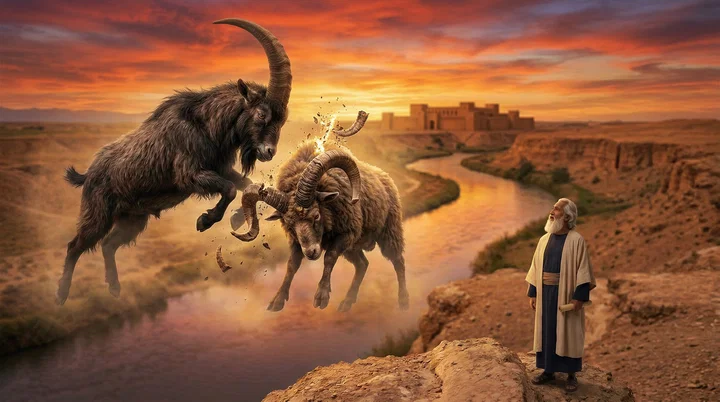
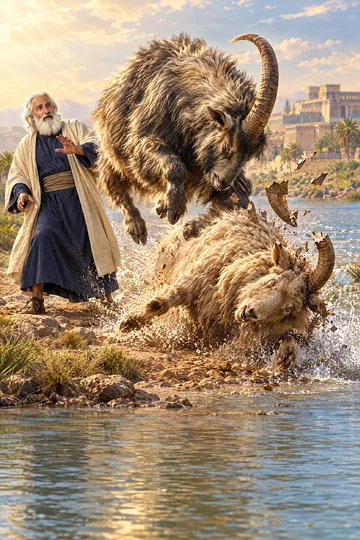
And as I was considering, behold, an he goat came from the west on the face of the whole earth, and touched not the ground: and the goat had a notable horn between his eyes.
Translations
American King James Version, King James Version
And as I was considering, behold, an he goat came from the west on the face of the whole earth, and touched not the ground: and the goat had a notable horn between his eyes.
And as I was considering, behold, a he goat came from the west on the face of the whole earth, and touched not the ground: and the goat had a notable horn between his eyes.
And as I was considering, behold, a he-goat came from the west on the face of the whole earth, and touched not the ground: and the goat had a notable horn between his eyes.
And as I was considering, behold, an he-goat came from the west over the face of the whole earth, and touched not the ground: and the goat had a notable horn between his eyes.
American Standard Version, Darby Translation
And as I was considering, behold, a he-goat came from the west over the face of the whole earth, and touched not the ground: and the goat had a notable horn between his eyes.
'And I have been considering, and lo, a young he-goat hath come from the west, over the face of the whole earth, whom none is touching in the earth; as to the young he-goat, a conspicuous horn [is] between its eyes.
Now, I, was observing, when lo! a he-goat, coming in out of the west, over the face of all the earth, but it meddled not with the earth,—and, the goat, had a conspicuous horn between his eyes.
Berean Standard Bible, Majority Standard Bible
As I was contemplating all this, suddenly a goat with a prominent horn between his eyes came out of the west, crossing the surface of the entire earth without touching the ground.
As I was considering, behold, a male goat came from the west over the surface of the whole earth, and didn’t touch the ground. The goat had a notable horn between his eyes.
And while I was giving thought to this, I saw a he-goat coming from the west over the face of all the earth without touching the earth: and the he-goat had a great horn between his eyes.
And as I considered, beholde, a goate came from the West ouer the whole earth, and touched not the grounde: and this goate had an horne that appeared betweene his eyes.
Douay-Rheims (Challoner revision)
And I understood: and behold a he goat came from the west on the face of the whole earth, and he touched not the ground, and the he goat had a notable horn between his eyes.
Pictures
Cross-references 20 of 28
- Daniel 8:14
And he said unto me, Unto two thousand and three hundred days; then shall the sanctuary be cleansed.
Gives the vision’s duration and the sanctuary’s cleansing.
- Daniel 8:21-22
And the rough goat is the king of Grecia: and the great horn that is between his eyes is the first king.
Identifies the goat as Grecia and its great horn as its first king, then names four successor kingdoms.
- Daniel 9:21-23
Yea, whiles I was speaking in prayer, even the man Gabriel, whom I had seen in the vision at the beginning, being caused to fly swiftly, touched me about the time of the evening oblation.
Gabriel returns to explain the unresolved time element in Daniel’s earlier vision.
- Daniel 8:9
And out of one of them came forth a little horn, which waxed exceeding great, toward the south, and toward the east, and toward the pleasant land.
The little horn follows the goat’s four divisions and represents Rome.
- Daniel 7:6
After this I beheld, and lo another, like a leopard, which had upon the back of it four wings of a fowl; the beast had also four heads; and dominion was given to it.
The leopard’s four heads parallel the goat’s four successor horns.
- Daniel 8:20
The ram which thou sawest having two horns are the kings of Media and Persia.
Identifies the ram defeated by the goat as the kings of Media and Persia.
- Daniel 8:16
And I heard a man’s voice between the banks of Ulai, which called, and said, Gabriel, make this man to understand the vision.
Gabriel is commanded to explain Daniel’s vision, including the he-goat.
- Daniel 8:22
Now that being broken, whereas four stood up for it, four kingdoms shall stand up out of the nation, but not in his power.
The four horns represent kingdoms arising after the notable horn is broken.
- Daniel 8:25
And through his policy also he shall cause craft to prosper in his hand; and he shall magnify himself in his heart, and by peace shall destroy many: he shall also stand up against the Prince of princes; but he shall be broken without hand.
The little horn stands against the Prince of princes and is broken without human power.
- Daniel 9:24-27
Seventy weeks are determined upon thy people and upon thy holy city, to finish the transgression, and to make an end of sins, and to make reconciliation for iniquity, and to bring in everlasting righteousness, and to seal up the vision and prophecy, and to anoint the most Holy.
Gabriel’s seventy weeks further explain the time element in Daniel’s vision.
- Daniel 11:3-4
And a mighty king shall stand up, that shall rule with great dominion, and do according to his will.
Describes the Grecian king and the division of his kingdom.
- Daniel 8:11-12
Yea, he magnified himself even to the prince of the host, and by him the daily sacrifice was taken away, and the place of his sanctuary was cast down.
The little horn takes away the daily sacrifice, casts down the sanctuary, and casts truth to the ground.
- Daniel 8:26
And the vision of the evening and the morning which was told is true: wherefore shut thou up the vision; for it shall be for many days.
The vision’s time element is confirmed but remains unexplained.
- Daniel 9:21
Yea, whiles I was speaking in prayer, even the man Gabriel, whom I had seen in the vision at the beginning, being caused to fly swiftly, touched me about the time of the evening oblation.
Gabriel returns to explain the vision Daniel saw earlier.
- Daniel 10:1
In the third year of Cyrus king of Persia a thing was revealed unto Daniel, whose name was called Belteshazzar; and the thing was true, but the time appointed was long: and he understood the thing, and had understanding of the vision.
Daniel 10 begins the fuller explanation of Daniel 8’s vision.
- Daniel 2:39
And after thee shall arise another kingdom inferior to thee, and another third kingdom of brass, which shall bear rule over all the earth.
Daniel 2’s succession of kingdoms includes Greece, which Daniel 8 further describes.
- Daniel 8:23
And in the latter time of their kingdom, when the transgressors are come to the full, a king of fierce countenance, and understanding dark sentences, shall stand up.
The king arises after Alexander’s successors and represents Rome.
- Daniel 7:8
I considered the horns, and, behold, there came up among them another little horn, before whom there were three of the first horns plucked up by the roots: and, behold, in this horn were eyes like the eyes of man, and a mouth speaking great things.
Both visions feature a horn representing the same power.
- Daniel 8:12
And an host was given him against the daily sacrifice by reason of transgression, and it cast down the truth to the ground; and it practised, and prospered.
Truth is cast down as apostasy prospers.
- Daniel 8:1
In the third year of the reign of king Belshazzar a vision appeared unto me, even unto me Daniel, after that which appeared unto me at the first.
Dates the vision to Belshazzar’s third year.
Commentary part 1 of 2
Each commentary is drawn from primary sources: the writings of Ellen G. White and Adventist pioneers and periodicals. Each commentary is separate. Its own words are not a quotation; follow the references to read the source passages.
Ellen G. White
5 sources
The he-goat from the west belongs to a vision given directly by God as part of the wonderful prophecies of Daniel 7-12 that reveal the mysteries of ages to come.PK 547.1Ms 142, 1901, par. 6 Within that vision the symbols of the ram, the goat, and the little horn were explained to Daniel.LS 45.2–3 Its symbols are applied to Rome rather than to Antiochus Epiphanes, with no separate explanation made of the goat itself or of its notable horn.LS 67.3–69.3
The part of chapter 8 left unexplained was the 2300-day time period.LS 45.2–3 The verse was not fully understood even by Daniel himself and was shut up and sealed until the time of the end.PK 547.1 The chronological periods of this prophetic vision are reckoned from 457 B.C.GC 687.4
In the closing period of this world's history its sealed words are to be unsealed.PK 547.1 Its events belong to prophecies now being fulfilled and soon to come to pass.Ms 142, 1901, par. 6 Daniel was given assurance that at the end of the days he would rest and then stand in his lot and place.PK 547.1
Sources
Pioneers and periodicals
254 sources
The he-goat is Greece, the third world kingdom succeeding Medo-Persia, and its notable horn is its first king, Alexander the Great, under whom Greece became united and reached its greatest glory.RH Dec 30, 1915RH Dec 23, 1852RH Feb 15, 1870RH Oct 3, 1912ST Feb 20, 1912 Coming from the west on the face of the whole earth and touching not the ground means Greece advanced from the west against Persia with extraordinary swiftness, sweeping everything before it as if flying.RH Jan 6, 1853ST Feb 18, 1886ST Oct 29, 1885ST Jun 3, 1897ST Nov 28, 1895 It runs upon the two-horned ram in fury, breaks his horns and tramples him, meaning Greece swiftly conquered Medo-Persia and replaced it as the ruling world power.RH Feb 15, 1870RH Oct 3, 1912ST Feb 20, 1912ST Jun 11, 1896RH Sep 22, 1874 When the great horn was broken while strong, four horns arose, meaning Alexander died at the height of power and his empire was divided among his successors into four lesser kingdoms.ST Feb 18, 1886RH Feb 15, 1870RH Nov 21, 1854ST Dec 24, 1894ST Feb 25, 1889 The goat stands in the middle of the vision between the ram and the little horn, leading through Rome to the cleansing of the heavenly sanctuary at the end of the 2300 years in 1844, when the investigative judgment began before Christ's coming.RH May 26, 1853ST May 30, 1895ST Jan 11, 1883ST Nov 13, 1879
Symbols and Historical Setting
The he-goat is a symbolic and not literal power, representing an earthly kingdom, namely Greece or Grecia, the third universal kingdom that succeeded Medo-Persia, paired with the ram denoting Medo-Persia.RH Dec 30, 1915RH Dec 23, 1852RH Feb 15, 1870RH Oct 3, 1912RH Jul 14, 1863 Its appearance and movements correspond to the history of Grecia and show the fitness of the symbol to portray that kingdom, and tradition called the Grecian people the goat's people. The identification is definite and cannot be misunderstood, because the angel stated both the ram and the goat positively with certainty in language that cannot be misunderstood.ST Nov 24, 1881RH Jun 28, 1870 Left to their own judgment without that clear statement, men would apply the symbols to anything and everything but the right objects.RH Jun 28, 1870
In symbolic prophecy living creatures represent mighty nations and earthly governments, horns represent kingdoms or civil or ecclesiastical rulers, and days in connection with such visions stand for years.ST Jan 6, 1887RH Mar 21, 1854RH May 8, 1916RH Jun 25, 1857ST Nov 30, 1882 A plain animal like the ram and the goat stands for a government in itself, without showing church and state united in persecution, unlike fierce, wild, cruel beasts that stand for governments where church and state are united and therefore persecuting. A horn symbolizes a ruler, either civil or ecclesiastical, and a symbolic horn represents a kingdom or nation.ST Jan 6, 1887RH Mar 21, 1854 This use of symbols is fitting and continues in the visions of Revelation, just as nations today are spoken of as the lion, the bear, the crescent, and the eagle.RH May 8, 1916
The notable or great horn between the goat's eyes is its first king, Alexander the Great, the excelling power under whom Greece became united and attained its greatest glory, coming from the west after Medo-Persia.RH Feb 15, 1870RH Oct 3, 1912ST Feb 20, 1912RH Nov 21, 1854 The word king in the explanation means kingdom, since the horn represents the first kingdom of Grecia rather than merely its first individual king.ST May 10, 1877 It is civil power alone, centered in one king, Alexander the Great, rather than the nation as a whole, and a horn can represent a civil element within a larger power.RH May 19, 1851ST Dec 11, 1879RH Dec 23, 1851ST Dec 4, 1879RH Nov 21, 1871 In Daniel 8 the horns represent civil power, in contrast to the papal symbol where a horn represents ecclesiastical power. The horn therefore stands with the horns of the ram in Daniel 8, the horns on the beasts in Daniel 7, and the horns in Revelation 13 as the background for identifying what horns signify.
Coming from the west means Greece, which lay west of Persia, advanced against Persia from the west, marking the rapid transfer of world dominion from Asia to Europe.ST Oct 29, 1885ST Nov 28, 1895ST Sep 2, 1913ST Oct 22, 1885 Coming on the face of the whole earth means sweeping everything before it and leaving nothing behind and ruling over all the earth, and touching not the ground means moving with extraordinary speed and swiftness, as if flying from point to point with the speed of the wind, so swiftly that it does not touch the ground.ST Oct 29, 1885ST Jun 3, 1897ST Sep 2, 1913ST Oct 22, 1885 The swiftness means impetuous and fierce warfare like a panther after prey, flying upon enemies, outrunning other armies, pursuing foes on horseback day and night, and making long marches for days together as in pursuing Darius nearly forty miles a day for eleven days.RH Jan 6, 1853ST Feb 18, 1886RH Feb 15, 1870RH Mar 17, 1853ST Feb 20, 1912 It means coming upon enemies unaware before they could resist, and in twelve and a half years subjecting all nations from the Adriatic Sea to the Ganges.RH Nov 12, 1908
The vision was seen in the third year, that is the last year, of Belshazzar's reign, about 538 B.C. in the last year of the Babylonian monarchy, two years after the vision of Daniel 7.ST Dec 24, 1894RH Oct 3, 1912STRH May 12, 1910ST Feb 20, 1912 It was seen in Shushan the palace in Elam by the river Ulai, at the beginning of Darius the Mede's reign when Babylon fell to the Medes and Persians.ST Dec 24, 1894RH May 12, 1910ST Feb 20, 1912 Babylon is left out because its career was run and it was soon to pass away and was then history not prophecy, while Medo-Persia was just at hand and coming into actual view.ST Feb 7, 1906ST Jul 15, 1913RH Mar 18, 1862ST Sep 2, 1913RH Jun 27, 1878 The vision traces Medo-Persia, Grecia and Rome onward to the end of all earthly rule.RH Oct 3, 1912ST Aug 14, 1893ST Feb 7, 1906ST Sep 2, 1913 The exact time of the vision within that year cannot be positively settled; the explanation of the time in Daniel 9 came the same year, possibly only weeks or months later in the first year of Darius.RH May 12, 1910
The verse stands in the Hebrew part of the book running from chapter 8 to the close, suited for the common people concerning restoration of the Jews and God's future dealings with them, while the Chaldee begun at Daniel 2:4 is kept through chapter 7 because of likeness of subject between chapters 2 and 7.RH Nov 25, 1873 The verse belongs to the part pertaining to the kingdoms themselves as kingdoms, distinct from the spiritual aspect affecting the people of God.ST Feb 20, 1912 For chronology and sequence the verse places the male goat coming from the west after the ram, with the later little horn after it, the goat having been already explained as the Grecian empire.RH Mar 1851ST Nov 19, 1885ST Oct 10, 1878RH Jan 28, 1858ST Oct 18, 1877 In that connection its extraordinary speed in not touching the ground and its prominent horn between its eyes are left without further interpretation, and the he-goat with Greece and Rome is understood without difficulty as Medo-Persia, Greece, and Rome.RH Mar 1851RH Jan 28, 1858ST Oct 18, 1877RH Nov 26, 1857
Greece Conquers Persia Swiftly
The he goat runs upon the two-horned ram in the fury of his power, smites him, breaks his two horns so that none can deliver him, and tramples him underfoot.RH Feb 15, 1870RH Oct 3, 1912ST Feb 20, 1912RH Nov 21, 1854RH Apr 30, 1857 This is Greece conquering Medo-Persia and succeeding Persia as the ruling world power, so that brass replaces silver and the bear gives way to the leopard and the goat.RH Feb 15, 1870RH Oct 3, 1912RH Nov 21, 1854RH Apr 30, 1857ST Sep 21, 1882 Medo-Persia is a kingdom composed of two nationalities, the Medes and the Persians, whose two horns are those two divisions.ST Sep 29, 1881 The higher horn coming up last means the Persian element arose last but attained the higher eminence and became the leading division of the kingdom.ST Sep 29, 1881
Grecia swiftly conquered Medo-Persia and ended Persia's power as a world-shaping empire, becoming master of the world and a universal kingdom corresponding to the brass division of the image.ST Jun 11, 1896RH Sep 22, 1874ST Jun 25, 1874ST Apr 23, 1912RH Feb 1, 1870 This was accomplished by decisive victories such as Granicus and Issus, culminating in the defeat of the last Persian king Darius, also called Darius Codomannus, at Arbela in 331 B.C.ST Jun 11, 1896RH Sep 22, 1874ST Apr 23, 1912RH Nov 26, 1857RH Feb 1, 1870 Grecia's rule began in 331 B.C. when Alexander overthrew Darius at Arbela and continued 170 years until 161 B.C., when Rome succeeded it as the fourth and last universal kingdom.ST May 3, 1877 Alexander conquered the world in eight years, defeated Persia at Arbela in 331 B.C. and died in 323 B.C., eight years later, at age 33.ST Jun 11, 1896 The westward advance is dated to 331 B.C., though it is also given as Alexander's conquest of the Medo-Persian kingdom in 361 B.C.ST May 20, 1913RH Nov 26, 1857
Medo-Persia is the silver that shines where the gold of Babylon dazzled and the bear that takes the lion's domain, and after being softened by ease and made weak by plenty it falls to the forcible Greeks by the sword just as Babylon fell to the Medes and Persians, with history echoing the divine presage.ST Sep 21, 1882 Grecia was the third power to dominate the Jewish nation after Medo-Persia and received the dominion of the earth in the second overturning of kingdoms.ST Jan 1, 1894 Dominion was given to Grecia by God Himself, who controls the affairs of earth and sets aside powers when His purpose can use them no longer. The vision thus helps identify the third kingdom of Nebuchadnezzar's image as Grecia, represented by the brass part, succeeding the Medes and Persians.RH Sep 22, 1874ST Jun 25, 1874RH Apr 3, 1900ST Mar 13, 1884
Alexander conquered the world from the west with speed little short of miraculous because in it he was cooperating with what was spoken by prophecy, and his success proves that the testimony cannot be broken.ST Feb 13, 1912 The same Alexander who could easily conquer the world while acting in harmony with prophecy could not build a single city when he fought against prophecy by trying to resurrect Babylon from its heaps of ruins.ST Feb 13, 1912 When the book of Daniel was shown to Alexander at Jerusalem, wherein it was declared that one of the Greeks should destroy the empire of the Persians, he recognized himself as the person intended and bowed before the God of heaven who had declared his career in plain language generations before.RH Mar 21, 1912 That career was named two hundred years before Grecia came to power and fulfilled two hundred years after the vision, in the decisive victories of Granicus and Issus with Persia laid prostrate.ST Jun 3, 1897ST Nov 28, 1895RH Mar 21, 1912 During the Grecian period the Scriptures were translated into Greek in the Septuagint, spreading knowledge of God through the learned world.ST May 20, 1897 These events show that God, who rules over human kingdoms, knows and reveals the future with certainty, and the verse means that kingdoms rise and fall.RH Dec 3, 1857ST Sep 9, 1913
Alexander Dies and Divides Fourfold
The great horn is broken while the goat is still strong because Alexander died at the height of the power of Grecia without a successor.ST Dec 24, 1894ST Feb 25, 1889RH Dec 3, 1857 He was the youthful possessor of every land who died while yet in his prime from the cup amid laughter and mirth, showing how weak earth's mightiest hero is.ST Sep 21, 1882 In its first united phase under him Grecia attained its greatest glory as a unit, and he was as vile a man and as great a king as the world has seen.ST Sep 21, 1882ST Oct 4, 1877RH Aug 9, 1870
After the great horn was broken four horns arose in its place, representing the four kingdoms into which Alexander's empire was divided after his death under his successors and principal generals.RH Feb 15, 1870RH Nov 21, 1854RH Nov 12, 1908RH Apr 30, 1857ST Sep 21, 1882 They stood out of the nation but not in his power, none as powerful as the original united kingdom.ST Feb 18, 1886 They are still the divided form of Grecia, to be passed over until Rome became connected with God's people in 161 B.C.ST Feb 18, 1886
After Alexander's death his kingdom was broken and divided among four rulers into four kingdoms represented by the four horns.ST Jun 3, 1897ST Nov 28, 1895 The horn had no like successor, and the empire was divided among four of his generals.ST Jun 3, 1897 The four horns picture the same four divisions pictured by the four heads of the leopard, for the he-goat corresponds to the leopard of Daniel 7 as the ram corresponds to the bear.ST Jul 15, 1913RH Oct 30, 1856RH Mar 18, 1862 The notable horn covers the undivided empire, so acts attributed to the beast before it is broken belong to its undivided stage, while acts carried out after the division belong to the resulting divisions or kingdoms.RH Mar 18, 1862 The goat's later four horns are thus related to the division of Alexander's kingdom after his death, with the rapid movement answering to the speed of Greek conquest named two hundred years before Grecia came to power.ST Jun 3, 1897RH Oct 30, 1856
The four kingdoms that arose after Alexander were Macedonia, Thrace, Syria, and Egypt.RH Apr 14, 1853 They are also described as Macedon, Thrace or Syria, Syria, and Egypt, and after him four kingdoms — Macedon, Syria, Egypt, and Thrace — arose in his place like the four notable horns.ST Sep 21, 1882RH Apr 14, 1853 More particularly they were Macedon, Asia Minor and Thrace, Egypt, and Syria begun by Cassander, Lysimachus, Ptolemy, and Seleucus, out of one of which the little horn comes forth.ST Feb 27, 1912 The four horns correspond to the four divisions of the kingdom after Alexander's death, matching the leopard's four heads, and the goat gives a more particular account of that fourfold division.ST Sep 29, 1881ST May 3, 1877 The rapidity of Grecian conquests under Alexander answers to the leopard's four wings.ST May 3, 1877ST Feb 5, 1880
The division of Grecia denoted by the four horns dates back to within eight years of Grecia's introduction into prophecy, showing that the divided element in a prophetic symbol exists from the first.RH Mar 16, 1869
Rome and Little Horn Follows
The ram comes first, then the goat with its notable horn, then the four horns, then the little horn, then the 2300 days, and the explanation follows the symbols in the order seen because to skip from the ram to the little horn would leave the vision unable to be understood.ST Mar 4, 1886 The goat is the middle one of three powers, standing between the ram and the little horn which waxes exceeding great, but the chief subject is not the ram or the he-goat but the third power, which is Rome, the same as the fourth beast of Daniel 7, to which more space is given in vision and explanation than to ram and he-goat together, with its time further explained in Daniel 9.RH May 29, 1900 The first world power is left out because it had passed away, and this fixed order shows the part first spoken of is the first part of the 2300 days.RH May 29, 1900ST Mar 4, 1886
The goat from the west is the second step in a prophetic history reaching from the rise of the Persian Empire till the final destruction of all earthly kingdoms by the God of Heaven.ST Jan 11, 1883ST Nov 13, 1879 It is Grecia following the ram that is Media and Persia, and it is followed by the exceeding great horn that is the Roman power, the great destroyer of the people of God that put to death the Prince of princes.ST Jan 11, 1883 These animal symbols represent the great world empires that have since arisen, and the time belonging to the vision that contains them is unto two thousand and three hundred days, then shall the sanctuary be cleansed.ST Jan 11, 1883 The vision of ram, he-goat, and little horn therefore represents Medo-Persia, Greece, and Rome, tracing world history from the rise of Persia toward the destruction of earthly kingdoms by God, with its reference to cleansing at the end of the 2300 days concerning a later event and not the end of the seventy-year captivity or the restoration then.ST Nov 13, 1879ST Feb 16, 1882
The goat is Grecia and its notable horn is Alexander, the first king of the Grecian Empire, and its movement from the west also fits Rome attacking Grecia in its western part and conquering the kingdom.ST Feb 10, 1898ST Jun 26, 1907 By divine command Gabriel explained that the goat is Greece, while the ram is Media and Persia and the little horn is the kingdom that succeeded Greece, Rome, an explanation clear and easily understood.ST Jun 26, 1907 The little horn succeeds the goat after its division and is the only power brought to view from there down to the cleansing of the sanctuary at the end of the 2300 days, taken as a unit corresponding to the fourth kingdom of the other visions, which takes away the daily when the Roman power changes from paganism to papacy.RH Jan 28, 1858 Babylon is omitted because Babylon was passing away and Medo-Persia was coming into actual view, and Medo-Persia and Greece are specifically named in their order, so the goat is Greece and the succeeding power after Greece is Rome as Rome followed Greece in history.ST Feb 7, 1906 This prophecy repeats the history of earlier visions with added detail, and its later events lead to Rome and the investigative judgment beginning after the prophetic time ending in 1844, with Rome as the king of fierce countenance that stands up against the Prince of princes and will be broken without hand.ST Feb 7, 1906ST
The little-horn specifications are applied to Rome, first in its pagan form and fully in its later religious form.ST Mar 12, 1912 That little horn is Rome throughout its entire history in both pagan and papal forms, covering the same period as the fourth beast and all its horns in Daniel 7, and it is distinct from Daniel 7's little horn, which represents the papacy during only part of Rome's history.ST Nov 19, 1885 The little horn of Daniel 8 is not the same as the little horn of Daniel 7, and the two cannot be made identical.RH Jan 10, 1871 The leading symbol, the little horn, is the same power as the little horn of Daniel 7 and the woman of Revelation 17, namely ecclesiastical Rome, or papal Rome, or the papacy, known in divine history as Babylon the Great.RH Jul 31, 1900 It arises during the time of the ten kingdoms into which the fourth universal kingdom, Rome, was divided, has sovereignty over the sovereigns of the earth, and as an ecclesiastical power has exercised much more influence upon world history than Rome as a civil power, so that it is this ecclesiastical power with which the prophecy is more particularly concerned.RH Jul 31, 1900
Grecia became great by sudden conquest, sweeping from the west over the whole earth, and upon Alexander's death it was divided into four kingdoms that stood up out of the nation but not with his power.ST Feb 7, 1884 Those four are in turn succeeded by a little horn that waxes exceeding great and becomes stronger than all the kingdoms before it, a power small in its beginning that grows gradually great by successive conquests and holds the world in its iron grasp, namely Rome, which magnifies itself even to the prince of the host and stands up against the Prince of princes.ST Feb 7, 1884 This prophetic development awaits being broken without hand.RH Dec 11, 1856 The chapter continues the earlier lessons about the world kingdoms and identifies Rome as the little horn, carrying the sequence to the papacy's overthrow in 1798.RH Mar 29, 1864 The goat with the notable horn is Grecia with Alexander as its first king, and after his death his kingdom is divided into four, and the little horn arising afterward is Rome, which stood up against the Prince of princes, Jesus Christ, at His crucifixion and will be broken without hands by destruction at the second coming of Christ.ST Jan 8, 1880
The whole course of Rome from beginning to end, from its entrance on the scene to the end of the world in both ancient and modern phases, is sketched under the symbol of a little horn that waxes exceeding great, so that every feature applies to modern Rome as well as ancient Rome and some features apply only to modern Rome.RH Apr 10, 1900 2 Thessalonians 2 refers definitely to Daniel 8 together with Daniel 7, as taught concerning the man of sin, the son of perdition, the mystery of iniquity, and that Wicked.RH Apr 10, 1900 The goat's swift movement belongs to the prophetic sequence of kingdoms and their rise and fall, leading through Rome's persecution of God's people to the cleansing of the sanctuary and ultimately Christ's second coming.ST Jul 1, 1897 Daniel 8:1-23 applies to Rome and to no other power but Rome, leading to the power to be broken without hand, which is Rome including papal Rome as continuation of pagan Rome in its fundamental principle of self-exaltation, not only the ancient empire destroyed by the barbarian tribes of Germany.ST Feb 19, 1894
The vision speaks of two desolating powers that desolated the people of God, first pagan Rome and then papal Rome, represented as the daily and the transgression of desolation.RH Feb 15, 1870 The prophecy exposes the mystery of iniquity and puts the church on guard against all deceivableness of unrighteousness.RH Sep 13, 1915 That mystery is the attempt, after failure to hold world empire by force of arms, to establish universal spiritual rule by enthroning itself as professed vicar of Christ to gain the worship and allegiance due to God in Christ, which is the Papacy.RH Sep 13, 1915 The goat belongs to the earlier part of the vision with its four horns, out of one of which the little horn comes as a third power, separate, independent and distinct from the horns of the goat themselves.ST Nov 24, 1881 The vision thus sets the Greek kingdom before the rise of Rome, which the next prophetic symbol depicts as the little horn emerging from one of those divisions, specifically Macedonia.ST Nov 5, 1885
The identification is definite and cannot be misunderstood, with the he-goat denoting Grecia paired with the ram denoting Medo-Persia.ST Nov 24, 1881 Alexander's empire was afterward divided into the four kingdoms of Macedon, Asia Minor and Thrace, Egypt, and Syria begun by Cassander, Lysimachus, Ptolemy, and Seleucus, out of one of which the little horn comes forth, with the notable horn between the goat's eyes as her first king Alexander and his empire following the ram which is Medo-Persia.ST Feb 27, 1912 The he-goat means Grecia, standing in sequence with the ram meaning Medo-Persia and the little horn meaning Rome, its application to Grecia clear and definite, with no reference to the United States. It belongs to the prophecy of the Greek empire and its later division, placing Rome as the power that succeeded Greece and arose in connection with the prophecy's little horn.RH Dec 10, 1857
The claim that Antiochus Epiphanes was the vision's central figure is erroneous.RH May 1, 1856 The vision concerns more than Antiochus Epiphanes, his persecution of the Jews, and his desecration of the temple, being connected with Christ's coming and the establishment of God's everlasting kingdom.RH May 15, 1856 The prophecy applies to the Roman power, pagan and papal, not to Antiochus Epiphanes, who was a Syrian king who could not resist the mandates of Rome, and applying it to him is a shift made to save the papal church from any share in its fulfillment.RH Dec 23, 1852 The little horn does not refer to Antiochus, and the everlasting kingdom of God on earth is not set up among the ten horns, as fulfilled prophecy that is evidence which cannot be overthrown.ST Dec 27, 1905 The specified events are presented as fulfilled, with the coming of the Son of man remaining as crowning event in the sequence of Babylon, Persia, Greece, and Rome.ST Oct 10, 1878
The great horn was broken and four horns sprang up in its place, the divided form of Grecia under Alexander's successors, to be passed over in prophecy until Rome became connected with the people of God in 161 B.C.ST Feb 12, 1880 One of those four divisions was the Syrian horn, consisting of twenty-six kings, of whom Antiochus Epiphanes was only the eighth, an ignoble and mad character who paid tribute to Rome, abandoned Egypt at Rome's command, and died 164 years before Christ, and therefore could not be the exceeding great power that followed Grecia.ST Feb 12, 1880 The claim that he-goat, great horn and four horns, and later little horn were all fulfilled in three years under Antiochus is foolish and idle, for the symbols are applied to Rome rather than Antiochus.LS 67.3–69.3 Particular details about the great kingdoms have been fulfilled in history apart from events at the close, foretelling the rise and fall of nations whose fulfillment can be seen.ST Jun 27, 1878ST Mar 1, 1905
Much of this divine prophetic portrayal has been fulfilled, more is being fulfilled, and its climax is near, connected with the coming ruin of the American republic and the failure of the world's best government.ST Jul 4, 1900 History has fulfilled its events, leaving the breaking of the exceeding great horn without human power.RH Dec 13, 1853 Its great symbols clearly indicate the last generation has been reached and Christ's coming is near, even in the lives of many now living, when the opening heavens will disclose the Son of man in power and glory, combining with fulfilling prophecy, nature, and human events to point to the King of kings and Lord of lords.RH Aug 28, 1913 Those who held the little horn to be Mahometanism, distinct from the little horn of Daniel 7 which is the Roman Catholic hierarchy as proved by respective places of origin and spheres of influence, taught that its cleansing of the sanctuary has reference to affairs on earth at the destruction of Mahometanism.RH Apr 15, 1873 The field of vision including the putting to death of saints, standing up against the Prince of princes, and the appointed fate and time of destruction of that power together give conclusive proof about the scope of the vision.RH Oct 6, 1863
Sources