Daniel 7:16
I came near unto one of them that stood by, and asked him the truth of all this. So he told me, and made me know the interpretation of the things.
Translations
American King James Version, Webster Bible
I came near to one of them that stood by, and asked him the truth of all this. So he told me, and made me know the interpretation of the things.
King James Version, KJV Cambridge Paragraph Bible
I came near unto one of them that stood by, and asked him the truth of all this. So he told me, and made me know the interpretation of the things.
Revised Version, American Standard Version
I came near unto one of them that stood by, and asked him the truth concerning all this. So he told me, and made me know the interpretation of the things.
I have drawn near unto one of those standing, and the certainty I seek from him of all this; and he hath said to me, yea, the interpretation of the things he hath caused me to know:
I came near unto one of them that stood by, and asked him the certainty of all this. And he told me, and made me know the interpretation of the things:
I drew near unto one of them who stood by, and made exact enquiry of him, concerning all this,—so he told me, and, the interpretation of the things, made he known unto me.
Berean Standard Bible, Majority Standard Bible
I approached one of those who were standing there, and I asked him the true meaning of all this.So he told me the interpretation of these things:
I came near to one of those who stood by, and asked him the truth concerning all this.“ So he told me, and made me know the interpretation of the things.
I came near to one of those who were waiting there, questioning him about what all this was. And he said to me that he would make clear to me the sense of these things.
Therefore I came vnto one of them that stoode by, and asked him the trueth of all this: so he tolde me, and shewed me the interpretation of these things.
Douay-Rheims (Challoner revision)
I went near to one of them that stood by, and asked the truth of him concerning all these things, and he told me the interpretation of the words, and instructed me:
Pictures
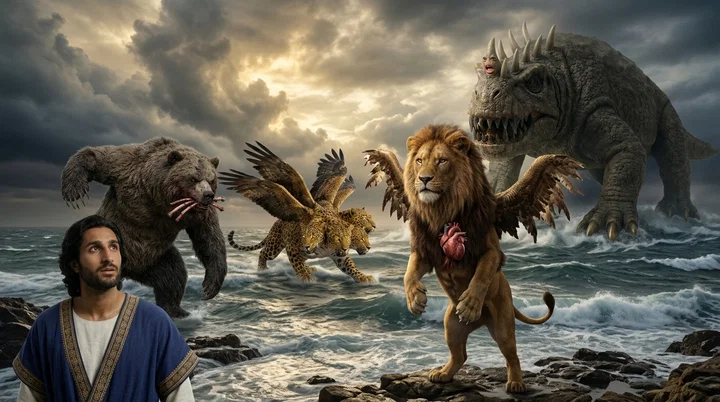
Cross-references
- Daniel 7:7-8
After this I saw in the night visions, and behold a fourth beast, dreadful and terrible, and strong exceedingly; and it had great iron teeth: it devoured and brake in pieces, and stamped the residue with the feet of it: and it was diverse from all the beasts that were before it; and it had ten horns.
Describes the fourth beast, its ten horns, and the little horn.
- Daniel 2:31-45
Thou, O king, sawest, and behold a great image. This great image, whose brightness was excellent, stood before thee; and the form thereof was terrible.
Both visions portray the same succession of kingdoms, ending in God’s everlasting kingdom.
- Daniel 7:23-27
Thus he said, The fourth beast shall be the fourth kingdom upon earth, which shall be diverse from all kingdoms, and shall devour the whole earth, and shall tread it down, and break it in pieces.
Explains the fourth kingdom, its rulers, judgment, and the saints’ everlasting kingdom.
- Daniel 9:21-23
Yea, whiles I was speaking in prayer, even the man Gabriel, whom I had seen in the vision at the beginning, being caused to fly swiftly, touched me about the time of the evening oblation.
Gabriel comes to give Daniel understanding and explain the vision.
- Daniel 7:9-10
I beheld till the thrones were cast down, and the Ancient of days did sit, whose garment was white as snow, and the hair of his head like the pure wool: his throne was like the fiery flame, and his wheels as burning fire.
The Ancient of Days sits in judgment as the heavenly books are opened.
- Daniel 7:3
And four great beasts came up from the sea, diverse one from another.
The four beasts rise from the sea amid striving winds.
- Daniel 7:4-6
The first was like a lion, and had eagle’s wings: I beheld till the wings thereof were plucked, and it was lifted up from the earth, and made stand upon the feet as a man, and a man’s heart was given to it.
same lion, bear, leopard beasts
- Daniel 8:15-17
And it came to pass, when I, even I Daniel, had seen the vision, and sought for the meaning, then, behold, there stood before me as the appearance of a man.
Gabriel is instructed to explain Daniel’s vision.
- Daniel 7:27
And the kingdom and dominion, and the greatness of the kingdom under the whole heaven, shall be given to the people of the saints of the most High, whose kingdom is an everlasting kingdom, and all dominions shall serve and obey him.
The vision’s interpretation ends with the everlasting kingdom given to the saints.
- Daniel 7:23
Thus he said, The fourth beast shall be the fourth kingdom upon earth, which shall be diverse from all kingdoms, and shall devour the whole earth, and shall tread it down, and break it in pieces.
Further explains the beasts as kingdoms ruling on earth.
- Daniel 10:11-14
And he said unto me, O Daniel, a man greatly beloved, understand the words that I speak unto thee, and stand upright: for unto thee am I now sent. And when he had spoken this word unto me, I stood trembling.
An angel speaks to Daniel and explains the vision’s meaning.
- 2 Peter 1:20
Knowing this first, that no prophecy of the scripture is of any private interpretation.
gives rule that no prophecy is self-solving
Commentary part 1 of 2
Each commentary is drawn from primary sources: the writings of Ellen G. White and Adventist pioneers and periodicals. Each commentary is separate. Its own words are not a quotation; follow the references to read the source passages.
Ellen G. White
7 sources
Daniel drew near to one of the heavenly attendants standing by the throne and asked for the truth of all that he had seen in the vision, and that attendant told him and made known to him the interpretation of the things.LS 66.1–67.2PK 547.1PK 484.3 He was able to receive this as God's ambassador to whom were given revelations of the mysteries of ages to come.PK 547.1 This understanding was given him in all visions and dreams as God's blessing and approval upon his firmness, self-denial, and purity of motive, fulfilling the promise that God honors those who honor Him.PK 484.3
As he clung to God with unwavering trust the spirit of prophetic power came upon him, teaching him to read the mysteries of the future and to record in figures and symbols for coming generations the events covering the history of this world till the close of time.PK 484.3 Even so the wonderful prophecies recorded in chapters seven to twelve were not fully understood even by Daniel himself, for it was not given him to understand all that God had revealed of the divine purpose.PK 547.1 The words of his prophetic writings were to be shut up and sealed even to the time of the end, with the assurance that at the end of the days, in the closing period of this world's history, he would rest and then stand in his lot and place.PK 547.1
The prophecy to which this asking belongs is to be diligently studied and correctly applied, for it presents events in order as a figurative outline leading toward the close of earth's history.Ms 31, 1896, par. 1–2 The four beasts of the vision are the successive empires of Babylon, Persia, Greece, and Rome.4SP 502.2–3 The beast of Revelation 13 bears the characteristics of those four beasts and inherits the power they held in succession.4SP 502.2–3 The little horn in this chapter is the Roman Church, even before it possessed civil power.4SP 502.4–6
The vision Daniel saw and asked to have explained stands as a warning whose significance is reflected in the judgments witnessed in San Francisco and other places.Ms 129, 1908, par. 8–10 Those warnings call for spiritual cleansing and may lead people to be warned and converted.Ms 129, 1908, par. 8–10
Sources
Pioneers and periodicals
286 sources
Daniel went near to one of those standing by in the vision and asked him for the truth of all he had seen, and he was told and made to know the interpretation of the things and their symbols.ST Dec 24, 1912ST Jun 30, 1914RH Jun 20, 1854 The one standing by is a heavenly attendant, an angel and divine messenger acting as interpreter, while Daniel is the troubled spectator seeking understanding of the prophetic scenes.ST Oct 6, 1881RH Jun 8, 1869RH Jul 6, 1911ST Feb 9, 1882RH Aug 28, 1866 The interpretation he was given is that the four great beasts are four successive universal earthly kingdoms arising from the earth, specifically Babylon, Medo-Persia, Greece, and Rome.ST Dec 24, 1912ST Oct 17, 1906RH Feb 8, 1870ST Jun 19, 1884ST Jun 26, 1879 The same explanation carries forward to the ten horns as ten kingdoms dividing Rome, to the little horn with man's eyes and blasphemous mouth as the papal power thinking to change times and laws and wearing out the saints for a time, times and dividing of time, and to the judgment and everlasting kingdom given to the saints.ST Dec 24, 1912ST Jun 30, 1914RH Jun 20, 1854ST Feb 17, 1909RH Feb 24, 1874 Being made to know means the vision has its own definite divine interpretation that can truly be learned and understood with certainty, leaving no need for speculation or conjecture.ST Jun 30, 1914ST May 8, 1907ST Aug 30, 1905
Asking and Receiving Interpretation
Daniel drew near to one of those standing by in the vision and asked him for the truth of all he had seen, and was told and made to know the interpretation of the things with their symbols and events.ST Dec 24, 1912ST Jun 30, 1914RH Jun 20, 1854RH Apr 23, 1857ST Feb 17, 1909 Troubled and not understanding what had been shown him, he approached a heavenly attendant to have the vision explained, and the answer identified the four beasts as four kings and declared that the saints of the Most High shall receive and possess the kingdom forever.ST Dec 24, 1912RH Jun 20, 1854RH Apr 23, 1857ST Feb 17, 1909RH Feb 3, 1853 The vision's description and its explanation belong together for study, for the vision covers the same broad ground as the earlier vision while bringing out further developments in medieval and modern times, with the beasts as Babylon, Medo-Persia, Greece and Rome, the ten horns as the divisions of Western Rome, and the little horn as the cruel papal-centered church-and-state apostasy, ending in the everlasting kingdom given to the saints.ST Dec 24, 1912ST Jun 30, 1914RH Jun 20, 1854 The ten horns were explained as ten kings arising out of the kingdom represented by the beast, and the kingdom of the vision is set up at the judgment after the world kingdoms are destroyed, not before.ST Dec 24, 1912RH Apr 23, 1857ST Feb 17, 1909
The one standing by was a heavenly attendant or being, an angel and divine messenger acting as heavenly interpreter, whose personal identity is not given, while Daniel stood as listener and spectator receiving understanding of the prophetic scenes.RH Jul 6, 1911ST Feb 9, 1882RH Aug 28, 1866RH Nov 21, 1854RH Apr 30, 1857 He asked an attendant angel for the meaning and received the interpretation in plain words, and as with Daniel 8 the symbols were likewise explained by an angel identifying the goat as Grecia with its first horn as the first king and its four horns as four kingdoms.RH Jul 6, 1911RH Aug 28, 1866RH Nov 21, 1854RH Apr 30, 1857ST Oct 18, 1877 The figure who told and made known the interpretation was probably an angel, though which angel is not stated.ST Feb 9, 1882ST Oct 18, 1877 Daniel was troubled and without understanding, and he sought understanding when well advanced in years.ST Oct 6, 1881RH Jun 8, 1869ST May 4, 1876 His sincere inquiry is the example for seekers, showing that sincere inquiry into these important truths is met with the Lord's readiness to guide to correct understanding, for God is the revealer of the meaning of the prophecy, and age does not impair the spirit of prophecy manifested through the obedient in every age.ST Oct 6, 1881RH Jun 8, 1869ST May 4, 1876RH Feb 17, 1874ST Jul 23, 1874
To be made to know means the vision has its own definite divine interpretation that can truly be learned, studied, explained and understood with certainty beyond refutation, leaving no need for mistake, speculation or conjecture.ST Jun 30, 1914ST May 8, 1907ST Aug 30, 1905RH Jan 16, 1900 He was not merely told what it means but made to know it, so the vision can be understood rather than left to speculation, its symbols and historical fulfillment to be examined by careful historical and logical study which people eagerly desire when offered.ST May 8, 1907ST Aug 30, 1905ST Jun 3, 1897RH Jan 16, 1900 The symbols have an interpretation that can be made known, disclosing the beasts as kingdoms and describing the fourth kingdom, its horns, the little horn arising during Rome's division, overcoming three kingdoms, differing in rule, speaking against God, persecuting saints and attempting to change God's times and law until its persecuting power is taken away, and the eventual kingdom given to the saints.ST May 8, 1907ST Aug 30, 1905ST Jun 3, 1897 The interpretation recorded in Daniel 7:17-27 first answers briefly that the four beasts are four successive kings or kingdoms arising one after another and the end is the kingdom given to the saints of the Most High.RH Dec 6, 1853RH Jan 10, 1856RH Aug 14, 1900 That brevity, joined with the terrible impression made by the fourth beast with iron teeth and brass nails, its ten horns, and the little horn with human eyes and blasphemous mouth making war with the saints, left Daniel still desiring more accurate information concerning the fourth beast and the horns.RH Aug 14, 1900 Unlike chapter 8 it needed no further explanation of its time period and starting point, yet it left unanswered for chapters 8 and 9 how long the host would be trodden underfoot and what would happen to Daniel's people at the end of the indignation, and its symbolic form allowed predictions about the papal power to be fulfilled without openly naming it in advance.RH Dec 6, 1853RH Jan 10, 1856ST Feb 9, 1882RH Aug 23, 1870
The asking is the second of three repeatings of the leading events, in which Daniel repeats what he saw in the form of inquiry bringing an explanation of each emblem in order, winding up with the universal triumph of the saints which shall never end.RH Jun 20, 1854 To ask for the truth of all this is to ask what kingdoms the four beasts represent, what the ten horns and the little horn represent, and what the principal theme is, with the interpretation connected to Revelation, especially the first beast of Revelation 13 and the beast of Revelation 17 with the woman upon it.ST Oct 8, 1902RH Jun 20, 1854 The verse lies in the Aramaic portion running from Daniel 2:4 to the close of chapter 7, which is distinctively prophetic and closely related to Daniel 2, with return to Hebrew at Daniel's personal introduction; in Hebrew reckoning Daniel stands among the Hagiographa rather than the prophets, while the whole book including this verse is more or less prophetic.ST Sep 17, 1902RH Jan 16, 1900ST Oct 21, 1908 The vision was given in a dream in Belshazzar's first year, dated to 540 B.C., more than sixty years after Nebuchadnezzar's dream, standing in dated order with Daniel 8 and 10, and its giving time is not the same as the time to which as present it applies.ST Sep 17, 1902RH Apr 23, 1867RH Apr 21, 1851 Its time and setting are to be identified and its symbols and judgment scenes to be studied, for the four beasts represent the same kingdoms as the parts of the image — Babylon, Medo-Persia, Grecia and Rome — shown not only to mark their place in history but to locate the territory, time and work of the small kingdom of antichrist, taught also as God's teaching of His servants through dreams.ST Sep 17, 1902RH Jan 16, 1900RH Jul 31, 1900RH Apr 21, 1851 The chapter is the account of the vision of the four beasts, one of three distinct visions in the book.
Four Kingdoms and Beasts
The interpretation given is that the four great beasts are four kings or kingdoms, four successive universal earthly governments arising from the earth and ruling one after another since the days of Nebuchadnezzar.RH Feb 8, 1870ST Jun 26, 1879ST Jun 17, 1903ST Nov 8, 1905ST Jun 20, 1911 They are presented as separate, distinct empires, cruel beasts in character, whose rise, character, work and duration are outlined before the everlasting kingdom of Christ and His people comes.ST Jun 17, 1903ST Nov 8, 1905ST Jun 20, 1911 The truth asked for is that these universal empires combine in a succeeding power, for the lion's mouth, bear's feet, leopard's body and horns of the fourth beast reappear together, with the dragon giving seat in Rome and civil authority to show that successor is papal Rome following pagan Rome.ST Jun 19, 1884ST Jun 26, 1879 That succeeding power is blasphemous like the little horn, makes war with the saints, and continues forty-two months, which are the one thousand two hundred and sixty year-days allotted to the little horn, beginning A.D. 538 and extending to the captivity of the pope by the French in 1798.ST Jun 19, 1884ST Jun 26, 1879 The saints of the Most High will ultimately take and possess the kingdom forever after these powers.RH Feb 8, 1870ST Nov 8, 1905
The four are specifically Babylon, Medo-Persia, Greece or Grecia, and Rome.ST Dec 24, 1912ST Oct 17, 1906ST May 18, 1915ST May 3, 1877ST Oct 1, 1902 They are pictured as the winged lion, the bear with three ribs, the four-headed four-winged leopard, and the great dreadful terrible nondescript beast, corresponding respectively to the gold, silver, brass and iron of the image in Daniel 2.ST Dec 24, 1912ST Oct 17, 1906ST May 18, 1915RH Aug 9, 1915ST May 3, 1877 The vision's beasts represent these successive kingdoms, and Rome's ten horns represent the divisions of Western Rome while the little horn represents a cruel power identified with the papal-centered church and state apostasy that rises among those divisions and grows to dominate them.ST Dec 24, 1912ST Oct 17, 1906ST May 18, 1915ST Oct 1, 1902 The chapter thus traces world history from literal Babylon, beginning in 625 B.C., to the end of time, closing with spiritual Babylon judged for its tyranny, followed by the victims of its oppression receiving the everlasting inheritance and God's kingdom given to the saints of the Most High.ST Dec 24, 1912ST May 18, 1915RH Aug 9, 1915 Its symbols are explained by the literal language of Scripture, the waters representing peoples and nations, the winds political strife and war, and the beasts four successive kingdoms, the same four represented by Daniel's image in chapter 2.ST May 3, 1877
The lion with eagle's wings portrays Babylon's power, strength, occasional ferocity, soaring pride and moral character in conquest, persecution and Nebuchadnezzar's self-exaltation, destined to yield to a lesser empire.ST Jul 15, 1913ST Nov 28, 1895 The bear is Media and Persia succeeding Babylon, and the leopard is Grecia erected by Alexander, matching the ram and goat of Daniel 8.ST Jul 15, 1913RH Apr 30, 1857RH Nov 21, 1854 Its four heads and four wings are for its four divisions under four rulers after the first king, corresponding to the four kingdoms that arose when Alexander's empire was divided.ST Jul 15, 1913RH Apr 30, 1857RH Nov 21, 1854 The dreadful beast with great iron teeth is Rome succeeding Grecia, and its ten horns symbolize divisions of the Roman kingdom.ST Jul 15, 1913ST Jul 25, 1911
Heads in prophecy denote kingdoms, as plainly interpreted for the leopard's four heads as the four kingdoms into which Grecia was divided, not literal mountains of earth.RH Aug 14, 1856 The beast is a symbol of a government, and the beast's parts belong to one symbolic representation not to be divided so that some represent literal hills while others represent governments.RH Dec 23, 1851
Persia succeeded Babylon in 538 B.C., Grecia lasted from B.C. 331 to 161 erected by Alexander the Great and continued in four divisions, and Rome became dominant over Greece in 168 B.C.ST Jul 15, 1913ST Jul 1, 1897 The whole consecutive prophecy extends from literal Babylon beginning in 625 B.C., with the lion with eagles' wings as the Chaldean empire advanced under Nebuchadnezzar, the bear raised up on one side with three ribs in its mouth as Persia, the leopard with four wings and four heads as the Grecian empire, and the dreadful and terrible fourth beast with ten horns as Rome, whose ten horns are ten kingdoms.RH Aug 9, 1915 The vision carries its own definite interpretation given inside the book itself, so no mistake or speculation is needed, that there would be four world monarchies with the last one divided and remaining in that divided state until the end of time, running parallel to Daniel 2.ST Jun 30, 1914 That interpretation is fortified by Daniel 8, which was given after the first monarchy had passed off the stage and names the Medo-Persians and Greeks among the three powers to follow, proving the certainty of the power and coming of the Lord Jesus Christ.ST Jun 30, 1914 The vision begins with Babylon, unlike Daniel 8 beginning with Medo-Persia at its height prevailing westward, northward and southward, and presents the same four great earth-empires as Daniel 2 under symbols of cruel beasts, the great and terrible beast being Rome in its united iron state and its divided iron-and-clay state, the division shown by iron and clay being shown here by horns.ST Jul 1, 1897STST Sep 2, 1913
The four kingdoms will be destroyed together at Christ's second coming, for Daniel 7 corresponds to Daniel 2 with its beasts representing the same empires as the image's metals.RH Jan 31, 1856RH Jan 31, 1856 Their lives continuing after loss of dominion means successive empires persist until the powers are destroyed together, not requiring a resurrection of the nations. When Christ comes the nations will be judged and their judgment executed, and the nations will then cease to exist; after the thousand years the wicked will rise as individuals with their former characters, not as members of their ancient nations.ST Jan 21, 1913
One early exposition made the winged lion the kingdom of Nebuchadnezzar, the bear with three ribs in its mouth the kingdom of Darius, the four-headed leopard the kingdom of Alexander, and the great and terrible beast with the little horn the kingdom of Augustus.RH Nov 2, 1905 This meaning was understood as early as 1617 and was engraved in stone over the portals of the Nurnberg city hall as the truth of God for this time.RH Nov 2, 1905
It is disputed whether the little horn is Antiochus Epiphanes centuries before Rome's division, which would place the alleged Sabbath change before the Christian era, or Rome pagan and papal rather than Antiochus or Syria.RH May 27, 1873RH May 27, 1873ST Feb 12, 1880 The widely held teaching is that the horn could not be Antiochus because it arose after the ten divisions of the Roman Empire, centuries after his death, and does not designate Antiochus Epiphanes, a king of Syria, but designates the Roman power, pagan and papal.RH May 27, 1873ST Feb 12, 1880 Futurists identify that horn as an anti-Christian power still to arise in connection with the beginning of Christ's everlasting kingdom.ST One argument claims neither account fits the historical testimony it presents that Christian churches observed Sunday before the fall of Rome.RH May 27, 1873 Likewise Daniel 8's symbols are explained by an angel, whose explanation identifies the goat as Grecia, its first horn as the first king, and its four horns as four kingdoms, while the little horn's description is applied to Rome rather than Antiochus.RH Nov 21, 1854
One interpretation makes the little horn the religious organizations of 1844.RH May 28, 1901 Their likeness to the little horn is seen in their animosity against the doctrine that Christ would come that year, refusing to let believers remain in peace unless they refrained from public expression of that faith, turning out of doors any man who avowed it, and opposing Advent preaching.RH May 28, 1901
Meaning of Sea Winds Horns
Wild beasts in the vision stand for earthly governments, kingdoms or nations, shown by their character and by their attitude toward God, His laws and His people, even as persecuting powers antagonistic to God and His work, and living creatures in symbolic prophecy stand for mighty nations through their characteristic qualities.ST May 3, 1877RH Mar 12, 1857RH Aug 1, 1865 The explanation makes known that the four beasts are four kings or kingdoms, the same four successive empires shown by the parts of Nebuchadnezzar's image in Daniel 2, namely Babylon, Medo-Persia, Greece and Rome, and the symbols of beasts, heads and horns given by the Holy Spirit are to be treated with care and not scoffed at or made light of since all Scripture is profitable.ST May 3, 1877ST Dec 22, 1881RH Aug 1, 1865 The beasts are kingdoms or nations rather than a judgment upon their character, and the wild beast is the symbol generally chosen to represent the governments of earth.ST Dec 22, 1881RH Mar 12, 1857
The great sea is the peoples of the earth, peoples and nations and humanity among the nations, and the striving of the four winds upon the sea is the stirring up of peoples in political strife, commotion, conflict and aggressive wars.ST May 3, 1877ST Oct 1, 1885RH Jun 25, 1857RH Nov 14, 1871 Wind designates war and waters designate nations, so the winds are not literal winds but commotions among peoples by which the four kingdoms arose through bloodshed and wars of conquest.ST Oct 1, 1885ST Aug 7, 1879RH Jun 25, 1857ST May 24, 1883 A symbol once used in prophecy with a certain meaning keeps that same meaning wherever it is found.ST Oct 1, 1885 The four great kingdoms arose by the strife of the winds upon the great sea, which means wars among the great nations.ST May 24, 1883RH Nov 14, 1871
A horn represents a kingdom, nation or power, and horns in the chapter are explained as kingdoms.ST Dec 22, 1881RH Sep 30, 1873ST Jan 6, 1887ST Jun 19, 1884 The interpretation of the beasts and horns given when Daniel asked for the truth is the pattern after which all visions of beasts and horns are framed and by which all study of them must be guided.RH Sep 30, 1873 A horn can also represent a church or ecclesiastical power, as well as a kingdom or civil authority, even before it receives civil power or is united with the state, as shown in the identification of the little horn as the Roman Catholic Church.RH Sep 30, 1873RH Nov 26, 1857ST Jun 19, 1884
King and kingdom are used interchangeably.ST Dec 22, 1881 The rise of the beasts from the sea amid winds pictures empires formed through wars of conquest, in contrast with the peaceful gradual rise of the two-horned beast from the earth.ST Aug 7, 1879ST Jun 19, 1884RH Aug 19, 1851 That earth-beast rising from the earth is identified with the United States, while the papal beast rising from the sea stands in contrast with it.ST Aug 7, 1879ST Jun 19, 1884RH Aug 19, 1851
The vision is a symbolic prophecy whose predictions are conveyed through figures, symbols and pictured imagery, using symbols to represent the nations and forming one of Scripture's clearest prophetic chains.RH Jun 12, 1855ST Jan 17, 1884ST Oct 11, 1905ST Jan 10, 1878 This symbolic presentation stands in contrast with Daniel 11, which is given mostly in plain literal language describing historical events.ST Jan 10, 1878RH Dec 12, 1912RH Dec 28, 1911
Fourth Beast and Ten Horns
The fourth dreadful terrible beast is Rome as the final earthly kingdom before the world's end, different from the others and sketched even while it was in republican power.ST Nov 29, 1899RH Nov 11, 1915ST Dec 12, 1878 It ruled the world at the opening of the gospel dispensation, and under its rule Christ came to redeem humanity.RH Nov 11, 1915 Its power broke and subdued other nations until it came to dominate the known world.ST Dec 12, 1878 Its ten horns are ten kings or kingdoms arising out of and dividing the fourth or Roman empire, the latter Roman Empire.ST Dec 24, 1912ST Jun 30, 1914ST Feb 17, 1909RH Feb 24, 1874ST Oct 17, 1906 They match the divided iron-and-clay feet and toes, so the breaking up of the western empire was twice prophesied in Daniel 2 and 7.ST Dec 24, 1912ST Jun 30, 1914ST Jun 5, 1884
The division was brought by incursions of the northern barbarians between A.D. 351 and 476, and was completed before the end of the fifth century.ST Oct 17, 1906ST Oct 22, 1894ST Jan 30, 1896RH Dec 31, 1914 The ten are named as the Ostrogoths, Visigoths, Allemani, Franks, Vandals, Suevi, Burgundians, Heruli, Anglo-Saxons and Lombards.ST Oct 22, 1894 They are also listed as the Alemanni, Franks, Burgundians, Vandals, Suevi, Visigoths, Saxons, Ostrogoths, Lombards and Heruli, with ten kingdoms existing in Western Rome between A.D. 476 and 493.ST May 26, 1909 The same breaking is reckoned as the ten kingdoms into which the Western Roman Empire was divided between A.D. 353 and 483, and before the close of the sixth century as the Huns, Ostrogoths, Visigoths, Franks, Vandals, Sueves and Alans, Burgundians, Heruli and Turingi, Saxons and Angles, and Lombards.RH Jan 31, 1854RH Sep 22, 1874 Rome stood as a united iron kingdom till A.D. 351-353 and as a divided iron-and-clay empire until now.ST Nov 28, 1895
Imperial Rome has passed away but continues in its divided form, while Babylon is extinct though its principles shaped later powers. Although three horns were later destroyed, the prophecy still pictures the ten divisions as continuing to the time when God establishes His kingdom.RH Nov 19, 1901 Ten kingdoms were planted in the territory of Western Rome after its destruction in A.D. 476, three were uprooted before the papacy, and in the days of the remaining seven God will establish His everlasting kingdom.RH Aug 14, 1900ST Aug 13, 1902 That fifth kingdom is set up in the days of these kings, after A.D. 476 and before the overthrow of these ten kingdoms, occupying exactly the same territory once held by the Roman Empire.ST Aug 13, 1902
Acts ascribed to the beast belong to its undivided state before division, while acts after the division belong to the horns and the little horn.RH Mar 18, 1862 The seven heads are successive, each giving a distinct character to the beast during its period, while the ten horns exist together at the same time in the last agencies.ST Nov 14, 1906ST Jul 4, 1911 France was one of the ten kingdoms that arose from the old Roman Empire.RH Jan 10, 1871 Later France, England, Germany, Italy and other powers are divisions of that empire occupying the same territory, Rome having become dominant over Greece in 168 B.C.ST Jul 15, 1913ST Jul 1, 1897
Little Horn as Papacy
The little horn with human eyes and a mouth speaking great things is the papacy, the papal-centered apostate church and state, a priest-king power based in Rome that grew from a small beginning among the ten kingdoms to civil and ecclesiastical dominance, differing from the others and warring against God, His law and His saints as a great system of deception and lawlessness.ST Dec 24, 1912RH Jun 20, 1854RH Feb 24, 1874RH Aug 9, 1915ST Oct 14, 1889 The four beasts are Babylon, Medo-Persia, Greece or Grecia, and Rome, and the ten horns are the divisions of Western Rome, after which the blasphemous persecuting power arises that wears out the saints and into whose hand they were given.ST Dec 24, 1912RH Jun 20, 1854RH Feb 24, 1874 Its rule and persecution ran 1,260 years, its dominion was taken away, and the sitting of the Ancient of Days in judgment comes at the point when its dominion is removed, with the everlasting kingdom then given to the saints of the Most High.ST Dec 24, 1912RH Feb 24, 1874 The interpretation lists its marks as arising during Rome's division, overcoming three kingdoms, differing in rule, speaking against God, persecuting the saints, and attempting to change God's times and law, with its persecuting power taken away though persecution returns at the end of the age.ST Jun 3, 1897ST Oct 14, 1889 The latter phase of the last beast includes the papacy, which as apostate power persecutes God's people, rebels against His laws and blasphemes His holy name, continuing as persecutor even after every vestige of its power as earthly ruler is removed until the Judge puts judgment into the hands of His people at the second coming, when the saints are no longer persecuted but possess the kingdom under the whole heaven, its allotted career about run with only a little spell of seeming triumph before its end draws nigh.ST Oct 14, 1889
It is a later form of Rome produced by union of the apostate Christian church with the Roman State, marking the change from pagan to papal rule under guise of Christianity.RH Apr 10, 1900RH Apr 15, 1909ST Oct 8, 1902 Daniel 7 describes Rome first as the great beast in its pagan phase and then, after that phase falls, as the little horn in its papal phase, whose destruction at the end shows Rome continues in essence and character under the little-horn phase.RH Apr 10, 1900RH Apr 15, 1909 The vision's purpose is to identify the little-horn power's territory, time of rise, duration of supremacy and work, portraying the papacy as a kingdom and political power fulfilling these specifications.RH Oct 28, 1902ST Oct 8, 1902ST Oct 8, 1902 The fourth beast is political Rome and the little horn is ecclesiastical Rome, the papacy, identified as modern Babylon whose destruction belongs to the judgment scene, with the same subject presented in Revelation 13:1-10 where the beast joining lion, bear and leopard characteristics with ten horns, blasphemy, the same length of supremacy and war against the saints is the fourth beast and little horn, and in Revelation 17:3 where the beast with seven heads, ten horns and names of blasphemy is identical with them.RH Aug 7, 1900ST Oct 8, 1902ST Oct 8, 1902 The vision's leading subject is the rise and work of the fourth beast and the little horn.ST Oct 8, 1902
Before it three Arian kingdoms opposing the Trinitarian bishop of Rome were plucked up, namely the Heruli, Vandals and Ostrogoths, whose Arian rulers restricted the Roman bishops and had to be removed for the papacy to become the dominating spiritual power of the divided Roman Empire, reaching spiritual supremacy in 538.ST Oct 29, 1902RH Jul 23, 1872ST Oct 22, 1894RH Jun 20, 1912ST Oct 13, 1881 The fourth Roman kingdom was divided into ten parts symbolized by the ten horns, and another kingdom different from the rest arose among the ten, which is the kingdom of the popes of Rome, rising on the plucking up of the third and last opposed power, the Ostrogoths finally subdued in March A.D. 538.RH Jul 23, 1872RH Feb 21, 1865 Its supremacy lasts a time and times and the dividing of time, three and a half prophetic years of 360 days with each day a literal year, 1,260 years reckoned from 538 to A.D. 1798 when the papal throne was overturned and the pope carried captive by France.RH Jul 23, 1872 Its dominion is taken away to consume and destroy it unto the end, continuing to the second advent to be destroyed by the brightness of His coming in flaming fire, after which the beast is slain and his body destroyed and given to the burning flame, ending human government, unlike the preceding beasts whose lives were prolonged after their dominion was taken.RH Jul 23, 1872
The Heruli were exterminated in A.D. 493 by the Ostrogoths under Theodoric encouraged by Zeno, the Vandals were conquered with their king taken captive to Constantinople and denied favor for refusing to renounce Arianism, and the Ostrogothic kingdom fell to Justinian's general Belisarius.RH May 27, 1875 Belisarius entered Rome December 10, 536, the Ostrogoths besieged it from March 537 and raised the siege in March 538 with their nation nearly consumed, removing the last hindrance.ST May 25, 1882RH May 27, 1875RH Mar 7, 1871 The Ostrogoths held Rome and opposed the religion of Justinian and the pope, so they had to be rooted out before the pope could exercise the power clothed upon him by Justinian's decree of 533 making the pope head of all churches, and therefore the Italian war was begun in 534, with the Goths retiring in March 538 with numbers scarcely sufficient to preserve their existence as a nation.ST May 25, 1882RH Mar 7, 1871 The three fell by the policy of the spiritual power coming up, leaving nothing in the way of its assumption of civil power in A.D. 538 when it became the little horn of Daniel 7.RH May 27, 1875
The papacy succeeded pagan Rome and occupied its seat at Rome from 538 when the Goths were driven out and the decree of Justinian for papal supremacy became effectual in fact not in purpose only, putting the saints, times and laws into his hands.RH Oct 24, 1871ST May 25, 1882 From 538 the saints, times and laws were in the pope's hands not in purpose only but in fact, marking the year the abomination was placed or set up and the point from which to date the predicted 1,260 years of supremacy in uninterrupted supremacy to 1798 when its power was temporarily overthrown and permanently crippled by the French.RH Oct 24, 1871ST May 25, 1882 By Justinian's decree the papacy became Head of all the Churches and true and effective Corrector of Heretics, the three kingdoms standing in its way having to be plucked up with the last being the Arian Ostrogoths overthrown by Justinian's army under Belisarius in A.D. 538, and its forty and two months are 1,260 years reaching to 1798 when its power as persecutor was destroyed and its spiritual domination over the nations was no longer acknowledged.ST Nov 5, 1894 The little horn was an ecclesiastical power from 538 and became a temporal power in 755.ST Dec 4, 1879
Thinking to change times and laws means only thinking to change them and not truly changing them, and the attempted change is the change of the Sabbath, shown by secular history, fulfilled in nothing else.ST Jun 28, 1877 The only change in the law of God ever to be made was to be made by that blasphemous little-horn power, and the only change that has been made is the change of the Sabbath from the seventh day to the first day.RH Jul 21, 1874 The papacy arose in due time, did the foretold work with no scriptural authority, openly confesses it, and sets forth the very act of changing the Sabbath into Sunday as token, mark, badge and proof of the authority and power of the church.RH Jul 21, 1874 Christ did not make this change, for if He had He would have filled the office of the blasphemous power, robbing the pope of his badge of authority and making the prophecy fail and the Scriptures unreliable.RH Jul 21, 1874 They are God's laws not human laws because the power is condemned for controlling them, exalting its decrees above God, and the prophecy points to a final reform in which God's people restore His law including the Sabbath, with the little horn's prediction about changing times and laws connected to the papacy's attempt to change the Sabbath of the commandment.ST Jun 24, 1886ST Mar 4, 1913RH Jun 26, 1856
It speaks blasphemy and great words against the Most High, wears out the saints, makes war with desolating rule, and is identified with the beast of Revelation 13 and the man of sin, that wicked one, abiding upon the earth till Christ comes again.ST Jun 20, 1900ST Nov 21, 1895ST Nov 26, 1894RH Aug 14, 1900 It wears out the blood-bought saints with stake, dungeon and rack to bind conscience, thinks to change God's law and holy time, casts God's truth to the ground, practices deception and prospers, and its power begins after three of the ten horns are plucked up to make room and ceases when its head is made prisoner by France.ST Nov 26, 1894 Its wasting power is compared with the beast's deadly wound, and its rage is tamed when the world helps the church and lessens the flood meant to drown her sons, giving freedom from cruel war.ST Jun 20, 1900ST Nov 26, 1894 It exercises desolating rule, prevails till its abuses are exposed, and is a religio-political power whose rise and period of supremacy are specified, which seeks to alter God's law and claimed worldly rule arising among the kingdoms of divided Rome.ST Jun 20, 1900RH Aug 14, 1900RH Sep 15, 1910
Its marks are given without naming, and the prophecy warns against evil religious-political systems and principles rather than condemning individuals.ST Jun 3, 1897ST Nov 13, 1901 The little horn is a religious and political power that rose among the divisions of Western Rome, with signs including growth from small beginning, removal of three kingdoms and eventual prominence, warning people within and outside such a system against submitting to evil principles.ST Nov 13, 1901 The chapter foretells religious persecution, with Sunday laws, growing intolerance and persecution marking the beginning of its final fulfillment.ST Oct 29, 1896 The four great beasts are the four kingdoms presented again under symbols of beasts, heads and horns, taking up again the subject of Daniel 2 with many additional facts, and since all Scripture is profitable these symbols are to be treated with care and not scoffed at or made light of.RH Aug 7, 1900RH Jan 16, 1900RH Aug 1, 1865
The little horn on the fourth beast symbolizes the papacy exclusively, distinct from the little horn of Daniel 8 which embraces Rome through its whole career both pagan and papal.ST May 10, 1877RH Apr 15, 1873 The horn of Daniel 8 is the same as the great and terrible beast of Daniel 7 in both its phases.ST May 10, 1877 Together with Daniel 2 it establishes that only one universal kingdom was to follow Greece, so Rome as the next universal empire corresponds to the power represented by the little horn in Daniel 8.ST Nov 19, 1885 The little horn of Daniel 7 is distinguished from that of Daniel 8 by its place of origin and sphere of influence, representing the Roman Catholic hierarchy, while Daniel 7 presents the same four world powers as Daniel 2 but adds that the fourth is divided into ten parts with a little horn arising among the ten and uprooting three.RH Apr 15, 1873
Daniel 7 briefly identifies Rome as the last universal monarchy and then outlines the rise of papal Rome, its self-exaltation against God and its warfare against the truth and God's saints.RH Dec 30, 1915 The chapter describes the fourth beast with ten horns and a crafty blasphemous little horn among them, identifying the fourth beast with the papal form of the fourth kingdom and describing the little horn's persecution of the saints and its loss of dominion.RH Dec 23, 1851RH Nov 21, 1871
Twelve Hundred Sixty Years
The time and times and dividing of time is twelve hundred and sixty prophetic days, which are years on the year-day principle where each day stands for a year, equal to forty-two months, when the church was given into the hand of the persecuting power and fled into the wilderness.ST Aug 9, 1910RH Dec 29, 1863RH Nov 21, 1912RH Jul 8, 1909GSAM 79.2–3
That papal period of spiritual domination and supremacy ran 1,260 years from its full establishment in 538, when Justinian's decree took effect upon the overthrow of the Ostrogoths, until 1798, when its dominion was taken away.RH Feb 24, 1874RH Jan 20, 1853RH Feb 10, 1874ST Aug 19, 1880RH Jul 23, 1872
The reckoning is three and a half prophetic years of 360 days, each day a literal year, counted from 538 to 1798 when the papal throne was overturned and the pope carried captive by France, Berthier entering Rome February 10 and the pope being taken prisoner February 15 and shut in the Vatican.RH Jul 23, 1872RH Nov 7, 1871ST Feb 7, 1878ST Apr 16, 1894
Then its power as persecutor was destroyed, its domination no longer acknowledged, temporarily overthrown and permanently crippled with a deadly wound, bringing the prophecy to within seventy-four years of 1871.RH Feb 24, 1874ST Jun 27, 1878ST Aug 19, 1880RH Nov 7, 1871RH Apr 15, 1875
The saints were given into its hand when Justinian's A.D. 533 edict made the Bishop of Rome head of the churches, and that date marks the start of the period leading to the coming of Christ.RH Jun 20, 1854
Its tribulation or persecution was checked and ceased about 1776 through the influence of the Reformation, so that the darkening of the sun and moon foretold to follow it occurred between 1776 and 1798.ST Apr 16, 1894
The 1,260-year reign had to run its course before the Ancient of Days sat in judgment, which places the judgment at least six centuries after Peter Waldo's time and not in the twelfth century.ST Jul 1, 1897RH Sep 2, 1851
It belongs in the later history of the papal power, with destruction of earthly powers and reward of God's people shortly after, and since the papal supremacy from 538 to 1798 is the last event before the judgment, the judgment-hour message belongs after 1798 and not to earlier ages.ST Jul 1, 1897RH Jan 23, 1855RH Apr 26, 1870ST Jun 22, 1882
The loss of its civil power in 1798 marks the beginning of the time of the end of Daniel 11:35, when the events of Daniel 11:40 occur.ST Jul 8, 1897RH Apr 26, 1870
Thus Daniel 7 fixes the time of the end to 1798, the close of the 1,260 days of persecution of the Dark Ages.ST Jul 8, 1897RH Apr 26, 1870ST Nov 28, 1895
That date begins the fulfilling of the definite-time prophecies of the word of God, the last of which meets its termination in 1844.ST Nov 28, 1895
Since then its civil power is consumed and destroyed unto the end while as a church it continues till Christ comes, the judgment now sitting to take away his dominion to consume and destroy it unto the end.RH Nov 7, 1871RH Apr 15, 1875ST Jun 26, 1879
This consuming was fulfilled in the humbling of Naples, Spain, Austria, and France and the pope left a captive in Rome with no territory under excommunicated Victor Emmanuel as king of united Italy despite claims of infallibility.RH Nov 7, 1871RH Apr 15, 1875
The body of the beast will soon be given to the burning flame, consumed until destroyed by fire at the second coming, and the next thing is the kingdom and dominion under the whole heaven given to the saints of the Most High.ST Aug 19, 1880RH Jul 23, 1872RH Nov 7, 1871ST Jul 1, 1897
It is to revive a little just before the Lord comes and receive civil aid for a short time in the coming trouble, like a failing wick flaring before darkness, then sink to utter ruin.RH Nov 7, 1871RH Apr 15, 1875ST Nov 25, 1913
After the judgment is set and the books are opened the beast is slain and his body destroyed and given to the burning flame, ending human government.RH Jul 23, 1872RH Nov 7, 1871
Sources