Daniel 7:17
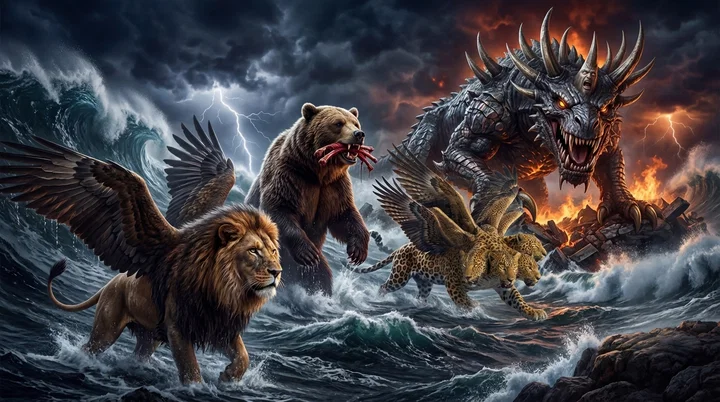
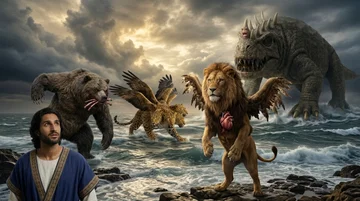
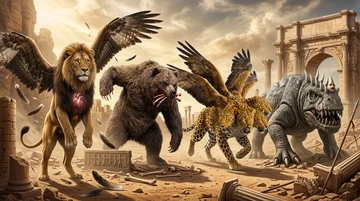
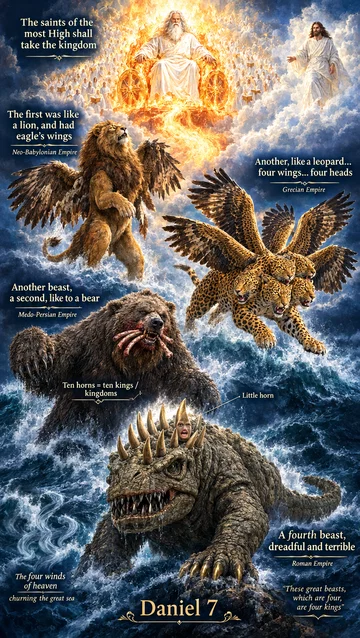
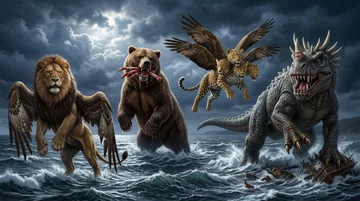
These great beasts, which are four, are four kings, which shall arise out of the earth.
Translations
American King James Version, King James Version, KJV Cambridge Paragraph Bible, Webster Bible, Revised Version
These great beasts, which are four, are four kings, which shall arise out of the earth.
These great beasts, which are four, are four kings, that shall arise out of the earth.
'These great beasts, that [are] four, [are] four kings, they rise up from the earth;
These great beasts, which are four, are four kings, [ that] shall arise out of the earth.
These great wild beasts, which are four,—are four kings who shall arise out of the earth;
Berean Standard Bible, Majority Standard Bible
‘ These four great beasts are four kings who will arise from the earth.
‘ These great animals, which are four, are four kings, who will arise out of the earth.
These great beasts are four kings who will be cut off from the earth.
These great beastes which are foure, are foure Kings, which shall arise out of the earth,
Douay-Rheims (Challoner revision)
These four great beasts are four kingdoms, which shall arise out of the earth.
Pictures
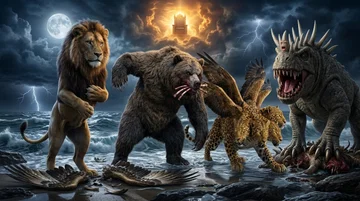
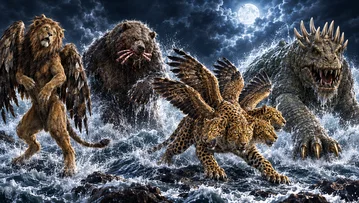
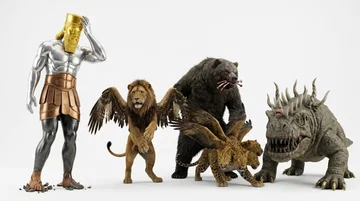
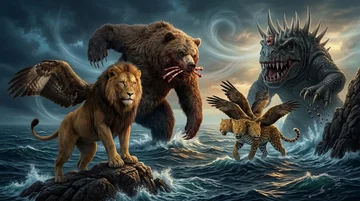
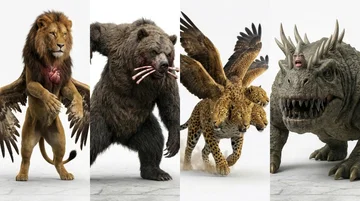
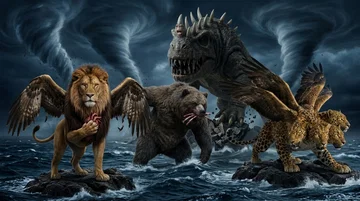
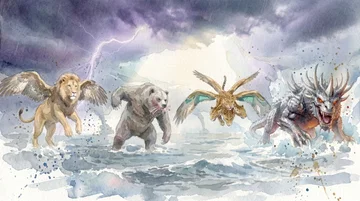
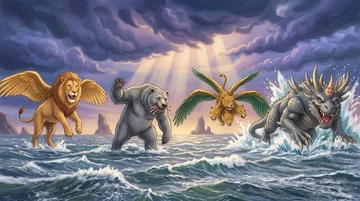
Cross-references 20 of 37
- Daniel 2:31-44
Thou, O king, sawest, and behold a great image. This great image, whose brightness was excellent, stood before thee; and the form thereof was terrible.
Both visions trace successive kingdoms and culminate in God’s everlasting kingdom.
- Daniel 7:3-8
And four great beasts came up from the sea, diverse one from another.
The vision describes the four beasts that are identified as kings.
- Daniel 7:23-25
Thus he said, The fourth beast shall be the fourth kingdom upon earth, which shall be diverse from all kingdoms, and shall devour the whole earth, and shall tread it down, and break it in pieces.
Describes the fourth kingdom’s ten horns and the little horn’s rise and power.
- Daniel 7:27
And the kingdom and dominion, and the greatness of the kingdom under the whole heaven, shall be given to the people of the saints of the most High, whose kingdom is an everlasting kingdom, and all dominions shall serve and obey him.
The kingdom under heaven is given to the saints after earthly powers fall.
- Daniel 7:23
Thus he said, The fourth beast shall be the fourth kingdom upon earth, which shall be diverse from all kingdoms, and shall devour the whole earth, and shall tread it down, and break it in pieces.
Identifies the fourth beast as a kingdom, clarifying the beasts as kingdoms.
- Daniel 8:20-21
The ram which thou sawest having two horns are the kings of Media and Persia.
These verses also identify beasts as kings or kingdoms.
- Daniel 7:2-3
Daniel spake and said, I saw in my vision by night, and, behold, the four winds of the heaven strove upon the great sea.
The vision shows four beasts rising from the sea, representing kingdoms.
- Revelation 13:1-2
And I stood upon the sand of the sea, and saw a beast rise up out of the sea, having seven heads and ten horns, and upon his horns ten crowns, and upon his heads the name of blasphemy.
The composite beast combines features of Daniel’s four beasts and receives power from the dragon.
- Daniel 2:37-40
Thou, O king, art a king of kings: for the God of heaven hath given thee a kingdom, power, and strength, and glory.
The passage links Daniel 2’s prophecy of four kingdoms with Daniel 7.
- Daniel 7:8
I considered the horns, and, behold, there came up among them another little horn, before whom there were three of the first horns plucked up by the roots: and, behold, in this horn were eyes like the eyes of man, and a mouth speaking great things.
The little horn arises within the sequence of kingdoms represented by the beasts.
- Daniel 7:4
The first was like a lion, and had eagle’s wings: I beheld till the wings thereof were plucked, and it was lifted up from the earth, and made stand upon the feet as a man, and a man’s heart was given to it.
The lion with eagle’s wings represents Babylon.
- Daniel 7:22
Until the Ancient of days came, and judgment was given to the saints of the most High; and the time came that the saints possessed the kingdom.
The saints receive the kingdom after judgment is given to them.
- Daniel 7:11-12
I beheld then because of the voice of the great words which the horn spake: I beheld even till the beast was slain, and his body destroyed, and given to the burning flame.
The fourth beast is destroyed by fire, while the other beasts lose dominion but continue for a time.
- Daniel 7:5
And behold another beast, a second, like to a bear, and it raised up itself on one side, and it had three ribs in the mouth of it between the teeth of it: and they said thus unto it, Arise, devour much flesh.
The bear is identified as the second beast in the sequence of four kingdoms.
- Daniel 8:3-8
Then I lifted up mine eyes, and saw, and, behold, there stood before the river a ram which had two horns: and the two horns were high; but one was higher than the other, and the higher came up last.
The ram and goat represent kingdoms parallel to the beasts in Daniel 7.
- Daniel 7:6
After this I beheld, and lo another, like a leopard, which had upon the back of it four wings of a fowl; the beast had also four heads; and dominion was given to it.
The leopard’s four heads and wings represent Alexander’s empire divided among four successor kingdoms.
- Daniel 11:3-4
And a mighty king shall stand up, that shall rule with great dominion, and do according to his will.
Describes Alexander’s kingdom and its division after his rule.
- Daniel 2:34-35
Thou sawest till that a stone was cut out without hands, which smote the image upon his feet that were of iron and clay, and brake them to pieces.
The stone strikes and destroys the image, paralleling the eventual destruction of the beastly kingdoms.
- Daniel 7:26
But the judgment shall sit, and they shall take away his dominion, to consume and to destroy it unto the end.
The judgment takes away the dominion of the power represented by the beast.
- Revelation 17:3
So he carried me away in the spirit into the wilderness: and I saw a woman sit upon a scarlet coloured beast, full of names of blasphemy, having seven heads and ten horns.
The scarlet beast’s symbolism parallels Daniel’s beasts.
Commentary part 1 of 2
Each commentary is drawn from primary sources: the writings of Ellen G. White and Adventist pioneers and periodicals. Each commentary is separate. Its own words are not a quotation; follow the references to read the source passages.
Ellen G. White
10 sources
The four great beasts are four kings, meaning four kingdoms, that arise out of the earth.LS 40.1–54SP 502.4–6DA 837.74SP 502.2–3 They are four successive empires, Babylon, Persia, Greece, and Rome.LS 40.1–54SP 502.4–64SP 502.2–3 In order they correspond to the gold, silver, brass, and iron of Nebuchadnezzar's image.LS 40.1–5
Their rising from the sea marks them as nations of the Old World, in contrast to the two-horned beast that rises in a previously unknown part of the world.DA 837.7 The beasts represent powers arising from the union of church and state that cruelly persecute those who oppose them.DA 837.3–4 The wider prophecy portrays the little horn as the Roman Church before it gained civil power.4SP 502.4–6
The little horn parallels the leopard-like beast of Revelation 13 and points to the papacy, which succeeded ancient Rome in power, seat, and authority.GC88 439.1 The papal power inherited in turn the authority previously held by each of those empires.4SP 502.2–3 The prophecy is a figurative outline of historical events unfolding in order toward the close of earth's history, whose meaning is established by careful study and by recognizing events that fulfill prophecy.Ms 31, 1896, par. 1–2 It is explained through historical events, including the chapter's 1260-day period ending in 1798, when Berthier entered Rome and the Pope was taken prisoner, marking the removal of the little horn's dominion.LS 66.1–67.2
The verse belongs to the prophecies of Daniel 7 to 12 that reveal the mysteries of ages to come given to Daniel as God's ambassador.PK 547.1 Even Daniel did not fully understand them, and they were ordered to be shut up and sealed until the time of the end, the closing period of this world's history, when Daniel after resting will stand again in his lot and place.PK 547.1 God gave Daniel this revelation because he honored God with firmness, self-denial, purity of motive, and unwavering trust.PK 484.3 God gave him knowledge and skill, understanding in all visions and dreams, and the spirit of prophetic power to read the mysteries of the future, so that through figures and symbols he recorded for coming generations events covering the history of this world till the close of time.PK 484.3
Sources
Pioneers and periodicals
385 sources
These great beasts are four kings arising out of the earth, and kings here means kingdoms, empires or earthly governments rather than single men.RH Aug 7, 1900RH Jan 17, 1871RH Feb 17, 1874RH Mar 24, 1874ST Jun 3, 1897 They are four distinct successive universal monarchies arising one after another from Daniel's time to the end, no more and no less, bearing rule over all the earth until the judgment and the everlasting kingdom.RH Jan 17, 1871ST Jun 30, 1914 Those four powers are Babylon, Medo-Persia, Greece, and Rome, which successively arose in foretold order and, except for closing events, have passed away as foreshown.RH Jan 17, 1871ST Jan 4, 1916ST Jun 27, 1878 The vision parallels Nebuchadnezzar's dream in Daniel 2, covering the same empires and period, with lion as gold, bear as silver, leopard as brass, and the fourth beast as iron with toes corresponding to horns.ST Jun 30, 1914ST Oct 14, 1889ST Aug 19, 1880 Earthly rule ends with the destruction of the fourth beast and the overthrow of earthly governments, after which the saints of the Most High take and possess the everlasting kingdom forever at Christ's second advent.RH Aug 7, 1900ST May 4, 1876ST Jun 22, 1882
Words Symbols and Setting
The four great beasts are four kings that arise out of the earth.RH Aug 7, 1900RH Jan 17, 1871RH Feb 17, 1874ST Jun 30, 1914 The saying belongs to a prophecy of successive world kingdoms and their rise and fall, traced from Daniel's time to the end and contrasted with God's everlasting kingdom.RH Aug 7, 1900RH Jan 17, 1871RH Feb 17, 1874ST Jun 30, 1914 The sequence includes Babylon, Persia, Greece, and Rome, with Rome's breakup and the rise of the papal power, and the fourth empire breaking into ten lesser kingdoms that remain with changes until Christ's second coming when the heavenly kingdom is established.RH Jan 17, 1871ST Jun 30, 1914RH Mar 24, 1874 The fourth beast is Rome in pagan and papal phases, unlike the others, exceedingly strong and dreadful, and among the ten arises an eleventh ecclesiastical kingdom about which the chapter gives further detail.ST Jun 30, 1914RH Mar 24, 1874ST Aug 14, 1893
Kings here means kingdoms, empires, governments, nations or powers, the terms being used interchangeably.RH Jan 17, 1871RH Mar 24, 1874ST Jun 3, 1897RH Aug 9, 1915 It does not mean single men or a judgment on character, as shown by the fourth beast being called the fourth kingdom upon earth and by the promise that the saints take the kingdom.RH Jun 20, 1854RH Jan 16, 1908RH Feb 17, 1874 The beasts therefore represent four successive earthly empires arising amid the strife of nations.RH Aug 9, 1915RH Jun 20, 1854
In prophetic symbolism a beast is not a literal animal but an earthly government, nation, kingdom or civil ruling power, a symbol like the image in Daniel 2.RH May 8, 1916ST Nov 30, 1882ST Jan 26, 1915RH Apr 29, 1909 A horn likewise symbolizes a kingdom or civil power and can represent a church, heads stand for kings or kingdoms, and days can stand for years.RH Sep 30, 1873RH May 8, 1916ST Jan 26, 1915 The meaning of the beasts is explained within Daniel itself, and other prophecies and histories confirm the fulfillment.RH Jan 23, 1913RH Jun 25, 1857 A power is identified only when it definitely fulfills the specifications given, for prophecy is not indefinite guesswork but requires that the rise and development match what the symbol specifies.RH Jun 25, 1857
The vision portrays these governments from heaven's perspective as wild and ferocious powers.RH Aug 9, 1915ST Nov 29, 1905 They embody brute force, passion, ambition, and a fierce and cruel nature, shown as cruel and bloodthirsty, predatory and destructive.ST Aug 14, 1893RH Apr 25, 1912 They portray the character of the kingdoms and their attitude toward God and His people, as antagonistic to God and His truth and in opposition to His work.ST Nov 29, 1905ST Dec 24, 1912 The verse helps delineate the character of those successive governments from Daniel's day to the coming of the everlasting kingdom of Jesus Christ and their relation to one another with special clearness, so the governments intended cannot be mistaken.RH Jun 20, 1854 The contest set forth is between the spiritual kingdom of heaven and worldly power, teaching that loyalty to God and righteousness provide lasting stability.RH Aug 7, 1900
Their arising out of the earth marks them as mortal, temporary, perishable earthly empires estranged from God and ruling for a limited time.RH Jul 11, 1854RH Aug 7, 1900 They precede the everlasting fifth kingdom, are destroyed at the judgment, and are succeeded by an everlasting kingdom the saints receive when God's time comes and earthly kingdoms are found wanting.RH Jul 11, 1854 Their earthly origin stands in contrast to the heavenly kingdom, which will endure forever.RH Aug 7, 1900 The warning concerns the evil systems they represent and the consequences of submitting to their principles, not individual people, and the saints do not conquer one of these empires to establish God's kingdom but receive it as an inheritance from the King.ST
The four come up from the sea, pictured as rising from a symbolic stormy sea of peoples amid unrest.RH Apr 15, 1909RH Jan 16, 1908 The sea or waters are the restless mass of humanity divided among peoples, nations, multitudes, tongues, tribes and tongues, and the four winds striving upon it are strife, war, political commotion, bloodshed, revolutions and movements among nations and governments.ST Oct 1, 1885RH Feb 17, 1874RH Nov 19, 1857 From that conflict the four kingdoms arise among the nations through war, by war and conquest and subduing prior powers at the beginning of their careers as temporal world-ruling powers.RH Apr 25, 1912RH Nov 19, 1857 Winds therefore denote strife, political commotion and war, and the sea denotes peoples and nations from which these kingdoms rise, with a king representing the empire through its whole duration including the succession of rulers who head it.RH Jan 16, 1908RH Feb 17, 1874 This warlike rise stands unlike the later two-horned beast that comes up peacefully out of the earth, by which same rule of interpretation that beast is also a great power brought into the prophetic field.ST Jan 26, 1915
The vision was given to Daniel in the night in the first year of Belshazzar and reveals the same essential events as the image shown to Nebuchadnezzar, with the first kingdom the universal Chaldean empire, the same as the head of gold.RH Nov 19, 1857 It stands in the section written in Chaldee, which continues through chapter 7 because its subject is similar to that of chapter 2.RH Nov 25, 1873 It was presented as symbolic images with Daniel's inquiry and ordered explanation, explained to him by one standing nearby, probably an angel, and needing no further explanation.RH Aug 23, 1870 Its new symbols are explained by the interpretation that follows, opening the way to interpret the symbols and adding to the Bible's symbolic vocabulary so that symbolic prophecy can be understood from its own inspired explanation.RH Sep 2, 1909 It gives the pattern after which all visions of beasts and horns are framed, and its explanation must guide research into later symbols, proving for example that a horn can stand for a church even before it receives civil power or direct union with the state.RH Sep 30, 1873
The verse is also cited as part of symbols for kingdoms already represented without explaining the four beasts or kings named in it.RH Nov 6, 1866ST Dec 17, 1874 In such use the little horn is the papacy and the same power as the leopard beast of Revelation 13, arising at the same time, occupying the same territory, having the same character and work, lasting the same period and meeting the same fate.RH Nov 6, 1866 It is likewise connected with Christ receiving dominion, glory and a kingdom from the Ancient of Days before returning to earth.ST Dec 17, 1874
Identity of Four Kingdoms
The four are four distinct universal world monarchies, empires or Gentile dynasties arising one after another in order from Daniel's time to the end of time, no more and no less and not contemporaneous and not to be mixed together, bearing rule over all the earth and spanning to the judgment, the everlasting kingdom and Christ's coming in the clouds.RH Jan 17, 1871ST Jun 30, 1914RH Jun 20, 1854 They are four kings meaning four successive kingdoms arising amid the strife of nations, with the fourth broken into ten lesser kingdoms remaining with changes until the second coming, followed by ten kingdoms and then a blasphemous persecuting power wearing out the saints into whose hand the saints are given.ST Jun 30, 1914RH Jun 20, 1854ST Oct 17, 1906
The four successive powers are Babylon, Medo-Persia, Greece or Grecia, and Rome, which successively arose and except for closing events have passed away as foreshown, their rise and later division of Rome marking stages leading to God's everlasting kingdom.RH Jan 17, 1871ST Jan 4, 1916ST Jun 27, 1878RH Dec 11, 1860ST Oct 17, 1906 They rise and fall before Christ's kingdom is established, their predicted course fulfilled through Rome's division into ten kingdoms and the rise of the papacy whose destruction by the judgment is still to come.ST Jan 4, 1916ST Jun 27, 1878RH Dec 11, 1860ST May 18, 1915 In one account the successive world kingdoms are instead listed as Assyria, Medo-Persia, Greece, and Rome.RH Apr 14, 1853
The lion is Babylon, the first universal kingdom and glory of kingdoms, greatest in power and wealth, like the king of beasts with eagle's wings for rapid conquests, soaring pride and self-exaltation.RH Jun 6, 1912ST Sep 21, 1882ST Jun 17, 1913RH Jan 23, 1908RH Aug 1, 1865 It is Babylonia represented by the gold of the statue, ruling many nations but declining through luxury and indulgence and yielding dominion to the Medes and Persians.RH Jun 6, 1912ST Sep 21, 1882RH Aug 1, 1865 The bear raised up on one side is the second kingdom after Babylon, the dual Medo-Persian kingdom with Persia ascendant, following Babylon in the sequence of earthly kingdoms corresponding to the great image in Daniel 2.ST Jan 22, 1880RH Jun 6, 1912RH Nov 26, 1857 It is ferocious and blood-thirsty and devouring much flesh, with three ribs in its mouth tasting blood as Babylon, Lydia and Egypt subdued and brought into subjection, cruel and relentless in conquest.RH Aug 1, 1865
The leopard with four fowl's wings and four heads is Greece under the youthful Alexander, bold and swift to dominion, succeeding Persia as the world power in 331 B.C.RH Jun 6, 1912RH Apr 30, 1857RH Aug 1, 1865ST Jun 17, 1913 Its four wings mark rapid conquest and rapid progress, partly lion-like in boldness, courage and prowess and panther-like in cunning craftiness, and its four heads mark its fourfold division toward the four winds into four minor kingdoms after Alexander's death.RH Jun 6, 1912RH Apr 30, 1857RH Aug 1, 1865 That division was made within twenty-two years after his death among four leading generals: Cassander holding the west with Macedon and Greece, Lysimachus holding the north with Thrace and part of Asia Minor, Ptolemy holding the south with Egypt, Lydia, Arabia, Palestine and Coele-Syria, and Seleucus holding the east with Syria and the rest of the kingdom.ST Jun 17, 1913 The dreadful, terrible beast strong exceedingly with great iron teeth is Rome, devouring and breaking in pieces and stamping the residue and devouring and breaking the whole earth, connected with the iron legs of the image in Daniel 2.RH Apr 7, 1874RH Jun 6, 1912ST Oct 29, 1885 In its stage before the rise of the little horn it is pagan Rome, paganism having its seat at Rome, the same as the great red dragon that sought to put the Bethlehem man-child Jesus to death as soon as He was born.ST Jun 19, 1884
The vision shows in order a winged lion that loses feathers and stands disheartened, coming up from the sea one after another in a storm with high billows, the first like a lion with eagle-like wings losing its feathers and standing on the shore disheartened.ST Jul 20, 1882 Next is a bear raised on one side with three ribs in its mouth, tasting blood and rising to devour much flesh, then a four-headed leopard with four fowl's wings moving swiftly to mighty dominion.ST Jul 20, 1882ST Jul 23, 1874 Then comes a dreadful terrible beast stronger than the others with great iron teeth treading down the whole earth and ten horns, treading down the former beasts with its feet and eating the whole earth, and lastly the same beast with three horns plucked up and a peculiar horn with a man's eyes and mouth coming up in their place.ST Jul 20, 1882ST Jul 23, 1874 An older exposition understood the winged lion as Nebuchadnezzar's kingdom, the bear with three ribs as Darius's kingdom, the four-headed leopard as youthful Alexander's kingdom, and the great terrible beast complete with the little horn as eagle-helmeted Augustus's kingdom, a meaning understood as far back as 1617 and engraved in stone over the portals of Nurnberg city hall in Bavaria.RH Nov 2, 1905
In detailed chronology Babylon was founded in 612 B.C. by revolt from Assyria under Nabopolassar and ended in 538 B.C. when conquered by Medo-Persia, which was inferior to Babylon and lasted until 331 B.C. when conquered by Grecia under Alexander as the kingdom of brass.ST Aug 13, 1902 Grecia was conquered by Rome in 168 B.C. by victory over Perseus of Macedonia as the iron monarchy strong as iron.ST Aug 13, 1902 In another reckoning Babylon lasted till 538 B.C., Medo-Persia till 331 B.C., Grecia till 168 B.C., and Rome as a united kingdom till A.D. 351 and as a divided empire until the present, showing the next great event after these kingdoms is the setting up of Christ's everlasting kingdom at His coming.ST Nov 28, 1895 Babylon has become extinct though its principles continued in later powers and to shape later powers; Medo-Persia and Macedonia survive only as the small states of Persia and Greece; imperial Rome has passed away and remains in its divided form.
The four arose in the Old World and together covered nearly all of it, each arising from territory distinct from the others and retaining its distinct territorial identity even while overthrowing its predecessor.ST Oct 2, 1884ST Nov 12, 1885 The first beast of Revelation 13 joins the lion, bear and leopard traits to show the papal power gained dominion over all the same territory they had occupied.ST Oct 2, 1884 Their warlike rise stands contrary to a power coming up quietly out of the earth, for the sea out of which they rose means peoples, nations, multitudes and tongues, and the striving of the winds upon that sea means commotions and movements among peoples bringing those kingdoms to power by aggressive wars.RH Jun 25, 1857 Each kingdom retained its distinct territorial identity even as it overthrew the preceding kingdom and extended its rule, Babylon, then Media and Persia, then Greece, then a western power beyond Greece later identified as Rome.ST Nov 12, 1885
The beasts together show the stages of a continuing church-and-state system through which Satan works as the dragon's agent, separate successive empires of Babylon, Medo-Persia, Greece and pagan Rome yet one continued perverted system.ST Jun 17, 1903ST Jul 4, 1911 Their rise and fall demonstrates the failure of the long effort to establish universal permanent world rule under the god of this world, outlining world history again to reveal the plan to establish a kingdom of a different kind after those four have fallen and God restores all things in Christ.RH Sep 13, 1915 They are earthly powers used by the god of this world in his effort to bring the world under his rule, and having failed by force of arms he evolved the mystery of iniquity seeking extensive spiritual rule as professed vicar of Christ, which Daniel 7 and Daniel 8 expose.RH Sep 13, 1915 They stand against God and His government as persecuting powers antagonistic to God and His work, the lion, bear, leopard and great composite monster symbolizing respectively Babylon, Medo-Persia, Grecia and Rome.ST Jul 4, 1911ST Mar 30, 1915
The beasts represent the nations making up successive kingdoms while their horns represent the civil governments of those nations, and a nation can continue to exist even after its dominion is taken away.RH May 19, 1851 The lion is the gold kingdom, the bear the silver, the leopard the brass, and the fourth beast the iron kingdom, with the image's toes corresponding to the beast's horns. Their lives continue after their dominion ends and they are destroyed together when the fourth beast is destroyed at Christ's coming, which refers to the kingdoms and not to the resurrection of their former rulers or peoples. The four exist at the same time rather than as a succession of individual rulers, as shown by the little horn uprooting three of them, with kings also meaning kingdoms parallel to the image in Daniel 2 and supporting ten toes as ten independent kingdoms.RH Mar 9, 1869
The four beasts are universal kingdoms serving as successive signs and waymarks along history toward the Holy City through the little horn's war with the saints to the kingdom given to the saints.RH Feb 3, 1853ST Mar 11, 1903 They represent kingdoms through their kings and the same four kingdoms as the parts of Nebuchadnezzar's image, marking successive world powers and also locating the territory, time and work of the small yet worldwide kingdom of antichrist.RH Feb 3, 1853ST Sep 17, 1902 After the last horn-sign no more signs remain, the next thing looked for being the judgment, reward and glorious city.ST Jul 23, 1874
Parallel with Daniel Two
The vision runs parallel to Nebuchadnezzar's dream of the image in Daniel 2, covering the same dominant empires and the same ground and period from Daniel's day to the end.ST Jun 30, 1914ST Oct 14, 1889ST Aug 19, 1880ST Nov 29, 1905ST Jun 13, 1878 The lion answers to the gold, the bear to the silver, the leopard to the brass, and the fourth beast to the iron, while the toes of the image correspond to the horns of the beast.ST Oct 14, 1889ST Aug 19, 1880ST Nov 29, 1905ST Jun 13, 1878ST May 3, 1877 The four are the same great dynasties shown by the image, Babylon, Medo-Persia, Grecia and Rome, set forth here with more definite and particular specifications fulfilled in past history.ST Jun 30, 1914ST Oct 14, 1889ST Aug 19, 1880ST Jun 13, 1878ST May 3, 1877
Daniel 7 reviews Daniel 2 under different symbols, giving the same four universal kingdoms with marks of identity so clear they refer to the same events.RH Mar 29, 1864ST Dec 22, 1881RH Aug 24, 1869RH Nov 11, 1915ST Jul 1, 1897 The first dream was given to Nebuchadnezzar a heathen as introductory metals, and the next was given to Daniel as beasts to bring out new features and important movements in the same line of history that metals were little adapted to express.RH Mar 29, 1864ST Dec 22, 1881 After this review Daniel 7 gives an advance lesson on the same terrible beast, where a change in its horns shows the rise and work of the papacy.RH Mar 29, 1864RH Aug 24, 1869ST Jul 1, 1897
The sequence covers the same ground as the metallic image of gold, silver, brass, and iron mixed with miry clay, showing diminishing power and grandeur ending in a broken divided state.GSAM 54.1–2ST Jun 21, 1905 It presents other features of those kingdoms, including the rise of the little-horn papal power after the fourth kingdom divides into ten parts, until Christ receives the kingdom from His Father and gives it to the saints of the Most High to bear rule over all the earth and stand forever.GSAM 54.1–2ST Jun 21, 1905 The repetition with explanations makes assurance doubly sure against mistaken interpretation.GSAM 54.1–2ST Jun 21, 1905
Daniel 2 is the alphabet of symbolic prophecy by which its beasts and kings are read, and Daniel 7 gives God's view of the nations as part of the sure word of prophecy about Christ's coming.ST Aug 16, 1905 The chapter is arranged chronologically in parallel with Daniel 2 and Daniel 8, with its symbols shown in their corresponding order.RH Oct 8, 1908ST Jun 30, 1914 One prophecy fortifies the other, with Daniel 8 naming Medo-Persia and Greece, giving certainty about the coming of the Lord Jesus Christ, and the meaning is definite and plain because the interpretation is given in the Bible itself.RH Oct 8, 1908ST Jun 30, 1914
The vision of Daniel 7 is the second of four distinct lines of prophecy covering the same great field of the four perishable kingdoms reaching to and introducing the eternal kingdom of God.ST Apr 9, 1912RH Dec 23, 1852 Like the great metallic image of Daniel 2 it begins with Babylon in its glory, while the visions of Daniel 8 and Daniel 10-12 begin with Medo-Persia after Babylon passed as a world power.ST Apr 9, 1912RH Dec 23, 1852 All four lines cover the same ground in regular course and close at the same time, when the Roman Empire comes to its end at the second coming of Christ and the resurrection of the dead.ST Apr 9, 1912
The same essential events are also given through related symbols in Daniel 8, where the ram is Media and Persia corresponding to the bear and the goat is Greece succeeding Medo-Persia, and is further filled up by Daniel 10-12, so Daniel 11 covers the same powers and reaches the same end.ST Nov 9, 1882RH Mar 16, 1869RH Jun 27, 1878RH May 28, 1867 The vision was given near the beginning of Belshazzar's reign at a measurable interval before Daniel 8 and 10, when Babylon was soon to pass away and so was omitted from Daniel 8 which begins with Media and Persia at its height.RH Jun 27, 1878ST Nov 29, 1905ST Nov 29, 1905 Daniel 7 is explained together with Daniel 2 and Daniel 8 as one connected prophecy of the successive kingdoms involving the sanctuary and the 2300 days.ST Nov 9, 1882RH Mar 16, 1869RH May 28, 1867
Daniel 7 shows the great kingdoms of the earth through symbolic beasts, whereas Daniel 11 presents historical events in mostly plain literal language.RH Dec 12, 1912ST Jan 10, 1878RH Dec 28, 1911 The visions in chapters 2, 7 and 8 are clothed in figures and symbols, unlike the prophecy of Daniel 11 which is given mostly in plain language.RH Dec 12, 1912ST Jan 10, 1878RH Dec 28, 1911ST Apr 6, 1882 Daniel 7 is explained in the same way as Daniel 2 and explained together with it.RH Feb 25, 1873RH Jun 25, 1867RH Aug 15, 1865RH Apr 26, 1864RH Aug 4, 1868
The verse must not be taken by itself alone but compared with other prophecies and other symbols to establish and hold the unity of prophecy, because the same four beasts are symbolized again in the one beast of Revelation 13.ST Feb 25, 1913 To explain the verse entirely by itself without regarding that parallel prophecy is private, special, arbitrary interpretation.ST Feb 25, 1913 The chapter is to be expounded together with Daniel 8 concerning the sanctuary and the 2300 days, as part of parallel prophetic lines in Daniel 2, 7, 8, and 9 which together extend through the Christian dispensation to the end.ST Aug 12, 1875RH Apr 23, 1867 Placing the 2,300 days' end at Christ's ascension would wrongly compress these prophecies into the former dispensation.ST Aug 12, 1875RH Apr 23, 1867
Ten Horns and Little Horn
The fourth kingdom is Rome, afterward divided into ten kingdoms symbolized by the ten horns, which remain in a divided state with changes until Christ's second coming and the setting up of God's kingdom.ST Dec 14, 1882ST Jun 27, 1878RH Jun 20, 1854RH Dec 11, 1860 The four beasts are four successive universal empires arising on earth from Daniel's time to the end, and the fourth empire breaks into ten lesser kingdoms followed by a blasphemous persecuting power to whom the saints are given.ST Jun 30, 1914ST Jun 27, 1878RH Jun 20, 1854RH Dec 11, 1860 The fourth monarchy parallels Daniel 2, and Daniel 7 gives in detail what the eleventh ecclesiastical kingdom arising among the ten would do.ST Jun 30, 1914ST Dec 14, 1882ST Jun 27, 1878ST Jul 6, 1915 The Latin empire oppresses God's people, and the apostasy arising from it after its division continues until Christ's second coming.RH Aug 9, 1915ST Dec 14, 1882ST Oct 14, 1889ST Jun 27, 1878RH Aug 31, 1869
The fourth beast represents the Roman Empire, matching the iron legs of Daniel 2, and its ten horns represent kingdoms formed from its divisions, matching the image's ten toes.RH Aug 24, 1869ST Nov 9, 1882RH May 19, 1874ST Nov 5, 1885 The number of these kingdoms changed over time while retaining identity as the ten kings of prophecy, and they were to remain until God's kingdom.ST Nov 9, 1882RH Apr 15, 1862RH Apr 7, 1874RH Nov 19, 1901RH Jan 26, 1860 They arose by barbarian incursions between A.D. 351 and 476, were divided before the end of the fifth century with the last arising in A.D. 488, include France, and correspond to the feet and toes of Daniel 2.RH Aug 24, 1869ST Jun 22, 1882ST Nov 9, 1882RH May 19, 1874 The little horn is distinct from the ten, ruled by a priest-king, arising after that division and opposing God and His people.RH Aug 24, 1869ST Jun 22, 1882RH May 19, 1874ST Nov 5, 1885
The ten horns are ten kings that divided the Western Roman Empire after its fall in 476, rising historically from 476 to 493 as the Alemanni, Franks, Burgundians, Vandals, Suevi, Visigoths, Saxons, Ostrogoths, Lombards, and Heruli.ST Feb 17, 1909ST Oct 29, 1902RH May 27, 1875ST May 26, 1909RH Jan 31, 1854 The Heruli, Vandals, and Ostrogoths are the three kingdoms plucked up.ST Oct 29, 1902RH Jun 20, 1912RH May 27, 1875ST Nov 5, 1894ST Oct 13, 1881 The ten horns were ten contemporary powers visible together from A.D. 483 to 493, including the Heruli in Italy, the Vandals, the Ostrogoths, the Anglo-Saxons in England, the Lombards on the Danube and five others.ST Feb 17, 1909RH Apr 7, 1874RH May 27, 1875RH Nov 19, 1901RH Jan 26, 1860 Although three were later destroyed, the ten horns remain in prophecy as the divisions existing when God sets up His kingdom, and when Christ's priestly ministry ends He destroys the earthly kingdoms as the stone strikes the image.RH Apr 15, 1862RH Apr 7, 1874RH May 27, 1875RH Nov 19, 1901RH Jan 26, 1860
The division into ten kingdoms is historically fulfilled between A.D. 351 and 476, in another reckoning applied to the Western Roman Empire between A.D. 353 and 483, and in another reckoning the ten divisions as kingdoms arising from the Roman power existed between A.D. 476 and 493.ST Jan 28, 1889ST May 26, 1909RH Jan 31, 1854RH Aug 14, 1900ST Nov 9, 1882 After Christianity was finally established by Theodosius in A.D. 390, the western empire was broken up and filled with northern tribes, forming ten barbarian kingdoms before the close of the sixth century: the Huns, Ostrogoths, Visigoths, Franks, Vandals, Sueves and Alans, Burgundians, Heruli and Turingi, Saxons and Angles, and Lombards.RH Aug 14, 1900ST Nov 9, 1882ST Dec 17, 1896RH Mar 16, 1869RH Sep 22, 1874 The fourth beast is Rome presented as one single undivided power with no eastern and western division that remained a unit for nearly six hundred years.ST Nov 9, 1882ST Dec 17, 1896RH Mar 16, 1869RH Apr 22, 1862ST Nov 29, 1905 Its divisions are to be looked for only in the territory proper of Rome in the west, where it was finally broken into ten kingdoms by barbarian invasions from the Visigoths under Alaric in A.D. 395 to the Herulian kingdom of Italy in A.D. 476, occupying the same territory, with ten from 476 to 493.RH Aug 14, 1900ST Nov 9, 1882ST Dec 17, 1896RH Mar 16, 1869RH Apr 22, 1862
The number may change as they rise and fall but they remain the divided powers of the horns and toes, and after three are uprooted seven remain when God sets up His kingdom.RH Apr 7, 1874RH Nov 19, 1901RH Jan 26, 1860RH Aug 14, 1900ST Nov 9, 1882 The peoples who brought about Rome's destruction are ancestors of the great nations of the present day and remain subjects of prophecy.RH Apr 15, 1862ST Oct 25, 1905RH Aug 14, 1900ST Mar 6, 1901RH Sep 22, 1874 The ten kingdoms were still in existence in 1798 and, because no material revolution had since altered Europe's kingdoms, were still in existence at the time of writing.RH Apr 15, 1862RH Apr 7, 1874RH Nov 19, 1901RH Jan 26, 1860RH Aug 14, 1900 The fourth monarchy is Rome broken into exactly ten kingdoms, among which an eleventh ecclesiastical church power would arise, with Daniel giving in detail what that church power would do.ST Jun 30, 1914ST Dec 14, 1882ST Jun 27, 1878ST Jul 6, 1915
Among the ten arises an eleventh, distinct ecclesiastical kingdom, the little horn, which is the papacy, the Roman Pontiff, the Man of Sin, the great antichristian power embodied in Roman Catholicism and modern Babylon.ST Jun 3, 1897RH Aug 9, 1915ST Dec 14, 1882ST Jun 27, 1878RH Aug 31, 1869 It is ruled by a priest-king who is both ecclesiastical and civil sovereign, a kingdom with limited territory whose pope is a king among kings, and the leading theme after the fourth beast.RH Aug 9, 1915ST Oct 14, 1889ST Jun 27, 1878RH Aug 31, 1869RH May 19, 1874 Its predicted course has been fulfilled through Rome's division into ten kingdoms and the rise of the papacy, with the papal power's destruction by the judgment still to come.RH Aug 9, 1915ST Dec 14, 1882ST Oct 14, 1889ST Jun 27, 1878RH Aug 31, 1869 The last beast has two phases, and its latter phase includes the Papacy, which persecutes God's people, rebels against God's law, and blasphemes His name.RH Aug 9, 1915ST Dec 14, 1882ST Oct 14, 1889ST Jun 27, 1878RH Aug 31, 1869
The little horn arising among the ten is papal Rome or ecclesiastical Rome, a power distinct from Rome's civil divisions.ST May 25, 1882RH Jun 26, 1856ST Feb 7, 1906RH Jan 18, 1870RH Jun 20, 1912 Its later phase arose through union of the apostate church with the Roman state, changing Rome from pagan Rome to papal Rome.ST May 25, 1882RH Jun 26, 1856ST Feb 7, 1906RH Jan 18, 1870RH May 21, 1914 The fourth beast is Rome in two phases, pagan Rome as the great beast followed by papal Rome as the little horn, the second phase identified with the beast of Revelation 13.RH Mar 24, 1874ST Oct 14, 1889RH Apr 10, 1900RH Jan 18, 1870 The beast's continued presence at its final destruction shows Rome's essential character continues under the little horn to the end of its career.RH Mar 24, 1874ST Oct 14, 1889RH Apr 10, 1900RH Jan 18, 1870
The fourth beast in its stage before the little horn is pagan Rome, paganism seated at Rome, the same as the great red dragon that sought to kill the Bethlehem man-child Jesus as soon as He was born.RH Mar 24, 1874RH Apr 10, 1900ST Jun 19, 1884RH Oct 27, 1874 In that role Rome attempted to destroy Jesus immediately after His birth through Herod, a Roman governor.RH Mar 24, 1874RH Apr 10, 1900RH Jan 18, 1870ST Jun 19, 1884RH Oct 27, 1874 Rome as the fourth kingdom was unlike the others because it was a republic, and while a republic it conquered and crushed other peoples.RH Mar 24, 1874ST Oct 14, 1889RH Apr 10, 1900ST Nov 29, 1899
The little horn is not Antiochus Epiphanes, who lived centuries earlier as a Syrian king unable to resist Rome's mandates, but the papacy identified with the character described in Daniel 7.RH May 27, 1873RH May 29, 1900RH Dec 23, 1852ST Feb 12, 1880RH Dec 10, 1857 Rome was the more notable and expansive power whose authority continued over the Syrian kings, and substituting Antiochus saves the Roman church from a share in fulfillment.RH May 27, 1873RH May 29, 1900RH Dec 23, 1852ST Feb 12, 1880RH Dec 10, 1857 Rome is the great subject of the latter half of Daniel as Babylon is of the first half, with fulfillment including the Roman power pagan and papal and reaching at least to the First Advent.RH May 29, 1900RH Dec 23, 1852RH Mar 2, 1852ST Feb 12, 1880RH Dec 10, 1857 The fourth beast has its own symbolized existence with its ten horns and brazen nails, and no head of the third can absorb the whole of the fourth.RH May 29, 1900RH Dec 23, 1852RH Mar 2, 1852ST Feb 12, 1880RH Dec 10, 1857
The little horn in Daniel 7 is the papacy during only part of Rome's history, distinct from Daniel 8's little horn which represents Rome throughout both pagan and papal forms and covers the fourth beast and all its horns, proved by their respective places of origin and spheres of influence.ST Nov 19, 1885RH May 29, 1900RH Dec 23, 1852RH Mar 2, 1852RH Apr 15, 1873 The little horn speaks blasphemies against the Most High, claims authority over God's law, wears out the saints to whom they are given, subdues three kingdoms, and continues until the judgment and Christ's coming when its dominion is taken away and destroyed.ST Jun 3, 1897RH Aug 9, 1915ST Oct 14, 1889ST Jun 27, 1878RH Aug 31, 1869 It arises among the ten kingdoms and persecutes God's people, and the great antichristian power having completed its prophetic career and decline awaits destruction at Christ's second coming before the everlasting kingdom is established over the whole earth.ST Jun 3, 1897RH Aug 9, 1915ST Dec 14, 1882ST Oct 14, 1889RH Aug 31, 1869
The power prophesied to speak great words against the Most High, wear out the saints, and think to change times and laws is the blasphemous papal power, not Christ, and the attempted change is fulfilled in nothing but the change of the Sabbath as secular history shows.ST Jun 28, 1877ST Mar 4, 1913RH Jul 21, 1874RH Jan 9, 1872RH May 27, 1873 The little horn changes God's law, identified as the Sabbath change made by the papal power, not by Christ.ST Jun 28, 1877ST Mar 4, 1913RH Jul 21, 1874RH Jan 9, 1872RH May 27, 1873 Since the horn appears only after Rome broke into ten parts, that change must have occurred after Rome's fall, not before the Christian era as would follow from identifying the horn with Antiochus Epiphanes.RH May 27, 1873RH Jan 9, 1872RH May 27, 1873RH Dec 23, 1852ST Feb 12, 1880
The little horn is the same as Paul's man of sin, son of perdition and antichrist, known by blasphemies, war on the saints, and seeking to change times and laws by changing the Sabbath to Sunday, which it claims as its own act and mark of authority.ST Jun 22, 1882RH Aug 1, 1865ST Jan 30, 1879ST Mar 4, 1913RH Jul 21, 1874 To attribute that change to Christ robs the papacy of its badge, makes prophecy fail and Scripture unreliable, putting Christ in the office of that blasphemous power.ST Jun 22, 1882RH Aug 1, 1865ST Jan 30, 1879RH Jul 21, 1874RH May 27, 1873 Its civil dominion is taken away a little before the end and consumes away unto the end, when it is utterly destroyed from under heaven at the second coming of Christ, consumed with the spirit of His mouth and destroyed with the brightness of His coming, proving it continues to the day of Christ.ST Jan 15, 1880RH Jan 10, 1865ST Jun 22, 1882RH Aug 1, 1865ST Jan 30, 1879
Three Arian kingdoms were plucked up by the roots, meaning cessation of existence, before the spiritual power: the Heruli exterminated by the Ostrogoths under Theodoric in A.D. 493, the Vandals conquered with their king taken captive at Carthage and deposed at Constantinople for refusing to renounce Arianism, and the Ostrogoths overthrown with Belisarius entering Rome in A.D. 536.ST Feb 17, 1909ST Oct 29, 1902RH Jun 20, 1912RH May 27, 1875ST Oct 13, 1881 According to another reckoning the three uprooted kingdoms were the Heruli in 493, the Vandals in 534, and the Ostrogoths in 552-553.ST Oct 29, 1902RH Jun 20, 1912RH May 27, 1875ST Nov 5, 1894ST Oct 13, 1881 The Ostrogothic kingdom, last of the three removed, fell in A.D. 538, clearing the way for papal supremacy.ST May 25, 1882ST May 9, 1878RH Jun 20, 1912ST Nov 5, 1894RH Mar 7, 1871 Its persecuting power then lasted forty-two months or 1260 years until 1798, when persecution and spiritual domination ended.RH Jul 23, 1872GSAM 54.1–2ST Jan 15, 1880RH Jan 10, 1865ST Nov 5, 1894
By Justinian's decree in 533 the pope was made head of all churches, but exercise of that power was hindered while Arian Ostrogoths held Rome and Italy.RH Apr 15, 1875RH Oct 24, 1871ST May 25, 1882ST May 9, 1878RH Mar 7, 1871 Belisarius entered Rome December 10, 536, endured the Gothic siege from March 537, and in March 538 the Goths retired broken, so saints, times and laws were then in the pope's hands in fact and not in purpose only.RH Apr 15, 1875RH Oct 24, 1871ST May 25, 1882ST May 9, 1878RH Mar 7, 1871 The year 538 is the setting up of the abomination and the starting point for counting the predicted 1260 years of papal supremacy.ST May 25, 1882ST May 9, 1878RH Mar 7, 1871RH Apr 22, 1862ST Nov 3, 1914
The little horn's full supremacy as spiritual ruler after overthrowing three lasts 1260 years, reckoned as a time and times and the dividing of time from the setting up of special papal supremacy in the days of Justinian, completed in A.D. 538, to A.D. 1798 and the events of the last decade of the eighteenth century that gave the papacy a deadly wound.RH Oct 7, 1915RH Jul 23, 1872GSAM 54.1–2RH Jan 23, 1855ST Jan 15, 1880 Afterward its dominion is taken away unto the end until finally destroyed at Christ's coming when dominion is given to His people raised from the dead, with no temporal millennium intervening.RH Oct 7, 1915RH Jul 23, 1872GSAM 54.1–2ST Jan 15, 1880RH Jan 10, 1865 The little horn arises after the fourth kingdom is divided into ten kingdoms, placing its rise about five hundred years after Christ, so the judgment could not come before that, and the judgment could be preached as immediately impending only after its 1,260-year period and work had ended.RH Oct 7, 1915RH Jul 23, 1872GSAM 54.1–2RH Jan 23, 1855ST Jun 22, 1882
That papal supremacy began in 538 from the uprooting of three of the ten horns, ruled 1,260 years, and ended when its head was taken prisoner and it went into captivity in 1798, when a French general entered Rome and took the pope prisoner and its dominion was taken away with a deadly wound ending its spiritual domination.RH Mar 29, 1864ST Jun 22, 1882RH Apr 15, 1875ST Feb 7, 1878 After the healing its civil power is consumed to the end while it continues as a church till Christ comes.RH Mar 29, 1864ST Jun 22, 1882RH Apr 15, 1875RH Oct 24, 1871 The papal period is dated from 538 to 1798, or 1,260 years, matching Revelation 13's leopard beast by timing, territory, character, persecution, duration, and downfall.RH Mar 29, 1864RH Apr 15, 1875ST Feb 7, 1878RH Oct 24, 1871
The little horn spoke great things and blasphemies, warred against the saints, claimed to change times and laws and to be obeyed in place of God, received throne and authority from paganism, and held supremacy for time, times and half a time, that is 1,260 prophetic days as 1,260 years of civil rule from the decree taking effect in 538, when power was given by Justinian and the Catholic Church was established, until its deadly wound in 1798 when the pope was taken prisoner by French forces and its civil power was taken away.RH Nov 26, 1857RH Nov 21, 1912RH Sep 22, 1863RH Apr 22, 1862ST Nov 3, 1914 Its wound is later healed and it comes out of captivity again.RH Apr 15, 1875RH Nov 26, 1857RH Nov 21, 1912ST Jun 22, 1882ST Nov 3, 1914 Following God's commandments as altered means obeying the power that changed them, and the advent movement's closing gospel work warns against following this power.RH Nov 26, 1857RH Nov 21, 1912ST Jun 22, 1882RH Sep 22, 1863RH Apr 22, 1862
The little horn makes war against the saints and remains prominent and to a degree dominant until the Ancient of Days comes, with the dominating beast power as a persecutor continuing to the end.RH Aug 9, 1915ST Oct 14, 1889RH Aug 31, 1869ST Oct 25, 1905ST Mar 6, 1901 A horn can stand for a church even before it receives civil power or direct union with the state, because Rome is introduced as the little horn before it had civil power.RH Sep 30, 1873ST Dec 4, 1879RH Nov 26, 1857RH Nov 21, 1912RH Sep 22, 1863 The horns include the papacy, which began as an ecclesiastical power and became a temporal monarchy in 755.ST May 25, 1882ST May 9, 1878RH Sep 30, 1873ST Dec 4, 1879RH Mar 7, 1871 Those ten sovereignties all adopted the faith emanating from Rome in the sixth century, with the papacy establishing its influence over them as paganism revived under a new form.RH Aug 14, 1900ST Nov 9, 1882ST Dec 17, 1896RH Mar 16, 1869RH Sep 22, 1874
The beast's actions occur before the empire's division, while later actions are attributed specifically to the little horn.RH Mar 18, 1862RH Apr 7, 1874RH May 27, 1875RH Nov 19, 1901RH Jan 26, 1860 When actions belong to kingdoms represented by horns they are attributed to the horns rather than to the beast from which they arose.RH Mar 18, 1862RH Apr 7, 1874RH May 27, 1875RH Nov 19, 1901RH Jan 26, 1860 A final specification points to the papacy again becoming the world's dominating power.ST Jun 24, 1897RH Apr 15, 1875ST Oct 25, 1905ST Nov 3, 1914ST Mar 6, 1901
Sources