Daniel 7:4
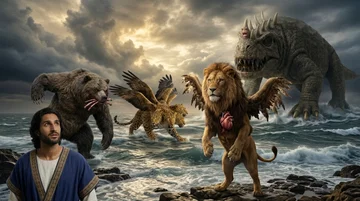
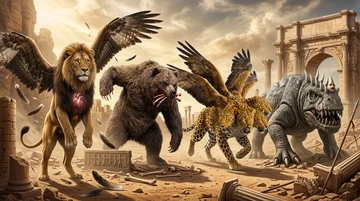
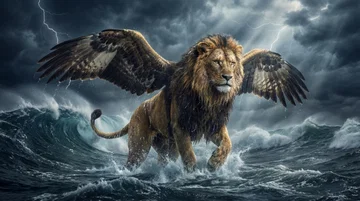
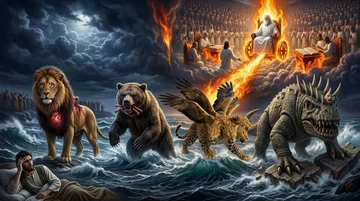
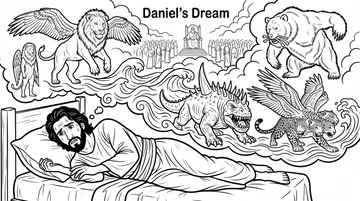
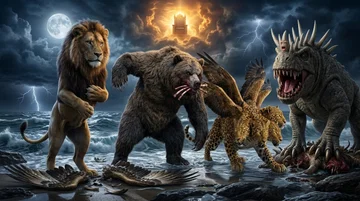
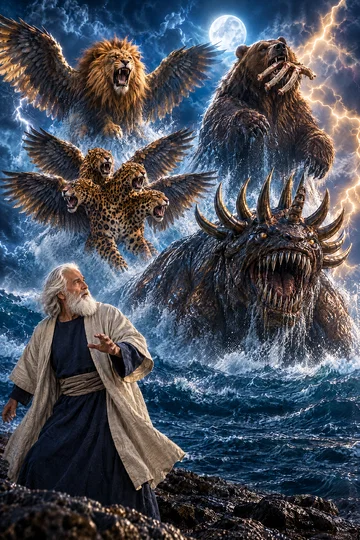
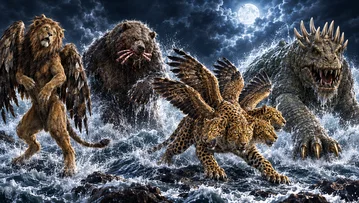
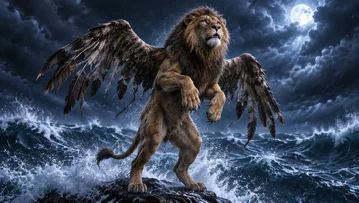
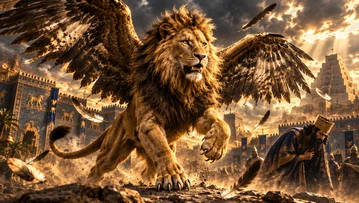
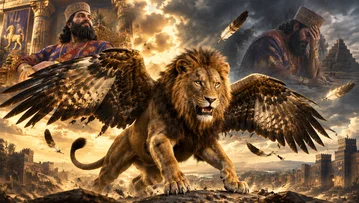
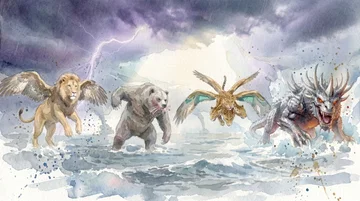
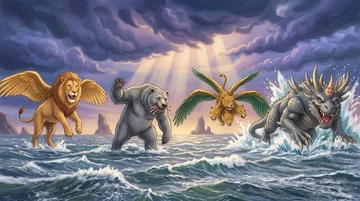
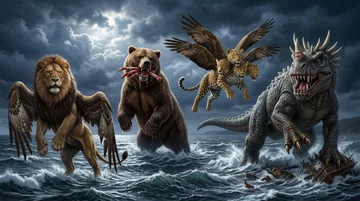
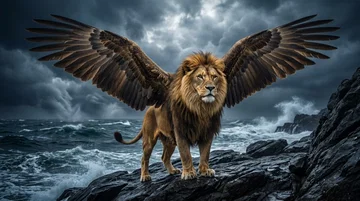
The first was like a lion, and had eagle’s wings: I beheld till the wings thereof were plucked, and it was lifted up from the earth, and made stand upon the feet as a man, and a man’s heart was given to it.
Translations
The first was like a lion, and had eagle’s wings: I beheld till the wings thereof were plucked, and it was lifted up from the earth, and made stand on the feet as a man, and a man’s heart was given to it.
The first was like a lion, and had eagle’s wings: I beheld till the wings thereof were plucked, and it was lifted up from the earth, and made stand upon the feet as a man, and a man’s heart was given to it.
The first was like a lion, and had eagle’s wings: I beheld till the wings thereof were pluckt, and it was lifted up from the earth, and made stand upon the feet as a man, and a man’s heart was given to it.
The first was like a lion, and had eagles' wings: I beheld till its wings were plucked, and it was lifted up from the earth, and made to stand upon the feet as a man, and a man's heart was given to it.
The first was like a lion, and had eagle’s wings: I beheld till the wings thereof were plucked, and it was lifted up from the earth, and made to stand upon two feet as a man, and a man’s heart was given to it.
The first was like a lion, and had eagle’s wings: I beheld till the wings thereof were plucked, and it was lifted up from the earth, and made to stand upon two feet as a man; and a man’s heart was given to it.
The first [is] like a lion, and it hath an eagle's wings. I was seeing till that its wings have been plucked, and it hath been lifted up from the earth, and on feet as a man it hath been caused to stand, and a heart of man is given to it.
The first was like a lion, and had eagle's wings: I beheld till its wings were plucked; and it was lifted up from the earth, and made to stand upon two feet as a man, and a man's heart was given to it.
The foremost, like a lion, having, the wings of an eagle,—I looked until the wings thereof, were torn out, and it was lifted up from the earth, and, upon its feet, like a man, was it caused to stand, and, the heart of a man, was given to it.
The first beast was like a lion, and it had the wings of an eagle. I watched until its wings were torn off and it was lifted up from the ground and made to stand on two feet like a man, and given the mind of a man.
The first beast was like a lion, and it had the wings of an eagle. I watched until its wings were torn off and it was lifted up from the ground and made to stand on two feet like a man and given the mind of a man.
“ The first was like a lion, and had eagle’s wings. I watched until its wings were plucked, and it was lifted up from the earth and made to stand on two feet as a man. A man’s heart was given to it.
The first was like a lion and had eagle's wings; while I was watching its wings were pulled off, and it was lifted up from the earth and placed on two feet like a man, and a man's heart was given to it.
The first was as a lyon, and had eagles wings: I beheld, til the wings thereof were pluckt of, and it was lifted vp from the earth, and set vpon his feete as a man, and a mans heart was giuen him.
Douay-Rheims (Challoner revision)
The first was like a lioness, and had the wings of an eagle: I beheld till her wings were plucked off, and she was lifted up from the earth, and stood upon her feet as a man, and the heart of a man was given to her.
Pictures
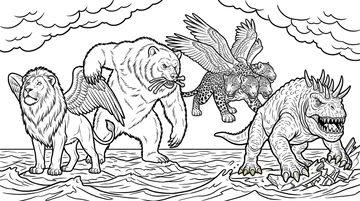
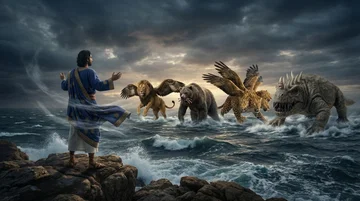
Cross-references 20 of 29
- Daniel 2:37-38
Thou, O king, art a king of kings: for the God of heaven hath given thee a kingdom, power, and strength, and glory.
Nebuchadnezzar’s Babylonian rule corresponds to the lion and its human heart.
- Revelation 13:1-2
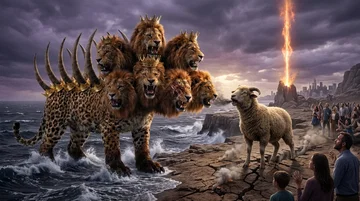
And I stood upon the sand of the sea, and saw a beast rise up out of the sea, having seven heads and ten horns, and upon his horns ten crowns, and upon his heads the name of blasphemy.
The beast combines Daniel’s beast imagery and has a lion’s mouth.
- Daniel 7:17
These great beasts, which are four, are four kings, which shall arise out of the earth.
The beasts in the vision are explained as kings.
- Daniel 7:13-14
I saw in the night visions, and, behold, one like the Son of man came with the clouds of heaven, and came to the Ancient of days, and they brought him near before him.
The Son of Man receives an everlasting kingdom after the judgment.
- Daniel 7:27
And the kingdom and dominion, and the greatness of the kingdom under the whole heaven, shall be given to the people of the saints of the most High, whose kingdom is an everlasting kingdom, and all dominions shall serve and obey him.
The everlasting kingdom is given to the saints after the earthly kingdoms.
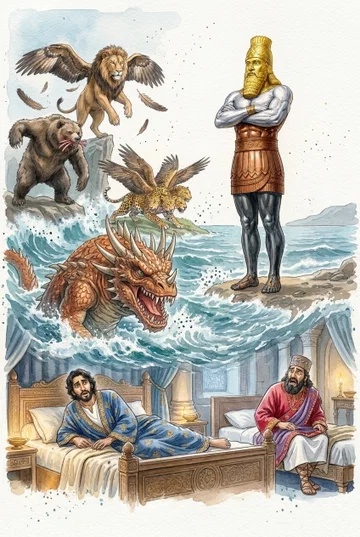
- Daniel 2:32
This image’s head was of fine gold, his breast and his arms of silver, his belly and his thighs of brass,
The lion corresponds to the image’s head of gold.
- Daniel 2:44
And in the days of these kings shall the God of heaven set up a kingdom, which shall never be destroyed: and the kingdom shall not be left to other people, but it shall break in pieces and consume all these kingdoms, and it shall stand for ever.
Both visions trace earthly kingdoms to the establishment of God’s everlasting kingdom.
- Daniel 8
In the third year of the reign of king Belshazzar a vision appeared unto me, even unto me Daniel, after that which appeared unto me at the first.
Daniel 8 parallels Daniel 7, and its prophetic period spans the age to its end.
- Daniel 7:18
But the saints of the most High shall take the kingdom, and possess the kingdom for ever, even for ever and ever.
The vision’s sequence ends with the saints receiving the eternal kingdom.
- Daniel 4:33-37
The same hour was the thing fulfilled upon Nebuchadnezzar: and he was driven from men, and did eat grass as oxen, and his body was wet with the dew of heaven, till his hairs were grown like eagles’ feathers, and his nails like birds’ claws.
The beast’s abasement and return to human understanding parallel Nebuchadnezzar’s humiliation and restoration.
- Daniel 7:23
Thus he said, The fourth beast shall be the fourth kingdom upon earth, which shall be diverse from all kingdoms, and shall devour the whole earth, and shall tread it down, and break it in pieces.
The beast imagery is explained as kingdoms and rulers.
- Jeremiah 4:7
The lion is come up from his thicket, and the destroyer of the Gentiles is on his way; he is gone forth from his place to make thy land desolate; and thy cities shall be laid waste, without an inhabitant.
Both describe Babylon as a lion advancing to devastate the land.
- Daniel 7:9-10
I beheld till the thrones were cast down, and the Ancient of days did sit, whose garment was white as snow, and the hair of his head like the pure wool: his throne was like the fiery flame, and his wheels as burning fire.
The vision proceeds to the Ancient of Days’ heavenly tribunal and judgment.
- Daniel 7:16
I came near unto one of them that stood by, and asked him the truth of all this. So he told me, and made me know the interpretation of the things.
Daniel asks one standing nearby to explain the vision.
- Daniel 2:34-35
Thou sawest till that a stone was cut out without hands, which smote the image upon his feet that were of iron and clay, and brake them to pieces.
Both visions trace world kingdoms to their final destruction and God’s kingdom.
- Daniel 7:8
I considered the horns, and, behold, there came up among them another little horn, before whom there were three of the first horns plucked up by the roots: and, behold, in this horn were eyes like the eyes of man, and a mouth speaking great things.
Continues the same vision with the little horn’s rise.
- Daniel 2:40-43
And the fourth kingdom shall be strong as iron: forasmuch as iron breaketh in pieces and subdueth all things: and as iron that breaketh all these, shall it break in pieces and bruise.
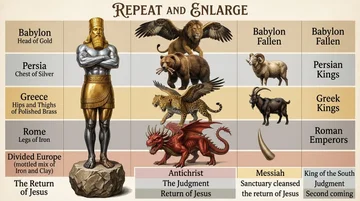
Daniel 7 repeats the sequence of kingdoms, including the fourth kingdom.
- Revelation 13:1
And I stood upon the sand of the sea, and saw a beast rise up out of the sea, having seven heads and ten horns, and upon his horns ten crowns, and upon his heads the name of blasphemy.
The beast rising from the sea is compared with Daniel’s beasts.
- Daniel 7:12
As concerning the rest of the beasts, they had their dominion taken away: yet their lives were prolonged for a season and time.
The beasts lose their dominion, though their lives continue.
- Daniel 7:20-21
And of the ten horns that were in his head, and of the other which came up, and before whom three fell; even of that horn that had eyes, and a mouth that spake very great things, whose look was more stout than his fellows.
The little horn’s power is linked to the beast’s deadly wound.
Commentary part 1 of 2
Each commentary is drawn from primary sources: the writings of Ellen G. White and Adventist pioneers and periodicals. Each commentary is separate. Its own words are not a quotation; follow the references to read the source passages.
Ellen G. White
11 sources
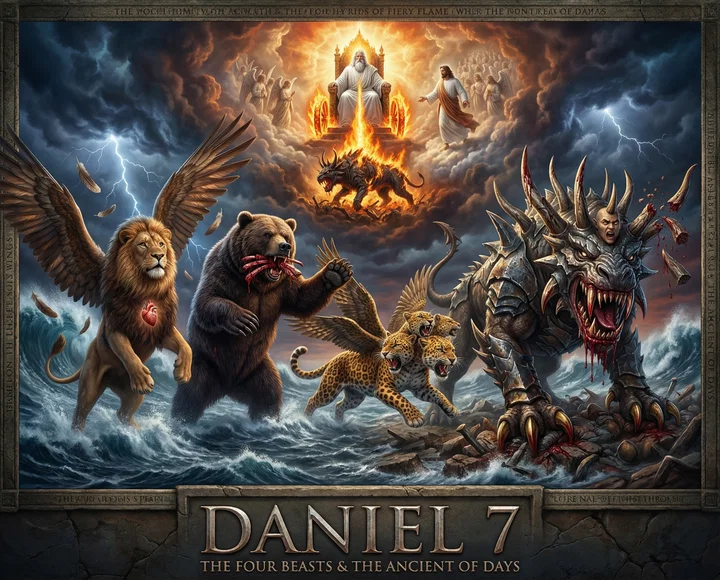
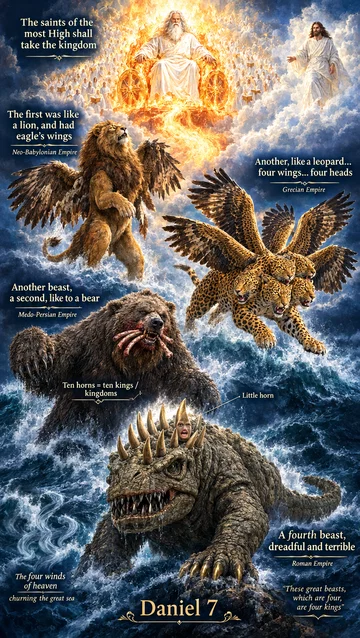
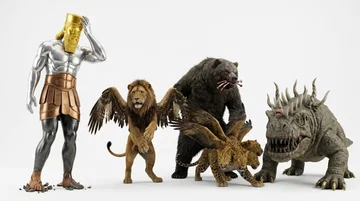
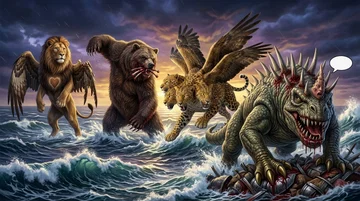
The lion with eagle's wings is the first of the four beasts, symbolizing the Chaldean or Babylonian empire at the height of its prosperity under Nebuchadnezzar.LS 40.1–5 It stands first in the order of the great world empires, followed in succession by Medo-Persia, then Greece, then Rome.LS 40.1–54SP 502.2–3PK 535.1 Together the four beasts represent Babylon, Persia, Greece, and Rome.4SP 502.2–3
The fierce, ferocious beasts of prey picture earthly kingdoms that prevail by physical force and maintain dominion by war.Ms 27a, 1900, par. 12–13ST Feb 16, 1915COL 76.1–77.2 They pursue advantage through war and destruction.Ms 27a, 1900, par. 12–13 They use brute force to compel the conscience and external measures to promote righteousness.ST Feb 16, 1915COL 76.1–77.2
In direct contrast stands Christ's pure church and kingdom, founded by the Prince of Peace.Ms 27a, 1900, par. 12–13ST Feb 16, 1915COL 76.1–77.2 Christ is the Lamb of God who takes away sin, and He builds His kingdom by implanting the principles of truth and righteousness to counterwork error and sin.ST Feb 16, 1915COL 76.1–77.2 His government uses no carnal weapons, no coercion, and no brute force to compel the conscience.Ms 27a, 1900, par. 12–13ST Feb 16, 1915COL 76.1–77.2
The apocalyptic beasts represent powers arising from the union of church and state, which when united become destructive and cruelly crush those who oppose them.DA 837.3–4 The same beast imagery also supplies characteristics inherited by the papal power described in Revelation 13.4SP 502.2–3
God permitted Babylon to occupy its place on the earth so it might be determined whether it would fulfill the purposes of the Watcher and the Holy One.PK 535.1 Babylon had its period of test and failed, so its glory faded and its power departed.PK 535.1 This repeats the history of every nation that is tested.PK 535.1
The verse is part of the figures, symbols, and mysteries of ages to come recorded for coming generations in chapters seven to twelve, covering the history of this world and delineating historical events leading to the close of time.PK 547.1PK 484.3Ms 31, 1896, par. 1–2 Its symbols are to be interpreted carefully and in their proper place in prophetic history.Ms 31, 1896, par. 1–2 The verse was given because Daniel clung to God with unwavering trust, firmness, self-denial, and purity of motive, so he received approval and blessing with knowledge, skill, and understanding in all visions and dreams and the spirit of prophetic power to read the mysteries of the future, fulfilling the promise that God honors those who honor Him.PK 484.3
The revelation was given to Daniel as God's ambassador but was not fully understood even by Daniel himself.PK 547.1 He was directed to shut up the words and seal the book until the time of the end.PK 547.1 At the end of the days, in the closing period of this world's history, Daniel will again be permitted to stand in his lot and place.PK 547.1 The verse belongs to a vision discussed in connection with the close of the 1,260 days, when on February 10, 1798 Berthier entered and took Rome and on February 15 the pope was taken prisoner, without explaining the lion or the other details of this verse.LS 66.1–67.2
Sources
Pioneers and periodicals
229 sources
The first beast is Babylon, the first of four successive universal kingdoms — Babylon, Medo-Persia, Greece and Rome — answering to the head of gold in Daniel 2.ST Jun 27, 1878ST Sep 29, 1881ST Dec 24, 1912 The lion, noblest of beasts as gold is noblest of metals, denotes Babylon's glory, strength and preeminence under Nebuchadnezzar, and its eagle's wings denote the speed and far reach of its conquests.RH Feb 17, 1874RH Apr 23, 1857RH Feb 8, 1870 Its wings being plucked means Babylon lost its conquering force and made no further conquests after Nebuchadnezzar, until it fell to Cyrus and the Medes and Persians in 538 B.C.ST Sep 29, 1881ST Jun 30, 1914 Being lifted up, made to stand as a man and given a man's heart means its lionlike courage gave way to human weakness, fear and timidity, as shown in Belshazzar and the later kings who shut themselves in the city rather than face their enemies.ST Sep 29, 1881RH Aug 7, 1900 While the metals in Daniel 2 portray the glory and splendor of these powers, the beasts portray their cruel, ravenous and persecuting character as seen from heaven, at the head of a chain running from Babylon to the everlasting kingdom of God given to the saints.ST Sep 29, 1881ST Jun 30, 1914STST Jun 3, 1897
Text Vision and Setting
The first beast is like a lion with eagle's wings, whose wings are plucked, which is then lifted up from the earth and made to stand on feet as a man, and to which a man's heart is given, arising with the other beasts from the sea as the first of four successive empires in a prophetic vision of world government.ST Jan 20, 1898RH Jan 18, 1870RH Apr 15, 1909ST Nov 25, 1913 It is represented by a lion with wings whose posture is changed so it stands like a man after its wings are removed and a human heart is given to it, as the first of four kingdoms arising from the symbolic sea of peoples.ST Jan 20, 1898RH Apr 15, 1909ST Oct 22, 1885ST Apr 5, 1877 The chapter is a symbolic outline of world history paralleling Daniel 2, also predicting the rise and work of the papacy, its 1,260-year rule, and events near its end, while the later little horn's rise marks a change in Roman rule from paganism to papal power.RH Jan 18, 1870ST Nov 25, 1913
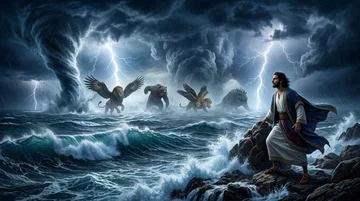
The vision belongs to the first year of Belshazzar, Babylon's last king, when Daniel stood alone looking seaward at a storm-tossed sea after Nebuchadnezzar's death, with the beast rising from the troubled waters borne aloft on eagle-like wings and then standing unfeathered and disheartened on the sand when they are plucked.RH Sep 9, 1915ST Jul 20, 1882ST Jan 20, 1898 It came about 541 B.C., three years before Babylon fell, carrying Daniel's attention back to Babylon's rise so the whole chain would stand complete, with prophetic history reckoned from 625 B.C. and Babylon's period given as 677-538 B.C.RH Aug 9, 1915RH Sep 9, 1915ST May 3, 1877 Nebuchadnezzar, under whom rapid expansion brought Babylon to its height, reigned from 604 to 561 B.C., and by the time of the vision Babylon had declined, its strength gone and its empire tottering to overthrow by the Medes and Persians in 538 B.C.RH Sep 9, 1915RH Aug 9, 1915
The section from Daniel 2:4 through the close of Daniel 7 is written in Aramaic or Chaldee, continued through chapter 7 because its subject resembles Daniel 2, and is distinctively prophetic.ST Oct 21, 1908RH Nov 25, 1873 In the Hebrew Bible Daniel stands among the Hagiographa rather than among the prophets, with chapters 1 through 6 narrative and the following chapters including chapter 7 prophetic, yet all of the book more or less prophetic.ST Oct 21, 1908 The prophecy conveys its predictions through symbols rather than stating them directly in words, since in a symbol the thing represented is not expressed in the symbol itself.RH Jun 12, 1855 Truth is given through lifelike symbolic picture-illustrations presented by an angel, not actual animals or direct words, in which beasts and heads denote kingdoms and animals with particular characteristics represent rulers and nations.RH Aug 14, 1856RH Feb 18, 1873RH Dec 28, 1911 This symbolic prophecy stands unlike Daniel 11, which is given mostly in plain literal language, and it shows the difference between the time a prophecy is given and the time to which it applies, for Daniel sees the events as if present in his own day while fulfillment lies later with some parts still unfulfilled, fulfilled consecutively in written order and understood by combining parallel visions.ST Mar 23, 1915RH Feb 18, 1873RH Dec 28, 1911ST Apr 6, 1882
The four successive beasts represent kings or kingdoms, with the first kingdom in the sequence Babylon, but the lion's wings being removed, its being made to stand like a man, and the human heart given to it are left without further separate interpretation.ST Oct 22, 1885ST Apr 5, 1877ST The lesson asks what the change denotes without giving the explanation, and the succession is traced to the time when God will establish His kingdom without explaining the lion or its wings particularly.RH Apr 7, 1874RH Mar 10, 1868 The beast-symbol vision of Daniel 7 is linked with Revelation 13 as a parallel prophecy whose little-horn specifications are fulfilled in the Papacy, whose fourth beast's ten horns are linked with the ten toes of Daniel 2 and the ten horns in Revelation as Rome divided into ten kingdoms, and whose comparison with Revelation 13:1-10 identifies Revelation's first beast as the Roman hierarchy and shows Rome in pagan and papal phases with the change between them marked.ST Nov 28, 1892ST Sep 11, 1879RH Feb 23, 1860 As a whole Daniel 7 is linked with the beast power of Revelation 13 and identified with the Papacy, with Daniel 7:25 predicting its attempt to change God's law, without separate explanation of the lion, its wings, or their changes.ST Nov 28, 1892ST Sep 11, 1879RH Jun 3, 1858
Lion Identified as Babylon
The first beast is Babylon, first in the succession of four universal earthly empires — Babylon, Medo-Persia, Greece, and Rome — whose descriptions stand fulfilled and make certain the events still promised.ST Jun 27, 1878ST Dec 24, 1912 It corresponds to the head of gold in Nebuchadnezzar's image, revisiting the kingdoms of Daniel 2 with further features added, and shows earthly governments as they appear in Heaven's view.ST Sep 29, 1881RH Feb 17, 1874RH Apr 23, 1857 As a lion, king of beasts, it signifies Babylon's glory, while its eagle's wings show how rapidly Babylon extended its conquests under Nebuchadnezzar and the soaring pride of its monarchs.ST Sep 29, 1881RH Feb 17, 1874RH Apr 23, 1857RH Feb 8, 1870 By the time of the vision the wings had been plucked: Babylon had lost its former boldness and power, and the man's heart given to it represents weakness, fear, and faintness, seen in Belshazzar who shut himself inside Babylon instead of confronting his enemies.ST Sep 29, 1881RH Feb 17, 1874RH Feb 8, 1870 That plucking may point either to the humiliation of Babylon's proud king in Daniel 4:31-37 or to Belshazzar's cowardice in feasting with his lords until he was killed and the kingdom passed to the Medes and Persians in 538 B.C.RH Feb 17, 1874RH Apr 23, 1857RH Feb 8, 1870
The four beasts are four kings or kingdoms arising from the earth, four Gentile universal governments in symbolic outline of world history paralleling Daniel 2, with the lion among them representing Babylon in its civil aspect in a vision where kingdoms are represented by beasts.ST Nov 25, 1913ST Oct 22, 1885ST Apr 5, 1877ST The first is like a lion with eagle's wings, whose wings are plucked, after which it is lifted from the earth, made to stand on human feet, and given a human heart.ST Oct 22, 1885ST Apr 5, 1877 The same succession is presented without separate explanation of the lion's wings being removed, its being made to stand like a man, or the human heart given to it, and without separate treatment of the lion or its features individually.ST Nov 25, 1913STRH Apr 7, 1874RH Mar 10, 1868 The outline also traces the course of empires to the time when the God of Heaven will establish His kingdom, predicts the rise and work of the papacy with its 1,260-year rule and events near its end, and links the fourth beast and its horns to Rome and the kingdoms arising from the division of the Roman Empire.ST Nov 25, 1913RH Apr 7, 1874RH Mar 10, 1868
The winged lion as symbol of Nebuchadnezzar's first universal kingdom was already so understood by 1617, when it was engraved in stone over the portals of the Nurnberg city hall with the figure of Nebuchadnezzar beside it.RH Nov 2, 1905 The lion does not represent England despite England sometimes being called a lion kingdom, but Babylon the first of the four world kingdoms followed by Medo-Persia, Grecia, and Rome.ST Jul 15, 1913 The verse's symbol represents that earthly government of Babylon, first of the kingdoms represented by the beasts, and does not refer to the United States.ST Sep 4, 1879
Those who held otherwise identified the first beast, a lion with eagle's wings, with Assyria, the first of the great world empires corresponding to the prophetic image's head of gold and later giving way to the Medo-Persian empire.RH Apr 14, 1853 Others identified the first beast as the kingdom of the Ostrogoths, whose eagle's wings being plucked and whose change from beastly posture to standing like a man picture the removal of its power.ST Oct 27, 1881 In that reckoning the Ostrogoths' establishment in Italy under Theodoric and their later defeat belong to the historical setting of the forces that stood in the way of papal supremacy.ST Oct 27, 1881
Lion Wings Denote Glory
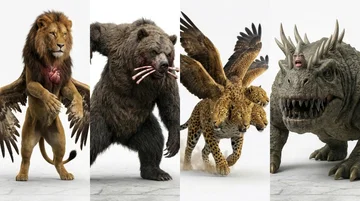
The lion is the king of beasts and the noblest of animals, answering to gold as the most precious of metals, and denotes Babylon's glory, strength, preeminence and chief place, its courage, boldness, vigor, wealth, alertness, dignity and honor, its success in gaining dominion and generosity in ruling, especially as advanced to its summit of prosperity under Nebuchadnezzar and excelling the later kingdoms though not in duration or extent, its glory empty and transient.RH Feb 17, 1874RH Apr 23, 1857RH Feb 8, 1870ST Jul 23, 1874 The lion shows the kingdom's glory and corresponds to the head of gold in Daniel 2, representing its strength under Nebuchadnezzar.ST Jul 23, 1874RH Nov 14, 1854ST Dec 30, 1903ST Oct 13, 1909 Its meaning is approached through its known qualities and relation to other animals.ST Nov 28, 1895ST Nov 28, 1895
It also depicts Babylon's soaring pride, self-exaltation and towering ambition, its occasional ferocity, its persecution of God's people, its imperious laws and commands, and itself as a proud rich haughty kingdom.ST Nov 3, 1914ST Nov 28, 1895ST Nov 28, 1895RH Jul 24, 1855ST Dec 30, 1903 As a predatory beast it is a picture of cruel, destructive force used for self-advantage, directed against truth and God's people, one of the cruel rapacious beasts picturing ruling world empires and hideous beasts of prey in contrast with the kingdom to come.ST Nov 3, 1914ST Nov 28, 1895ST Nov 28, 1895RH Jul 24, 1855ST Oct 13, 1909 These qualities appeared in Babylon's conquests, its persecution of God's people, and Nebuchadnezzar's self-exaltation, with the winged lion's defeat portraying proud Babylon's fall and its replacement by a lesser empire.ST Nov 28, 1895
The eagle's wings denote the speed, rapid movement, vigor, far-reaching extent, and unusual rapidity and power of Babylon's conquests, especially under Nebuchadnezzar who brought the kingdom to its height.ST Sep 29, 1881RH Feb 17, 1874RH Apr 23, 1857RH Feb 8, 1870 They signify flying to devour and reaching seemingly inaccessible places as in carrying the Jews captive to Babylon, like horses that are swift and fly like an eagle in Habakkuk 1:6-8.ST Sep 29, 1881RH Feb 17, 1874RH Apr 23, 1857RH Oct 22, 1861RH Nov 24, 1904 They show how rapidly Babylon extended its conquests under Nebuchadnezzar and depict the rapid conquests made under him and the soaring pride of its monarchs and ruler.ST Sep 29, 1881ST Jul 23, 1874RH Nov 14, 1854ST Dec 30, 1903
The Babylonians are the nation described by the swift eagle image in Moses' warning against disobedience in case of Israel's disobedience.RH Oct 22, 1861 The same lion and eagle imagery appears in the winged man-headed lion, winged man-headed ox, and winged eagle-headed human figures common in Assyria and Babylonia.ST Aug 28, 1901 Jeremiah also likens Babylon to a lion in Jeremiah 4:7, 13 and Ezekiel likens it to an eagle.ST Aug 28, 1901
The lion supplies the comparison for the four-winged leopard, whose wings represent even greater speed of conquest than the lion's rapidity.RH Nov 24, 1904ST Apr 5, 1877 The four wings on the leopard denote the Grecian army and signify the rapid movement of the Grecian army.RH Nov 24, 1904ST Dec 30, 1903 The leopard's four heads and wings represent Greece and the four kingdoms into which Alexander's empire was divided after his death.RH Apr 30, 1857
Babylon was an ancient mighty kingdom that shaped other nations, especially through its religious and cultural influence, becoming a major religious shaping power for the apostate empires that followed.ST Oct 17, 1906 It was the first city and kingdom after the Flood, founded by Nimrod, and the origin of later cities and kingdoms. It is the mother type of all the nations.ST Aug 28, 1901
Plucking and Human Weakness
The plucking of the wings means Babylon lost its conquering force, boldness, military valor and spirit, made no further conquests after Nebuchadnezzar's death, came to a full stop while luxury weakened it, while subject nations revolted and its armies retreated until it fell to Cyrus and the Medes and Persians in 538 B.C., a fulfilled past waymark.ST Sep 29, 1881ST Jun 30, 1914RH Sep 9, 1915RH Nov 19, 1857 The lion's strength was under Nebuchadnezzar, and the wings showed the speed, rapid movement and far-reaching extent of its conquests and its soaring pride, but by the time of the vision its glory had passed, its strength was gone, its humiliation had come, and the tottering empire was overthrown within three years.ST Jun 30, 1914ST Jun 3, 1897RH Dec 11, 1860RH Sep 9, 1915 Babylon is the first world empire in the prophetic sequence, also pictured as the head of gold in Daniel 2, and its fall is the past waypoint leading toward God's kingdom.ST Sep 29, 1881ST Jun 3, 1897RH Dec 11, 1860
The plucking may refer either to the humiliation of Babylon's proud king described in Daniel 4:31-37 or to Belshazzar's cowardice in shutting himself inside the city instead of resisting his enemies and feasting and drinking with his lords until he was killed and the kingdom passed to the Medes and Persians.RH Feb 17, 1874RH Apr 23, 1857RH Feb 8, 1870ST Jul 23, 1874RH Nov 14, 1854 Instead of driving away his foe like a lion, he remained feasting in the city while his enemies approached, and the creature standing like a man with a man's heart marks that loss of glory.RH Feb 17, 1874RH Apr 23, 1857RH Feb 8, 1870ST Jul 23, 1874RH Feb 3, 1853 Those who hold the other teaching say the plucked wings and change to human posture and heart point to Nebuchadnezzar's punishment by insanity at the height of Babylon's power, followed by his restoration to sanity and recognition of his humble place before God.RH Jan 23, 1908
Being lifted up, made to stand on feet as a man, and given a man's heart means Babylon's bold lionlike courage gave way to human weakness, fear, faintness, timidity and unsteadiness, becoming like the naturally weak human heart when not sustained by God.ST Sep 29, 1881RH Nov 19, 1857 This was shown in Belshazzar at his impious feast and in later cautious timid kings who retreated within Babylon rather than facing Cyrus, as when Belshazzar shut himself in Babylon not daring to face Cyrus as a man would not face a bear that a lion would despise.ST Sep 29, 1881RH Aug 7, 1900RH Nov 19, 1857 The wings being plucked and the beast made to stand on two feet like a man portray Babylon's later degeneracy, with the lion's fearless heart replaced by a man's heart and its conquering spirit declining under Nebuchadnezzar's successors.RH Aug 7, 1900
Together the plucked wings, lifting from the earth, unsteady standing on two feet like a man, and receiving a man's heart depict Babylon after Nebuchadnezzar's death, weakened in vigor, power and majesty under five weak and wicked succeeding kings given to inactivity, luxury and indulgence, culminating in weak Belshazzar in whose reign the kingdom ended.ST Nov 28, 1895ST Dec 30, 1903ST Nov 29, 1905ST Oct 10, 1906ST Nov 29, 1905 Babylon lasted less than seventy years, held sovereignty from 603 or 625 B.C. to 538 B.C., and at the vision was nearing the end with waning power as Medo-Persia began to conquer it.ST Dec 30, 1903ST Nov 29, 1905ST Nov 29, 1905ST Oct 10, 1906ST Nov 29, 1905 The winged lion's defeat portrays proud Babylon's fall and its replacement by a lesser empire among four successive world empires arising amid war and strife to be replaced by God's everlasting kingdom.ST Nov 28, 1895ST Dec 30, 1903ST Nov 29, 1905 The wings are an unnatural addition to the lion, departing from nature to make the animal fit as a prophetic symbol, and the growing departure from natural forms in the beasts reflects the degenerating governments they represent.RH Jun 15, 1869ST Oct 6, 1881ST Apr 26, 1877
Sea Winds and Violent Rise
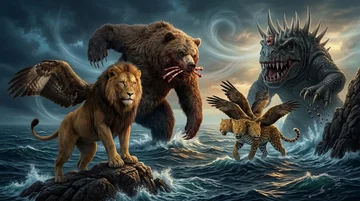
The four beasts come up from the great troubled sea when the four winds of heaven strive upon it, where the sea is peoples, multitudes, nations, tongues and kings and restless humanity, and the striving winds are war, strife, bloodshed, political commotion and fierce ungoverned passions of men.ST Oct 1, 1885RH Jul 14, 1874RH Jun 9, 1874RH Jun 25, 1857 As winds make waves cast up mire and dirt, so commotions among peoples throw up revolutions and wars by which governments arise through upheaval among peoples.RH Jul 14, 1874RH Jun 9, 1874RH Jun 25, 1857 These risings and fallings of great kingdoms remain under God's rule, with mighty angels holding or releasing the winds as He sees best even when sin and death make the nations' course appear governed by evil. The first of these four universal kingdoms to come up in this way is Babylon, arising through commotion and conquest among the nations by the ungoverned passions of peoples.ST Oct 1, 1885ST Oct 1, 1885
Babylon rose to power by aggressive war, attacking other nations, overthrowing their governments, and establishing its own dominion on their ruins among crowded nations.ST Oct 1, 1885RH Jul 14, 1874RH Jun 25, 1857 Its swift, far-reaching conquest is shown by the eagle's wings, for the Chaldeans spread and flew to devour, then stopped flying over countries in conquest and came to a full stop when the wings were plucked.ST Oct 1, 1885 This rising by conflict between powers and overthrow of earlier governments stands in contrast to the two-horned beast that comes up afterward out of the earth in previously unoccupied territory without conquest.RH Jan 15, 1861RH Jul 14, 1874RH Jun 25, 1857 That peaceful power grows up like a plant in the New World west of the Atlantic, in untrodden solitudes and virgin forests outside the Old World dominions occupied by Babylon, Persia, Greece, Rome and the papacy, and outside the dominions of the four beasts the United States arose.ST Jun 18, 1885ST Aug 31, 1882ST Jan 23, 1907RH Jun 30, 1874
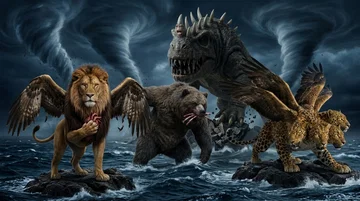
The fierce and unnatural wild forms of the four great diverse beasts reveal the true cruel character of earthly empires, picturing the character of the kingdom of man as wild and cruel.ST Aug 30, 1905ST Nov 29, 1905 They present God's view of the nations and of human history viewed down the ages to the end, with the eagle-winged lion as the first symbol in the sequence of kingdoms arising from the sea.ST Aug 30, 1905ST Oct 11, 1905ST Nov 29, 1905 Rising from a wind-swept sea means arising from peoples, nations and tongues through war and strife, covering the same time and empires as the image in Daniel 2, for beasts signify kingdoms and the lion with eagle's wings is the first of four kingdoms that shall rise on the earth.ST Nov 29, 1905 Babylon in its power and glory is thus shown nearing its end as the first of four great successive world empires.ST Oct 11, 1905ST Nov 29, 1905
When a kingdom is succeeded its dominion is taken away but its life is prolonged after its dominion ends, unlike the fourth beast whose body is slain and destroyed and given to the burning flame at the coming of Christ.RH Jul 23, 1872 Its territory, subjects and peoples continue under the new ruler for a season and time; Babylon's dominion passed to Persia but it was not exterminated by Cyrus.RH Jul 23, 1872ST Mar 18, 1880RH Dec 5, 1871 This shows a nation may survive after losing rule or civil government, and that the change from the lion to the bear represents transfer of dominion from Babylon to Persia, not destruction of territory or people.ST Mar 18, 1880RH Dec 5, 1871 A beast ceases to function as a prophetic symbol when transfer of dominion ends its place, though the powers represented are ultimately destroyed together with the other kingdoms at Christ's coming, which does not require a resurrection of the nations.RH Oct 25, 1870RH Dec 5, 1871
Each symbol occupies territory peculiarly its own and never reuses territory already appropriated by a previous beast.RH Oct 31, 1871 Babylon as the first universal kingdom had its own distinct territory in that portion of Asia known to ancient civilization, and together with Medo-Persia it covered that Asian territory, with Medo-Persia rising on territory not occupied by Babylon.RH Oct 31, 1871RH Feb 8, 1870 Greece arose to the west occupying Eastern Europe, Rome arose still to the west in territory unoccupied by Greece, and the ten divisions of Rome are confined to Western Europe which had never been included in the other kingdoms.RH Oct 31, 1871RH Feb 8, 1870 So the territory of Babylon in Asia remains belonging to the first and second beasts and cannot furnish the territory of any later beast or horn, while the four great empires successively ruled the world from the Eastern continent in an east-to-west course of empire before the two-horned beast located west of the Atlantic.RH Oct 31, 1871RH Feb 8, 1870ST Aug 31, 1882 The fourth kingdom would surpass, break in pieces and succeed the Babylonian kingdom in dominion, and Rome later absorbed Babylon and the other kingdoms into its territory.RH May 24, 1864
Beasts Expose Earthly Character
Unlike the metallic image of Daniel 2 which displays the glory, splendor, value and lasting qualities of the powers as worthy of admiration, the four beasts display their character and their attitude toward God, His people and true religion.ST Jun 3, 1897ST Nov 29, 1905 The beasts present earthly governments as they appear in Heaven's judgment, in their true light as viewed from Heaven: cruel, wild, ravenous, bloodthirsty, hideous beasts of prey and cruel destroyers seeking self-advantage against truth.ST Jun 3, 1897ST Aug 14, 1893ST Nov 29, 1905 Daniel 7:4 belongs to that picture as the first of the four beasts representing one of the great earthly powers and successive earthly dynasties, covering the same empires and period as Daniel 2.ST Aug 14, 1893ST Nov 29, 1905
The term beast by itself symbolizes a government or nation in the succession of kingdoms and does not by itself describe that kingdom's character.ST Dec 22, 1881 The beast is a symbol of a kingdom or empire continuing through successive changes and revolutions with a shared character rather than one individual.ST Oct 25, 1883
The chapter is the pattern after which all visions of beasts and horns are framed, and study of later beast and horn symbols must be guided by its explanation.RH Sep 30, 1873 The four kingdoms first shown in Daniel 2 are here given again with many additional facts line upon line as four great beasts, including the lion with eagle's wings as the first great kingdom ruling in succession with the others.RH Aug 1, 1865RH May 19, 1874 These symbols of beasts, heads and horns are used by the Holy Spirit, and because all Scripture is profitable they are to be treated with care and reverence and not derided or scoffed at.RH Aug 1, 1865 In prophecy beasts symbolize kingdoms or governments, so the lion stands for Babylon as the first of four universal kingdoms since Nebuchadnezzar — Babylon, Medo-Persia, Greece and Rome — corresponding to the golden head, with its traits reappearing with the bear, leopard and terrible beast in the composite beast of Revelation 13.ST Jun 26, 1879
Worldly kingdoms are represented as fierce beasts of prey revealing their use of brute force to compel the conscience and of external measures to promote righteousness.ST Feb 16, 1915ST Feb 15, 1877 This stands in direct contrast to Christ as the Lamb of God who takes away sin and who builds His kingdom by implanting the principles of truth and righteousness to counterwork error and sin.ST Feb 16, 1915 The kingdoms of this world appear as hideous beasts of prey, in contrast with the kingdom to come, which is unlike this world and free from its evil.RH Jul 24, 1855
The lion, bear and leopard are cruel and ferocious beasts symbolizing empires whose governments united church and state and therefore persecute.ST Jul 18, 1900 Daniel sees ruling world empires as cruel, rapacious beasts using predatory, cruel, destructive force for self-advantage, directed against truth and God's people, with the first beast as the Babylonian dynasty in the sequence.ST Nov 3, 1914ST Nov 28, 1895 The winged lion symbolizes power, strength, occasional ferocity and soaring pride, seen in Babylon's conquests, its persecution of God's people and Nebuchadnezzar's self-exaltation, and its defeat portrays proud Babylon's fall and replacement by a lesser empire.ST Nov 28, 1895 The lion as symbol of earthly power is distinguished by its setting from the Lion of the tribe of Judah, so the same symbol need not have the same specific meaning in every context.RH Jul 24, 1855
The lion imagery also represents Satan's destructive power, showing the ruinous character of rule under the power of sin in which earthly kingdoms are pictured as fierce beasts and Babylon appears as a cruel destroyer.RH Jun 29, 1916 These kingdoms joined church and state, established worship of their gods by law, and persecuted the worship of the one true God when their systems came into conflict.ST Jun 3, 1897 Babylon stands at the head of this church-and-state system, whose scheme of rebellion and self-salvation began at Babel.ST Jun 3, 1897
Sources