Daniel 9:4
And I prayed unto the LORD my God, and made my confession, and said, O Lord, the great and dreadful God, keeping the covenant and mercy to them that love him, and to them that keep his commandments;
Translations
American King James Version, Webster Bible
And I prayed to the LORD my God, and made my confession, and said, O Lord, the great and dreadful God, keeping the covenant and mercy to them that love him, and to them that keep his commandments;
And I prayed unto the LORD my God, and made my confession, and said, O Lord, the great and dreadful God, keeping the covenant and mercy to them that love him, and to them that keep his commandments;
and I prayed unto the Lord my God, and made my confession, and said,O Lord, the great and dreadful God, keeping the covenant and mercy to them that love him, and to them that keep his commandments;
And I prayed unto the LORD my God, and made confession, and said, O Lord, the great and dreadful God, which keepeth covenant and mercy with them that love him and keep his commandments;
And I prayed unto Jehovah my God, and made confession, and said, Oh, Lord, the great and dreadful God, who keepeth covenant and lovingkindness with them that love him and keep his commandments,
And I pray to Jehovah my God, and confess, and say: 'I beseech Thee, O Lord God, the great and the fearful, keeping the covenant and the kindness to those loving Him, and to those keeping His commands;
and I prayed unto Jehovah my God, and made my confession, and said, Alas Lord! the great and terrible God, keeping covenant and loving-kindness with them that love him, and that keep his commandments:
yea I prayed unto Yahweh my God, and made confession,—and said—I beseech thee, O Lord, the GOD great and to be revered, keeping the covenant and the lovingkindness, to them who love him, and to them who keep his commandments.
Berean Standard Bible, Majority Standard Bible
And I prayed to the LORD my God and confessed, “ O, Lord, the great and awesome God, who keeps His covenant of loving devotion to those who love Him and keep His commandments,
I prayed to the LORD my God, and made confession, and said,“Oh, Lord, the great and dreadful God, who keeps covenant and loving kindness with those who love him and keep his commandments,
And I made prayer to the Lord my God, putting our sins before him, and said, O Lord, the great God, greatly to be feared. keeping your agreement and mercy with those who have love for you and do your orders;
And I prayed vnto the Lord my God, and made my confession, saying, Oh Lord God, which art great and fearefull, and keepest couenant and mercy toward them which loue thee, and toward them that keepe thy commandements,
Douay-Rheims (Challoner revision)
And I prayed to the Lord my God, and I made my confession, and said: I beseech thee, O Lord God, great and terrible, who keepest the covenant, and mercy to them that love thee, and keep thy commandments.
Pictures


Cross-references 20 of 32
- Daniel 9:23
At the beginning of thy supplications the commandment came forth, and I am come to shew thee; for thou art greatly beloved: therefore understand the matter, and consider the vision.
Gabriel answers Daniel’s prayer with understanding and assurance that he is greatly beloved.
- Jeremiah 29:10
For thus saith the LORD, That after seventy years be accomplished at Babylon I will visit you, and perform my good word toward you, in causing you to return to this place.
The promised end of the seventy-year exile prompts Daniel’s prayer for the people’s return.
- Jeremiah 25:11-12
And this whole land shall be a desolation, and an astonishment; and these nations shall serve the king of Babylon seventy years.
Jeremiah foretold the seventy years of captivity that Daniel understood were nearing their end.
- Daniel 9:18-19
O my God, incline thine ear, and hear; open thine eyes, and behold our desolations, and the city which is called by thy name: for we do not present our supplications before thee for our righteousnesses, but for thy great mercies.
Daniel pleads for God’s mercy, forgiveness, and restoration, not on the basis of human righteousness.
- Daniel 9:20-21
And whiles I was speaking, and praying, and confessing my sin and the sin of my people Israel, and presenting my supplication before the LORD my God for the holy mountain of my God;
Gabriel comes to Daniel while he is praying and confessing.
- James 5:16
Confess your faults one to another, and pray one for another, that ye may be healed. The effectual fervent prayer of a righteous man availeth much.
Daniel’s petition is effectual, fervent prayer.
- Deuteronomy 7:9
Know therefore that the LORD thy God, he is God, the faithful God, which keepeth covenant and mercy with them that love him and keep his commandments to a thousand generations;
Both describe God’s covenant faithfulness and mercy toward those who love and obey him.
- 1 John 1:9
If we confess our sins, he is faithful and just to forgive us our sins, and to cleanse us from all unrighteousness.
Both connect confessing sin with forgiveness and cleansing.
- Daniel 10:12
Then said he unto me, Fear not, Daniel: for from the first day that thou didst set thine heart to understand, and to chasten thyself before thy God, thy words were heard, and I am come for thy words.
Daniel’s prayer was heard from the first day of humble seeking.
- 1 Kings 8:23
And he said, LORD God of Israel, there is no God like thee, in heaven above, or on earth beneath, who keepest covenant and mercy with thy servants that walk before thee with all their heart:
Both prayers praise God for keeping covenant and mercy.
- Daniel 9:16-17
O Lord, according to all thy righteousness, I beseech thee, let thine anger and thy fury be turned away from thy city Jerusalem, thy holy mountain: because for our sins, and for the iniquities of our fathers, Jerusalem and thy people are become a reproach to all that are about us.
Daniel continues his prayer, pleading for mercy and restoration for Jerusalem and its people.
- Nehemiah 1:5
And said, I beseech thee, O LORD God of heaven, the great and terrible God, that keepeth covenant and mercy for them that love him and observe his commandments:
Both describe God as keeping covenant and mercy for those who love and obey him.
- Exodus 20:6
And shewing mercy unto thousands of them that love me, and keep my commandments.
God promises mercy to those who love him and keep his commandments.
- Psalms 89:34
My covenant will I not break, nor alter the thing that is gone out of my lips.
God will not break covenant
- Daniel 9:22
And he informed me, and talked with me, and said, O Daniel, I am now come forth to give thee skill and understanding.
Gabriel came in response to Daniel’s prayer to give understanding.
- 1 Chronicles 16:17
And hath confirmed the same to Jacob for a law, and to Israel for an everlasting covenant,
covenant designed everlasting
- Exodus 19:5
Now therefore, if ye will obey my voice indeed, and keep my covenant, then ye shall be a peculiar treasure unto me above all people: for all the earth is mine:
Both connect Israel’s covenant relationship with God to obedience.
- Ezra 9:5
And at the evening sacrifice I arose up from my heaviness; and having rent my garment and my mantle, I fell upon my knees, and spread out my hands unto the LORD my God,
Ezra is named as another example of confession.
- Daniel 9:17
Now therefore, O our God, hear the prayer of thy servant, and his supplications, and cause thy face to shine upon thy sanctuary that is desolate, for the Lord’s sake.
Continues the plea for God to look favorably on the sanctuary.
- Ezra 1:1
Now in the first year of Cyrus king of Persia, that the word of the LORD by the mouth of Jeremiah might be fulfilled, the LORD stirred up the spirit of Cyrus king of Persia, that he made a proclamation throughout all his kingdom, and put it also in writing, saying,
Cyrus’s decree fulfills the promise Daniel prayed about.
Commentary
Each commentary is drawn from primary sources: the writings of Ellen G. White and Adventist pioneers and periodicals. Each commentary is separate. Its own words are not a quotation; follow the references to read the source passages.
Ellen G. White
43 sources
As the seventy years foretold for Jerusalem's desolation neared their end in the first year of Darius the Median, Daniel understood from Jeremiah and set himself to seek the Lord by prayer with fasting, sackcloth and ashes.Ms 138, 1899, par. 26–31Ms 32, 1903, par. 17–18Ms 129, 1908, par. 11PK 556.4BS 39.2 He opened by appealing to God as great and awe-inspiring, faithful to covenant and mercy toward those who love Him and keep His commandments.PK 554.3–556.2Lt 271, 1904, par. 11–16Lt 203, 1903, par. 7–15 Though faithful, true and greatly beloved, he did not claim innocence but humbled himself and confessed the sins, rebellion and disobedience of his people as his own, pleading only God's righteousness and great mercies for pardon and restoration.Ms 138, 1899, par. 26–31Lt 271, 1904, par. 11–16Ms 32, 1903, par. 17–18BS 39.2RH Jul 13, 1905 His earnest, tearful wrestling for Jerusalem and for God's honor was heard before it was finished, when Gabriel was sent to give understanding of the seventy weeks and the coming of Messiah the Prince.Ms 138, 1899, par. 26–31Ms 93, 1900, par. 27Ms 32, 1903, par. 17–18Ms 38, 1905, par. 15–1618MR 17.4–18.3 That confession stands as the model for God's people now to humble themselves, confess and repent, and pray without ceasing with assurance of pardon, wisdom and heavenly guarding.Ms 38, 1905, par. 15–1611MR 103.4–104.3Lt 175, 1902, par. 5–618MR 19.4–20.2Lt 201, 1899, par. 22–25
Setting and Wording
The prayer belongs to the first year of Darius the Median after Babylon fell, about two years before Cyrus succeeded him when the seventy years since the first Judean captives were taken to Babylon were completed, as the seventy years of captivity neared their end.PK 556.4BS 39.2 After searching the books and understanding from Jeremiah that seventy years were appointed for the desolation of Jerusalem, Daniel set his face to seek the Lord by prayer and supplication with fasting and sackcloth and ashes.Ms 138, 1899, par. 26–31Ms 32, 1903, par. 17–18Ms 129, 1908, par. 11 This seeking followed the true evening-morning vision for many days, which left him astonished, faint and sick and then risen to do the king's business with none understanding it.Ms 129, 1908, par. 11
He opens by addressing God as the great and dreadful or awe-inspiring God, keeping covenant and mercy to those who love Him and keep His commandments, appealing to His greatness, covenant faithfulness and mercy.PK 554.3–556.2Lt 271, 1904, par. 11–16Lt 203, 1903, par. 7–15PK 556.3 Great and dreadful means holy and glorious, dwelling in unapproachable light whom no one can see and live and who will soon judge in the last day.EW 60.2ExVEGW 58.1EW 100.2SCEV 43.1 His name is holy and reverend, and nearness to His encircling light makes the body tremble and shake as if struck out of existence, so He must be approached with reverence and awe.ExVEGW 58.1EW 100.2SCEV 43.1
Careless, thoughtless or irreverent use of His name, especially in prayer, displeases Him, shows no realizing sense of His greatness and majesty and of who He is, grieves the tender Holy Spirit and shuts petitions out of heaven.EW 60.2ExVEGW 58.1EW 100.2SCEV 43.1 This reverence the church must understand and practice in order to prosper.EW 100.2SCEV 43.1
Daniel's Humble Intercession
Daniel was faithful and true in service, greatly beloved and brought near to God, yet he did not claim innocence or boast but felt his need, humbled himself, and identified himself with his people by confessing their sins as his own.Lt 271, 1904, par. 11–16Ms 32, 1903, par. 17–18RH Jul 13, 1905Ms 6, 1884, par. 9Ms 56, 1905, par. 10–12 Closeness to God led him to humility rather than self-exaltation, and even one so loved must confess sin and seek forgiveness.Lt 271, 1904, par. 11–16RH Jul 13, 1905Ms 6, 1884, par. 9Ms 56, 1905, par. 10–12 Such confession is necessary for cleansing from unrighteousness, for closeness does not remove the need to acknowledge sin.Ms 6, 1884, par. 9Ms 56, 1905, par. 10–12
His confession named sin, iniquity, wickedness and rebellion by departing from God's precepts and judgments and by not hearkening to His servants the prophets.Ms 138, 1899, par. 26–31Ms 32, 1903, par. 17–18BS 39.2 It acknowledged disobedience to God's laws revealed through the prophets.Ms 138, 1899, par. 26–31BS 39.2RH Mar 21, 1907 His plea for pardon and restoration rested on God's righteousness and great mercies, not on the people's own righteousness.Ms 138, 1899, par. 26–31RH Mar 21, 1907
The prayer was most earnest, full and complete, with fasting and affliction of soul, tears, humiliation, contrition of soul and deep sorrow over the desolation of Jerusalem.Ms 93, 1900, par. 27Ms 38, 1905, par. 15–1618MR 17.4–18.318MR 14.1 He wrestled with God and sought Him wholeheartedly, interceding for himself and Israel.Ms 32, 1903, par. 17–18Lt 264, 1902, par. 12–13 It came from unfeigned lips in sincere confession, showing contrition and faithfulness rather than self-esteem.Ms 38, 1905, par. 15–16Lt 335, 1905, par. 10Lt 264, 1902, par. 12–13 Such intensity and earnestness in prayer was humble supplication joined with confession.Ms 32, 1903, par. 17–18Ms 38, 1905, par. 15–16Lt 335, 1905, par. 10
It was intercession laying hold of the throne of infinite power for the restoration of Jerusalem and for God's honor and promises.Ms 138, 1899, par. 26–31PK 554.3–556.2 It was offered because Israel had been humbled by idolatrous nations and had become a reproach, while he pleaded for the people he loved.Ms 138, 1899, par. 26–31Lt 203, 1903, par. 7–15 He began with confession while appealing to God's greatness, covenant faithfulness and mercy toward those who love Him and keep His commandments.PK 554.3–556.2Lt 203, 1903, par. 7–15
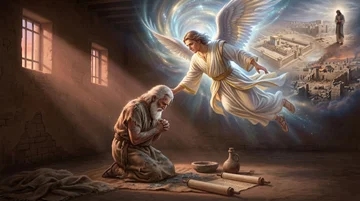
The prayer was not in vain, for all heaven was interested in his supplication.Ms 138, 1899, par. 26–31Ms 93, 1900, par. 27 It was heard before it was finished, and ministering angels came to him with a communication from God in vision.Ms 138, 1899, par. 26–31Ms 93, 1900, par. 27 Gabriel was sent to give skill and understanding, revealing seventy weeks determined upon the people and the holy city and the coming of Messiah the Prince.Ms 138, 1899, par. 26–31 Mercy was extended in a second temple built and another probation given to Jerusalem.Ms 138, 1899, par. 26–31 Such intensity draws the praying one nearer and still nearer to God with assurance that God hears and will answer, showing that God hears the contrite, answers those who seek Him wholeheartedly, and gives wisdom, understanding and salvation.Ms 32, 1903, par. 17–1818MR 15.4 Even simple petitions uttered in broken sentences by a burdened soul casting itself on Christ the Burden-bearer receive mercy and pardon and peace with God.Ms 32, 1903, par. 17–18
Prophecy and Fulfillment
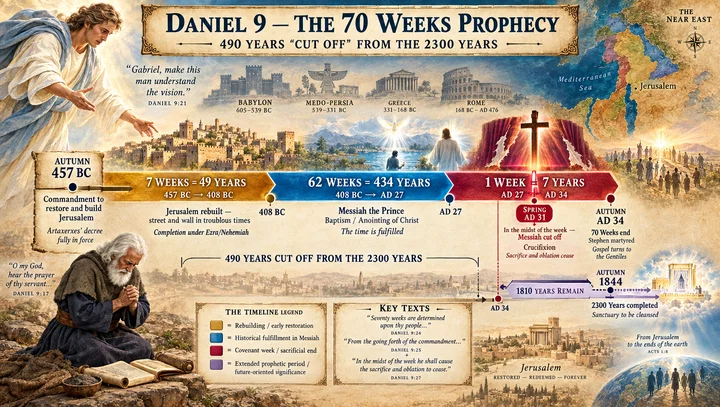
Daniel 9 belongs together with Daniel 8 by an unmistakable connection, and Daniel 9 holds the key to the commencement and termination of the 2300 days of Daniel 8:14.LS 44.2 It contains prophetic periods whose reckoning begins in the year 457 B.C., a starting point established by historical and chronological facts.GC 687.4 Fulfillment extends to the date of the crucifixion.GC 687.4
The seventy-week prophecy of the chapter provided the basis for the first disciples' time-specific proclamation that the time is fulfilled and the kingdom of God is at hand.GC88 351.1–352.3GC 352.3 That message rested on one portion of the same great prophetic period later used in the message about the 2300 days.GC88 351.1–352.3 The same scripture foretold the death of the Messiah and pointed to the kingdom to be set up at the end of the seventy weeks.GC 352.3
Adherence to popular errors about that kingdom blinded minds to the foretold death.GC 352.3 Those who gave the right message at the right time fulfilled the will of God in delivering it, yet through misapprehension of it suffered disappointment.GC 352.3 In this they parallel those who preached from Daniel 8:14 and Revelation 14:7 yet were mistaken about the event at the expiration of the 2300 days.GC 352.3
Pattern for Prayer Today
Daniel's prayer of confession stands as the model for seeking God with humility, contrition, and earnest supplication, and for testing one's experience before Him while asking the Holy Spirit to work on one's behalf.Ms 38, 1905, par. 15–16Lt 175, 1902, par. 5–618MR 19.4–20.2Lt 195, 1903, par. 20–22Lt 59, 1896, par. 21–22 It is full, earnest, and complete, showing contrition and faithfulness rather than self-esteem, and those who truly know God will humble themselves in this way and honor Him through obedience.18MR 19.4–20.2Lt 59, 1896, par. 13–17 God's people now are to make this prayer their own, assembling together, confessing sins, repenting, and continuing in prayer until the Lord manifests Himself with power.STGC 70.4Lt 175, 1902, par. 5–6 That confession includes self-confidence and presumption, failure to heed the light and testimonies of His Spirit, departure from His expressed commands and working contrary to messages given for years about the different features of the work, selfishly gathering facilities to a few favored places while neglecting other parts of the field, and great neglect of the large cities and the Southern field.STGC 70.4 It is prayed with pride, self-esteem, and stubbornness expelled by seeing what redemption cost at the cross, humbling themselves in God's sight that He may lift them up, while holding true worth from the infinite price paid for redemption and valuing every capability and talent as the Lord's precious endowment to use for His glory unto perfection and completeness in Christ, looking to a change in which those who claim to believe the truth practice the truth.STGC 70.46MR 103.1–2
Praying as Daniel prayed brings the same results now, for God is willing to help all who come to Him, and those who approach as Daniel did with trust, personal communion of soul, and praying without ceasing will be heard.18MR 16.1Lt 200, 1899, par. 5–6 Such prayer confesses sin and finds pardon, since even one faithful and true and called greatly beloved felt his need to pray and confess.11MR 103.4–104.3Lt 201, 1899, par. 22–25 Those who so pray are not asleep but keenly alive to their exposure to the enemy's malignant devices, see keeping God's commandments as their only safety, and live wholly for God's glory.11MR 103.4–104.3Lt 201, 1899, par. 22–25 They are called greatly beloved, guarded by heavenly intelligences and ministering spirits sent to minister to heirs of salvation, kept under angels' protection, faithful in lot and place, and prepared for the Lord's coming.11MR 103.4–104.3Lt 201, 1899, par. 22–25
Closeness to God does not remove the need to acknowledge sin, for although Daniel was greatly beloved he confessed that he and his people had sinned.Ms 56, 1905, par. 10–12 Confession of wrongdoing is necessary for cleansing from unrighteousness as part of repentance and preparation to meet God, and those who refuse to confess will not enter the kingdom of heaven.Ms 56, 1905, par. 10–12Lt 271, 1904, par. 20–22 The verse shows what it means to humble the heart in God's sight, and it is to be read to learn true humbling and to be followed even by one who has borne responsibilities and been reproved for walking in false paths, with the promise that God will speak peace to him and call him greatly beloved.13MR 321.2–3Ms 58, 1903, par. 12Lt 30, 1906, par. 10 Daniel so humbled himself in Babylon, giving God the glory due His name, while never erasing the line of demarcation between God's commandment-keeping people and those who have no respect for His law.Ms 58, 1903, par. 12 His prayer, offered after the true evening-morning vision for many days that left him astonished with none understanding it, opens what he saw would be and stands as the response to God's judgments witnessed in San Francisco as a standing warning to Oakland, for great things are before the living who shall see these judgments to the end.Ms 129, 1908, par. 11
Sources
Pioneers and periodicals
98 sources
Daniel opens his prayer with confession to the Lord his God, addressing him as great and awe-inspiring, who keeps covenant and shows mercy to those who love him and keep his commandments.RH Mar 1851RH Dec 31, 1857RH Mar 21, 1865RH Feb 11, 1915ST Sep 6, 1883 Studying Jeremiah's books in the first year of Darius after Babylon fell, he understands the seventy years for Jerusalem's desolation are about to end and responds with fasting, sackcloth and ashes, confessing his own sins and his people's while the city and sanctuary still lie desolate.ST Oct 26, 1882ST Dec 24, 1894ST Apr 9, 1912RH Dec 6, 1853ST Apr 19, 1910 He seeks understanding of what remained unexplained in the preceding vision, especially its time, and while confession comes first Gabriel is sent swiftly to give him skill and additional minute information continuing the explanation begun in Daniel 8.ST Apr 9, 1912RH Dec 31, 1857RH Dec 6, 1853ST Apr 1, 1880ST Jul 28, 1909 The address acknowledges God's faithfulness that never fails to keep his commitments, so the captivity vindicates his just dealings and is due to Israel's sins, while he remains willing to show mercy and turn displeasure from ruined Jerusalem toward those who love him and obey his law.ST Feb 9, 1882RH Feb 13, 1900ST Nov 23, 1904ST Nov 13, 1884ST Feb 24, 1898 His humble identification with his sinful people without excuse or claim of personal purity, pleading God's righteousness and great mercy rather than their own, gives the pattern for guilty seekers and intercessors to begin with reverence and confession of personal and communal faults before asking to hear, pardon, bless and renew covenant.ST Oct 26, 1882RH Mar 21, 1907ST Oct 28, 1880ST Oct 14, 1880RH Feb 13, 1900
Verse Wording and Address
The verse opens Daniel's prayer as confession made to the Lord his God.RH Mar 1851RH Dec 31, 1857RH Mar 21, 1865RH Feb 13, 1900RH Aug 23, 1870 He addresses God as great and dreadful, or great and awe-inspiring and awesome.RH Mar 1851RH Dec 31, 1857RH Mar 21, 1865RH Feb 13, 1900RH Aug 23, 1870 He describes God as keeping covenant and showing mercy, faithful to his covenant and merciful toward those who love him and keep his commandments.RH Mar 1851RH Dec 31, 1857RH Mar 21, 1865RH Feb 13, 1900RH Aug 23, 1870 The confession is joined with praise that sets God's covenant faithfulness and mercy alongside the people's love and obedience, and it is also joined with humility over the people's sin and over the promised end of Jerusalem's seventy-year desolation.RH Mar 21, 1865RH Feb 13, 1900ST Sep 7, 1915 The supplication so begun is the setting in which Gabriel is sent to give understanding of the vision and its omitted time element.RH Dec 31, 1857
The address is adoration having to do with God and heavenly sublimities.RH Feb 11, 1915 It means addressing God according to his exalted position and holy character as the great and dreadful God who keeps covenant and mercy to those who love him and keep his commandments.RH Feb 11, 1915 It means entering into his presence with realization of who he is and of permission to stand before him.RH Feb 11, 1915 The title great and dreadful declares him worthy of reverent awe and worship.ST Sep 6, 1883
Historical Setting and Occasion
The prayer belongs to the first year of Darius the Mede, about 538 B.C., shortly after Babylon fell and Medo-Persia overthrew it.ST Dec 24, 1894RH May 12, 1910ST Mar 11, 1889 It came only months after the vision of Daniel 8, which was given in the third and last year of Belshazzar, the year he was slain, so that less than two years and perhaps only the same year separates the two chapters.ST Dec 24, 1894ST Mar 11, 1889ST Jan 20, 1904 The close date joins the chapters together, with chapter 9 given to explain the time left unexplained in chapter 8, and marginal dates in reference Bibles that put fifteen years between them are not inspired and may be wrong.ST Dec 24, 1894RH May 12, 1910 The instruction respecting the seventy weeks in chapter 9 came four years before the vision of Daniel 10 in the third year of Cyrus.RH Dec 20, 1870 It was offered during the transition from Babylonian rule to the reign of Darius the Mede, a few months after the earlier vision had left Daniel unable to understand its time element, when he sought God's blessing upon the sanctuary.ST Jan 20, 1904ST Sep 2, 1913
The occasion was Daniel's study of the books of Jeremiah, showing that the seventy years appointed for Jerusalem's desolation and Babylonian rule and captivity were about to end, implying restoration and return from captivity.RH Mar 21, 1865ST Apr 19, 1910ST Apr 21, 1881 As those seventy years drew to a close he responded with prayer and supplication, humility and confession, addressing God as great and awe-inspiring, faithful to covenant and merciful to those who love him and keep his commandments.ST Oct 26, 1882RH Mar 21, 1865 He confessed both his own sins and the sins of his people while seeking God amid anxiety about their suffering and promised restoration, rather than claiming personal purity but humbly identifying himself with them and reaching upward in faith to the promises.ST Oct 26, 1882ST Apr 19, 1910ST Mar 26, 1912 This was the faith of the few who believed the promises of restoration, seeking God, confessing sin, and praying for and expecting fulfillment, while most were slow to believe.RH Feb 17, 1874
He sought God with prayer and supplication with fasting, sackcloth and ashes, setting his heart to understand what remained unexplained in the preceding vision.ST Apr 9, 1912RH Dec 6, 1853ST Apr 19, 1910 The prayer was offered while God's people were still captive in Babylon and Jerusalem and its sanctuary lay desolate in ruins, with earnest confession of his own sins and the sins of his people and the plea for God to let His face shine upon the sanctuary.STST Jun 26, 1907ST Feb 18, 1886 While he was fasting, praying and confessing and seeking God's will, Gabriel was sent to give him skill and understanding about the vision seen earlier.ST Apr 9, 1912RH Dec 6, 1853ST
The prayer belongs to the period of Judah's captivity and to Israel's deliverance from Babylon after seventy years of bondage, with God's prophetic word and Daniel's prophetic role prominent in that deliverance, which together with the conquest and bondage took place within one generation.RH Aug 24, 1916RH May 11, 1916 It came at the end of the seventy years in the time of Nebuchadnezzar's grandson, when God punished the king of Babylon and opened the way for restoration to their own land.RH Feb 17, 1874 When freedom to return was offered only few were ashamed of their sins and embraced it and went up to rebuild in troublous times, and God sustained that few in their arduous work.RH Feb 17, 1874
Purpose and Answer of Prayer
Daniel set his heart to understand what remained unexplained in the preceding vision, especially its time element, connecting the seventy years of captivity with that vision and praying for light upon it.ST Apr 9, 1912ST Apr 1, 1880ST Jul 28, 1909RH Aug 24, 1916 The vision of chapter 8 with the ram and the he-goat had left him sad and perplexed, showing the apostate power broken without hand yet assuring the eventual triumph of the Prince and the host only by far-fetched implication.ST Apr 9, 1912 Chapter 9 had given no comfort save God's great power to foretell, revealing the cutting off of Messiah without justice and the destruction of Jerusalem, and then closed, so he wished to know the ultimate issue and the eventual triumph.ST Apr 9, 1912 While God's house lay in ruins he confessed his own sins and the sins of his people and asked God to cause His face to shine upon His desolate sanctuary.ST Apr 1, 1880RH Jan 20, 1853ST Feb 18, 1886
While he was fasting and praying and confessing, with confession coming first before appeal for favor, Gabriel was sent to give him skill and understanding about the vision seen earlier.RH Dec 31, 1857RH Dec 6, 1853ST Apr 1, 1880 The angel's return continued the explanation begun in Daniel 8 which had stopped at the time element when Daniel fainted and was left sick and depressed, supplying the omitted point of time in the 2300 days ending with the cleansing of the sanctuary.ST Apr 1, 1880RH Dec 6, 1864ST Jul 28, 1909 In answer the angel told him that sixty-nine weeks after the decree to restore and build Jerusalem Messiah the Prince would come and then be cut off, and that afterward the city and the sanctuary rebuilt in Zerubbabel's time would be destroyed and left in ruins till the consummation, with the sixty-nine weeks ending in A.D. 27 when Messiah came preaching.RH Jan 20, 1853 That additional minute information is unfolded in chapters 10-12 as a comment and filling up of chapters 8 and 9, covering the same ground, dealing with the same powers, and reaching the same end.ST Apr 9, 1912
His words were heard from the beginning and prompted divine response through angelic ministry within God's purposes and decrees.RH Jan 12, 1864RH May 16, 1865 God showed approbation and delight in those who humbly set themselves to understand truth by causing Gabriel to fly swiftly to give skill and understanding, coming before the prayer finished.RH May 16, 1865RH Oct 3, 1912 God's command was carried out promptly without hesitation, teaching that His word calls for immediate obedience when the will is yielded to Him.ST Apr 2, 1894 Such prayer of simple persevering faith brings heaven near, and the one who holds on in faith is beloved, committing him to take part without hesitation in the work he asks God to hasten and calling God's people to persistent supplication that prepares them to cooperate.RH Nov 14, 1912RH Oct 3, 1912
The earnest prayer humbled himself, pleaded for his people in Babylonian captivity, and sought deliverance and fulfillment of the promise.RH Nov 25, 1909ST Aug 19, 1897RH Jan 5, 1905 It was heard, and soon the rulers of Media and Persia commanded Israel to return to Jerusalem, God sending a leader to bring His people back to their land and city.RH Nov 25, 1909RH Jan 5, 1905 Michael the Archangel and Gabriel who stands in the presence of God were sent to move upon the heart of Cyrus king of Persia, and by the decree of the king of Persia God's people were set free.ST Aug 19, 1897RH Nov 12, 1914 This proves God still fashions things according to His own will and upholds earthly governments and sets up the sovereign that He will.ST Aug 19, 1897
Prophetic Time Periods Explained
Daniel 9 supplies Gabriel's explanation of what was left unexplained in the vision of Daniel 8, especially its time element.RH Jan 20, 1853RH Jun 2, 1874RH Jul 21, 1863 The seventy weeks are cut off from the 2300 days and begin at the same time, furnishing the starting point and key to that longer period.RH Jun 2, 1874RH Nov 15, 1853RH Sep 17, 1861 That connection is one of the main pillars in the system of interpretation of prophetic times, fortified by a mass of direct testimony, so that if the connection does not exist the whole system is shaken to its foundation.RH Dec 23, 1852 At the termination of the seventy weeks cut off upon the worldly sanctuary of the first covenant, the heavenly sanctuary of the new covenant with its anointing, sacrifice and minister is introduced, with transfer from the tabernacle made with hands to the true tabernacle which the Lord pitched and not man at the very point where the shadow of good things to come ceased, nailed to the cross.RH Jan 20, 1853
Both periods begin together with the going forth of the commandment to restore and build Jerusalem.RH Jun 2, 1874RH Sep 17, 1861RH Mar 20, 1856 That going forth meets its full fulfillment in the decree recorded in Ezra 7, issued in the seventh year of Artaxerxes Longimanus, son and successor of Xerxes, the Ahasuerus of Esther.RH Jun 2, 1874ST Oct 4, 1899 By the Canon of Ptolemy that seventh year is dated to B.C. 457, from which point the 2300 days are dated.RH Nov 15, 1853RH Sep 17, 1861ST Oct 4, 1899 The seventy weeks therefore begin in 457 B.C. and form the first 490 years of that period.RH Nov 15, 1853RH Mar 20, 1856
The 490 years reach to Messiah's first coming and work.ST Dec 24, 1912ST Mar 2, 1915ST Aug 12, 1875 Forty-nine years extend to the restoration of Jerusalem under Nehemiah in B.C. 408, and 483 years or sixty-nine weeks extend to Messiah the Prince in A.D. 27 at His baptism and preaching.RH Nov 24, 1910RH Jun 2, 1874ST Jul 1, 1897 He is cut off in the midst of the last week in A.D. 31 at death upon the cross, and the 490 years end in A.D. 34 with the cutting off of the Jews as a special people when the apostles turned to the Gentiles.ST Mar 2, 1915RH Jun 2, 1874ST Jul 1, 1897 The Messiah therefore had to appear as a man between A.D. 27 and 34, and exact fulfillment proves Jesus the true Messiah and Daniel divinely inspired.ST Mar 2, 1915ST Jul 1, 1897ST Aug 12, 1875
The remaining 1,810 years of the 2300 days reach to 1844, when the sanctuary to be cleansed is the heavenly sanctuary and true tabernacle.RH Jun 2, 1874RH Nov 15, 1853ST Jul 1, 1897 The cleansing is Christ's entrance into the most holy place to begin the investigative judgment, the finishing of the work in the most holy place of the heavenly sanctuary, the last act of the great High Priest in heaven in the making of the atonement as the final atonement and blotting out of sin and approval of those worthy previous to His coming.RH Jun 2, 1874ST Jul 1, 1897 That event precedes Christ's second coming, leaving the second coming as the next event, with proclamation on earth of the last threefold message that judgment had come.RH Nov 15, 1853ST Jun 20, 1916ST Jul 1, 1897 After the disappointment the date stands but the event is corrected: the sanctuary is not the earth as first set for spring 1844 and then for October 22, 1844, but in 1844 Christ entered the most holy place of the heavenly sanctuary to begin the investigative judgment.RH Nov 24, 1910ST Jun 20, 1916ST Jul 1, 1897
The date of the seventy weeks is established, and the prophecy concerns the commandment to restore and build Jerusalem.RH Dec 27, 1870ST Sep 9, 1875RH Dec 20, 1870 Daniel 9 contains the seventy weeks whose date is established and gives the explanation of that commandment.RH Nov 18, 1873RH Apr 14, 1874
Prophetic Scope and Connections
Daniel 9:4 stands within the prophetic portion of Daniel, whose forecasts are definite and dependable and have been fulfilled with minute accuracy.ST Nov 24, 1914 It belongs to the vision of Daniel 8 and 9 that carries earth's history before the prophet to its climax in the cleansing of the sanctuary, which is the investigative judgment taking place immediately before the coming of Christ and leading to His eternal reign. That prophetic line has the sanctuary and its cleansing as its principal subject, reaches the solemn scenes of the day of atonement and judgment, and belongs to the appointed time of the end.ST Nov 28, 1900 With the other great lines of symbolic and literal prophecy in Daniel and Revelation and the discourses in Matthew 24, Mark 13, and Luke 21, it begins at its own date in the world's history, converges toward the focal center, unfolds the plan of salvation in type and shadow and reality, and carries forward to the glorious consummation of the kingdom of Christ, showing that the end of earthly rule is nearly over and His coming is near.ST Nov 28, 1900
The prophecy in Daniel 8 and 9 presents the earth-empires after Babylon under the ram, the goat, and a little horn greater than all, which is Rome in its entirety in Medo-Persia, Greece, and Rome.ST Dec 24, 1912ST Jul 1, 1897 That power carries on persecuting work against God's people under the daily or continual desolations of paganism and the transgression of desolation under church and state that met its completest type in the papacy, with suffering from the crucifixion of the Prince of princes to the end.ST Jul 1, 1897 The same prophecy predicts the time of Messiah's first coming and crucifixion and the turn to the Gentiles, and describes Christ's priesthood and the cleansing of the heavenly sanctuary as the last act of the great High Priest in heaven in the most holy place, the blotting out of sin and approval of those worthy previous to His coming, leaving the second coming as the next event.ST Dec 24, 1912ST Jul 1, 1897 The time given is unto 2300 days, understood as years beginning with the going forth of the commandment to restore and build Jerusalem in 457 B.C., with 49 years to the restoration of Jerusalem under Nehemiah in 408 B.C., 483 years to Messiah the Prince in A.D. 27, 486 1/2 years to His death upon the cross in A.D. 31, 490 years to the cutting off of the Jews as a special people in A.D. 34, and the remaining 1810 years reaching to 1844, when began on earth the proclamation of the last threefold message and in heaven the finishing of the work in the most holy place of the heavenly sanctuary.ST Jul 1, 1897 This longest definite prophetic period in the Bible, with the other great lines of prophecy, focalizes at the second coming of Christ and proclaims that the closing days of earth's history have been reached, placing the present on the last link on the verge of the day of God for punishment of the ungodly, reward of the saints, and redemption and restitution.RH Mar 11, 1875
Daniel 7 to 12 expand and fill out in detail the outline given in Daniel 2 under the symbol of the great metallic image, from the history of the great world empires to the everlasting and universal reign of Christ, bringing out many new and characteristic features including the coming of the Messiah.ST Oct 8, 1896 They form four parallel supplementary lines covering the same great field and closing at the same time: the metallic image of Daniel 2, the four beasts and little horn of Daniel 7, Medo-Persia, Grecia, the little-horn power and the 2300 days of Daniel 8 and 9, and the kings of the north and south and reign of Michael of Daniel 10-12.ST Apr 9, 1912 The first two begin with Babylon while the last two begin with Medo-Persia after Babylon passed as a world power, and together they span Babylon, Media and Persia, Grecia, Rome, and the eternal kingdom of God, ending with the second coming of Christ and the resurrection.ST Oct 8, 1896ST Apr 9, 1912 They are supplemented and completed by Revelation 12 to 22, especially the symbols in chapters 12, 13, 17 and 18, with Revelation 12 serving as the mount of observation and alphabet for developing their truths, while Daniel 8 and 9 were given for the latter days, belong to the time of the end, concern the indignation, and end with the final apostasy broken without human help like the stone cut out without hands.ST Oct 8, 1896ST Apr 9, 1912 In this reckoning Daniel 2, 7, 8, and 9 deal with symbols, while Daniel 11 uses no symbols and is a literal prophecy.RH Dec 28, 1911
Daniel 9 gives Gabriel's explanation of both the 2300 days and the sanctuary left unexplained in Daniel 8, showing what the sanctuary is and the nature of its cleansing and distinctly pointing out the commencement and termination of the 2300 days.RH Jan 20, 1853RH Aug 21, 1856RH Jul 10, 1856 The sanctuary Daniel has in view is the habitation of Jehovah, the true tabernacle which the Lord pitched and not man, not the land of Canaan, which was only the place where God's sanctuary or habitation was located.RH Jan 20, 1853RH Jan 6, 1853 Seventy weeks are cut off upon the worldly sanctuary of the first covenant, of which 400 years of the 2300-year period belonged to the first covenant and its earthly sanctuary, and at their termination legal worship in the earthly temple would cease.RH Jan 20, 1853RH Feb 28, 1854RH Oct 2, 1856 At that point the heavenly sanctuary of the new covenant with its anointing, sacrifice, and minister is introduced, Christ confirms the new covenant, and ministry transfers from the tabernacle made with hands to the true tabernacle at the very point where the shadow of good things to come ceased, nailed to the cross, after which the sanctuary would later be cleansed, explaining the disappointment of the Advent people in regard to time and the true position of those now waiting for their Lord.RH Jan 20, 1853RH Oct 2, 1856RH Jul 10, 1856
The chapter predicts Jerusalem's destruction and speaks of desolations in the plural, allowing for more than one abomination to trample the church in paganism and the papacy.ST May 18, 1882 The final desolation of the sanctuary in Daniel 8 is the same desolation described in Daniel 9 and refers to Rome, not Mohammedism.RH May 1, 1856 The apostasy and persecution to come upon Daniel's people are not included in the explanation of the vision in chapter 9 but are revealed in chapter 10.ST Apr 23, 1912
Read with Jeremiah 31, Hebrews 8-9, and Acts 3:25-26 and 13:44-46, the prophecy supports that the new-covenant promise to the houses of Israel and Judah was fulfilled and the covenant was confirmed to both houses before the apostles turned to the Gentiles.ST May 12, 1881
Doctrinal Lessons Taught
The opening confession acknowledges divine faithfulness, that God never fails to keep his commitments to his followers, so the captivity of the Jews came not from any failure to defend or uphold them but from their own sins.ST Feb 9, 1882RH Feb 13, 1900ST Oct 11, 1877 The prayer humbles Daniel himself while vindicating God's dealings with Israel as just.RH Feb 13, 1900RH Feb 13, 1900 It declares the full extent and guilt of sin without excuse for himself or his people, confessing a nation that rejected divine requirements and entreaties.RH Feb 13, 1900
God is addressed as keeping covenant and showing mercy to those who love him and keep his commandments, giving assurance of willingness to show mercy to the obedient.ST Nov 23, 1904ST Feb 24, 1898 Daniel pleads for God to remember that covenant and mercifully turn displeasure away from a disobedient people whose sins left Jerusalem in ruins and brought Babylonian captivity.ST Nov 23, 1904 That covenant with Israel was designed as an everlasting covenant which God would never violate, and Israel might have retained her exalted position as the one nation recognized as his people had she remained true to the covenant by obeying his law.ST Nov 13, 1884
Though greatly beloved, Daniel does not claim personal purity but humbly identifies himself with his sinful people, beginning his plea as the seventy years draw to a close by acknowledging God's greatness and reaching upward in faith to the promises.ST Oct 26, 1882 He confesses both his own sin and the sin of his people with a contrite heart, in fervent humility with fasting, sackcloth and ashes.RH Sep 4, 1900ST Jul 8, 1875 His confession declares departure from God, rebellion against precepts and judgments, refusal to heed the prophets, and disobedience to laws revealed through them.RH Mar 21, 1907RH Feb 13, 1900RH Mar 21, 1865 Righteousness belongs to God while shame and confusion belong to the people, so the plea for restoration rests on God's righteousness and great mercy and not on any righteousness of the people.RH Mar 21, 1907RH Mar 21, 1865 In this he gives a pattern for a guilty person seeking God, with assurance to the repentant that God hears and cherishes them.RH Sep 4, 1900
The prayer stands as an example of true confession that names particular sins rather than speaking empty words.ST Sep 25, 1893RH Feb 13, 1900 Such confession must be joined with sincere repentance and reformation, with intent to turn from sin.ST Sep 25, 1893RH Feb 13, 1900 Sins against God are to be confessed to him, while wrongs done to others are also to be confessed to them.ST Sep 25, 1893
Christian Life and Application
Daniel stands as the devout, prayerful and practical student of prophecy who, when he understood from the books that the captivity was nearing its end, fell to his knees pouring out his full heart in penitential confession and wrestling supplication for deliverance.RH Jul 2, 1867RH May 16, 1865 His earnest prayer for God to fulfill His promise committed him to take part in the work he asked God to hasten, and his example calls God's people to persistent supplication that prepares them to cooperate without hesitation in God's timely work.RH Jul 2, 1867RH Nov 14, 1912 His words were heard from the first, and God showed His approbation and delight in those who humbly and devotionally set themselves to understand the truth by causing Gabriel to fly swiftly to give him skill and understanding.RH May 16, 1865RH Nov 14, 1912
His fasting and humiliation with outward humility in sackcloth and ashes were acceptable because his heart repented of sin and he intended to turn from it, and such acts are not condemned when joined to sincere repentance.ST Jun 14, 1883RH May 7, 1867 God regarded this sincere humility and answered Daniel, showing His delight in those who humbly set themselves to understand truth.ST Jun 14, 1883RH May 7, 1867RH May 16, 1865 The prayer thus gives the pattern for a guilty person seeking God and for intercession for others, beginning with confession and reverence toward One great and worthy of reverence, faithful to covenant and merciful to those who love Him and keep His commandments.RH Sep 4, 1900ST Oct 28, 1880RH Jan 15, 1861 It acknowledges His righteousness, justice and mercy, confesses personal and communal sins before asking Him to hear and answer, and seeks pardon and blessing with deep consecration and renewal of solemn covenant to fear Him and obey His commandments, with assurance that the repentant are heard and cherished.RH Sep 4, 1900ST Oct 28, 1880RH Jan 15, 1861 Read at meetings appointed for fasting and prayer, it connects confession with seeking God's pardon and blessing, and Daniel's praying for his people on their behalf supports continuing to pray for others.ST Oct 28, 1880ST Oct 14, 1880
In peril, while captive under heathen power, Daniel humbled himself with fasting and prayed to the Lord, and when sin and abominations prevail God's people should likewise pray that His wrath be restrained and turned away.RH Sep 17, 1914RH Oct 20, 1874 Instead of entering the political field, attending primaries, electing officials, tarrying at the polls or in legislative halls to suppress evil, Christians whose citizenship is in heaven are to seek deliverance through prayer reaching through Jesus to the throne, tarrying at the throne of grace until endued with power from on high and praying for rulers and those in authority.ST Aug 19, 1897 In answer Michael the Archangel and Gabriel who stands in the presence of God were sent to move upon the heart of Cyrus king of Persia, and thus God's people were set free, proving God still fashions things according to His own will and upholds earthly governments and sets up the sovereign He will, without His people steadying the ark or becoming contaminated by mixing with politics and politicians.ST Aug 19, 1897 The prayer belongs to the end of the seventy years when God punished the king of Babylon in the time of Nebuchadnezzar's grandson and opened the way for restoration, and it shows the faith of the few who believed God's promises, sought Him, confessed their sins, and prayed for and expected their fulfillment.RH Feb 17, 1874 Most were slow to believe, and when freedom to return was offered only few were ashamed of their sins and embraced it and went up to rebuild, and God sustained that few in their arduous work of rebuilding in troublous times, a lesson of faith.RH Feb 17, 1874
Recognizing the spiritual disorder and vileness of human nature before God's holiness brings shame and self-abhorrence.RH Nov 25, 1858 In contrition the exiles acknowledge they are rebels and sinners with no one else in heaven to turn to, asking the great and dreadful God to forgive.RH Sep 11, 1913 The earnest supplication offered in distress and fasting, appealing to God as great and dreadful and faithful in covenant mercy to those who love Him and keep His commandments, is the prayer God's people must now begin as the anger of the nations shows the end upon them and the coming wrath to destroy all who violate His commandments is next in quick succession.RH Sep 19, 1854 It means beseeching God to arouse His people from stupor and supineness and clothe them with more than mortal energy to sound the third angel's message with trumpet tone as the last call of mercy, so honest souls may flee Satan's snares and disentangle themselves from the mass of religious error and superstition sweeping the guilty world before the finally impenitent are left unsaved.RH Sep 19, 1854
Sources