Daniel 9:16
O Lord, according to all thy righteousness, I beseech thee, let thine anger and thy fury be turned away from thy city Jerusalem, thy holy mountain: because for our sins, and for the iniquities of our fathers, Jerusalem and thy people are become a reproach to all that are about us.
Translations
O LORD, according to all your righteousness, I beseech you, let your anger and your fury be turned away from your city Jerusalem, your holy mountain: because for our sins, and for the iniquities of our fathers, Jerusalem and your people are become a reproach to all that are about us.
King James Version, KJV Cambridge Paragraph Bible
O Lord, according to all thy righteousness, I beseech thee, let thine anger and thy fury be turned away from thy city Jerusalem, thy holy mountain: because for our sins, and for the iniquities of our fathers, Jerusalem and thy people are become a reproach to all that are about us.
O LORD, according to all thy righteousness, I beseech thee, let thy anger and thy fury be turned away from thy city Jerusalem, thy holy mountain: because for our sins and for the iniquities of our fathers, Jerusalem and thy people have become a reproach to all that are about us.
O Lord, according to all thy righteousness, let thine anger and thy fury, I pray thee, be turned away from thy city Jerusalem, thy holy mountain: because for our sins, and for the iniquities of our fathers, Jerusalem and thy people are become a reproach to all that are round about us.
O Lord, according to all thy righteousness, let thine anger and thy wrath, I pray thee, be turned away from thy city Jerusalem, thy holy mountain; because for our sins, and for the iniquities of our fathers, Jerusalem and thy people are become a reproach to all that are round about us.
'O Lord, according to all Thy righteous acts, let turn back, I pray Thee, Thine anger and Thy fury from Thy city Jerusalem, Thy holy mount, for by our sins, and by the iniquities of our fathers, Jerusalem and Thy people [are] for a reproach to all our neighbours;
Lord, according to all thy righteousnesses, I beseech thee, let thine anger and thy fury be turned away from thy city Jerusalem, thy holy mountain; for because of our sins, and because of the iniquities of our fathers, Jerusalem and thy people [ are become] a reproach to all round about us.
O Lord! according to all thy righteousness, I beseech thee, let thine anger and thine indignation turn away from thy city Jerusalem, thy holy mountain,—for, by reason of our sins, and by reason of the iniquities of our fathers, Jerusalem and thy people, have become a reproach, to all who are round about us.
Berean Standard Bible, Majority Standard Bible
O Lord, in keeping with all Your righteous acts, I pray that Your anger and wrath may turn away from Your city Jerusalem, Your holy mountain; for because of our sins and the iniquities of our fathers, Jerusalem and Your people are a reproach to all around us.
Lord, according to all your righteousness, please let your anger and your wrath be turned away from your city Jerusalem, your holy mountain; because for our sins and for the iniquities of our fathers, Jerusalem and your people have become a reproach to all who are around us.
O Lord, because of your righteousness, let your wrath and your passion be turned away from your town Jerusalem, your holy mountain: because, through our sins and the evil-doing of our fathers, Jerusalem and your people have become a cause of shame to all who are round about us.
O Lord, according to all thy righteousnes, I beseech thee, let thine anger and thy wrath be turned away from thy citie Ierusalem thine holy Mountaine: for because of our sinnes, and for the iniquities of our fathers, Ierusalem and thy people are a reproche to all that are about vs.
Douay-Rheims (Challoner revision)
O Lord, against all thy justice: let thy wrath and thy indignation be turned away, I beseech thee, from thy city Jerusalem, and from thy holy mountain. For by reason of our sins, and the iniquities of our fathers, Jerusalem, and thy people are a reproach to all that are round about us.
Pictures
Cross-references 20 of 42
- Daniel 9:24-25
Seventy weeks are determined upon thy people and upon thy holy city, to finish the transgression, and to make an end of sins, and to make reconciliation for iniquity, and to bring in everlasting righteousness, and to seal up the vision and prophecy, and to anoint the most Holy.
Gabriel answers Daniel’s prayer with the seventy weeks and Jerusalem’s restoration.
- Daniel 9:23
At the beginning of thy supplications the commandment came forth, and I am come to shew thee; for thou art greatly beloved: therefore understand the matter, and consider the vision.
Gabriel comes in response to Daniel’s prayer and promises understanding.
- Daniel 9:2
In the first year of his reign I Daniel understood by books the number of the years, whereof the word of the LORD came to Jeremiah the prophet, that he would accomplish seventy years in the desolations of Jerusalem.
Daniel understands Jeremiah’s prophecy of Jerusalem’s seventy years of desolation.
- Jeremiah 25:11-12
And this whole land shall be a desolation, and an astonishment; and these nations shall serve the king of Babylon seventy years.
Jeremiah foretold the seventy years of captivity Daniel had in view.
- Jeremiah 29:10
For thus saith the LORD, That after seventy years be accomplished at Babylon I will visit you, and perform my good word toward you, in causing you to return to this place.
The promised return after seventy years prompts Daniel to pray.
- Daniel 9:24
Seventy weeks are determined upon thy people and upon thy holy city, to finish the transgression, and to make an end of sins, and to make reconciliation for iniquity, and to bring in everlasting righteousness, and to seal up the vision and prophecy, and to anoint the most Holy.
The seventy weeks begin the time explanation in response to Daniel’s prayer.
- Ezra 1:1-3
Now in the first year of Cyrus king of Persia, that the word of the LORD by the mouth of Jeremiah might be fulfilled, the LORD stirred up the spirit of Cyrus king of Persia, that he made a proclamation throughout all his kingdom, and put it also in writing, saying,
Cyrus’s decree ends the captivity and permits the people to return to Jerusalem.
- Daniel 9:5
We have sinned, and have committed iniquity, and have done wickedly, and have rebelled, even by departing from thy precepts and from thy judgments:
Daniel confesses Israel’s sin and rebellion, appealing to God’s mercy.
- Daniel 9:3-4
And I set my face unto the Lord God, to seek by prayer and supplications, with fasting, and sackcloth, and ashes:
Daniel humbles himself, fasts, and confesses as he earnestly seeks God in prayer.
- Daniel 9:20
And whiles I was speaking, and praying, and confessing my sin and the sin of my people Israel, and presenting my supplication before the LORD my God for the holy mountain of my God;
Daniel confesses his and his people’s sins while praying for them.
- Ezra 9:6-15
And said, O my God, I am ashamed and blush to lift up my face to thee, my God: for our iniquities are increased over our head, and our trespass is grown up unto the heavens.
Both are prayers confessing Israel’s sins and seeking God’s mercy for Jerusalem.
- 2 Chronicles 36:17-21
Therefore he brought upon them the king of the Chaldees, who slew their young men with the sword in the house of their sanctuary, and had no compassion upon young man or maiden, old man, or him that stooped for age: he gave them all into his hand.
Judah’s sins bring Jerusalem’s destruction and Babylonian captivity, fulfilling the desolation for seventy years.
- Numbers 14:13-19
And Moses said unto the LORD, Then the Egyptians shall hear it, (for thou broughtest up this people in thy might from among them;)
Moses pleads for Israel, appealing to God’s name and mercy.
- Nehemiah 1:5-11
And said, I beseech thee, O LORD God of heaven, the great and terrible God, that keepeth covenant and mercy for them that love him and observe his commandments:
Both prayers confess Israel’s sins and plead for God’s mercy and restoration.
- Ezra 7:11-14
Now this is the copy of the letter that the king Artaxerxes gave unto Ezra the priest, the scribe, even a scribe of the words of the commandments of the LORD, and of his statutes to Israel.
The decree to restore Jerusalem marks the prophecy’s starting point and is dated to 457 BC.
- Zechariah 8:3
Thus saith the LORD; I am returned unto Zion, and will dwell in the midst of Jerusalem: and Jerusalem shall be called a city of truth; and the mountain of the LORD of hosts the holy mountain.
Both texts call Jerusalem the holy mountain.
- Daniel 9:11
Yea, all Israel have transgressed thy law, even by departing, that they might not obey thy voice; therefore the curse is poured upon us, and the oath that is written in the law of Moses the servant of God, because we have sinned against him.
Israel’s disobedience brought the covenant curse underlying Jerusalem’s desolation.
- Daniel 9:8
O Lord, to us belongeth confusion of face, to our kings, to our princes, and to our fathers, because we have sinned against thee.
Daniel confesses the people’s shame and guilt for their sins.
- Jeremiah 7:12-14
But go ye now unto my place which was in Shiloh, where I set my name at the first, and see what I did to it for the wickedness of my people Israel.
Both connect the people’s unfaithfulness with judgment on the temple.
- Daniel 11:45
And he shall plant the tabernacles of his palace between the seas in the glorious holy mountain; yet he shall come to his end, and none shall help him.
The glorious holy mountain is identified with Jerusalem.
Commentary
Each commentary is drawn from primary sources: the writings of Ellen G. White and Adventist pioneers and periodicals. Each commentary is separate. Its own words are not a quotation; follow the references to read the source passages.
Ellen G. White
38 sources
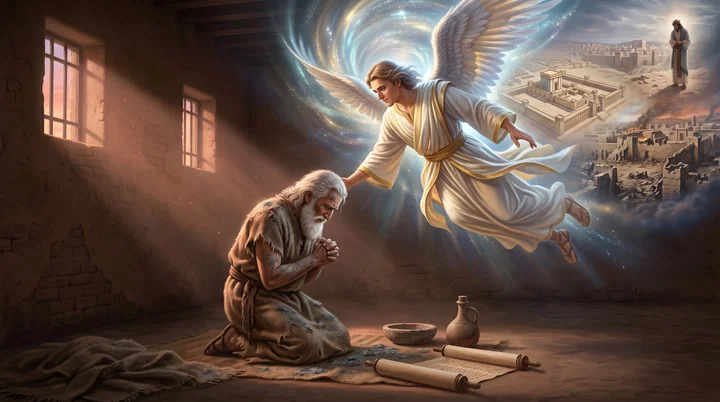
Daniel was interceding for Jerusalem in the first year of Darius the Mede after Babylon fell, when he understood from the books that the seventy years of desolation foretold through Jeremiah were near accomplishment.Ms 138, 1899, par. 26–31PK 556.4 He begged God on the ground of His own righteousness and great mercies, not Israel's, to turn His anger away from His city and holy mountain called by His name and to preserve His honor, because by their own sins and their fathers' iniquities Jerusalem lay desolate and His people had become a reproach to all around them.Ms 138, 1899, par. 26–31PK 554.3–556.24SP 301.1–302.1 Though greatly beloved and commended, he came as a sinner identifying himself with guilty Israel, confessing departure, rebellion and refusal to hear the prophets, with sorrow, fasting, sackcloth, ashes and tears, seeking pardon rather than claiming purity or righteousness.Ms 138, 1899, par. 26–31PK 554.3–556.2Ms 93, 1900, par. 274SP 301.1–302.1Lt 203, 1903, par. 7–15 His prayer was heard before it was finished, angels came with answer, and Gabriel explained the seventy weeks beginning with the command to restore Jerusalem, which hold the key to the commencement and termination of the 2300 days reckoned from 457 B.C. and supplied the time for the message that the appointed time was fulfilled while also foretelling the Messiah's death.GC 687.4Ms 138, 1899, par. 26–31Ms 93, 1900, par. 27GC88 351.1–352.3LS 44.2 That humble, earnest, wholehearted confession and supplication is given as the model for God's people today to make their own, confessing personal and shared guilt, putting away pride and self-confidence, keeping His commandments, and continuing in prayer until He manifests Himself with power.Ms 38, 1905, par. 15–16STGC 70.4Lt 175, 1902, par. 5–6Ms 142, 1901, par. 16Lt 195, 1903, par. 20–22
Daniel's Plea for Jerusalem
Daniel was interceding for Jerusalem in the first year of Darius the Mede after Babylon fell, when he understood from the books that the seventy years of Jerusalem's desolation foretold through Jeremiah were near accomplishment.Ms 138, 1899, par. 26–31PK 556.4 His prayer followed the true vision of the evening and the morning which shall be for many days, after which he fainted and was sick certain days, then rose and did the king's business, astonished at the vision with none understanding it.Ms 129, 1908, par. 11 The great things to take place are still before the living to the end of the judgments, and the judgments witnessed in San Francisco stand as a warning to Oakland, opening what Daniel saw in vision.Ms 129, 1908, par. 11
He begs God according to all His righteousness and great mercies, not Israel's righteousness, to turn His anger and fury away from His city Jerusalem, His holy mountain and city called by His name.Ms 138, 1899, par. 26–31PK 554.3–556.24SP 301.1–302.1Ms 5, 1885, par. 23–25RH Mar 21, 1907 He pleads for God's honor to be preserved and for His promises to be fulfilled, because for their own sins and the iniquities of their fathers Jerusalem has become desolate and Jerusalem and His people have become a reproach to all around them.Ms 138, 1899, par. 26–31PK 554.3–556.24SP 301.1–302.1RH Mar 21, 1907Lt 59, 1896, par. 13–17 Israel's sins and fathers' iniquities brought misfortune upon them, and by not keeping God's law Israel lost its holy character as His chosen people.BS 41.2 His plea rests on their need to repent and become humble, faithful, and obedient.BS 41.2
Though a longtime servant commended by God and greatly beloved, Daniel comes as a sinner, identifies himself with sinful Israel, and confesses both his own sin and the people's guilt, sin, departure from God's word, rebellion, and refusal to hear His prophets.Ms 138, 1899, par. 26–31PK 554.3–556.24SP 301.1–302.1Lt 203, 1903, par. 7–15Ms 5, 1885, par. 23–25 He seeks pardon and deliverance rather than claiming personal purity, righteousness, faithfulness, or sinlessness, pleading out of love and a sense of the people's need.4SP 301.1–302.1Lt 203, 1903, par. 7–15Ms 5, 1885, par. 23–25RH Jul 13, 1905Lt 264, 1902, par. 12–13 He seeks God with sorrow, humiliation, contrition, prayer and supplication, fasting, sackcloth, ashes, tears, and affliction of soul.Ms 138, 1899, par. 26–31Ms 93, 1900, par. 2718MR 14.1 The prayer is simple, deeply earnest, full, and complete, offered in deep contrition and sorrow as he witnessed Jerusalem's desolation.Ms 138, 1899, par. 26–31Lt 203, 1903, par. 7–1518MR 17.4–18.318MR 14.1Lt 59, 1896, par. 13–17
All heaven is interested in the prayer for God's honor, it is heard before it is finished and is not for naught.Ms 138, 1899, par. 26–31Ms 93, 1900, par. 27 Ministering angels come with communication from God, and Gabriel appears and explains the seventy weeks beginning with the command to restore and rebuild Jerusalem.Ms 138, 1899, par. 26–31Ms 93, 1900, par. 27PK 556.3 God has mercy on His rebellious people by restoring Jerusalem, granting another probation, and providing for a second temple to be built.Ms 138, 1899, par. 26–31
Prophetic Time Connections
Daniel 9 belongs to a prophetic chronology connected with the prophetic periods of Daniel 8.GC 687.4LS 44.2 It holds the key to the nature, commencement, and termination of the 2300 days.LS 44.2 That chronology is reckoned from 457 B.C.GC 687.4
Its seventy-week prophecy supplied the time basis for the disciples' message that the appointed time had been fulfilled and God's kingdom was near.GC88 351.1–352.3 The same chapter also foretold the death of the Messiah.GC88 351.1–352.3GC 352.3 That part of the prophecy the disciples did not understand at the time.GC88 351.1–352.3
The prophecy of Daniel 9 gives the time fulfilled when the kingdom of God was at hand at the end of the seventy weeks.GC 352.3 The time was right, but the event at the end of the seventy weeks was mistaken for a kingdom to be set up then.GC 352.3 That mistake came through adherence to popular errors that blinded the mind to the truth.GC 352.3 Both the correct giving of the appointed message and the disappointment from misapprehending it fulfilled the will of God.GC 352.3
Pattern for Prayer Today
Daniel's prayer to which this plea belongs is given as a model to study, make one's own, and follow with humility and contrition, confession of sin, and earnest supplication.Ms 38, 1905, par. 15–16Ms 142, 1901, par. 16Lt 195, 1903, par. 20–2218MR 19.4–20.26MR 103.1–2 It is to test experience, and is given for instruction and encouragement, as a model of prayer through which the Holy Spirit may work on behalf of those who pray.Ms 142, 1901, par. 16Lt 195, 1903, par. 20–2218MR 19.4–20.26MR 103.1–2 To humble oneself before God as Daniel did is to confess sins and plead for mercy, putting away pride, self-esteem, and stubbornness, humbling self to be lifted up.13MR 321.2–3Lt 30, 1906, par. 106MR 103.1–2 It is to give God the glory due His name, while holding a true sense of worth measured by the infinite price paid for redemption.Ms 58, 1903, par. 126MR 103.1–2
Daniel's example teaches confession of both personal and shared guilt rather than stubborn denial, even by one greatly beloved.RH Jul 13, 1905Ms 6, 1884, par. 9Ms 56, 1905, par. 10–1213MR 321.2–3 It provides the pattern for one who has walked in false paths, departed from the faith, or been reproved to read, learn true humility, and make a change.13MR 321.2–3Lt 30, 1906, par. 10 God's people today, especially Seventh-day Adventists, need to offer this prayer of confession and intercession, assembling together, confessing sins, repenting, and continuing in prayer until the Lord manifests Himself with power.STGC 70.4Lt 175, 1902, par. 5–6 It is needed because of self-confidence and presumption, unheeded light and testimonies of His Spirit, departure from His expressed commands and working contrary to long-given messages, selfish gathering of facilities to a few favored places, and neglect of other parts of the field, the large cities, and the Southern field, and that neglect will end when those who claim to believe the truth practise the truth.STGC 70.4Lt 175, 1902, par. 5–6
As Daniel's humble, sincere, unfeigned, wholehearted prayer was heard, earnest prayer is heard, God is willing to help those who come to Him, and people may come in faith to ask for wisdom and help, trusting Him to answer and reveal His salvation.18MR 15.4Lt 335, 1905, par. 1018MR 16.1 Prayer has power and efficacy: God gives victories and help to those who rely on Him and approach Him as Daniel did in weakness, unworthiness, trust, and communion.Lt 200, 1899, par. 5–6 He enlightens the mind, gives clear conceptions of truth, softens and subdues the heart, quickens understanding to discern truth from error, establishes the wavering mind with knowledge and faith that will stand the test, and gives joy, assurance of Christ's love and care, and confidence that He will not leave them in weakness.Lt 200, 1899, par. 5–6
Those who pray as Daniel prayed confess sins and find pardon, live wholly for God's glory, and keep God's commandments as their only safety against the enemy's malignant devices.11MR 103.4–104.3Lt 201, 1899, par. 22–25 They keep a clear separation between commandment-keeping people and those with no respect for His law, value every capability and talent as God's precious endowment to use for His glory unto perfection and completeness in Christ in the strife for immortality and eternal life.Ms 58, 1903, par. 126MR 103.1–2 They remain faithful, true, awake, watching, and ready for the last great controversy, the Lord's coming, and their lot and place, and are guarded and protected by heavenly intelligences and angels as ministering spirits.11MR 103.4–104.3Lt 201, 1899, par. 22–25 Without such prayer, confession, and thorough work there is no preparation for the Lord's coming and for eternity.11MR 103.4–104.3
Sources
Pioneers and periodicals
100 sources
Daniel pleads for the Lord according to His righteousness and mercy to turn away His anger and fury from Jerusalem, His holy mountain, and to restore the city and cause His face to shine upon His desolate sanctuary, because for their own sins and the iniquities of their fathers His people and city have become a reproach to all around them, appealing not to their own merit but to God's name and to Jerusalem's relation to Him while confessing full guilt including his own.RH Feb 13, 1900ST Oct 11, 1877RH Aug 16, 1870ST Feb 9, 1882
He offers this supplication in the first year of Darius the Mede after the fall of Babylon, because from Jeremiah he understood that the seventy years of Jerusalem's desolation and captivity were nearing their end, mistakenly supposing that the 2300 days and cleansing of the sanctuary would end at the same time.ST Oct 11, 1877RH Dec 31, 1857RH May 12, 1910RH Mar 21, 1865RH Feb 17, 1874
His prayer is answered while he is still speaking, when Gabriel is sent to give him skill and understanding and to explain the point left incomplete in Daniel 8 because he fainted and was left astonished, namely time.RH Jan 12, 1864RH Dec 31, 1857RH Dec 23, 1852RH Aug 23, 1870ST Apr 1, 1880
Daniel 9 is the key and appendix to Daniel 8, and the seventy weeks are cut off from the 2300 days as its first 490 years, both commencing together with the command to restore and rebuild Jerusalem in the autumn of B.C. 457.RH Aug 4, 1868RH Dec 23, 1852RH Nov 24, 1910RH Sep 17, 1861RH Feb 28, 1854
By the day for a year the 2300 years reach to A.D. 1844 and the cleansing of the heavenly sanctuary and beginning of the investigative judgment, with sixty-nine weeks to Messiah the Prince at His baptism in A.D. 27, His being cut off in the midst of the seventieth week in A.D. 31, and 490 years to A.D. 34, leaving 1810 years to 1844, and his humble confessing prayer stands as the example for believers when a foretold event approaches to seek God earnestly and cooperate in the work.RH Nov 24, 1910RH Nov 15, 1853RH Mar 20, 1856RH Mar 21, 1865ST Jul 1, 1897
Setting of Daniel's Prayer
Daniel's plea belongs to the supplication of Daniel 9:4-19, offered in the first year of Darius the Mede, about B.C. 538, shortly after Babylon fell to Medo-Persia under Darius and Cyrus.ST Dec 24, 1894RH May 12, 1910ST Mar 11, 1889 The vision of Daniel 8 had been given in the third and last year of Belshazzar, so Daniel 9 followed it by only a few months or even weeks, less than two years and probably in the same year, after Medo-Persia had succeeded Babylon and after the death of Belshazzar.ST Mar 11, 1889ST Mar 26, 1912ST Jan 20, 1904 Babylon is left out of Daniel 8 because it was passing away that very year when overthrown, and the close chronological connection means the vision of Daniel 9 was given to explain the time brought to view in Daniel 8.ST Dec 24, 1894RH May 12, 1910 The date assigned to Daniel 9 in relation to Daniel 8 was revised to accord with historical research on Babylon, but the length of time between the chapters is not essential to interpreting the prophecy.RH May 12, 1910
Daniel prayed because from Jeremiah, and perhaps Isaiah, he understood that the prophesied seventy years of Jerusalem's desolation and Babylonian captivity were nearing their end.RH Mar 21, 1865ST Apr 21, 1881ST Oct 11, 1905ST Jan 13, 1888 He studied Jeremiah's prophecy of the seventy years and recognized that the time for his people's deliverance and restoration from Babylon to their own land and to the Holy Land was near, about two years before the captivity ended.ST Mar 26, 1912ST Oct 11, 1905ST Jan 13, 1888 He was anxious after connecting that promise of restoration and return with the vision of Daniel 8 and its predictions of his people's sufferings, and with anxiety to make Cyrus know his mission and to awaken the people to prepare to return.ST Mar 26, 1912 His faith in the promise led him at that appointed time to seek God, confess sins, pray for and expect fulfillment.RH Mar 21, 1865RH Feb 17, 1874
The prayer was offered at the time of the evening oblation, with fasting, mourning, and outward humility.RH Dec 31, 1857ST Apr 1, 1880RH May 7, 1867 His fasting was not absolute abstinence from food but use of only plain and simple diet, eating no pleasant bread or delicacies, no flesh nor wine, and not anointing the head as an outward sign of fasting.RH Dec 20, 1870 His humble, heartfelt plea for God to remember His people and deliver them from captivity was joined with fasting, and his fasting was not condemned as empty ritual, because God heard his prayer.RH Nov 25, 1909RH May 7, 1867RH Sep 17, 1914 Soon afterward the kings of Media and Persia commanded the Israelites to return to Jerusalem.RH Nov 25, 1909
He prayed for Jerusalem and its desolate sanctuary on a mistaken understanding, supposing that the 2300 days and the cleansing of the sanctuary in Daniel 8 would end at the same time as the seventy years of servitude and desolation.ST Oct 11, 1877RH Dec 31, 1857RH Aug 23, 1870 Compared with Daniel 9:1-2, his earnest prayer shows he thought the 2,300 days concerning the sanctuary would end with the 70 years foretold through Jeremiah, and his plea reflects concern that the 2,300-year period might also end with that captivity.ST Oct 11, 1877RH Dec 23, 1852 He understood the seventy years to be near their end and wrongly concluded that the end of the captivity would also bring the cleansing of the sanctuary.ST Oct 11, 1877RH Aug 23, 1870
God's response began at the very start of the supplication, for while Daniel was still speaking and praying the command was given and Gabriel was sent to him.RH Jan 12, 1864RH Dec 31, 1857ST Mar 26, 1912 The one who came at that supplication during this broader prayer for Jerusalem and the holy mountain was the same Gabriel seen in the vision at the beginning in Daniel 8, still under the charge to make Daniel understand the vision.RH Dec 31, 1857ST Apr 1, 1880ST Mar 26, 1912 That charge had not been completed in Daniel 8 because Daniel fainted and was sick certain days and was left astonished with none understanding it, so Gabriel now came forth to give skill and understanding and to undeceive Daniel concerning his application of the time.RH Dec 31, 1857ST Apr 1, 1880 He came to fulfill his appointed duty to make Daniel understand the vision left unexplained in chapter 8, bringing further understanding and its answer while Daniel was still offering this earnest pleading.RH Aug 23, 1870ST Jan 24, 1878ST Mar 26, 1912
Meaning of the Plea
The plea asks the Lord, according to all His righteousness and mercy, to turn away His anger and fury from His city Jerusalem, His holy mountain.RH Feb 13, 1900ST Oct 11, 1877RH Aug 16, 1870ST Feb 9, 1882ST Nov 23, 1904 It seeks the restoration of the city and the causing of His face to shine upon His desolate sanctuary.ST Oct 11, 1877ST Feb 9, 1882ST Apr 19, 1910ST Nov 23, 1904 The prayer is offered as the seventy years of Jerusalem's desolation and Babylonian captivity approach their end, with Jerusalem lying ruined and the people in captivity.ST Apr 19, 1910ST Nov 23, 1904
The reason given is that for their own sins and for the iniquities of their fathers Jerusalem and God's people have become a reproach to all that are about them, to the surrounding nations.RH Feb 13, 1900ST Oct 11, 1877RH Aug 16, 1870ST Feb 9, 1882RH Nov 14, 1912 Their ruin and disgrace came because of the sin and iniquity of Daniel's people and their ancestors.RH Nov 14, 1912RH Jul 21, 1863ST Apr 19, 1910 Spiritual loss preceded the visible loss of the city.
The appeal rests on God's righteousness, mercy, and power, and on the honor of His name, not on the people's own righteousness or merit or on human ability.ST Oct 11, 1877RH Aug 16, 1870ST Feb 9, 1882RH Nov 14, 1912ST Nov 23, 1904 It rests on Jerusalem's special relation to Him as the city called by His name, pleading for its restoration so that His name will not be reproached among the nations, for His honor and not for personal advantage.RH Aug 16, 1870ST Feb 9, 1882 Daniel does not excuse himself or Israel but confesses full guilt, including his own sins with those of his people.ST Apr 19, 1910
Thy holy mountain is Mount Zion on which Jerusalem stands, in the land of Palestine.RH Oct 9, 1916ST May 9, 1916 It is equated with the glorious holy mountain, identifying the place where Jerusalem stands.RH Oct 9, 1916 This use supports the prophetic use of mountain as a symbol of a government or seat of government.ST Nov 25, 1930
The sanctuary in the prayer is Jehovah's habitation itself, which the prophet had his eye upon, not the land of Canaan itself.RH Jan 6, 1853RH Feb 15, 1870 Jerusalem and His holy mountain were only the place where God's sanctuary or habitation was located, not the sanctuary itself.RH Jan 6, 1853RH Feb 15, 1870
Jerusalem here also names the church and people of God, who are trodden underfoot during an appointed period.RH Jan 10, 1856 That treading underfoot ends in 1798 with the downfall of the Papacy.RH Jan 10, 1856 Its 1260 years and the preceding 1260 years under Paganism make up the two periods described as Jerusalem receiving double for her sins.RH Jan 10, 1856
Daniel 9 Explains Daniel 8
Daniel 9 is the explanation of Daniel 8, its key and appendix, and the connection between the two chapters is settled beyond doubt and cannot be invalidated.RH Aug 4, 1868RH Dec 23, 1852ST Dec 24, 1894 The vision of chapter 9 was given in B.C. 538 in the first year of Darius, only a few months after the vision of chapter 8 given in the third and last year of Belshazzar, and that close chronological connection shows the later vision was given to explain the time brought to view in the earlier one.ST Dec 24, 1894RH May 12, 1910 Babylon is left out of Daniel 8 because it was passing away in that very year when overthrown by the Medo-Persians under Darius and Cyrus.ST Dec 24, 1894 Keeping this connection shows the earth is not the sanctuary, for Gabriel completes in chapter 9 the explanation of the vision left unfinished in chapter 8, especially its 2300 days and the sanctuary, identifying the command to restore and rebuild Jerusalem as the starting point for the 2300 days.RH Aug 4, 1868ST Oct 21, 1880RH Dec 23, 1852 That Daniel later understood the vision and its time is confirmed by Daniel 10:1.RH Dec 23, 1852
Gabriel came to fulfill his still unfinished charge to make Daniel understand the vision.RH Dec 31, 1857ST Apr 1, 1880 That work was not completed in chapter 8 because Daniel fainted and was sick certain days and was left astonished with none understanding it.RH Dec 31, 1857ST Apr 1, 1880 The same Gabriel seen in the vision at the beginning in Daniel 8 comes to Daniel at his supplication at the time of the evening oblation to give him skill and understanding, referring directly to the vision at the beginning.RH Dec 31, 1857ST Apr 1, 1880 He comes to undeceive Daniel concerning his application of the time, for Daniel supposed the 2300 days ended with the seventy years of servitude and prayed for Jerusalem and its desolate sanctuary on that understanding.RH Dec 31, 1857ST Apr 1, 1880 He does not re-explain the ram, the goat, or the little horn, already made plain in chapter 8, but explains the point there omitted, namely time, and thereby gives the information about the 2300 days ending with the cleansing of the sanctuary which he was sent to give.RH Dec 31, 1857ST Apr 1, 1880RH Dec 6, 1864 That apostasy when worship had sunk very low, the worst persecution in their history suffered to chastise them, and the defiling of the temple and its cleansing and restoration of worship three years to a day later, is not mentioned in this explanation but is left to be shown in Daniel 10 concerning what would come to Daniel's own people.ST Apr 23, 1912
The seventy weeks are cut off from the 2300 days of Daniel 8:14 and are the first 490 days or years of that longer period.RH Nov 24, 1910RH Sep 17, 1861RH Feb 28, 1854RH Jul 21, 1863RH Nov 15, 1853 Both periods commence together with the going forth of the commandment to restore and rebuild Jerusalem.RH Nov 24, 1910RH Sep 17, 1861RH Nov 15, 1853 That command went out in 457 B.C.RH Sep 17, 1861RH Nov 15, 1853 At the end of the seventy weeks legal worship in the earthly temple would cease, while the remaining period concerns the gathering of all nations in the promise to Abraham.RH Feb 28, 1854 The events predicted for the seventy weeks provide a test of the prophecy's accuracy and help establish its application, reaching in weekly sections to the finishing of the wall in 408 B.C., the baptism of Christ in A.D. 27, His crucifixion in A.D. 31, the giving of the gospel to the Gentiles in A.D. 34, and culminating with the cleansing of the sanctuary, or beginning of the investigative judgment, in 1844.RH Nov 24, 1910RH Oct 4, 1870
Chapters 9, 10, 11 and 12 are a continuation and explanation of the vision of chapter 8.RH Jul 18, 1871 That vision as carried out and explained contains four prophetic periods, namely the 2300, 1260, 1290 and 1335 days, with the 2300 days as the principal and longest period and the others as intermediate parts and subdivisions of it.RH Jul 18, 1871 Daniel 9 stands as the third of four parallel supplementary lines of prophecy in Daniel, the Medo-Persia, Grecia, little-horn power, and 2300-day vision of Daniel 8 and 9, which begins with Medo-Persia after Babylon passed as a world power, covers the same great field as the metallic image of Daniel 2, the beasts and little horn of Daniel 7, and the kings of the north and south of Daniel 10-12, and closes at the same time with the close of the fourth monarchy, the second coming of Christ and the resurrection of the dead, and the eternal kingdom of God.ST Aug 9, 1910ST Oct 8, 1896ST Apr 9, 1912 Like the rest of Daniel it was given before the coming of the Messiah whom Daniel predicted, expands and fills out in detail the outline of the great metallic image in Daniel 2 from the great world empires to the everlasting reign of Christ with many new features, and is left incomplete without the later supplement in Revelation, especially Revelation 12-22 with its central symbols in Revelation 12, 13, 17 and 18.ST Oct 8, 1896 It was given for the latter days and belongs to the time of the end, portraying the rise and fall of earthly empires opposed to God's gospel to show earthly rule is temporary and to lead God's children through trouble to His eternal kingdom of righteousness.ST Aug 9, 1910ST Apr 9, 1912ST Oct 20, 1909
Daniel 9 belongs with Daniel 8 to one prophetic highway leading to the second coming of Christ and His eternal reign.ST Jul 1, 1897ST Nov 8, 1905 Together with Daniel 8 it gives the period of 2300 days until the cleansing of the sanctuary, and with Revelation 10 and 14 fixes the close of that period in 1844, first set for the spring and then for October 22 as the time for Christ to come, after which disappointment the cleansing means Christ entered the most holy place in the heavenly sanctuary to begin the investigative judgment.ST Jun 20, 1916RH Nov 23, 1905 That highway is marked by suffering and persecution from the crucifixion of the Prince of princes to the end, exposes the work of civil persecuting powers, and predicts the very time of the Lord's first advent as Messiah, the length of His ministry, the time of His death, and the time of the beginning of the judgment at the end of the 2300 days.ST Jul 1, 1897ST Nov 8, 1905 The prophecy reviews a large part of the same historical period in a line extending from 457 B.C. to A.D. 1844, verified by history, whose converging lines bring time almost to the focal center, the second coming of Christ, giving evidence the end of earthly rule is nearly over; after this period the gospel is to be preached to all nations before the end, when the last threefold message began on earth and the finishing work of the great High Priest in the most holy place began in heaven, with the next event the second coming of the Lord Jesus Christ.ST Jul 1, 1897ST Nov 28, 1900 Within Daniel 7-12 it stands as true prophecy of the future given by supernatural insight, holding with Daniel 2 and Daniel 7 the succession of the Babylonian, Medo-Persian, Grecian and Roman kingdoms.ST It stands in symbolic prophecy dealing with symbols, like Daniel 2, Daniel 7 and Daniel 8, unlike Daniel 11 which is literal prophecy using no symbols and for that reason in some respects easier to understand.RH Dec 28, 1911
Prophetic Periods and Dates
The going forth of the commandment to restore and rebuild Jerusalem is the starting point for both the seventy weeks and the 2300 days, which begin together as one period with its first 490 days cut off from the whole.RH Nov 24, 1910RH Sep 17, 1861 That commandment met its plenary fulfillment in the decree of Artaxerxes recorded in Ezra 7 in his seventh year, which includes the provisions of the earlier decrees of Cyrus and Darius.ST Nov 7, 1916 It is dated to 457 B.C., to the autumn of 457 B.C., when Artaxerxes' decree went out.RH Sep 17, 1861RH Mar 20, 1856ST Nov 7, 1916 This date fits the prophecies concerning the Messiah and fixes with Ezra 7 the beginning in the autumn of 457 B.C. and, with Revelation 10 and Revelation 14, the close marking the great advent movement and the time for proclaiming the threefold message of Revelation 14 and the everlasting gospel of Revelation 14:6-14.RH Mar 20, 1856ST Nov 7, 1916
By the Bible rule of a day in symbolic prophecy for a year, the 2300 days are 2300 years from 457 B.C. to A.D. 1844, to the autumn of 1844 A.D.RH Nov 15, 1853ST Jul 1, 1897ST Nov 7, 1916 At its close the sanctuary is cleansed, an event preceding Christ's second advent, when Christ begins His final ministry in the most holy place of the heavenly sanctuary.RH Nov 15, 1853RH Mar 20, 1856 That cleansing is the beginning of the investigative judgment, the antitypical day of atonement and the finishing work of the great High Priest in the most holy place in heaven, while on earth the last threefold message began, with the next event the second coming of the Lord Jesus Christ.RH Nov 24, 1910ST Jun 20, 1916ST Jul 1, 1897 The close was first set for the spring and then for October 22 as the time for Christ to come, and after the disappointment it was understood that Christ entered the most holy place in the heavenly sanctuary to begin the investigative judgment.ST Jun 20, 1916 Daniel 9 with Daniel 8 gives this period of 2300 days until the cleansing, and with Revelation 10 and 14 fixes its close in 1844, showing the 2300 days have expired and the time of the cleansing has come.ST Jun 20, 1916RH Nov 8, 1864
The period reaches in weekly sections to the finishing of the wall in 408 B.C., or 49 years to the restoration of Jerusalem under Nehemiah in B.C. 408.RH Nov 24, 1910ST Jul 1, 1897 Then 483 years reach to Messiah the Prince at Christ's baptism in A.D. 27, when His ministry began at the end of the sixty-nine weeks.RH Nov 24, 1910ST Jul 1, 1897RH Feb 21, 1856 Three and a half years more, or 486 1/2 years from the start, reach to His death on the cross in A.D. 31 in the midst of the seventieth week, at the end of the sixty-nine and a half weeks, when He was cut off unjustly.RH Nov 24, 1910ST Jul 1, 1897RH Feb 21, 1856 Then 490 years reach to the cutting off of the Jews as a special people and the giving of the gospel to the Gentiles in A.D. 34, when the apostles turned to the Gentiles at the end of the seventy weeks, leaving 1810 years to 1844.RH Nov 24, 1910ST Jul 1, 1897RH Feb 21, 1856
The verse stands within the seventy-weeks prophecy of Daniel 9 whose date is established, concerning the commandment to restore and build Jerusalem.ST Sep 9, 1875RH Nov 11, 1873RH Apr 14, 1874RH Nov 18, 1873 It belongs to the seventy weeks of Daniel 9 whose date is established.ST Sep 9, 1875RH Nov 11, 1873RH Apr 14, 1874ST Apr 15, 1875
Messiah Jerusalem Sanctuary Fulfilled
Daniel 9 gives the very time when the Messiah would appear as a man for the comfort of His people, during the seventieth week, 490 years from Jerusalem's restoration under the Persian kings.ST Nov 29, 1899ST Mar 2, 1915ST Nov 8, 1905 The sixty-nine weeks are measured from the command to restore and rebuild Jerusalem to Christ's baptism and anointing as Messiah in A.D. 27, when He was baptized in Jordan and the holy dove descended upon Him and the voice from heaven proclaimed Him the beloved Son of God.ST Nov 29, 1899ST Mar 2, 1915ST Sep 7, 1915 That date is counted by the Bible rule of a prophetic day for a year, and the same prophecy marks the beginning of Christ's ministry at the end of the sixty-nine weeks, His death for the world's sins three and a half years later in the midst of the week at the end of sixty-nine and a half weeks, and the apostles' turn to the Gentiles at the end of the seventy weeks.ST Mar 2, 1915RH Feb 21, 1856ST Sep 7, 1915 It thus predicts the length of His ministry, the time of His death when He was cut off unjustly, and with Daniel 8 the time of the beginning of the judgment at the end of the 2,300 days, exposing the work of civil persecuting powers on one of the great highways of prophecy leading to Christ's coming.ST Apr 9, 1912ST Nov 8, 1905RH Feb 21, 1856 God thereby gave through prophecy the very year the Messiah would appear, and His coming occurred in A.D. 27 when Messiah began to preach.RH Feb 18, 1909RH Jan 20, 1853
The same prophecy foretold that after Messiah was cut off the rebuilt city and sanctuary would afterward be destroyed by an army and left in ruins till the consummation, never to be rebuilt again.ST Mar 2, 1915RH Jan 20, 1853 That desolation occurred less than forty years after Christ's crucifixion, including Messiah being cut off unjustly and Jerusalem's destruction.ST Mar 2, 1915ST Apr 9, 1912 Its final desolation is identified with the sanctuary's desolation in Daniel 8, and that desolating power is identified as Rome rather than Islam.RH May 1, 1856RH Jan 20, 1853 The language of desolations and abominations in the plural allows for more than one power to tread down the church, identified as paganism and the papacy.RH May 1, 1856RH Feb 28, 1871
The exposition of Daniel 8 and 9 fixes distinctly the commencement and termination of the 2300 days, shows what the sanctuary is and the nature of its cleansing, explains the disappointment of the Advent people in regard to time, and shows the true position of those now waiting for their Lord.RH Jul 10, 1856RH Jun 26, 1856RH Dec 11, 1856RH Aug 7, 1856RH Jan 10, 1856 Daniel had studied Jeremiah's prophecy of the seventy years of Jerusalem's desolation and recognized that the time for his people's deliverance was near, showing that prophecy can be understood.ST Oct 11, 1905RH Apr 26, 1864 The chapter's prophecies also enabled the wise men to recognize that the time of the Messiah was at hand, definitely locating the first advent at a certain period alongside numerous chains of prophecy locating the second advent and terminating within a few years of the present time.ST Oct 11, 1905RH Apr 26, 1864 Most of God's professed people ignored this instruction, while only a small minority recognized and accepted its fulfillment in Jesus.RH Feb 18, 1909ST Oct 11, 1905 Together with Daniel 8 and Daniel 10-11 it covers the same history and ends in violence followed by Michael's reign, giving no support to the idea that the world will be converted but pointing instead toward the opposite outcome.RH Feb 18, 1909ST Jul 1, 1908
The earlier vision had left Daniel sad and perplexed, and his prayer sought further light about the visions and their ultimate outcome concerning suffering, persecution, and events to befall the church of God in coming time.ST Apr 9, 1912RH Dec 20, 1870 That fuller and more minute information respecting the events included in the great outlines of his former visions is unfolded through chapters 10 to 12 in answer to supplication continued until granted.ST Apr 9, 1912RH Dec 20, 1870 The explanation in Daniel 9 does not mention the apostasy when God's worship had sunk very low and His people had almost lost the worship of God, the worst persecution in their history that God suffered to come to chastise them, and the defiling of the temple and its cleansing and restoration of worship three years to a day later.ST Apr 9, 1912ST Apr 23, 1912 That apostasy and persecution was left to be shown in Daniel 10 concerning what would come to Daniel's own people.ST Apr 23, 1912RH Dec 20, 1870 Daniel set his heart to understand more fully the divine purpose and humbled himself in mourning three full weeks with fasting that was not absolute abstinence from food but use of only plain and simple diet, eating no pleasant bread or delicacies, no flesh nor wine, and not anointing the head as an outward sign of fasting.ST Apr 23, 1912RH Dec 20, 1870
Daniel 9 is one of the prophecies showing that God's promise to Judah and Israel was fulfilled, with the covenant ratified and confirmed to both houses before the apostles turned to the Gentiles.RH Feb 21, 1856ST May 12, 1881
Prayer as Example Today
When the end of the seventy years of Jerusalem's desolation drew near, Daniel understood the promise of restoration and sought God in prayer and humility, and the approach of a foretold event is in the same way a reason for the church to seek God.RH Mar 21, 1865RH Feb 17, 1874 His faith in the promise that the Jews would be restored from Babylon to their own land led him at that appointed time to confess sins and to pray for and expect fulfillment, even while most were slow to believe.RH Feb 17, 1874RH Nov 14, 1912 That earnest, continuous supplication was joined with readiness to cooperate in the work prayed for, and the lesson now applies to praying for the speedy completion of the gospel work in the present crisis.RH Nov 14, 1912 Only a few, ashamed of sin, embraced the free offer to return, and God sustained them in rebuilding in troublous times.RH Feb 17, 1874
The prayer in Daniel 9:11-19 takes less than four minutes to speak aloud.ST Aug 26, 1875 It stands with other recorded prayers as a model of how to pray, showing point, expression, directness, and above all short length.ST Aug 26, 1875 The desired blessing is asked tenderly, filially, directly, quietly and simply, as a child speaking to a Father more willing to give good gifts than men are to ask.ST Aug 26, 1875 There is no wandering, no wearying of fellow worshipers with vain repetitions, and no frequent Ohs and Ahs.ST Aug 26, 1875 Its prime object is to lift hearts to commune with Heaven.ST Aug 26, 1875
It is an example of humbling the self, confessing sin, and praying for God's help, and its course is recommended for seeking God's blessing.ST Oct 14, 1880RH May 7, 1867RH Jun 5, 1866 It was offered during a fast marked by outward humility, and that fasting was not empty ritual, for God answered.RH May 7, 1867 With Jeremiah's foretold return from captivity in view, God’s will was sought through confession, earnest supplication, and fasting.STRH May 16, 1865 The prayer is a penitential confession and supplication in which sins of the people are confessed and God's favor toward the sanctuary is pleaded for, humbly pleading for the people and for Jerusalem and its people.RH Jun 5, 1866RH May 16, 1865ST Feb 18, 1886 Confession of personal and communal faults is necessary before expecting God to hear, and reproof accepted in this way offers hope as a loving call to return.ST Oct 14, 1880ST
The humble, heartfelt plea for God to remember His people, to turn anger from Jerusalem become a reproach through their sins and their fathers' iniquities, and to deliver from Babylonian captivity was joined with fasting and with intercession for others.RH Nov 14, 1912RH Feb 17, 1874RH Nov 25, 1909 Trust rested in God's righteousness and power rather than human ability.RH Nov 14, 1912 God heard, and after the praying the assurance came that the suppliant was greatly beloved.RH Nov 25, 1909RH Sep 4, 1900 Soon afterward Media and Persia were moved and a leader sent, so that Cyrus decreed that the people could return and rebuild the temple, and the conquest, captivity, and deliverance were thus completed within one generation.RH Nov 14, 1912RH Nov 25, 1909RH May 11, 1916 The closing scenes of that prophecy are fulfilled in earth's last generation.RH May 11, 1916
The prayer was also earnest prayer for light and deliverance with deep concern for the Lord's sanctuary, asking for favor to shine on the desolate sanctuary at Jerusalem.RH Dec 8, 1915ST Jul 10, 1901 It was fasting and praying to learn more about the vision of the cleansing of the sanctuary, confessing personal sins and the sins of all the people, and before the intercession finished Gabriel returned to give understanding of the matter, bidding consideration of the vision and especially the time reaching to Daniel 8:14.RH Dec 8, 1915ST Jul 10, 1901 It confesses that sins and the iniquities of earlier generations brought disgrace upon Jerusalem and God's people among surrounding nations and asks God according to His righteousness to turn anger from Jerusalem the holy mountain.ST Oct 26, 1882RH Oct 3, 1912 Israel's misfortunes followed from transgressing God's law, and restoration required repentance, humility, faithfulness, and obedience.ST Oct 26, 1882 The same earnest confession prayed for the promised Deliverer, the coming Messiah, the promised Seed, whose reign would bring Israel's return and prosperity, belonging to prophecies that must be fulfilled before Christ comes.ST Sep 17, 1902ST Feb 4, 1913
Sources