Deuteronomy 1:6
The LORD our God spake unto us in Horeb, saying, Ye have dwelt long enough in this mount:
Translations
The LORD our God spoke to us in Horeb, saying, You have dwelled long enough in this mount:
The LORD our God spake unto us in Horeb, saying, Ye have dwelt long enough in this mount:
The Lord our God spake unto us in Horeb, saying, Ye have dwelt long enough in this mount:
The LORD our God spoke to us in Horeb, saying, Ye have dwelt long enough in this mount:
The LORD our God spake unto us in Horeb, saying, Ye have dwelt long enough in this mountain:
Jehovah our God spake unto us in Horeb, saying, Ye have dwelt long enough in this mountain:
'Jehovah our God hath spoken unto us in Horeb, saying, Enough to you — of dwelling in this mount;
Jehovah our God spoke unto us in Horeb, saying, Ye have stayed long enough in this mountain.
Yahweh our God, spake unto us in Horeb, saying, Long enough, have ye dwelt in this mountain:
Berean Standard Bible, Majority Standard Bible
The LORD our God said to us at Horeb: “ You have stayed at this mountain long enough.
“ The LORD our God spoke to us in Horeb, saying, ‘ You have lived long enough at this mountain.
The Lord our God said to us in Horeb, You have been long enough in this mountain:
The Lord our God spake vnto vs in Horeb, saying, Ye haue dwelt long ynough in this mount,
Douay-Rheims (Challoner revision)
The Lord our God spoke to us in Horeb, saying: You have stayed long enough in this mountain:
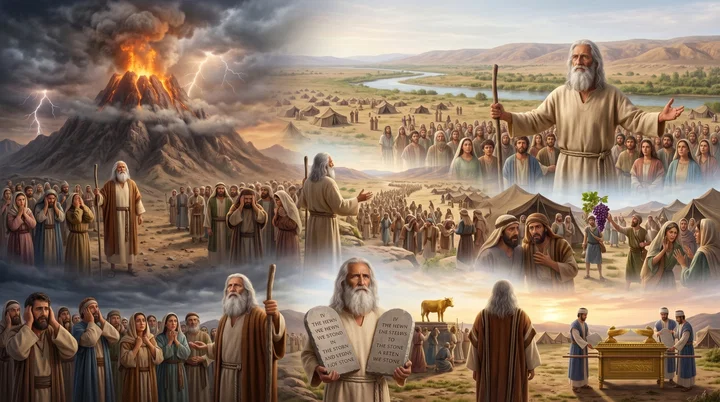
Pictures
Cross-references
- Deuteronomy 4:12-13
And the LORD spake unto you out of the midst of the fire: ye heard the voice of the words, but saw no similitude; only ye heard a voice.
God speaks the Ten Commandments directly, contrasting with laws mediated through Moses.
- Deuteronomy 5:1-3
And Moses called all Israel, and said unto them, Hear, O Israel, the statutes and judgments which I speak in your ears this day, that ye may learn them, and keep, and do them.
Moses recalls the covenant made with Israel at Horeb.
- Exodus 19:1-2
In the third month, when the children of Israel were gone forth out of the land of Egypt, the same day came they into the wilderness of Sinai.
Places Israel at Horeb in the third month after leaving Egypt.
- Numbers 10:11-12
And it came to pass on the twentieth day of the second month, in the second year, that the cloud was taken up from off the tabernacle of the testimony.
Israel’s cloud-led journey from Sinai began after their stay there.
- Deuteronomy 1:2
( There are eleven days’ journey from Horeb by the way of mount Seir unto Kadesh-barnea.)
It gives the journey's length from Horeb to Kadesh-barnea.
- Exodus 20:1-17
And God spake all these words, saying,
Records the commandments given before Moses’ later rehearsal.
- Exodus 13:21-22
And the LORD went before them by day in a pillar of a cloud, to lead them the way; and by night in a pillar of fire, to give them light; to go by day and night:
The cloud and fire led Israel on its journey from Egypt.
- Exodus 24:12
And the LORD said unto Moses, Come up to me into the mount, and be there: and I will give thee tables of stone, and a law, and commandments which I have written; that thou mayest teach them.
Cited for God’s law written on stone.
- Numbers 13:30
And Caleb stilled the people before Moses, and said, Let us go up at once, and possess it; for we are well able to overcome it.
Both urge Israel to move forward and take possession of the land.
Commentary
Each commentary is drawn from primary sources: the writings of Ellen G. White and Adventist pioneers and periodicals. Each commentary is separate. Its own words are not a quotation; follow the references to read the source passages.
Ellen G. White
7 sources
At Horeb God told Israel that they had dwelt long enough in the mount and must set out toward the land promised to their ancestors.RH Dec 31, 1903Ms 9, 1903, par. 3–5Lt 106, 1897, par. 21–24 The command ended the long encampment at the mountain and began the journey to take possession of the promised land by conquest.RH Dec 31, 1903Ms 9, 1903, par. 3–5 The verse belongs to the instruction Moses repeated to Israel before they entered the land.Ms 9, 1903, par. 3–5
It is part of the history Moses was instructed to rehearse, including failures and victories, so Israel could learn from experience and carry out each new move according to the principles God had given during the forty years of wandering.Lt 204, 1908, par. 2–3 The chapter explains why the adult army that left Egypt was not brought into the promised land: they did not wholly follow God, and their disobedience led to exclusion and prolonged wandering.15MR 292.3Lt 106, 1897, par. 21–24 The Lord's promises are upon condition of obedience.15MR 292.3
The verse is part of the words of the Lord in Deuteronomy 1, 7, and 8, to be read together as a whole and heeded.20MR 111.2–112.2Lt 73, 1896, par. 30–31 It is written for admonition for those living at the ends of the world.20MR 111.2–112.2Lt 73, 1896, par. 30–31 It calls for learning and appreciating the word of the Lord and completely submitting to and obeying His voice instead of holding to human judgment and ideas or following only to the point that agrees with human judgment.20MR 111.2–112.2Lt 73, 1896, par. 30–31 The standard is perfection of character, viewing everything in the light of Christ's example, and only those who do so are fit to be connected with God's institutions.20MR 111.2–112.2Lt 73, 1896, par. 30–31
Sources
Pioneers and periodicals
21 sources
The Lord told Israel encamped at Horeb that their stay at the mount had been long enough and they must break camp and press on to possess the land promised to their fathers.RH Dec 31, 1903RH Feb 24, 1916RH Aug 17, 1916 The word stands at the opening of Moses' rehearsal of God's dealings on the east side of the Jordan in the last year of his life, at the close of the forty years' wandering as Israel was ready to cross over, distinct from the first giving of the law at Horeb after the exodus.ST Mar 11, 1913RH Feb 24, 1916ST Mar 1, 1910 It belongs to the instruction given through Moses, written by him in a book, in contrast to the ten commands spoken by God's own voice and written by His finger on stone.ST Sep 21, 1876ST Mar 20, 1879RH Jan 12, 1905RH May 7, 1867 The journey from Horeb could have taken eleven days, but unbelief and rebellion kept Israel from entering for thirty-eight years, so the rehearsal solemnly recalls both God's goodness and the people's unbelief to impress the sacred claims of His law.ST Mar 1, 1910RH Apr 6, 1911 The command is therefore a call not to rest in secure encampment and preparation but to move onward by faith, leaving delay behind through repentance, cleansing, and prayer to carry God's work forward to the heavenly Canaan.RH Aug 17, 1916RH Apr 6, 1911RH Apr 6, 1911RH Nov 26, 1903
Setting and Command
Deuteronomy is the second law, or repetition of the law, and this verse belongs to Moses' first discourse in it.ST Mar 11, 1913ST Mar 1, 1910ST Feb 28, 1911 It is his rehearsal of God's dealings and goodness to His children, given on the east side of the Jordan in the final year of Moses' life.ST Mar 11, 1913ST Mar 1, 1910ST May 23, 1911RH Jan 7, 1862 It was spoken at the close of the forty years' wandering, as Israel prepared to cross over and pass into the promised land.ST Mar 11, 1913ST Mar 1, 1910ST May 23, 1911 It is therefore distinct from the original giving of the law at Horeb, which took place in the third month after leaving Egypt.RH Jan 7, 1862 It rehearses the wonderful things God had done for His people and the chief laws connected with Israel, and it introduces Moses' review of God's goodness.RH Feb 24, 1916ST Mar 1, 1910
Moses gave this repetition as a loving father who had cared for often rebellious children through forty years of wandering in the wilderness.ST Mar 1, 1910 He himself could not go over with them, because when provoked by their rebellion he yielded to impatience and hasty words glorifying himself instead of honoring God.ST Mar 1, 1910 Its purpose is to bring solemnly to remembrance the lessons God taught during the forty years.ST Mar 1, 1910 It recounts both the goodness of God and the unbelief and stumbling of the people, and it is rich in righteous precept.ST Mar 1, 1910 In this way it impresses the sacred import of God's holy law and the necessity of keeping it.ST Mar 1, 1910
The verse records the Lord telling Israel at Horeb that they had dwelt and stayed at the mount long enough.RH Dec 31, 1903RH Feb 24, 1916ST Feb 28, 1911ST May 23, 1911 He commanded them to break camp and set out toward the land promised to their ancestors to possess it.RH Dec 31, 1903RH Aug 17, 1916RH Apr 6, 1911 It marks the end of their stay there and the transition from encampment and preparation to journey and conquest.RH Dec 31, 1903ST May 23, 1911RH Apr 6, 1911 It is an inspiring call to leave the mountain and go onward to possess the promised inheritance.RH Aug 17, 1916
The journey from Horeb to the border of the promised land could have taken eleven days.RH Apr 6, 1911 Because of unbelief and rebellion, Israel's entry was delayed and the journey took thirty-eight years.RH Apr 6, 1911
Law Spoken by Moses
The verse stands in the opening of Moses' address and proves a second law, the ceremonial law of types, spoken by Moses in contrast to the moral law of the ten commandments spoken by God Himself.ST Sep 21, 1876ST Mar 20, 1879RH Mar 24, 1874RH Nov 16, 1869 The one law was spoken by Moses and written by him, while the other law was spoken directly by God to the people.ST Sep 21, 1876ST Mar 20, 1879RH Mar 24, 1874RH Nov 16, 1869 The distinction is plain, for the ten commands were spoken by God's own voice to the people, written by God's own finger on tables of stone and kept inside the sacred ark, whereas the instruction through Moses, seen in Deuteronomy 1:1-18 and Deuteronomy 1:5-6, was written by Moses in a book and kept in the side or beside the ark.RH Jan 12, 1905RH May 7, 1867 The larger passage containing the verse, Deuteronomy 1:1-34, belongs to Israel's history and exemplifies the laws and constitution given to Israel, which make the duties of rulers and the righteousness of citizens the foundation of the welfare of the state.RH Dec 17, 1901
Call to Move Forward
The word spoken at Horeb is an inspiring call to leave the mountain and go onward to possess the land set before Israel.RH Apr 6, 1911RH Nov 26, 1903 The stay there had been long enough, and the quiet, secure encampment was not the destination, for the land promised to the fathers still lay ahead to be taken.RH Apr 6, 1911RH Nov 26, 1903
It therefore marks the transition from encampment and preparation to breaking camp and moving forward into the promised possession.RH Apr 6, 1911 The journey from Horeb to the border of that land could have been made in eleven days, but unbelief and rebellion delayed the entry for thirty-eight years, showing that God's people must not remain stalled when He bids them advance.RH Apr 6, 1911 The same call is to move forward by faith in Christ, using the power that comes through forgiveness of sins to advance God's work and gain possession of the heavenly Canaan.RH Aug 17, 1916
For the church's spiritual work it means leaving delay behind, following God's leading, and pressing toward the promised goal.RH Aug 20, 1903RH May 11, 1911 That advance comes by reviving the consecration of early times to gain spirit for entering in, and by carrying revival and the message to the churches and to the world.RH Aug 20, 1903RH May 11, 1911 Such forward movement requires personal repentance and cleansing from sin, earnest prayer, and the decrease of self so that Christ may increase.RH May 11, 1911 The same word bids workers in Washington to move on from delay and press forward with the work before them, trusting that faithful effort will bring sudden, glorious, and lasting victory.RH Nov 5, 1903
Sources