Exodus 19:1
In the third month, when the children of Israel were gone forth out of the land of Egypt, the same day came they into the wilderness of Sinai.
Translations
American King James Version, King James Version, KJV Cambridge Paragraph Bible
In the third month, when the children of Israel were gone forth out of the land of Egypt, the same day came they into the wilderness of Sinai.
In the third month, when the children of Israel had gone forth from the land of Egypt, the same day they came into the wilderness of Sinai.
Revised Version, American Standard Version
In the third month after the children of Israel were gone forth out of the land of Egypt, the same day came they into the wilderness of Sinai.
In the third month of the going out of the sons of Israel from the land of Egypt, in this day they have come into the wilderness of Sinai,
In the third month after the departure of the children of Israel out of the land of Egypt, the same day came they [ into] the wilderness of Sinai:
In the third month, by the coming forth of the sons of Israel out of the land of Egypt, on this day, came they into the desert of Sinai:
Berean Standard Bible, Majority Standard Bible
In the third month, on the same day of the month that the Israelites had left the land of Egypt, they came to the Wilderness of Sinai.
In the third month after the children of Israel had gone out of the land of Egypt, on that same day they came into the wilderness of Sinai.
In the third month after the children of Israel went out from Egypt, on the same day, they came into the waste land of Sinai.
In the third moneth, after the children of Israel were gone out of the lande of Egypt, the same day came they into the wildernes of Sinai.
Douay-Rheims (Challoner revision)
In the third month of the departure of Israel out of the land of Egypt, on this day they came into the wilderness of Sinai:
Pictures
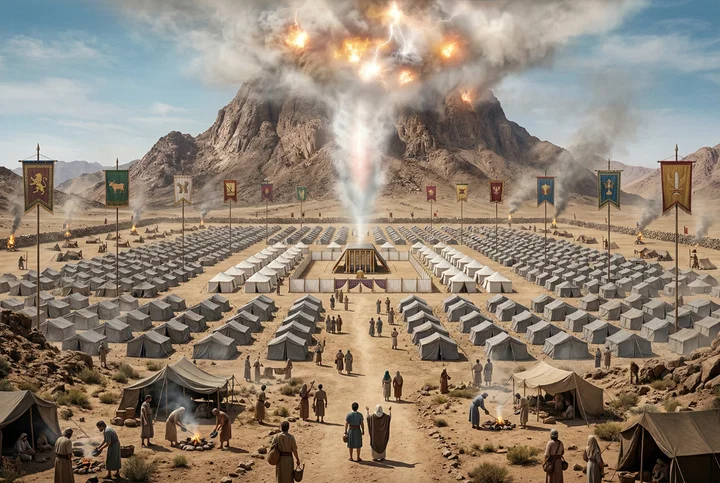
Cross-references 20 of 53
- Exodus 20:1-17
And God spake all these words, saying,
God proclaims the commandments that form the basis of the Sinai covenant.
- Exodus 16:1
And they took their journey from Elim, and all the congregation of the children of Israel came unto the wilderness of Sin, which is between Elim and Sinai, on the fifteenth day of the second month after their departing out of the land of Egypt.
Dates Israel’s wilderness arrival about a month before reaching Sinai.
- Exodus 19:5-8
Now therefore, if ye will obey my voice indeed, and keep my covenant, then ye shall be a peculiar treasure unto me above all people: for all the earth is mine:
God gives the covenant terms, and Israel agrees to obey.
- Deuteronomy 5:2-3
The LORD our God made a covenant with us in Horeb.
Identifies the covenant God made with Israel at Horeb, recalling the Sinai occasion.
- Deuteronomy 4:12-13
And the LORD spake unto you out of the midst of the fire: ye heard the voice of the words, but saw no similitude; only ye heard a voice.
God speaks the commandments at Sinai and identifies them as his covenant.
- Exodus 19:10-11
And the LORD said unto Moses, Go unto the people, and sanctify them to day and to morrow, and let them wash their clothes,
The people are sanctified and prepared for the Lord’s arrival to speak at Sinai.
- Deuteronomy 5:22
These words the LORD spake unto all your assembly in the mount out of the midst of the fire, of the cloud, and of the thick darkness, with a great voice: and he added no more. And he wrote them in two tables of stone, and delivered them unto me.
God proclaimed the commandments to Israel at Sinai with a great voice.
- Deuteronomy 33:2
And he said, The LORD came from Sinai, and rose up from Seir unto them; he shined forth from mount Paran, and he came with ten thousands of saints: from his right hand went a fiery law for them.
Describes the Lord’s presence at Sinai and his giving of the law.
- Exodus 24:3-8
And Moses came and told the people all the words of the LORD, and all the judgments: and all the people answered with one voice, and said, All the words which the LORD hath said will we do.
Together, the texts record Israel’s covenant with God at Sinai.
- Hebrews 8:9
Not according to the covenant that I made with their fathers in the day when I took them by the hand to lead them out of the land of Egypt; because they continued not in my covenant, and I regarded them not, saith the Lord.
Identifies the covenant made when God led Israel out of Egypt as the old covenant, broken by disobedience.
- Jeremiah 11:4
Which I commanded your fathers in the day that I brought them forth out of the land of Egypt, from the iron furnace, saying, Obey my voice, and do them, according to all which I command you: so shall ye be my people, and I will be your God:
Identifies the covenant God made with Israel when he brought them from Egypt.
- Jeremiah 31:32
Not according to the covenant that I made with their fathers in the day that I took them by the hand to bring them out of the land of Egypt; which my covenant they brake, although I was an husband unto them, saith the LORD:
Identifies the covenant made when God led Israel out of Egypt.
- Exodus 31:18
And he gave unto Moses, when he had made an end of communing with him upon mount Sinai, two tables of testimony, tables of stone, written with the finger of God.
God gives Moses the stone tablets written with his finger.
- Exodus 19:16-20
And it came to pass on the third day in the morning, that there were thunders and lightnings, and a thick cloud upon the mount, and the voice of the trumpet exceeding loud; so that all the people that was in the camp trembled.
God reveals his presence to Israel as he descends upon Sinai.
- Psalms 68:17
The chariots of God are twenty thousand, even thousands of angels: the Lord is among them, as in Sinai, in the holy place.
God is present at Sinai among his angelic host.
- Exodus 24:18
And Moses went into the midst of the cloud, and gat him up into the mount: and Moses was in the mount forty days and forty nights.
Moses enters the cloud on Sinai and remains there forty days and nights.
- Galatians 4:24-25
Which things are an allegory: for these are the two covenants; the one from the mount Sinai, which gendereth to bondage, which is Agar.
Mount Sinai is associated with the covenant that brings bondage.
- Exodus 19:5-6
Now therefore, if ye will obey my voice indeed, and keep my covenant, then ye shall be a peculiar treasure unto me above all people: for all the earth is mine:
Sets out the Sinai covenant terms and Israel’s promise as God’s treasured, priestly nation.
- Nehemiah 9:13
Thou camest down also upon mount Sinai, and spakest with them from heaven, and gavest them right judgments, and true laws, good statutes and commandments:
God speaks from Sinai and gives Israel his laws.
- Exodus 20:3-17
Thou shalt have no other gods before me.
The Ten Commandments are given at Sinai.
Commentary
Each commentary is drawn from primary sources: the writings of Ellen G. White and Adventist pioneers and periodicals. Each commentary is separate. Its own words are not a quotation; follow the references to read the source passages.
Ellen G. White
29 sources
In the third month after leaving Egypt, on the very day of their arrival, Israel entered the wilderness of Sinai, having left Rephidim by the cloud-guided route to camp on the plain before the mountain where they would remain nearly a year.1SP 232.2Ms 119, 1903, par. 1–2PP 303.1–3 God chose that mountain rising above the barren desert as His natural temple, with the cloud marking His presence, to reveal His glory in awful grandeur and speak in an audible voice, opening the setting for His instruction and covenant and for Moses to go up alone to meet Him.PP 303.1–3Ms 64, 1903, par. 1Ms 84, 1910, par. 3–4RH Sep 5, 19071MR 106.2–3 Their coming began their close and peculiar relation to God as a church and nation under His government, for He reminded them that He had borne them from Pharaoh's opposition as on eagles' wings to bring them to Himself, and promised that if they would truly obey His voice and keep His covenant He would make them His treasured people above all others, a kingdom of priests and a holy nation.Ms 119, 1903, par. 1–2PP 303.1–3Ms 81, 1903, par. 8–11Lt 407, 1904, par. 4–5Ms 170, 1904, par. 7–8 The people solemnly answered that they would do all He had spoken, and God prepared them and then proclaimed the Ten Commandments to all with great authority, restoring the knowledge of the Eden law largely lost in bondage and idolatry to reveal His holiness and raise them morally and to show the law's sacredness for all ages.PP 303.1–3Ms 65, 1906, par. 6–7Ms 13, 1906, par. 16–17Lt 176, 1907, par. 11–12Ms 83, 1907, par. 4–8 That word spoken at Sinai is spoken to every person now as truly as to ancient Israel, calling each one to understand and do whatever God commands, to obey the instruction given through Moses and keep holy the memorial of creation, and to be brought to God so He can work through them in preparing a people to stand in the day of the Lord.Ms 187, 1907, par. 1Lt 407, 1904, par. 4–5Ms 84, 1910, par. 3–4Ms 71, 1907, par. 1–4Lt 160, 1906, par. 3–9
Arrival in Wilderness
In the third month after going out of the land of Egypt, on the very same day, the children of Israel came into the wilderness of Sinai.1SP 232.2Ms 119, 1903, par. 1–2PP 303.1–3Ms 81, 1903, par. 8–111MR 104.1–2 The verse fixes their arrival to that third month and to that same day of coming there.Lt 407, 1904, par. 4–5Ms 84, 1910, par. 3–4Ms 71, 1907, par. 1–4Lt 176, 1907, par. 11–12Ms 2, 1904, par. 6–19
They had left Rephidim and followed the cloud-guided route to Sinai, and camped before the mountain on the plain below it.1SP 232.2Ms 119, 1903, par. 1–2PP 303.1–31MR 104.1–2Ms 2, 1904, par. 6–19 There in the wilderness before the mount they encamped in preparation to hear God's law.1SP 232.2Ms 119, 1903, par. 1–21MR 104.1–2Ms 64, 1903, par. 1Ms 71, 1907, par. 1–4 They would remain there nearly a year.1SP 232.2Ms 119, 1903, par. 1–2Ms 2, 1904, par. 6–19
God chose that mountain, a natural temple rising above the barren desert, to reveal His glory and speak His law in an audible voice.RH Sep 5, 19071MR 106.2–3Ms 64, 1903, par. 8–9STB 7.1–2 The cloud marked His presence above it.PP 303.1–3 He manifested Himself there in awful grandeur and overwhelming majesty and authority, and the impression of that scene was never forgotten by those who beheld it.RH Sep 5, 19071MR 106.2–3Ms 64, 1903, par. 8–9STB 7.1–2
The arrival opens the setting for God's instruction and covenant at Sinai.Ms 64, 1903, par. 1Ms 84, 1910, par. 3–4Lt 160, 1906, par. 3–9Lt 176, 1907, par. 11–12Lt 168, 1909, par. 16–17 Soon after the encampment Moses alone climbed the steep and rugged path to meet with God.PP 303.1–3 It sets the scene for the Lord's coming to the mount to give Israel His law and for the instruction given through Moses which is to be obeyed.Ms 84, 1910, par. 3–4Lt 160, 1906, par. 3–9Lt 176, 1907, par. 11–12Lt 168, 1909, par. 16–17
Covenant and Law Given
Coming to Sinai began Israel's close and peculiar relation to God, incorporating them as a church and a nation under His government by a great charter that received them as His chosen and denominated people.PP 303.1–3Ms 81, 1903, par. 8–11Ms 170, 1904, par. 7–8Lt 259, 1903, par. 10–12 Soon after the encampment Moses alone climbed to meet with God, received the message of deliverance and the offer to be a peculiar treasure, a kingdom of priests and a holy nation if obedient, returned and repeated it to the elders of Israel.PP 303.1–3 Their answer entered them into solemn covenant, pledging themselves to accept Him as their ruler and making them in a special sense the subjects of His authority.PP 303.1–3
God reminded them that He had delivered them from Egypt despite Pharaoh's opposition and had carried them as on eagles' wings to bring them to Himself.Ms 119, 1903, par. 1–2Ms 81, 1903, par. 8–11Lt 407, 1904, par. 4–5 His people must be brought to Him before He can work through them.1MR 119.1–2Ms 71, 1907, par. 1–4 The words belong to believers now as truly as to Israel, and it is each person's individual duty to understand what God means and to do whatever He commands.Ms 71, 1907, par. 1–4
He set out the terms of the covenant He desired to make with them, conditional upon their really obeying His voice indeed and keeping His covenant, not merely professing to worship God.1SP 232.21MR 104.1–2Lt 407, 1904, par. 4–5 If they would so obey, He would greatly bless them, honor them, constantly care for them, and manifest His love and power upon them.1MR 104.1–2 He would make them His treasured people above all people, a kingdom of priests and a holy nation.Ms 119, 1903, par. 1–2Ms 81, 1903, par. 8–111MR 104.1–2Ms 13, 1906, par. 16–17
The people answered, All that the Lord hath spoken we will do, entering the solemn covenant accepting Him as ruler.PP 303.1–3Ms 83, 1907, par. 4–8 God declared to Moses that He would come in a thick cloud so the people would hear Him speak with Moses and believe Moses forever, and He expected the pledge to lead to believing Him forever.Ms 83, 1907, par. 4–8Ms 125, 1909, par. 20–21 Yet they soon turned aside from the way God had commanded and failed in their short time of test.Ms 13, 1906, par. 16–17Ms 83, 1907, par. 4–8 In perplexity the right course under such a pledge is to stand the proving when brought into a hard place instead of murmuring, complaining and fretting, but to kneel in simplicity and ask the Lord God of Israel for help as He gave water to show His great kindness, which would please Him.Ms 125, 1909, par. 20–21
At Sinai, during their wilderness journey, God prepared the people to hear His law and then proclaimed the Ten Commandments to all the people amid scenes of great grandeur and with great authority.Ms 65, 1906, par. 6–7Lt 164, 1910, par. 5–7RH Aug 16, 1906FE 505.2–3 The Lord manifested Himself in awful grandeur in giving His law, and the impression of that scene was never forgotten by those who beheld it.RH Sep 5, 1907 The law thus spoken restored knowledge of the Eden law largely lost in long bondage and idolatry, revealed His holiness, majesty and power, raised them morally after slavery, preserved humanity from total apostasy, and showed the law's sacredness and importance for all ages, spoken by Christ the Redeemer.RH Sep 5, 1907 The instruction given in Exodus and Deuteronomy in connection with that proclamation requires obedience to all the commandments of God, presented as the highest education for humanity and as learning from God.Lt 176, 1907, par. 11–12Lt 164, 1910, par. 5–7RH Sep 5, 1907
Call to Obey Today
The word given when Israel came into the wilderness of Sinai in the third month after going out of Egypt takes in every person now, with every one included and none left out.Ms 187, 1907, par. 1Lt 407, 1904, par. 4–5 It was spoken to ancient Israel as they camped before the mount where God would speak through Moses, and it belongs to believers now as truly as to them, to the Israel of God for as long as people live on earth.Ms 71, 1907, par. 1–4Ms 141, 1906, par. 1–4RH Sep 5, 1907 There God called them to remember their deliverance and set before them His covenant offer, that if they would obey His voice and keep His covenant they would be His treasured people above all, a kingdom of priests and a holy nation, and that covenant is for every soul.Lt 407, 1904, par. 4–5 It means His bearing His people as on eagles' wings and bringing them to Himself, for He must bring each person to Himself before He can work through them in preparing a people to stand in the day of the Lord.Ms 71, 1907, par. 1–4
The mercies and blessings given at the mountain call for valuing and observing His instruction for human good and for the honor of His name, obeying what was given through Moses and all the commandments in Exodus and Deuteronomy.Ms 84, 1910, par. 3–4Lt 160, 1906, par. 3–9RH Sep 5, 1907 The law there spoken with great authority is the highest education for humanity, and obedience to all its commandments is learning from God.Lt 164, 1910, par. 5–7 That revelation on the mountain, a natural temple rising above the barren desert where He revealed His glory and spoke His law in an audible voice with awful grandeur never forgotten by those who saw it, shows the law's sacredness and importance for all ages and the continuing duty to keep His commandments.RH Sep 5, 19071MR 106.2–3 The instruction opened there, with Exodus 20, is of great importance and should be often repeated and sacredly observed, declaring the Lord the only true God who requires obedience to His Word.Lt 168, 1909, par. 16–17 All who would stand on the Lord's side are therefore to keep holy the memorial of creation made when God wrought His work in six days and appointed the seventh day as rest, blessing and sanctifying it, at a time when every device is used to draw people from truth and righteousness.Lt 168, 1909, par. 16–17
It is each person's individual duty to understand what God means and to do whatever He commands.Ms 71, 1907, par. 1–4 That pledge to obey means standing the proving when brought into a hard place instead of murmuring, complaining and fretting against the Lord, but kneeling in simplicity in perplexity to ask the God of Israel for help as He gave water to show His great kindness, which pleases Him and leads to believing Him forever.Ms 125, 1909, par. 20–21 At Sinai the people answered that they would do all the Lord had spoken, entering His promise on condition of obedience, with God declaring He would come in a thick cloud so they would hear Him speak with Moses and believe Moses forever.Ms 83, 1907, par. 4–8 As He dealt with His ancient people who failed in their short time of test, so He will deal with those today, and the Sinai experience is a lesson for the churches not to despise the Word of the Lord and refuse to humble proud hearts before the wisdom and righteousness of God.Ms 83, 1907, par. 4–8
Sources
Pioneers and periodicals
104 sources
In the third month after going forth out of Egypt Israel came into the wilderness of Sinai and encamped before the mount, opening the giving of the Ten Commandments and the covenant that bound the ransomed people to Jehovah.ST Jan 25, 1910ST Mar 3, 1914 There God proposed through Moses as mediator that if they would obey His voice and keep His covenant they would be His peculiar treasure, a kingdom of priests and a holy nation, and all the people answered together that they would do all the Lord had spoken.ST Jul 8, 1875ST Jul 8, 1875ST Aug 13, 1885 The Ten Commandments spoken aloud a few days later with fire, thunder, trumpet and earthquake were the moral terms and basis of that agreement, while the rites about sacrifices were a separate law given afterward.ST Aug 13, 1885RH Apr 28, 1868ST Mar 4, 1889RH Mar 4, 1862RH Mar 9, 1869 The Sabbath and the commandments already existed and were binding before Sinai, for Israel had been instructed, tested and rebuked concerning the Sabbath in the wilderness of Sin thirty days before reaching Sinai.ST May 17, 1883ST Mar 11, 1875ST Jun 16, 1887RH Jun 3, 1862RH Nov 25, 1852 Israel's promise was made in their own strength without power to obey and genders bondage, whereas the new and everlasting covenant rests on God's promises with the same law put in heart and mind so obedience springs from love.ST Aug 22, 1911ST Apr 22, 1913ST Mar 17, 1909 The journey also forms the fifty days from Passover exodus to the proclamation of the law, so that Pentecost commemorated the giving of the law when Christ as Jehovah lawgiver gave it in fire and afterward poured out the Spirit in fire.RH Jan 15, 1914RH Mar 1, 1906ST Aug 25, 1909
Arrival Time and Place
In the third month after going forth out of the land of Egypt, on the same day, the children of Israel came into the wilderness of Sinai and encamped before Mount Sinai.ST Jan 25, 1910ST Mar 4, 1889RH Dec 24, 1861RH Dec 24, 1861 The chapter opens there the account of the giving of the Ten Commandments on Mount Sinai and of the covenant that bound the ransomed people to Jehovah.ST Jan 25, 1910ST Mar 3, 1914 At Sinai God solemnly took Israel as His treasured people and holy nation to Himself and brought them out to meet Him, proclaiming the Ten Commandments amid fire and shaking.RH Dec 24, 1861RH Dec 24, 1861
Sinai is Horeb, the mount of God, in the range of Horeb, and the setting where the covenant as the agreement and its laws as its terms were given.RH Aug 27, 1857ST Jan 30, 1907 It is the most celebrated of all earth's mountains because of the majestic scenes it witnessed and the words of power to which it listened, becoming to Israel a schoolhouse of flame from whose lofty, burning doorway spoke the Teacher of the universe lessons of life if received and obeyed and of death if disobeyed, and the place where the tabernacle was built.ST Jun 10, 1908 The solitude of the great world where the law was given attests its importance, when after three days of careful preparation amid grandeur such as earth had never before witnessed the Majesty of Heaven came down and spoke the Royal Law, the Ten Words, from Sinai's blazing peak to the assembled thousands.ST Jun 12, 1907 The mountain was set apart as holy when God chose it to display His presence and power and give His law, sanctified before Jehovah descended to proclaim it, so that once sanctified for this sacred purpose it could not be used or occupied as ordinary common ground.RH Jul 16, 1861RH Mar 15, 1870
They came out of the wilderness of Sin lying between Elim and Sinai in Western Arabia, journeying by way of Rephidim to Sinai, and made their encampment there.RH Dec 9, 1915RH Oct 21, 1851ST Jun 10, 1908RH Jan 2, 1908 Their arrival began about two years spent in the shadow of Sinai in the vicinity of Horeb the mount of God learning the law of the Most High, taught by the daily manna that Jehovah could supply bread where no grain grew and water in desert wastes, and above all that enduring character is that taught by the precepts of the Decalogue amplified by the sanctuary.ST Jan 30, 1907 From arrival until the end of Moses' second forty-day period with God about three months passed, during forty days and nights on the mountain Moses receiving the pattern, and the rest of the year was spent building the tabernacle.
They came into the wilderness of Sinai as a pilgrim people called out to be priests to the whole world and to proclaim God's glory among all the nations.ST Jun 12, 1907 Their going out of Egypt toward Canaan is a type of God's people being delivered from the dark Egypt of earth.ST At Sinai they had to receive God's commandments, have the tabernacle erected, and be set in order before going forward to possess Canaan and subdue their enemies, and that preparation to enter the earthly Canaan types preparation in obedience in every detail to enter the heavenly Canaan.RH Dec 31, 1857
Journey Dates and Sequence
Israel left Egypt on the fifteenth day of the first month, the day after the Passover was killed on the fourteenth, reached the wilderness of Sin on the fifteenth day of the second month, and came into the desert of Sinai on the fifteenth day of the third month, the same day of the month on which they left, journeying by way of Rephidim from the wilderness of Sin between Elim and Sinai.ST Jun 16, 1887ST Jun 26, 1901RH Oct 21, 1851RH Jan 2, 1908RH Feb 23, 1911 The arrival in the third month after going forth out of Egypt was about or exactly two months into the journey, about one month after reaching the wilderness of Sin.RH Mar 7, 1854ST Apr 8, 1886ST Sep 16, 1886ST Aug 12, 1886 Compared with Exodus 16:1, the coming to Sinai was thirty days after the manna was first given and after Israel was instructed, tested and rebuked concerning the Sabbath in the wilderness of Sin, and more than a month after those events before the testimony was given.ST May 17, 1883RH Mar 1, 1864RH Oct 21, 1851RH Jan 2, 1908RH Feb 23, 1911 Sixty days passed from leaving Egypt to coming to the mount, which was three days before the giving of the law.ST Jun 16, 1887ST Sep 16, 1886 After the arrival Moses was to sanctify the people, set bounds around the mount, and have them ready against the third day, when with thunder, lightning, thick cloud and fire the Lord descended and proclaimed the Royal Law.ST Jun 26, 1901RH Oct 21, 1851 The Ten Commandments were thus spoken thirty-two days after the arrival, thirty days after Israel kept the Sabbath in the wilderness of Sin before seeing Mount Sinai.RH Oct 21, 1851RH Jan 2, 1908 Exodus 19 through 32 stands in chronological order, with chapter 19 preliminary to the making of the first covenant.ST Sep 23, 1889ST Feb 13, 1879 Chapter 19 records the preliminary contract in which the people solemnly pledged to obey God's voice before they had heard it, laying the first part of the solemn agreement respecting the Ten Commandments.ST Feb 6, 1879ST Mar 8, 1883ST Mar 8, 1883ST Mar 8, 1883 That pledge was not treated as closed but was tested after they heard that voice in ten precepts, when they were given full opportunity to refuse to close the compact, and the covenant begun in Exodus 19 was completed by ratification with blood in Exodus 24.ST Sep 23, 1889ST Feb 13, 1879ST Feb 6, 1879ST Mar 8, 1883 The timing of the law's giving in relation to the departure is disputed and does not by itself establish fifty days after departure.ST Apr 1, 1889 The calculation that the Lord came down on the fifth day of the third month to prove Sunday the true seventh day or a change of the Sabbath at the Exodus is rejected as a false theory. May 30 is identified as the anniversary of the giving of the law at Mount Sinai.ST Jun 5, 1884 The arrival belongs to the ordered Bible story from creation to Sinai, told to children in simple words they can understand with pictures making the meaning plain.RH Oct 1, 1903RH Jul 30, 1901
Covenant Promises and Terms
Exodus 19:1 opens the making of the first or old covenant with Israel after the Exodus at Sinai-Horeb, a mutual contract concerning God's words made in verses 1-8 three days before the audible speaking of the Ten Commandments, though the commandments themselves are also called a covenant.ST Jul 8, 1875ST Jul 8, 1875ST Aug 13, 1885ST Sep 17, 1885 That preliminary contract was distinct from the later declaration of the words of the condition, for the covenant was the agreement to obey God's voice and keep His covenant while the Ten Commandments proclaimed a few days later were its moral conditions, terms and basis, not the agreement itself.ST Jul 8, 1875ST Jul 8, 1875ST Aug 13, 1885ST Sep 17, 1885 The rites and offerings and law about sacrifices came afterward as a second and separate law forming no part of the ten words, with nothing commanded at first about burnt offerings or sacrifices but only to obey His voice that He would be their God and they His people.ST Aug 13, 1885RH Apr 28, 1868ST Mar 4, 1889ST May 20, 1875ST May 20, 1875
God proposed the covenant through Moses from the mountain by reminding Israel of deliverance from Egypt, that if they would obey His voice and keep His covenant they would be His peculiar treasure above all people, a kingdom of priests and a holy nation.ST Jul 8, 1875ST Jul 8, 1875RH Oct 21, 1851ST Sep 17, 1885 Moses laid all those words before the elders, all the people answered together that they would do all the Lord had spoken, and Moses returned their words to the Lord, closing the preliminary contract.ST Jul 8, 1875ST Jul 8, 1875ST Aug 13, 1885RH Oct 21, 1851RH Mar 25, 1875 In this making Moses stood between the Lord and the people as mediator conveying the word both ways, but three days afterward when God Himself declared the words of the condition directly in the hearing of all the host from the mount out of the midst of the fire, Moses did not stand between to show the word and all Israel heard directly.ST Jul 8, 1875RH Mar 25, 1875
The Ten Commandments were the law that was the basis of that covenant, the voice of God and the ten words forming no part of the ritual or ceremonial system, a complete and perfect law and rule of life pointing out sin and comprehending justice, truth and righteousness as the foundation of God's government and reflex of His character.ST Aug 13, 1885RH Apr 28, 1868ST Mar 4, 1889RH May 2, 1854ST May 20, 1875 The covenant was solemnly ratified before the ceremonial system was set out, opening the Levitical dispensation, and its setting distinguishes the covenant-making at Sinai from the earlier existence of God's commandments and laws including the Sabbath which already existed and were understood before this public proclamation.ST Mar 4, 1889RH May 2, 1854ST May 20, 1875 The people remained obligated to obey God's voice whether or not they had made their promise, while their disobedience forfeited their claim to the covenant promises.ST Sep 17, 1885RH May 3, 1860RH Mar 25, 1873
Breaking the Ten Commandments therefore broke the covenant by failure to fulfill the people's part, forever forfeiting all claims under it because that covenant made no provision for forgiveness of sin or restoration of the transgressor.ST Sep 17, 1885RH May 3, 1860RH Mar 25, 1873STRH Feb 1851 A new covenant providing forgiveness while keeping the same law as its basis became necessary, with God's design that the same law written on tables of stone be written on the heart.RH May 3, 1860STRH Feb 1851 Failure by either party nullifies an agreement, but disobedience does not weaken or change a law in its nature, authority or perpetuity, with effect only on the transgressor, for the moral law is the rule of holiness so a disobedient people could not be holy but were sinners like all the nations, and for God still to count them holy contrary to their real character would deny Himself.ST Sep 17, 1885RH Mar 25, 1873ST Mar 15, 1883 Through this contract God became Israel's husband and undertook to accept them as His people and be their God, and their later disobedience could end the contract but could not weaken the authority of God's law.RH Mar 25, 1873ST Mar 15, 1883ST Feb 20, 1879
Through the contract God solemnly took Israel as His treasured people and made them a holy nation to Himself, bringing them out to meet Him amid fire and shaking where He proclaimed the Ten Commandments including the Sabbath commandment.ST Mar 15, 1883RH Dec 24, 1861RH Dec 24, 1861ST Feb 20, 1879 The covenant at Horeb contains the first promise of a kingdom to the descendants of Jacob, conditional on obeying God's voice and keeping His covenant which is the Ten Commandments.RH Oct 21, 1851RH Jan 19, 1860RH Jan 13, 1852 Like all the kingdom promises to that people it was forfeited under the old covenant and can only be regained by obtaining an interest in Jesus, now the Prince and soon to be crowned King.RH Jan 19, 1860 Its promised blessings concerning the welfare of the Jews in literal Canaan depended on their keeping the Ten Commandments as conditions of the covenant rather than the covenant itself.RH Oct 21, 1851RH Jan 19, 1860RH Jan 13, 1852
The Sinai covenant with natural Israel, the children of the flesh taken as His people as a whole nation, was after and distinct from the covenant made with Abraham and his seed and with the fathers Abraham, Isaac and Jacob.RH Oct 21, 1851RHST Mar 11, 1913RH That Sinai covenant added to the promises another condition of justification, the righteousness of perfect obedience, which was perfectly just yet fallen guilty man has never complied with, so if the inheritance could be obtained only on that condition the promises to Abraham would be made void and of no effect.RH It rested on the same basic principle as the new covenant, the law of God, but Israel's promise to obey could not give them power to do God's will, and as a national covenant it could not save individuals.ST Apr 22, 1913ST Mar 17, 1909 People saved under the old covenant were saved by faith in the Christ who was to come, not by trying to keep the law in their own strength, for Moses by contrast with those who asked God not to speak was willing to hear God and received the glory of justification, while in entering the covenant God also gave through Moses the law of carnal ordinances with its meats and drinks and divers washings, with a typical atonement and typical priesthood in the tabernacle which was the pattern of the true.ST Apr 22, 1913RH
The verse shows Israel's own promise to do God's will in their own power, saying all that the Lord had said they would do and be obedient, feeling they could work obedience out of themselves and leaving the Lord out except for wanting His blessings, trying to buy or obtain those blessings through their own works.ST Aug 22, 1911ST Apr 22, 1913ST Mar 17, 1909 That self-dependent religion genders or bears children to bondage, figured by Hagar and her son born after the flesh through man's work, bringing only sorrow and trouble and giving glory to man if it succeeded.ST Aug 22, 1911 It stands opposite the new covenant figured by Sarah and Isaac born after the Spirit through God's promise and miraculous power with man yielding and cooperating, where deliverance from sin and all glory belong wholly to God.ST Aug 22, 1911 Apart from its national view the old covenant was man's effort to save himself by his own promise, faulty because no stronger than its weakest promise which was the promise of the people with the fault in the people, whereas the new and everlasting covenant rests on the promises of God where man's part is yielding to and receiving those promises and God puts His law in hearts and minds so that obedience springs from love.ST Aug 22, 1911ST Apr 22, 1913ST Mar 17, 1909
Those who held the other position denied that the first covenant was a mere agreement distinct from the law in Exodus 20 that became useless and void because the people did not fulfill it, holding instead that it expired by limitation.RH Apr 15, 1873 On that showing the first covenant was both agreement and enacted law-covenant because it was legislated, and the same legislated character belongs to the old and the new covenant, which points irresistibly to the Decalogue itself as the first covenant.RH Apr 15, 1873
Law Proclaimed at Sinai
At Sinai God came down in fire amid thunder and lightning, thick cloud and smoke, earthquake and trumpet sound, with thousands of angels and overwhelming majesty about twenty-five hundred years after creation.RH Mar 9, 1869RH Jan 12, 1869RH Apr 21, 1874 Moses sanctified the people and set bounds around the mount because God was about to speak to them.RH Apr 21, 1851RH Dec 24, 1861 There God proclaimed the Royal Law aloud with His own voice from the fire while trembling Sinai was stirred to its base, each precept distinctly heard.RH Mar 4, 1862RH Mar 9, 1869RH Apr 21, 1851 He then wrote it on two stone tablets and it was placed in the ark beneath the mercy seat.RH Mar 4, 1862RH Apr 21, 1851 This descent is set beside the future descent of the Son of God in His Father's glory accompanied by the trumpet of God.RH Jan 12, 1869
The law there given, identified with Exodus 20 and Deuteronomy 4, is the Ten Commandments.ST Sep 9, 1913 It is recorded in Exodus 20:1-17, while Deuteronomy 5 is Moses' rehearsal in the fortieth year pointing back to the earlier statute with as the Lord thy God hath commanded thee.RH May 27, 1852RH Jan 7, 1862ST Sep 9, 1913 The whole of Exodus 19 is its setting, showing where Israel was when the words were spoken.ST Jul 2, 1902 Exodus 19:1 fixes the date when the original Ten Commandments were given, proving Deuteronomy 5 is not the original fourth commandment.RH Jan 7, 1862
The moral law was given first and its covenant solemnly ratified before the ceremonial system was set out.ST May 20, 1875ST May 6, 1875 Exodus 19:1 begins the record of the covenant that opened the Levitical dispensation, whose basis was the law of God, the voice of God, the ten words, which formed no part of the ritual or ceremonial system.ST Mar 4, 1889 God's first dealing there commanded obedience to His voice to be His people, with nothing commanded about burnt offerings or sacrifices.ST May 20, 1875 The law about sacrifices came afterward as a second and separate law.ST May 20, 1875ST May 6, 1875 This came at the close of the patriarchal dispensation after more than two hundred years of bondage in which many had become idolaters, brought out that they might serve God and enter covenant relation before the Levitical priesthood, with reform and proving by the Sabbath first, beginning a new stage of civil and religious life as Jehovah's people.ST Feb 25, 1889ST Feb 4, 1886
That law is complete and perfect, the rule of life that points out sin and comprehends all justice, truth and righteousness as the foundation of God's government and reflex of His character.ST Mar 4, 1889 It is universal because God the Creator speaks it, and has significance beyond Israel for all mankind.ST Jan 24, 1911ST Feb 4, 1886 It reveals God's righteousness and requires perfect obedience, exposing sin and humanity's inability to attain righteousness by its own deeds.RH Mar 26, 1861 It is a law of love and remains binding, so that keeping God's commandments is how love for God is expressed.RH Sep 17, 1861
He gave the law in love to bring the people into close fatherly fellowship and write it on their hearts.ST Jan 27, 1909ST Jan 27, 1909 The law came through Christ and was intended to bring God near as a message of grace and life.ST Jan 11, 1905 Israel could have had it written within through faith, but fearing His glory they asked Moses to speak instead.ST Jan 24, 1911ST Jan 11, 1905 So they received it as condemning precept rather than as life-giving truth.ST Jan 11, 1905 Those who refused to hear did not have it written within, while Moses was willing to hear and received the glory of justification.ST Apr 22, 1913
The verse means the law then entered and the oracles of God were committed to Israel, not that the law then began to exist.RH Apr 21, 1874 The proclamation restored knowledge of the law largely lost during long bondage and displayed God's power in bringing them out of Egypt to preserve humanity from total apostasy.ST Sep 9, 1913 Though a historical truth and once-present necessity in carrying out God's purpose for its people and time, it does not by itself supply the truth needed for every later generation's present emergencies.ST May 11, 1915
The verse marks the time when God placed the precepts of Jehovah in a temporary unnatural position because of man's incapacity, the same event to which Deuteronomy 5:5 points.RH May 6, 1873
Sabbath Known Before Sinai
In the third month after going forth out of Egypt Israel came into the wilderness of Sinai, after the manna had begun and after the people had already been instructed to observe the Sabbath in the wilderness of Sin.ST May 17, 1883ST Mar 11, 1875RH Oct 4, 1906 They had left Egypt on the fifteenth day of the first month, the day after the Passover was killed on the fourteenth, had reached the wilderness of Sin on the fifteenth day of the second month, and came to the desert of Sinai by way of Rephidim on the fifteenth day of the third month, the same day of the month on which they left.ST Jun 16, 1887ST Sep 16, 1886RH Oct 21, 1851 Sixty days passed from leaving Egypt to coming to the mount, exactly two months after the departure and thirty days after coming to the wilderness of Sin, and the arrival was three days before the giving of the law.ST Jun 16, 1887ST Sep 16, 1886RH Oct 21, 1851 There in Exodus 16 the people knew the obligations of the Sabbath and some violated them and were reproved by God thirty days before seeing Sinai and at least thirty days before reaching it, and the ten words were spoken thirty-two days after the arrival, so Sabbath observance and accountability for breaking God's commandments and laws came before the proclamation at Sinai.ST Mar 11, 1875ST Sep 16, 1886RH Jun 3, 1862RH Nov 25, 1852RH Oct 21, 1851
That interval proves the Sabbath and God's commandments and laws already existed, were understood, and were obligatory before Sinai, and were not made or instituted at Horeb when God talked face to face with the people.RH Jun 3, 1862RH Nov 25, 1852RH Oct 21, 1851 The commandments including the Sabbath are traceable through Genesis and were ordained at creation, already known before the law was given at Sinai, so the law given there did not begin the Sabbath obligation.RH Jan 7, 1862ST Aug 31, 1882 The date fixes when the original Ten Commandments were given and proves Deuteronomy 5 is not the original fourth commandment but Moses' rehearsal in the fortieth year at the end of the forty years' sojourn, pointing back to the earlier statute with as the Lord thy God hath commanded thee.RH Jan 7, 1862
The covenant made at Horeb was the mutual agreement between the Lord and Israel in Exodus 19, entered by the people's own pledges in Exodus 19 with Exodus 24, with the Ten Commandments in Exodus 20 as its moral conditions and basis formally declared there.RH May 2, 1854RH Jun 3, 1862RH Nov 25, 1852RH Jan 7, 1862 That covenant-making at Sinai is therefore distinguished from the earlier existence of God's commandments and laws including the Sabbath, for that covenant at Horeb was simply an embodiment of the precepts of the moral law with mutual pledges between God and the people and did not give existence to any of the Ten Commandments.RH May 2, 1854RH Jan 7, 1862 The moral duties set out in that covenant were embodied in it, not created by it, and could have been binding before their solemn revelation at Sinai.RH Feb 3, 1852 Hence the covenant does not show that the Sabbath was made only for Israel, since the Sabbath existed before it, and the Sabbath no more originated from that covenant than did the prohibitions of idolatry, theft, or murder.RH Feb 3, 1852RH Jan 7, 1862
The passage does not make the Sabbath a movable affair changing every year beginning with the first of the year, for the weekly Sabbath is distinct from the yearly sabbaths which sometimes fall on the seventh day of the week and sometimes on other days, just as the Fourth of July or New Year does.ST Apr 3, 1907 Coming into the wilderness of Sinai means being brought to the foot of Sinai's awful mount to hear Remember the Sabbath day, and the same leading happens when messengers bring a person there to accept the Sabbath as a delight and the holy and honorable of the Lord.RH Apr 18, 1854 The chapter sets the scene for God's descent on Mount Sinai and the proclamation of His law, including the Sabbath commandment and instruction about the Sabbath and Jehovah.RH Mar 10, 1863 That law includes the Sabbath commandment whose time, the seventh day, is inseparable from the commandment itself, yet the Sabbath obligation did not begin with that speaking.ST Jun 13, 1878ST Aug 31, 1882
Pentecost Type and Application
Israel came into the wilderness of Sinai on the first day of the third month, Sivan, forty-five days after going out of Egypt on the fifteenth day of the first month.RH Jan 15, 1914ST Aug 25, 1909 With five further days for settling, making the preliminary covenant, and three days of preparation, the law was proclaimed on Sivan 6, fifty days after the departure, on the day of Pentecost.RH Jan 15, 1914RH Mar 1, 1906 Pentecost therefore commemorated the giving of the law at Sinai, the climax of the Passover exodus when Israel heard the voice of God.RH Jan 15, 1914RH Mar 1, 1906 The journey is thus counted as forty-nine days or seven weeks, linked to the seven Sabbaths counted before Pentecost, and the fifty days of the Omer between Passover and Pentecost bear the same relation to Pentecost as the days of the week do to the Sabbath.RH Mar 1, 1906ST Aug 25, 1909
God gave His law there in flaming fire and blazing glory through Christ, who was Jehovah the Lawgiver, to the people who were to be the representatives of His truth.RH Mar 1, 1906 The same Christ on Pentecost poured out the Holy Spirit in fire upon His representatives to proclaim salvation and to show the glory of the law by His sacrifice.RH Mar 1, 1906 That outpouring fittingly falls on the blessed rest of the seventh-day Sabbath which Jesus always honors.RH Mar 1, 1906 Later Jews commemorated Sinai at Pentecost, though the Old Testament gives no trace of that festival custom.
About sixty days after deliverance God reminded Israel of duty to their Creator and Deliverer, spoke His law at Sinai, and the people awed by His presence promised obedience.ST Feb 23, 1915 They did not recognize their weakness nor seek the power God had shown in delivering them, and they soon transgressed, showing an astonishing change from faith and obedience to rebellion and idolatry.RH Jan 7, 1862ST Feb 23, 1915 Their transgressions under the first testament are redeemed through Christ's death, so that those called may receive the promised eternal inheritance.ST May 9, 1916
The Lord manifested Himself in awful grandeur in giving His law, and the impression of that scene was never forgotten by those who beheld it.RH Sep 5, 1907 The words of Jehovah spoken to ancient Israel there are spoken as verily now and require obedience to the commandments of God given in Exodus and Deuteronomy.RH Sep 5, 1907 The two years spent in the shadow of Sinai in the vicinity of Horeb the mount of God taught by the daily manna that Jehovah could supply bread where no grain grew and furnish abundance of water in desert wastes knowing neither rain nor stream.ST Jan 30, 1907 Above all it taught that character is enduring and that the only right character is that taught by the precepts of the Decalogue, amplified, impressed, and enforced by the object-lessons of the sanctuary and service of God.ST Jan 30, 1907
God gathered the people following the pillar of cloud from Rephidim and camped them beneath the mountain to speak with them.ST Apr 22, 1880 Their difficult journey through the wilderness was a school in faith and trust in God, and the solemn barren surroundings taught them to feel their smallness before Him.ST Apr 22, 1880 His mighty leading in bringing them forth from Egypt and through the Red Sea should have given unshaken faith that He was leading them and would provide for them.RH Dec 23, 1909 Instead they did not stand the proving when they came into a hard place, but complained and murmured against the Lord.RH Dec 23, 1909 The same faithlessness is the danger today when believers who pledge themselves to be led by God become fearful in trouble or perplexity instead of being strong and of good courage, and they should come in simplicity to the same God who led Israel of old and ask Him to show His great kindness.RH Dec 23, 1909
The law from Mount Sinai was given to Israel as the rule of life for the people of God and the rule of moral obligation for that past Jewish or law dispensation, as set forth in the law and in the prophets and in the Psalms.RH Sep 13, 1853 It is distinct from the rule of life given by the apostles for the present Christian or gospel dispensation in which Jew or Gentile must become a Christian to secure the favor of God.RH Sep 13, 1853 There in the wilderness of Sinai Israel saw the glory of God.RH Sep 13, 1853RH Jan 29, 1867
Sources