Deuteronomy 17:18
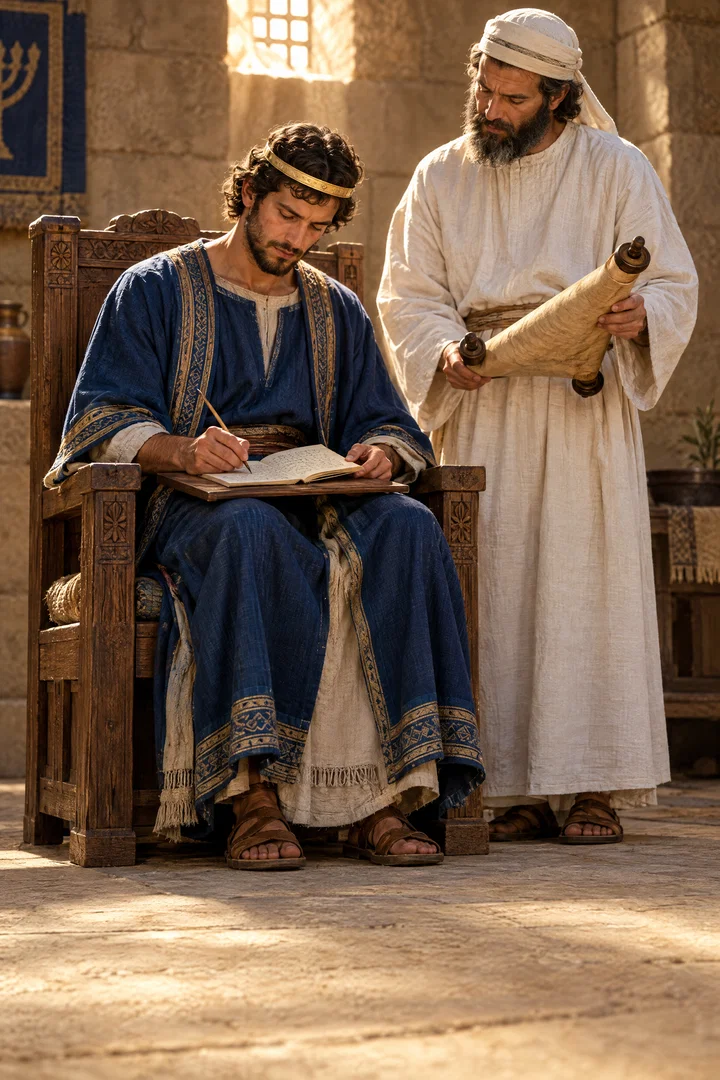
And it shall be, when he sitteth upon the throne of his kingdom, that he shall write him a copy of this law in a book out of that which is before the priests the Levites:
Translations
And it shall be, when he sits on the throne of his kingdom, that he shall write him a copy of this law in a book out of that which is before the priests the Levites:
King James Version, KJV Cambridge Paragraph Bible
And it shall be, when he sitteth upon the throne of his kingdom, that he shall write him a copy of this law in a book out of that which is before the priests the Levites:
And it shall be when he sitteth upon the throne of his kingdom, that he shall write him a copy of this law in a book out of that which is before the priests the Levites.
Revised Version, American Standard Version
And it shall be, when he sitteth upon the throne of his kingdom, that he shall write him a copy of this law in a book, out of that which is before the priests the Levites:
'And it hath been, when he sitteth on the throne of his kingdom, that he hath written for himself the copy of this law, on a book, from [that] before the priests the Levites,
And it shall be, when he sitteth upon the throne of his kingdom, that he shall write for himself a copy of this law in a book out of that which is before the priests, the Levites;
But it shall be when he sitteth upon the throne of his kingdom, then shall he write for himself a copy of this law upon a scroll, out of that which is before the priests the Levites:
Berean Standard Bible, Majority Standard Bible
When he is seated on his royal throne, he must write for himself a copy of this instruction on a scroll in the presence of the Levitical priests.
It shall be, when he sits on the throne of his kingdom, that he shall write himself a copy of this law in a book, out of that which is before the Levitical priests.
And when he has taken his place on the seat of his kingdom, he is to make in a book a copy of this law, from that which the priests, the Levites, have in their care:
And when he shall sit vpon the throne of his kingdo, then shall he write him this Law repeted in a booke, by the Priests of the Leuites.
Douay-Rheims (Challoner revision)
But after he is raised to the throne of his kingdom, he shall copy out to himself the Deuteronomy of this law in a volume, taking the copy of the priests of the Levitical tribe,
Pictures
Cross-references
- Deuteronomy 31:24
And it came to pass, when Moses had made an end of writing the words of this law in a book, until they were finished,
Both concern the written law, and the verse identifies the law book’s contents.
- Joshua 1:8
This book of the law shall not depart out of thy mouth; but thou shalt meditate therein day and night, that thou mayest observe to do according to all that is written therein: for then thou shalt make thy way prosperous, and then thou shalt have good success.
Both command the king to attend to the law and keep it.
- Deuteronomy 31:9
And Moses wrote this law, and delivered it unto the priests the sons of Levi, which bare the ark of the covenant of the LORD, and unto all the elders of Israel.
both show writings kept by priests and copied
- 2 Chronicles 34:14-15
And when they brought out the money that was brought into the house of the LORD, Hilkiah the priest found a book of the law of the LORD given by Moses.
Neglect of the king’s copying duty explains how the book of the law was lost.
- Nehemiah 8:1-3
And all the people gathered themselves together as one man into the street that was before the water gate; and they spake unto Ezra the scribe to bring the book of the law of Moses, which the LORD had commanded to Israel.
It is cited as evidence about the law book.
- Galatians 3:10
For as many as are of the works of the law are under the curse: for it is written, Cursed is every one that continueth not in all things which are written in the book of the law to do them.
The law book is identified with the law whose disobedience brings a curse.
- 1 Kings 2:3
And keep the charge of the LORD thy God, to walk in his ways, to keep his statutes, and his commandments, and his judgments, and his testimonies, as it is written in the law of Moses, that thou mayest prosper in all that thou doest, and whithersoever thou turnest thyself:
David charges Solomon to keep the law of Moses.
- 1 Kings 11:3-4
And he had seven hundred wives, princesses, and three hundred concubines: and his wives turned away his heart.
Solomon’s many wives turned his heart toward other gods, as the directions warned.
- Deuteronomy 12:32
What thing soever I command you, observe to do it: thou shalt not add thereto, nor diminish from it.
both forbid changing the law, backing multiple copies
- Exodus 20:1-17
And God spake all these words, saying,
The Decalogue is distinguished from the full book of law.
- Deuteronomy 4:2
Ye shall not add unto the word which I command you, neither shall ye diminish ought from it, that ye may keep the commandments of the LORD your God which I command you.
both forbid changing the law, backing multiple copies
- 1 Kings 2:12
Then sat Solomon upon the throne of David his father; and his kingdom was established greatly.
Solomon enthroned under this requirement
Commentary
Each commentary is drawn from primary sources: the writings of Ellen G. White and Adventist pioneers and periodicals. Each commentary is separate. Its own words are not a quotation; follow the references to read the source passages.
Ellen G. White
12 sources
When seated upon the throne of his kingdom, the king was to write for himself a copy of the law in a book from the text that was before the priests the Levites.RH Dec 21, 1905PK 52.1–2Ms 81, 1900, par. 1–4PK 52.3 That direction was given through Moses long before Solomon became king to guard Israel's rulers against the dangers of kingship and apostasy.RH Dec 21, 1905PK 52.1–2 He was to keep that copy with him, beside him on his throne, and read in it all the days of his life.RH Dec 21, 1905Ms 81, 1900, par. 1–4RH Dec 21, 1905PK 52.321MR 169.1 Keeping the Word beside him makes a ruler immovable, as David was while he obeyed.21MR 169.1Lt 16, 1888, par. 58–59
By that continual study he was to learn reverence and fear for God and to keep and do all the words of the law, its statutes, commandments, judgments, and testimonies.RH Dec 21, 1905Ms 81, 1900, par. 1–4RH Dec 21, 1905PK 52.3 The study was meant to keep his heart from being lifted up above his brethren and to keep him from turning aside from the commandment to the right hand or to the left.RH Dec 21, 1905Ms 81, 1900, par. 1–4RH Dec 21, 1905PK 52.3 Obedience on these terms prolongs his days in his kingdom, he and his children in the midst of Israel.RH Dec 21, 1905Ms 81, 1900, par. 1–4PK 52.3 For Solomon prosperity and establishment on David's throne was made conditional on walking in God's ways and keeping what was written in the law of Moses.Ms 81, 1900, par. 1–4
The surrounding instruction warns the king against accumulating horses, wives, and great wealth, since multiplying wives could turn his heart from God.RH Dec 21, 1905 The law of kingship places the king under God's law rather than as an unchecked monarch.SG4 65.4 Israel's demand for a king departed from God's direct leadership, and a proud king could lead the people away from God and therefore needed to trust God and receive wisdom from Him.SG4 65.4
A monarchical government was foretold, but monarchy was not God's will for Israel.ST Jul 13, 1882 When the people refused His wiser counsel He permitted them to take their own course and instructed Samuel to grant their request while warning of the consequences.ST Jul 13, 1882 God foresaw Israel would desire a king but did not consent to a change in the principles on which the state was founded.PP 603.1–2 God was still recognized as head of the nation, His law was enforced as the supreme law of the land, and the king was to serve as vicegerent of the Most High, administering government in God's name and by His authority with no authority to legislate for the nation, which remained the condition of Israel's existence as a nation.PP 603.1–2
God reserved to Himself the right to choose the king, and Israel respected that authority by leaving the selection entirely to God, so that the choice fell upon Saul, a son of Kish of the tribe of Benjamin.PP 608.1–2 Solomon knew these instructions and for a time obeyed them, desiring to rule by the statutes given at Sinai in contrast with rulers who trampled God's law.RH Dec 21, 1905PK 52.3 But his later reliance on his own strength and alliances with surrounding nations marked a departure from God's commands.RH Dec 21, 1905 Josiah followed the instruction given for rulers to obey the law for their guidance, and his obedience made him fit for God's service.PK 384.1
When David forsook its doctrines he sullied one of the fairest reputations.21MR 169.1Lt 16, 1888, par. 58–59 Forsaking its doctrines violates the will of God, sets aside God's wisdom for the wisdom of man and human invention, and brings a day of retribution upon nations and individuals.21MR 169.1Lt 16, 1888, par. 58–59
Sources
Pioneers and periodicals
25 sources
When he took the throne, Israel's future king was to write out by hand for himself a copy of the law from the copy kept by the priests the Levites, and to keep it with him and read it all the days of his life.RH Dec 21, 1905ST Apr 27, 1904RH Mar 25, 1902 The book takes its name from this command, for the Greek rendering of copy of this law means a repetition or rehearsal of the law given before, not a new law.ST Apr 27, 1904RH Feb 24, 1916RH Jul 26, 1870 The copy embraced the whole body of law given through Moses to direct the king in governing, judging, and instructing the people by word and example.RH Oct 8, 1857ST Oct 10, 1895RH Jun 27, 1871 By it he would learn to fear the Lord, to keep and do all His commandments, to remain humble and not turn aside to the right or left, and so to prolong his days and his children's in the kingdom.RH Dec 21, 1905ST Apr 27, 1904RH Mar 25, 1902 The same careful reading still makes its readers obedient, God-fearing, and humble, and writing it out by hand impresses its truth still more deeply on the mind.ST Apr 27, 1904
Name and Historical Setting
The book takes its name from this verse, because the Greek Septuagint renders “copy of this law” as deuteronomy, meaning a duplicate of the law, a second law, a repetition of the law.ST Apr 27, 1904RH Feb 24, 1916 The underlying Hebrew phrase, mishneh ha-torah, means a repetition or doubling of the law, describing a rehearsal of laws given earlier, not a second law or a new covenant.RH Jul 26, 1870 The verse directs the prospective king, when he sits on the throne of his kingdom, to write for himself a copy of this law in a book from that which is before the priests the Levites.ST Apr 27, 1904RH Jul 26, 1870 That copy was to remain with him and be read by him all the days of his life, so that he might learn to fear the Lord his God and keep and do all the words of the law and its statutes, so that his heart would not be lifted up above his brethren and he would not turn aside from the commandment to the right hand or to the left, to the end that he might prolong his days in his kingdom, he and his children, in the midst of Israel.ST Apr 27, 1904 The section to which the verse belongs reviews the law for the new generation.RH Feb 24, 1916
The verse stands in Moses’s repetition of the law, a rehearsal of the wonderful things God had done for His people and of some of the chief laws connected with Israel.ST Mar 1, 1910ST Mar 3, 1909 It was given by Moses before the Israelites crossed the Jordan River into the promised land, after he had cared for the often rebellious people like a great and loving father during forty years of wandering in the wilderness.ST Mar 1, 1910 Having yielded in impatient hasty words in which he was glorified instead of God, Moses could not go with them into the promised land, but before leaving them he solemnly brought to their remembrance the wonderful lessons God had taught them during the forty years and impressed upon them as solemnly as possible the sacred import of God’s holy law and the necessity of keeping it.ST Mar 1, 1910 It recounts Israel’s experiences and God’s guidance, appeals constantly to serve the Lord and to turn away from the sins which wrecked the other nations and to exemplify Him, and develops the precepts of the law with the gracious promises of God.ST Mar 3, 1909 In that appeal and development alone would lie their greatness and continuance.ST Mar 3, 1909
The verse belongs to God’s directions for Israel’s future king, given in view of Israel’s demand for a king like those of other nations, and to the last part of the chapter that foreshadowed the coming kingdom in Israel and gave instruction as to what the king ought to be.ST Dec 9, 1889ST Mar 18, 1913 These directions set limits on the king’s duties intended to guard the king and the people from turning from God and to guard the people from the tyranny kings often exercised.ST Dec 9, 1889ST Sep 4, 1893 Kingship and being governed by a king had been foretold, but that did not mean monarchy was God’s will or God’s preferred order for them.ST Jul 13, 1882ST Sep 4, 1893 When the people asked for a king and rejected God’s rule and refused His wiser counsel, God permitted them to take their own course and mercifully gave instruction to protect those subject to unrighteous rule.ST Jul 13, 1882ST Sep 4, 1893 Samuel told the people the manner of the kingdom in obedience to that instruction when Saul was chosen king, requiring the king constantly to study God’s law, beginning the 500-year period of the monarchy when the theocracy was withdrawn.ST Jul 1, 1903
King's Copy and Obedience
When he sits upon the throne of his kingdom, the king is to write for himself a copy of the law in a book from that which is before the priests the Levites, including Deuteronomy as well as the preceding books.RH Dec 21, 1905ST Apr 27, 1904RH Mar 25, 1902ST Oct 30, 1884RH Oct 8, 1857 That copy is to remain with him and be read by him all the days of his life.RH Dec 21, 1905ST Apr 27, 1904RH Mar 25, 1902ST Oct 30, 1884RH Oct 8, 1857
The law so copied comprised the whole body of law given through Moses, not only the moral precepts and not only the ceremonial law.RH Oct 8, 1857 The king was thus to know the laws needed to govern the people and to carry out the judicial code.RH Oct 8, 1857 Kings were to be directed by God's law, which provides a model for a king and guides his rule, a copy for a king and a rule for his subjects.ST Oct 10, 1895RH Jun 27, 1871 He was to study it that he might instruct his people both in word and in example and thus preserve the kingdom to the Lord.ST Oct 10, 1895
The copy's purpose and result is that he learns to fear the Lord his God and to keep and do all the words of the law and its statutes.RH Dec 21, 1905RH Dec 21, 1905ST Apr 27, 1904RH Mar 25, 1902 Continual study is meant to keep him humble toward his fellow Israelites, so that his heart is not lifted up above his brethren.RH Dec 21, 1905RH Dec 21, 1905ST Apr 27, 1904RH Mar 25, 1902 It is meant to prevent him from turning aside from the commandment to the right hand or to the left.RH Dec 21, 1905RH Dec 21, 1905ST Apr 27, 1904 Such obedience is tied to prolonging his days in his kingdom, he and his children, in the midst of Israel.RH Dec 21, 1905ST Apr 27, 1904RH Mar 25, 1902
The surrounding instruction warns the king against accumulating horses, wives, and great wealth, and gives God's wish that he should not multiply wives, because multiplying wives could turn his heart from God.RH Dec 21, 1905ST Oct 30, 1884ST Nov 19, 1896ST Jul 21, 1898 It is a warning for kings of what they should not be and do and serves as a warning for all time.ST Nov 19, 1896 Disobedience brought sad strife among David's sons, and Solomon's many wives turned his heart away to idols.RH Dec 21, 1905ST Nov 19, 1896ST Jul 21, 1898 Keeping and reading the law would have warned Solomon against the choices that led him into idolatry.ST Oct 30, 1884 Solomon knew these instructions to copy, keep, read, and obey and followed them for a time, but his later reliance on his own strength and alliances with surrounding nations marked a departure from God's commands.RH Dec 21, 1905
Preservation and Present Application
The verse shows the custom by which kings and others made copies of the law for personal use, while inspired writings were delivered to the priests to be placed by the side of the law for safe keeping.RH Sep 30, 1915 Rulers were required to have a copy made from the priests' copy, and parents also had copies in order to teach the law to children who learned it from earliest childhood.RH Jan 3, 1865 Because the law was thus in the hands of rulers, priests, and families, no one person could corrupt it without others detecting the change, which kept the Pentateuch genuine and unaltered.RH Jan 3, 1865
The written roll transcribed by each king from that before the priests the Levites was the standard for the service of God.ST Aug 2, 1905 With printing unknown, neglect of it left men dependent on oral tradition passed from lip to lip and stored in memory and on the traditions and habits of the sanctuary.ST Aug 2, 1905 A succession of later kings neglected this duty of transcribing the Sacred Roll, and even better-disposed kings like Hezekiah left it undone amid the harassing cares of the kingdom, while the priests themselves became careless of the written code.ST Aug 2, 1905 In such neglect the book of the law could easily be let slip and lost by a single apostate generation.ST Aug 2, 1905
As the king was to take time to write by hand and then read all his life, and writing is slow work taking much longer than reading, those who already have a printed copy for convenience can at least take time to read it.ST Apr 27, 1904 Carefully reading brings the same beneficial results as to the monarch in making readers obedient to all Jehovah's requirements, fearing God and keeping His commandments, keeping them humble so their hearts are not lifted up to consider themselves better than others, and prolonging their days in the midst of God's chosen Israel.ST Apr 27, 1904 Writing out copies by hand would help impress divine truth upon the mind, and while the press is a great blessing, allowing it to make readers more careless and less thorough in accurate knowledge of the Scriptures is an unfortunate misuse of it.ST Apr 27, 1904
The verse belongs to the ancient theocratic system in which kings were subject to divine law and religious authorities claimed to declare God's will.RH Feb 2, 1911 That setting evokes the danger of clerical influence over rulers and the state enforcing religious interpretations.RH Feb 2, 1911 The Blessed Book affords a copy for a king and a rule for a subject and is so complete a system that nothing can be added to it and it contains everything needful to be known or done.RH Mar 30, 1869 A nation governed by no other laws than its laws would be truly happy.RH Mar 30, 1869
Sources