Nehemiah 8:1
And all the people gathered themselves together as one man into the street that was before the water gate; and they spake unto Ezra the scribe to bring the book of the law of Moses, which the LORD had commanded to Israel.
Translations
And all the people gathered themselves together as one man into the street that was before the water gate; and they spoke to Ezra the scribe to bring the book of the law of Moses, which the LORD had commanded to Israel.
And all the people gathered themselves together as one man into the street that was before the water gate; and they spake unto Ezra the scribe to bring the book of the law of Moses, which the LORD had commanded to Israel.
And all the people gathered themselves together as one man into the street that was before the water gate; and they spake unto Ezra the scribe to bring the book of the law of Moses, which the Lord had commanded to Israel.
And all the people assembled as one man in the street that was before the water-gate; and they spoke to Ezra the scribe to bring the book of the law of Moses, which the LORD had commanded to Israel.
And all the people gathered themselves together as one man into the broad place that was before the water gate; and they spake unto Ezra the scribe to bring the book of the law of Moses, which the LORD had commanded to Israel.
And all the people gathered themselves together as one man into the broad place that was before the water gate; and they spake unto Ezra the scribe to bring the book of the law of Moses, which Jehovah had commanded to Israel.
And all the people are gathered as one man unto the broad place that [is] before the water-gate, and they say to Ezra the scribe to bring the book of the law of Moses, that Jehovah commanded Israel.
all the people gathered together as one man to the open place that was before the water-gate; and they spoke to Ezra the scribe to bring the book of the law of Moses, which Jehovah had commanded Israel.
Then all the people gathered themselves together as one man, into the broad way that was before the water-gate,—and they spake unto Ezra the scribe, to bring the book of the law of Moses, which Yahweh had commanded Israel.
Berean Standard Bible, Majority Standard Bible
At that time all the people gathered together in the square before the Water Gate, and they asked Ezra the scribe to bring out the Book of the Law of Moses, which the LORD had commanded for Israel.
All the people gathered themselves together as one man into the wide place that was in front of the water gate; and they spoke to Ezra the scribe to bring the book of the law of Moses, which the LORD had commanded to Israel.
And when the seventh month came, the children of Israel were in their towns. And all the people came together like one man into the wide place in front of the water-doorway; and they made a request to Ezra the scribe that he would put before them the book of the law of Moses which the Lord had given to Israel.
And all the people assembled themselues together, in the streete that was before the watergate, and they spake vnto Ezra the Scribe, that hee would bring the booke of ye Law of Moses, which the Lord had commanded to Israel.
Douay-Rheims (Challoner revision)
And the seventh month came: and the children of Israel were in their cities. And all the people were gathered together as one mall to the street which is before the water gate, and they spoke to Esdras the scribe, to bring the book of the law of Moses, which the Lord had commanded to Israel.
Pictures
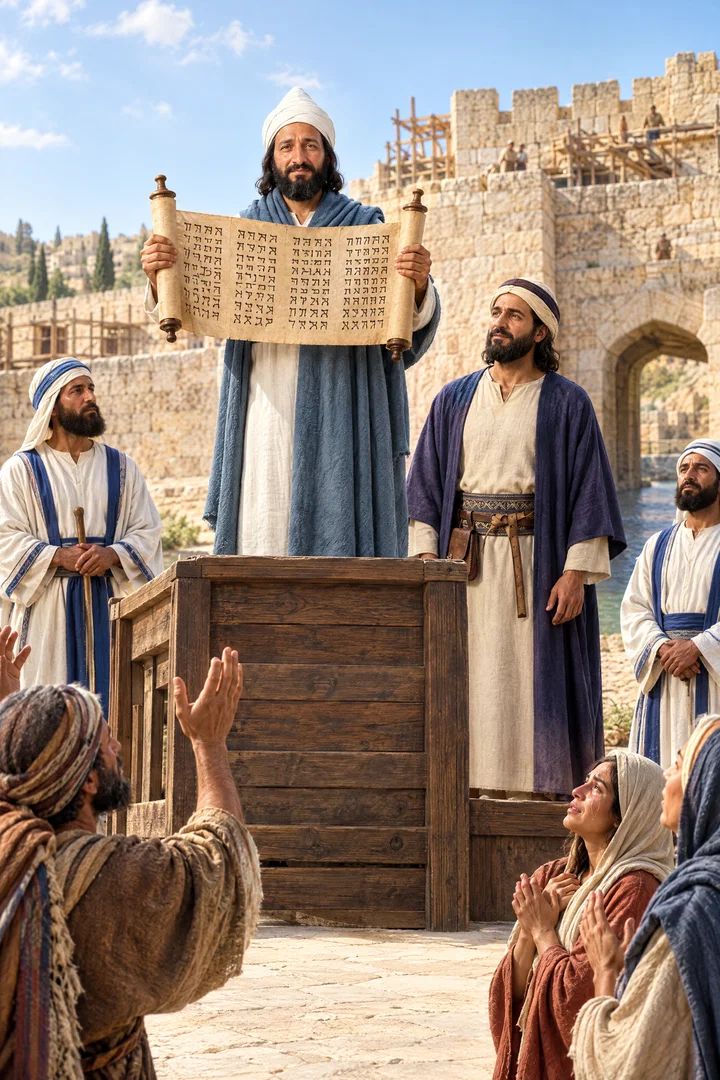
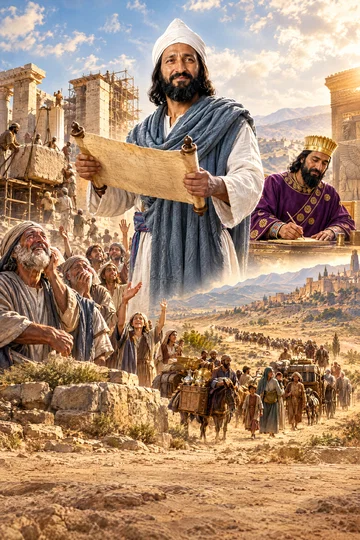
Cross-references 20 of 39
- 2 Chronicles 34:14
And when they brought out the money that was brought into the house of the LORD, Hilkiah the priest found a book of the law of the LORD given by Moses.
Both identify the book as the law given through Moses.
- Deuteronomy 31:9-13
And Moses wrote this law, and delivered it unto the priests the sons of Levi, which bare the ark of the covenant of the LORD, and unto all the elders of Israel.
Commands the public reading of Moses’ law so all Israel may hear and learn it.
- 2 Chronicles 34:30
And the king went up into the house of the LORD, and all the men of Judah, and the inhabitants of Jerusalem, and the priests, and the Levites, and all the people, great and small: and he read in their ears all the words of the book of the covenant that was found in the house of the LORD.
The book of the law is read aloud to the gathered people.
- Deuteronomy 31:24
And it came to pass, when Moses had made an end of writing the words of this law in a book, until they were finished,
Both identify the book of the law as Moses’ writing.
- Nehemiah 9:3
And they stood up in their place, and read in the book of the law of the LORD their God one fourth part of the day; and another fourth part they confessed, and worshipped the LORD their God.
Public reading of the law leads the people to confess and worship.
- Nehemiah 8:8
So they read in the book in the law of God distinctly, and gave the sense, and caused them to understand the reading.
Cited alongside verse 1 as another use of law terminology.
- Mark 12:26
And as touching the dead, that they rise: have ye not read in the book of Moses, how in the bush God spake unto him, saying, I am the God of Abraham, and the God of Isaac, and the God of Jacob?
Both refer to the Book of Moses.
- Nehemiah 8:14-18
And they found written in the law which the LORD had commanded by Moses, that the children of Israel should dwell in booths in the feast of the seventh month:
The people learn the law’s instruction and keep the Feast of Tabernacles.
- Ezra 7:10
For Ezra had prepared his heart to seek the law of the LORD, and to do it, and to teach in Israel statutes and judgments.
Ezra’s purpose to seek, obey, and teach the law is carried out at Jerusalem.
- 2 Kings 22:8
And Hilkiah the high priest said unto Shaphan the scribe, I have found the book of the law in the house of the LORD. And Hilkiah gave the book to Shaphan, and he read it.
The discovered book is called the law of Moses.
- 2 Kings 23:21
And the king commanded all the people, saying, Keep the passover unto the LORD your God, as it is written in the book of this covenant.
Both identify the Mosaic law as the book governing Israel’s observance.
- Nehemiah 8:11
So the Levites stilled all the people, saying, Hold your peace, for the day is holy; neither be ye grieved.
The Levites tell the people to stop grieving because the day is holy.
- Leviticus 23:34-43
Speak unto the children of Israel, saying, The fifteenth day of this seventh month shall be the feast of tabernacles for seven days unto the LORD.
The law prescribes the Feast of Booths observed by the people.
- Joshua 1:8
This book of the law shall not depart out of thy mouth; but thou shalt meditate therein day and night, that thou mayest observe to do according to all that is written therein: for then thou shalt make thy way prosperous, and then thou shalt have good success.
Both texts identify the law of Moses as the book to be kept and followed.
- 2 Kings 23:2
And the king went up into the house of the LORD, and all the men of Judah and all the inhabitants of Jerusalem with him, and the priests, and the prophets, and all the people, both small and great: and he read in their ears all the words of the book of the covenant which was found in the house of the LORD.
Describes the book of the covenant being read before the people.
- Nehemiah 8:18
Also day by day, from the first day unto the last day, he read in the book of the law of God. And they kept the feast seven days; and on the eighth day was a solemn assembly, according unto the manner.
The people hear the book of God’s law read during the feast.
- Galatians 3:10
For as many as are of the works of the law are under the curse: for it is written, Cursed is every one that continueth not in all things which are written in the book of the law to do them.
Both refer to the book of the law and its requirements.
- Ezra 7:6
This Ezra went up from Babylon; and he was a ready scribe in the law of Moses, which the LORD God of Israel had given: and the king granted him all his request, according to the hand of the LORD his God upon him.
Ezra is identified as a scribe of the law of Moses.
- Malachi 4:4
Remember ye the law of Moses my servant, which I commanded unto him in Horeb for all Israel, with the statutes and judgments.
Israel is told to remember the law of Moses.
- Deuteronomy 31:9
And Moses wrote this law, and delivered it unto the priests the sons of Levi, which bare the ark of the covenant of the LORD, and unto all the elders of Israel.
Moses writes the law and delivers it to Israel’s leaders.
Commentary
Each commentary is drawn from primary sources: the writings of Ellen G. White and Adventist pioneers and periodicals. Each commentary is separate. Its own words are not a quotation; follow the references to read the source passages.
Ellen G. White
8 sources
The gathering took place in Jerusalem in the broad street before the water gate, after the wall and gates had been rebuilt while much of the city still lay in ruins amid rough masonry and partially ruined buildings.PK 661.1–2PK 661 The time was the seventh month, the divinely appointed Feast of Trumpets, kept after the return from exile, whereas during the captivity the observance had not been kept.PK 661.1–2ST Apr 28, 1898Ms 41, 1900, par. 37–39 Those assembled were the returned Jews, including people from the surrounding country, gathered together as one man in unity.PK 661.1–2Ms 156, 1902, par. 17–20Ms 53, 1910, par. 21–23PK 661ST Apr 28, 1898 They gathered as one after the return from exile to hear what they had requested.Ms 41, 1900, par. 37–39
The book they sought was the book of Moses' teaching which the Lord had commanded Israel, long lost sight of until it was found, centered on the Ten Commandments.Ms 156, 1902, par. 17–20PK 661 At their own united request they asked Ezra the scribe to bring the book and read it to them, which began a public reading with explanation so they could understand it.Ms 156, 1902, par. 17–20Ms 53, 1910, par. 21–23PK 661.3PK 661 The returned people repented in asking for the reading, and Ezra read to them from the platform from morning until midday.ST Apr 28, 1898Ms 41, 1900, par. 37–39
Ezra read from a raised wooden platform with other men standing behind him, holding the open book before the large assembly from morning until midday.PK 661.1–2PK 661ST Apr 28, 1898 When he blessed the Lord the people responded with amen, bowed their heads and worshiped, listening attentively, some raising hands or leaning forward.PK 661.1–2PK 661 Hearing and having the law explained was a great privilege that confronted the people with their sins, the blessings lost through disobedience, and the national violation that had caused their scattering into captivity.Ms 41, 1900, par. 37–39 It led them to repentance and return to the Lord, an outcome like that later expected from the preaching of John, and gave reason for joy and praise for mercy rather than lasting grief.DA 215.3–216.1ST Apr 28, 1898Ms 41, 1900, par. 37–39 Their united request and attention show the importance of making God's Word known, calling those who know its truths to work to extend that knowledge to neighbors and surrounding settlements.Ms 53, 1910, par. 21–23
Sources
Pioneers and periodicals
35 sources
All the people gathered together as one man in unity into the open square before the Water Gate after the wall was finished, on the first day of the seventh month, and asked Ezra the scribe to bring the book.ST Dec 20, 1899RH Apr 22, 1902ST May 28, 1902 The book was the book of the law of Moses which the Lord had commanded Israel, the first five books and especially the instructions given through Moses, distinct from the Ten Commandments which God Himself wrote on tables of stone.ST Dec 20, 1899RH Apr 7, 1904ST Feb 13, 1893RH Oct 21, 1851RH Apr 30, 1857 Ezra read it distinctly from a platform from morning until midday, while the Levites as appointed teachers gave the sense in language the people could understand, and the people listened attentively and reverently with desire to know and do God's will.RH Apr 22, 1902ST Feb 13, 1893ST Aug 19, 1897ST Feb 25, 1886 The reading wrought a genuine and lasting revival and national reformation through the Word and Spirit of God, bringing conviction of sin and weeping toward repentance, followed by confession and putting away of sin, separation from the world, worship, and a solemn covenant to keep the law with great joy.RH Apr 22, 1902ST May 21, 1896ST Aug 19, 1897ST Dec 30, 1913 On hearing it the people kept the Feast of Booths as written though it had not been so observed since the days of Joshua, and the law so read proves the distinction between the moral law on stone and the law of commandments contained in ordinances which shadowed the gospel and was nailed to the cross.ST Feb 12, 1885RH Jan 14, 1862RH Oct 21, 1851RH Apr 21, 1851RH Aug 20, 1872
Gathering Place and Time
All the people gathered themselves together as one man in unity in one place to hear the law read.ST Dec 20, 1899RH Apr 7, 1904ST Nov 1, 1899ST May 21, 1896 Their united gathering and united request showed eagerness to hear God's word and desire to know and do what He required.ST Dec 20, 1899RH Apr 7, 1904ST Jun 12, 1879 They gathered into the open square or street that was before the Water Gate.ST Dec 20, 1899ST Nov 1, 1899ST Feb 25, 1886ST Jun 12, 1879 There they spoke unto Ezra the scribe to bring the book of the law of Moses which the Lord had commanded Israel.ST Dec 20, 1899ST Nov 1, 1899ST Feb 25, 1886ST May 28, 1902
The gathering took place after Judah's Babylonian captivity, when Ezra and Nehemiah had brought a remnant back to Jerusalem.STST Sep 26, 1895 After the exile the Israelites still possessed the book of the law of Moses, even though the ark was said to have been burned.ST Dec 24, 1894 Ezra had brought the book from Babylon to Jerusalem after it had fallen into disuse, to lead the people back to keeping its laws and forms of worship.ST Apr 28, 1898ST Sep 26, 1895
It took place after the wall and gates of Jerusalem were finished.RH Apr 22, 1902RH Jul 2, 1908 This was on the first day of the seventh month, a divine appointment for public reading of Scripture which had not been observed during the captivity.ST Apr 28, 1898ST May 28, 1902 By then the people could dwell in comparative safety while worship was being restored according to Scripture, though they came in from the surrounding country when much of the city still lay in ruins.ST May 28, 1902 The verse belongs to the time of Ezra and Nehemiah, a period whose Babylonian life and history can be studied through archaeological records.ST Mar 10, 1909
Book of Law Described
The book Ezra was asked to bring is the book of the law of Moses which the Lord had commanded Israel.ST Dec 20, 1899RH Apr 7, 1904ST Feb 13, 1893ST Sep 26, 1895 It means the first five books of the Bible, especially the instructions given to Israel.ST Feb 13, 1893 It is also called the Pentateuch.ST Sep 26, 1895
It was law recorded in a book.RH Nov 25, 1852ST Dec 20, 1905RH Apr 21, 1851 It was written by the hand of Moses in a book and called the book of the covenant.RH Oct 21, 1851RH Dec 9, 1851RH Apr 21, 1851RH Aug 5, 1851 It contains the whole body of law given through Moses, including its ceremonies and ordinances of the Jewish religion.ST Sep 10, 1912RH Oct 21, 1851RH Dec 9, 1851RH Apr 21, 1851 As such the whole law was called the law of God.ST Sep 10, 1912
This book-law is distinct from the Ten Commandments which God Himself wrote on tables of stone.RH Oct 21, 1851RH Dec 9, 1851RH Apr 21, 1851RH Aug 5, 1851 The two expressions are not claimed to mean precisely the same thing.RH Jun 10, 1862 The reading from morning until midday shows by its length that it was not merely the Ten Commandments, which could have been read in a few minutes.RH Apr 30, 1857
Though written by Moses, the law's words are God's words.ST Feb 25, 1886ST Feb 25, 1886 Attentive hearing of it is therefore fitting respect for its divine Author.ST Feb 25, 1886ST Feb 25, 1886
The verse evidences that the Scriptures were preserved after the exile even though the ark was said to have been burned.ST Dec 24, 1894 Ezra brought the book from Babylon to Jerusalem after it had fallen into disuse, to lead the people back to keeping its laws and forms of worship.ST Sep 26, 1895 That event established the Pentateuch as the canonical and authoritative book of the Jews, laying the foundation of the Old Testament canon about the middle of the fifth century B.C., never questioned since.ST Sep 26, 1895 At that time copies were so rare that the people depended on hearing it read, and access to Scripture brought overwhelming joy.ST Aug 12, 1897
Reading and Hearing Explained
The people's request for the book brings about a public reading of Scripture, fulfilling Ezra's lifelong devotion to studying the law and teaching it in Israel.ST Nov 1, 1899ST Feb 25, 1886RH Oct 16, 1900 That reading is distinct and audible, given from a raised platform, and it continues from early morning until midday, from dawn until midday.ST Apr 28, 1898ST Aug 19, 1897ST Jun 12, 1879 The length and steadiness of the reading show a sustained, ordered proclamation rather than a brief recital.ST Apr 28, 1898ST Aug 19, 1897ST Jun 12, 1879
Alongside the reading the Levites stand before the congregation as restored God-appointed teachers after a time of general decay in which they had been deprived of their work.RH Apr 22, 1902 They give the sense of what is read and help the hearers understand it, explaining its meaning in simple language the people can grasp.ST Aug 19, 1897ST Jun 12, 1879 This explanation is needed because the people's Hebrew has become corrupted through contact with other nations, so the law must be put into language they understand.ST Jun 12, 1879 Even though the law is worded briefly and plainly, its meaning is comprehensive and still requires gifted, Spirit-guided teachers to unfold it.
The people receive the reading with attentive, reverent, close attention through the long hours of hearing.ST Aug 19, 1897ST Feb 25, 1886ST Feb 25, 1886ST Jun 12, 1879ST Jun 12, 1879 Their united request and fixed attention show eagerness to hear God's word and a desire to know it in order to do it.ST Feb 13, 1893ST Jun 12, 1879 That desire reveals a submissive heart toward God.ST Feb 13, 1893 Since the words, though written by Moses, are God's own words, such attentive hearing is fitting respect for their divine Author.ST Feb 25, 1886ST Feb 25, 1886
Revival Reformation and Covenant
The gathering records a great religious revival and national reformation that followed the building of the walls through courage and unrelenting zeal, after the people had grown negligent in the study of the Scriptures.RH Apr 22, 1902 Men, women, and children gathered about Ezra and the Levites and listened for hours, even the fourth part of the day, to the reading of the law and the teaching of the Levites.RH Apr 22, 1902 The Levites, deprived of their work in the general decay, stood before the congregation restored as their God-appointed teachers.RH Apr 22, 1902 The gathering as one to hear the law read was part of a reformation and a separation from the world, a national reformation centered on hearing God's Word in which civil rulers and religious leaders worked together.ST May 21, 1896RH Jul 2, 1908RH Sep 7, 1911 Bible teaching in this setting brought great spiritual uplift.ST Dec 30, 1913
It was a genuine revival and lasting work of the Spirit of God wrought through the Word of God and not by might nor army.ST Aug 19, 1897 The Bible read distinctly with the sense given so the people understood brought conviction of sin and led toward repentance and reformation.ST Aug 19, 1897 Its message moved the people to weep when sins were revealed, and Ezra calmed them rather than letting their grief become passionate but useless feeling.
The reading was followed by confessions, the putting away of revealed sin, and the worship of God.RH Apr 22, 1902ST Aug 19, 1897 Those meetings in which the people studied God's Word led them to recognize their duty to support the worship of God's house.RH Jul 9, 1908 Copies of the sacred books were then so rare that the gathered people depended on hearing them read and explained, and this access to Scripture brought them overwhelming joy.ST Aug 12, 1897 The gathering to hear Ezra read the law after it had fallen into disuse led the people back to keeping its laws and forms of worship in a solemn covenant to keep the law of Moses.ST Sep 26, 1895
The reading led to a heart reformation, not merely a change in outward forms.RH Jul 2, 1908 The people were determined on rigid observance because they remembered that neglect of the law had caused their exile.ST That resolve, begun here, was later pushed into fanatical over-observance, with rabbis loading the Sabbath with fanciful meanings and oppressive ceremonial restrictions, so that when Jesus came as the embodiment of the true Sabbath idea He was persecuted.ST
When they heard the law read they followed its instructions to celebrate the Feast of Booths, treating the written command as duty without using ancestral failure as excuse, even though Israel had not observed it in this way since the days of Joshua.ST Feb 12, 1885 The feast of tabernacles is presented as a joyful festival commemorating the wilderness sojourn.RH Jan 14, 1862 It is also a probable type of the rejoicing after God's people are gathered into His kingdom.RH Jan 14, 1862
Doctrine Typology and Example
The reading Ezra was asked to give belongs among the public readings of the Levitical law.RH Aug 20, 1872 The book he brought is the law of Moses, written by the hand of Moses in a book and called the book of the covenant.RH Oct 21, 1851RH Apr 21, 1851 It is the law of commandments contained in ordinances, distinct from the ten commandments which God Himself wrote with His finger on tables of stone.RH Oct 21, 1851RH Apr 21, 1851 Its carnal rites, with burnt offerings and sacrifices, meats and drinks and divers washings, shadowed forth the good things of the gospel.RH Apr 21, 1851 Those ordinances were blotted out and nailed to the cross when the Lamb of God shed His blood.RH Apr 21, 1851
The book was brought to teach what God required of Israel.ST Dec 20, 1899 Its meaning was to be explained so that the requirements could be fully understood.ST Dec 20, 1899 Though written by Moses, its words are God's words, so attentive hearing shows fitting respect for its divine Author.ST Feb 25, 1886 God's word thus taught leads people in the way of happiness and peace.ST Feb 25, 1886
The united request of the people and the presence of the leaders show that God's Word was highly esteemed and that they felt their need to know God's will.RH Jul 2, 1908 Their gathering began a national reformation centered on hearing God's Word.RH Jul 2, 1908 That reading produced a heart reformation, not merely a change in outward forms.RH Jul 2, 1908 The account therefore stands as a model for gatherings to give more time to Bible study and less to business.RH Jul 2, 1908
Sources