Deuteronomy 4:10
Specially the day that thou stoodest before the LORD thy God in Horeb, when the LORD said unto me, Gather me the people together, and I will make them hear my words, that they may learn to fear me all the days that they shall live upon the earth, and that they may teach their children.
Translations
Specially the day that you stood before the LORD your God in Horeb, when the LORD said to me, Gather me the people together, and I will make them hear my words, that they may learn to fear me all the days that they shall live on the earth, and that they may teach their children.
Specially the day that thou stoodest before the LORD thy God in Horeb, when the LORD said unto me, Gather me the people together, and I will make them hear my words, that they may learn to fear me all the days that they shall live upon the earth, and that they may teach their children.
specially the day that thou stoodest before the Lord thy God in Horeb, when the Lord said unto me, Gather me the people together, and I will make them hear my words, that they may learn to fear me all the days that they shall live upon the earth, and that they may teach their children.
Specially the day that thou stoodest before the LORD thy God in Horeb, when the LORD said to me, Assemble the people to me, and I will make them hear my words, that they may learn to fear me all the days that they shall live upon the earth, and that they may teach their children.
the day that thou stoodest before the LORD thy God in Horeb, when the LORD said unto me, Assemble me the people, and I will make them hear my words, that they may learn to fear me all the days that they live upon the earth, and that they may teach their children.
the day that thou stoodest before Jehovah thy God in Horeb, when Jehovah said unto me, Assemble me the people, and I will make them hear my words, that they may learn to fear me all the days that they live upon the earth, and that they may teach their children.
'The day when thou hast stood before Jehovah thy God in Horeb — in Jehovah's saying unto me, Assemble to Me the people, and I cause them to hear My words, so that they learn to fear Me all the days that they are alive on the ground, and their sons they teach; —
the day that thou stoodest before Jehovah thy God in Horeb, when Jehovah said to me, Gather me the people together, that I may cause them to hear my words, that they may learn them, and fear me all the days that they live upon the earth, and teach them to their children.
What day thou didst stand before Yahweh thy God, in Horeb, when Yahweh said unto me, Gather unto me the people, that I may let them hear my words,—which they must learn that they may revere me all the days which they are living upon the soil, their children also, must they teach.
Berean Standard Bible, Majority Standard Bible
The day you stood before the LORD your God at Horeb, the LORD said to me, “ Gather the people before Me to hear My words, so that they may learn to fear Me all the days they live on the earth, and that they may teach them to their children.”
the day that you stood before the LORD your God in Horeb, when the LORD said to me, “ Assemble the people to me, and I will make them hear my words, that they may learn to fear me all the days that they live on the earth, and that they may teach their children.”
That day when you were waiting before the Lord your God in Horeb, and the Lord said to me, Make all the people come together, so that hearing my words they may go in fear of me all the days of their life on earth and give this teaching to their children.
Forget not the day that thou stoodest before the Lord thy God in Horeb, when the Lord said vnto me, Gather me the people together, and I wil cause them heare my wordes, that they may learne to feare me all the dayes that they shall liue vpon the earth, and that they may teache their children:
Douay-Rheims (Challoner revision)
From the day in which thou didst stand before the Lord thy God in Horeb, when the Lord spoke to me, saying: Call together the people unto me, that they may hear my words, and may learn to fear me all the time that they live on the earth, and may teach their children.
Pictures
Cross-references 20 of 44
- Exodus 20:1-17
And God spake all these words, saying,
Records the commandments given to Israel at Sinai.
- Deuteronomy 6:6-7
And these words, which I command thee this day, shall be in thine heart:
God’s words are to remain in the heart and be taught diligently to children.
- Exodus 19:16-20
And it came to pass on the third day in the morning, that there were thunders and lightnings, and a thick cloud upon the mount, and the voice of the trumpet exceeding loud; so that all the people that was in the camp trembled.
Israel gathers at Sinai to hear God speak amid fire and the mountain’s signs.
- Deuteronomy 5:1-22
And Moses called all Israel, and said unto them, Hear, O Israel, the statutes and judgments which I speak in your ears this day, that ye may learn them, and keep, and do them.
Repeats the commandments spoken publicly to Israel at Horeb.
- Deuteronomy 11:19
And ye shall teach them your children, speaking of them when thou sittest in thine house, and when thou walkest by the way, when thou liest down, and when thou risest up.
Both command parents to teach God’s words to their children throughout daily life.
- Exodus 19:5-6
Now therefore, if ye will obey my voice indeed, and keep my covenant, then ye shall be a peculiar treasure unto me above all people: for all the earth is mine:
Both describe Israel hearing God’s words and the covenant calling to obey him.
- Deuteronomy 10:4
And he wrote on the tables, according to the first writing, the ten commandments, which the LORD spake unto you in the mount out of the midst of the fire in the day of the assembly: and the LORD gave them unto me.
The tablets contain the commandments spoken at the assembly.
- Exodus 19:10-14
And the LORD said unto Moses, Go unto the people, and sanctify them to day and to morrow, and let them wash their clothes,
The people prepare themselves before gathering to hear God at Sinai.
- Acts 7:38
This is he, that was in the church in the wilderness with the angel which spake to him in the mount Sina, and with our fathers: who received the lively oracles to give unto us:
Identifies the words given at Horeb as living oracles received by Israel.
- Deuteronomy 5:29
O that there were such an heart in them, that they would fear me, and keep all my commandments always, that it might be well with them, and with their children for ever!
God desires Israel to fear him and keep his commandments for their children’s good.
- Exodus 24:12
And the LORD said unto Moses, Come up to me into the mount, and be there: and I will give thee tables of stone, and a law, and commandments which I have written; that thou mayest teach them.
Both describe God giving the law and commandments at Horeb.
- Psalms 68:17
The chariots of God are twenty thousand, even thousands of angels: the Lord is among them, as in Sinai, in the holy place.
The Lord is present among the angelic host at Sinai.
- Deuteronomy 33:2
And he said, The LORD came from Sinai, and rose up from Seir unto them; he shined forth from mount Paran, and he came with ten thousands of saints: from his right hand went a fiery law for them.
God comes to Sinai and gives the law as a fiery word.
- Ecclesiastes 12:13
Let us hear the conclusion of the whole matter: Fear God, and keep his commandments: for this is the whole duty of man.
Both identify fearing God and keeping his commandments as humanity’s duty.
- Psalms 111:10
The fear of the LORD is the beginning of wisdom: a good understanding have all they that do his commandments: his praise endureth for ever.
Both link fearing the Lord and obeying his commands with wisdom and understanding.
- Deuteronomy 4:16-19
Lest ye corrupt yourselves, and make you a graven image, the similitude of any figure, the likeness of male or female,
The Horeb experience grounds the warning against worshiping images and heavenly bodies.
- Exodus 24:7
And he took the book of the covenant, and read in the audience of the people: and they said, All that the LORD hath said will we do, and be obedient.
Israel hears God’s words and pledges to obey them.
- Deuteronomy 5:22
These words the LORD spake unto all your assembly in the mount out of the midst of the fire, of the cloud, and of the thick darkness, with a great voice: and he added no more. And he wrote them in two tables of stone, and delivered them unto me.
God spoke these words to the gathered people and added no more.
- Psalms 78:5-7
For he established a testimony in Jacob, and appointed a law in Israel, which he commanded our fathers, that they should make them known to their children:
God’s instruction is entrusted to parents to pass on to the next generation.
- Deuteronomy 4:36-40
Out of heaven he made thee to hear his voice, that he might instruct thee: and upon earth he shewed thee his great fire; and thou heardest his words out of the midst of the fire.
Both ground keeping the commandments in Sinai instruction.
Commentary
Each commentary is drawn from primary sources: the writings of Ellen G. White and Adventist pioneers and periodicals. Each commentary is separate. Its own words are not a quotation; follow the references to read the source passages.
Ellen G. White
33 sources
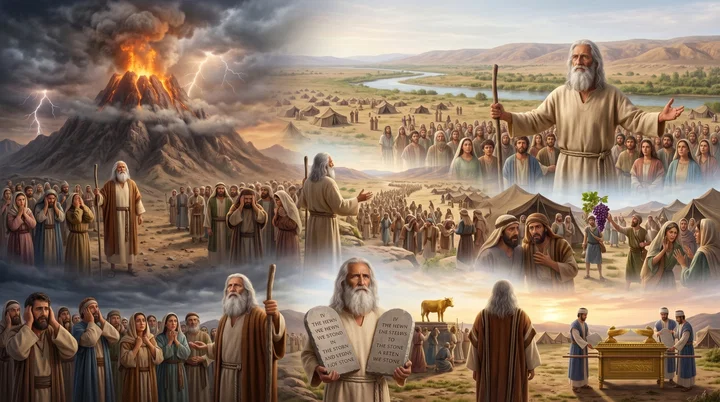
At Horeb, also called Sinai, God had the people gathered together beneath the mountain to stand before Him and hear His own words spoken from the cloud and fire, hearing His voice but seeing no form.RH Sep 5, 1907Ms 152, 1901, par. 24–26Lt 31, 1898, par. 37–40Ms 125, 1901, par. 1–2Ms 146, 1906, par. 36–44
What they heard was His covenant, the Ten Commandments declared and written on two tables of stone together with righteous statutes and judgments to guide their lives.Lt 6, 1909, par. 5Lt 31, 1898, par. 37–40Ms 125, 1901, par. 1–2
The purpose was that they would learn to fear Him with reverence all the days they live on the earth, with careful attention, full surrender and simple obedience rather than mere belief.RH Sep 5, 1907Ms 152, 1901, par. 24–26Lt 31, 1898, par. 37–40Ms 110, 1899, par. 6–9Lt 55, 1897, par. 9–11
That day and what was witnessed there were never to be forgotten but to be kept in the heart and carefully taught to children and grandchildren from generation to generation.RH Sep 5, 1907Ms 152, 1901, par. 24–26Lt 31, 1898, par. 37–40Ms 187, 1907, par. 3–4Ms 141, 1906, par. 31–33
Parents carry this duty in the home by precept and example, and faithful obedience would fulfill the condition of God's promises, display the wisdom and righteousness of His law before other nations, and keep Israel in the promised inheritance.Ms 15, 1903, par. 9–11FE 508.1–4Lt 34, 1899, par. 34–38Ms 120, 1909, par. 8–10Ms 83, 1910, par. 7–8
Horeb Setting and Words
At Horeb Israel stood before God when He commanded the people to be gathered together to hear His words directly, so that they would learn to fear Him with reverence all the days they live upon the earth and would teach their children.RH Sep 5, 1907Ms 152, 1901, par. 24–26Lt 31, 1898, par. 37–40Ms 15, 1903, par. 9–11RH Aug 23, 1906 The gathering was to hear Him for themselves, that reverent fear learned there would last through life and be passed on in the family.RH Sep 5, 1907Ms 152, 1901, par. 24–26Lt 31, 1898, par. 37–40RH Aug 23, 1906Ms 110, 1899, par. 6–9
Horeb is also called Sinai, and the gathering took place at the mountain where the people stood beneath it while it was covered with a cloud and burned with fire.Ms 146, 1906, par. 36–44Ms 131, 1907, par. 26–28 The infinite God spoke through the cloud and from the fire with a voice that made the people tremble every time they heard it, and they heard His voice but saw no form or visible likeness.Ms 125, 1901, par. 1–2Ms 146, 1906, par. 36–44Ms 131, 1907, par. 26–28 God gave no visible likeness so the people would not copy it to make an image.Ms 84, 1910, par. 51–53Ms 131, 1907, par. 26–28 He set Israel apart from other nations at that place.PP 376.4
The people came to associate the sacred mountain with His presence and the display of His glory, and the scene made His presence and will known to them.ST May 13, 1886PP 376.4 The words heard at Horeb were God's covenant, the Ten Commandments which He declared and wrote on two tablets of stone, together with righteous statutes and judgments that showed how near He was to Israel and were given to guide their lives.Lt 31, 1898, par. 37–40Ms 125, 1901, par. 1–2ST May 13, 1886Ms 131, 1907, par. 26–28 That covenant included the Sabbath commandment proclaimed at Sinai, and the instruction was never to be erased or changed.Lt 6, 1909, par. 5Ms 93, 1908, par. 38–4120MR 395.5
The day at Horeb and what was witnessed there were not to be forgotten but to be remembered, kept in the heart, and carefully passed down through the generations to children and grandchildren.RH Sep 5, 1907Ms 152, 1901, par. 24–26Lt 31, 1898, par. 37–40Ms 110, 1899, par. 6–9Ms 125, 1901, par. 1–2 That remembrance included an explanation of why the law was given at Sinai and what Israel was to do and become in the promised land.Ms 152, 1901, par. 24–26Ms 116, 1902, par. 21–27
Law, Obedience and Witness
Deuteronomy 4:10 belongs to a chapter that calls God's covenant people to careful attention to His law and to what He required of ancient Israel in order to be holy to Him.Lt 6, 1909, par. 57MR 309.1–3 Studying those instructions helps people understand God's requirements.7MR 309.1–3 The charge in the chapter must be carefully regarded, with full surrender and simple obedience in which none of the important things specified in God's Word are neglected.Lt 42, 1910, par. 6 That careful study includes the law proclaimed at Sinai, including the Sabbath God gave to be kept holy, which marks those who obey as His people.Lt 6, 1909, par. 520MR 395.5
The directions in the chapter express God's mind and remain binding, teaching enduring principles for religious service and for conduct toward God and toward one another.Ms 40, 1891, par. 42–45 Those principles are part of His law to be put into practice, including justice, love, compassion, tenderness, liberality, and courtesy.Ms 40, 1891, par. 42–45 Disregarding them misrepresents His character.Ms 40, 1891, par. 42–45 The claim that a person once in grace is always in grace while disregarding the law turns souls away from a plain Thus saith the Lord.Ms 2, 1904, par. 31–35
Obedience to the law of God is the only condition on which His promises to Israel would be fulfilled.Ms 2, 1904, par. 31–35 The law given at Sinai, including the Sabbath of the fourth commandment, applies to God's people as surely as it applied to ancient Israel.RH Sep 5, 1907Ms 2, 1904, par. 31–35 Its lessons apply in the present as they did to Israel.FE 508.1–4 This instruction at Horeb to hear His words, learn reverence throughout life, and teach children is among the reasons God's people are identified as His people and is to be repeatedly presented.RH Sep 5, 1907Ms 175, 1905, par. 3
The record stands as instruction for God's commandment-keeping people today, warning and guiding God's people in every age.Ms 110, 1899, par. 6–9 Those seeking to enter the heavenly Canaan must heed the lessons of the wilderness experience.Ms 110, 1899, par. 6–9 Hearing God's words means learning to fear Him all the days of life upon the earth and teaching children, expressed not in merely theoretical belief but in combined faith and works.Lt 55, 1897, par. 9–11 That is shown in walking in the light shining in strong steady rays across the pathway, setting a right example, receiving the Spirit and favor of God, and educating others to do service for the Lord, including medical missionary service.Lt 55, 1897, par. 9–11
Faithful obedience in remembering what was seen and keeping God's commands would display the wisdom and righteousness of God's law to other nations and give Israel an ennobling influence among them.Lt 34, 1899, par. 34–38 Keeping God's commandments brings well-being and long life, while disobedience brings judgment.FE 508.1–4 Remembering God's words and obeying His law were essential to retaining the promised inheritance, for Israel would perish from the land if they did evil.PP 465.2–4 Israel's wilderness history confirms that God's word is fulfilled, in that only two adults who left Egypt entered Canaan.FE 508.1–4
Teaching Children at Home
The charge at Horeb lays on parents the duty to teach God's requirements, the Scriptures, and the way of the Lord to sons and daughters through sacred, repeated instruction.Ms 152, 1901, par. 24–26Ms 187, 1907, par. 3–4Ms 120, 1909, par. 8–10Lt 259, 1902, par. 3–5Ms 222, 1902, par. 1 That teaching is to bring the commandments prominently before the people so they can teach heaven's requirements, explaining why the law was given at Sinai and what Israel was to do and become in the promised land.Ms 152, 1901, par. 24–26Lt 259, 1902, par. 3–5 It supports giving children instruction in Scripture from childhood to respect the law, to fear God, and to keep His commandments.Ms 187, 1907, par. 3–4Ms 120, 1909, par. 8–10Ms 222, 1902, par. 1
Parents must first obey God themselves and take time to pray and train their children by precept and example, without harsh or discouraging speech.Ms 15, 1903, par. 9–11 They are to watch over them and guide them with patience, kindness, and watchfulness, encouraging their hearts with God's words.Ms 120, 1909, par. 8–10Ms 83, 1910, par. 7–8 Genuine humility and reality in the Christian life make the impression on others, and God Himself makes the impression on children's hearts so that they follow the heavenly Father in obedience.Ms 120, 1909, par. 8–10Ms 83, 1910, par. 7–8 Such faithful teaching brings grace and blessing both to parents and to youth.Ms 120, 1909, par. 8–10
True education is parents teaching their children to fear God all the days they live upon the earth and to teach their own children in turn, passing the charge from father to son for generations.Ms 152, 1901, par. 24–26Ms 141, 1906, par. 31–33 It includes strict training in observance of the very day observed today.Ms 141, 1906, par. 31–33 Each person must take heed to himself, beginning with himself, and must not neglect the duty by giving all attention to business, for such teaching serves the highest interest of the soul.Ms 187, 1907, par. 3–4Ms 141, 1906, par. 31–33 Those who honor God by remembering His instruction, keeping His commandments, and teaching them to children are called holy and sanctified.Ms 195, 1901, par. 9–14
The beginning of work for the church is in the home, where every house is to be as a church even if only father, mother, and children are present.Ms 15, 1903, par. 9–11Ms 146, 1906, par. 36–44 There children are to be brought up in nurture and admonition to keep the way of the Lord and to walk humbly before Him.Ms 15, 1903, par. 9–11Ms 146, 1906, par. 36–44 Children are God's redeemed property, to be taught His lessons so they may be His missionaries in the church and in the world.Ms 15, 1903, par. 9–11 The same duty of careful, sincere work extends to youth in institutions and to work in the home and in assemblies, with the aim to honor God and communicate the truth clearly.Ms 15, 1903, par. 9–11Ms 83, 1910, par. 7–8
Parents are accountable for this training, for disobedience of children follows disobedience of parents.Ms 15, 1903, par. 9–11 Letting children grow up in ignorance and disobedience of the words God spoke leaves parents to answer, and those who disregard the Word will be cut off to be punished.Ms 146, 1906, par. 36–44 Childhood training in obedience to respect the law of God, to fear God and keep His commandments, would keep people from becoming robbers and filling up wickedness.Ms 146, 1906, par. 36–44 Cleansing from iniquity and healing of backsliding and forgetfulness are needed to fulfill the charge.Ms 15, 1903, par. 9–11 The Israelite camp makes this a lesson for parents at camp meetings to teach children consistently to honor the sacred gathering, keep it orderly, and take part in useful work, and the responsibility to give these lessons and to follow on to know the Lord remains just as binding now as at Horeb until Christ comes in the clouds of heaven.Ms 187, 1907, par. 3–4Ms 120, 1909, par. 8–10Ms 152, 1901, par. 27–28
Sources
Pioneers and periodicals
53 sources
On the special day recalled in the verse Israel stood before the Lord at Horeb, which is Sinai, where God Himself gathered about two to three million people to hear His own voice out of fire, cloud and darkness.ST Jan 31, 1911RH Oct 27, 1868ST Feb 8, 1905RH May 28, 1901ST Mar 26, 1896 The words they heard were His covenant, even the Ten Commandments, spoken audibly and added to no more, then written by His own finger on two tables of stone to be kept in the ark.ST May 13, 1886ST Sep 30, 1886RH Oct 27, 1868ST Nov 12, 1912RH Apr 30, 1872 They were made to hear in order that they might learn to reverence Him all the days they should live on the earth, for learning the fear of God comes by hearing His words.RH Sep 5, 1907ST Sep 30, 1886RH Jan 19, 1911RH Jan 1851 That same hearing lays an inescapable charge on parents to keep what they saw and heard in their hearts and to teach it diligently to sons and grandsons at all times, rising, lying down, walking and sitting, in place of folly and fiction.RH Sep 5, 1907RH Dec 15, 1859ST Oct 18, 1905ST Jan 4, 1905ST Mar 27, 1901 Those commandments were not for Israel only but are perpetual for all nations in every age, set apart in origin, form and keeping from the ceremonial, civil and other statutes given privately through Moses, and forming the enduring basis of both covenants and of the gospel itself.RH Sep 5, 1907RH Oct 27, 1868ST Aug 13, 1885RH Mar 26, 1872ST Mar 7, 1906
Context and Setting at Horeb
The verse stands in the fifth and last book of the Pentateuch, in the first of three addresses given by Moses just before his death.RH Feb 24, 1916 That opening section, chapters 1 to 4:40, rehearses God's goodness to Israel, His deliverances, and the lessons of the wilderness on the journey from Egypt to Canaan.RH Feb 24, 1916ST Feb 27, 1912ST Mar 1, 1910 It belongs to Moses' repetition of the law and recounting of what God had done, recalling lessons already taught in the wilderness years.ST Feb 27, 1912ST Mar 1, 1910
Near death Moses called all Israel to hear, rehearsing the wilderness journey and what God had done for them.ST Oct 18, 1905 He charged them to take heed to themselves and keep their souls diligently, never to forget what their eyes had seen nor let it depart from their hearts all the days of their lives.RH Feb 19, 1914ST Oct 18, 1905RH Oct 16, 1900ST Aug 27, 1885 They were to keep that memory in heart all their days and teach it to sons and grandsons, to sons' sons and to their children.RH Feb 19, 1914ST Oct 18, 1905RH Oct 16, 1900ST Aug 27, 1885 The appeal in Deuteronomy 4 is a mighty incentive to observe the Decalogue, reminding Israel of its own littleness and of God's goodness.ST Feb 28, 1911 It warns continually not to forget but to take diligent heed, pressing God's great moral lessons home upon the heart with tremendous force.ST Feb 28, 1911
Horeb and Sinai are the same place, where Israel stood before the Lord thy God on the special day recalled forty years later.RH Oct 27, 1868ST Mar 26, 1896 About two millions heard God's own voice there by His own voice in the hearing of all the people.RH Oct 27, 1868 Counting women, children, and older people, the people gathered to witness the giving of the law numbered about three million.RH May 28, 1901
At Horeb God's visible presence was necessarily veiled by clouds and darkness.ST Feb 14, 1906 Sin had separated humanity from God, who is a consuming fire dwelling in unapproachable light that no sinful mortal can see and live, so He could no longer walk and talk with man face to face as in the beginning.ST Feb 14, 1906 The hiding of His face was not anger but loving, necessary precaution to preserve human life until the plan of redemption restores face-to-face dwelling in His light and glory.ST Feb 14, 1906 Even while veiled, He continued to make known the provisions and requirements of His will through the gifts and manifestations of His Spirit, in His dealings and in the works of His hands.ST Feb 14, 1906 He spoke out of the midst of the fire with a sublime and awe-inspiring display of glory.ST Jan 31, 1911ST Feb 8, 1905ST Sep 3, 1912 The people heard the voice of the words but saw no form, only a voice, amid cloud, fire, and darkness.ST Jan 31, 1911ST Feb 8, 1905ST Sep 3, 1912RH Sep 3, 1857
Special stress on Horeb was needed because they were a stiff-necked people who needed their minds stirred up by remembrance.ST Oct 18, 1905 Most had seen God's wonders as children, when impressions are most vivid and lasting.ST Oct 18, 1905 Fallen humanity is most impressed by temporal loss of property, life, and friends, while the spiritual words and rules of life given at Horeb were in danger of being overlooked.ST Oct 18, 1905 In repeating the law Moses does not always repeat the laws in their exact earlier wording, but recalls them and sometimes adds reasons for keeping them.ST Feb 27, 1912
Hearing Words and Learning Reverence
God commanded Moses to gather the people together at Horeb to hear His words.RH Oct 27, 1868RH Jan 1851ST Mar 7, 1906RH Oct 14, 1873 He made them hear those words Himself, by His own voice spoken directly in the hearing of all the people, about two millions standing before Him.RH Oct 27, 1868ST Mar 7, 1906RH Oct 14, 1873 Learning to fear God comes by hearing His words, and those who so learn must pass that fear and those words on to their children.RH Jan 1851
The purpose of that hearing was that they might learn to fear or reverence Him all the days they shall live upon the earth.RH Sep 5, 1907RH Aug 23, 1906ST May 13, 1886ST Sep 30, 1886RH Jan 19, 1911 It was a lifelong lesson learned through hearing His words, with the memory of the Horeb encounter and the law given there to be kept in heart and never forgotten.RH Sep 5, 1907ST May 13, 1886RH Jan 19, 1905 That instruction in the fear of the Lord was for parents to pass on with God's law and the story of His dealings, as lasting instruction for future generations.RH Sep 5, 1907RH Jan 19, 1911RH Jan 19, 1905
God desired to come near to the people through Christ His Son, by whom the law was given.ST Jan 11, 1905 If gladly received directly from Him as given, the whole law would have been a series of enabling acts, the Gospel in promise, filling the people with glory as Moses was filled.ST Jan 11, 1905 The people refused direct hearing, fearing death if God spoke with them, though gladly receiving His word would have proved life, and they asked for Moses to speak instead.ST Jan 11, 1905 God granted their request and gave His law of life through Moses, which they then received as cold, lifeless, condemning precept kept at best only in form, instead of grace and truth.ST Jan 11, 1905
Ten Commandments Declared at Horeb
The words Israel was gathered to hear at Horeb were God's covenant which He commanded them to perform, even the Ten Commandments. ST Sep 30, 1886ST Nov 12, 1912ST Feb 8, 1905ST Oct 6, 1887ST Aug 13, 1885 He gathered the people together and caused them Himself to hear His words by His own voice in the hearing of all, spoken audibly out of the midst of the fire, to make His presence and will known and to give His law to guide their lives. ST May 13, 1886ST Sep 30, 1886ST Nov 12, 1912ST Feb 8, 1905 They were to remember especially that day and to teach it to children and adults alike as the core of instruction, that by hearing those words they might learn to fear or reverence Him all the days they should live upon the earth and might teach their children. ST May 13, 1886ST Sep 30, 1886ST Nov 12, 1912ST Oct 6, 1887 Those same Ten Commandments so spoken are the basis of both the old covenant and the new covenant, under which that same law is written in the heart, so that the gospel as good news of salvation from sin, which is transgression of the law, rests upon them. ST Aug 13, 1885
God's own voice spoke the Ten Commandments to the gathered people and added no more. RH Apr 30, 1872 They were given in His own handwriting, plainly written with the finger of God upon two tables of stone. RH Oct 27, 1868ST Feb 8, 1905RH Jan 29, 1901 Those tables are the tables of the covenant delivered to Moses and ordered to be placed in the ark. RH Oct 27, 1868ST Feb 8, 1905 This is the earliest writing in existence and the only complete code of moral precepts God ever gave to man, constituting God's law. RH Oct 27, 1868
What is meant by the oracles or living oracles of God is what God delivered orally at Horeb, which were committed to the Jews as a blessing. RH Mar 26, 1872RH Oct 14, 1873 Their being spoken by God shows their authority, and their scope is not merely Jewish but concerns all nations. RH Mar 26, 1872 The Ten Commandments are distinguished above every other part of the Bible as the commandments of God, the words God especially appointed people to attend to. RH Jan 29, 1901RH Oct 16, 1900 The law given at Sinai stands at the foundation of Israel's life, while the later laws, rites, and ceremonies explained its meaning, how to avoid breaking it, and what to do when it was broken. ST Jun 13, 1906
Israel were made depositaries of the Sabbath, and God committed the Ten Commandments to them besides it. RH Mar 31, 1863 He proclaimed the whole law with His own voice to the people gathered together at Horeb that they might learn to fear Him all their days and teach their children, writing it on tables of stone as a whole law with its own features. RH Mar 31, 1863 He placed it in the midst of the moral law beneath the mercy-seat, which founds the Sabbath institution and is its great citadel of defense. RH Mar 31, 1863
Covenant and Distinct Laws
The covenant at Horeb was a mutual agreement in which God promised great blessings on condition of obedience to His voice, while the people pledged themselves to obey.RH Apr 30, 1872 The Ten Commandments were the matter concerning which that covenant was made, spoken by God's own voice to the people gathered together with nothing added.RH Apr 30, 1872 Yet the Ten Commandments themselves are the covenant which God commanded, not a covenant which He made with anyone, for a covenant made with someone is a mutual agreement and there is nothing of that mutual character in the Ten Commandments themselves.ST Aug 3, 1915 They were the basis of the agreement with Israel, but they were not the agreement itself.ST Aug 3, 1915
The words God spoke to the gathered people at Horeb were the Ten Commandments, and those Ten Commandments are the basis of both the old covenant and the new covenant.ST Aug 13, 1885 Under the new covenant that same law is written in the heart, so the gospel as good news of salvation from sin rests upon the Ten Commandments, since sin is transgression of the law.ST Aug 13, 1885 To obey the voice of God and to keep His covenant mean precisely the same thing, so the will of God and the law of God mean the same and refer to the same Ten Commandments spoken at Horeb.RH Aug 18, 1868 Obedience to that spoken law is what sanctifies.RH Aug 18, 1868
At Horeb God gathered the people and made them hear His words Himself, by His own lips in the hearing of all, so that they would learn to fear Him and teach their children.ST Mar 7, 1906ST Sep 3, 1912RH Sep 3, 1857 That public speaking amid a sublime and awe-inspiring display of glory, with cloud, fire, and darkness, together with writing on stone by God's own hand to be kept in the ark, sets the fundamental, eternal Ten Commandments alone apart from the rest of the law given through Moses.ST Mar 7, 1906ST Sep 3, 1912RH Sep 3, 1857 In origin, form, object, location, and application they stand distinct from the sacrificial, ceremonial, sanitary, dietary, and civil statutes communicated to Moses in private and written by him in a book to be read and taught.ST Mar 7, 1906RH Sep 3, 1857 The precepts of the moral law were to be taught diligently to the children, in contrast to the law of Moses, which was read to the people by the priests once every seven years.RH Oct 7, 1851
This does not establish that the Ten Commandments were the only laws given there, for ceremonial laws were also given to Moses at Horeb.RH Jan 20, 1853 The passage speaks of the Ten Commandments which God spoke to the people at Horeb to teach lifelong reverence and transmission to children, without proving exclusivity.RH Jan 20, 1853 The doings of the day Israel stood before God in Horeb were designed to demonstrate to all men henceforth and forevermore the enduring nature and binding obligation of Jehovah's Ten Words.ST Mar 7, 1906
Perpetual Obligation and Witness
The commandments heard at Horeb were not given for the children of Israel only, but for all nations of the earth in every generation.RH Oct 27, 1868RH Mar 26, 1872 They are perpetual, with promised blessings to all who obey and keep them, and their scope is not merely Jewish but concerns all nations.RH Oct 27, 1868RH Mar 26, 1872 The law given at Sinai applies to God's people as surely as it applied to ancient Israel.RH Sep 5, 1907
The moral principles set out by Moses apply to people in every age.ST Feb 27, 1912 The instruction given at Sinai is for later generations too, and it grounds education in the fear of God and obedience to His commandments.RH Aug 1, 1907 Those great moral lessons, pressed home upon the heart with tremendous force, are needed today.ST Feb 28, 1911
If Israel observed the document specially emphasized at Horeb they would become a noted and wise people, superior to all others upon the earth.ST Sep 29, 1914 God's law was to be Israel's wisdom and understanding before the nations.ST Jan 27, 1898RH Oct 8, 1903 That speaking proved how near God is to Israel in all that they call upon Him for, and how righteous are the statutes and judgments set before them, beyond all other nations.ST Jan 31, 1911
The gathering at Horeb sets forth to typical Israel the same principle as Gospel liberty.ST Mar 31, 1898 That liberty is deliverance from the power of sin through faith in Jesus Christ manifested in obedience to the law.ST Mar 31, 1898 In it, being justified by faith gives peace with God, access by faith into grace, and rejoicing in hope of the glory of God.ST Mar 31, 1898
His law was given in the wilderness to prepare them to obey it in the land He would give them.RH Jul 23, 1914 It formed them as a people set apart from idolatry and from the customs of the nations among whom they had lived.RH Jul 23, 1914
Moses called Israel to remember that day in order to impress obedience to the law of God.ST Jan 31, 1911 Its sacred precepts were to be made the rule of daily life.ST Jan 31, 1911 As children of God they were to suffer any inconvenience rather than break one commandment, since such obedience pleases God more than mere professions of loyalty or words of praise.ST Jan 31, 1911
Parents Teaching Children Always
The verse lays a fearful responsibility on parents and guardians to teach their children to fear God all the days they live upon the earth, a responsibility that cannot be shifted, evaded, or excused by inability, want of time, or forgetfulness.RH Dec 15, 1859 God commands parents to instruct the child in His ways and words as irresistible wisdom.RH Dec 15, 1859ST Mar 27, 1901 Children are expected to be under the immediate inspection of one or both parents at all times, with every opportunity embraced to instruct them when the child rises in the morning, lies down at night, walks by the way, or sits at the family hearth, under parental watchfulness and love.RH Dec 15, 1859 Moses bound them to talk of God's laws constantly in homes and work to keep the memory of God's goodness ever before them.ST Oct 18, 1905
Israel was charged to keep God's commandments and statutes diligently, to remember the Horeb encounter and the law given there and keep it in heart all their days.RH Sep 5, 1907RH Feb 19, 1914RH Jun 23, 1853ST Aug 27, 1885 They were to take heed to themselves and diligently guard their souls, never forgetting what their eyes had seen nor letting it depart from their hearts all their days.RH Feb 19, 1914ST Aug 27, 1885 The memory and instruction were to be passed on to future generations, to sons and grandsons and sons' sons.RH Sep 5, 1907RH Feb 19, 1914RH Jan 29, 1901RH May 28, 1901ST Aug 27, 1885 The Horeb event is singled out because God there declared His covenant, even the Ten Commandments spoken by God and written on two tables of stone, distinguished above every other part of the Bible as the words God especially appointed people to attend to.RH Jan 29, 1901
What must be passed on is God's law and the story of His dealings with His people.RH Jan 19, 1911RH Aug 4, 1910RH Jan 19, 1905ST Mar 27, 1901 The subject of the giving of the law is to be taught to children as well as adults as part of lasting instruction in the fear of the Lord.RH Jan 19, 1905RH May 28, 1901 The day they stood before God at Sinai and the Ten Commandments heard there are to be specially remembered and taught as the core of children's instruction.ST Oct 6, 1887 This teaching is the proper food for the spiritual needs of the child.ST Jan 4, 1905
It is the true solution to what to do with boys, that by hearing God's words they may learn to fear Him and may teach their children.ST Aug 4, 1898 It is to be given in place of tales of imagination, rhyme, pagan mythology, folly, fiction, and fanciful tales such as Robinson Crusoe, the Arabian Nights, the legends of the Alhambra, and Alice in Wonderland, for God sets apart no time for the study of folly or fiction.ST Jan 4, 1905ST Mar 27, 1901ST Mar 27, 1901 This constant instruction drops like sunshine and dew to develop the mental powers and form a character pleasing to God.RH Dec 15, 1859 It supports a system of education grounded in the fear of God and obedience to His commandments, the instruction given at Sinai being for later generations too.RH Aug 1, 1907 A parent stands next to God in relation to the child, shaping his life, health, bent of mind, and first impressions of God and truth, on which his present and future happiness and eternal well-being and immortality depend.RH Dec 15, 1859
Sources