Exodus 17:11
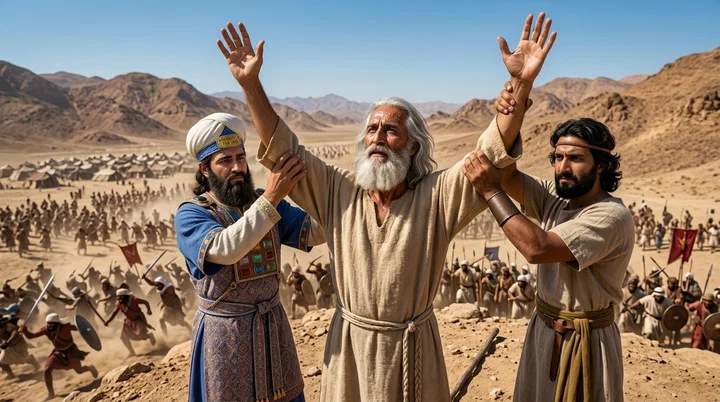
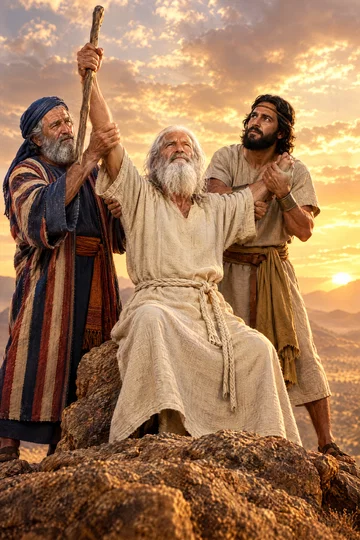
And it came to pass, when Moses held up his hand, that Israel prevailed: and when he let down his hand, Amalek prevailed.
Translations
American King James Version, King James Version, KJV Cambridge Paragraph Bible, Webster Bible, Revised Version
And it came to pass, when Moses held up his hand, that Israel prevailed: and when he let down his hand, Amalek prevailed.
And it came to pass, when Moses held up his hand, that Israel prevailed; and when he let down his hand, Amalek prevailed.
and it hath come to pass, when Moses lifteth up his hand, that Israel hath been mighty, and when he letteth his hands rest, that Amalek hath been mighty.
And it came to pass when Moses raised his hand, that Israel prevailed; and when he let down his hand, Amalek prevailed.
And it shall be when Moses shall lift on high his hands, then shall Israel prevail, but when he shall let down his hands, then shall Amalek prevail.
Berean Standard Bible, Majority Standard Bible
As long as Moses held up his hands, Israel prevailed; but when he lowered them, Amalek prevailed.
When Moses held up his hand, Israel prevailed. When he let down his hand, Amalek prevailed.
Now while Moses' hand was lifted up, Israel was the stronger: but when he let his hand go down, Amalek became the stronger.
And when Moses helde vp his hande, Israel preuailed: but when he let his hande downe, Amalek preuailed.
Douay-Rheims (Challoner revision)
And when Moses lifted up his hands, Israel overcame: but if he let them down a little, Amalec overcame.
Pictures
Cross-references
- Deuteronomy 25:17-19
Remember what Amalek did unto thee by the way, when ye were come forth out of Egypt;
Recalls Amalek’s attack on Israel and commands its eventual blotting out.
- 1 Samuel 15:2
Thus saith the LORD of hosts, I remember that which Amalek did to Israel, how he laid wait for him in the way, when he came up from Egypt.
Recalls Amalek’s attack on Israel, for which God commands judgment.
- Exodus 17:16
For he said, Because the LORD hath sworn that the LORD will have war with Amalek from generation to generation.
Amalek’s opposition brings the Lord’s continuing war against them.
- Numbers 24:20
And when he looked on Amalek, he took up his parable, and said, Amalek was the first of the nations; but his latter end shall be that he perish for ever.
Balaam foretells Amalek’s eventual destruction.
- 1 Chronicles 4:43
And they smote the rest of the Amalekites that were escaped, and dwelt there unto this day.
Simeonites finish the judgment on Amalek by defeating its survivors.
- Esther 3:1
After these things did king Ahasuerus promote Haman the son of Hammedatha the Agagite, and advanced him, and set his seat above all the princes that were with him.
Haman the Agagite carries on Amalek’s threat against Israel.
- Genesis 36:12
And Timna was concubine to Eliphaz Esau’s son; and she bare to Eliphaz Amalek: these were the sons of Adah Esau’s wife.
Identifies Amalek as a descendant of Esau.
- 1 Samuel 15:3
Now go and smite Amalek, and utterly destroy all that they have, and spare them not; but slay both man and woman, infant and suckling, ox and sheep, camel and ass.
Amalek’s destruction was mercy that saved many.
- Exodus 24:14
And he said unto the elders, Tarry ye here for us, until we come again unto you: and, behold, Aaron and Hur are with you: if any man have any matters to do, let him come unto them.
Moses leaves Aaron and Hur to lead the people while he is away.
- Numbers 14:45
Then the Amalekites came down, and the Canaanites which dwelt in that hill, and smote them, and discomfited them, even unto Hormah.
cited as Amalekite history
- 1 Samuel 15:8
And he took Agag the king of the Amalekites alive, and utterly destroyed all the people with the edge of the sword.
Identifies Agag as king of the Amalekites.
Commentary
Each commentary is drawn from primary sources: the writings of Ellen G. White and Adventist pioneers and periodicals. Each commentary is separate. Its own words are not a quotation; follow the references to read the source passages.
Ellen G. White
19 sources
When Moses lifted his hands during battle, Israel was facing Amalek's first unprovoked assault in the wilderness against a weary and defenseless people whom Amalek despised and vowed to destroy in defiance of God.1SP 361.3–362.1PP 299.3–300.1PP 627.3 His raised hands toward heaven were earnest prayer and intercession for the fighting Israelites, so that Israel gained ground while his hands were held up and Amalek gained ground when weariness let them fall.SG3 257.1–258.21SP 229.14T 530.3–531.2 The uplifted hands showed that God was Israel's might and source of strength and that Israel's destiny and help rested in Him as their acknowledged leader, a dependence openly declared even to enemies and onlookers.2T 107.1PP 299.1–2Ms 12, 1894, par. 15 Israel's prevailing depended on looking to God and trusting in Him rather than on their own power or on Moses' strength, for when they relied on His strength He fought for them and subdued their enemies, but when they let go of trust they were weaker than their enemies and were overcome.Ms 125, 1909, par. 6–10SG3 257.1–258.21SP 229.11SP 229.2–3 Divine strength worked together with human effort while Moses prayed and Joshua and his soldiers actively fought, teaching God's people in every age to do their part while seeking His help in prayer and to hold up the hands of ministers and workers by praying for wisdom, grace, and protection.4T 530.3–531.2GW92 31.3–32.2PP 299.1–2Ms 75, 1903, par. 175T 162.1
Amalek's Attack and Raised Hands
This was Amalek's first, unprovoked attack on Israel in the wilderness, falling upon a weary and defenseless people.PP 299.3–300.1PP 627.3 Amalek despised Israel and vowed to destroy them, mocking their deliverance through Moses and boasting that their God could not rescue them.1SP 361.3–362.1 That assault was defiance of God Himself, and cruelty aimed especially at the weakest.1SP 361.3–362.1PP 299.3–300.1
Such cruelty and defiance marked Amalek for destruction by the very people they had despised.1SP 361.3–362.1 It shows that God's care shields His people and His justice answers oppression.PP 299.3–300.1 The sentence was pronounced then, though its execution was delayed for four hundred years.PP 627.3
Moses' raised hands toward heaven were earnest prayer and intercession, entreating God's help for the fighting Israelites.SG3 257.1–258.21SP 229.14T 530.3–531.2PP 298.4 While his hands were raised Israel prevailed and gained ground, and when fatigue let them fall Amalek prevailed and Israel lost ground.SG3 257.1–258.21SP 229.14T 530.3–531.2PP 298.41SP 229.2–3 The uplifted hands showed that God was Israel's might and source of strength, not Moses' own strength nor the rod itself.2T 107.1 They showed that Israel's destiny rested in God's hands as their acknowledged leader, and that Israel's help was in God.2T 107.1PP 299.1–2Ms 179, 1901, par. 9–10
Aaron and Hur's holding up of his hands was a sign that Israel must reach toward heaven and depend on the God of heaven, with Christ as helper.Ms 12, 1894, par. 15 As long as the hands were stretched upward Israel had vitality, strength, and power.Ms 179, 1901, par. 9–10 That uplifted posture openly declared, even to enemies and onlookers, that Israel's help was in God.Ms 179, 1901, par. 9–10
When Moses' hands grew weary, Aaron and Hur kept them raised until sunset, when Israel won completely and put the enemy to flight.2T 107.14T 530.3–531.2PP 298.4GW92 31.3–32.2 Aaron's thus supporting Moses formed part of his work in leading Israel.PP 425.4
Victory Through Trust in God
Israel's prevailing in that battle turned on looking to God and trusting in Him, not on Israel's own power.Ms 125, 1909, par. 6–10SG3 257.1–258.21SP 229.11SP 229.2–3SG3 256.1 It did not come from Moses' strength or from the rod itself, for Moses raised his hand toward heaven to show the people that God was their might and the source of their strength.Ms 125, 1909, par. 6–102T 107.1 The shifting outcome taught them that God was guiding them and that they must follow His directions in order to overcome their enemies.Ms 125, 1909, par. 6–10 His uplifted hands further declared that Israel's destiny rested in God's hands as their acknowledged leader.2T 107.1
When the people trusted God and relied on His strength, He fought for them and subdued their enemies.SG3 257.1–258.2PP 299.1–2SG3 256.1 When they let go of that trust and relied on their own power, they became weaker than their enemies, lost ground, and were overcome while their foes prevailed.SG3 257.1–258.21SP 229.11SP 229.2–3PP 299.1–2SG3 256.1 Victory came from trusting God and relying on His strength, not from their own power.1SP 229.11SP 229.2–3
Divine strength worked together with human effort, for while Moses prayed and interceded, Joshua and his soldiers actively fought.GW92 31.3–32.2PP 299.1–2 They fought with the resources available to them, showing that prayerful dependence on God was central to victory yet joined to action.GW92 31.3–32.2 God's people are therefore to prepare and do their part while seeking His help in prayer, with success coming from the Mighty One who undertakes their cause and fights their battles when they depend on Him.4T 530.3–531.2 They are still to press the battle to the gate as though they had something to do.Ms 179, 1901, par. 9–10 That victory was given by the angels of God, principalities and powers.Ms 179, 1901, par. 9–10
Supporting Others Through Prayer
The lesson belongs to God's people throughout time, for as Israel prevailed while hands were held toward heaven in earnest prayer and Amalek prevailed when fatigue let them fall, so victory is given and battles are fought by God when His people depend on Him.4T 530.3–531.2GW92 31.3–32.2 Aaron and Hur held up the weary hands until Israel won completely, showing that success comes from the Mighty One who undertakes the cause of those who prepare and do their part while seeking His help in prayer.4T 530.3–531.2GW92 31.3–32.2 While intercession was offered, Joshua and the soldiers also acted and fought with the resources available to them, for God is the strength of His people and fights their battles in union with their effort.GW92 31.3–32.2
To hold up hands today is to support ministers and harvest-field workers through prayer.GW92 31.3–32.2Ms 75, 1903, par. 175T 162.1 Those who remain at home are to lift the hands of those who go out into the harvest field by praying for them and not neglecting this duty.Ms 75, 1903, par. 17 Holding up ministers' hands means asking God to give them wisdom, grace, and protection as they preach.5T 162.1 Such support is a powerful help to another person's prayer and service, with Christ as helper, and with Israel taught to reach toward heaven and depend on the God of heaven.GW92 31.3–32.2Ms 12, 1894, par. 15
To prevail as Israel prevailed is to take hold of God's power by faith in Jesus Christ when the inner man is strengthened by the Spirit.Ms 179, 1901, par. 18–20 It means having the mind drawn to God and to heaven, receiving His righteousness and His truth wrought within.Ms 179, 1901, par. 18–20 It means following on to know the Lord whose going forth is prepared as the morning.Ms 179, 1901, par. 18–20
The uplifted hands declared openly, even to enemies and onlookers, that Israel's help was in God, and just as long as they were stretched upward Israel had vitality, strength, and power.Ms 179, 1901, par. 9–10 That victory was given by the angels of God, principalities and powers.Ms 179, 1901, par. 9–10 God's people must therefore take no glory to themselves but continually look to God and trust in Him while still pressing the battle to the gate as though they had something to do, showing under the banner of Prince Emmanuel that power is granted to overcome all corruption in the world through lust by being partakers of the divine nature.Ms 179, 1901, par. 9–10
Sources
Pioneers and periodicals
59 sources
At Rephidim Joshua led chosen men with the sword on the plain below while Moses stood on the hilltop with the rod of God directing the battle, and Israel prevailed while his hand was held up but Amalek prevailed when it sank through weariness, until Aaron and Hur steadied his hands to sunset and Joshua won the victory.RH Apr 25, 1907ST Feb 25, 1889RH Jul 30, 1914ST Jun 18, 1885 His uplifted hands were prayer and dependence toward heaven, and keeping them extended brought triumph by divine power while letting them fall gave the enemy advantage and showed the weakness of flesh without God.ST Apr 15, 1880RH Jan 1851ST Jan 20, 1909RH Jun 9, 1903 The outcome depended on persevering prayer above joined with hard fighting below, for divine strength and human effort must work together with patience until God finishes what He began.RH May 29, 1913RH Nov 9, 1911RH Oct 29, 1861RH Aug 31, 1869ST Jul 8, 1880 Moses pleading thus for Israel while the battle raged is a type of Jesus interceding in heaven for His people in spiritual warfare, teaching that victory over evil comes only through Christ and His cross.RH Apr 23, 1908RH Feb 19, 1861RH Feb 19, 1861 Aaron and Hur holding up his weary hands shows that leaders and heralds of final truth must be sustained by the prayers, means, and sympathy of fellow workers, and that no one may stand as a mere spectator while the battle goes hard.RH Nov 18, 1909RH Apr 25, 1907RH Jan 20, 1859
Battle Setting and Outcome
At Rephidim, also called Mount Horeb, Joshua led Israel against Amalek with chosen men and the sword on the plain below while Moses stood on the hilltop with the rod of God, with Aaron and Hur beside him.RH Apr 25, 1907ST Feb 25, 1889ST Jun 18, 1885RH Nov 17, 1859RH Sep 14, 1916 Moses directed the battle from the hill and Joshua fought under him as his leader, with great armies of men on both sides until the Amalekites were beaten and fled.RH Apr 25, 1907ST Feb 25, 1889ST Jun 18, 1885RH Sep 14, 1916 The holding up of Moses' hands gave victory to the banner of Israel and made Horeb memorable.RH Nov 17, 1859
When Moses held up his hand Israel prevailed, and when he let it down Amalek prevailed.RH Apr 25, 1907RH Jul 30, 1914RH Jan 1851RH Nov 18, 1909 The lowering came through weariness and heaviness, with his hands growing heavy until they fell.RH Apr 25, 1907RH Jul 30, 1914RH Jan 1851RH Nov 18, 1909 Aaron and Hur as his chief assistants stayed and supported his hands to keep them steady until sunset, and then Joshua defeated Amalek and Israel won the battle.RH Apr 25, 1907RH Jan 1851RH Nov 18, 1909ST Mar 25, 1889
The battle belongs to the time after manna was first given in the Wilderness of Sin on the fifteenth day of the second month and before Israel came to Mount Sinai thirty days later.ST May 17, 1883 At that time the obligations of the Sabbath were already understood and disobedience to them was reproved by God.ST May 17, 1883 This proves the Sabbath was known one month before Sinai and not first made known there, with the later words about making it known referring to its special proclamation by God alongside the other commandments.ST May 17, 1883RH Jan 12, 1860
The setting includes Israel's second outbreak of unbelief at Rephidim, where thirst led the people to murmur against Moses and wish they were back in Egypt instead of looking to the Lord for help.ST Nov 7, 1895 They did not deny God's past deliverance or His power to help, but focused only on human leaders and blamed them for their need.ST Nov 7, 1895 Praising God for past blessings while complaining about what is lacking now repeats that unbelief and can lead to perishing in the wilderness.ST Nov 7, 1895
The Lord was with Israel in the wars they encountered, driving Amalek's host by sovereign power against that bitter foe of God and His work.ST Feb 11, 1913ST Nov 4, 1880 The battle is remembered as a deliverance in which the Lord was His people's banner against Amalek's treacherous attack at Rephidim.ST Feb 11, 1913ST Apr 30, 1902 It stands as one act of God's defense and care for His elect people on the wilderness journey of Abraham's descendants from Egypt toward the promised land, alongside the passage of the Red Sea, the dropping manna, the drink from the smitten rock, the staying of the heaped-up Jordan, and the fall of the ramparts of Jericho.ST Nov 4, 1880RH Nov 21, 1854
Amalek's Attack and Judgment
Amalek was a bitter, enduring foe of God and His rule and of His work, who treacherously attacked Israel soon after the exodus on the journey from Egypt to the promised land to Canaan.ST Aug 24, 1882ST Feb 11, 1913ST Apr 23, 1902ST Feb 9, 1915 The attack was without provocation and cowardly, striking those who had fallen behind through weakness, weariness and exhaustion.ST Aug 24, 1882ST Apr 23, 1902ST Feb 9, 1915 The Lord was with Israel in the wars they encountered, and the defeat of Amalek at Rephidim is remembered as a deliverance in which the Lord was His people's banner.ST Feb 11, 1913ST Apr 30, 1902
The Amalekites were kinsmen descended from Amalek the son of Esau, strengthened by others of kin into a strong and warlike nation, and the first nation to attack Israel.ST Feb 25, 1889 Their attack was rooted in the old prophecies concerning Jacob and Esau and in Jacob's taking of the birthright and blessing, though Jacob's sin had been forgiven by God and forgiven by Esau.ST Feb 25, 1889 Instead of helping their brethren Israel they made cruel war upon them, and that greater sin of cruelty to kinsmen brought God's sentence of utter annihilation upon them, while Israel's prevailing when Moses' hands were lifted was God's faithful keeping of His promises to Jacob's descendants, repeating Jacob's deliverance from Esau by prevailing prayer.ST Feb 25, 1889 The battle at Rephidim, where the raised hand marked Israel's prevailing and the lowered hand marked Amalek's advantage, stands among the swift, signal punishments and judgments in Israel's wilderness history.ST May 23, 1911
That conflict brought the Lord's sworn word to have war with Amalek from generation to generation and to utterly put out the remembrance of Amalek from under heaven.RH Sep 15, 1874 This meant not scattering among the nations nor becoming the basest of nations, but continuing war until the last of that nation ceased from the earth.RH Sep 15, 1874 Saul's later destruction of Amalek was punishment for this attack at Rephidim.ST Apr 23, 1902
God granted Amalek four hundred years afterward to seek Him and make matters right, but at the expiration of that time they had filled the cup of their iniquity.ST Feb 9, 1915 By then they had become a curse to themselves and a menace to the surrounding nations.ST Feb 9, 1915 So the later command to Saul to destroy them utterly was an act of love, because letting that wicked nation live would have caused the eternal destruction of many souls.ST Feb 9, 1915
Raised Hands as Prayer
Moses' uplifted hand was a posture of prayer and dependence on God, with hands and the rod lifted toward heaven to entreat help in battle, and while they were held up Israel prevailed but when weariness let them fall Amalek prevailed.ST Apr 15, 1880RH Jan 1851RH Jun 9, 1903 Keeping the hands continually extended toward heaven guarantees victory through divine power to those who avail themselves of the power offered in Jesus, especially in daily experience in the closing days of the great controversy when fullness of power is needed.RH Jun 9, 1903 Letting the hands fall gives advantage to the enemy and exposes the weakness of the flesh unless it is energized by divine power, for prevailing in the conflict with evil comes only through that dependence.RH Jun 9, 1903 Prayer is a secret invisible power that nothing can resist, by which Israel prevails when hands are lifted, and enemies have good reason to fear such prayers more than armies.RH Dec 22, 1859 Those who stand with and uphold a man of prayer hold up his hands in the conflict, as Aaron and Hur supported Moses' heavy hands until sunset and then Joshua defeated Amalek.RH Jan 1851RH Dec 22, 1859
Holding up the rod was the more spiritual duty while wielding the sword was the outward physical work, and Moses grew weary holding the rod while Joshua did not grow weary wielding it, teaching that people tire of spiritual duty more readily than of active labor.ST Jul 19, 1883 The outcome depended on God's power working through a simple act rather than on the strength of the means, when Moses raised his rod in prayer and Israel prevailed.RH Apr 2, 1861 Israel was delivered not by its own strength but by the direct interposition of God, and the turning of the battle with Moses' hands proves it.ST Feb 25, 1889 God fought for them when they trusted in him, but relying on their own strength left them weaker than their enemies.ST Apr 15, 1880 The victory was one of the Lord's deliverances showing his working for his people, in which enemies were overcome through God's power, the battle belonged to the Lord, and both Moses' intercession on the hill with the rod of God and Joshua's fighting with chosen men, with Aaron and Hur keeping the hands steady, had his approval.ST Jan 20, 1909ST Aug 31, 1888
Moses acting as mediator for Israel through uplifted intercession is a type of Jesus interceding in heaven while his people are engaged in spiritual warfare.RH Feb 19, 1861 His uplifted hands connected with victory over Amalek are a type of Christ's victory over Satan and sinners through his heavenly intercession.RH Feb 19, 1861 That battle teaches that victory for each person and for the church comes through the power of Christ's cross.RH Apr 23, 1908
Persevering Prayer and Effort
Israel’s victory turned on Moses continuing in prayer while Joshua and his men fought below, so that divine strength and human effort had to be joined together without pause until the work was done.RH May 29, 1913RH Oct 29, 1861ST Jul 8, 1880 To rely on prayer without faithful effort, or on effort without prayer, leaves the work weak and ineffective, while faith and works together bring victory over the difficulties met in doing God’s work.RH May 29, 1913ST Jul 8, 1880 The holding up of the hands lasted until sunset, teaching patience and perseverance rather than haste, because God completes in due time what He has begun even when His people pass through difficulty.RH Oct 29, 1861
Prevailing in the conflict with evil comes only through dependence on God, and hands lifted toward heaven express that dependence in battle.RH Jun 9, 1903RH Dec 22, 1859RH Nov 14, 1912 To let the hands fall gives advantage to the enemy and exposes the weakness of the flesh unless it is energized by divine power, while to keep them continually extended toward heaven guarantees victory to those who depend on divine power.RH Jun 9, 1903 This belongs to daily experience in the closing days of the great controversy, where fullness of power is needed and is received by availing of the power offered in Jesus.RH Jun 9, 1903 Prayer is a secret invisible power that nothing can resist, by which God’s battles are gained through hands uplifted to heaven, so that enemies have more reason to fear such prayers than armies.RH Dec 22, 1859RH Nov 14, 1912
The triumph below depended on God’s answer to prayer: while Moses prayed with hands raised Israel triumphed and Amalek was discomfited, and when he ceased and lowered them Amalek prevailed.RH Nov 9, 1911ST Sep 5, 1900RH Aug 31, 1869RH Aug 1, 1871 Joshua’s victory and Amalek’s defeat were answers to prayer, showing that prayer reaches the heart of God and accompanies His people’s victory.RH Aug 31, 1869ST
Keeping watch over the heart is a work never done till life ends and allows no intermission in any time or condition of life.RH Oct 2, 1856ST Apr 14, 1914ST Jul 20, 1904 As soon as Moses’ hands grew heavy and sank, Amalek prevailed, so letting down the guard for even a few minutes lets corruption break loose in temptation and prevail, bringing many sad days and nights as with David and Peter.RH Oct 2, 1856 The Amalekites picture the persistent assaults of temptation, and such assaults with inward weakness need not defeat the Christian but should drive him to Christ and to Jesus Christ for victory.ST Apr 14, 1914ST Jul 20, 1904
Upholding Leaders and Missions
Moses grew weary and let his hands fall, and at that turn Amalek gained the advantage, but while his hands were held up steady Israel prevailed and won the battle, for the battle belonged to the Lord.RH Nov 18, 1909RH Apr 25, 1907 Aaron and Hur stayed his hands and kept them steady, showing that victory in the continuing battle requires sustained support in prayer and that the outcome depends on such loyal help from fellow workers.RH Nov 18, 1909RH Apr 25, 1907 To bear up those who carry heavy burdens is how the work advances so that God's people prevail, and to fail in upholding those chosen to lead is to endanger the cause.RH Apr 25, 1907RH Jun 23, 1868RH Jul 30, 1914 The lesson is to uphold people in authority rather than criticize or complain against them, encouraging and cooperating with those who bear responsibility.RH Apr 25, 1907RH Jun 23, 1868
Holding up the hands means upholding by prayer the heralds of the last truth, that they may be strengthened to give the trumpet a certain sound and the people may hear the third angel's message.RH Jan 20, 1859RH Jun 26, 1855RH Apr 18, 1854 Those who proclaim the final message stand in warfare in which Amalek must not prevail, with hands lifted up to prevail and sustained by the fervent humble prayers of the elect that attend and follow them.RH Jan 20, 1859RH Jun 26, 1855 Those who understand the work must therefore stand in their place to strengthen and uphold the messengers of truth in the great harvest where laborers are few, for Israel prevails when the hands of God's messengers are stayed up.RH Jan 20, 1859RH Jun 26, 1855RH Apr 18, 1854 It is as pastors lifting hands on the mountain while the people fight on the plain, the duty of ministry to support the faithful while they battle.RH Jan 20, 1859RH Jun 25, 1867
Those who cannot serve as watchmen preaching the way to heaven, or go to China or to West Africa, or labor directly for the salvation of others, can still do Aaron's faithful work of holding up the prophet's hands.RH Mar 30, 1911RH Dec 1, 1904 Their prayers at home hold up the workers' hands and help the cause advance amid hardship and opposition, and by prayer and giving they share in the mission work.RH Mar 30, 1911RH Dec 1, 1904 When the battle goes hard every person must lift and lift together, men, women and the young individually feeling the burden and moving in harmony like a well-disciplined army, with none as mere spectators.RH Mar 30, 1911RH May 13, 1873 That united lifting is shown by prayers, sympathy, giving of means and spreading light, which forwards the work and glorifies God, and by standing by and sustaining the Lord's servants and ministers in their organizing work until victory is won.RH May 13, 1873RH Oct 21, 1862RH Oct 2, 1866
The work of Aarons and Hurs is secret prayer upholding the cause when no eye but God's sees, yet its effects reach individuals, families, churches and the world.RH Apr 12, 1860 Hundreds are saved in answer to such unseen prayer.RH Apr 12, 1860 At the day of judgment, when the secrets of all hearts are revealed, God will openly reward them before the whole universe, with all holy beings witnessing their elevation in the glories of heaven.RH Apr 12, 1860 The souls saved through them will shine like gems in the crown of their rejoicing, and they themselves will shine like stars forever in the kingdom of God.RH Apr 12, 1860
Amalek as Opposition Symbol
Amalek stands as aliens and enemies opposed to God's people, and later opposition to God's people continues the same conflict begun at Rephidim.RH Dec 9, 1858 Those who write outside the Third Angel's Message stand in that same alien, Amalekite place toward the remnant.RH Dec 9, 1858 Israel prevails in that conflict when believers flood in with good, lively, spirited testimonies until such opposition is driven to the wall or the margin.RH Dec 9, 1858
The same pattern is applied figuratively to the Bible, whose guiding strength is upheld through the battles of the ages against its foes.ST Mar 25, 1913 As Israel prevailed while the hand was held up and Amalek prevailed when it was lowered, so the Bible prevails through its upheld guiding strength.ST Mar 25, 1913
Sources