Esther 3:1
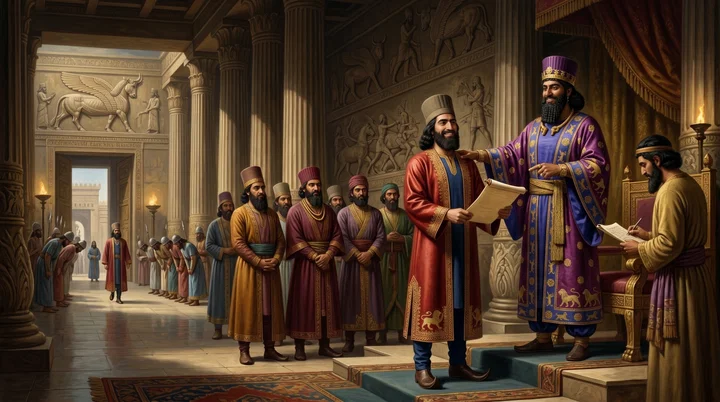
After these things did king Ahasuerus promote Haman the son of Hammedatha the Agagite, and advanced him, and set his seat above all the princes that were with him.
Translations
American King James Version, King James Version, KJV Cambridge Paragraph Bible, Revised Version, American Standard Version
After these things did king Ahasuerus promote Haman the son of Hammedatha the Agagite, and advanced him, and set his seat above all the princes that were with him.
Webster Bible, Darby Translation
After these things king Ahasuerus promoted Haman the son of Hammedatha the Agagite, and advanced him, and set his seat above all the princes that were with him.
After these things hath the king Ahasuerus exalted Haman son of Hammedatha the Agagite, and lifteth him up, and setteth his throne above all the heads who [are] with him,
After these things, did King Ahasuerus promote to power Haman son of Hammedatha the Agagite, and exalted him,—and placed his seat above all the rulers who were with him.
Berean Standard Bible, Majority Standard Bible
After these events, King Xerxes honored Haman son of Hammedatha, the Agagite, elevating him to a position above all the princes who were with him.
After these things King Ahasuerus promoted Haman the son of Hammedatha the Agagite, and advanced him, and set his seat above all the princes who were with him.
After these things, by the order of the king, Haman, the son of Hammedatha the Agagite, was lifted up and given a position of honour and a higher place than all the other captains who were with him.
After these things did King Ahashuerosh promote Haman the sonne of Hammedatha the Agagite, and exalted him, and set his seate aboue all the princes that were with him.
Douay-Rheims (Challoner revision)
After these things, king Assuerus advanced Aman, the son of Amadathi, who was of the race of Agag: and he set his throne above all the princes that were with him.
Pictures

Cross-references
- 1 Samuel 15:2-3
Thus saith the LORD of hosts, I remember that which Amalek did to Israel, how he laid wait for him in the way, when he came up from Egypt.
Saul’s conflict with Agag links Haman’s Agagite descent to Amalek.
- Esther 8:11-12
Wherein the king granted the Jews which were in every city to gather themselves together, and to stand for their life, to destroy, to slay, and to cause to perish, all the power of the people and province that would assault them, both little ones and women, and to take the spoil of them for a prey,
The Jews receive permission to defend themselves against the threatened destruction.
- Exodus 17:16
For he said, Because the LORD hath sworn that the LORD will have war with Amalek from generation to generation.
Haman’s Amalekite ancestry connects him to the enduring conflict between God and Amalek.
- Esther 3:5-6
And when Haman saw that Mordecai bowed not, nor did him reverence, then was Haman full of wrath.
Haman’s promotion leads to Mordecai’s refusal and Haman’s plot against the Jews.
- Esther 5:9
Then went Haman forth that day joyful and with a glad heart: but when Haman saw Mordecai in the king’s gate, that he stood not up, nor moved for him, he was full of indignation against Mordecai.
Mordecai continues to refuse to honor Haman.
- Esther 7:6-10
And Esther said, The adversary and enemy is this wicked Haman. Then Haman was afraid before the king and the queen.
Haman is exposed and punished, frustrating his plot against God’s people.
- Esther 4:13-14
Then Mordecai commanded to answer Esther, Think not with thyself that thou shalt escape in the king’s house, more than all the Jews.
Haman’s plot threatens the Jews, but deliverance arises to preserve them.
- Esther 9:1-2
Now in the twelfth month, that is, the month Adar, on the thirteenth day of the same, when the king’s commandment and his decree drew near to be put in execution, in the day that the enemies of the Jews hoped to have power over them, (though it was turned to the contrary, that the Jews had rule over them that hated them;)
The Jews gain rule over enemies who sought to destroy them, reversing Haman’s threat.
- 1 Samuel 15:8
And he took Agag the king of the Amalekites alive, and utterly destroyed all the people with the edge of the sword.
identifies Agag as king of the Amalekites
- Esther 9:24-26
Because Haman the son of Hammedatha, the Agagite, the enemy of all the Jews, had devised against the Jews to destroy them, and had cast Pur, that is, the lot, to consume them, and to destroy them;
It explains Haman’s lot and the origin of the name Purim.
- Esther 3:10-15
And the king took his ring from his hand, and gave it unto Haman the son of Hammedatha the Agagite, the Jews’ enemy.
The king authorizes Haman’s decree against the Jews.
- Deuteronomy 25:17-18
Remember what Amalek did unto thee by the way, when ye were come forth out of Egypt;
Describes the Amalekite attack on Israel behind Haman’s Agagite ancestry.
- Deuteronomy 25:19
Therefore it shall be, when the LORD thy God hath given thee rest from all thine enemies round about, in the land which the LORD thy God giveth thee for an inheritance to possess it, that thou shalt blot out the remembrance of Amalek from under heaven; thou shalt not forget it.
Commands Israel to blot out the memory of Amalek.
- Esther 3:8-9
And Haman said unto king Ahasuerus, There is a certain people scattered abroad and dispersed among the people in all the provinces of thy kingdom; and their laws are diverse from all people; neither keep they the king’s laws: therefore it is not for the king’s profit to suffer them.
Haman seeks the king’s approval to destroy the Jews.
- Genesis 36:12
And Timna was concubine to Eliphaz Esau’s son; and she bare to Eliphaz Amalek: these were the sons of Adah Esau’s wife.
Amalek, Esau’s grandson, is contrasted with Haman’s line.
- Exodus 17:8-14
Then came Amalek, and fought with Israel in Rephidim.
Records Amalek’s attack on Israel and the resulting judgment.
Commentary
Each commentary is drawn from primary sources: the writings of Ellen G. White and Adventist pioneers and periodicals. Each commentary is separate. Its own words are not a quotation; follow the references to read the source passages.
Ellen G. White
1 source
After these things the king advanced Haman to high authority above all his princes, and that promotion set the stage for his decree against the Jews.Ms 51, 1899, par. 25–26 Haman's hostility began when Mordecai refused to gratify his vanity with the reverence that belongs to God alone.Ms 51, 1899, par. 25–26 He then secured the king's decision for extermination by false pretenses and misrepresentation of the Jews.Ms 51, 1899, par. 25–26
Behind the plot stood Satan himself, seeking through Haman to destroy the people who preserved among men the knowledge of the true God.Ms 51, 1899, par. 25–26 God's protecting angels worked to defeat the scheme and to turn its consequences back upon its makers and adversaries.Ms 51, 1899, par. 25–26 The episode stands as a pattern for a future decree to be issued against God's people.Ms 51, 1899, par. 25–26 In that coming crisis Satan will move religious powers to condemn and put to death those who refuse to worship the idol sabbath.Ms 51, 1899, par. 25–26 Those who put their trust in God will then see his devices defeated, just as they were defeated in the day of Mordecai.Ms 51, 1899, par. 25–26
Sources
Pioneers and periodicals
14 sources
After these things King Ahasuerus, who is Xerxes, promoted Haman the son of Hammedatha and advanced him and set his seat above all the princes as favored prime minister, counselor and treasurer, with command for the servants at the gate to bow to him and honor him.ST Dec 20, 1899ST Jun 27, 1911ST Apr 23, 1912ST Apr 23, 1902 Haman is called the Agagite because he was a descendant of Agag, king of the Amalekites, an alien to Persian blood and heir to Amalek's bitter enmity against the Lord.ST Dec 20, 1899ST Sep 20, 1899ST Jul 1, 1908ST Feb 23, 1915 Exalted by this promotion, Haman was angered by Mordecai's refusal to bow to him and plotted revenge to destroy the Jews under the king's authority out of hatred for all of God's people.ST Dec 20, 1899ST Jun 27, 1911ST Nov 19, 1896ST Mar 4, 1886 Mordecai's refusal proves that disobedience to any ordinance of man becomes duty when the law of God is at stake, for we ought to obey God rather than men.RH May 12, 1868 That plot was Satan's effort through Medo-Persian opposition to cut off the people through whom the promised Man-child would come, continuing the enmity of Amalek against the throne of God declared in Exodus 17 after Saul's failure in 1 Samuel 15, but God frustrated it and overruled it by wonderful providence to the salvation and deliverance of His people.ST Jun 27, 1911ST Nov 19, 1896ST Jun 16, 1909ST Sep 20, 1899
Haman's Promotion and Ancestry
The court is that of Ahasuerus, who is Xerxes, and the setting is Medo-Persian in the time of the events involving Mordecai.ST Apr 23, 1902ST Oct 27, 1898 After these things the king promoted Haman, advanced him, and set his seat above all the princes that were with him.ST Dec 20, 1899ST Jun 27, 1911ST Apr 23, 1912ST Jun 16, 1909ST Jul 1, 1908 That advancement gave him the highest rank and precedence over the other princes and officials.ST Dec 20, 1899ST Jun 16, 1909ST Apr 23, 1902ST Oct 27, 1898ST Sep 7, 1904 He became the empire's favored prime minister and special favorite of the king, serving as royal counselor and as royal treasurer and exactor.ST Apr 23, 1912ST Jun 16, 1909ST Jul 1, 1908ST Apr 23, 1902 By royal order the servants at the gate were commanded to bow to him and honor him.ST Apr 23, 1902
Haman is identified as the son of Hammedatha the Agagite.ST Dec 20, 1899ST Sep 20, 1899ST Sep 7, 1904 Agagite means a descendant of Agag, king of the Amalekites, so that Haman was an Amalekite.ST Sep 20, 1899ST Jul 1, 1908ST Feb 23, 1915 That links him with Amalek and with the Amalekites' bitter enmity against the Lord.ST Sep 20, 1899 He was not a Persian by blood but an alien from the blood of the Persians, also called a Macedonian by those who so held him.ST Feb 23, 1915 His title denotes descent from that Amalekite king, a people distinct from Edom and not sprung from Esau's grandson Amalek, whose earlier existence proves a separate and unknown origin.ST Feb 23, 1915 This promotion to precedence over the other princes supplies the biblical identity behind the proverb as high as Haman.ST Sep 7, 1904
Plot to Destroy Jews
The promotion set Haman above the other princes and led him to exalt himself, and when Mordecai refused to bow to him that refusal angered him and prompted his revengeful plot to destroy the Jews under the king's authority.ST Dec 20, 1899ST Mar 4, 1886 The rise to exceptional authority and the highest place among the princes gave Haman the setting and the influence he later used in his attempt to destroy the Jews.ST Dec 20, 1899ST Nov 19, 1896ST Jun 16, 1909 That attempt was aimed at all of God's people and was driven by his hatred of them as an Amalekite and descendant of Agag, and as the king's favored prime minister he plotted their destruction.ST Jun 27, 1911ST Jun 16, 1909ST Jul 1, 1908
That attempt to destroy all of God's people became part of the Medo-Persian power's opposition to God's people.ST Jun 27, 1911ST Nov 19, 1896 It was Satan's effort to prevent the survival of the people through whom the promised Man-child would come.ST Jun 27, 1911ST Nov 19, 1896
The account therefore illustrates an effort to destroy those who will not yield to a human demand, with Haman's rise to power setting the context for the threat against God's people in the events that follow.ST Jun 27, 1911ST Nov 19, 1896ST Aug 20, 1896 But God frustrated that purpose and that opposition, and by wonderful providence overruled all of Haman's plotting to the salvation and deliverance of the Jews and saved them from their enemies.ST Jun 27, 1911ST Nov 19, 1896ST Jun 16, 1909 In the Medo-Persian setting of the events involving Mordecai, God through his servants thus proclaimed his saving power to the rulers.ST Oct 27, 1898
Obedience and Scriptural Parallels
Mordecai's refusal to bow to the promoted Haman and to honor him at the king's command proves that disobedience to any ordinance of man becomes duty when the law of God is at stake.RH May 12, 1868 We ought to obey God rather than men, and obedience to civil rulers in such a case is sin.RH May 12, 1868 The command to honor the one advanced above all the princes required what was contrary to the laws of God, so refusal was duty.RH May 12, 1868
Haman is identified as an Agagite, linking him with Amalek and the Amalekites' bitter enmity against the Lord.ST Sep 20, 1899 He was the descendant of King Agag himself, cropping up again against God's people at the court of Xerxes.ST Sep 20, 1899 His promotion and plotting continue the enmity declared in Exodus 17 that Amalek would be against the throne of God forever. This followed Saul's failure to destroy a power that was wicked and only wicked as commanded in 1 Samuel 15.
The high place given by setting his seat above all the princes illustrates that of a royal treasurer and exactor like Heliodorus under Seleucus Philopator.ST Apr 23, 1912 Heliodorus was sent to rob the temple at Jerusalem but was prevented by supernatural means.ST Apr 23, 1912 A horseman in armor of gold rode him down, while two others in shining apparel scourged him.ST Apr 23, 1912 He afterward treacherously slew Seleucus neither in anger nor in battle.ST Apr 23, 1912
Sources