Exodus 17:12
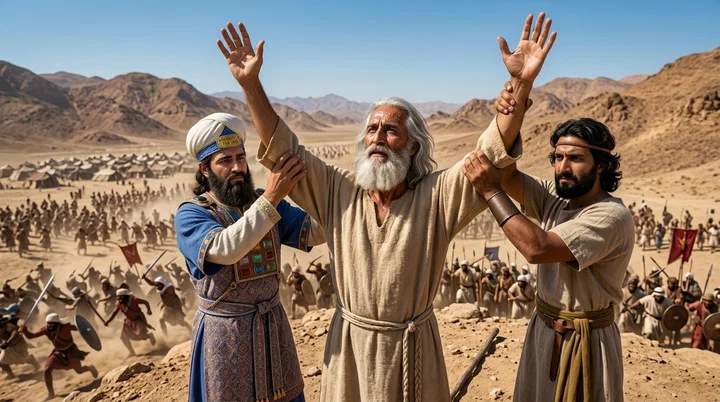
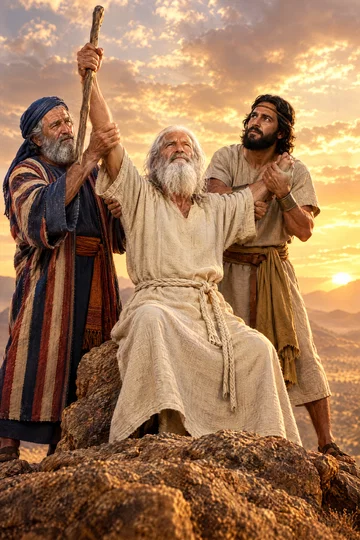
But Moses’ hands were heavy; and they took a stone, and put it under him, and he sat thereon; and Aaron and Hur stayed up his hands, the one on the one side, and the other on the other side; and his hands were steady until the going down of the sun.
Translations
American King James Version, King James Version, KJV Cambridge Paragraph Bible, Revised Version, American Standard Version
But Moses’ hands were heavy; and they took a stone, and put it under him, and he sat thereon; and Aaron and Hur stayed up his hands, the one on the one side, and the other on the other side; and his hands were steady until the going down of the sun.
But Moses's hands were heavy; and they took a stone, and put it under him, and he sat upon it: and Aaron and Hur supported his hands, the one on the one side, and the other on the other side; and his hands were steady until the going down of the sun.
And the hands of Moses [are] heavy, and they take a stone, and set [it] under him, and he sitteth on it: and Aaron and Hur have taken hold on his hands, on this side one, and on that one, and his hands are stedfast till the going in of the sun;
And Moses' hands were heavy; then they took a stone, and put [ it] under him, and he sat on it; and Aaron and Hur supported his hands, one on this side, and one on that side; and his hands were steady until the going down of the sun.
But, the hands of Moses, were weary, so they took a stone, and put under him, and he sat thereupon,—and, Aaron and Hur, upheld his hands—on this side, one and on that side, one, and so his hands became steady, until the going in of the sun.
Berean Standard Bible, Majority Standard Bible
When Moses’ hands grew heavy, they took a stone and put it under him, and he sat on it. Then Aaron and Hur held his hands up, one on each side, so that his hands remained steady until the sun went down.
But Moses’ hands were heavy; so they took a stone, and put it under him, and he sat on it. Aaron and Hur held up his hands, the one on the one side, and the other on the other side. His hands were steady until sunset.
But Moses' hands became tired; so they put a stone under him and he took his seat on it, Aaron and Hur supporting his hands, one on one side and one on the other; so his hands were kept up without falling till the sun went down.
Nowe Moses handes were heauy: therefore they tooke a stone and put it vnder him, and hee sate vpon it: and Aaron and Hur stayed vp his hands, the one on the one side, and the other on the other side: so his hands were steady vntill the going downe of the sunne.
Douay-Rheims (Challoner revision)
And Moses’ hands were heavy: so they took a stone, and put under him, and he sat on it: and Aaron and Hur stayed up his hands on both sides. And it came to pass that his hands were not weary until sunset.
Pictures
Cross-references
- Deuteronomy 25:17-19
Remember what Amalek did unto thee by the way, when ye were come forth out of Egypt;
Israel is told to remember Amalek’s attack on the weary and the judgment against them.
- 1 Samuel 15:2-3
Thus saith the LORD of hosts, I remember that which Amalek did to Israel, how he laid wait for him in the way, when he came up from Egypt.
God commands Saul to destroy Amalek for its attack on Israel.
- 1 Chronicles 4:43
And they smote the rest of the Amalekites that were escaped, and dwelt there unto this day.
Describes the destruction of the Amalekites.
- Deuteronomy 25:19
Therefore it shall be, when the LORD thy God hath given thee rest from all thine enemies round about, in the land which the LORD thy God giveth thee for an inheritance to possess it, that thou shalt blot out the remembrance of Amalek from under heaven; thou shalt not forget it.
Commands Israel to blot out Amalek in response to the attack.
- Exodus 17:6
Behold, I will stand before thee there upon the rock in Horeb; and thou shalt smite the rock, and there shall come water out of it, that the people may drink. And Moses did so in the sight of the elders of Israel.
both presented as memorable events at Horeb
- Exodus 17:16
For he said, Because the LORD hath sworn that the LORD will have war with Amalek from generation to generation.
The Lord declares his opposition to Amalek.
- Numbers 14:45
Then the Amalekites came down, and the Canaanites which dwelt in that hill, and smote them, and discomfited them, even unto Hormah.
cited as Amalekite conflict
- Numbers 3:2-3
And these are the names of the sons of Aaron; Nadab the firstborn, and Abihu, Eleazar, and Ithamar.
Aaron’s sons are consecrated to minister as priests.
- Galatians 6:2
Bear ye one another’s burdens, and so fulfil the law of Christ.
Supporting Moses fulfilled the call to bear one another’s burdens.
Commentary
Each commentary is drawn from primary sources: the writings of Ellen G. White and Adventist pioneers and periodicals. Each commentary is separate. Its own words are not a quotation; follow the references to read the source passages.
Ellen G. White
69 sources
Moses grew too weary to keep his arms raised alone during Israel's battle with Amalek, so he sat on a stone while Aaron and Hur stood on either side and held his hands steady until sunset when the victory was won.Ms 125, 1909, par. 6–102T 107.14T 530.3–531.2 His uplifted hands were prayer and intercession toward heaven for those fighting below, and Israel prevailed while they were raised but lost ground when they fell.4T 530.3–531.21SP 229.1SG3 257.1–258.2PP 298.4 Their steadiness until sunset shows that victory came by depending on God and trusting His strength rather than by human power.Ms 125, 1909, par. 6–102T 107.11SP 229.1 That dependence did not replace human effort, for Moses prayed while Joshua and his followers fought, and believers must likewise look to God continually while pressing the battle themselves.PP 299.1–2Ms 179, 1901, par. 9–10 Aaron and Hur's part makes it the duty of God's people to sustain those who carry heavy burdens in His work by prayer, encouragement, unity, and practical help, rather than leaving them to faint alone or weakening them by criticism.2T 107.14T 530.3–531.2PP 298.45T 162.1Ms 93, 1894, par. 1–2
Battle Setting and Actions
The verse belongs to Israel's battle with Amalek in Exodus 17:8-13, the first war made against Israel after deliverance.1SP 361.3–362.1PP 627.3 That attack was unprovoked and struck the weary and defenseless, especially those lagging behind, in defiance of God.1SP 361.3–362.1PP 299.3–300.1 It became the basis for God's sentence against Amalek, with the command to remember the attack and the declaration that Amalek's remembrance would be blotted out.1SP 361.3–362.1PP 299.3–300.1PP 627.3 The episode shows that cruelty against the weakest is not overlooked.PP 299.3–300.1
During the battle Moses held his hands up toward heaven and toward God in prayer and intercession for Israel, while Joshua and his followers fought below.4T 530.3–531.2PP 298.4GW92 31.3–32.2PP 299.1–2Ms 75, 1903, par. 17 His growing weariness in holding them up showed his arduous work in receiving God's word for the people.4T 530.3–531.2PP 298.4GW92 31.3–32.2 To stay up his hands means to support and encourage him in that work.TCBMP 41.2 Aaron and Hur did this by supporting him on either side until sunset, keeping his hands steady so Israel won the victory and the enemy was put to flight.4T 530.3–531.2PP 298.4GW92 31.3–32.2Ms 75, 1903, par. 17
Israel prevailed while Moses' hands were raised and began to lose ground when he lowered them, so that Amalek prevailed when his hands fell.1SP 229.1SG3 257.1–258.2PP 298.4GW92 31.3–32.2Ms 75, 1903, par. 17 The raised hands expressed Israel's dependence on God and taught Israel the issue of the battle when the enemy was put to flight.1SP 229.1SG3 257.1–258.2PP 298.41SP 229.2–3 While they trusted God's strength He fought for them and subdued their enemies, but when they let go of that dependence and relied on their own power their enemies gained the advantage and they were overcome.1SP 229.1SG3 257.1–258.21SP 229.2–3
Moses' hands grew heavy and he became too weary to keep them raised alone.2T 107.14T 530.3–531.21SP 229.1SG3 257.1–258.2PP 298.4 They placed a stone under him and he sat on it while Aaron and Hur stood on either side and held his hands steady until sunset.2T 107.14T 530.3–531.21SP 229.1SG3 257.1–258.2PP 298.4 Their help kept his hands raised until the work and the day ended, when victory required Israel to depend on God rather than human power.Ms 125, 1909, par. 6–102T 107.14T 530.3–531.21SP 229.1PP 298.4
Dependence on Divine Strength
Moses’ hands, lifted up and held steady until sunset by the support placed under and around him, show that victory required Israel to depend on God and to trust the living God and follow His directions rather than human power.Ms 125, 1909, par. 6–102T 107.11SP 229.1PP 298.4 The event was recorded as a lesson for all who desire to do God’s will, that help comes from God and that Israel’s destiny was in God’s hands.Ms 125, 1909, par. 6–10PP 298.4
His raised hands toward heaven and toward God expressed and taught Israel’s dependence on God and stood as a sign of appeal to heaven.SG3 257.1–258.21SP 229.2–3Ms 12, 1894, par. 15SG3 256.1 They openly revealed, even to enemies and to all onlookers around, that their help was in God, and while they looked to God they had vitality and strength of power.Ms 179, 1901, par. 9–10 Aaron and Hur holding them up on either side showed support for that appeal, and Israel too must reach toward heaven.Ms 12, 1894, par. 15
While Israel trusted God and relied on His strength, He fought for them and subdued their enemies.1SP 229.1SG3 257.1–258.21SP 229.2–3PP 299.1–2 When they let go of that dependence and trust and relied on their own power, their enemies gained the advantage and they were overcome.1SP 229.1SG3 257.1–258.21SP 229.2–3 Relying on their own power left them weaker than those without knowledge of God.PP 299.1–2
Israel prevailed by faith in God’s strength while also making human effort, for Moses prayed as Joshua and his followers fought below.PP 299.1–2 No one is to take glory to himself, but to look to God and trust Him continually while still pressing the battle to the gate as one having something to do.Ms 179, 1901, par. 9–10
Lifting the hands takes hold of God’s power by faith in Jesus Christ through the inner man strengthened with might by the Spirit.Ms 179, 1901, par. 18–20 As minds are drawn to God and to heaven they receive His righteousness and His truth wrought within them and follow on to know the Lord whose going forth is prepared as the morning.Ms 179, 1901, par. 18–20 With Christ as helper believers prevail in the same way Israel prevailed, and the victory is given by the angels of God, principalities and powers.Ms 12, 1894, par. 15Ms 179, 1901, par. 9–10 Standing under the bloodstained banner of Prince Emmanuel, power is granted to overcome all the corruptions in the world through lust by being partakers of the divine nature.Ms 179, 1901, par. 9–10
Duty to Sustain Workers
Aaron and Hur seated Moses on a stone and held his weary hands steady until sunset so they stayed raised, and that keeping of his hands raised enabled Israel to continue until victory was won.2T 107.14T 530.3–531.2PP 298.4GW92 31.3–32.2 Their help showed Israel's duty to sustain Moses in his arduous work of intercession as he bore a heavy burden and received God's words for them.2T 107.1PP 298.4PP 299.1–2 It illustrates that God gives strength to His people and that prayerful support through faith and prayer can strengthen those serving others in God's work.4T 530.3–531.2GW92 31.3–32.2Ms 75, 1903, par. 17 Moses' act showed that Israel's destiny was in God's hands and that victory depended on God and trust in Him rather than human strength.PP 298.4GW92 31.3–32.2PP 299.1–2 Israel prevailed by faith in God's strength while also making human effort, for Moses prayed as Joshua and his followers fought below.PP 299.1–2
The verse is a model for helping and sustaining all who carry heavy responsibilities and difficult burdens in God's work, so that a leader is not left alone to faint under the load.1T 526.2Ms 3, 1890, par. 18–19GW 491.1–3 Those who bear such loads need others to support them and share the burden, as Aaron and Hur sustained Moses' hands until the day ended.3T 19.1Ms 3, 1890, par. 18–197T 277.1–3 It is a picture of standing by Elder Haskell and helping sustain him in his work.Lt 58, 1911, par. 5 It is applied to the failure of ministering brethren to support the man left standing alone under the burdens at Battle Creek, and to people who instead weakened and discouraged a woman worker in her work.3T 19.1 It illustrates the duty to encourage and uphold workers carrying difficult burdens in difficult places.GW 491.1–37T 277.1–3
Believers are to support ministers, tried servants, and those preaching and laboring to save souls and reach those who have not heard the truth, rather than leaving the responsibility to a few or merely criticizing their plans.Ms 93, 1894, par. 1–25T 131.1–2Ms 31, 1907, par. 138MR 95.2–3 They should faithfully encourage and uphold ministers in their work and join in prayer to support and strengthen them.9T 134.35T 131.1–28MR 95.2–3 Holding up their hands includes praying for them, asking God to give them wisdom, grace, and knowledge and to guard them from temptation and impurity.5T 162.1 It means sustaining ministers in their efforts to save souls and accepting responsibility for saving souls.Ms 31, 1907, par. 138MR 95.2–3
Fellow workers, messengers, and shepherds are to hold one another up through shared effort, encouragement, and unity, and their unity strengthens them and benefits the church.SCEV 22.1–2EW 83.1Ms 14, 1850, par. 16–18 It is a model for messengers traveling and laboring together, especially in difficult places, and illustrates the value of going two by two so workers can support one another.SCEV 22.1–2Ms 4, 1853, par. 1 Those who love the truth and the cause of truth should unite their efforts to uphold its defenders, strengthen its advocates, and stay watchful against the enemy.SCEV 38.25MR 425.2 This work calls for everyone's wholehearted and quick effort, helping keep the flock from division and dangerous error.5MR 425.2Ms 14, 1850, par. 16–18
Those remaining at home hold up workers in the field who share the bread of life with hungry souls through prayer and encouraging words.8MR 192.1Ms 42, 1901, par. 7 Holding up a fellow worker's hands is the encouragement and practical support ministers should give trusted laborers rather than discouraging or restricting them or undermining their efforts.Lt 56, 1894, par. 19–20Lt 113, 1890, par. 7 Each worker is to encourage and strengthen the one next to him in mutual support while turning to God and laboring under His eye in faith and prayer.Lt 113, 1890, par. 7Ms 12, 1905, par. 14
Holding up hands includes family duties, for family members are to help and encourage one carrying heavy responsibilities when he bears a heavy burden.4T 102.2 A strong, kind, intelligent Christian wife may be honored in cooperating with God's servant in his sphere of usefulness, encouraging him and aiding him to do a good and acceptable work for the Master.Lt 77, 1902, par. 9 A wife should hold up her husband's hands by cheering his spirit with looks, words, and actions, by kind sympathetic words and prayer, and by praying with and for him, encouraging rather than burdening or hindering him, and sharing this support she will share his reward.Lt 6, 1854, par. 1–7Ms 3, 1858, par. 8 Mary should help her husband and labor wherever she has opportunity, as Aaron and Hur held up Moses' hands.Ms 3, 1858, par. 2 Children sustain worn parents by care, encouragement, cheerful words, younger strength, and willingness to carry burdens.Lt 41, 1876, par. 4–5 Unlike Aaron and Hur, Dr. Lay had no one at home staying up his hands though his family could help him.
The verse's image of Aaron and Hur holding up Moses' hands when his strength failed applies to supporting Elder Daniells as he works under severe strain, great responsibility, and severe tax on strength and courage to advance the work.STB 74.1RCOC 59.2Lt 255, 1904, par. 4–10 Every church and every believer is called to hold up his hands by offering prayer for him as he bears heavy burdens, by helping him instead of looking for wrong in him, and by refusing to listen to, speak, or stand ready to criticize, condemn, or censure those bearing weighty responsibilities.STB 74.1RCOC 59.2Lt 255, 1904, par. 4–10 It is likewise applied to upholding Brother Haskell in connection with the school by respecting his age and experience, carrying out the instruction graciously given through him, heeding his counsel in management and economy rather than following personal inclinations, and in no case belittling his counsel.Ms 41b, 1896, par. 46–48
Staying up hands means strengthening and assisting a worker in his work with sympathy and words of hope and courage, as Aaron and Hur supported Moses.4MR 264.3Lt 86, 1895, par. 18 Edson is urged so to support Brother Olsen, whose associates should have strengthened him rather than weakening him.4MR 264.3Lt 86, 1895, par. 18 "Hold up the hands" is applied to supporting Brother Prescott in his work in England through practical help and provision of means.17MR 212.2–3 It is applied to encouraging and supporting Sutherland and his coworkers by practical help including providing funds for the Madison school so the teachers' labor will not be so hard.Lt 118, 1907, par. 6 Discouraged people who are willing to sustain God's work but whose hands have grown weak need their hands strengthened, as Aaron and Hur upheld Moses' hands.1T 237.1–238.1
How to Hold Up Hands
To hold up another's hands is to cooperate with him in his sphere of usefulness, to strengthen and assist him in his work, to lighten burdens, encourage hearts, and strengthen brethren to do God's will.Lt 77, 1902, par. 9STB 224.3Ms 26, 1902, par. 33–34Lt 86, 1895, par. 18 It is done with words that are a savor of life unto life and not of death unto death, with cheerful words, sympathy, hope, courage, and the prayer of faith.SCEV 24.2–26.1RH Aug 11, 1853Ms 26, 1902, par. 33–34 It begins reform by building over against one's own house instead of criticizing and condemning, and a strong, kind, intelligent Christian wife may be honored in thus encouraging and aiding her husband to do a good and acceptable work for the Master.Lt 77, 1902, par. 9Ms 26, 1902, par. 33–34 The failure to do this is to weaken instead of strengthening, as when associates should have supported Brother Olsen but weakened him.Lt 86, 1895, par. 18
Support must be practical and prompt, strengthening a worker for heavy labor in a needy field by making every effort without delay to send means to advance the work and establish the school.Lt 71, 1898, par. 14–15Lt 118, 1907, par. 617MR 212.2–3 It encourages him to be of good courage in the Lord with the assurance that God will help him and his fellow laborer and add others to their number, as in providing funds for the Madison school so the teachers' labor will not be so hard for Sutherland and his coworkers.Lt 71, 1898, par. 14–15Lt 118, 1907, par. 6 It likewise upholds work in England through practical help and provision of means for Brother Prescott.17MR 212.2–3 Professed sympathy that withholds such help leaves the work doubly hard.Lt 71, 1898, par. 14–15
Those who know the truth must not weaken God's laborers, add a feather's weight to their burden, or burden them with difficulties and personal trials that belong for each to settle before God himself.EW 86.2SCEV 24.2–26.1Ms 64, 1903, par. 34–36RH Aug 11, 1853 They are to get right before God beforehand by breaking down before Him with fasting and prayer, getting trials and difficulties out of the way beforehand and never deferring personal trials to burden a whole meeting or waiting for the messengers to settle them.EW 86.2RH Aug 11, 1853 They are then in a situation to help brethren with a free spirit, looking about to help others instead of claiming help, helping with cheering words and the prayer of faith rather than criticism and discouragement.Ms 6, 1866, par. 3SCEV 24.2–26.1Ms 64, 1903, par. 34–36RH Aug 11, 1853 When hands are thus held up free from discouragement and trial, the servants of God can labor more effectually with a free spirit, affect the heart, present the truth in its beauty, reach the hungry sheep starving for the bread of life and the dark places where the truth has not yet been proclaimed, and God is glorified and the very object for which He called them is accomplished.RH Aug 11, 1853
Holding up hands means exercising active faith and concern for perishing people so that those who declare the truth can speak boldly and lovingly and warn sinners while mercy is still offered.SCEV 41.2EW 99.1–2 Church members are to accept responsibility for saving souls and help those laboring to reach people who have not heard the truth through prayer.RH Dec 20, 19068MR 95.2–3 They must faithfully do their part by uniting in much prayer to hold up the hands of God's chosen ministers and draw light from the heavenly sanctuary, using their God-given capabilities to speak helpful and blessing words in season and out of season.RH Dec 20, 1906 When they humble themselves, put away wrong, and consult God at every step, He manifests Himself to them, gives them courage in Him, and leads, guides, and strengthens His ministers so the work advances as it should, for Christ is Alpha and Omega and success comes only in His strength.RH Dec 20, 1906
Brethren hold up a worker's hands by standing by his side when they have evidence and light that he is working in accordance with the will of God, helping him by heeding God's admonitions and warnings.Lt 38, 1899, par. 1–3 Those who work out their own attributes and act as if appointed to work against God's servant work on Satan's side, hinder the work, make it doubly as hard as it should be, and lead God's servant to stand apart from those not in sympathy with the work of God, revealing corrupted principles and lack of self-denial and failure to take up the cross to follow Christ, bringing its sure result.Lt 38, 1899, par. 1–3 Staying up hands also means standing with God's messenger by receiving the testimonies of God as from the Lord, confessing a hard, unimpressible spirit and the heavy burdens and sorrow cast upon her, weeping in repentance and asking forgiveness with pledge that it will be the last, and giving the testimonies their rightful place in experience.Lt 32, 1891, par. 7–9 One who falls on the Rock and is broken is then able to give this support, and this removal of what barred the Spirit of God lets Jesus work with him and brings gladness, rejoicing, and profitable meetings.Lt 32, 1891, par. 7–9 Holding up a leader's hands likewise means respecting his age and experience, carrying out the instruction graciously given through him, and in no case belittling his counsel, as in upholding Brother Haskell in connection with the school and heeding his counsel in management and economy rather than following personal inclinations.Ms 41b, 1896, par. 46–48
Sources
Pioneers and periodicals
74 sources
At Rephidim on the wilderness journey to Canaan Israel fought an unprovoked attack by Amalek, and won not by its own strength but by God's intervention when Moses directed the battle with Joshua leading the forces below.RH Apr 25, 1907ST May 17, 1883ST Nov 7, 1895 Moses grew weary holding up his hands with the rod, so he sat on a stone while Aaron and Hur stood beside him and held his hands steady toward heaven until sunset.RH Apr 25, 1907ST Feb 25, 1889 While his hands stayed up Israel prevailed and when they sank Amalek gained ground, for the lifted hands were prayer and dependence on God in which all victory over evil is found through Christ.ST Apr 15, 1880RH Jan 1851RH Jun 9, 1903RH Dec 7, 1911RH Apr 23, 1908 His holding up his hands to conquer Amalek is a type of Christ's intercession in heaven for his people while they are engaged in spiritual warfare.RH Feb 19, 1861RH Feb 19, 1861 Aaron and Hur's part is the abiding duty of all God's people to hold up the hands of ministers, leaders and fellow workers by earnest intercession and by practical help with means, encouragement and cooperation, rather than murmuring or standing as spectators.RH Jul 30, 1914RH Apr 25, 1907RH Sep 24, 1872RH Nov 21, 1865RH Jun 23, 1868
Wilderness Battle Setting
The verse belongs to Israel's fight with Amalek at Rephidim, also called Mount Horeb, on the wilderness journey to Sinai and on to Canaan.ST Apr 23, 1902RH Sep 15, 1874 It stands after the first giving of manna in the Wilderness of Sin and before Israel reached Mount Sinai, thirty days later.ST May 17, 1883RH Jan 12, 1860 It is part of the account of Israel's second outbreak of unbelief at Rephidim, where thirst led the people to murmur against Moses and wish to return to Egypt instead of seeking God's help, blaming human leaders although God was able to provide for them.ST Nov 7, 1895 It belongs to Israel's successful encounter with the Amalekites during that journey to Sinai.
Amalek attacked without provocation as Israel left Egypt for the promised land, striking the weak and weary from behind.ST Aug 24, 1882ST Apr 23, 1902ST Feb 9, 1915 The ambush began treacherous and cruel hostility toward Israel by aliens outside God's people and opposed to them, in enduring hostility to God's throne.ST Apr 23, 1902RH Dec 9, 1858 This account of swift punishment is recalled in Exodus 17:8-14 among the judgments suffered by discontented Israel.ST May 23, 1911
Joshua was chosen to lead Israel's forces under Moses, with Moses with Aaron and Hur on the top of a hill above the plain where Israel fought, and the battle ended with the Amalekites beaten and fleeing.ST Aug 24, 1882ST Jun 18, 1885 Moses grew weary holding up his hands during the battle, and with Aaron and Hur supporting them until sunset his hands remained raised and Israel won.RH Apr 25, 1907 The deliverance came not through Israel's own strength but through God's direct intervention and faithfulness to his promises in prevailing prayer, and both Moses and Joshua were approved in their roles.ST Apr 15, 1880ST Feb 25, 1889ST Feb 25, 1889
The outcome stands as a memorial that the Lord was his people's banner against Amalek, and his promised judgment against Amalek remained in force.ST Apr 30, 1902 The Lord declared the purpose to utterly put out the remembrance of Amalek from under heaven by war with Amalek from generation to generation until the nation ceased from the earth.RH Sep 15, 1874 That purpose was later answered in Saul's destruction of them in response to the hostility begun at Rephidim.ST Apr 23, 1902 Like Passover, the feast of Tabernacles, baptism, the Lord's Supper and other memorials, this Bible memorial began with the events commemorated by it.RH Feb 3, 1852
After the attack Amalek was granted four hundred years to seek God and make matters right, but at the expiration of that time they had filled the cup of iniquity and had become a curse to themselves and a menace to the surrounding nations.ST Feb 9, 1915 The later command to Saul to destroy them utterly was an act of love, because their baneful influence if permitted to live would have resulted in the eternal destruction of many souls, so God slew hundreds to save thousands.ST Feb 9, 1915 The setting also proves the Sabbath was already known and obligatory a month before Sinai, kept in gathering a double portion on the sixth day and none on the seventh and enforced by rebuke for violation.ST May 17, 1883 Therefore the statement that God made known his holy Sabbath at Sinai means its special promulgation with the other nine commandments by the voice of God, not its first revelation, proving the Sabbath was instituted at creation and not first given in the wilderness of Sin nor for the Jews alone.ST May 17, 1883RH Jan 12, 1860RH Feb 3, 1852
Heavy Hands Made Steady
Moses grew weary with heavy hands while holding them up with the rod during the battle, and a stone was taken and put under him and he sat on it while Aaron and Hur, the one on the one side and the other on the other side, stayed up his hands and kept them steady toward heaven until the going down of the sun.RH Apr 25, 1907ST Feb 25, 1889RH Jan 1851RH Nov 18, 1909 With their help his hands remained raised through the rest of the day, and Israel won the battle, for the victory was the Lord's and not through Israel's own strength but through God's direct intervention, and both Moses and Joshua were approved in their roles.RH Apr 25, 1907ST Feb 25, 1889RH Dec 7, 1911 While his raised hands remained up Israel prevailed, and when weariness let them sink Amalek gained the advantage, so sustaining the raised hands was associated with victory through the rest of the day until Amalek was defeated.ST Apr 15, 1880RH Jun 9, 1903RH Dec 7, 1911RH Jun 23, 1868RH Oct 2, 1856
Aaron and Hur were Moses' chief assistants, standing beside him and sustaining him to the decisive time, the same men who later acted as his deputies in his absence.ST Oct 14, 1880ST Mar 25, 1889ST Oct 7, 1897 Aaron was of Levi, the tribe belonging to God in which the priesthood was vested, and Hur was the chief prince of Judah from which the royal line and the Saviour would come, so the two supporters were the chief priest and the chief prince.ST Mar 25, 1889 Hur was an eminent and good man, from whose descendants God chose a skillful man to build the most sacred vessels.ST Mar 25, 1889 Moses became weary holding up the rod while Joshua did not tire wielding the sword, meaning spiritual duty brings weariness more quickly than physical work and the more spiritual the duty the more apt people are to tire of it.ST Jul 19, 1883 Holding up the hands until sunset also teaches patience and perseverance while waiting for God to complete what he began even in distress, and the victory was one of faith and works.RH Oct 29, 1861ST Jul 8, 1880
The passage points to Moses' wisdom in sharing the people's burdens as a lesson for all.ST Jan 20, 1909 When the battle goes hard none can be mere spectators but every person, men, women and the young, must lift and lift together in harmony like a well-disciplined army.RH May 13, 1873
Prayer Faith and Christ
Lifted hands are a posture of prayer, an appeal to God and an expression of dependence on the God of heaven for help needed in battle.ST Apr 15, 1880RH Jan 1851RH Jun 9, 1903RH Nov 9, 1911 Letting the hands drop shows the weakness of the flesh unless energized by divine power, while keeping them continually extended toward heaven shows certainty of victory for those who depend on divine power.RH Jun 9, 1903 Amalek's defeat and Joshua's victory came in answer to prayer, with Moses praying while Joshua prevailed in the valley below.RH Nov 9, 1911ST Sep 5, 1900
Israel's victory depended on trusting God rather than relying on its own strength.ST Apr 15, 1880RH Jun 9, 1903RH Apr 23, 1908 The account was written for present learning that all are wholly dependent on the power of God in the conflict with evil, and that through the abundant power offered in the gift of Jesus victory is certain.RH Jun 9, 1903 Victory for each person and for the church comes through the power of Christ's cross, without whom people can do nothing.RH Jun 9, 1903RH Apr 23, 1908 In the closing days of the great controversy the fullness of power is needed in daily experience by keeping the hands extended toward heaven.RH Jun 9, 1903 Hands held steady until sunset picture how courage, faith and hope are supplied from heaven for those going into battle in God's name, and Israel's deliverance through prevailing prayer showed God faithful to his promises.ST Feb 25, 1889RH Dec 1, 1910
The victory depended on prayer joined with active effort, for while Moses prayed with rod raised toward heaven Joshua and the Israelites fought, and both continued until day's end.RH May 29, 1913 Divine strength must be combined with human effort, since leaving out either makes the other weak and unproductive.RH May 29, 1913 Prayer itself is a form of labor for others, one that even the aged and physically weak can continue in private, as Aaron and Hur seating Moses on a stone and sustaining his hands until sunset sustained his work during the battle.RH May 29, 1913RH Jan 5, 1905
Moses conquering Amalek by holding up his hands is a type of Christ's intercession in heaven, by which Christ conquers Satan and sinners.RH Feb 19, 1861 Moses acting as mediator for Israel in the fight foreshadows Jesus interceding in heaven while his people are engaged in spiritual warfare.RH Feb 19, 1861
The Amalekites' attack pictures persistent temptation and constant assaults that threaten a Christian's spiritual life and may cause discouragement.ST Apr 14, 1914ST Jul 20, 1904 Keeping watch over the heart must continue without interruption, for just as the enemy prevailed when Moses' hands sank, neglecting watchfulness even briefly can allow sin to gain ground.RH Oct 2, 1856 Such assaults may overwhelm a person's spiritual life or drive that person to Jesus Christ for victory.ST Apr 14, 1914ST Jul 20, 1904
Holding Up Hands Today
Aaron and Hur holding up Moses' weary hands until sunset is the pattern and duty for God's people to uphold those bearing heavy responsibility in the cause, and loyal help of that kind matters to the outcome, for victory depends on sustaining the one entrusted with the burden.RH Jul 30, 1914RH Apr 25, 1907RH Jun 23, 1868RH Nov 6, 1866RH Sep 25, 1866 Ministers, leaders, workers and messengers proclaiming the last message of mercy are to be sustained with sympathetic practical help to finish their work until sunset, so that burdens are borne together, the work prevails, and the battle is turned to blessing.RH Jul 30, 1914RH Apr 25, 1907RH Jun 23, 1868RH Nov 6, 1866RH Sep 25, 1866 Faithful people strengthen God's servants and encourage the work instead of distrusting, murmuring, criticizing, complaining against them or making their defects a subject of conversation.RH Jul 30, 1914RH Aug 21, 1900RH Nov 6, 1866 Their weak points are to be strengthened rather than talked about.RH Aug 21, 1900
Staying up their hands chiefly means earnest prayer, fasting and intercession, crying to God to stand by afflicted servants, uphold them by His Spirit, give fresh anointing, wisdom, protection from evil and divine direction, and keep them at their post while He moves on hearts and interest to hear increases.RH Sep 24, 1872RH Nov 21, 1865RH Jul 31, 1866RH Feb 19, 1867 Church members as a reserve force are to attend and follow ministers standing in the forefront proclaiming the most solemn truths with fervent humble prayers, silent prayers during preaching, secret prayer that moves individuals, families, churches and the world, sharing trials and burdens with sympathy until victory, and special remembrance at the mercy seat.RH Sep 24, 1872RH Dec 22, 1859RH Jul 31, 1866RH Apr 12, 1860 Those who stood with praying men were like many Aarons and Hurs in the army.RH Dec 22, 1859
It also means material and practical aid, not mere blessings, praise or words about duty, but temporal necessities such as food, drink, clothing, money for expenses and for meeting expenses, support for the messenger and the dependent family, giving of means, and an example that lives out the truth.RH Feb 19, 1857RH Mar 5, 1867RH Dec 23, 1858RH Aug 15, 1854 Believers are to arise with prayers and money so ministers can gird themselves anew and move out to preach, to call workers to come and help, find places for them to preach, relieve their wants, and proclaim with a certain sound before the Mediator leaves the most holy place.RH Aug 15, 1854RH Jun 26, 1855 Staying up a weary preacher's arms includes spreading light and literature and sending religious papers to friends, acquaintances and relatives to remind them where they stand and create desire to hear, casting them out even if unwelcomed, unread or lost, planting with prayers and tears, walking by faith not sight, laboring earnestly and leaving results to God, since even one soul saved repays all sent, and it includes diligent business at home to have something to help instead of burdening workers.RH Jun 10, 1873RH Apr 7, 1903
It means easing burdens and making the work pleasant and sharing trials, with encouraging words, sympathy, testimonies, presence, cooperation, receiving workers gladly, paying well, inviting hearers, speaking well of them, and living consistent godly lives in hearty agreement with sound scriptural counsel.RH Dec 29, 1863RH Nov 30, 1905RH Oct 10, 1865RH Aug 20, 1872RH Apr 7, 1903 A remembered act of Christian faith can steady one to do difficult duty, and hearty words steady ministers and fellow believers as they speak, pray and testify.RH Dec 29, 1863RH Nov 30, 1905 Only those moving forward with that counsel truly give this support, while prayers of those determined not to heed it avail little, and all are duty bound by all rightful means to esteem chosen instruments very highly in love, submit one to another, esteem others better than themselves, enter solemn covenant to regard reproof and be true helpers, and grow in brotherly love and closer union in faith and action.RH Aug 20, 1872RH Jan 13, 1874
No one is exempt and all have a place, for even those who cannot stand in the front rank, preach publicly, or bear heavy burdens can hold up fellow workers around the world before God and share in soul-winning by prayer, gifts and moral support.ST Oct 31, 1911RH Apr 20, 1916 The aged and feeble, the young, wives for husbands, sisters, isolated believers, parents by home piety, readers for a paper, those remaining at home, and Christians of unfailing constancy sustain uplifted hands, upholding laborers, abiding in Christ and feeling the worth of souls while souls are dying and the Master calls, instead of idly saying there is nothing to do.ST Oct 31, 1911ST Jan 6, 1909ST Nov 14, 1892RH Apr 20, 1916 Gentle counsel to wait quiets mortification and anger.ST Nov 14, 1892
This upholding belongs to mission and distant workers in West Africa, India, Mexico, Barotseland, the Philippines, China and Africa, whose strength and efforts need to be upheld by prayers and practical support of believers at home.RH Mar 30, 1911RH Apr 20, 1916 It belongs to canvassers as an essential gift of the body, to educators and training schools needing parents' prayers and cooperation, to sanitarium workers, tent meetings in different states where suitable men can preach and friends furnish means, to organization, the Health Institute, Publishing Association and General Conference, and to readers helping the Signs carry out its mission.ST Jan 6, 1909RH Aug 15, 1854 It was applied to supporting Bro. White, the Whites, Andrews and his family, Bro. Blanchard, Bro. Steward, Elder Farman, Sr. White, and a new union with its president and committee, so they could continue the Lord's work and lead it.RH Dec 1, 1863RH Nov 23, 1869RH Jun 26, 1855
Faithful support, including a wife's encouragement of her husband or members' patient support of church officers, is honored by God and remembered in the final accounting.RH Jul 30, 1914 Hidden prayers of Aarons and Hurs produce great effects, bringing salvation of hundreds in answer when no eye but God could see, and God will openly reward them at judgment and in retribution when secrets are revealed, with souls saved shining as gems in the crown of rejoicing and supporters shining as stars forever in the kingdom before the universe and all holy beings.RH Jul 30, 1914RH Apr 12, 1860 Such help relieves perplexities and discouragements, gives courage, advances the work in Christ's strength, brings large ingathering and glorious prosperity, and lets servants labor with free spirit free from discouragement and trial, affect the heart, present truth in beauty, reach hungry sheep starving for bread of life and dark places unreached, so God is glorified and the object of their calling accomplished.RH Aug 11, 1853RH Jan 13, 1874 When hearers fail to support a minister a sermon may fail and God's people may lose a battle, which betrays the cause; neglect is disobedience giving no excuse in others' failures, and getting right before God, getting trials out of the way beforehand, settling one's own matters with fasting and prayer instead of deferring personal trials to burden a meeting or waiting for messengers to settle them, adding not a feather's weight, but helping with cheering words and the prayer of faith, is what holds hands up.RH Aug 11, 1853RH Dec 19, 1907RH Aug 20, 1872
God Himself upholds believers when hands grow weary, giving aid and deliverance to sufferers for truth in Europe.RH Aug 13, 1914 Those who give help to others may later need and receive help themselves, as Moses receiving practical support when tired until sunset illustrates.ST May 11, 1904
Sources