Exodus 19:20
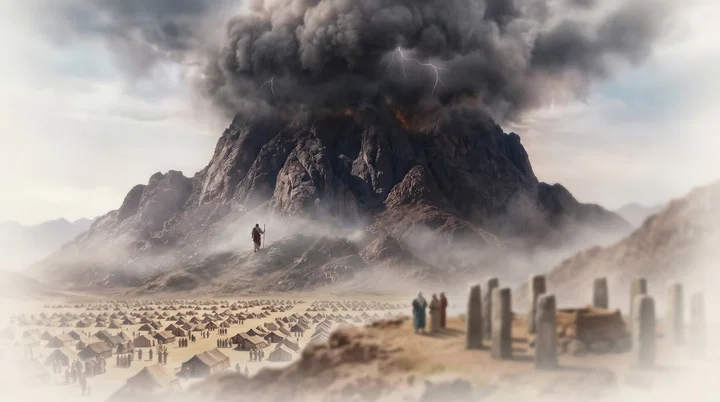
And the LORD came down upon mount Sinai, on the top of the mount: and the LORD called Moses up to the top of the mount; and Moses went up.
Translations
And the LORD came down on mount Sinai, on the top of the mount: and the LORD called Moses up to the top of the mount; and Moses went up.
And the LORD came down upon mount Sinai, on the top of the mount: and the LORD called Moses up to the top of the mount; and Moses went up.
And the Lord came down upon mount Sinai, on the top of the mount: and the Lord called Moses up to the top of the mount; and Moses went up.
And the LORD came down upon mount Sinai, on the top of the mount: and the LORD called Moses to the top of the mount; and Moses went up.
And the LORD came down upon mount Sinai, to the top of the mount: and the LORD called Moses to the top of the mount; and Moses went up.
And Jehovah came down upon mount Sinai, to the top of the mount: and Jehovah called Moses to the top of the mount; and Moses went up.
And Jehovah cometh down on mount Sinai, unto the top of the mount, and Jehovah calleth for Moses unto the top of the mount, and Moses goeth up.
And Jehovah came down on mount Sinai, on the top of the mountain; and Jehovah called Moses to the top of the mountain, and Moses went up.
Thus came Yahweh down upon Mount Sinai unto the top of the mount,—and Yahweh called Moses unto the top of the mount, and Moses went up.
Berean Standard Bible, Majority Standard Bible
The LORD descended to the top of Mount Sinai and called Moses to the summit. So Moses went up,
The LORD came down on Mount Sinai, to the top of the mountain. The LORD called Moses to the top of the mountain, and Moses went up.
Then the Lord came down on to Mount Sinai, to the top of the mountain, and the Lord sent for Moses to come up to the top of the mountain, and Moses went up.
(For the Lord came downe vpon mount Sinai on the toppe of the mount) and when the Lord called Moses vp into the top of the mount, Moses went vp.
Douay-Rheims (Challoner revision)
And the Lord came down upon mount Sinai, in the very top of the mount, and he called Moses unto the top thereof. And when he was gone up thither,
Pictures
Cross-references 20 of 64
- Exodus 20:1-17
And God spake all these words, saying,
God’s descent at Sinai leads to his proclamation of the commandments.
- Deuteronomy 4:12-13
And the LORD spake unto you out of the midst of the fire: ye heard the voice of the words, but saw no similitude; only ye heard a voice.
God speaks from the fire at Horeb and declares the Ten Commandments as his covenant.
- Exodus 19:5-6
Now therefore, if ye will obey my voice indeed, and keep my covenant, then ye shall be a peculiar treasure unto me above all people: for all the earth is mine:
states the agreement terms in Exodus 19
- Exodus 24:3-8
And Moses came and told the people all the words of the LORD, and all the judgments: and all the people answered with one voice, and said, All the words which the LORD hath said will we do.
Israel agrees to the covenant words, and Moses ratifies the covenant with blood.
- Exodus 31:18
And he gave unto Moses, when he had made an end of communing with him upon mount Sinai, two tables of testimony, tables of stone, written with the finger of God.
God gives Moses stone tablets bearing the commandments written with his finger.
- Deuteronomy 5:2-3
The LORD our God made a covenant with us in Horeb.
Names the covenant the LORD made with Israel at Horeb.
- Exodus 19:7-8
And Moses came and called for the elders of the people, and laid before their faces all these words which the LORD commanded him.
Israel accepts the covenant terms by promising obedience.
- Exodus 20:1-2
And God spake all these words, saying,
God begins speaking the law at Sinai after descending and identifies himself as Israel’s deliverer.
- Exodus 20:19
And they said unto Moses, Speak thou with us, and we will hear: but let not God speak with us, lest we die.
Israel asks Moses to mediate because they fear hearing God speak.
- Exodus 19:10-15
And the LORD said unto Moses, Go unto the people, and sanctify them to day and to morrow, and let them wash their clothes,
Israel sanctifies and prepares before the Lord descends on Sinai.
- Deuteronomy 5:22
These words the LORD spake unto all your assembly in the mount out of the midst of the fire, of the cloud, and of the thick darkness, with a great voice: and he added no more. And he wrote them in two tables of stone, and delivered them unto me.
God speaks the commandments to Israel at the assembly and writes them on stone tablets.
- Deuteronomy 33:2
And he said, The LORD came from Sinai, and rose up from Seir unto them; he shined forth from mount Paran, and he came with ten thousands of saints: from his right hand went a fiery law for them.
The Lord came from Sinai and gave the law.
- Exodus 24:12
And the LORD said unto Moses, Come up to me into the mount, and be there: and I will give thee tables of stone, and a law, and commandments which I have written; that thou mayest teach them.
God calls Moses up Sinai to receive the stone tablets and law.
- Hebrews 12:18-21
For ye are not come unto the mount that might be touched, and that burned with fire, nor unto blackness, and darkness, and tempest,
Recalls the fearful, awe-inspiring scene when God spoke at Sinai.
- Hebrews 12:26
Whose voice then shook the earth: but now he hath promised, saying, Yet once more I shake not the earth only, but also heaven.
God’s voice shook the earth at Sinai and will shake heaven and earth.
- Exodus 24:16-17
And the glory of the LORD abode upon mount Sinai, and the cloud covered it six days: and the seventh day he called unto Moses out of the midst of the cloud.
God’s glory rests on Sinai and appears like devouring fire.
- Psalms 68:17
The chariots of God are twenty thousand, even thousands of angels: the Lord is among them, as in Sinai, in the holy place.
Both describe the Lord’s presence at Sinai.
- Exodus 19:16
And it came to pass on the third day in the morning, that there were thunders and lightnings, and a thick cloud upon the mount, and the voice of the trumpet exceeding loud; so that all the people that was in the camp trembled.
Thunder, lightning, cloud, and trumpet accompany the Lord’s descent at Sinai.
- Exodus 19:12
And thou shalt set bounds unto the people round about, saying, Take heed to yourselves, that ye go not up into the mount, or touch the border of it: whosoever toucheth the mount shall be surely put to death:
Bounds around the mountain mark it as set apart for God.
- Nehemiah 9:13
Thou camest down also upon mount Sinai, and spakest with them from heaven, and gavest them right judgments, and true laws, good statutes and commandments:
The Lord came down at Sinai and gave Israel laws and commandments.
Commentary
Each commentary is drawn from primary sources: the writings of Ellen G. White and Adventist pioneers and periodicals. Each commentary is separate. Its own words are not a quotation; follow the references to read the source passages.
Ellen G. White
34 sources
The Lord came down upon the top of Mount Sinai and called Moses alone up a steep and rugged path into the cloud marking the place of His presence.PP 303.1–3SG3 264.1–3Lt 198, 1908, par. 5–11 He came down in fire on the third-day morning amid thunders and lightnings, thick cloud and smoke ascending as from a furnace, an exceeding loud trumpet waxing louder and louder, and the whole mount quaking greatly while the people trembled below.SG3 264.1–3Ms 93, 1908, par. 4–10Lt 198, 1908, par. 5–11 The One who descended was Christ, the Son of God, enshrouded in glory with a glorious retinue of angels appearing as flames of fire, His form hidden by thick cloud and darkness.Lt 154, 1906, par. 34–3921MR 89.2–6Lt 51, 1901, par. 2–4ST Feb 27, 1896 His coming down and calling Moses was the immediate preparation for the great work of giving the Ten Commandments, which God spoke audibly to all the people and wrote with His own finger on tables of stone so they could not claim ignorance.Lt 198, 1908, par. 5–11SG3 298.1–299.2Lt 126, 1907, par. 6–7 This public display of awful grandeur as Ruler of the world was to impress profound veneration, display the holiness of God and the sacredness of His law, and show its importance for all ages till the close of time.SG3 264.1–3Ms 93, 1908, par. 4–10Lt 168, 1909, par. 16–171SP 234.2–235.1Lt 374, 1908, par. 3–4
Descent Upon Mount Sinai
Soon after the encampment at Sinai Moses was called alone up into the mountain to meet with God, climbing the steep and rugged path to the cloud marking the place of Jehovah's presence.PP 303.1–3 There Israel was to be taken into a close and peculiar relation to the Most High, to be incorporated as a church and a nation under the government of God.PP 303.1–3
On the third-day morning the Lord came down in fire upon the top of the mount amid thunders and lightnings, thick cloud, and smoke ascending as from a furnace.Ms 93, 1908, par. 4–10Lt 198, 1908, par. 5–111SP 234.2–235.1 An exceeding loud trumpet sounded long and waxed louder and louder, and the whole mount quaked greatly while the people stood trembling at the nether part.Ms 93, 1908, par. 4–10Lt 198, 1908, par. 5–111SP 234.2–235.1 Moses spoke and God answered him by voice.Ms 93, 1908, par. 4–10Lt 198, 1908, par. 5–111SP 234.2–235.1 The descent took place with a glorious retinue of angels appearing as flames of fire, and God's glory rested on the mountain like devouring fire.1SP 234.2–235.1RH Aug 16, 1906 Israel listened in solemn awe, prostrate before Him.
He came enshrouded in glory, His form hidden by thick cloud and darkness and veiled in mercy so the people could hear His voice throughout the camp without being destroyed by His presence.Lt 154, 1906, par. 34–3921MR 89.2–6RH Aug 16, 1906Lt 126, 1907, par. 6–7 In awful majesty He spoke His law in the hearing of all the people, surrounded by His angels.Lt 126, 1907, par. 6–7PP 363.2 God chose for this a high mountain in the barren desert, a temple of His own creation among His created works and surrounded by them rather than by human buildings and pride.Lt 154, 1906, par. 34–3921MR 89.2–6Ms 64, 1903, par. 8–9 There He revealed His majesty and made Himself known in awe-inspiring glory with an audible voice, to make the people feel their insignificance before the Almighty.Lt 154, 1906, par. 34–3921MR 89.2–6Ms 64, 1903, par. 8–9 His presence made the rocky mount sacred, and the mountain setting gave the giving of the law solemn grandeur.BS 63.1–2Lt 259, 1903, par. 13–17
Moses obeyed calmly and trustfully, going through smoke and flame and disappearing from the people's sight.ST Mar 7, 1878 He drew near and entered the thick darkness surrounding the cloud of glory without entering within it, standing between the Lord and the people.SG3 264.1–31SP 234.2–235.1 He was then sent back down to charge the people not to break through the set bounds to gaze lest the Lord break forth upon them and many perish, and to require the priests who come near to sanctify themselves.SG3 264.1–3Lt 198, 1908, par. 5–111SP 234.2–235.1 Aaron alone was to come up with him, and Moses later descended.Lt 198, 1908, par. 5–11ST Mar 7, 1878 The One who thus descended and called Moses was Christ, the Son of God, who proclaimed the law amid thunder and flame.Lt 51, 1901, par. 2–4ST Feb 27, 1896
The descent came for a people newly delivered from Egyptian slavery, to give them evidence that He was God that they might gain a knowledge of God they had never before had.Ms 93, 1908, par. 4–10 During long bondage they had largely lost knowledge of the law, which had been known at creation and preserved by Noah and Abraham but corrupted by intercourse with idolaters and bondage to the Egyptians, and their religious life was taking the shape of idolatrous practices.ST Feb 27, 1896ST Sep 9, 1913PP 363.2 Though erring and disobedient and rebellious, they were still His chosen people, honored above all people on the earth not because they were more in number, for they were the fewest of all people, but because He loved them and would keep the oath sworn to their fathers.2T 108.1 Having with upraised hand solemnly covenanted to do all He had spoken and accept Him as ruler, they became in a special sense subjects of His authority, His denominated people, a peculiar treasure above all people, a kingdom of priests and a holy nation.PP 303.1–3Lt 198, 1908, par. 5–11 Israel's beforehand washing of clothes impressed God's purity and His concern for their physical as well as moral well-being as they prepared to hear.CTBH 181.3
Law Proclaimed With Majesty
The coming down upon the top of the mount and the calling of Moses up was the immediate preparation for the great work of giving the Ten Commandments to Israel.Lt 198, 1908, par. 5–11SG3 298.1–299.2Lt 126, 1907, par. 6–7 God spoke those commandments audibly to all the people from the mountain so they could not claim ignorance or confuse His requirements with human traditions.SG3 298.1–299.22T 108.1 He wrote them with His own finger on tables of stone, and their precepts came from God, not from Moses or any human mind.2T 108.1Ms 4, 1904, par. 19 It was a wondrous communication from God to humanity.Lt 126, 1907, par. 6–7
The law so proclaimed included the fourth commandment and its Sabbath obligation.Lt 51, 1901, par. 2–4GC88 453.1–2 It calls for keeping holy the memorial of creation, the seventh day blessed and sanctified as rest after six days of creation work.Lt 198, 1908, par. 5–11Lt 168, 1909, par. 16–17 That instruction regarding His requirements is to be pointed to in simple language even children can understand as the reason for observance of the seventh day.Lt 198, 1908, par. 5–11
The law given there was the covenant of ten commandments, given with wonderful promises if kept.Lt 176, 1907, par. 11–12RH Sep 5, 1907 Israel was to keep it and teach it to succeeding generations.RH Sep 5, 1907 Obedience to all the commandments is the highest source of education, teaching what human teachers who reject God's instruction cannot teach, and Israel's prosperity depended on obeying them.PP 303.1–3Lt 164, 1910, par. 5–7Ms 4, 1904, par. 19
The public display of divine majesty and awful grandeur as Ruler of the world gave every evidence that He was God.Ms 93, 1908, par. 4–101SP 234.2–235.1Lt 54, 1911, par. 4 He made known that He is the only true and living God who will not bear iniquity, displaying the holiness of God and the sacredness of His law.Ms 93, 1908, par. 4–101SP 234.2–235.1ST Mar 7, 1878 It was to impress profound veneration, to cause the people to believe and know His will, and to lead them to fear transgressing and to fear and obey Him continually.1SP 234.2–235.1GC88 453.1–2Lt 54, 1911, par. 4 Its impressions were to remain in memory, inspiring confidence in the Lawgiver.RH Sep 5, 1907Lt 54, 1911, par. 4
This unique manifestation showed the law's importance for all ages and calls for obedience to God's commandments.Ms 64, 1903, par. 8–91MR 106.2–3 Its instruction is of great importance and must be often repeated and sacredly observed and never lost sight of.Lt 168, 1909, par. 16–17Lt 374, 1908, par. 3–4 The lessons taught while Israel abode at Mount Sinai were not for that time only but carry an influence not to be lost till the close of time.Lt 374, 1908, par. 3–4 The mount remains a place to draw near to God, learn what He commands and obey His expressed will, with those lessons amid scenes of nature and the everlasting hills needful for the education of youth.Lt 374, 1908, par. 3–4Ms 169, 1899, par. 56
The teachings given to Moses there remain needed now, and Christ is the same Teacher who gave the directions on Sinai.Lt 160, 1906, par. 3–9 God talking with the people through Moses wants all to understand what He was telling Israel there as He goes on to speak the words of Exodus 20:1.Lt 160, 1906, par. 3–9Ms 125, 1909, par. 22–25
The verse stands for the divine authority of the Lawgiver who demands obedience to His Word.Lt 168, 1909, par. 16–17Ms 40, 1894, par. 7 Claiming sanctification while evading those requirements and substituting a self-made standard is spurious.Ms 40, 1894, par. 7 When Satan uses every device to draw people from truth and righteousness, all who would stand on the Lord's side are called to obedience.Lt 168, 1909, par. 16–17
The descent reveals His great power acting for the children of Israel.PP 590.5 It is the same power that parted the Red Sea and made a way through Jordan and that again struck the Philistines with a terrible storm that left the earth strewn with dead warriors.PP 590.5
Sources
Pioneers and periodicals
169 sources
The Lord himself came down upon the top of Mount Sinai, called Moses up to the top, and Moses went up.ST Apr 5, 1899ST Apr 8, 1886
He descended on the third day in the morning amid thunders and lightnings, thick cloud, trumpet, smoke and fire and quaking, and there proclaimed the Ten Commandments in the hearing of all the people with his own voice.ST Apr 5, 1899ST Sep 25, 1893RH Mar 4, 1862ST Mar 4, 1889RH Jun 13, 1854
The descent belongs to the making and dedication of the old first covenant, a solemn mutual agreement in which the Ten Commandments were its basis, terms and moral conditions that the people pledged to obey.RH Apr 28, 1868RH May 3, 1860ST Sep 23, 1889RH Jan 8, 1857
The Sabbath and the duties of the commandments already existed before that covenant and were not instituted at Sinai, for the Sabbath was made at creation and already understood and rebuked in its violation at the manna before Sinai.ST May 17, 1883ST Mar 11, 1875RH May 2, 1854RH Feb 3, 1852ST May 17, 1883
The One who descended in fire and glory was Christ, and the scene is a pattern of His future descent with the trump of God to vindicate His authority by saving the keepers of His law and destroying transgressors.ST Feb 27, 1896STRH Jan 12, 1869ST Dec 19, 1892RH Aug 3, 1869
Descent and Surrounding Signs
The Lord himself came down upon the top of Mount Sinai, called Moses up to the top of the mount, and Moses went up.ST Apr 5, 1899ST Apr 8, 1886RH Apr 3, 1900 The descent came on the third day in the morning amid thunders and lightnings, thick cloud, and an exceeding loud trumpet, with the people trembling at the nether part of the mount.ST Apr 5, 1899ST Mar 4, 1889RH Jun 13, 1854 Sinai smoked because the Lord descended in fire, with smoke ascending as the smoke of a furnace and great quaking of the whole mount.ST Apr 5, 1899ST Mar 4, 1889RH Jun 13, 1854 The trumpet waxed louder and louder as Moses spoke and God answered by a voice.ST Apr 5, 1899RH Dec 5, 1871ST Jan 16, 1912 The earth shook and God spoke his law with terrifying power and clarity after Israel had sanctified themselves and were prepared to hear him.RH Dec 5, 1871ST Jan 16, 1912RH Aug 3, 1869
He came in flaming fire and blazing glory with thousands of angels, heralded by the sound of God's trumpet.ST Apr 8, 1886RH Dec 24, 1861RH Apr 21, 1874 He came down in a resting cloud as his pavilion, with thunder as sentinels and lightning as lances, and his presence caused the signs that accompanied the giving of the law.ST Apr 8, 1886RH Dec 24, 1861RH Jun 13, 1854 He came in a chariot of light with fiery wheels rolling in awful commotion, with devouring fire and glory and thunderings and peal upon peal of God's trumpet rolling over ocean and valley, so that the flame-covered mountain rocked like a ship on the ocean.RH Jun 16, 1868 On the third day he spoke from the mountain, surrounded by angels and hidden by thick darkness.RH Aug 16, 1906 From the midst of the fire he proclaimed the Ten Commandments, including the Sabbath commandment, to make known his holy Sabbath and command precepts, statutes, and laws by the hand of Moses his servant.RH Dec 24, 1861ST Mar 4, 1889
Moses parted from the trembling people he had led to the foot and with solemn step scaled the rocks and climbed the heights through smoke and flame till the cloud received him in its bosom.ST Mar 7, 1878RH Jun 13, 1854 He obeyed calmly and trustfully, going through smoke and flame and disappearing from the people's sight, and he later descended.ST Mar 7, 1878RH Jun 13, 1854 The top of Sinai was God's audience room where Moses went up as auditor, meek and fearless in duty, to talk with the glorious King in his beauty, to receive the moral law and also the civil code.ST Mar 30, 1915RH Jun 13, 1854RH Jun 16, 1868 The mountain is presented as the place of God's visible presence with Moses as mediator standing before God.ST Mar 30, 1915
Bounds were set around the sanctified mountain because God was about to speak, and the people were brought out of the camp to meet God but kept back from breaking through to gaze or touch even its border lest many perish and the Lord break forth upon them.ST Apr 5, 1899RH Dec 4, 1913RH Apr 21, 1851RH Aug 14, 1856 Only Moses and Aaron were suffered to go up.ST May 25, 1904 The priests who come near to the Lord were commanded to sanctify themselves lest the Lord break forth upon them.ST Jul 30, 1902 That command warned even Nadab and Abihu beforehand, proving they were not cut down without warning.ST Jul 30, 1902
To sanctify the people and the mountain means to set apart as holy and to establish boundaries and directions for sacred use.RH Aug 10, 1876 To sanctify the mount meant to set bounds about it and command the people not to go up into it or touch even the border of it, telling them to treat the mountain as sacred to God.ST May 11, 1915 In the same way, to sanctify the rest day of the Lord meant to tell Adam to treat the day as holy to the Lord, using the same kind of language as the sanctifying of the Sabbath in Genesis where it means to set apart.ST May 11, 1915 The mountain thus was set apart as holy when Jehovah descended upon it to proclaim his law, becoming holy ground that could not be treated as ordinary or common ground.ST Jul 28, 1909RH Jul 16, 1861RH Mar 15, 1870 It became closely associated with God's presence and holy angels, the sacred mountain where God gathered Israel apart from other nations to give them his holy law, and as the Lord's presence made the temple sacred so it sanctified Sinai.ST Jul 29, 1880ST Jul 28, 1909
Horeb and Sinai are names for different peaks of the same mountain range, and Sinai of Horeb's range is the place of revelation where God came down upon the top and called Moses up to reveal his unchangeable law.RH Nov 12, 1861ST Sep 10, 1902 The mountain stands in the midst of desolate scenery, lifting its huge form into the heavens, with a bold and naked summit and barren and rocky sides, wild and lonely and gloomy.RH Jun 13, 1854 It stood in wild land claimed by no nation so that all nations might have a portion in Israel's God, and God coming down upon rugged Sinai spoke his holy law to all the world through Israel.ST Oct 31, 1906 This calling up happened twice, each time for forty days and nights, when Moses was called up to be shut in with God.ST Oct 31, 1906
The event truly happened as a real descent and personal coming down from heaven to earth, when the one who spoke the law and met with Moses on Sinai was Christ the Son of God through whom the Father works, so Moses saw the Son.STRH Apr 3, 1900 It was not merely a spiritual impression or an inward experience, and not a volcanic eruption as critics' strained deductions claim.STST May 10, 1910 To strip the narrative of its supernatural element and reduce it to very primitive thoughts about what ancient people thought possible fulfills the prophetic question whether the Son of man shall find faith on the earth at his coming.ST May 25, 1904 Immediately after Moses went up the Lord sent him down to charge the people and priests not to break through to gaze lest many perish and the Lord break forth upon them.ST Apr 5, 1899 That display of divine power at Sinai, like creation and the crossing of the Red Sea, is known now only by testimony to those who did not witness it.RH Feb 20, 1866
Time Place and Setting
The Lord's coming down on Sinai belongs to Israel's arrival at the mount in the third month after leaving Egypt, and to the third day after the covenant pledge when the law was proclaimed.RH Jan 15, 1914RH May 27, 1852RH Feb 2, 1864 That day is dated as Sivan 6, fifty days after the Exodus.RH Jan 15, 1914 It is connected with Pentecost, the feast of first-fruits, which commemorated the giving of the law in flaming fire and blazing glory when the people heard God's voice and received the commandments.RH Jan 15, 1914RH Mar 1, 1906
Israel came to Sinai thirty days after manna was first given in the Wilderness of Sin on the fifteenth day of the second month, the place from which the Ten Commandments in Exodus 20:2-17 were proclaimed by God.ST May 17, 1883RH May 27, 1852ST May 17, 1883 They had kept the Sabbath in the Wilderness of Sin thirty-two days before hearing the commandments at Sinai, after God brought them out of Egyptian bondage where they could not observe it to remind them of His Sabbath and speak the ten commandments and give the tables of stone.RH Oct 21, 1851RH Oct 21, 1851RH Mar 1851 The thirty-day interval proves the Sabbath was already understood and its violation already rebuked before Sinai, so it was not instituted there but existed before as an old institution well understood.ST May 17, 1883ST May 17, 1883RH Mar 1851
The Sabbath had been observed in Exodus 16 about a month before the preliminary work of making the old covenant began here, so it did not owe its existence to that covenant and could continue after that covenant was dissolved.ST Aug 13, 1885 After reaching the wilderness the people were given three days to prepare before the law was spoken from the mountain, a setting showing the seventh-day Sabbath was known and expected before it was given from Sinai.ST Jun 26, 1901
The giving at Sinai was forty years before Moses' rehearsal of the commandments in Deuteronomy 5 in the fortieth year after the departure from Egypt.RH May 27, 1852RH Jan 7, 1862 It is set in contrast to Moses' later repetition in Deuteronomy, and the Horeb covenant there embodied the precepts of the moral law with mutual pledges by which Israel came into personal obligation to obey, yet gave existence to none of the ten commandments.RH Jan 7, 1862ST Mar 11, 1913 God had already given the Sabbath law from Sinai where the earth quaked at His voice forty years before Israel's march around Jericho.RH Nov 15, 1864
The event marks Israel entering into covenant relation with God at the closing of the patriarchal dispensation and before the beginning of the Levitical dispensation and priesthood.ST Mar 4, 1889ST Feb 25, 1889 It follows God bringing Israel out of more than two hundred years of bondage that they might serve Him, reforming and proving them by the Sabbath and leading them by displays of power and majesty and care.ST Feb 25, 1889ST Jun 26, 1901 The impressive giving of the law in Exodus 19 and 20 opened that Levitical dispensation by the covenant in Exodus 19 and 24 whose basis was the law of God, the voice of God, the ten words in Exodus 20:3-17, the whole code of His great constitution.ST Mar 4, 1889
The ascent begins the chronological course running from Exodus 19 to Exodus 32 for God to speak His law and give other instruction through Moses, including the sanctuary in Exodus 25 to 31, followed by its building and setting up in Exodus 33 to 40.ST Dec 10, 1896 At this point the people had promised to obey but had not yet heard God's voice, so God did not seal the covenant but proceeded to speak His law.ST Dec 10, 1896 God came down on rugged Sinai in wild land claimed by no nation so all nations might have a portion in Israel's God, to speak His holy law to all the world through Israel, and called Moses up to be shut in with God, a calling up that happened twice, each time for forty days and nights.ST Oct 31, 1906
The verse belongs to solemn preparation for the giving of the law, after thorough prompt preparation to cleanse the camp, wash clothes, humble hearts, and appear decently before God on the appointed day.ST Feb 11, 1913RH Nov 21, 1865RH Jul 4, 1912 The mountain was set apart as forbidden ground, and the scene conveys awe and eager expectation as God approaches His people.RH Jul 4, 1912 The sublime display of the Creator's power as a consuming fire showed His instructions carried solemn authority and are to be obeyed even when given quietly and seeming unimportant.RH Nov 21, 1865
God deliberately chose the bare, dry, desolate heights of Horeb for a world-molding revelation to instruct Israel in saving truth and the fundamental law of His government, illuminating vast stretches of barren solitude with His presence instead of using the universities of Babylon or Egypt.ST Feb 20, 1907 This proves He chooses the base and despised things of the world so that no flesh should glory in His presence.ST Feb 20, 1907
The glory shining forth on Horeb at the promulgation of the moral law makes Horeb memorable above all other mountains.RH Nov 17, 1859 It closes the Bible story running from creation to Sinai and marks the point in the Bible story when the law was spoken.RH Sep 22, 1904RH Oct 22, 1901 As part of the historical record of God's dealings including the leadership of Moses, these were truths needed for their time, but as past events they did not by themselves meet the present needs of later generations.ST May 11, 1915
The Sinai scene with cloud, thunder, lightning, and fire was part of the scriptural history Jesus learned as a child, where He heard the Ten Commandments.ST Aug 13, 1912
Old Covenant Made at Sinai
Exodus 19:20 belongs to the making and dedication of the old or first covenant whose marks are found in Exodus 19:3 to 24:8, preliminary in Exodus 19 and completed by ratification in Exodus 24 by writing, sacrifice, and blood.ST Sep 23, 1889RH Jan 8, 1857ST Mar 8, 1883ST Mar 8, 1883 Exodus 19 together with Exodus 24 records the contract relative to the Ten Commandments that is the identical first covenant, and Exodus 19 identifies the old covenant whose terms must be understood when considering Israel's future and comparing it with the new covenant.RH Jan 8, 1857ST Mar 8, 1883 The chapter does not give the Ten Commandments as the covenant itself, but gives the solemn agreement between God and Israel to keep the words He spoke, made before they heard His voice and ratified after hearing it.ST Mar 8, 1883ST Mar 8, 1883
The covenant was a solemn mutual agreement and contract between God and Israel concerning obedience to His law, not the law itself.RH Apr 28, 1868ST Sep 17, 1885RH Feb 3, 1852ST Mar 15, 1883RH Mar 25, 1875 The Ten Commandments were its basis, terms, moral conditions, and the part the people were bound to perform, the words of the covenant they agreed to obey and keep.RH Apr 28, 1868RH May 3, 1860ST Sep 17, 1885RH Feb 3, 1852RH Mar 25, 1875 A covenant is an agreement distinct from the enduring law given in Exodus 20, and this agreement in Exodus 19 made three days before the ten commandments were spoken, not the ten commandments themselves, is the old or first covenant that passed away.RH Apr 28, 1868RH Mar 25, 1875 The rites and offerings given through Moses depended on the people's relationship to that law, and Israel's keeping or breaking the covenant did not abolish the law, which continues and is confirmed in the new covenant where God puts His law in hearts.RH Apr 28, 1868RH Feb 3, 1852
God proposed that if they would obey His voice indeed and keep His covenant they would be a peculiar treasure above all people, a kingdom of priests and a holy nation.RH Mar 25, 1873RH Mar 25, 1875RH Aug 18, 1868 After Moses laid the terms before the elders all the people answered together that all the Lord had spoken they would do, presenting the first mutual agreement God made with the house of Israel after leading them out of Egypt. To obey His voice and to keep His covenant mean precisely the same thing, for the voice He uttered and the covenant He gave are the ten commandments, and obedience to that law would make Israel a peculiar treasure, a kingdom of priests and an holy nation sanctified by obeying it.RH Jul 26, 1864RH Aug 18, 1868 By entering the contract God took Israel as His people and became their husband, promising to accept them and be their God and care for them on condition of obedience.ST Sep 17, 1885ST Mar 15, 1883ST Feb 20, 1879RH Dec 24, 1861 The Lord came in person to Mount Sinai and solemnly chose Israel as a holy nation belonging to Him.RH Dec 24, 1861
The people pledged to obey God's voice before they had heard it, then after hearing the ten precepts in Exodus 20 they ratified the agreement.ST Feb 13, 1879ST Feb 6, 1879ST Mar 8, 1883ST Mar 8, 1883 God did not treat the Exodus 19 promise alone as closing the contract but gave further opportunity to confirm or refuse after hearing every word and judgment, leading to the final contract and its ratification by writing, sacrifice, and blood.ST Feb 6, 1879ST Mar 8, 1883ST Mar 8, 1883 Exodus 19:3-8 records the making of the covenant contract when Moses stood between God and Israel to convey promises and return the answer, while Exodus 19:20 marks the Lord's own descent three days afterward to declare the words of that condition in the hearing of all the people out of the midst of the fire.ST Jul 8, 1875RH Mar 25, 1875ST Mar 1, 1883ST Feb 6, 1879 At that descent Moses did not stand between them to convey the Ten Commandments, but all the host of Israel heard them directly from the mount.ST Jul 8, 1875RH Mar 25, 1875 Exodus 19:9-25 records the next act in entering the first covenant after the preliminary contract was closed, devoted to the preparation of the people to hear God and to the descent of God upon Sinai to speak the Ten Commandments.ST Mar 1, 1883ST Feb 6, 1879
The setting was Israel ignorant from long slavery yet made self-confident by wonders in Egypt, the Red Sea, and food in the wilderness, thinking they could do anything required. God gave them opportunity to try in order to teach their utter helplessness without Him. Israel met God promising in their own strength to do all He said, wanting blessings but trying to buy them by works and leaving the Lord out except for the blessings.ST Aug 22, 1911 That self-dependent promise to work out obedience of themselves is the Sinai covenant that bears children to bondage, pictured by Hagar and her son born after the flesh through human planning, in contrast to Isaac born through Sarah by promise and miraculous power to those who yield wholly to His plan.ST Aug 22, 1911
The first covenant was faulty because it was no stronger than its weakest promise, the people's promise, and the fault lay with the people.ST Mar 17, 1909ST Apr 22, 1913 Apart from its national view it was man's effort to save himself by his own promise, in contrast to the new and everlasting covenant based on God's promises in which man's part is yielding to and receiving those promises and God writes His law in hearts and minds so that obedience springs from love.ST Mar 17, 1909 The Sinai covenant therefore shows both that people cannot do God's will by their own power and that a national covenant cannot save individuals, for when God spoke the law they asked Him not to speak to them again and did not have His law written in their hearts.ST Apr 22, 1913 When the people broke the Ten Commandments they broke the covenant and forfeited all claims under it, because that covenant made no provision for forgiveness or restoration.RH May 3, 1860ST Sep 17, 1885 Hence a new covenant was necessary providing pardon through Christ, while the law that was its basis remains the basis of the new.RH May 3, 1860RH Under this first covenant He gave Israel the Ten Commandments in person and also gave them the ceremonial laws through Moses, and its weakness was not God's law but Israel's transgression and the absence of the new covenant's promises of pardon.STRH
They continued not in His covenant by not regarding His moral law, the rule of holiness, so they were not holy but sinners like all nations.RH Mar 25, 1873RH Mar 25, 1875 God could not continue to regard them as holy contrary to their real character without denying Himself, therefore He regarded them not.RH Mar 25, 1873RH Mar 25, 1875 God dealt with them according to His declared rule to honor those who honor Him and to lightly esteem those who despise Him, as He will deal with all.RH Mar 25, 1875 The Horeb covenant contains the first promise of a kingdom to Israel conditional on obeying God's voice and keeping the Ten Commandments.RH Jan 19, 1860 The condition was broken and the promise forfeited by Jacob's descendants under the old covenant, so the kingdom was taken from them, and it can only be regained by interest in Jesus, now Prince and soon crowned King, given to a nation bringing forth its fruits, the poor rich in faith who love Him.RH Jan 19, 1860
The covenant added to Abraham's promises another condition of justification, the righteousness of perfect obedience, and required perfect obedience.RH Feb 1851RH Fallen guilty man never complied, so if inheritance came by that condition only the promises to Abraham would be void, yet the law is not against the promises but concludes all under sin that the promise by faith in Jesus Christ might be given to believers.RH One position holds instead that Exodus 19 records an agreement while Exodus 20 contains the first covenant itself, which is the Decalogue as an enacted law-covenant.RH Apr 15, 1873 On that position it did not become void by non-fulfillment but expired by limitation, and though it may be called an agreement it was also a law-covenant because it was enacted or legislated.RH Apr 15, 1873
Law Proclaimed in Majesty
Exodus 19:20 belongs to the giving of the Ten Commandments on Mount Sinai, beginning the giving of the law and covenant statutes after the people accepted the covenant amid thunder and lightning.ST Mar 3, 1914RH Dec 8, 1874 It was given in the solitudes of the world to a pilgrim people called out to be priests to the whole world, only after three days of careful preparation.ST Jun 12, 1907 The grandeur earth had never before witnessed proved the law full, complete, comprehensive, the epitome of all morality.ST Jun 12, 1907 Its circumstances of exceptional, sublime impressiveness were later paralleled only by those surrounding the Crucifixion, and so great in glory, majesty and terror that only the second coming of Christ can parallel them.ST May 20, 1908RH Feb 23, 1869
The Lord himself descended in awful grandeur upon Sinai and proclaimed the ten holy precepts in the hearing of all the people, rather than leaving Moses or an angel to assemble the tribes and utter the law.ST Jun 10, 1880ST May 10, 1883RH Feb 4, 1875 He spoke the commandments to the people, then wrote them with his own finger on two stone tablets of his own handiwork, too jealous of their sacredness and accuracy to permit Moses or even Gabriel to write or copy them.ST Jun 10, 1880ST Sep 25, 1893RH Nov 11, 1873 That Sinai revelation includes the proclamation later written by God on stone and placed in the ark beneath the mercy seat, so the people could not confuse his requirements with human traditions.ST Jun 10, 1880RH Mar 4, 1862 The setting was Mount Sinai in the wilderness, not far from the Red Sea, where God descended in fire amidst thunderings and lightnings and earthquakes to reinstitute his almost forgotten Sabbath and re-enact it with awe illustrating his majesty.ST Sep 25, 1893RH Nov 11, 1873
The preparations and awe-inspiring events were meant to impress the people with the law's grandeur, dignity, perpetuity and importance.ST Apr 15, 1886ST Oct 22, 1902ST May 10, 1883 Joined with Exodus 24:12 and Deuteronomy 4:12-13 and Exodus 20:1-17, the account proves the law God gave Moses there was the ten commandments, one unified and complete law spoken to all the assembly out of the midst of the fire, afterward written on two tables of stone, to which he added no more. Its public, majestic proclamation by the same Lawgiver means it could not be abolished or altered in secret without a like public act.ST May 10, 1883ST Mar 11, 1875 That law is the Royal Law, the voice of God, the ten words or ten commandments, containing the whole code of God's great constitution in Exodus 20:3-17.ST Mar 4, 1889RH Apr 21, 1851
It formed no part of Israel's ritual or ceremonial system, being distinct from the other laws given through Moses and from the law of ordinances regulating the typical service.ST Mar 4, 1889ST May 20, 1875ST Mar 4, 1886 It is expressly called a law, points out sin because it is the rule of life, is complete and perfect in itself, comprehends all justice, truth and righteousness, and is the foundation of God's government, a reflex of his character.ST Mar 4, 1889 Moses' ascent begins the period in which he receives and writes the separate ceremonial law, the moral law having been written out first and the law of ordinances immediately afterward.ST May 20, 1875ST May 6, 1875 The commandments are divided into two tables, the first four concerning duties toward God and the last six concerning duties and relations toward other people.ST Sep 25, 1893
That law is a law of love and remains binding, connected with the command to love one's neighbor, binding people to obedience and forming part of Christian character alongside faith.RH Sep 17, 1861RH Dec 15, 1868 God's own voice spoke forth every precept so each was distinctly heard while Sinai trembled to its base, proving the whole law entirely true.RH Mar 9, 1869 The commandments came directly from God, not Moses, and their divine origin marks them as unalterable and eternal, spoken from heaven in his own voice from the summit to the people at the base.RH Mar 6, 1866RH Feb 4, 1875ST Jan 11, 1883 Its later abolition or alteration would have required clear open announcement, just as its original proclamation was made openly by God himself.ST Mar 11, 1875
The law reveals God's righteousness and requires perfect obedience, exposing sin and humanity's inability to attain righteousness by effort.RH Mar 26, 1861 By itself and apart from Christ it brings condemnation and death, not righteousness, warning people not to seek righteousness through works and directing them back to God's promise.ST Nov 21, 1900 Sinai came before Calvary: the law first disciplines the heart and makes a person feel helpless and in need of righteousness, so that the person can appreciate peace in Christ.ST Mar 20, 1901 God came near through Christ by whom the law was given; received from God it could be a life-giving message of grace and truth and enabling promise, but Israel asked Moses to speak for God and received it as cold precept condemning them and kept only in outward form.ST Jan 11, 1905
The revelation included a pattern of God's holy temple and a transcript of his will, his holy law, connected with showing Moses the pattern for the earthly sanctuary built after the heavenly one, filling Israel with awe.RH Aug 31, 1916RH Oct 4, 1864 The descent demonstrated that there is one God to impress that truth on the people, though its force would fade with time.RH Sep 7, 1911 It displayed the stately, awe-inspiring presence of Israel's invisible King, openly showing his power and glory as acknowledged ruler guided by no human hand.ST Jun 3, 1886 The law proclaimed there was also the foundation of the principles Jesus taught on the Mount of Beatitudes.ST Jan 21, 1897
The law was not first given there but proclaimed to remind Israel, whose ideas had become confused by association with idolaters in Egypt and whose knowledge was largely lost in bondage, of its terms and true worship.ST Oct 15, 1896ST Sep 9, 1913 After calling them out from Egyptian idolatrous influences he restored among them knowledge of the Lamb and the plan of salvation weakened when bondage deprived them of sacrificial worship, and Israel heard and pledged in solemn covenant to obey.RH Dec 14, 1911 This condescension displayed his wisdom, power and love and desire to give intelligent knowledge of his will, because he does not command obedience without making requirements understood.ST Oct 15, 1896 The infinite God came down in fire and smoke standing side by side with his Son while the law was given, the Father speaking through Jesus Christ with audible voice, and the one who spoke and met Moses was Christ the Son through whom the Father works, so Moses saw the Son.ST Oct 15, 1896ST
The law restates the Sabbath and marriage instituted in Eden and is the foundation of his government.ST Oct 15, 1896 The fourth commandment grounds the Sabbath in creation, when God made the world in six days and rested the seventh and required rest every seventh day, confirming Genesis.ST Apr 7, 1914 The Sabbath command points back to creation, made while humanity was still innocent as a holy day because God rested after creating, not as a type of redemption or reminder of sin.ST Dec 12, 1878 When the people asked not to hear God's voice directly, Moses went up into thick darkness and terror at their urgent request despite his own trembling, sustained by divine strength and serving as their speaker.ST Dec 30, 1913
That scene also leads to the promise of a Prophet from among them who would speak God's words and teach salvation.ST Dec 30, 1913 The loud terrible display with voice, thunderings, lightnings, earthquake, fire and smoke produced a general revival in which all professed to accept the message and live on a higher plane.RH Apr 2, 1901 It was not God's delight or preferred way but was necessary because the people were far in acquaintance and so dull that thunder was needed to hold attention, and he was then silent forty days to prove whether they would retain it.RH Apr 2, 1901 Character is built in the quiet time not the earthquake, while those close like Moses are spoken to in lowered quiet conversational tone face to face as a friend.RH Apr 2, 1901
God was for a time compelled by man's incapacity to place his precepts in an unnatural mediated position, to which Deuteronomy 5:5 refers.RH May 6, 1873 At Sinai he communicated through a mediator with greater glory and public demonstration to command attention of a vast fallen multitude.RH Mar 20, 1856 This contrasts with his direct communication of his will to the first two holy sinless human beings at the Sabbath's beginning, whose glory and demonstrations were lesser.RH Mar 20, 1856
Sabbath Known Before Sinai
Israel came to Mount Sinai thirty days after manna was first given in the Wilderness of Sin on the fifteenth day of the second month, to the place from which the Ten Commandments were proclaimed.ST May 17, 1883ST Mar 11, 1875ST May 17, 1883 That thirty-day interval proves the Sabbath was already understood and its violation already rebuked before Sinai, so the Sabbath was not instituted or first given there.ST May 17, 1883ST Mar 11, 1875ST May 17, 1883 The Sabbath and the duties expressed in the commandments already existed before the covenant at Horeb was made, which was a mutual agreement between the Lord and Israel whose moral conditions and basis were the Ten Commandments including the Sabbath.RH May 2, 1854RH Feb 3, 1852RH Nov 25, 1852 That covenant embodied the duties of the moral law but did not create them, for those duties could be binding before their distinct solemn revelation at Sinai, as murder had already been forbidden to Noah and his descendants, and since the Sabbath existed before the covenant its inclusion in the law at Sinai did not make it a duty only for the Hebrews.RH May 2, 1854RH Feb 3, 1852RH Nov 25, 1852
The commandments were formally declared at Sinai yet were already in force and had been enjoined before the Exodus, traceable through Genesis and up to Exodus 19, while the Sabbath itself was made at creation, not at Sinai.RH Jun 3, 1862RH Feb 2, 1864ST Aug 31, 1882 The descent on the mount came three days after Israel covenanted to obey His voice, marking the setting in which God spoke the commandments including the Sabbath command immediately before the law was given and written.RH Feb 2, 1864ST Aug 31, 1882 Entrusting the Sabbath and law to Israel on that occasion of God's presence honored them and did not make the Sabbath Jewish, for Israel was then the only people to whom God could deliver the precepts of His holy law.RH Mar 10, 1863RH Oct 21, 1851 After bringing the children out of Egyptian bondage where they could not observe it He reminded them of His Sabbath and spoke the Ten Commandments and gave the tables of stone, yet that makes the Sabbath no more Jewish than the other nine precepts, for the seventh day is the Sabbath of the Lord made for man.RH Mar 10, 1863RH Oct 21, 1851
God gave His holy law from Sinai with His own voice and engraved it on stone with His own finger, and the Sabbath commandment within it has time as its defining concern, for the seventh day is the Sabbath.ST Jun 13, 1878 Because time is inseparable from that commandment, changing its time changes the commandment itself, which is identified as God's day lasting from Friday evening until Saturday evening.ST Jun 13, 1878 The giving of the law belongs to the account of the law proclaimed with a voice that shook the earth saying Remember the Sabbath day, whose reason is creation and the Creator's seventh-day rest.ST May 31, 1905ST Oct 28, 1880 The seventh day was the Sabbath, the same day marked by creation and confirmed throughout Israel's forty years in the wilderness by manna falling in double portion on the sixth day and not on the seventh.ST May 31, 1905ST Oct 28, 1880 Its place in the law given at the landmark beginning Israel's civil and religious life as Jehovah's nation extends its significance beyond Israel to all mankind.ST Feb 4, 1886 One position holds instead that the law given from Sinai, as set forth in the law and in the prophets and in the Psalms, was given to Israel as the rule of life and moral obligation for that past Jewish or law dispensation, so that one not of the twelve tribes had to become a Jew by being circumcised and submit to obey that rule to secure favor, distinct from the apostles' rule of Christian life in the present Christian or gospel dispensation.RH Sep 13, 1853
Christ Second Coming and Contrast
The Son of God descended upon Sinai on the third day in fire, smoke and unapproachable glory and called Moses up to the summit, and the Lord who came down and gave the law there was Christ, lawgiver and Savior in one.ST Feb 27, 1896STST Dec 19, 1892ST Apr 8, 1897 There he proclaimed the Ten Commandments with God's rules and statutes to Israel, whose religious life had taken the shape of long idolatrous association.ST Feb 27, 1896ST His presence made the mountain holy as it had made the ground at the burning bush holy, and his abiding presence within people sanctifies them and keeps them set apart for his service.ST Jul 30, 1894ST Apr 8, 1897 The public proclamation declared principles expressing God's own character and loving perfection with enduring authority, and it points forward to Jesus' second coming in the glory of his Father, when he will vindicate his authority by saving those who keep his law and destroying its transgressors.ST Dec 19, 1892
The scene of God descending in fire where the people witnessed his awesome majesty is a pattern of the Son of God's future descent in the glory of his Father with the sound of God's trumpet.RH Jan 12, 1869ST Dec 19, 1892 After solemn preparation and separation from the mountain that no man or beast should touch it, he came with rolling thunders and trumpet sounding exceeding loud, calling Moses to the top whose whole top was as devouring fire, so that the alarmed people entreated God not to speak with them directly lest they die but that Moses speak with God and then with them.RH Aug 3, 1869 Such a scene will not be paralleled until the Son of God descends with mighty shout, with the voice of the Archangel and the trump of God to wake the dead.RH Jan 12, 1869RH Aug 3, 1869 Sinai as the Mountain of the Law, hallowed by sublime majesty and lifting its unconquered crest above time while generations gaze with awe, reveals in cloud of darkness with vivid lightnings and thunders a God of vengeance who will repay, upholding in justice the laws he made so that each fault brings its penance and each sin the avenging blade, as you keep me so shall it be done to you.RH Mar 24, 1910 It stands opposite Calvary, the Mountain of the Gospel where the Passover Lamb was slain to ransom the earth from utter loss, and its thunders remain to direct feet to keep God's perfect law and guard from sin while Calvary's light draws to God's love.RH Mar 24, 1910
Sinai is a fiery mountain where God came down and called Moses to the top, but it is not a hiding place from divine justice, for refuge is found in Jesus Christ.RH Nov 7, 1871 The terror of the law associated with God at Sinai contrasts with seeing God through Christ and the lilies, which teaches love rather than fear and hatred.RH Nov 7, 1871ST May 7, 1894 The profession of faith and obedience at Sinai when Moses went up at God's call, set beside the giving of the law and the covenant pledge, marks one side of an astonishing transition from faith and obedience to rebellion and idolatry in the golden-calf apostasy.RH Jan 7, 1862RH Aug 3, 1869 Even with manifestations of God's power and grandeur continually before their eyes while Moses communed with God forty days in the mount, the people grew accustomed to them and lost all sense of solemnity, trembling before the display yet forgetting its power and the claims of the true God before Moses came down and dancing before the calf they had made.RH Aug 3, 1869RH This proves the power of unbelief to make solemn realities common and to harden the heart until the force of judgment and of consequences hanging on conduct is entirely lost.RH Aug 3, 1869
Israel had to wait at Sinai for God's commandments to be given, the tabernacle to be erected, and the camp to be arranged in order before possessing the land and subduing enemies, and their waiting types the preparation required before entering the heavenly Canaan.RH Dec 31, 1857 From Sinai Moses stood as on an observatory and vantage ground for surveying his course, looking backward across the Red Sea cleft as a highway out of bondage and forward across the desert way ahead.RH Nov 5, 1861 That footing pictures the firm footing and broad vision given to the Christian pilgrim after years of progress to look back to his starting point and forward along his heavenward pursuit.RH Nov 5, 1861
Reverence Obedience and Warning
Exodus 19 shows how to approach God with reverence and humility, as the people prepared to meet Him at Sinai. The calling of Moses alone up the mountain into private interview illustrates that time alone with God humbles people, teaches them their weakness in the light of His power, and prepares them for His use.ST Nov 4, 1880
Moses climbing to stand in God's presence pictures by his rough, hazardous ascent a difficult climb by which people may come into God's presence.ST May 2, 1916 Sinai stood in wild land claimed by no nation so that all nations might have a portion in Israel's God, and the Lord called Moses up into the mount to be shut in with God, a calling up that happened twice, each time for forty days and nights.ST Oct 31, 1906
God came to Mount Sinai to speak His holy law and other laws through Moses, and He gave the law in love to draw the people to Himself and write it on their hearts, bringing them into the godly, fatherly nearness He shared with Moses.ST Jan 27, 1909 The mighty God on high who rules earth and sea stoops to hear a humble cry and makes His law and statutes known from the clouds of Sinai, and hearing those statutes stirs gratitude, joy and delight and leaning on His word, and creates need for strength to keep that law.ST Jun 23, 1909
God's presence and voice at Sinai as He gave the Ten Commandments and called Moses up the mountain were real and powerful, and His requirements remain fully binding even when He is unseen, for His existence and power are no less real than if people could see and hear Him directly. The Lord descended on Mount Sinai and called Moses to the top on the appointed day after Israel had made thorough, prompt preparations to cleanse themselves and appear decently before God, and the sublime display of the Creator's power made clear that His instructions carried solemn authority as from a consuming fire, showing why His directions are to be obeyed even when given quietly and seem unimportant.RH Nov 21, 1865 The Israelites were directed to prepare for the third day when God would speak from Mount Sinai and proclaim the Decalogue, and their prompt obedience to that command is essential to their being remembered in the record of Israel's history.RH Nov 21, 1865
Preaching should set congregations in that same place at the base of Sinai before the voice of God speaking His unalterable and eternal commandments from the summit with Moses called up to the top, so the majesty of the law reveals the purity of God and the impurity of the hearer, awakens conscience and makes hearts tremble, brings recognition of sin in transgressing God's holy law including that the seventh day is the Sabbath of the Lord in which no work is to be done, and shows the fearfulness of impending doom, so the awakened sinner can then be pointed to the Saviour whose blood washes away even deep stains of transgression.ST Jan 11, 1883 Amid the thunders of Sinai where Jehovah descended and called Moses and the commandment Thou shalt not kill was spoken as God's authoritative law, hearing it brings terror and remorse to a murderer.ST May 13, 1886
The thunders of Sinai were a remarkable event in Israel's history that showed God lives and reigns and knows how to save His people and punish the wicked.RH Apr 20, 1916 The law sounding forth from the top of Sinai came after the Passover in Egypt, when obedience already reigned supreme in a faithful home even though the law had not yet been proclaimed.ST Feb 4, 1889 Seeing God's glory at Sinai was one of the great signs of God's care, yet it did not keep the Israelites from later craving Egypt's food and disobeying Him.RH Jan 29, 1867
God brought Israel out of Egypt and through the Red Sea to Mount Sinai to give the law, and His mighty working to bring them forth and lead them should have given them unshaken faith that God was leading them and would provide for them, yet their course of complaining and murmuring shows faithlessness that is astonishing.RH Dec 23, 1909 The same faithlessness is the danger for believers now, pledging willingness to be led by God yet becoming fearful and murmuring when they come into a hard place instead of being strong and of good courage, and the lesson is to come in simplicity to the same God who led Israel of old, ask Him to show His great kindness, seek the blessing He has in store, give heed to His messages, search the Bible to know what God says, be individually obedient, make peace with God, and make thorough work for eternity without trifling with opportunity.RH Dec 23, 1909
God descending to Sinai in majesty and calling Moses up the mountain shows divine power and sovereignty, and the Lawgiver's gentleness is meaningful because it belongs to the God of overwhelming greatness who governs the universe, loves righteousness, and is patient and kind toward sinners.ST Mar 25, 1880RH Jun 16, 1874 The solemn scene at Sinai where God's presence and the thunders of the law made the mountain a place of awe illustrates the spiritual heights to which worship may lead a congregation. His patience, kindness, and love of righteousness have their full meaning against this picture of divine greatness, showing gentleness not as weakness but as an attribute of one whose power, sovereignty, and majesty govern the universe.RH Jun 16, 1874
The LORD came down upon Mount Sinai and proclaimed His law with His voice, and to obey His voice and to keep His covenant mean precisely the same thing, for the voice He uttered and the covenant He gave are the Ten Commandments, and obedience to that law would make Israel a peculiar treasure above all people, a kingdom of priests and an holy nation, sanctified by obeying it.RH Aug 18, 1868 The descent on Mount Sinai and proclamation of His law displayed God's awful grandeur whose impressions were to remain in Israel's memory, and the law given there was the covenant of Ten Commandments which Israel was to keep and teach to succeeding generations.RH Sep 5, 1907 The solemn occasion at Sinai when God promulgated His moral law presents the commandments as God's will, binding people to obedience and forming part of Christian character alongside faith.RH Dec 15, 1868
Sources